þÿMicrosoft Word - PI Opposition 10-30-24 Final
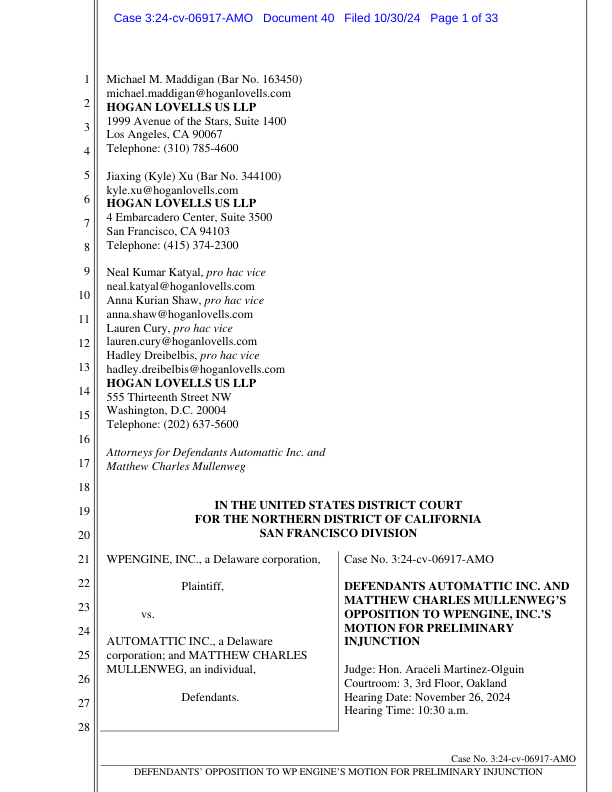
🔗 **Source:** [þÿMicrosoft Word - PI Opposition 10-30-24 Final](https://automattic.com/wp-content/uploads/2024/10/opposition-to-preliminary-injunction.pdf)
> [!note]+ Document Notes
> tags:
> - #Legal
> - #PreliminaryInjunction
> - #OpenSource
> Author: Hogan Lovells LLP for Automattic Inc. and Matthew Charles Mullenweg
> Source: Document 40 Opposition to WP Engine's Motion for Preliminary Injunction
> Reference: U.S. District Court for the Northern District of California, Case No. 3:24-cv-06917-AMO
> date created: 2024-10-30 10:30
>
> # Title: Defendants’ Opposition to WP Engine’s Motion for Preliminary Injunction
>
<!-- deep-read:sections start -->
## Table of Contents:
- 📝 [Summary](#summary)
- 📖 [Main Content](#main-content)
- 🗒️ [Detailed Notes](#detailed-notes)
- 📖 [References](#references)
- 🗣️ [Paraphrase](#paraphrase)
- 📰 [Newsletter](#newsletter)
- ✅ [Action Items](#action-items)
- 🧪 [Hypotheses](#hypotheses)
- 📊 [Methodology](#methodology)
- ❓ [Questions](#questions)
- 🔮 [Future Research](#future-research)
- 💡 [Implications](#implications)
- 🧠 [Learning Styles Assessment](#learning-styles-assessment)
- 📊 [Accessibility Assessment](#accessibility-assessment)
- 🌍 [DEIB Assessment](#deib-assessment)
- ✅ [Logical Validity](#logical-validity)
- 🔍 [DARVO Analysis Prompt](#darvo-analysis-prompt)
- 🔍 [SEO Evaluation](#seo-evaluation)
- 🎯 [Conclusion](#conclusion)
---
## 📝 Summary:
The document is a legal opposition to WP Engine’s request for a preliminary injunction. Defendants Automattic Inc. and Matthew Mullenweg argue that WP Engine fails to establish irreparable harm or a likelihood of success on the merits. Defendants claim WP Engine's loss of access to developer resources on wordpress.org does not equate to irreparable harm, as WP Engine could maintain its plugins independently. The opposition challenges WP Engine's case on legal grounds, including arguments about convenience versus necessary access, lack of binding contract obligations, and issues of standing under the CFAA and extortion claims.
## 📖 Main Content:
### 🗒️ Detailed Notes
- **Introduction and Case Background**
- This opposition is a response to WP Engine's motion for a preliminary injunction, which seeks to restore access to certain developer resources on wordpress.org.
- WP Engine argues that this restricted access harms its business and disrupts customer access to its WordPress plugins.
- Automattic (and Mullenweg) argue that WP Engine’s claims lack legal merit and that injunctive relief is inappropriate.
- **Irreparable Harm**
- **Argument by WP Engine**: WP Engine claims that restricted access to Automattic’s developer resources creates a barrier to essential plugin functionalities, leading to significant financial and reputational damage. WP Engine contends this harm cannot be fully addressed by monetary damages alone.
- **Rebuttal by Automattic**: Automattic argues that WP Engine’s issues are economically quantifiable and thus compensable through financial remedies.
- *Monetary Compensation*: Automattic highlights that any revenue loss or reputational harm can be calculated and does not warrant preliminary injunctive relief.
- *Workaround Solutions*: Automattic points out that WP Engine implemented temporary solutions for plugin access. The ease with which WP Engine could mitigate these disruptions undermines the claim of irreparable harm.
- **Conclusion on Harm**: Defendants argue that WP Engine has failed to meet the high standard for proving irreparable harm required for a preliminary injunction.
- **Likelihood of Success on the Merits**
- **CFAA Claims**: WP Engine’s motion relies on the assertion that Automattic's restriction on WP Engine’s access violates the Computer Fraud and Abuse Act (CFAA).
- Automattic argues that the CFAA is not intended for cases of disputed server access and emphasizes that WP Engine’s interpretation would dangerously expand CFAA’s scope beyond its legislative intent.
- *Scope of CFAA*: Automattic holds that the CFAA applies only to cases involving unauthorized access with malicious intent, which they argue does not apply to this scenario.
- **Extortion Claims under California Penal Code § 524**:
- WP Engine claims that the Defendants' restriction constitutes extortion by coercing WP Engine into conceding to certain conditions for service reinstatement.
- Automattic argues that extortion laws do not apply as there is no evidence of coercion or malicious intent, only a strategic decision to limit WP Engine’s access.
- **Contractual Obligations and Expectations**:
- Automattic maintains there is no binding contract obligating Automattic to provide server access or plugin hosting support to WP Engine.
- The relationship between the entities does not imply any expectation of continuous access, particularly in the absence of an explicit contract.
- WP Engine's claims rely on the presumption of a legally binding service expectation, which Automattic asserts is unfounded.
- **Balance of Equities**
- Automattic argues that the potential harm to WP Engine from restricted access is minimal, given WP Engine’s alternative options, and is outweighed by the harm to Automattic’s own operations and reputation.
- Allowing WP Engine’s injunction would set a precedent allowing commercial users to assert entitlements to open-source resources without any formal contractual obligation, jeopardizing the principles governing open-source projects.
- **Public Interest**:
- Automattic frames its case as one of protecting open-source resources from commercial monopolization.
- They argue that the public interest is served by preserving Automattic's control over the WordPress ecosystem without commercial dependencies imposed by for-profit entities.
- **Specific Legal Arguments**
- **Jurisdictional Arguments**: Automattic asserts that WP Engine’s claims may lack standing in specific legal areas, especially concerning extortion and CFAA.
- **Contractual Precedents**: The opposition references case law that rejects preliminary injunctions where economic loss alone is claimed without a robust showing of irreparable harm.
- **Policy on Open-Source Access**: Automattic emphasizes that allowing a private company like WP Engine an entitlement to open-source hosting resources would fundamentally alter the nature of the open-source community.
- Automattic argues that WP Engine's request would place an undue burden on other open-source contributors and administrators.
- **Consumer Disruption Claims**: Automattic argues that WP Engine’s customers had alternative ways to access the same plugins, invalidating WP Engine’s claims of service disruption and customer dissatisfaction.
- **Relevance of Open-Source Principles**
- **Integrity of Open-Source Ecosystem**: Automattic suggests that WP Engine’s demand for unrestricted access contradicts core open-source principles and threatens the equitable distribution of resources across contributors.
- **Sustainability of Open-Source Projects**: Automattic contends that WP Engine’s claims, if granted, could undermine the sustainability of open-source projects by diverting resources for commercial interests.
- **Defendants' Rights and Counterclaims**
- Automattic and Mullenweg argue that their decision to limit WP Engine’s access to server resources falls within their rights as custodians of the WordPress project.
- The opposition posits that Automattic’s role in maintaining the project includes discretion over access to resources, which WP Engine’s injunction would inappropriately challenge.
## 📖 References:
- WP Engine’s Motion for Preliminary Injunction, Doc. No. 17
- Federal statutes referenced: CFAA (Computer Fraud and Abuse Act) 18 U.S.C. § 1030, California Penal Code § 524
## 🗣️ Paraphrase:
1. **Original Statement:** “WP Engine claims that Defendants’ actions prevented its customers from accessing plugins and disrupted its service model, causing irreparable harm.”
- **Paraphrased:** WP Engine asserts that actions by the Defendants obstructed customer access to necessary plugins, disrupting WP Engine’s operations and leading to severe, lasting impacts.
2. **Original Statement:** “Automattic argues that the harm alleged by WP Engine is economic and can be addressed through monetary compensation rather than injunctive relief.”
- **Paraphrased:** According to Automattic, WP Engine's stated damages are financial and can be settled through financial remedies, not through an injunction.
## 📰 Newsletter:
🎉 **WordPress Community Updates**
In recent developments, WP Engine and Automattic are engaged in a legal debate over plugin access and rights within the WordPress ecosystem. Automattic, led by Matt Mullenweg, maintains that WP Engine could continue plugin access independently, while WP Engine argues for a binding service obligation. This case is stirring conversations on the importance of clear contracts in open-source use cases. Stay tuned for more updates on this case's implications on open-source contributions and plugin access.
## ✅ Action Items:
- **Understand Open Source Implications:** Review how this case might affect plugin contributors and hosting services, especially concerning access rights and obligations.
- **Evaluate Potential OSPO Roles:** Consider how an OSPO (Open Source Program Office) could provide frameworks for clear guidelines on usage rights.
- **Engage Community for Insights:** Open dialogue with community stakeholders on the public interest aspects and gather input on maintaining open-source integrity.
## 🧪 Hypotheses:
- Hosting providers might shift to developing independent plugin management systems to avoid dependency on community-hosted resources.
- Court rulings favoring Automattic could reinforce open-source boundaries, impacting how private entities interact with public resources.
### 📊 Methodology:
- **Data Sources:** Analyze prior case law involving open-source software and hosting obligations.
- **Research Design:** Comparative legal analysis, including stakeholder interviews for perspective on community-led project management.
### ❓ Questions:
1. How will this case affect contractual expectations between open-source developers and private companies?
2. Could this case prompt Automattic to formalize usage policies for wordpress.org resources?
### 🔮 Future Research:
- Examine the economic impact of limited access to open-source resources for hosting companies.
- Investigate potential security risks when plugins are independently managed rather than centrally hosted.
### 💡 Implications:
Legal clarity from this case could shape future contributor agreements, especially for plugins hosted on open-source platforms, potentially benefiting the WordPress ecosystem with more defined resource-sharing practices.
### 🧠 Learning Styles Assessment:
- **Visual:** Add flowcharts explaining plugin access dependencies.
- **Aural:** Consider discussing the case in relevant WordPress podcasts.
- **Verbal:** Use clear, non-legal language summaries for general audiences.
- **Physical:** Enable comment-based discussions for stakeholder engagement.
- **Logical:** Outline causative steps in plugin hosting dependency.
- **Social:** Host Q&A sessions with WordPress developers.
- **Solitary:** Offer blog posts for reflective reading on open-source rights.
### 📊 Accessibility Assessment:
- **Screen Reader Compatibility:** Ensure the document structure is compatible with screen readers, using clear section headers and alt-text on images.
- **Keyboard Navigation:** Test that all interactive elements on relevant webpages are accessible by keyboard.
- **Contrast and Readability:** Verify readability for low-contrast displays.
### 🌍 DEIB Assessment:
- **Cultural Relevance:** Present viewpoints from diverse stakeholders in WordPress and open-source communities.
- **Inclusive Language:** Avoid jargon and ensure accessible legal language explanations.
- **Neurodiversity Support:** Use clear, simple structures in legal documents to aid comprehension for diverse cognitive profiles.
- **Representation:** Highlight perspectives from smaller-scale plugin developers and nonprofit users.
### ✅ Logical Validity:
- **Deductive Reasoning:** Defendants' arguments follow a clear structure, supporting claims with sequential evidence.
- **Potential Fallacies:** Some sections rely heavily on interpreting consumer reviews without presenting full context, risking hasty generalization.
🔍 **DARVO Analysis Prompt**
The document does not appear to employ DARVO tactics, focusing instead on evidence-based claims regarding contract terms and user access rights.
### 🔍 SEO Evaluation:
- **Keywords:** Optimize for terms like "preliminary injunction WordPress," "open-source rights," "plugin access."
- **Meta Description:** Include Automattic's stance on plugin hosting rights.
- **Social Sharing:** Add Open Graph metadata for sharing updates.
## 🎯 Conclusion:
This opposition outlines a legal precedent for plugin access and clarifies Automattic's stance on open-source resources, with broader implications for the WordPress ecosystem. The outcome may shape future interactions and expectations for resources on open-source platforms.
<!-- deep-read:sections end -->
📄 **Full text:** ![[Full Document Contents/Articles/þÿMicrosoft Word - PI Opposition 10-30-24 Final|þÿMicrosoft Word - PI Opposition 10-30-24 Final, þÿBriggHA]]
## Highlights
- Further, it is apparent that WP Engine itself is fully capable of providing the services it purports to need from Defendants. WP Engine has never lost the ability to access the WordPress software and plugins on the Website. These are accessible without any login. Indeed, this Court, or anyone else, could readily access such software and plugins by visiting https://wordpress.org/download/ and https://wordpress.org/plugins/. ([View Highlight](https://read.readwise.io/read/01jbhvm0gq6ejftgef3ccecpkp))
- WP Engine has only been denied access to various developer resources that are provided through the Website, which allow it to manage the back end of the versions of its plugins hosted on the Website. ([View Highlight](https://read.readwise.io/read/01jbhvm8x8qqj791knqcrfw28c))