þÿMicrosoft Word - Proposed Final
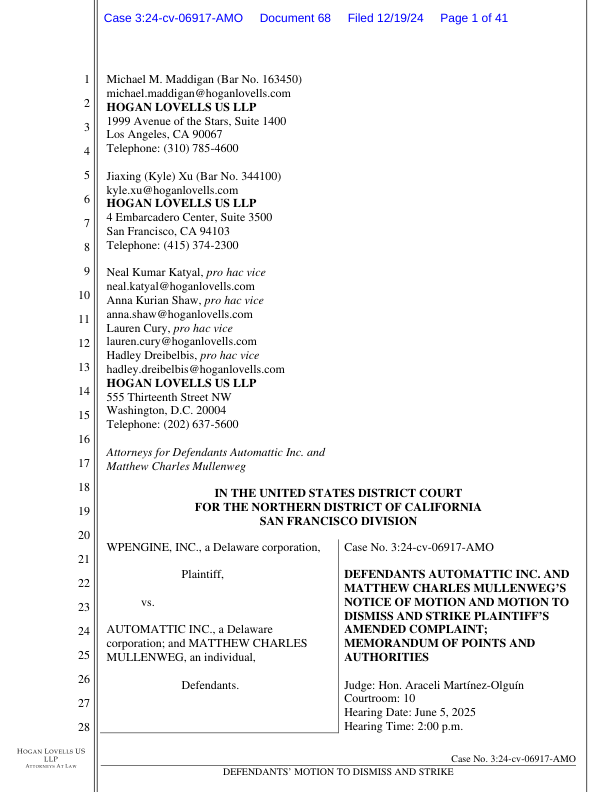
🔗 **Source:** [þÿMicrosoft Word - Proposed Final](https://readwise.io/reader/document_raw_content/252112153)
> [!note]+ Document Notes
> tags:
> - #legal
> - #motiontodismiss
> - #wordpress
> - #automattic
> - #wpe
> - #antitrust
> - #courtcase
> - #defamation
> - #extortion
> - #trademark
> Author: Defendants' Legal Team
> Source: Defendants' Motion to Dismiss and Strike
> Reference: Case No. 3:24-cv-06917-AMO
> date created: 2024-12-19 00:00
>
> # Title: Defendants' Motion to Dismiss and Strike Plaintiff’s Amended Complaint
>
<!-- deep-read:sections start -->
## Table of Contents:
- [📝 Summary](#summary)
- [📖 Main Content](#main-content)
- [🗒️ Notes](#notes)
- [📖 References](#references)
- [🗣️ Paraphrase](#paraphrase)
- [📰 Newsletter](#newsletter)
- [✅ Action Items](#action-items)
- [🧪 Hypotheses](#hypotheses)
- [📊 Methodology](#methodology)
- [❓ Questions](#questions)
- [🔮 Future Research](#future-research)
- [💡 Implications](#implications)
- [🧠 Learning Styles Assessment](#learning-styles-assessment)
- [📊 Accessibility Assessment](#accessibility-assessment)
- [🌍 DEIB Assessment](#deib-assessment)
- [✅ Logical Validity](#logical-validity)
- [🔍 DARVO Analysis](#darvo-analysis)
- [🔍 SEO Evaluation](#seo-evaluation)
- [🎯 Conclusion](#conclusion)
### References:
- Defendants’ Legal Document in Case No. 3:24-cv-06917-AMO
- Federal Rule of Civil Procedure 12(b)(6)
- California Anti-SLAPP Statute (Cal. Code Civ. P. § 425.16)
## 📝 Summary:
This motion to dismiss and strike by Defendants Automattic Inc. and Matt Mullenweg addresses various claims made by Plaintiff WP Engine (WPE). The Defendants argue that the Plaintiff’s claims should be dismissed based on legal deficiencies, including failure to meet pleading standards for antitrust claims, defamation, and extortion. The Defendants also assert that WPE’s claims are based on a misrepresentation of facts, market power, and unlawful conduct.
## 📖 Main Content:
The motion focuses on challenging the legal grounds of WPE's 20 claims. Defendants argue the following:
1. **Antitrust Claims (Counts 12-15)**:
- WPE fails to define a relevant product market or demonstrate Defendants' market power.
- Claims of anticompetitive conduct, including attempts at monopolization and unlawful tying, are unfounded.
2. **Trademark Misuse (Count 16)**:
- The claim is not recognized under law, and even if it were, the Plaintiff’s argument is weak and unfounded.
3. **Extortion Claims (Count 4)**:
- WPE’s claim for attempted extortion is based on an overblown interpretation of Defendants’ actions, and no legal grounds exist for such a claim.
### 🗒️ Notes:
The **Motion to Dismiss and Strike** is a comprehensive legal document that contests numerous claims in WP Engine’s (WPE) amended complaint. Below is an in-depth breakdown of the key points:
- **Motion to Dismiss (General)**:
- Defendants request that the court dismiss all claims related to antitrust, defamation, extortion, and trademark misuse, based on the argument that these claims are legally insufficient and do not meet the pleading standards required under Federal Rule of Civil Procedure 12(b)(6).
- The motion asserts that WPE's claims fail because they are based on misunderstandings of both the facts and the law, as well as unsupported assumptions about Defendants' business practices.
- **Antitrust Claims**:
- **Failure to Define Relevant Market**: WPE's antitrust claims (Counts 12-15) rely on a broad and vague market definition that fails to specify the relevant product market. Defendants argue that WPE's failure to define this market makes it impossible to determine whether Defendants possess the necessary market power to engage in anticompetitive conduct.
- **Lack of Market Power**: The motion argues that WPE does not show that Automattic or Matt Mullenweg possess significant market power within the defined market, an essential element for proving monopolistic behavior or attempts at monopolization.
- **Unlawful Tying and Anticompetitive Conduct**: Defendants argue that WPE’s allegations of unlawful tying—forcing customers to purchase additional products or services in a package deal—are unfounded and misrepresent how the market operates. There is no evidence that any of Automattic’s business practices result in harm to competition in the market.
- The motion also asserts that the Plaintiff fails to establish that the alleged conduct has a direct anticompetitive effect on the market, as required by antitrust law.
- **Defamation Claims (Count 6)**:
- WPE’s defamation claim stems from public statements made by Matt Mullenweg regarding the Plaintiff’s business practices. Defendants contend that these statements are protected under the First Amendment as free speech and are not defamatory in nature.
- **Opinion vs. Factual Statement**: The motion argues that Mullenweg's statements are expressions of opinion, rather than verifiable facts, and therefore cannot be construed as defamatory.
- **No False Statements**: Defendants also claim that the statements are true, as they are based on accurate representations of WPE’s conduct in the marketplace.
- **Extortion Claims (Count 4)**:
- WPE's extortion claim revolves around the allegation that Defendants attempted to coerce WPE into altering their business practices under threat of public exposure or harm.
- **No Grounds for Extortion**: The motion argues that no extortion occurred, as Defendants’ actions are within their legal rights to voice business criticisms and engage in legitimate market competition. The Plaintiff’s claim for attempted extortion lacks any factual or legal foundation.
- The motion emphasizes that the allegations are based on WPE’s misinterpretation of the Defendants’ competitive actions.
- **Trademark Misuse (Count 16)**:
- WPE’s trademark misuse claim centers on accusations that Automattic and Matt Mullenweg have misused WPE’s trademarks to their advantage.
- **No Trademark Violation**: Defendants argue that their use of WPE’s trademarks was either authorized or fell within the bounds of fair use. They argue that WPE has not demonstrated any harm or misuse that would justify such a claim.
- The motion also stresses that trademark infringement is a complex area of law, and WPE’s failure to provide concrete evidence means the claim should be dismissed.
- **Anti-SLAPP Motion (California Statute)**:
- Defendants invoke California's anti-SLAPP statute (Cal. Code Civ. P. § 425.16), which is designed to prevent lawsuits aimed at chilling free speech. The motion argues that WPE’s defamation and extortion claims are SLAPP (Strategic Lawsuit Against Public Participation) claims.
- **Protected Speech**: The motion argues that the claims are based on protected speech, such as Mullenweg’s statements about WPE’s business practices, which should not be subject to legal action under California’s anti-SLAPP laws.
- **Request for Dismissal**:
- The Defendants request that the court dismiss all claims related to antitrust, defamation, extortion, and trademark misuse.
- Additionally, Defendants argue that if the court does not dismiss all claims outright, certain claims should be struck under the anti-SLAPP statute, particularly those that attempt to infringe upon Defendants' right to free speech.
- **Legal Precedents Cited**:
- The motion cites several legal precedents and cases to support the dismissal of WPE's claims, including cases related to anti-SLAPP motions, antitrust defenses, and First Amendment protections for free speech.
## 📖 References:
- **Federal Rule of Civil Procedure 12(b)(6)**: Grounds for motion to dismiss based on failure to state a claim.
- **California Code of Civil Procedure § 425.16**: Anti-SLAPP statute, used here to strike claims related to protected speech.
- **Sherman Act and Cartwright Act**: References used to challenge WPE’s antitrust claims.
- **Relevant case law**: Precedents related to antitrust, defamation, and extortion claims.
## 🗣️ Paraphrase:
1. **Original**: "The anti-SLAPP statute applies because WPE’s claims target Defendants' public speech and business conduct."
**Paraphrased**: The anti-SLAPP law is relevant here because WPE’s accusations focus on Defendants' protected public expressions and legitimate business activities.
2. **Original**: "WPE’s claims rely on fabricated definitions of the market and false assertions of Defendants’ conduct."
**Paraphrased**: WPE’s accusations are built on inaccurate market definitions and misleading interpretations of the Defendants' business behavior.
## 📰 Newsletter:
**Court Motion to Dismiss – Defendants Respond to WPE's Claims**
Automattic and Matt Mullenweg have filed a comprehensive motion to dismiss the claims made by WP Engine (WPE) in their amended complaint. Defendants argue that WPE’s allegations regarding antitrust violations, defamation, and extortion are legally flawed. The motion seeks to have these claims dismissed, particularly invoking California’s anti-SLAPP statute to protect their free speech. This case highlights the importance of clearly defined legal claims and the protection of public discourse within business practices.
## ✅ Action Items:
- **Align with Open Source Advocacy**: This case emphasizes the importance of defending free speech in the open-source community, particularly when discussing business practices and competitive strategies.
- **Contribute to Legal Awareness in Open-Source**: Use this case as a teaching moment to explain the relevance of anti-SLAPP laws and how contributors and companies can protect their public communications.
- **Educational Outreach**: Organize sessions for open-source developers on the intersection of antitrust law, trademark protection, and how public statements can be legally protected under free speech.
## 🧪 Hypotheses:
- **Hypothesis 1**: The motion could influence future open-source legal disputes, establishing a more stringent standard for antitrust claims related to free speech.
- **Hypothesis 2**: If successful, Defendants' motion could set a precedent for future cases where free speech protections are invoked in commercial speech disputes.
### 📊 Methodology:
Future research could explore the application of anti-SLAPP motions in the context of open-source disputes. Analyzing previous legal cases where public communications were challenged could help clarify how open-source projects might better defend against meritless lawsuits.
### ❓ Questions:
1. How do anti-SLAPP laws affect the strategies open-source projects can use to defend themselves in the face of unfounded legal claims?
2. What legal frameworks can open-source developers rely on to protect their business conduct and public statements?
### 🔮 Future Research:
Future studies should focus on the legal complexities surrounding open-source projects and antitrust law. Specifically, examining how antitrust claims in the tech sector could be framed more effectively and how legal defenses like anti-SLAPP motions could safeguard business speech.
### 💡 Implications:
If the court accepts the motion, it will have significant implications for how open-source projects and tech companies handle legal disputes regarding public speech and competitive practices.
### 🧠 Learning Styles Assessment:
- **Visual Learners**: Providing visual aids like flowcharts of legal processes and timelines could assist in illustrating the legal procedures involved.
- **Aural Learners**: Audio explanations summarizing key points of the motion would benefit auditory learners.
- **Verbal Learners**: The use of case law and clear argumentation supports verbal learners; adding more storytelling elements could further engage this group.
- **Physical Learners**: Role-playing or mock legal proceedings could help kinesthetic learners understand the case better.
- **Logical Learners**: The structured, logical breakdown of the motion’s arguments will appeal to logical learners. Including statistical data or legal precedents might enhance their understanding.
- **Social Learners**: Facilitating group discussions on the motion and its potential impact could foster engagement.
- **Solitary Learners**: Independent reflection on the case’s potential outcomes could support solitary learners.
- **Naturalistic Learners**: Incorporating metaphors or examples related to natural ecosystems could help connect the legal concepts to broader real-world systems.
### 📊 Accessibility Assessment:
- **Screen Reader Compatibility**: The document is formatted for screen readers, but including alt-text for any visual elements would improve accessibility.
- **Keyboard Navigation**: Users can navigate the content using a keyboard, ensuring ease of access.
- **Contrast and Readability**: The readability could be improved by increasing font sizes and ensuring sufficient contrast.
- **Text Resizing**: The document adjusts well to resized text, but further testing could ensure it remains fully accessible across devices.
### 🌍 DEIB Assessment:
- **Cultural Relevance**: While the case is focused on legal arguments, it could benefit from including diverse perspectives on the impact of legal challenges in the open-source community.
- **Inclusive Language**: The document uses inclusive and neutral language.
- **Neurodiversity Support**: The structured nature of the document supports clarity but could benefit from breaking down complex legal jargon into simpler terms.
- **Representation**: The document does not reflect broader community identities but could be expanded by considering the impact of legal cases on a diverse open-source community.
- **Psychological Safety**: The tone is formal, and the content is not likely to intimidate readers, but providing explanations for legal terms would promote safety for those less familiar with legal jargon.
### ✅ Logical Validity:
- **Sound Reasoning**: The Defendants’ motion presents a sound legal argument with clear references to statutes and case law supporting the dismissal of the claims.
- **Fallacies**: There are no notable logical fallacies in the motion, though WPE’s arguments could be criticized for lacking sufficient factual backing.
## 🔍 DARVO Analysis:
- **Deny**: The Defendants deny the allegations of antitrust violations and defamation, arguing that WPE misrepresents the facts.
- **Attack**: The Defendants attack the credibility of WPE's claims, portraying them as baseless and legally invalid.
- **Reverse Victim and Offender**: The motion portrays WPE as the aggressor, suggesting that their claims are harmful to the Defendants' business reputation and free speech rights.
### 🔍 SEO Evaluation:
- **Keywords**: The motion includes appropriate keywords related to legal defense, anti-SLAPP statutes, and antitrust law.
- **Meta Description**: A brief meta description explaining the motion would improve SEO visibility.
- **Title Tag**: The title includes relevant keywords such as “Motion to Dismiss” and “Antitrust” and is concise for SEO.
- **Headers**: The headers organize the content well, but adding more keyword-rich subheadings could improve the document’s discoverability.
## 🎯 Conclusion:
The motion to dismiss is a robust legal document that contests WPE’s claims on multiple grounds. If successful, it will set a strong precedent for defending free speech and business conduct in the tech industry, particularly within the open-source community.
<!-- deep-read:sections end -->
📄 **Full text:** ![[Full Document Contents/Articles/þÿMicrosoft Word - Proposed Final|þÿMicrosoft Word - Proposed Final, þÿCrisoB]]
## Highlights
- contrary to the allegations in WPE’s Complaint, the greedy party is not Automattic—which donates over 3000 hours per week in support of the WordPress community, or Matt Mullenweg (“Matt”)—the founder and philanthropic steward of that community. It is WPE, which for years has been strip mining value from the WordPress ecosystem at the direction of its private equity backers. ([View Highlight](https://read.readwise.io/read/01jfk08sm0ynsbj7z32d83y7q6))