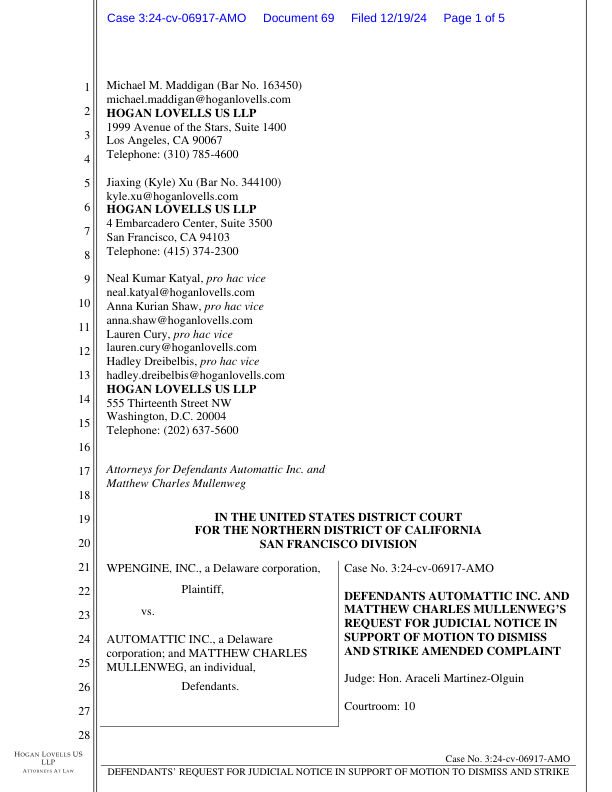
þÿMicrosoft Word - Request for Judicial Notice
🔗 **Source:** [þÿMicrosoft Word - Request for Judicial Notice](https://readwise.io/reader/document_raw_content/252110829)
> [!note]+ Document Notes
> tags:
> - #legal
> - #judicialnotice
> - #motiontodismiss
> - #wordpress
> - #automattic
> - #mullenweg
> - #courtcase
> - #wpe
> Author: Defendants' Legal Team
> Source: Request for Judicial Notice in Support of Motion to Dismiss
> Reference: Case No. 3:24-cv-06917-AMO
> date created: 2024-12-19 00:00
>
> # Title: Defendants' Request for Judicial Notice in Support of Motion to Dismiss
>
<!-- deep-read:sections start -->
## Table of Contents:
- [📝 Summary](#summary)
- [📖 Main Content](#main-content)
- [🗒️ Notes](#notes)
- [📖 References](#references)
- [🗣️ Paraphrase](#paraphrase)
- [📰 Newsletter](#newsletter)
- [✅ Action Items](#action-items)
- [🧪 Hypotheses](#hypotheses)
- [📊 Methodology](#methodology)
- [❓ Questions](#questions)
- [🔮 Future Research](#future-research)
- [💡 Implications](#implications)
- [🧠 Learning Styles Assessment](#learning-styles-assessment)
- [📊 Accessibility Assessment](#accessibility-assessment)
- [🌍 DEIB Assessment](#deib-assessment)
- [✅ Logical Validity](#logical-validity)
- [🔍 DARVO Analysis](#darvo-analysis)
- [🔍 SEO Evaluation](#seo-evaluation)
- [🎯 Conclusion](#conclusion)
### References:
- Hogan Lovells Legal Document
- Case No. 3:24-cv-06917-AMO
- WP Engine, Inc., Plaintiff vs Automattic Inc., and Matt Mullenweg, Defendants
## 📝 Summary:
The document presents a formal request by Defendants Automattic Inc. and Matt Mullenweg for judicial notice in support of their motion to dismiss and strike an amended complaint filed by WP Engine (WPE). The request outlines the materials the Defendants seek the court to recognize, including publicly available websites, blog posts, and media relevant to the case.
## 📖 Main Content:
The defendants' motion seeks judicial notice of various exhibits, including websites, blog posts, and audiovisual materials, all of which are publicly available and cited by WPE in their amended complaint. These include materials from WP Engine's website, WooCommerce, WordCamp US 2024, and Matt Mullenweg's blog. The argument centers on the assertion that these materials are integral to the case, either referenced directly in the complaint or constituting public records.
### 🗒️ Notes:
- The motion requests judicial notice of several exhibits, including:
- Public webpages and blog posts from WP Engine and WordPress-related sites.
- Video recordings of Matt Mullenweg's sessions at WordCamp US 2024 and a Twitch livestream interview.
- Legal guidelines and public statements related to trademarks and other intellectual property concerns.
- The legal team argues that these materials are relevant and can be introduced without dispute, supported by judicial notice standards under Federal Rule of Evidence 201.
- The motion's core argument rests on the idea that these publicly available materials form the basis for several claims in the amended complaint, thus justifying their consideration by the court.
### 📖 References:
- **Exhibits 1-16**: Links to websites, blog posts, YouTube videos, and LinkedIn profiles cited in the motion.
- **Federal Rule of Evidence 201**: Judicial notice standards for publicly available materials.
## 🗣️ Paraphrase:
1. **Original:** "Defendants respectfully request that the Court take judicial notice of the following exhibits in support of their motion to dismiss and strike."
**Paraphrased:** The Defendants have formally asked the Court to acknowledge the following exhibits to support their motion to dismiss and strike the amended complaint.
2. **Original:** "Exhibits 1-16 consist of publicly-available websites, blog posts, online customer support forum posts, transcripts of two podcast episodes, an audio-visual recording of a Q&A session..."
**Paraphrased:** Exhibits 1-16 include publicly accessible websites, blog articles, forum posts, podcast transcripts, and recordings of various interviews and sessions.
## 📰 Newsletter:
**Defendants’ Legal Request for Judicial Notice**
In a recent development in the case between WP Engine and Automattic, Defendants filed a motion requesting that the Court take judicial notice of several key pieces of publicly available content, including blog posts, Q&A sessions, and trademark guidelines. These materials, central to the claims in the amended complaint, are set to be considered by the Court as part of the motion to dismiss. This legal maneuver aligns with standard practices for handling publicly accessible documents in litigation.
## ✅ Action Items:
- **Align with Open Source Advocacy**: This case underscores the significance of publicly available content, an important factor when handling open-source projects and community standards. By recognizing the power of publicly shared content, similar strategies can be applied when addressing open-source policy violations or disputes within the community.
- **Educate Stakeholders on Legal Precedents**: Share insights from this case with open-source developers to highlight the importance of ensuring transparency in community communications, from blog posts to media appearances.
- **Integrate Legal Knowledge into Contributor Engagement**: Advocating for the use of publicly available information for transparency purposes in open-source ecosystems will enhance contributor engagement and trust.
## 🧪 Hypotheses:
- Hypothesis 1: Judicial notice of publicly available content can influence the outcome of open-source disputes by establishing the public nature of evidence.
- Hypothesis 2: The inclusion of audiovisual materials as judicial evidence may set a precedent for future cases involving digital content and online interactions.
### 📊 Methodology:
Future studies should explore the impact of publicly available materials in litigation, particularly in tech-related disputes. The research could involve examining case law where judicial notice was used and analyzing outcomes based on the type of evidence introduced.
### ❓ Questions:
1. How might this case influence the way open-source projects handle public statements and content shared by key figures?
2. What role does transparency in public communications play in legal outcomes for tech companies and communities?
### 🔮 Future Research:
Future research should focus on the legal implications of publicly available online content, especially as it pertains to open-source and tech-related litigation.
### 💡 Implications:
If the court acknowledges the submitted exhibits, this case could set a precedent for future open-source litigation, particularly in how public digital content is treated in courtrooms.
### 🧠 Learning Styles Assessment:
- **Visual Learners**: The use of publicly available websites and media may appeal to visual learners, but it could be improved by adding annotated diagrams or screenshots of the key exhibits.
- **Aural Learners**: Audio-visual recordings used as evidence support auditory learners, though providing summaries or transcripts would enhance accessibility.
- **Verbal Learners**: The clear, detailed description of each exhibit is beneficial, but incorporating more narrative explanation could assist verbal learners.
- **Physical Learners**: No hands-on interaction is provided in the article, but real-world applications could be included for better engagement.
- **Logical Learners**: The structure and presentation of the evidence are logical, helping learners to follow the arguments.
- **Social Learners**: The case’s implications for the open-source community may foster discussion in group settings.
- **Solitary Learners**: Individual reflection on the legal and technological aspects can be encouraged through personal study of the case.
- **Naturalistic Learners**: No environmental or nature-based learning is incorporated in the content.
### 📊 Accessibility Assessment:
- **Screen Reader Compatibility**: The document is well-formatted for screen readers, but including descriptions for images or media would improve accessibility.
- **Keyboard Navigation**: Accessible via standard keyboard functions.
- **Contrast and Readability**: Text contrast is adequate, but improving font size and spacing could benefit those with visual impairments.
- **Text Resizing**: The document appears to be responsive to resizing, but further testing across devices would be ideal.
### 🌍 DEIB Assessment:
- **Cultural Relevance**: No direct cultural context is provided, but including diverse perspectives on the legal handling of public content could enhance the inclusivity of the case study.
- **Inclusive Language**: The language is neutral, but greater inclusivity could be introduced through more diverse legal and community examples.
- **Neurodiversity Support**: The clear, organized structure supports accessibility for neurodiverse readers, but further simplification could help.
- **Representation**: The article focuses on a specific legal case, which may not represent diverse stakeholders in the open-source ecosystem.
### ✅ Logical Validity:
- The argument for judicial notice of public content is valid, backed by evidence and legal precedents.
- **Fallacies**: The document does not present significant logical fallacies, maintaining clarity and solid reasoning in its request.
## 🔍 DARVO Analysis:
No signs of DARVO are apparent in this legal motion, as it does not involve character attacks or the reversal of victim and offender roles.
### 🔍 SEO Evaluation:
The document appears well-structured for legal professionals, but to improve SEO:
- Use more descriptive meta descriptions and title tags for better online discoverability.
- Include additional internal and external links to relevant case law or related articles for comprehensive content coverage.
## 🎯 Conclusion:
The motion to take judicial notice of various public materials represents a strategic move in the ongoing case between WP Engine and Automattic. If successful, this motion could significantly impact the handling of public content in legal disputes, particularly for tech and open-source industries.
<!-- deep-read:sections end -->
📄 **Full text:** ![[Full Document Contents/Articles/þÿMicrosoft Word - Request for Judicial Notice-2|þÿMicrosoft Word - Request for Judicial Notice, þÿCrisoB]]
## Highlights
- Because those materials are incorporated by reference into the Amended Complaint, it is proper for the Court to consider these materials for this reason as well. Bernier v. Travelers Prop. Cas. Ins. Co., No. 17cv1028-MMA (BLM), 2017 WL 5843396, at *2 (S.D. Cal. Nov. 29, 2017). CONCLUSION For all of the foregoing reasons, Defendants respectfully request that this Court grant their request for judicial notice. ([View Highlight](https://read.readwise.io/read/01jfjzxz4gsyszjn6vykjctc4t))