🥘 the Konik Method for Making Delicious Food
🔗 **Source:** [🥘 the Konik Method for Making Delicious Food](https://www.eleanorkonik.com/p/the-konik-method-for-making-delicious)
> [!note]+ Document Notes
> tags: #cooking #meal-planning #productivity #family-life #efficiency
> author: Eleanor Konik
> source: Manuscriptions (Substack)
> reference: https://www.eleanorkonik.com/p/the-konik-method-for-making-delicious
> date created: 2024-12-19 16:32
>
> # 🏷️ Title: 🥘 The Konik Method for Making Delicious Food
>
<!-- deep-read:sections start -->
## 🧰 Action Inbox
- [H1] Try the flexible no-knead dough recipe for easy homemade bread #cooking
- [H2] Test sheet pan meat + veg approach for weeknight dinners #meal-planning
- [H3] Experiment with variations in familiar recipes to build confidence #cooking
## 🧭 Table of Contents
- [[#📝 Summary]]
- [[#📖 Main Content]]
- [[#🗒️ Notes]]
- [[#📚 References]]
- [[#🗣️ Paraphrase]]
- [[#📰 Newsletter]]
- [[#✅ Action Items]]
- [[#🧪 Hypotheses]]
- [[#📊 Methodology]]
- [[#❓ Questions]]
- [[#🔮 Future Research]]
- [[#💡 Implications]]
- [[#🧠 Learning Styles Assessment]]
- [[#📊 Accessibility Assessment]]
- [[#🌍 DEIB Assessment]]
- [[#✅ Logical Validity]]
- [[#🛡️ DARVO Analysis]]
- [[#🎯 Conclusion]]
### 🔗 References
- [Eleanor Konik's Substack](https://www.eleanorkonik.com/)
## 📝 Summary
- Eleanor Konik shares five practical, low-stress recipes for regular family cooking
- Emphasizes flexibility, efficiency, and building confidence over perfectionism
- Targets busy parents who want homemade meals without complex preparations
- Challenges the false dichotomy between overly complicated and overly processed recipes
- Advocates for trusting your instincts and experimenting with variations
## 📖 Main Content
Konik presents a middle path between two extremes in recipe culture: the "seventeen obscure ingredients with eighty-two steps" complexity and the "can of soup plus packet mix" shortcuts. Her approach prioritizes practical home cooking for families with limited time and energy.
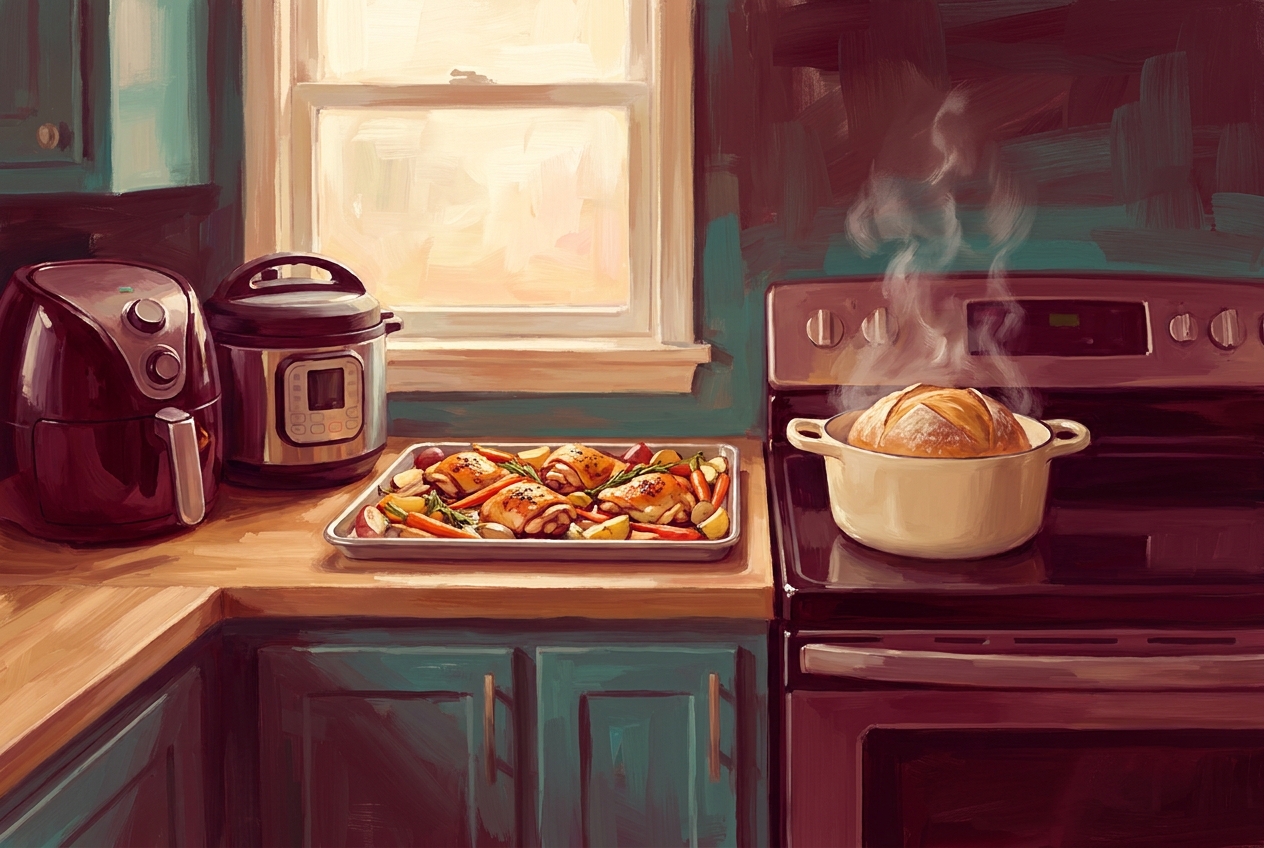
The five core recipes progress in difficulty: flexible no-knead dough (bread/pizza), sheet pan meat and vegetables, air fryer burgers, instant pot sausage and rice, and dutch oven chicken and rice. Each recipe emphasizes substitutions and variations rather than rigid adherence to ingredients or techniques.
Konik's philosophy centers on building confidence through experimentation. She notes that bread is "incredibly difficult to screw up" and encourages readers to trust their judgment about substitutions and modifications. This approach stems from her consulting experience where clients often needed permission to pursue sensible solutions they'd already identified.
The recipes incorporate time-saving tools like air fryers and instant pots, justified by safety considerations with young children rather than just convenience. Leftovers are specifically addressed, with suggestions for repurposing dishes into breakfast or using different reheating methods for optimal texture.
## 🗒️ Notes
#### Article-based format — Introduction and Philosophy
- Key idea: Recipe posts fall into two unhelpful extremes: overly complex or overly processed
- Evidence: "Just buy these seventeen obscure things... and then follow these eighty-two discrete steps" vs "Just mix a can of mushroom soup with a packet of ranch mix"
#### Recipe 1 — Flexible No-Knead Dough
- Key idea: Bread is extremely forgiving and hard to ruin completely
- Evidence: "I've given this recipe to multiple teenagers and absolutely 0% of the time has it ever turned out anything but delicious"
#### Recipe 2 — Sheet Pan Meat + Vegetables
- Key idea: One-pan cooking with seasonal flexibility and minimal cleanup
- Evidence: Suggests using "some meat that was cheap at the grocery store that week" with various seasoning options
#### Recipe 3 — Air Fryer Burgers
- Key idea: Air fryers provide safety benefits with children while producing consistent results
- Evidence: "the auto-shutoff is amazing with kids and the oven... is actually a huge liability with small curious children"
#### Recipe 4 — Instant Pot Sausage & Rice
- Key idea: Complex-tasting one-pot meals that transform into breakfast leftovers
- Evidence: "THE NEXT DAY: Fry it in a buttered skillet with an egg or three. Yum!"
#### Recipe 5 — Dutch Oven Chicken & Rice
- Key idea: Adapted from complex recipes but simplified for regular family cooking
- Evidence: "My version is much shorter (and has a lot more root vegetables)"
#### Confidence Building — Permission to Experiment
- Key idea: Most cooking failures come from lack of confidence rather than lack of skill
- Evidence: "you are probably smart and should have more self-confidence in the kitchen"
#### Consulting Insight — Common Problem Pattern
- Key idea: People often know reasonable solutions but seek permission to implement them
- Evidence: "they'd say 'oh, can I? you don't think that would be too simple or stupid?'"
## 📚 References
- [The Konik Method for Making Delicious Food](https://www.eleanorkonik.com/p/the-konik-method-for-making-delicious)
- [Half Baked Harvest - Original Dutch Oven Recipe](https://www.halfbakedharvest.com/)
## 🗣️ Paraphrase
- Home cooking doesn't need to choose between overly complex recipes requiring specialty ingredients or processed shortcuts lacking nutrition and flavor
- Building cooking confidence comes from understanding that most techniques are forgiving and that intelligent substitutions usually work fine
- Practical family cooking should prioritize efficiency, safety, and flexibility over adherence to precise recipes or gourmet presentation
## 📰 Newsletter
**Simple, Stress-Free Cooking for Busy Lives**
Eleanor Konik's practical approach to family cooking offers a refreshing alternative to recipe culture extremes. Her five go-to recipes emphasize flexibility and confidence-building over perfection.
**Key Insight**: Most cooking "rules" are more like guidelines. Substitutions, timing variations, and ingredient swaps rarely ruin dishes completely.
**Practical Applications**:
- Start with no-knead bread for confidence building
- Use sheet pan cooking for easy weeknight meals
- Embrace appliances that offer safety benefits with children
- Plan for leftovers as intentional meal components
The real wisdom here applies beyond cooking: trust your judgment, experiment with variations, and don't let perfectionism prevent you from starting.
**Resources**: [Eleanor Konik's Substack](https://www.eleanorkonik.com/), [Half Baked Harvest](https://www.halfbakedharvest.com/)
## ✅ Action Items
#### Community
- Contributors: Share simplified versions of complex recipes
- Sponsors: Support content creators who emphasize accessibility over perfection
- Ecosystem: Create recipe databases focused on substitutions and variations
#### WordPress
- Documentation: Apply Konik's confidence-building approach to technical tutorials
- Support: Encourage experimentation within safe parameters
- Design: Consider how recipe sites could better support flexible cooking
## 🧪 Hypotheses
- Recipe anxiety stems more from perfectionism than actual cooking difficulty
- Confidence in cooking transfers to confidence in other technical domains
- Simple, flexible recipes get used more frequently than complex, rigid ones
- Teaching substitution principles creates more independent cooks than memorizing specific recipes
### 📊 Methodology
- Survey recipe usage frequency vs. complexity ratings
- Track confidence measures before/after teaching flexible cooking approaches
- Compare learning outcomes between rigid recipe following vs. principle-based cooking instruction
### ❓ Questions
- How does cooking confidence relate to general problem-solving confidence?
- What makes some people comfortable with substitutions while others fear them?
- Could cooking education models inform technical education approaches?
### 🔮 Future Research
- Cross-cultural analysis of recipe flexibility vs. cooking anxiety
- Relationship between cooking confidence and entrepreneurial confidence
- Impact of cooking education on general technical self-efficacy
### 💡 Implications
- Practice: Apply confidence-building principles to technical skill development
- Education: Teach principles and substitutions alongside specific procedures
- Documentation: Emphasize what can safely vary vs. what must remain fixed
- Community: Create spaces for sharing variations and experiments rather than just perfect executions
### 🧠 Learning Styles Assessment
Reading level estimate: 8th-9th grade (accessible, conversational tone)
#### 👀 Visual learners
- Present: Clear step-by-step structure, ingredient lists
- Improve: Process photos, ingredient substitution charts
#### 🔊 Aural learners
- Present: Conversational, storytelling tone
- Improve: Audio version of recipes, cooking podcast format
#### 🗣️ Verbal learners
- Present: Detailed explanations, analogies, personal anecdotes
- Improve: Cooking terminology glossary, comparison charts
#### 🧩 Kinesthetic learners
- Present: Hands-on recipes, experimentation encouragement
- Improve: Progressive skill-building sequence, tactile cues
#### 🧠 Logical learners
- Present: Difficulty progression, clear cause-effect relationships
- Improve: Troubleshooting decision trees, timing charts
#### 🧑🤝🧑 Social learners
- Present: Family context, sharing experiences, comment discussion
- Improve: Recipe exchange forums, cooking group activities
#### 🧘♀️ Solitary learners
- Present: Self-directed experimentation, personal reflection prompts
- Improve: Individual progress tracking, private practice suggestions
#### 🌿 Naturalistic learners
- Present: Seasonal ingredient flexibility, natural variation acceptance
- Improve: Garden-to-table connections, sustainability considerations
### 📊 Accessibility Assessment
#### Screen reader semantics
- Present: Clear headings, recipe structure
- Improve: Ingredient amounts in consistent format, step numbering
#### Keyboard navigation
- Present: Standard text navigation
- Improve: Jump-to-recipe links, ingredient list navigation
#### Contrast and readability
- Present: High contrast text, clear formatting
- Improve: Larger text options for recipe portions
#### Text resizing and reflow
- Present: Responsive text layout
- Improve: Recipe card format preservation at high zoom levels
#### Media and captions
- Present: Text-based content
- Improve: Video demonstrations with captions
#### Forms and interactions
- Present: Simple comment system
- Improve: Recipe scaling calculators, substitution generators
### 🌍 DEIB Assessment
#### Cultural breadth
- Present: European herb preferences, American grocery references
- Improve: Multi-cultural seasoning options, global ingredient substitutions
#### Inclusive language
- Present: Gender-neutral cooking terms, family structure flexibility
- Improve: Economic accessibility notes, dietary restriction options
#### Neurodiversity support
- Present: Clear structure, step-by-step format
- Improve: Time estimates, sensory descriptions, executive function supports
#### Representation
- Present: Family-focused perspective
- Improve: Various household types, different cooking skill starting points
#### Psychological safety
- Present: Encourages experimentation, reduces perfectionism pressure
- Improve: Explicit failure normalization, beginner-friendly language
### ✅ Logical Validity
#### Strong reasoning
- Deductive strength: If most recipe "rules" are guidelines, then substitutions usually work (supported by examples)
- Inductive strength: Personal success with teenagers suggests broader applicability (limited sample)
- Causal reasoning: Confidence building leads to better cooking outcomes (plausible but not proven)
- Analogical strength: Cooking confidence parallels other technical confidence (reasonable but needs testing)
#### Fallacies
- Survivorship bias: Only shares successful recipe adaptations, not failures
- Anecdotal evidence: Heavy reliance on personal experience rather than broader data
#### Tone of voice
- Overall tone: Encouraging, conversational, confidence-building with authentic vulnerability about parenting challenges
### 🛡️ DARVO Analysis
- Deny: No concerning denial patterns present
- Attack: No attacks on readers or other approaches
- Reverse victim/offender: No victim/offender dynamics present
- Emotional cues and rhetoric: Positive, supportive tone focused on empowerment
## 🎯 Conclusion
Konik's cooking method demonstrates how confidence-building and flexibility can transform overwhelming tasks into manageable routines. The real lesson extends beyond cooking: most complex skills become accessible when we focus on principles rather than rigid procedures and trust our judgment to make reasonable adaptations. For busy families and individuals, this approach offers a sustainable path to homemade meals without perfectionism paralysis.
## 🧱 Refactor Appendix
### 📚 Literature Split Pad
Purpose: Stage CEE units that become Literature notes.
Split level: H3
### [H1] Recipe culture creates false choice between complexity and shortcuts
> [!quote] [The Konik Method for Making Delicious Food](https://www.eleanorkonik.com/p/the-konik-method-for-making-delicious) by [[Eleanor Konik]] via [[Manuscriptions]]. Published 2026-04-30. Accessed 2024-12-19.
> "Recipe posts come in two varieties: overly complex with seventeen obscure ingredients, or overly processed with canned soup shortcuts."
Identifies gap in practical cooking education that balances homemade quality with realistic effort.
[view highlight](https://www.eleanorkonik.com/p/the-konik-method-for-making-delicious#H1) #xref #articleseed ID:rw_cooking_false_choice
### [H2] Cooking confidence builds through experimentation permission
> [!quote] [The Konik Method for Making Delicious Food](https://www.eleanorkonik.com/p/the-konik-method-for-making-delicious)
> "You are probably smart and should have more self-confidence in the kitchen; it's actually really hard to make disgusting food."
Confidence barriers often exceed actual technical barriers in skill development.
[view highlight](https://www.eleanorkonik.com/p/the-konik-method-for-making-delicious#H2) #xref ID:rw_cooking_confidence
---
### 🔖 Atomic Split Pad (Zettel Candidates)
Purpose: Promote reusable claims into Atomic notes.
Split level: H4
#### [Z1] Flexibility reduces cooking stress more than perfection
- Applied to family meal planning with time/energy constraints
- Evidence from simplified recipe adaptations and teenager success
- Links: [[Perfectionism-Paralysis]] [[Practical-Skill-Development]]
#### [Z2] Teaching principles enables independence better than rigid procedures
- Seen in substitution guidance vs exact recipe following
- Transfers to technical education and documentation approaches
- Links: [[Learning-Transfer]] [[Documentation-Philosophy]] [[Confidence-Building]]
---
### ✏️ Fleeting Queue
Purpose: Capture quick actions for Fleeting notes.
- [F1] Test no-knead dough recipe variations — build cooking confidence #fleeting #cooking
- [F2] Apply Konik's confidence-building approach to technical tutorials — documentation project #fleeting #education
- [F3] Research cooking confidence transfer to other domains — interesting research angle #fleeting #research
<!-- deep-read:sections end -->
📄 **Full text:** ![[Full Document Contents/Articles/🥘 the Konik Method for Making Delicious Food.md|🥘 the Konik Method for Making Delicious Food by eleanorkonik.com]]
## Highlights
- Oh, but you don’t have bread flour? Use all purpose flour, it’ll be fine just not as chewy. Oh, you prefer whole wheat flour? Swap in two cups if you want it to still be springy and focaccia-y, it’ll just be a bit softer and denser. Still delicious tho. ([View Highlight](https://read.readwise.io/read/01kr1gawb6zfdjn6xwk8bqfpdv))
- Tags: 👻 ai highlighted
- I’ve given this recipe to multiple teenagers and absolutely 0% of the time has it ever turned out anything but delicious. I do not knead, I measure with remarkable imprecision (sometimes I let my six year old help!), and I’ve never had this bread last long enough to go bad. You can roll it into circles and make buns if you want, why not. ([View Highlight](https://read.readwise.io/read/01kr1gawbman8km685gydgsrgr))
- Tags: 👻 ai highlighted