148: AI Psychosis Day
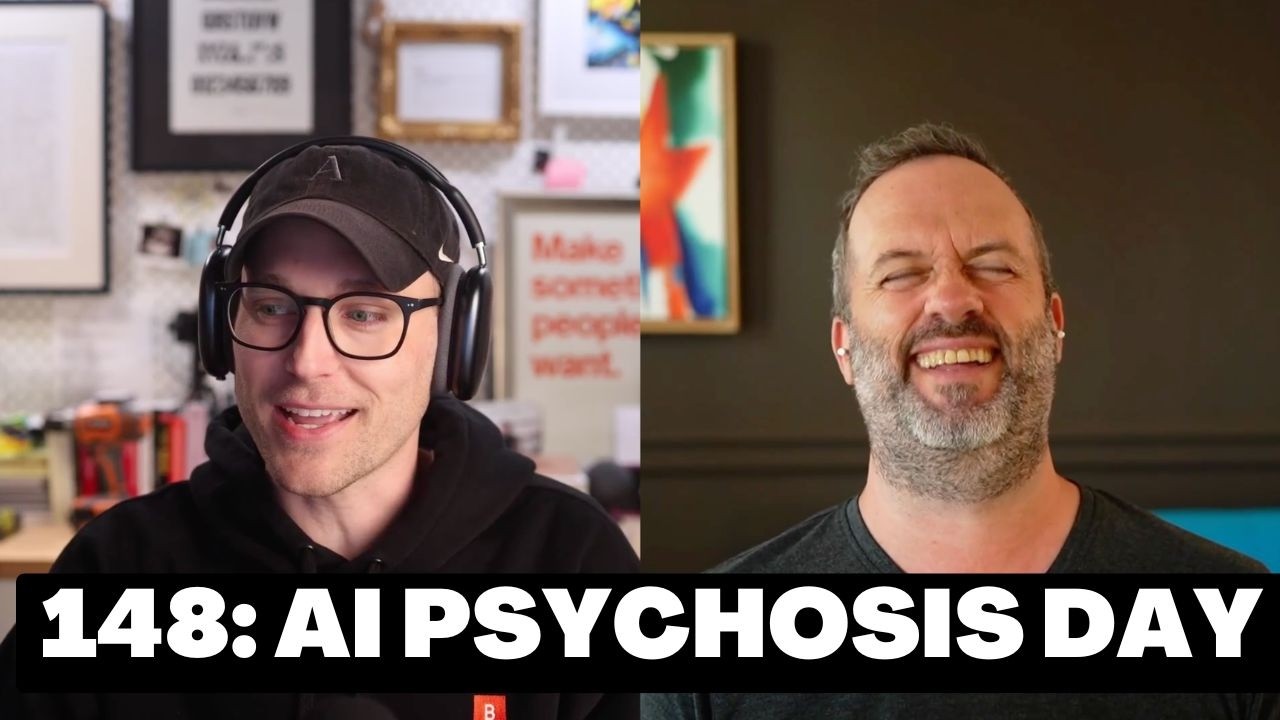
🔗 **Source:** [148: AI Psychosis Day](https://www.youtube.com/watch?v=UBMBSzLSIXM)
> [!note]+ Document Notes
> tags: [ai-coding-agents, model-capacity-economics, terminal-automation, generative-worldbuilding, developer-culture]
> author: [MISSING]
> source: Mostly Technical (YouTube)
> reference: https://www.youtube.com/watch?v=UBMBSzLSIXM
> date created: 2026-09-07
>
> > [!info] Generated analysis — not the author's words. Sections below are machine-written
> > from the captured source. Only text inside `> [!quote]` blocks is verbatim from the author.
> > Do not quote or attribute any other line to the named author.
>
> # 🏷️ Title: 148: AI Psychosis Day
>
<!-- deep-read:sections start -->
## 📝 Summary
- Episode 148 of *Mostly Technical* (a two-host developer podcast; one host is addressed on-air as "Ian," surname likely Landman/Landsman per an aside about his Instagram handle — the co-host is never named in this transcript) is an unstructured Labor Day catch-up, not a scripted segment show.
- The title "AI Psychosis Day" is the hosts' own jokey label for a day spent heavily using AI coding tools, coined on-air by one host: "this is teacher inservice AI psychosis day. You don't need to be actually doing work. You need to be ripping Astra tokens" (~[02:45]). This is casual internal slang for token-grinding, not a discussion of the clinical or popular-press concept of "AI psychosis" (chatbot-induced delusional thinking); the episode does not engage that topic at all.
- Content covers: burning through "Astra" (a new frontier coding-agent tier) usage quotas across multiple accounts; a personal, non-commercial art project using AI agents plus Blender to build a fictional world and narrate audio stories; porting a terminal-orchestration tool ("Solo") to Linux via the Omarchy distribution; training a small local classifier model to detect whether a terminal session needs human attention; a theory that Anthropic's perceived quality dip versus OpenAI is a compute-capacity/rationing problem, not a model-quality problem; and personal-life segments (a daughter's horse-show weekend, camera gear, an upcoming Vegas trip).
- Stakeholders: the two hosts and their listener base of practitioner developers who use frontier coding agents daily; sponsors (Svix, Bento, Typesense, Valor Security, DropInBlog) get read-in ad spots.
- Risk/tradeoff surfaced but not resolved: one host describes burning "the equivalent of eight full quotas" of a subscription tier and openly frames this as recreational rather than productive ("sending generous amounts of tokens for exactly zero ROI"), while also describing genuine tool-building work (the terminal classifier, the Linux port) done in the same sessions — the episode doesn't distinguish playful exploration from paid work time, and neither host treats that blurring as a problem worth examining.
- Bottom line: this is a casual industry chat, not a mental-health discussion — "AI psychosis" functions here purely as slang for intensive personal AI-tool use, and any reader encountering the title should not read it as reporting on or endorsing claims about AI-induced psychosis as a clinical phenomenon.
## 📖 Main Content
The episode has no formal structure; it's a recorded conversation between two developers who each run small software products alongside full-time jobs. Four threads carry the substantive (non-personal-life) content:
**1. "AI psychosis day" as slang, not clinical claim.** The phrase that titles the episode is introduced once, early, as a joke about spending an ostensible work holiday running AI coding agents instead of doing paid work (~[02:45]). Neither host revisits the phrase as a topic — it never becomes a discussion of the reported phenomenon (widely covered in tech press through 2025–2026) of chatbot conversations reinforcing delusional or grandiose thinking in vulnerable users. Because the episode borrows a contested, non-clinical popular term as in-group slang, any downstream reader or listener should be told plainly that this source does not address that phenomenon — the title is misleading if taken literally.
**2. Token-quota exhaustion as running bit.** Both hosts describe running out of usage allowances on "Astra" (their name for a new top-tier coding-agent offering) across multiple accounts, using "banked resets" (extra reset tokens that pull the next billing cycle forward rather than adding free capacity). One host estimates using "the equivalent of eight full quotas" over a weekend (~[03:01]); the other separately estimates roughly ten quotas' worth of usage across four accounts (~[61:12]). These are the hosts' own rough, self-reported estimates, not measured figures — treat them as color, not data.
**3. A non-commercial worldbuilding project.** One host describes a multi-month side project: an AI agent swarm builds out "canonical facts" for a fictional lost-civilization setting, uses Blender (which the host says they had never touched — "I said, 'What's Blender?' and had the agent download it and start using it," ~[09:33]) to render consistent 3D character and location studies, and pipes generated short stories through ElevenLabs for narration, which the host listens to "as I fall asleep at night" (~[13:25]). The stated goal is an eventual physical illustrated book, openly framed as an AI-agent collaboration rather than hidden authorship. No claim is made that this project is finished or commercially viable; it's presented as an ongoing hobby.
**4. Terminal-state classification and cross-platform porting.** The more clearly work-relevant segment: one host describes training a small local model (final size ~537 KB, reported P95 inference latency under 10ms even on dense scrollback) that reads a terminal's visible character grid plus internal diagnostics (last PTY byte seen, last human keystroke) and scores whether a given AI-agent session is idle, blocked on permissions, or needs input (~[50:56]–[58:41]). Labels for the initial ~500-sample training set were generated by prompting a frontier model (referred to as "codeex," i.e., a coding-agent CLI) to score each captured sample — described on-air, unprompted, as possible "distillation." Separately, the same host describes porting their terminal-orchestration tool "Solo" to Linux via System76's/DHH's Omarchy distribution, reachable over a Tailscale mesh network, with "10 to 15 little things" (~[35:19]) needing fixes before release.
## 🗒️ Notes
#### ⏱️ [00:00](https://www.youtube.com/watch?v=UBMBSzLSIXM&t=0) Cold open and sponsor reads
- Labor Day framing; both hosts joke about recording instead of taking the holiday off.
- Sponsor reads for Svix (webhooks-as-a-service) up top, described as their "first ever top of the show pre-roll."
#### ⏱️ [00:42](https://www.youtube.com/watch?v=UBMBSzLSIXM&t=42) "AI psychosis day" coined
- One host names the day "teacher inservice AI psychosis day," meaning a day for using AI tools recreationally rather than working.
- Immediately pivots into quota/token talk — the phrase is not revisited as a topic afterward.
#### ⏱️ [00:52](https://www.youtube.com/watch?v=UBMBSzLSIXM&t=52) Banked-reset mechanics
- Explains that a "banked reset" now pulls forward the next billing cycle rather than adding free usage — a policy change one host calls "the worst."
- Both hosts describe near-exhausting personal quotas across multiple accounts.
#### ⏱️ [05:14](https://www.youtube.com/watch?v=UBMBSzLSIXM&t=314) The fictional-world art project
- Origin story: started by asking an AI assistant about open math problems, pivoted to "what are fun things to do... with many agents working together."
- Describes the agent-driven canon-building, Blender rendering pipeline, and ElevenLabs audio narration workflow; explicitly says the eventual output would be released as an "AI writing" collaboration, not hidden.
#### ⏱️ [18:03](https://www.youtube.com/watch?v=UBMBSzLSIXM&t=1083) Solo on Linux
- Describes porting the "Solo" terminal-agent-orchestration tool to Linux via the Omarchy distribution, accessed over Tailscale/VNC from a MacBook.
- Frames Linux support as "completing the story" for a headless, multi-machine future rather than a near-term revenue driver; explicitly says "I still not a believer... this is the year of desktop Linux."
#### ⏱️ [49:02](https://www.youtube.com/watch?v=UBMBSzLSIXM&t=2942) Training a terminal-attention classifier
- Describes the recurring problem of AI-agent CLIs printing non-standard "do you want me to continue?" prompts that existing permission-detection heuristics miss.
- Demonstrates, live on the call, a first training run: 537 KB model, sub-millisecond to ~8ms inference depending on scrollback density, trained on ~500 samples labeled by a frontier model.
#### ⏱️ [61:44](https://www.youtube.com/watch?v=UBMBSzLSIXM&t=3704) OpenAI vs. Anthropic: capacity theory
- One host says Anthropic is "losing the mandate of heaven" on raw model quality since roughly Opus 4.7/4.8.
- The other host disagrees with the *cause*: argues the perceived quality gap is a compute-capacity and rate-limiting story (OpenAI secured more compute; Anthropic prioritizes enterprise contracts over max-tier consumer usage caps), not a model-capability regression. Both frame this as their own read of the market, not as data from either company.
## 📚 References
- No inline citations, hyperlinks, or named sources are present in the transcript — `paras2.py --links` returned zero results, confirming this is not a stripped-link artifact.
- Named tools/products referenced without links: Svix, Bento, Typesense, Valor Security, DropInBlog (sponsors); "Astra" and "Fable" (the hosts' informal names for AI-agent product tiers); Solo, Outro (the hosts' own software products); Omarchy (a Linux distribution associated with DHH); ElevenLabs (audio narration service); Tailscale (mesh VPN).
- Podcast home: mostlytechnical.com (stated on-air, not hyperlinked in the transcript).
## 🗣️ Paraphrase
- The hosts open by joking that recording on a holiday is itself "labor for the people," then immediately admit they're both burning AI-tool usage quotas for fun rather than doing paid work — which is the entire joke behind the episode's title.
- The back half pivots to two real engineering threads (a Linux port of a terminal-orchestration tool, and a small locally-trained model for detecting when an AI agent needs human attention) interleaved with personal updates about a side art project, a daughter's horse competition, and camera-gear shopping.
## 📰 Newsletter
Not directly WordPress-focused — this is a general developer/AI-tooling podcast (Laravel/PHP-adjacent community), so the blurb below is adapted rather than WordPress-specific, per the rule that non-WordPress sources should say so rather than invent WordPress angles:
- *Mostly Technical* episode 148 is a loose, funny Labor Day catch-up between two indie-hacker hosts, but buried in the banter is a genuinely useful build: one host demos training a 537KB local classifier model that reads a terminal's screen state and scores whether an AI coding agent needs your attention — sub-10ms inference, no cloud round-trip. If you're managing multiple long-running AI-agent sessions, this "watch the terminal, not the chat window" pattern is worth stealing.
- Also worth a listen if you're curious how developers are actually spending frontier-model usage quotas day to day, and how they're reasoning (informally, without company data) about why one AI lab's flagship model might feel "behind" another's — their working theory is compute rationing, not a quality regression.
## ✅ Action Items
#### DevRel
- Not applicable in the traditional sense — no DevRel program, workshop, or audience-facing developer education is described. The closest analog: the terminal-classifier build (~[49:02]) is a reusable pattern (local ML model reading raw terminal state to infer agent status) worth documenting as a technique for anyone building multi-agent developer tooling.
#### OSPO
- Not applicable to this source — no open-source governance, licensing, or security-disclosure topic appears.
#### Community
- Not applicable to this source — no maintainer, contributor, or sponsor-relations topic appears; this is a two-person independent podcast, not an OSS project.
#### WordPress
- Not applicable to this source — the episode is Laravel/PHP-adjacent developer culture and contains no WordPress content.
#### The WPOCC
- Not applicable to this source.
### FAIR
- Not applicable to this source.
## 🧪 Hypotheses
- H1: The perceived post-Opus-4.7 quality gap between Anthropic and OpenAI's flagship coding-agent offerings is driven more by usage-cap/rate-limiting differences than by underlying model capability differences.
- H2: Small (sub-1MB), narrowly-scoped local classifier models trained on terminal screen-grid state can reliably distinguish "agent needs input" from "agent is idle/working" with lower latency and cost than routing that judgment through a full LLM call.
- H3: Developers using frontier coding-agent subscriptions at the top usage tiers will, in aggregate, allocate a meaningful share of that usage to personal/recreational projects rather than paid work, without treating that allocation as noteworthy.
- H4: Casual reuse of clinical or mental-health-adjacent language ("psychosis") as in-group tech slang, unaccompanied by any discussion of the underlying clinical concept, is common enough in developer podcast culture that title/content mismatches like this one are not unusual.
### 📊 Methodology
- H1 would need actual rate-limit and compute-allocation data from both vendors (not available from this transcript) compared against blind quality evaluations on matched tasks.
- H2 is directly testable: benchmark the described classifier's precision/recall against a labeled holdout set, and against an LLM-call baseline, on latency and cost per classification.
- H3 would require usage-tier telemetry from a coding-agent vendor, broken out by self-reported project type (available to the vendor, not to outside researchers from public sources).
- H4 would need a corpus survey of tech-podcast titles/transcripts for clinical-term slang usage versus substantive engagement with the underlying condition.
### ❓ Questions
- Does the "banked reset pulls forward your renewal date" billing mechanic described here (~[00:52]) match the actual terms of service of the product being discussed, or is this the hosts' informal understanding of a policy they find frustrating?
- Is the local terminal-classifier's "distillation" framing (frontier model labels → small model trained on those labels) accurate distillation in the technical sense, or closer to weak supervision/pseudo-labeling? The host themselves flags uncertainty ("I don't know if this is distillation or not").
- What is the actual measured accuracy (not just "scoring worked") of the trained classifier once evaluated against ground truth rather than synthetic checks?
### 🔮 Future Research
- A follow-up episode or post benchmarking the terminal-attention classifier's real-world accuracy once it has "many thousands of samples" (mentioned as the near-term goal) would resolve H2 concretely.
- Tracking whether the Linux port of "Solo" via Omarchy ships, and whether it draws the "enough energy" for sales the hosts speculate about, would test their own stated uncertainty about desktop Linux's addressable market.
### 💡 Implications
- Practice: the terminal-state-classifier pattern (small local model, not an LLM call, for cheap high-frequency UI-state decisions) is a reusable technique for anyone building tooling that supervises multiple concurrent AI agent sessions.
- Security/process: one host notes running personal AI-agent experiments on "isolated projects," explicitly not against employer repos, "if the sock two auditors are listening" — a candid acknowledgment that SOC 2 compliance boundaries are a live consideration when developers experiment with AI tooling on work time/infrastructure.
- Funding/model economics: the capacity-vs-quality debate (~[61:44]) implies that subjective "this model got worse" perceptions among power users may be a rate-limiting artifact rather than a training or alignment regression — relevant context for anyone evaluating AI coding-agent vendors based on community sentiment rather than controlled benchmarks.
### 🧠 Learning Styles Assessment
- Reading level estimate: conversational transcript, Flesch-Kincaid grade approximately 6–7 (short sentences, high filler-word density, technical jargon offset by casual register); not representative of a written technical document.
#### 👀 Visual learners
- Present: none — pure audio/transcript, no diagrams, screenshots, or labeled code in the source.
- Improve: a simple architecture diagram of the terminal-classifier pipeline (screen grid → feature extraction → small model → confidence score) would help readers who skipped the audio.
#### 🔊 Aural learners
- Present: the native format — this is a podcast, well-suited to aural learners as-is.
- Improve: N/A, format already serves this style.
#### 🗣️ Verbal learners
- Present: informal analogies (comparing Linux distros to "the JavaScript ecosystem," warfare-as-logistics for the capacity debate).
- Improve: a glossary of the show's private jargon (Astra, Fable, Soul/Solo, Outro, orb) would help new listeners follow threads that assume prior-episode context.
#### 🧩 Kinesthetic learners
- Present: the live demo of the trained model responding to prompts in real time (~[54:30]–[58:41]).
- Improve: none needed for this format; the live-demo segment already serves this style.
#### 🧠 Logical learners
- Present: the capacity-vs-quality debate is structured as competing causal hypotheses, though neither host cites external data.
- Improve: a simple table contrasting "quality regression" vs "capacity rationing" predictions and what evidence would distinguish them.
#### 🧑🤝🧑 Social learners
- Present: the entire format is a two-person dialogue, useful for social learners who process ideas through conversation.
#### 🧘♀️ Solitary learners
- Present: none specifically; not this format's strength.
#### 🌿 Naturalistic learners
- Present: none; no sustainability or ecosystem framing appears in this episode.
### 📊 Accessibility Assessment
#### Screen reader semantics
- Present: N/A — source is a YouTube video; captions exist (this transcript derives from them) but caption quality includes garbled words ("heristics," "bananked resets," "Larville Holdings") typical of auto-generated captions.
- Improve: human-reviewed captions or a corrected transcript would materially improve accessibility for Deaf/hard-of-hearing viewers relying on captions for technical terms (e.g., "Astra," "Omachi"/Omarchy, product names) that auto-captioning consistently mangles.
#### Keyboard navigation
- Not applicable — video content, not an interactive interface.
#### Contrast and readability
- Not applicable to a transcript-only capture.
#### Text resizing and reflow
- Not applicable to a transcript-only capture.
#### Media and captions
- Present: auto-generated captions exist (source of this transcript).
- Improve: cleaned-up show notes with correct product names/spellings (the auto-captions render "Astra," "Omachi," and several proper nouns inconsistently) would help anyone reading rather than listening.
#### Forms and interactions
- Not applicable — no forms or interactive elements in this source.
#### Standards reference
- WCAG 2.2 AA gap: 1.2.2 (Captions, Prerecorded) is technically met by auto-captions but the accuracy issues above would likely fail a strict reading of "accurate" captioning for a technical audience.
### 🌍 DEIB Assessment
#### Cultural breadth
- Present: none — single US-based two-person conversation with no multi-region or multilingual content.
#### Inclusive language
- Present: casual, largely gender-neutral language throughout; a few casual references to family members (wife, daughter, in-laws) use conventional gendered terms consistent with how the speakers describe their own relationships — no pronoun inference was made beyond what the hosts state about themselves and named family members.
#### Neurodiversity support
- Present: none specifically; the conversational, tangent-heavy format (frequent interruption, topic-jumping) may be harder to follow for listeners who benefit from more linear structure.
- Improve: timestamped chapter markers (already partially present in the video description, not captured here) would help.
#### Representation
- Present: two male hosts and their described family members; no other identities represented in this episode's content.
#### Psychological safety
- Present: informal, low-stakes banter; no contentious or sensitive interpersonal content beyond the capacity/quality disagreement, handled collegially.
### ✅ Logical Validity
#### Strong reasoning
- The capacity-vs-quality argument (~[62:26]–[64:12]) is a reasonably structured causal alternative-hypothesis argument: the host proposes an alternative cause (compute allocation and enterprise-vs-consumer prioritization) for an observed effect (perceived quality gap) that the co-host had attributed to a different cause (model regression), and supports it with a specific mechanism (enterprise multi-year contracts competing with consumer max-tier usage for the same finite compute pool).
#### Fallacies
- Anecdotal generalization: both hosts' claims about relative model quality ("Opus 46 was awesome," "OpenAI's got it right now") rest entirely on personal usage impressions, not benchmarks — presented with more confidence than the evidentiary basis supports. Fix: flag these as subjective vendor comparisons, not measured claims, when citing this episode elsewhere.
- Hasty generalization: the "10 to 15 little things" found wrong when first running Solo on Linux is offered as evidence Linux support was nearly ready, without describing the severity or representativeness of those issues.
#### Tone of voice
- Casual, self-deprecating, high-energy; frequent joking self-interruption and mock arguing (e.g., the Canon-vs-Sony camera tangent) that signals in-group rapport rather than genuine dispute.
### 🛡️ DARVO Analysis
Not applicable to this source — no accusation, denial, or victim/offender reversal dynamic appears anywhere in the transcript; this is a friendly two-host conversation with no conflict being litigated.
## 🎯 Conclusion
Despite its title, this episode is not a discussion of "AI psychosis" as a mental-health topic — the phrase is a one-off in-group joke (~[02:45]) for spending a day heavily using AI coding tools, and the episode never returns to or engages the contested clinical/popular framing that phrase evokes in wider tech-press coverage. Readers should treat the title as slang, not as a signal that this source analyzes, endorses, or reports on AI-induced psychosis. The substantive content worth extracting is narrower and more concrete: a working pattern for cheap local classification of AI-agent terminal state, an informal but structured hypothesis about compute-capacity (not model-quality) driving perceived differences between AI labs, and a candid data point on how much of two developers' "AI usage" during work-adjacent time is recreational rather than billable. None of the model-quality or capacity claims here are backed by data the hosts share — treat them as informed practitioner opinion, not benchmarked fact.
## 🔄 Refactor Appendix — 148: AI Psychosis Day
> Density: 2–5 Literature atoms (H3), 0–3 Permanent candidates (H4).
> Konik claim-header rules: present tense, declarative, ≤10 words, searchable, unique.
> Atomicity: one declarative sentence per atom.
### 📚 Literature Atoms (H3)
#### [H1] "AI psychosis" used as slang for heavy tool use, not clinical claim
> [!quote] ID:rw_01m20gy037mh16p1d51kmy7nfg
> "teacher inservice AI psychosis day. You don't need to be actually doing work. You need to be ripping Astra tokens"
The episode title comes from this single off-the-cuff line, coined to mean "a day for recreational AI-tool grinding," not a discussion of AI-induced delusional thinking. Caveat: the phrase is never revisited or examined critically by either host — treat this as evidence of casual clinical-term slang usage in developer culture, not as commentary on the actual phenomenon.
Tags: `#xref`
#### [H2] Host attributes Anthropic's perceived quality dip to compute rationing
> [!quote] ID:rw_01m20gy037mh16p1d51kmy7nfg
> "I feel like they're losing the they're losing the mandate of heaven."
Said by one host about Anthropic's flagship model, immediately followed by the co-host's counter-argument that the real driver is compute capacity and enterprise-vs-consumer prioritization, not model quality. Caveat: both positions are stated as personal impression, with no benchmark or vendor data cited.
Tags: `#xref`
#### [H3] Local model classifies terminal-agent state from screen grid
> [!quote] ID:rw_01m20gy037mh16p1d51kmy7nfg
> "train a very small micro model that can input or ingest any terminal grid"
Describes a working technique: feed a terminal's visible character grid plus session diagnostics to a small (537KB) locally-trained model to score whether an AI coding agent needs attention, is idle, or is blocked on permissions — reported sub-10ms inference. Caveat: only "scoring worked," not verified accuracy, was demonstrated live.
Tags: `#xref`
#### [H4] AI agents drive a non-commercial worldbuilding art project
> [!quote] ID:rw_01m20gy037mh16p1d51kmy7nfg
> "I said, "What's Blender?" and had the agent download it and start using it."
Illustrates a personal, openly-disclosed use of AI agent swarms for creative (not commercial) work: building a fictional world's lore, rendering consistent 3D visuals, and generating narrated audio stories, with an eventual physical-book goal.
Tags: `#xref`
#### [H5] Terminal-orchestration tool ported to Linux via Omarchy
> [!quote] ID:rw_01m20gy037mh16p1d51kmy7nfg
> "this is the other thing you've been crunching tokens on and probably other solo stuff"
Marks the segment where a host describes porting their "Solo" AI-agent terminal-orchestration product to Linux (via the Omarchy distribution), accessed remotely over Tailscale, with "10 to 15" platform-specific fixes still pending before release.
Tags: `#xref`
### 🧠 Permanent Candidates (H4)
#### [P1] Clinical-sounding slang in tech culture rarely engages the real condition
**Claim** (one sentence, Courtney's voice): When a developer podcast or post borrows a mental-health term as in-group slang for something unrelated (heavy tool use, obsessive focus), the borrowed phrase almost never signals engagement with the actual clinical or contested phenomenon, so a title or headline using such language needs its own check before being cited or summarized as if it addresses that topic.
**Evidence pointer**: [[#H1]]
**Scope & conditions**: Holds for casual/conversational tech media; does not extend to journalism or research that explicitly investigates the clinical phenomenon by name.
**Links**:
- [[Contested framings in health journalism]] — because applies-in title/headline verification work
- [[Source attribution]] — because extends the general rule that a title is not evidence of content
<!-- atomicity: 1 idea ✓ -->
#### [P2] Perceived AI model quality gaps can be a rationing artifact, not a training one
**Claim** (one sentence, Courtney's voice): When power users report a top-tier AI model "got worse," the more testable first hypothesis is a change in usage limits, routing, or capacity allocation rather than a regression in the underlying model, because rate-limit changes are common, cheap to implement, and easy to mistake for quality drift under subjective daily use.
**Evidence pointer**: [[#H2]]
**Scope & conditions**: Applies specifically to subscription-tier consumer AI products with variable usage caps; does not apply where a vendor has published benchmark deltas confirming an actual capability regression.
**Links**:
- [[Vendor benchmark skepticism]] — because extends general practice of not trusting sentiment over measurement
- [[AI coding agents]] — because applies-in evaluating coding-agent vendor claims
<!-- atomicity: 1 idea ✓ -->
### ✏️ Fleeting Queue
- [F1] Check whether "Astra" and "Fable" map to real, publicly-named AI model releases as of episode air date (2026-09), since the hosts use these as informal in-group names throughout — worth confirming before citing this episode's model comparisons elsewhere `#fleeting #inbox`
- [F2] The terminal-classifier pattern (small local model scoring agent-attention state from screen-grid text) could be worth prototyping for any multi-agent WordPress/dev tooling Courtney builds or evaluates `#fleeting #inbox`
### → Things 3 (max 2 actions)
- [ ] Do not cite this episode's title as evidence of substantive "AI psychosis" (clinical) discussion in any future writing — content note it accurately as slang usage only `#things`
<!-- deep-read:sections end -->
📄 **Full text:** [[Full Document Contents/Articles/148 AI Psychosis Day.md|148: AI Psychosis Day by YouTube]]
## Highlights
- >> yeah, I don't know what I'm I have like I'm working till like 2. Do I have a phone? I have like an actual business call at 1. I got Yeah, it's we're just a work day pretty much. I'll head home after that. But >> no, this is this is uh teacher inservice AI psychosis day. You don't need to be actually doing work. You need to be ripping Astra tokens is what you need to be doing. >> Yeah, we got we got some new AI hotness. I wonder how many accounts you've added because of Astra. You're just loading up ([View Highlight](https://read.readwise.io/read/01m20hbx6pb6hddcyrjybqpqzz))
- Note: H1 — the episode title comes from this off-the-cuff line; it's slang for heavy token-grinding, not a discussion of clinical AI-induced psychosis. #atom/literature/h1
- Tags: atom/literature/h1
- twists and turns. >> And so, uh, I fired up Blender. I didn't fire up Blender. That's too generous. I said, "What's Blender?" and had the agent download it and start using it. And now it's building out 3D uh, representations of all the canonical details that we have. Oh my goodness. Look at this guy. >> Blender's cool. Never used Blender in my life. Still have it to be fair. >> But once you build up all these like 3D ([View Highlight](https://read.readwise.io/read/01m20hbzy5mn9764hhyt9g76j8))
- Note: H4 — a non-commercial AI-agent worldbuilding project: agents render consistent 3D lore visuals in Blender the host had never used. #atom/literature/h4
- Tags: atom/literature/h4
- >> Um, all right. So, we didn't even get to the main thing you worked on. I feel like we should talk about that. We solo on Linux. Like, this is the other thing you've been crunching tokens on and probably other solo stuff. >> Solo on Linux. >> But that's a big one. I'm excited about this one. And I feel like this is a very good direction for Solo. Get in with the Linux people. >> Y >> they they're they want to be in the desktop controlled world. >> They need tools to do it. All the Linux stuff is crappy in my opinion. Uh so I like all this where you're going. All ([View Highlight](https://read.readwise.io/read/01m20hc2qb2nyw4bc939a7cbv4))
- Note: H5 — porting the "Solo" terminal-agent-orchestration tool to Linux via Omarchy, reachable over Tailscale/VNC. #atom/literature/h5
- Tags: atom/literature/h5
- solution uh my pending solution to that is train a very small micro model that can input or ingest any terminal grid. So on the back end I have you know a representation of what is shown on the screen because I am the terminal >> right >> and so can I feed that grid of cells to a very small local only >> uh model I don't even think it's an LLM I think it's just a model can I feed it ([View Highlight](https://read.readwise.io/read/01m20hc5n80tdnq349ngrrkr2n))
- Note: H3 — training a small local model on terminal screen-grid state to score whether an AI agent needs attention; 537KB, sub-10ms inference. #atom/literature/h3
- Tags: atom/literature/h3
- this is I don't even think this is needed. I saw that Tibo tweeted >> that Astra on low is the is the same or better as soul on I think it was extra high. Was it high? I think it was. >> Um >> so it's it's very good. And you know to to broaden the conversation a bit. I don't know what Anthropic does at this point because I feel like they're losing the they're losing the mandate of heaven. I know that I know that they're embedded in enterprises and I fully I I ([View Highlight](https://read.readwise.io/read/01m20hc8g88jva1mq0w1h6y4pz))
- Note: H2 — host's compute-capacity-not-quality theory for why Anthropic's flagship feels behind OpenAI's; both hosts' takes are personal impression, no benchmark cited. #atom/literature/h2
- Tags: atom/literature/h2