A "Game"-Changing Approach to Accessibility Education
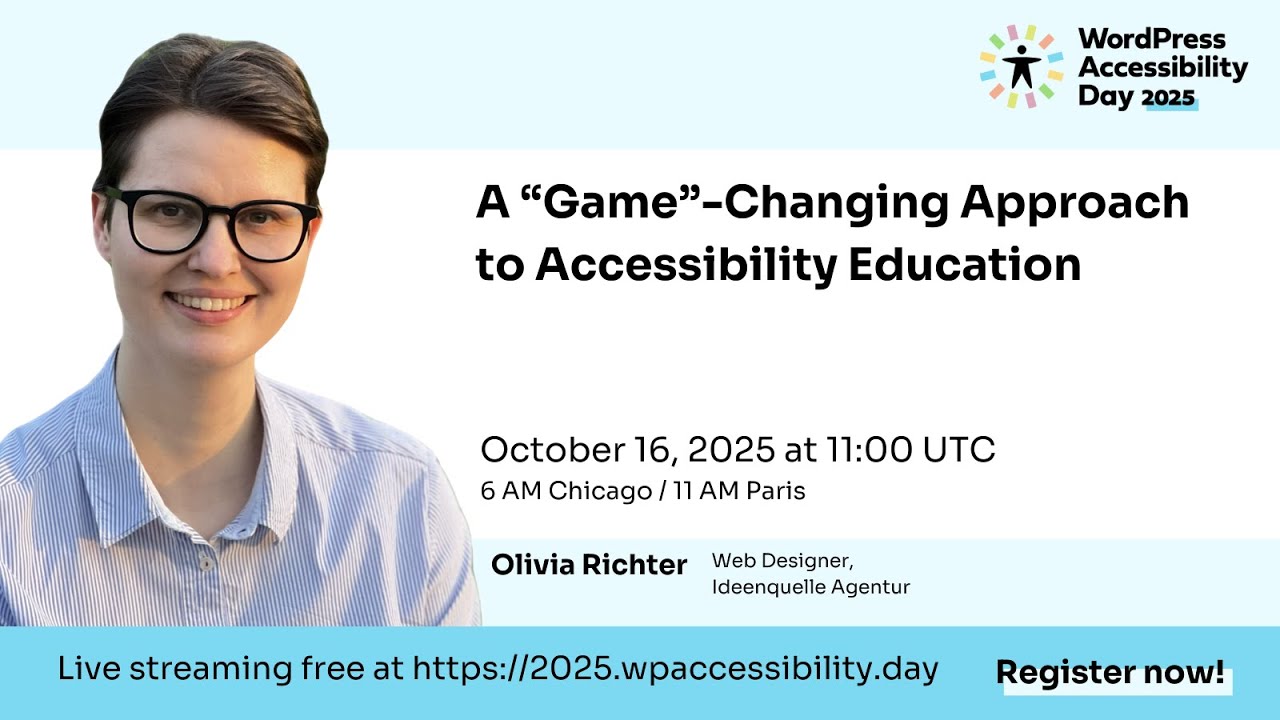
🔗 **Source:** [A "Game"-Changing Approach to Accessibility Education](https://www.youtube.com/watch?v=0TPngvm1fhw)
> [!note]+ Document Notes
> tags: [accessibility-education, disability-simulation, empathy-gap, inclusive-hiring, wordpress-accessibility, gamification]
> author: Olivia Richter
> source: WordPress Accessibility Day 2025
> reference: https://www.youtube.com/watch?v=0TPngvm1fhw
> date created: 2026-09-08
>
> > [!info] Generated analysis — not the author's words. Sections below are machine-written
> > from the captured source. Only text inside `> [!quote]` blocks is verbatim from the author.
> > Do not quote or attribute any other line to the named author.
>
> # 🏷️ Title: A "Game"-Changing Approach to Accessibility Education
>
<!-- deep-read:sections start -->
## 🧭 Table of Contents
- [📝 Summary](#-summary)
- [📖 Main Content](#-main-content)
- [🗒️ Notes](#️-notes)
- [📚 References](#-references)
- [🗣️ Paraphrase](#️-paraphrase)
- [📰 Newsletter](#-newsletter)
- [✅ Action Items](#-action-items)
- [🧪 Hypotheses](#-hypotheses)
- [📊 Methodology](#-methodology)
- [❓ Questions](#-questions)
- [🔮 Future Research](#-future-research)
- [💡 Implications](#-implications)
- [🧠 Learning Styles Assessment](#-learning-styles-assessment)
- [📊 Accessibility Assessment](#-accessibility-assessment)
- [🌍 DEIB Assessment](#-deib-assessment)
- [✅ Logical Validity](#-logical-validity)
- [🛡️ DARVO Analysis](#-darvo-analysis)
- [🎯 Conclusion](#-conclusion)
### 🔗 References
- [Barrieria — the escape game](https://game.ideenquelle-webdesign.de)
- [WordPress Accessibility Day 2025 feedback](https://2025.wpaccessibility.day/feedback)
- Social: #wpa11yday, #wpad2025
## 📝 Summary
- Olivia Richter, a WordPress web designer who runs her own studio (founded 2023), argues that classic disability simulations (blindfolds, wheelchairs, earplugs, dyslexia-scramble text) are a weak fix for what she calls the "empathy gap" — the gap between people saying they care about inclusion and actually acting on it.
- She lays out the case against simulations point by point: disabilities aren't one-size-fits-all (she shows two different diabetic retinopathy simulations with different dark-spot patterns), a temporary simulation isn't lived experience, simulations can reduce disabilities to stereotypes ("all blind people use Braille" / "use a screen reader"), some disabilities (chronic pain, autistic sensory overload) can't be simulated at all, and the practice draws real ethical criticism as "disability cosplay" tied to the medical model of disability.
- Her proposed middle path is simulating barriers instead of disabilities: build an experience that is broken for non-disabled default behavior (mouse-only, wide viewport) rather than one that pretends the user has an impairment. She built this as a WordPress site using the Bricks builder — an eight-challenge escape game called Barrieria at game.ideenquelle-webdesign.de, playable with a screen reader and keyboard, guided by a legally blind NPC named Freddy who acts as helper, not victim.
- Stakeholders: WordPress designers/developers and PMs who build training, DevRel/education teams designing onboarding for accessibility beginners, and disabled jobseekers caught in what she names the "accessibility paradox" — companies won't hire disabled staff until the site is fixed, but need disabled staff to fix it.
- Risk/tradeoff she names directly: barrier simulation is not a replacement for talking to disabled people, and she is explicit that no game closes the empathy gap — only listening to and hiring disabled people does.
- Bottom line: games and simulations are, at best, an "appetizer" that lowers the barrier to a first conversation about accessibility — never a substitute for paying disabled people for their expertise and involving them at every stage of the process.
## 📖 Main Content
Richter frames the accessibility problem as a knowledge-and-motivation gap, not a malice gap: "when you can glide through a website with a mouse, why would you question a broken tab order?" (00:04:08, t=248s). She names this the **empathy gap** — people don't act on stated values about inclusion until disability affects them directly (00:04:28, t=268s).
The talk's first half stress-tests the standard industry fix — simulating a disability (blindfolds, wheelchairs, earplugs, screen-scramble text for dyslexia) — against her own experience at the Muzieum in Nijmegen, Netherlands, a museum tour conducted in total darkness led by a blind guide. She grants simulations can work "like a spotlight, not a floodlight" for narrow, specific issues (color contrast is her example: a green-on-yellow-forest image that's unreadable once run through a color-blindness filter), but lists five structural limits: disabilities vary person to person (two diabetic retinopathy simulations look nothing alike); a temporary simulation misses the cumulative exhaustion of lived disability (broken elevators, wheelchair damage on flights, healthcare bureaucracy); simulations can distort perception into pity or stereotype ("all blind people use Braille"); some disabilities (chronic pain, sensory overload, missing limbs) resist simulation entirely; and the whole practice invites the ethical charge of "disability cosplay" — she links it explicitly to the medical model of disability, where the person, not the environment, is treated as the thing needing correction.
Her stated fix for the empathy gap isn't a better simulation — it's listening to and hiring disabled people directly, at every step of product development, not just in QA. She names the obstacles bluntly: the "perfect candidate trap" (companies wanting a senior developer who is also an accessibility expert with lived experience), the "awareness gap" (companies not realizing their product is inaccessible), and the "accessibility paradox" (career pages too inaccessible for the disabled candidates the company claims it wants to hire).
The talk's second half pivots to her actual proposal: simulating **barriers**, not disabilities. Instead of asking a sighted user to wear vision-restricting glasses, she inverts the default — an app that works fine at narrow viewport widths but breaks on standard widescreen displays, so a mouse-using, sighted developer hits a barrier without adopting anyone else's persona. She argues this keeps the anger pointed at the design ("this layout is terrible") rather than at the disability ("being visually impaired must be hard"). She's candid that this approach has its own limit: it doesn't work for every disability type (she tries and fails to adapt it for colorblindness) and it's still, in a looser sense, simulating part of a lived experience — she doesn't claim it's controversy-free.
She then walks the audience through Barrieria, the WordPress/Bricks-built escape game she built to operationalize this idea: eight challenges solved with a keyboard and a screen reader (NVDA or VoiceOver), guided by Freddy, a legally blind resident who acts purely as a helper — a deliberate inversion of media's usual "disabled person needing help" framing. Demoed challenges include finding a keyboard-only path to a mouse-only button, discovering a hidden URL fragment via alt text a screen reader reads aloud, and identifying the true H1 heading among visually larger, non-semantic headings.
## 🗒️ Notes
#### ⏱️ [00:01:36](https://www.youtube.com/watch?v=0TPngvm1fhw&t=96s) Introduction by Jeremy Rivera
- Jeremy Rivera, developer advocate at Deque Systems, opens WordPress Accessibility Day 2025 and introduces Olivia Richter as a web designer who founded her own company in 2023.
#### ⏱️ [00:02:46](https://www.youtube.com/watch?v=0TPngvm1fhw&t=166s) Olivia Richter self-introduction
- Richter self-describes her appearance ("brown pixie cut, glasses, black shirt") for screen reader users, a live model of accessible self-introduction. Calls herself a "WordPress web designer by day, and an accessibility advocate by passion."
#### ⏱️ [00:03:36](https://www.youtube.com/watch?v=0TPngvm1fhw&t=216s) Root cause: creators don't face their own barriers
- "People create digital experiences" and most creators never hit the barriers they build. Chef metaphor: they "don't taste their own food."
#### ⏱️ [00:04:28](https://www.youtube.com/watch?v=0TPngvm1fhw&t=268s) Naming the empathy gap
- Defines the empathy gap as an inability to empathize with disabled people, driving people to ignore daily barriers until disability affects them personally ("It won't be me... until, of course, it is").
#### ⏱️ [00:05:24](https://www.youtube.com/watch?v=0TPngvm1fhw&t=324s) Standard fix: simulate the disability
- Lists common simulation tactics: wheelchair-for-an-hour, blindfolding, trust walks, earplugs for hard-of-hearing/deaf simulation.
#### ⏱️ [00:05:54](https://www.youtube.com/watch?v=0TPngvm1fhw&t=354s) Muzieum Nijmegen example
- Personal story: a total-darkness museum tour in Nijmegen, Netherlands, guided by a blind guide, navigating a simulated home, street, and bar without sight.
#### ⏱️ [00:07:02](https://www.youtube.com/watch?v=0TPngvm1fhw&t=422s) Dyslexia text-scramble simulation
- Shows a letter-scrambling simulation of dyslexia as a reminder that simple tasks vary by how a brain processes information.
#### ⏱️ [00:07:34](https://www.youtube.com/watch?v=0TPngvm1fhw&t=454s) "Spotlight, not floodlight"
- Argues targeted simulations work for narrow, specific issues — demonstrates a green/yellow forest image under a color-blindness filter that becomes unreadable.
#### ⏱️ [00:08:57](https://www.youtube.com/watch?v=0TPngvm1fhw&t=537s) Limitation 1: disabilities aren't one-size-fits-all
- Shows two different diabetic retinopathy simulations with different dark-spot patterns as proof a single simulation can't represent a diagnosis.
#### ⏱️ [00:09:42](https://www.youtube.com/watch?v=0TPngvm1fhw&t=582s) Limitation 2: temporary isn't lived experience
- "Spending an hour in a wheelchair teaches you how to spend an hour in a wheelchair" — misses exhaustion of route planning, broken elevators, wheelchair damage on flights, healthcare bureaucracy, discrimination, and intersectionality with race/class.
#### ⏱️ [00:11:00](https://www.youtube.com/watch?v=0TPngvm1fhw&t=660s) Limitation 3: stereotyping
- Names the myth "all blind people use Braille" / "all blind people use a Screen Reader" as false generalizations simulations can reinforce.
#### ⏱️ [00:11:25](https://www.youtube.com/watch?v=0TPngvm1fhw&t=685s) Limitation 4: some disabilities can't be simulated
- Chronic pain, autistic sensory overload, and mobility loss (prosthetic hand, input-device barriers) resist simulation; warns that "keyboard macro" fixes built for a simulated disability often don't help real disabled users and can add new barriers.
#### ⏱️ [00:13:15](https://www.youtube.com/watch?v=0TPngvm1fhw&t=795s) Medical model of disability critique
- Links disability simulation to the medical model — treating the impairment, not the system, as the thing to fix — and flags its ableist criticism.
#### ⏱️ [00:13:49](https://www.youtube.com/watch?v=0TPngvm1fhw&t=829s) The ethical question: "disability cosplay"
- Raises whether it's appropriate for non-disabled people to simulate disability even for education; names the "disability cosplay" framing and the risk of misdirected, pitying empathy.
#### ⏱️ [00:15:29](https://www.youtube.com/watch?v=0TPngvm1fhw&t=929s) The real fix: listen to disabled people
- States the answer to the empathy gap is "listening to people with disabilities. Plain and simple," not simulation, pity, or guesswork.
#### ⏱️ [00:16:53](https://www.youtube.com/watch?v=0TPngvm1fhw&t=1013s) Benefits of direct listening
- Lists downstream benefits: diverse product teams, adaptability, employee retention/satisfaction, fewer last-minute accessibility patches, and the curb cut effect (curb cuts built for wheelchairs now serve strollers, bikes, trolleys).
#### ⏱️ [00:18:31](https://www.youtube.com/watch?v=0TPngvm1fhw&t=1111s) The "perfect candidate trap"
- Companies chase a "unicorn" — senior developer + accessibility expert + lived experience — instead of hiring "great talent who happens to be disabled."
#### ⏱️ [00:18:53](https://www.youtube.com/watch?v=0TPngvm1fhw&t=1133s) Awareness gap and accessibility paradox
- Many companies don't realize their product is inaccessible; career pages themselves are often inaccessible, creating a circular bind she frames as "your payroll," not charity.
#### ⏱️ [00:19:53](https://www.youtube.com/watch?v=0TPngvm1fhw&t=1193s) Pivot: simulating barriers instead of disabilities
- Introduces the alternate approach — simulate a barrier rather than a disability — and immediately flags her own earlier claim that simulations don't work.
#### ⏱️ [00:21:07](https://www.youtube.com/watch?v=0TPngvm1fhw&t=1267s) Barrier-simulation example: broken widescreen layout
- Demos an app that works perfectly on narrow viewports but breaks unpredictably on standard widescreen displays — a barrier with no persona attached.
#### ⏱️ [00:21:48](https://www.youtube.com/watch?v=0TPngvm1fhw&t=1308s) Why the barrier approach works better
- Argues it "hits people at home" without forcing perspective-taking; users get angry at "bad design" instead of pitying disabled people — "one leads to charity, the other leads to change."
#### ⏱️ [00:23:07](https://www.youtube.com/watch?v=0TPngvm1fhw&t=1387s) Limits of barrier simulation
- Concedes it isn't a plug-and-play replacement — tries and fails to adapt it for colorblindness — and states it's "a bridge to get teams to care enough to seek those perspectives," not a substitute for them.
#### ⏱️ [00:28:14](https://www.youtube.com/watch?v=0TPngvm1fhw&t=1694s) Requirements for the proof of concept
- Sets four design requirements: easy to understand (no jargon), short (an "aha" moment, not a course), engaging (users do something, not just watch), and fun — with fun framed as lowering defenses and encouraging exploration, balanced against trivializing the issue.
#### ⏱️ [00:30:38](https://www.youtube.com/watch?v=0TPngvm1fhw&t=1838s) Introducing Barrieria (the game)
- Reveals the game at game.ideenquelle-webdesign.de, built in WordPress with the Bricks builder; requires a screen reader and keyboard, playable on desktop (technically Android).
#### ⏱️ [00:32:20](https://www.youtube.com/watch?v=0TPngvm1fhw&t=1940s) Meet Freddy
- Introduces Freddy, a legally blind Barrieria resident who serves as in-game helper (giving hints) and as a prompt to reflect on real-world barriers — a deliberate reversal of disabled-people-as-needing-help media tropes.
#### ⏱️ [00:34:06](https://www.youtube.com/watch?v=0TPngvm1fhw&t=2046s) Barrieria isn't a utopia
- Clarifies Barrieria is not "better," just different, designed against non-disabled norms on purpose — floor markings, acoustic-only traffic signals, Braille-by-default signage — "designed to spite every mouse user."
#### ⏱️ [00:35:52](https://www.youtube.com/watch?v=0TPngvm1fhw&t=2152s) Challenge 1 demo: keyboard-only navigation
- Live demo: a button unresponsive to mouse clicks is solved with the Tab key and Enter, completing the first of eight challenges.
#### ⏱️ [00:36:31](https://www.youtube.com/watch?v=0TPngvm1fhw&t=2191s) Challenge 2 demo: alt text / "invisible message"
- Black-on-dark-background text is unreadable visually; solved by running VoiceOver on Safari to read the image's alt text, which contains a hidden URL clue.
#### ⏱️ [00:38:20](https://www.youtube.com/watch?v=0TPngvm1fhw&t=2300s) Challenge 3 demo: chaotic headings
- Multiple visually similar headings hide the true semantic H1; solved via VoiceOver announcing "Heading level 1" on a visually smaller, clickable heading.
#### ⏱️ [00:39:55](https://www.youtube.com/watch?v=0TPngvm1fhw&t=2395s) Challenge 4: tiny text (left unsolved on stream)
- A page with unreadably small interspersed text is left as a self-guided puzzle; Richter notes a screen reader won't solve this one and creativity is required.
#### ⏱️ [00:42:02](https://www.youtube.com/watch?v=0TPngvm1fhw&t=2522s) Closing: barriers are designed, not natural
- Reiterates that Barrieria "exposes the truth. Barriers aren't natural. They are designed," framing inaccessibility as an artificial, fixable problem, not a natural one.
#### ⏱️ [00:43:27](https://www.youtube.com/watch?v=0TPngvm1fhw&t=2607s) Q&A: burden of education on disabled people
- Jeremy Rivera asks how to avoid putting the burden of accessibility education on disabled people; Richter answers: hire and pay disabled people for their expertise rather than expecting free labor.
#### ⏱️ [00:46:03](https://www.youtube.com/watch?v=0TPngvm1fhw&t=2763s) Q&A: origin of Barrieria's design
- Richter explains her design method: for each barrier, ask "what's the opposite for a non-disabled user?" (mouse fails where keyboard works; extra alt text instead of missing alt text).
#### ⏱️ [00:47:47](https://www.youtube.com/watch?v=0TPngvm1fhw&t=2867s) Q&A: has the game been tested with keyboard-primary users?
- Richter admits she has not formally tested Barrieria with people who use a keyboard as their primary input method, only tested it herself.
## 📚 References
- [Barrieria — the escape game (WordPress + Bricks builder)](https://game.ideenquelle-webdesign.de)
- [WordPress Accessibility Day 2025 feedback form](https://2025.wpaccessibility.day/feedback)
- [Muzieum Nijmegen (referenced museum, Netherlands)](https://muzieum.nl/en/nijmegen/)
- [NVDA screen reader (referenced tool)](https://www.nvaccess.org/)
- [Deque Systems (Jeremy Rivera's employer, event host affiliation)](https://www.deque.com/)
## 🗣️ Paraphrase
Richter opens from her own frustration with how the industry teaches empathy: strapping on a blindfold or a wheelchair for an hour, she argues, produces a brief "aha" but not real understanding, because disability doesn't work like a costume you take off. She walks through the failure modes one by one — simulations flatten wildly different conditions into one generic experience, they can't touch invisible or fluctuating disabilities like chronic pain, and they risk turning empathy into pity aimed at a fake experience rather than respect for real people. Underneath all of it sits a harder critique: simulation still treats the disabled person's body as the problem to be understood, when the actual problem is a website or app that was never built with them in mind.
Her answer isn't "do better simulations" — it's "stop trying to feel what disabled people feel, and start paying them to tell you what's broken." But she doesn't stop at the critique; she builds a middle step for people who aren't there yet. Barrieria flips the simulation on its head: instead of asking a sighted mouse user to pretend to be blind, it builds a world where the mouse just doesn't work and the widescreen layout is broken by design, so a developer gets angry at the interface instead of pitying an imagined disabled user. It's explicitly a "spark," not a substitute — a short, playable on-ramp meant to get people curious enough to go do the real work: hiring disabled people and listening to them at every stage, not just at the QA finish line.
## 📰 Newsletter
Tired of blindfold-and-wheelchair "empathy exercises" that teach your team how to spend an hour in a wheelchair and not much else? WordPress designer Olivia Richter's WordPress Accessibility Day 2025 talk makes the case that disability simulations mostly teach the wrong lesson — and offers a sharper alternative: simulate the barrier, not the disability. Her proof of concept, Barrieria, is a WordPress + Bricks-builder escape game with eight screen-reader-and-keyboard challenges, guided by Freddy, a legally blind NPC who's the helper, not the victim. Play it at game.ideenquelle-webdesign.de, and bring the "perfect candidate trap" and "accessibility paradox" framing to your next hiring conversation — Richter's blunt version: "you don't need a disability hire, you need great talent who happens to be disabled."
## ✅ Action Items
#### DevRel
- Developer advocacy: Package the "simulate the barrier, not the disability" framing (t=1267s widescreen-break demo) as a 10-minute conference-talk-length demo module other WordPress DevRel speakers can reuse.
- Education: Not applicable to this source — Richter's talk is itself the education artifact; no DevRel curriculum-design gap identified beyond adapting the Barrieria mechanic.
- Developer experience: Not applicable to this source — no SDK, docs, or quickstart content discussed.
- Developer marketing: Not applicable to this source — no campaign or funnel content in scope.
- Community management: Not applicable to this source — no moderation or code-of-conduct topics raised.
- Internal/external/cross-project: Cross-reference this talk with Deque Systems' (Jeremy Rivera's employer) existing accessibility-training content to avoid duplicating the barrier-simulation concept.
#### OSPO
- Policy & Governance: Not applicable to this source — no open-source contribution policy discussed.
- License Compliance: Not applicable to this source.
- Security Management: Not applicable to this source.
- Software Inventory: Not applicable to this source.
- Developer Support: Not applicable to this source.
- Community Engagement: Not applicable to this source.
- Strategic Alignment: Not applicable to this source — talk targets individual/team practice, not organizational OSPO strategy.
#### Community
- Maintainers: Not applicable to this source — no plugin/theme maintainer workflow discussed.
- Contributors: Not applicable to this source.
- Sponsors: Note the WordPress Accessibility Day 2025 sponsor roster (Gravity Forms, WP Engine, Woo, Equalize Digital, GoDaddy, GreenGeeks, Yoast, Kinsta, Pressable, SiteGround, and others, t=3s–90s) as evidence accessibility-focused events can attract mainstream WordPress hosting/plugin sponsorship — usable precedent when pitching similar sponsorship for future a11y programming.
- Ecosystem: Not applicable to this source — no cross-project incident or disclosure topic raised.
#### WordPress
- Core: Not applicable to this source — talk doesn't touch core release criteria.
- Core Performance: Not applicable to this source.
- Core AI: Not applicable to this source.
- Core Program Team: Not applicable to this source.
- Mobile: Not applicable to this source — game is explicitly desktop-first ("technically you can also play the game on an Android smartphone, but I encourage you to use a desktop," t=1871s), no mobile-app implications.
- Playground: Consider hosting a Playground-based demo of Barrieria's four public challenges so WP Training can embed a playable barrier-simulation directly in a lesson without linking off-site.
- Community: Not applicable to this source beyond the sponsor note above.
- **Training:** Concrete, usable: build a WP Training lesson module around the "opposite of the barrier" design method Richter describes at t=2826s (e.g., mouse works everywhere except here / alt text present everywhere except here) — instructional designers can turn each of Barrieria's 8 challenges into a standalone WCAG-criterion micro-lesson (keyboard operable 2.1.1, non-text content 1.1.1, headings and labels 2.4.6) with a "spot the barrier" exercise instead of a lecture slide.
- Marketing: Not applicable to this source.
- Support: Not applicable to this source.
- Design: Reuse the "spotlight not floodlight" framing (t=457s) as a design-review heuristic: use a targeted simulation only to illustrate one specific, narrow issue (e.g., contrast), never as a general accessibility-training substitute.
- Documentation: Not applicable to this source — no DevHub/HelpHub gap identified.
- Photos: Not applicable to this source.
- TV: Consider indexing this WordCamp-adjacent WordPress Accessibility Day talk on WordPress.tv with captions if not already mirrored there (talk is currently only confirmed on YouTube).
- Polyglots: Note the game itself is German-first (game.ideenquelle-webdesign.de, NVDA demo shows a "Deutsch" language link, t=2258s) — a translation opportunity for English-first WP Training reuse.
- **Accessibility:** Concrete, usable: adopt Richter's four challenge types (keyboard-only nav, alt text discovery, heading-structure identification, text-legibility) as a repeatable WCAG self-audit checklist template for WordPress Accessibility team reviews, mapped to 2.1.1, 1.1.1, and 2.4.6/1.4.4.
- Meta: Not applicable to this source.
- CLI: Not applicable to this source.
- Hosting: Not applicable to this source beyond sponsor list.
- Tide: Not applicable to this source.
- Openverse: Not applicable to this source.
- Themes: Not applicable to this source.
- Plugins: Note the game was built with the Bricks page builder inside WordPress (t=1858s–1865s), not a WordPress.org-listed plugin stack — relevant if the WordPress Plugins team wants to evaluate whether a similar interactive-training pattern is reproducible with block-editor-native tools instead.
#### The WPOCC
- Programs: Not applicable to this source — talk doesn't reference WPOCC fellowship or funding programs.
- Projects: Not applicable to this source.
- Funding experiments: Not applicable to this source.
### FAIR
- Technical independence: Not applicable to this source — no metadata, provenance, or federation topic raised.
- Policies and covenants: Not applicable to this source.
- Productized governance artifacts: Not applicable to this source.
## 🧪 Hypotheses
- H1: Non-disabled participants who complete a barrier-simulation exercise (e.g., Barrieria) describe the experience afterward using more design-fault language ("broken," "bad design") and less disability-focused language ("hard," "must be difficult") than participants who complete a traditional disability simulation (blindfold/wheelchair).
- H2: Product teams that involve disabled testers at every development stage (not only final QA) ship measurably fewer post-launch accessibility hotfixes than teams that consult disabled testers only at QA.
- H3: Companies whose public career pages fail more WCAG 2.2 AA success criteria employ a lower proportion of self-identified disabled staff, testing the "accessibility paradox" Richter names at t=1145s–1162s.
- H4: A short (under 10-minute) gamified barrier exercise produces a larger increase in self-reported willingness to prioritize accessibility work than a lecture-format training of equal length, measured immediately post-session.
- H5: Framing screen reader and keyboard use as game mechanics rather than "assistive technology training" reduces self-reported screen-reader intimidation among accessibility-training beginners (the outcome Richter claims at t=2492s–2505s), measured pre/post session.
### 📊 Methodology
- H1: Controlled A/B session — assign matched groups to barrier-simulation vs. disability-simulation conditions, code open-ended post-session responses for design-fault vs. disability-focused language using a blinded rubric.
- H2: Retrospective analysis of internal bug/ticket trackers across teams with differing disabled-tester engagement models, counting post-launch accessibility fixes per release over a fixed window.
- H3: Correlational study pairing a WCAG 2.2 AA automated+manual audit score of career pages against self-reported or EEO-disclosed disability-employment data across a sample of companies.
- H4: Pre/post survey (5-point Likert on accessibility prioritization intent) administered to two randomly assigned training cohorts of equal duration.
- H5: Pre/post self-report survey on screen-reader comfort/intimidation, administered to accessibility-training beginners before and after a Barrieria-style session vs. a standard onboarding session.
### ❓ Questions
- Does the "spotlight, not floodlight" framing (targeted simulation for one narrow issue like contrast) generalize to invisible or fluctuating disabilities Richter says resist simulation entirely (chronic pain, sensory overload)?
- Barrieria's novelty is part of its "fun" mechanic (t=1793s–1834s) — does its effectiveness decay on repeat play once the surprise of a broken mouse or a mislabeled heading wears off?
- Richter admits she hasn't tested Barrieria with keyboard-primary users (t=2876s) — would that population report the same challenges as "no challenge for you" moments she predicts, or surface unanticipated barriers in her own game?
- How would a WP Training team measure whether a gamified barrier module changes actual commit or design-review behavior, rather than just post-session quiz or survey scores?
### 🔮 Future Research
- A longitudinal follow-up on whether Barrieria graduates go on to change hiring or design-review behavior, not just short-term attitude shift.
- Extending the barrier-simulation mechanic beyond keyboard/screen-reader barriers to touch/mobile-specific barriers (motor-impairment-relevant tap targets, gesture-only controls) — the current game is explicitly desktop-first.
- An English-language or multilingual localization of Barrieria beyond the current German-first build (game.ideenquelle-webdesign.de), to test whether the mechanic travels across audiences.
- Formal usability testing of Barrieria with keyboard-primary and screen-reader-primary disabled users, which Richter states has not yet happened (t=2876s–2895s).
### 💡 Implications
- Practice: WordPress training curricula built around barrier-simulation micro-exercises could replace generic empathy-simulation modules, directly usable by Courtney's instructional-design and WP Training work (see Action Items → Training/Accessibility above).
- Policy: Organizations pursuing disability hiring should audit and fix career-page WCAG 2.2 AA conformance first, breaking the circular "accessibility paradox" Richter names (t=1145s–1162s), rather than treating hiring and site fixes as sequential.
- Security: Not applicable to this source — no security topic raised; the closest adjacent point is that assistive-technology testing (screen reader, keyboard-only) surfaces edge cases in form and interaction flows that manual mouse-only QA misses, a secondary benefit not explored in the talk.
- Education: Richter's four proof-of-concept requirements (easy to understand, short, engaging, fun; t=1702s–1834s) are a reusable design checklist for any short accessibility-awareness training artifact, not just this specific game.
- Funding models: Reframes disabled hiring explicitly as a payroll and product-quality investment, not charity ("It's about closing the empathy gap where it matters most. Your payroll," t=1178s–1183s) — relevant language for budget conversations, not grant-style funding asks.
### 🧠 Learning Styles Assessment
- Reading level estimate: Flesch-Kincaid Grade Level ≈ 5.2, computed on a 130-word/12-sentence sample (00:03:24–00:04:28, t=204s–268s): 10.8 words/sentence average, ~1.4 syllables/word estimated. Short, declarative, spoken-cadence sentences dominate; occasional technical/clinical vocabulary (intersectionality, diabetic retinopathy, medical model of disability, WCAG-adjacent terms) locally raises complexity above the base grade level.
#### 👀 Visual learners
- Present: live on-screen demos (color-blindness filter comparison t=475s–504s, diabetic retinopathy dark-spot comparison t=552s–565s, Barrieria game screenshots t=1944s onward).
- Improve: add persistent on-screen captions of the WCAG success criterion number each demo illustrates, and labeled before/after image pairs in any published slide deck.
#### 🔊 Aural learners
- Present: the talk is itself an audio/narrated format with a live speaker walking through each demo verbally, including narrating screen reader output aloud (t=2253s, t=2349s).
- Improve: a standalone 2–3 minute audio-only recap of the "simulate barriers, not disabilities" argument for people who won't watch the full 43-minute recording.
#### 🗣️ Verbal learners
- Present: Richter defines her key terms in plain language as she introduces them (empathy gap t=268s, intersectionality t=622s, medical model of disability t=799s, curb cut effect t=1045s).
- Improve: a glossary companion (empathy gap / barrier simulation / medical model / curb cut effect / accessibility paradox) alongside the video for readers skimming rather than watching.
#### 🧩 Kinesthetic learners
- Present: the entire second half is a hands-on artifact — Barrieria, playable at game.ideenquelle-webdesign.de, requiring active keyboard and screen-reader use rather than passive viewing.
- Improve: a downloadable "build your own barrier" worksheet using Richter's own method (t=2826s: "what's the opposite of the barrier?") so teams can design a barrier exercise for their own product.
#### 🧠 Logical learners
- Present: the talk is structured as a point-by-point argument — five limitations of disability simulation, then a comparison table logic (simulate disability vs. simulate barrier) around t=1463s–1494s.
- Improve: an explicit side-by-side comparison table (disability simulation vs. barrier simulation: focus, risk, use case) would make the already-logical structure scannable without watching the full talk.
#### 🧑🤝🧑 Social learners
- Present: live Q&A with Jeremy Rivera (t=2607s–2953s) models a discussion format, including audience questions surfaced from Zoom Q&A.
- Improve: a discussion-guide version of the Q&A questions (burden of education, hiring awareness, keyboard testing) for teams to work through together after watching.
#### 🧘♀️ Solitary learners
- Present: Barrieria is designed for solo play — a single user navigates the eight challenges independently with Freddy as an in-game (not human) hint source.
- Improve: add a self-check reflection prompt after each of the eight challenges (e.g., "what real-world barrier did this represent?") for solo learners processing without a group debrief.
#### 🌿 Naturalistic learners
- Present: Not applicable to this source — no sustainability, ecosystem, or environmental analogy appears in the talk.
- Improve: Not applicable — the curb cut effect (t=1045s) is the closest adjacent "systems" analogy but maps to universal design, not naturalistic/environmental learning; forcing an environmental tie-in would misrepresent the content.
### 📊 Accessibility Assessment
#### Screen reader semantics
- Present: Richter models self-description of her own appearance at the open (t=176s–186s) and narrates live screen reader output for the audience during two demos (VoiceOver on Safari, t=2253s and t=2349s), which is good instructional practice for a video artifact.
- Improve: WCAG 1.1.1 (Non-text Content, Level A) — the color-blindness and diabetic-retinopathy comparison images (t=475s–572s) rely on the speaker's live narration for their meaning; a published transcript or slide deck needs written text alternatives for each image so the point survives without the audio track.
#### Keyboard navigation
- Present: keyboard operability (WCAG 2.1.1, Level A) is core subject matter — the game's first challenge is explicitly a Tab-key/Enter-key solution (t=2160s–2176s), and the talk critiques keyboard-macro non-solutions (t=716s–728s).
- Improve: WCAG 2.4.7 (Focus Visible, Level AA) — Richter shows a visible focus indicator during the demo (t=2166s) but the published game itself hasn't been confirmed tested with keyboard-primary users (t=2876s), so focus-visibility conformance across all 8 challenges is unverified from this source.
#### Contrast and readability
- Present: the talk explicitly teaches WCAG 1.4.3 (Contrast Minimum, Level AA) using a live counter-example — red text on a yellow forest background that Richter states she "literally can't read" (t=469s–504s).
- Improve: the video itself (slides, on-screen text) is not independently verifiable for contrast from a transcript alone; a published slide deck should be checked against the 4.5:1 minimum the talk teaches.
#### Text resizing and reflow
- Present: WCAG 1.4.10 (Reflow, Level AA) is directly demonstrated — the barrier-simulation example is an app that "worked perfectly for narrow viewports, but is completely broken when viewed on a standard widescreen display" (t=1275s–1281s).
- Improve: no confirmation in the transcript that Barrieria itself has been tested at 200% zoom or with prefers-reduced-motion respected during the video/animation segments (t=1289s–1297s) shown in the demo.
#### Media and captions
- Present: this analysis is built from a full timestamped transcript, indicating captions/transcript exist for the recorded talk (WCAG 1.2.2, Level AA baseline).
- Improve: WCAG 1.2.5 (Audio Description, Level AA) — visual-only content (the two diabetic retinopathy images, the color-blindness filtered image) depends on the speaker's live description; a published version should confirm audio description or fully-equivalent alt text is baked in for viewers who can't see the slides at all.
#### Forms and interactions
- Present: not directly demonstrated in this talk beyond the game's own challenge interactions (button activation, URL-fragment entry) narrated during the demo.
- Improve: not applicable to this source — no form-specific interaction pattern (labels, inline validation, error handling) is shown; note as a scope gap rather than a finding, since Barrieria's interactions weren't the talk's focus.
#### Standards reference
- Criteria touched by this source, mapped: 1.1.1 Non-Text Content (A), 2.1.1 Keyboard (A), 2.4.6 Headings and Labels (AA, via the "chaotic headings" challenge t=2300s), 2.4.7 Focus Visible (AA), 1.4.3 Contrast Minimum (AA), 1.4.4/1.4.10 Resize Text/Reflow (AA), 1.2.2 Captions (AA), 1.2.5 Audio Description (AA).
### 🌍 DEIB Assessment
#### Cultural breadth
- Present: references a Netherlands museum (Muzieum in Nijmegen, t=354s–408s) and a German-first game build (game.ideenquelle-webdesign.de, with an in-game "Deutsch" language link visible at t=2258s), plus WordPress Accessibility Day's global virtual-conference format.
- Improve: examples stay Western-European-centric (Germany, Netherlands); no examples from Global South accessibility contexts or non-Latin-script screen reader challenges are discussed.
#### Inclusive language
- Present: Richter mixes person-first ("people with disabilities") and identity-first ("disabled people," "disabled talent") language deliberately, explicitly names ableism and the medical model of disability (t=810s–824s), and defines intersectionality (t=622s–625s) rather than assuming audience familiarity.
- Improve: none identified as a gap — language use is consistent and self-aware throughout; no correction needed.
#### Neurodiversity support
- Present: explicitly names autistic sensory overload as a disability that resists simulation and that "isn't just loud noises equals to bad" (t=694s–698s), avoiding a flattened stereotype; content is organized into clearly bounded topic segments that a transcript/slide structure can chunk.
- Improve: the live, unscripted Q&A segment (t=2607s onward) is less structured than the prepared talk — a published companion could add a bulleted Q&A summary for readers who process better in list form than free-flowing conversational answers.
#### Representation
- Present: centers disabled expertise directly through Freddy, a legally blind character deliberately written as the in-game helper rather than the one needing help, which Richter names as a conscious reversal of media patterns (t=1985s–1997s).
- Improve: the talk's only named disabled figure is the fictional Freddy; no real disabled WordPress community members are quoted or credited by name in this talk, despite the talk's own argument that disabled people should be centered and paid for their expertise.
#### Psychological safety
- Present: Richter explicitly designs for psychological safety in the game's "fun" requirement — "Fun lowers defenses. People learn better when they are not feeling attacked" (t=1795s–1798s) — and addresses the "disability cosplay" criticism of her own topic area directly rather than defensively (t=850s–888s).
- Improve: no specific content warning precedes discussion of chronic pain, sensory overload, or discrimination topics (t=685s–722s); a brief heads-up at the top of the talk would help attendees who find those topics activating.
### ✅ Logical Validity
#### Strong reasoning
- Inductive/counter-example reasoning (t=537s–572s): Richter disproves "simulations accurately represent a disability" by showing two different diabetic retinopathy simulations with visibly different dark-spot patterns — a concrete, falsifiable counter-example rather than an assertion. Strength: it's directly observable in the demo, not merely claimed. Could be clarified further by citing a source study on retinopathy symptom variance rather than relying solely on the visual comparison.
- Named circular-constraint diagnosis (t=1145s–1162s): the "accessibility paradox" — companies can't hire disabled staff until the site is accessible, but need disabled staff to make it accessible — correctly identifies a real self-reinforcing bind in hiring practice, not just an assertion of unfairness. Strength: names the mechanism (career-page inaccessibility) precisely enough to be independently checked (WCAG audit of the career page).
- Analogical reasoning (t=1267s–1281s): the widescreen-break example makes the "barrier vs. disability simulation" distinction concrete via a direct structural parallel (invert who the default excludes) rather than abstract description — strengthens the argument by giving listeners a reproducible design pattern, not just a philosophy.
#### Fallacies
- Hasty generalization, t=284s: "Most people don't give a damn until it happens to them" is stated as a broad claim about human motivation with no data, survey, or citation offered. Location: 00:04:44 (t=284s). Weakness: it's presented with the same confidence as her evidenced claims (the retinopathy comparison, the paradox diagnosis) but has no comparable evidentiary backing. Fix: rephrase as an observed pattern from her own client work ("in my experience with clients...") or cite public-attitude survey data on accessibility prioritization.
- Overstated universal claim, t=2541s–2543s: "No simulation, no matter how clever, can replace listening to disabled people" is stated as an absolute ("no matter how clever") immediately after she has spent several minutes describing her own barrier-simulation game as a genuinely useful bridge tool. Location: 00:42:21 (t=2541s). Weakness: the "no matter how clever" framing slightly overstates her own more nuanced position (simulation as bridge, not replacement) stated elsewhere in the talk (t=1447s–1449s: "It's a bridge to get teams to care enough to seek those perspectives"). Fix: soften to "can replace" without the absolute qualifier, consistent with her own bridge framing.
#### Tone of voice
- Conversational and self-deprecating: "I know, incredibly insightful" (t=223s) undercuts her own opening observation for comic effect before making the serious point.
- Blunt and direct when naming uncomfortable truths: "Most people don't give a damn until it happens to them" (t=284s), "simulations can feel like disability cosplay" (t=852s).
- Playful/game-master voice during the Barrieria walkthrough ("Welcome to Barrieria, a world designed to frustrate the non-disabled," t=1944s–1945s), shifting to a plain advocacy register for the closing statement ("let's make the world a little bit more accessible," t=2597s).
### 🛡️ DARVO Analysis
- Deny: Not applicable to this source — Richter is not responding to an accusation against herself; she's proactively critiquing an industry practice (disability simulation), including practices she herself has used, with no denial pattern present.
- Attack: Not applicable to this source — no attack on an accuser's credibility appears; when she raises the "disability cosplay" criticism of her own topic area, she affirms it as valid rather than attacking the critics (t=1508s–1515s: "I actually agree with this argument").
- Reverse victim/offender: Not applicable to this source — no victim/offender reversal appears; Richter consistently keeps the "problem" framed as bad design and corporate practice, never recasts herself or non-disabled creators as victims.
## 🎯 Conclusion
Richter's bottom line, restated in her own closing (t=2529s–2543s): no simulation — disability-based or barrier-based — replaces listening to and hiring disabled people, and every technique in this talk is a bridge toward that, not a substitute for it. Barrieria (game.ideenquelle-webdesign.de) is offered as a concrete, playable "spark" — an eight-challenge WordPress/Bricks-built escape game using a screen reader and keyboard as its core mechanic — meant to get non-disabled creators past the "empathy gap" fast enough to start the harder, ongoing work: fixing career-page accessibility, ending the "perfect candidate trap," and paying disabled people for their expertise at every stage of a product, not just at final QA.
Practical next steps for readers: play Barrieria before assigning it as training; adapt one of its eight challenges into a WP Training micro-lesson mapped to a specific WCAG 2.2 AA criterion rather than using it as a stand-alone novelty; and audit your own organization's career pages against the "accessibility paradox" before launching any disabled-hiring initiative.
## 🔄 Refactor Appendix — A "Game"-Changing Approach to Accessibility Education
> Density: 2–5 Literature atoms (H3), 0–3 Permanent candidates (H4).
> Defaults: 3 Literature, 1 Permanent. Resonance filter: if you can't
> articulate in one line why a claim matters, drop it.
>
> Konik claim-header rules: present tense, declarative, ≤10 words when
> possible, searchable, unique, mirrors annotation focus if present.
>
> Atomicity: one declarative sentence per atom. "and"/"also" → split.
>
> Tag pool: #bmf · #addendum · #xref · #articleseed · #storystem · #share · #aphorisms
### 📚 Literature Atoms (H3)
#### [H1] Exclusion is ignorance on autopilot, not malice
> [!quote] ID:rw_0TPngvm1fhw_268
> Exclusion isn't malice, mostly. It's ignorance on autopilot.
**Context & use**:
- 00:04:19–00:04:28 (t=259s–268s), the pivot line into naming the "empathy gap."
- Reusable framing for any accessibility-advocacy piece that wants to avoid shaming while still naming the real cause (unquestioned default assumptions, not bad intent).
**Tags**: #xref #aphorisms
**Highlight**: [view highlight](https://www.youtube.com/watch?v=0TPngvm1fhw&t=259s)
<!-- atomicity: 1 idea ✓ -->
#### [H2] Simulations can reduce disabilities to false stereotypes
> [!quote] ID:rw_0TPngvm1fhw_662
> Simulations can reduce disabilities to stereotypes like, "All blind people use Braille," or more relevant to this talk, "All blind people use a Screen Reader."
**Context & use**:
- 00:11:00–00:11:12 (t=660s–672s), part of the five-point critique of disability simulation.
- Directly usable for a WP Training or Accessibility team caution note: don't let a simulation exercise imply a single "correct" adaptive-tech profile per disability type.
**Tags**: #xref
**Highlight**: [view highlight](https://www.youtube.com/watch?v=0TPngvm1fhw&t=660s)
<!-- atomicity: 1 idea ✓ -->
#### [H3] Barrier simulation inverts who the design excludes by default
> [!quote] ID:rw_0TPngvm1fhw_1275
> What if we designed an application that worked perfectly for narrow viewports, but is completely broken when viewed on a standard widescreen display?
**Context & use**:
- 00:21:15–00:21:26 (t=1275s–1286s), the core mechanic behind Barrieria's design method.
- Reusable design pattern: pick a non-disabled default assumption (mouse, wide viewport, color vision) and invert which condition breaks, rather than simulating a persona.
**Tags**: #xref #addendum
**Highlight**: [view highlight](https://www.youtube.com/watch?v=0TPngvm1fhw&t=1275s)
<!-- atomicity: 1 idea ✓ -->
#### [H4] Barrieria's premise: barriers are designed, not natural
> [!quote] ID:rw_0TPngvm1fhw_2445
> Barrieria exposes the truth. Barriers aren't natural. They are designed.
**Context & use**:
- 00:42:02–00:42:09 (t=2445s–2449s), the game's closing thesis statement.
- Core reframe for any accessibility-education artifact: locate the "problem" in the artifact, not the disability.
**Tags**: #xref #aphorisms
**Highlight**: [view highlight](https://www.youtube.com/watch?v=0TPngvm1fhw&t=2445s)
<!-- atomicity: 1 idea ✓ -->
### 🧠 Permanent Candidates (H4)
#### [P1] Barrier simulation beats disability simulation for shifting blame onto design
**Claim** (one sentence, Courtney's voice): When a training exercise breaks the default (mouse-only, wide viewport) instead of asking someone to role-play a disability, it directs frustration at the interface instead of at an imagined disabled experience.
**Evidence pointer**: [[#H3]] — the widescreen-break example
**Scope & conditions**: Holds for barriers that can be inverted structurally (input method, viewport, text-alternative presence). Richter's own counter-example — colorblindness — shows it breaks down for perceptual conditions that can't be represented as a missing/broken interaction; for those, targeted disability simulation ("spotlight, not floodlight") remains the better tool.
**Links** (≥1 with annotation):
- [[Empathy gap]] — because applies-in accessibility-training design
- [[Medical model of disability]] — because contrasts on where the "problem" is located (system vs. person)
<!-- atomicity: 1 idea ✓ -->
### ✏️ Fleeting Queue
- [F1] Check whether Barrieria has since been tested with keyboard-primary or screen-reader-primary users (Richter said no as of this talk, t=2876s) — search for a follow-up post on ideenquelle-webdesign.de #xref
- [F2] Look into whether WordPress.tv has a captioned mirror of this WordPress Accessibility Day 2025 session, separate from the YouTube upload #xref
### → Things 3 (max 2 actions)
- [ ] Draft one WP Training micro-lesson outline mapping a single Barrieria challenge (e.g., the alt text / "invisible message" puzzle, t=2191s) to WCAG 2.2 AA criterion 1.1.1 — deep-read source note #things
- [ ] Play through game.ideenquelle-webdesign.de firsthand before citing Barrieria in any WP Training materials — deep-read source note #things
<!-- deep-read:sections end -->
📄 **Full text:** [[Full Document Contents/Articles/A Game-Changing Approach to Accessibility Education.md|A "Game"-Changing Approach to Accessibility Education by Olivia Richter]]
## Highlights
- serving up dishes
that poison some of the diners, and they don't even realize it. Why? Because when you can glide
through a website with a mouse, why would you question
a broken tab order? When you can see colors perfectly,
why stress about contrast? Exclusion isn't malice, mostly. It's ignorance on autopilot. We call this issue the empathy gap, ([View Highlight](https://read.readwise.io/read/01m21ew1sqc0ws3ptbc84p3aez))
- Note: "Exclusion isn't malice, mostly. It's ignorance on autopilot." The diagnosis that justifies education over enforcement — you don't question a broken tab order you never encounter.
- Tags: atom/literature/h1, empathy-gap, accessibility-education
- Simulations can reduce disabilities to stereotypes like,
"All blind people use Braille," or more relevant to this talk, "All blind people
use a Screen Reader." This, of course, is not true. Another issue is the simple fact that some disabilities just
cannot be simulated in a way that even remotely
matches lived reality. Think about chronic pain. How do you simulate fatigue
that builds up over hours? ([View Highlight](https://read.readwise.io/read/01m21ew820mkq85shnbp253q10))
- Note: The case against blindfold-style empathy exercises: they flatten disability into stereotype, and some conditions — chronic pain, accumulating fatigue — can't be simulated at all. Richter's alternative simulates the barrier instead of the person.
- Tags: disability-simulation, accessibility-education, atom/literature/h2