AI First Principles: Rebuilding Operations Instead of Automating the Mess
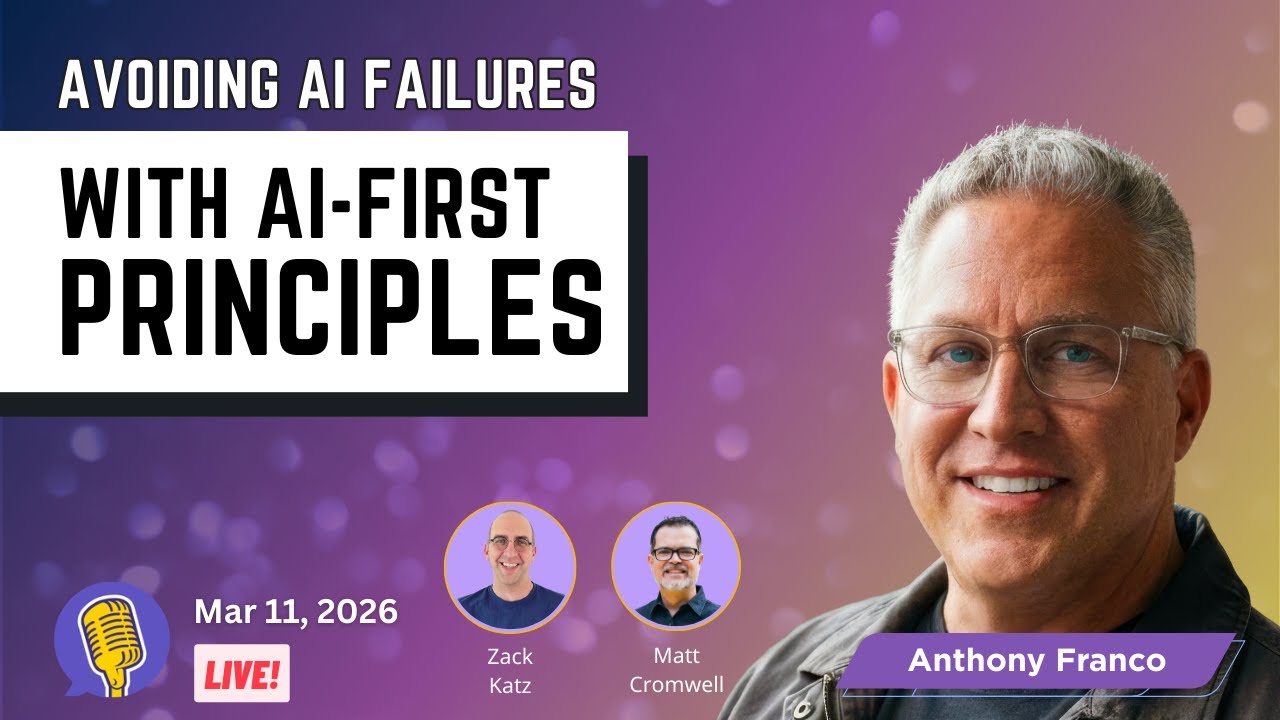
🔗 **Source:** [AI First Principles: Rebuilding Operations Instead of Automating the Mess](https://www.youtube.com/watch?v=YkRl5aTQ8pY)
> [!note]+ Document Notes
> tags: #artificial-intelligence #business-operations #automation #workflow-optimization #team-management
> author: WP Product Talk
> source: YouTube
> reference: https://www.youtube.com/watch?v=YkRl5aTQ8pY
> date created: 2024-12-19 14:30
>
> # 🏷️ Title: AI First Principles: Rebuilding Operations Instead of Automating the Mess
>
<!-- deep-read:sections start -->
## 🧰 Action Inbox
- [H1] Implement AI First Principles as organizational constitution — 12 principles framework #artificial-intelligence
- [H2] Shift from task ownership to objective ownership — focus on purpose over process #workflow-optimization
- [H3] Start with automating yourself before scaling to team and company levels — cursor/windsurf experimentation #automation
## 🧭 Table of Contents
- [[#📝 Summary]]
- [[#📖 Main Content]]
- [[#🗒️ Notes]]
- [[#📚 References]]
- [[#🗣️ Paraphrase]]
- [[#📰 Newsletter]]
- [[#✅ Action Items]]
- [[#🧪 Hypotheses]]
- [[#📊 Methodology]]
- [[#❓ Questions]]
- [[#🔮 Future Research]]
- [[#💡 Implications]]
- [[#🧠 Learning Styles Assessment]]
- [[#📊 Accessibility Assessment]]
- [[#🌍 DEIB Assessment]]
- [[#✅ Logical Validity]]
- [[#🛡️ DARVO Analysis]]
- [[#🎯 Conclusion]]
### 🔗 References
- [AI First Principles](https://aifirstprinciples.org)
- [The Wiser Method](https://wisermethod.com)
## 📝 Summary
- Anthony Franco discusses operationalizing AI through 12 principles rather than just using AI tools
- The framework emphasizes abundance mindset (10x productivity) vs scarcity mindset (reducing headcount)
- Four-stage AI maturity model: automate yourself, team, company, then help others automate
- Key insight: shift from owning tasks/outcomes to owning objectives and purpose
- Discussion reveals challenges around ownership, distribution, and the future of SaaS vs services
## 📖 Main Content
The conversation explores moving beyond basic AI usage to organizational AI operations. Anthony Franco, a serial entrepreneur who has worked with enterprise AI leaders, presents AI First Principles - a constitutional framework for companies adopting AI systematically.
The core philosophy emphasizes using AI to multiply human productivity rather than replace humans. Franco argues that successful AI implementation requires understanding what AI excels at versus what humans should continue doing, while maintaining human oversight through proper guardrails.
The discussion reveals practical challenges teams face when scaling AI adoption, including questions about work ownership, skill requirements, and business model disruption. The hosts share real experiences from WordPress product companies navigating these transitions.
## 🗒️ Notes
#### ⏱️ [00:00](https://youtu.be/YkRl5aTQ8pY?t=0) — [H1] Introduction to AI First Principles
- Key idea: AI can be more than just a tool - it can guide entire business operations
- Evidence: "You can actually run your whole business in a very AI principled oriented way"
#### ⏱️ [03:45](https://youtu.be/YkRl5aTQ8pY?t=225) — [H2] Defining AI Operations vs AI Usage
- Key idea: There's a spectrum from casual ChatGPT usage to true organizational AI discipline
- Evidence: "When somebody says they're in AI, what the hell does that mean? It can mean they're working for Nvidia or they're in ChatGPT 3 times a day"
#### ⏱️ [05:30](https://youtu.be/YkRl5aTQ8pY?t=330) — [H1] Trust and Human-in-the-Loop Philosophy
- Key idea: AI should be viewed as a collaborator, not an autonomous employee
- Evidence: "Should you trust AI, the answer is hell no. One of the principles revolves around keeping a human in the loop"
#### ⏱️ [07:15](https://youtu.be/YkRl5aTQ8pY?t=435) — [H1] Abundance vs Scarcity Mindset
- Key idea: Focus on 10x productivity rather than headcount reduction
- Evidence: "The folks that are doing it correctly, they're 10Xing their employee productivity instead of one employee doing one employee's worth of work"
#### ⏱️ [12:30](https://youtu.be/YkRl5aTQ8pY?t=750) — [H2] Knowledge Sharing and Tool Fragmentation
- Key idea: Teams develop AI "fiefdoms" that need integration for organizational benefit
- Evidence: Zack describes building cloud code plugin marketplace to share AI skills across team
#### ⏱️ [16:45](https://youtu.be/YkRl5aTQ8pY?t=1005) — [H1] The 12 Principles Framework
- Key idea: AI First Principles serves as an "agile manifesto for the AI era"
- Evidence: "It's 12 principles that a company needs to adopt as their AI constitution"
#### ⏱️ [18:20](https://youtu.be/YkRl5aTQ8pY?t=1100) — [H1] Four-Stage AI Maturity Model
- Key idea: Systematic progression from individual to organizational AI adoption
- Evidence: "Step one, automate yourself. Step two is automate your team. Step three is automate your company"
#### ⏱️ [21:00](https://youtu.be/YkRl5aTQ8pY?t=1260) — [H2] Human Value: Ambition and Purpose
- Key idea: True AGI unlikely because it lacks human traits like ambition and purpose
- Evidence: "To have true general intelligence, you have to have some human traits that I don't think AI is gonna ever have. One is ambition"
#### ⏱️ [25:15](https://youtu.be/YkRl5aTQ8pY?t=1515) — [H2] Ownership Crisis in AI Era
- Key idea: Teams struggle with reduced sense of ownership when AI does the work
- Evidence: "The more we use AI, the more we can get accomplished and do, but the less ownership we feel personally about having done something"
#### ⏱️ [28:30](https://youtu.be/YkRl5aTQ8pY?t=1710) — [H1] Shift to Objective Ownership
- Key idea: Move from owning tasks/outcomes to owning objectives and purpose
- Evidence: "People own objectives. I have shifted from the tasks to the purpose. AI has unlocked quite a bit"
#### ⏱️ [32:45](https://youtu.be/YkRl5aTQ8pY?t=1965) — [H2] Code Quality Concerns Eliminated
- Key idea: AI removes need for perfect architecture since it can refactor anything
- Evidence: "We don't have to have this whole strategic conversation about building perfect architecture because AI can just fix it"
#### ⏱️ [38:20](https://youtu.be/YkRl5aTQ8pY?t=2300) — [H1] Future of SaaS vs Services
- Key idea: Economy may shift from SaaS to services as AI commoditizes software creation
- Evidence: "I think our economy shifts from SaaS to services as a fundamental way of thinking about tech"
#### ⏱️ [42:10](https://youtu.be/YkRl5aTQ8pY?t=2530) — [H2] Distribution as the Moat
- Key idea: Competitive advantage lies in distribution and novelty generation speed
- Evidence: "The moat actually is gonna be distribution and novelty. Your ability to come up with novel ideas very quickly and distribute them"
#### ⏱️ [48:15](https://youtu.be/YkRl5aTQ8pY?t=2895) — [H2] Experience Trumps CS Degrees
- Key idea: Domain experience and objective-setting skills matter more than technical coding ability
- Evidence: "20-year-old CS grads are in trouble because it's no longer about computer science, it's about your ability to set objectives"
#### ⏱️ [52:30](https://youtu.be/YkRl5aTQ8pY?t=3150) — [H1] Everyone Becomes a Product Person
- Key idea: All team members need product thinking skills in AI era
- Evidence: "The most underrated hire right now is a great product person. All of your people have to be product people"
## 📚 References
- [AI First Principles](https://aifirstprinciples.org)
- [The Wiser Method](https://wisermethod.com)
- [Anthony Franco LinkedIn](https://linkedin.com/in/anthony-franco)
- [Cursor IDE](https://cursor.sh/)
- [Windsurf IDE](https://codeium.com/windsurf)
## 🗣️ Paraphrase
- AI First Principles provides a 12-point constitutional framework for organizations to operationalize AI beyond basic tool usage, emphasizing human-AI collaboration over replacement
- The maturity model progresses through four stages: personal automation, team automation, company automation, and helping others automate their operations
- Success requires shifting mindset from task ownership to objective ownership, focusing on purpose and outcomes rather than the specific methods of accomplishment
## 📰 Newsletter
🚀 **AI Operations Revolution for WordPress Teams**
WordPress product owners are discovering that AI isn't just about building features faster - it's about fundamentally restructuring how teams operate and think about work itself.
Anthony Franco's AI First Principles framework offers a constitutional approach to organizational AI adoption, moving beyond the "ChatGPT for everything" mentality to systematic operational integration.
**Key Takeaways:**
- Shift from scarcity (cutting costs) to abundance mindset (10x productivity)
- Progress through four maturity stages: self → team → company → ecosystem
- Focus on objective ownership rather than task ownership
- Embrace product thinking across all team roles
The WordPress ecosystem's collaborative nature positions it well for these changes, where community contribution and knowledge sharing align naturally with AI-augmented workflows.
Resources: [Learn WordPress](https://learn.wordpress.org/), [Developer Docs](https://developer.wordpress.org/), [WP-CLI](https://wp-cli.org/)
## ✅ Action Items
#### DevRel
- Developer experience: Create AI-first documentation that assumes AI-assisted development workflows
- Developer marketing: Develop case studies showcasing 10x productivity gains through AI operations
- Community management: Facilitate AI workflow sharing sessions and best practice exchanges
#### OSPO
- Policy & Governance: Establish AI usage policies that maintain human oversight while enabling innovation
- Developer Support: Provide training on AI-first development practices and tooling integration
- Strategic Alignment: Define KPIs measuring productivity multiplication rather than just cost reduction
#### Community
- Contributors: Create onboarding paths that incorporate AI-assisted contribution workflows
- Maintainers: Develop governance templates for AI-augmented project management
- Ecosystem: Coordinate cross-project AI tooling standards and integration patterns
#### WordPress
- Core: Integrate AI workflow considerations into development processes and tooling recommendations
- Community: Support meetup content around AI operations and business transformation
- Training: Develop learning paths for objective-driven AI adoption in WordPress businesses
- Documentation: Create guides for AI-first WordPress development and business operations
#### The WPCC
- Programs: Fund microgrants for AI operations experimentation in WordPress businesses
- Projects: Support governance clinic development for AI-first organizational structures
## 🧪 Hypotheses
- Teams adopting AI First Principles will achieve measurable productivity gains within 6 months
- Organizations focusing on objective ownership will maintain higher team satisfaction during AI transitions
- WordPress businesses implementing systematic AI operations will outperform those using AI ad-hoc
- The shift from SaaS to services will accelerate in AI-commoditized software markets
### 📊 Methodology
- Survey WordPress product teams before/after AI First Principles implementation
- Track productivity metrics across different AI maturity stages
- Analyze business model evolution in WordPress ecosystem over 2-year period
### ❓ Questions
- How do we measure objective ownership vs task ownership in distributed teams?
- What governance structures best support AI-first operations while maintaining quality?
- How quickly will the SaaS-to-services transition occur in the WordPress ecosystem?
### 🔮 Future Research
- Longitudinal study of AI maturity progression in WordPress businesses
- Analysis of skill requirements evolution for WordPress professionals
- Investigation of new business models emerging from AI-first operations
### 💡 Implications
- Practice: Teams need systematic frameworks for AI adoption rather than tool-by-tool approaches
- Policy: Organizations require AI constitutions defining human oversight requirements
- Education: Professional development must shift toward objective-setting and systems thinking skills
- Funding: Investment strategies should focus on distribution and novelty generation capabilities
### 🧠 Learning Styles Assessment
Reading level estimate: 12-14 (Graduate level due to business strategy complexity)
#### 👀 Visual learners
- Present: YouTube video format with host interaction
- Improve: Maturity model diagrams, organizational structure visuals
#### 🔊 Aural learners
- Present: Podcast-style discussion format
- Improve: Audio-only version, chapter markers for key concepts
#### 🗣️ Verbal learners
- Present: Rich business analogies, framework explanations
- Improve: Case study narratives, transformation stories
#### 🧩 Kinesthetic learners
- Present: Recommended tools (Cursor, Windsurf) for hands-on experimentation
- Improve: Step-by-step implementation checklists, progress tracking templates
#### 🧠 Logical learners
- Present: Four-stage maturity model, 12-point principle framework
- Improve: Decision trees for AI adoption, ROI calculation methods
#### 🧑🤝🧑 Social learners
- Present: Team discussion examples, collaborative challenges
- Improve: Group workshop guides, peer learning frameworks
#### 🧘♀️ Solitary learners
- Present: Self-assessment opportunities, individual reflection prompts
- Improve: Personal AI audit worksheets, solo experimentation guides
### 📊 Accessibility Assessment
#### Screen reader semantics
- Present: Clear heading structure in transcript
- Improve: Time-stamped navigation landmarks, chapter descriptions
#### Keyboard navigation
- Present: Standard YouTube controls
- Improve: Transcript navigation shortcuts, bookmark functionality
#### Contrast and readability
- Present: Standard video player interface
- Improve: High contrast transcript view, adjustable text sizing
#### Media and captions
- Present: Full transcript available
- Improve: Professional captions with speaker identification, audio descriptions
### 🌍 DEIB Assessment
#### Cultural breadth
- Present: Business perspectives from different company sizes
- Improve: Global case studies, non-Western business model examples
#### Inclusive language
- Present: Generally accessible business terminology
- Improve: Plain language alternatives for technical AI concepts
#### Representation
- Present: Mix of technical and business perspectives
- Improve: More diverse voice representation, various industry examples
### ✅ Logical Validity
#### Strong reasoning
- Deductive strength: Clear progression from principles to implementation stages
- Inductive strength: Examples from multiple business contexts support general claims
- Analogical strength: Effective comparison to agile manifesto for framework positioning
#### Fallacies
- Appeal to consequences: Overstates SaaS doom without considering adaptation strategies
- False dichotomy: Presents SaaS vs services as binary when hybrid models exist
#### Tone of voice
- Overall tone: Authoritative but conversational, balancing optimism with realistic challenges
### 🛡️ DARVO Analysis
- Deny: No denial patterns present
- Attack: No attacks on critics or skeptics
- Reverse victim/offender: No victim/offender reversal
- Emotional cues: Generally balanced, though some urgency around competitive advantage
## 🎯 Conclusion
AI First Principles offers a structured approach to organizational AI adoption that goes far beyond tool usage. The framework's emphasis on objective ownership over task ownership provides a practical path for WordPress businesses navigating the AI transformation while maintaining human agency and purpose.
The shift from scarcity to abundance mindset, combined with systematic maturity progression, offers a sustainable model for AI integration that enhances rather than replaces human capabilities. For WordPress product owners, this represents both an opportunity to 10x productivity and a necessity to remain competitive.
The broader implications suggest fundamental changes in business models, skill requirements, and organizational structures that WordPress businesses should begin planning for now rather than reacting to later.
## 🧱 Refactor Appendix
### 📚 Literature Split Pad
### [H1] AI operations require constitutional frameworks for organizational success
> [!quote] [AI First Principles: Rebuilding Operations Instead of Automating the Mess
---
## Full Transcript
[00:04] Hey everybody.<br>[00:04] Welcome to another episode of WP Product
Talk, where we talk about AI yet again,<br>[00:10] we are going to do it again because
it's kind of everything that everybody's<br>[00:14] talking about nowadays, including us.<br>[00:16] Uh, all the cohos co-hosts on the show.<br>[00:19] We're using it every day.<br>[00:20] We're leveraging it every day.<br>[00:21] We're seeing all kinds of fascinating
and amazing benefits from it.<br>[00:26] But is it just a tool to build stuff with?<br>[00:29] No, you can actually run your whole
business in a very AI, principled<br>[00:34] oriented way, and that's what
we're gonna talk about today.<br>[00:41] This is WP Product Talk a<br>[00:45] place where every week we bring you
insights, product marketing, business<br>[00:49] management, and growth, customer
experience, product development, and more.<br>[00:55] It's your go-to podcast for WordPress
product owners buy WordPress product<br>[00:59] owners and now enjoy the show.<br>[01:09] Hey.<br>[01:09] Hey Zack.<br>[01:10] Good to see you.<br>[01:11] Good to see you, Matt.<br>[01:13] I love your name today, Zack.<br>[01:15] Zackary<br>[01:17] Zach "ai" ry Katz.<br>[01:18] That's how I pronounce it.<br>[01:20] Nice.<br>[01:22] I do enjoy calling you Zackary,
just 'cause it bothers you so much.<br>[01:25] Um, but before we get into that,
before we get started, everybody, if<br>[01:30] you benefit from WP Product Talk, we
would love your continued support.<br>[01:35] The easiest way for you to do
that is to follow us, subscribe<br>[01:38] on YouTube, follow us on LinkedIn.<br>[01:41] Uh, subscribe to our podcast
wherever you listen to podcasts.<br>[01:44] All of that helps us a ton.<br>[01:48] Yeah.<br>[01:48] And, uh, I want to thank MIUs we all do
for being our exclusive growth partner.<br>[01:53] Uh, MIUs helps software makers
grow, monetize, and succeed.<br>[01:57] Uh, freeness is a merchant of
record platform, and what that means<br>[02:00] is they handle everything around
selling software, check out payment<br>[02:04] subscriptions, licensing updates, global
tax compliance, all that stuff so you<br>[02:09] can focus on building amazing products.<br>[02:12] That's right.<br>[02:13] And for today we're gonna jump into
the idea of AI first principles<br>[02:18] for running your business.<br>[02:19] And for this, we have invited a
special guest named Anthony Franco.<br>[02:26] Anthony, welcome.<br>[02:27] Welcome.<br>[02:28] Hey, thanks for having me.<br>[02:29] Good to be here.<br>[02:30] Absolutely.<br>[02:30] And tell the folks a
little bit about yourself.<br>[02:33] Who are you?<br>[02:33] What do you do?<br>[02:34] Why should we care?<br>[02:36] Uh, I'll answer the first two.<br>[02:38] You have to decide the third.<br>[02:39] Um, so I, I'm a serial entrepreneur.<br>[02:42] I've, I've started, um, and
exited six businesses, um, uh,<br>[02:47] over the last couple of years.<br>[02:50] Um.<br>[02:51] I, I guess you could say I caught the
bug, um, in AI and have been working.<br>[02:57] Long story short, I had a client
that is the leader in enterprise ai,<br>[03:02] saw how they delivered, um, and had
been working with the CEO in helping<br>[03:08] them evangelize how to do ai, right?<br>[03:11] And so that's, that's really
where AI first Principles is born.<br>[03:15] And, and the next projects
that I'm working on as well.<br>[03:19] Love it.<br>[03:19] That sounds fascinating.<br>[03:21] And you also have, um, basically tell us
a little bit just about your open source<br>[03:27] project, um, the AI first principles.<br>[03:29] Tell us about that.<br>[03:30] Yeah, so AI first, it's just
ai first principles.org.<br>[03:34] And it's, um, it essentially
came from watching.<br>[03:41] What goes right and what goes wrong
in AI implementations, not, not chat<br>[03:45] botting, but actually creating, um.<br>[03:50] Operationalizing ai, bringing
AI and actually putting it<br>[03:53] to use in an organization.<br>[03:55] Um, and then I, I, I worked on
it with, with Rob, the CEO, and<br>[04:00] then we started to ask other,
for other con contributors to it.<br>[04:04] So we have, I don't know,
40 or 50 contributors of, of<br>[04:08] the who's who in AI on it.<br>[04:10] And, um, over 5,000
supporters on it already.<br>[04:13] And it hasn't been out that long.<br>[04:14] So it's, it's 12 principles, um, for
teams charged with bringing AI and<br>[04:21] making it a part of their company.<br>[04:24] Love it.<br>[04:24] So what's the difference between
using AI and operationalizing ai?<br>[04:29] Well, when, when somebody says they're
in ai, what the hell does that mean?<br>[04:34] Yeah.<br>[04:34] The, the, it, it can mean they're working
for Nvidia or open ai, um, doing inference<br>[04:40] or, or they're in chat GPT-3 times a day.<br>[04:44] Mm-hmm.<br>[04:45] Um, there, there's, there hasn't
been until now a pre a way to.<br>[04:51] Think about AI as a practice
within an organization.<br>[04:55] I call it AI ops or, or agentic
ops, but other people are<br>[04:59] calling it different things.<br>[05:00] But it's, it's, it's how do you,
how do you incorporate it as a<br>[05:06] discipline within an organization?<br>[05:08] Yeah, let me ask the
difficult question right away.<br>[05:11] Um, should people operationalize
it, uh, as an organization?<br>[05:16] Sh should we be trusting, um,
the, the machine with all of<br>[05:21] this important business data?<br>[05:23] Um, what's the stop?<br>[05:24] Those<br>[05:24] are two different questions.<br>[05:26] Yeah.<br>[05:26] Yeah.<br>[05:26] But,<br>[05:26] um, yeah.<br>[05:27] Uh, so the first question is, should
you, um, if you, you don't have to,<br>[05:32] um, but if you don't, you're eventually
gonna be beat by somebody who does.<br>[05:36] Yeah.<br>[05:37] And,<br>[05:38] and should you trust ai,
the answer is hell no.<br>[05:44] Um, and, and, and one of the principles
is actually it, it, it itra, it<br>[05:48] revolves keeping a human in the loop.<br>[05:50] So AI isn't something that you just
hand something off to and let it run.<br>[05:56] You have to, you have to use, view it as
a, as a collaborator, not an employee.<br>[06:03] So it, it, it will level up.<br>[06:06] You and your employees,
but it won't replace it.<br>[06:10] So, well, there's two ways of thinking
about it, and, and I, I don't wanna go<br>[06:13] along here, but you can try to use AI
to reduce headcount, and that's where<br>[06:17] everybody's kind of thinking about right
now, and that's where all the news is.<br>[06:20] But in reality, the folks
that are doing it correctly.<br>[06:24] They're 10 Xing their
employee productivity.<br>[06:26] Yes.<br>[06:26] So instead of one employee doing one
employee's worth of work, they're now<br>[06:30] doing 10 employee's worth of work.<br>[06:32] So it's this, it's this mindset
of abundance versus scarcity.<br>[06:37] And the people that are winning
are, are viewing it as abundance.<br>[06:40] Like I can, I can grow my company, grow
my productivity, get my employees, get<br>[06:45] the, get them out of the bureaucracy in
the BS and actually doing the work that.<br>[06:49] The human brain is good for<br>[06:51] a hundred percent.<br>[06:52] I have seen and experienced that
myself in different contexts that<br>[06:56] this, this mentality that like,
we'll just use AI and then we can<br>[07:00] lay off 10 people, and it's like.<br>[07:03] Why don't you just use those
10 people to do a lot more work<br>[07:06] instead, like, you would be so
much more profitable if you did.<br>[07:09] Exactly.<br>[07:10] Exactly.<br>[07:10] Exactly right.<br>[07:12] There's there's only so
much you can cut, right?<br>[07:14] Yeah.<br>[07:15] Um, but, and, and there's an infinite
amount of, of, of, of what you can grow.<br>[07:20] Yeah.<br>[07:20] So.<br>[07:22] I get the need for wanting to
reduce headcount or, or make<br>[07:25] your company more profitable.<br>[07:28] Um, it, um, by reducing head
count, but you can make your stuff<br>[07:32] a lot more profitable and, and
increase the top line as well.<br>[07:35] Yeah.<br>[07:36] By, by increasing productivity.<br>[07:39] Yeah, a hundred percent.<br>[07:41] So, um, Zack, I'm, I know this is a
really interesting topic to you as well.<br>[07:46] I know that I actually nag Zack
regularly during the week about<br>[07:52] ideas about what he's doing with ai.<br>[07:54] Um, what's your take on some of this?<br>[07:56] How are, how are you thinking
about this idea of using AI or<br>[08:00] operationalizing AI in your company?<br>[08:03] Yeah.<br>[08:03] So, uh, at Gravity Kit we've had
been having, uh, AI calls every other<br>[08:09] week, uh, for the past, I don't know,
nine months or so, where, uh, we<br>[08:14] share and explore different things
that are happening in the AI space.<br>[08:17] We talk about how we're using it,
how we might be able to use it.<br>[08:21] Um, one of the things that's not been
going that well in those calls is<br>[08:26] like sharing problem, like saying ask,
having it be like a problem solving, uh,<br>[08:31] troubleshooting session, which is fine.<br>[08:33] Uh, we.<br>[08:34] Um, I think part of what ai, uh,
enables each of us to do is to<br>[08:38] explore and troubleshoot on our own.<br>[08:40] Um, but we then bring it, uh,
questions and like ideas to the AI<br>[08:44] channel, uh, that we have on Slack.<br>[08:47] We talk about it every other
week on our, our our talks.<br>[08:51] Um, one of the things that we've
been doing is, I've been doing,<br>[08:54] is trying to operationalize.<br>[08:56] Uh, the way that a, we interface with
AI because each of us has our little AI<br>[09:01] fiefdoms where we have our skill sets,
we have our, like our workflows, we<br>[09:05] have our prompts that we like to use.<br>[09:06] People, some people might have like
custom chat, GPT, like custom GPTs set up.<br>[09:11] Other people have whole like SQL light
database systems on their local computers.<br>[09:15] And I'm, I'm over here thinking
that there's a lot of knowledge<br>[09:18] that we need to integrate and share.<br>[09:21] And one of the things that we've been
building, or I've been building and,<br>[09:23] and uh, trying to get out there and
have people contribute to is a cloud<br>[09:28] code, um, plugin marketplace is a
way that you can distribute some of<br>[09:32] the skills and some of those shared,
um, technology that you can use.<br>[09:36] It's like a repo that everybody can,
can contribute to and update and<br>[09:40] have those skills automatically show
up in their cloud code instance.<br>[09:43] So that's an example of,
okay, how can we take.<br>[09:46] Um, all the CPS that each of us is
using and bring it all into one place<br>[09:50] so that when we say do this, it works
everywhere out of the box for everybody.<br>[09:55] That's kind of a tall, uh, tall
order, but, um, I'm seeing a lot of,<br>[10:01] um, fragmentation in how we use the
tools and I'm, I'm trying to align<br>[10:05] that, uh, so that we all have a common
set of practices that we can use.<br>[10:09] Interesting.<br>[10:11] Anthony, what's your take on some of that?<br>[10:12] Where, where, where, where's your
head go when you're, when you're<br>[10:15] thinking about first principles and
the things that Zack's working on?<br>[10:19] Well, so, um, first principles is one
thing that the, the other, the, uh,<br>[10:23] and I'll talk about that, but the,
the, where my head went is, um, Matt,<br>[10:27] you, you called Zack a nerd before
we, before we jumped on, and, um, and.<br>[10:34] I think there's, we're in this early
adopter phase of ai, so we are it.<br>[10:44] The tooling for AI in doing what Zack
is doing is really for developers,<br>[10:49] like you said, cloud code and
probably lost half your audience.<br>[10:52] Now, I might be wrong, you might
have a bunch of, um, um, developers,<br>[10:56] uh, that that tune in, but in
reality, AI for regular people<br>[11:03] mm-hmm.<br>[11:03] Is still relegated to chatbots.<br>[11:05] Mm-hmm.<br>[11:06] And, and so, um.<br>[11:10] I, I think I, you know, I'm in
Cloud code and in Cursor, um,<br>[11:13] eight hours a day, probably more.<br>[11:15] Mm-hmm.<br>[11:16] Um, but I'm really focused on how do
we, how do we bring those professional<br>[11:23] tools to consumers in a way that isn't,
doesn't require a developer mindset.<br>[11:28] Mm-hmm.<br>[11:29] Yeah.<br>[11:30] I was on a call with a friend yesterday,
uh, and this friend does sales and,<br>[11:35] uh, talks to a bunch of like, you
know, brick and mortar businesses<br>[11:38] all across the state and, uh.<br>[11:40] And his sales pipeline company, uh, the,
the, the, the company doesn't use AI yet.<br>[11:47] And I said like, dude, if you set up this,
uh, AI process, they already use HubSpot.<br>[11:54] They already have like, uh, data
going on, but they, they have manual<br>[11:59] bid prepare preparation for like,
putting together bids where they had<br>[12:03] to like drag and drop Microsoft Word.<br>[12:05] Things into Adobe Sign and like, ha,
like copy and paste the link in an email.<br>[12:10] So took an hour and a half with
him yesterday, got him set up.<br>[12:14] He's like, oh my gosh, this
is going to explode my sales.<br>[12:17] Like, thank you so much.<br>[12:18] Yeah.<br>[12:19] That type of the, the, the switch
that flipped in his head was, oh.<br>[12:24] It's not just copy and paste chat,
GBT, you know, app or whatever<br>[12:28] it is connecting to my computer.<br>[12:29] It's able to browse the internet, it's
able to do all the grunt work that I<br>[12:33] had been doing and just unlock all of
that and have me approve or reject or<br>[12:38] revise, uh, proposals that have been
put together by AI and tweak them<br>[12:43] so that, uh, and then send them out.<br>[12:44] So like, yes.<br>[12:45] Being unlocking from the copy and paste
that I, Anthony, I watched one of your,<br>[12:50] uh, one of your podcasts that you were
on, uh, earlier, and you were saying<br>[12:53] that that transition in that mind
space between copy and paste and Oh,<br>[12:57] I am working on files on my computer.<br>[13:00] Is one of the biggest things
that, that we can do as<br>[13:02] it's, it's funny right?<br>[13:04] It, that, that piece, that mindset
shift is a little bit weird.<br>[13:07] Yeah.<br>[13:09] Mm-hmm.<br>[13:09] I, I love it that way.<br>[13:10] I, I work in cursor.<br>[13:12] I have everything, um, on my
desktop here, um, interacting<br>[13:17] with it, and I. I do agency work.<br>[13:19] I, I, uh, working with clients and I
basically have a project per client and<br>[13:24] I'm constantly adding additional knowledge
into each client, uh, database so that I<br>[13:30] can just ask cursor whatever question I
need about like, what's our latest thing<br>[13:35] on performance for our email and whatnot.<br>[13:37] Um, there were several things I wanted
to do and accomplish, and sometimes<br>[13:41] the tools aren't quite there yet.<br>[13:42] Like, for example, I love and
adore Help Scout to death, but<br>[13:46] they don't have great reporting.<br>[13:48] Um, and they don't have an MCP.<br>[13:51] This is where I said I,
I ping Zack all the time.<br>[13:53] So Zack created his
own MCP for Help Scout.<br>[13:57] Um, and I was like, I'm
stealing that for sure.<br>[13:59] And I use that and then I just ask
Cursor, basically about anything<br>[14:03] related to the Help Scout account and
I get the information that I need.<br>[14:07] Um, it's incredible 'cause I used
to, I used to go over those reports.<br>[14:11] I would export stuff and query
stuff and filter and sort.<br>[14:14] It was, it would take me days to figure
stuff out, um, from trends and help scout.<br>[14:19] Um, and now it's, now
it's at my fingertips.<br>[14:22] Um,<br>[14:23] so Anthony, like we, I think in
this call, at least we all know<br>[14:26] how incredibly powerful AI is.<br>[14:29] Um, but what you're talking about is
like an organizational structure and<br>[14:33] organizational approach to using ai.<br>[14:36] How, like this conversation, we were
already talking about specifics,<br>[14:39] how can you help us like frame this
discussion around the org centered<br>[14:44] nature of, of what you're trying
to do with AI first principles?<br>[14:48] Yeah, so, so AI first principles is
essentially, um, think of it as the,<br>[14:55] the agile manifesto for the AI era.<br>[14:58] It's, it's, it's 12 principles
that a company needs to adopt<br>[15:02] as their AI constitution.<br>[15:05] Uh, it's, it's a suggestion
around what, what they should be.<br>[15:08] Um, and, and the first, the first
piece is know what AI is good at.<br>[15:12] Know what humans are good at, know what AI
should do, know what humans should, should<br>[15:15] do, and know where to put the guardrails.<br>[15:18] And that's really, that's really what
the 12th principles are, are about.<br>[15:22] So the first, the first
component to operationalizing<br>[15:26] ai, if you're not a, a, a.<br>[15:31] If you're not an a tech company, right?<br>[15:35] Um, you need to get your, your
head and your team's heads wrapped<br>[15:40] around what AI should be used for,
and that those are the principles.<br>[15:46] Um, then the next stage for you is to,
I put it in four stages of AI maturity,<br>[15:53] St. Step one, automate yourself.<br>[15:56] Step two is automate your team.<br>[15:57] Step three is automate your company.<br>[16:01] Um, and then step four, if you ever,
ever want to get there is help other<br>[16:06] people automate their companies.<br>[16:07] Hmm.<br>[16:08] Um, and so, uh, AI first principles
is the foundation of all of those.<br>[16:13] Um, even when you're automating,
when you're trying to automate<br>[16:16] yourself, you need to understand.<br>[16:20] When you, when AI needs to bring you
in the loop, when you need to self-heal<br>[16:23] the a ai, when, how you need to enter
the, how you need to enter and build<br>[16:29] your first agent, what are the things
you need to be thinking about when<br>[16:31] you're doing that kind of stuff?<br>[16:33] What value do I add
that a computer cannot?<br>[16:37] Mm-hmm.<br>[16:39] Um, uh, so ambition.<br>[16:45] A And so this is gonna get
a little philosophical.<br>[16:50] I've just been, I've been pulling
on this a little bit over the<br>[16:52] last, um, couple of weeks.<br>[16:55] Um, there's a lot of talk right now
about ag, well there has been for<br>[16:59] years, but it's really starting to
say, well, HEI is gonna come, um,<br>[17:05] this year, and I don't think it is.<br>[17:08] Mm-hmm.<br>[17:09] Because.<br>[17:12] I, I don't think we want that.<br>[17:13] I don't think we want a GI, because
really to have true general intelligence,<br>[17:18] you have to have some human traits that
I don't think AI is gonna ever have.<br>[17:22] One is ambition.<br>[17:24] Hmm.<br>[17:24] Um, I, I think, um, in, in, in
a, a true sense of purpose, what<br>[17:31] are you trying to accomplish?<br>[17:33] Mm-hmm.<br>[17:34] And, and I don't think.<br>[17:38] I don't think the issue anymore
is, are the models smart enough?<br>[17:43] Mm-hmm.<br>[17:43] I think the biggest issue is
can the models do what we are<br>[17:49] thinking we want it to do?<br>[17:51] Mm-hmm.<br>[17:51] In other words, how do you translate
what's in your head to an ai?<br>[17:56] And that's really hard, right?<br>[17:59] What, what usually what
happens, especially with the,<br>[18:02] the latest anthropic models.<br>[18:05] It's really smart at executing on things
that I poorly define and do do, and<br>[18:12] I'm like, no, why'd you do it that way?<br>[18:13] It's not it's fault.<br>[18:14] It's my fault for being able
to translate that to it.<br>[18:18] A hundred percent.<br>[18:19] I, I'm really fascinated why by the,
the way in which some folks talk<br>[18:25] about, like, I like how the way that
you dialed in on automation basically.<br>[18:30] 'cause that's basically the most
tangible way that we see huge benefits<br>[18:34] in AI is that we're automating work
that we used to trudge through before.<br>[18:39] Um, but what I keep trying to help
folks understand too, is that like.<br>[18:44] The objectives of your business
haven't actually changed all that much.<br>[18:48] You still are trying to execute
on objectives in a meaningful way.<br>[18:53] And it's so easy actually because
these, these tools can now do so many<br>[18:57] things to get kind of rabbit holed
into like, oh my gosh, I can do this<br>[19:01] cool thing and this cool thing and
this cool thing and this cool thing.<br>[19:04] And none of those cool things are related
to your business objectives at all.<br>[19:08] They're just, they're just
cool, fun toys, you know?<br>[19:11] Um, but being able to do, if, if
you can automate yourself, like you<br>[19:16] said at step one, automate yourself
with ai, what that does is that<br>[19:20] frees you up to have that ambition.<br>[19:23] Because I think, I, I talk to so many
solopreneurs who, who their, their<br>[19:28] pain point they say all the time is.<br>[19:31] I can't decide what is the next thing
I have to focus on because I have<br>[19:37] 30,000 things that I could be doing
right now and I want to do all of them.<br>[19:42] Um, and I feel like what you're talking
about here is freeing them up, giving them<br>[19:47] more capacity to do more things, um, and
ideally giving them tools to help them<br>[19:53] prioritize a little bit better as well.<br>[19:55] Um, Zack, does that resonate with you?<br>[19:58] Is that what you're thinking?<br>[19:59] Yeah, it, it does resonate with me,
but that there's also a flip side.<br>[20:03] I'd love your opinion on
Anthony is, um, moving so.<br>[20:08] The, the more we use ai, the more we
can get accomplished and do, but the<br>[20:13] less ownership we feel personally
about having done something.<br>[20:17] So if I, if I grind through migrating
a database, uh, manually, and I move a<br>[20:23] website and I update the DNS settings on a
website, and I, I've done something, whew.<br>[20:28] I have sweated for it and, and
I say to the team, I've done it.<br>[20:31] Versus I tell AI to do it, it's done.<br>[20:34] It's still the same magnitude
of accomplishment, but I<br>[20:37] haven't actually done anything.<br>[20:39] And I think that that type of
ownership of the outcomes is tough.<br>[20:43] And Ian, uh, one of our co-hosts
has, uh, a comment saying, use AI<br>[20:48] for everything, but make sure you
fully own the work and outcome.<br>[20:51] I'm afraid, I don't think that that's
possible where you use AI for something<br>[20:55] and then also have the same level of
ownership over the work and the outcome.<br>[21:00] I think they're incompatible concepts.<br>[21:02] So at Gravity Kit, one of the things
we're, I'm struggling with as a leader<br>[21:06] and trying to communicate to the team,
I'm trying to have the team take,<br>[21:09] like have reflect and have their own
opinions on is what does work look like<br>[21:14] when you're able to do 10 times the
amount of work, or 50 times the amount<br>[21:18] of work, but you have so much less
relationship to the work that you've done.<br>[21:21] Mm-hmm.<br>[21:22] How do we maintain our
relationship with what we're doing?<br>[21:25] Is that something we need
to worry about, like.<br>[21:27] I feel personally a little lost
from I'm, there's so much more<br>[21:32] I'm doing and there's so much less
that I'm doing at the same time.<br>[21:35] Mm-hmm.<br>[21:36] I'm, I'm struggling with the word outcome.<br>[21:41] So, Matt, Matt, Matt.<br>[21:43] Matt said it, Matt said it really well.<br>[21:44] He, he mentioned objectives.<br>[21:45] Actually.<br>[21:46] The third principle, um, of ai, first
principles is people own objectives.<br>[21:51] Mm-hmm.<br>[21:51] In reality, you need, I, my mindset
shift has gone from owning the<br>[21:56] outcome to owning the objectives.<br>[21:58] What am I trying to accomplish?<br>[22:01] You can't own, you can't.<br>[22:04] You can't necessarily
own all the outcomes.<br>[22:07] Mm-hmm.<br>[22:07] Because you're right.<br>[22:08] AI's producing a lot of that work.<br>[22:10] So I've had to.<br>[22:13] I've had to kind of shake
some of my limited mindset<br>[22:15] of what I'm responsible for.<br>[22:18] Um, I don't, I don't care necessarily
about, um, migrating a database myself.<br>[22:24] I, I don't want to do that.<br>[22:26] I, because I'm migrating
the database for a purpose.<br>[22:30] Why am I doing that?<br>[22:31] That is my objective.<br>[22:33] Yeah.<br>[22:33] And, and so I, I have shifted
from the tasks to the purpose.<br>[22:41] And AI has unlocked quite a bit of,
once you do that, you actually start to<br>[22:48] see where you're supposed to be going,
and you could just do it a lot faster.<br>[22:53] Mm-hmm.<br>[22:53] It also gives me the ability<br>[22:57] here, here's, here's a problem, here's
a problem that I used to experience.<br>[23:02] I, I would do something and know it
needed to be a different way, but let<br>[23:06] it sit because I didn't want to go
through the effort of switching it.<br>[23:10] Now it's trivial.<br>[23:11] Yeah,<br>[23:12] I can, I am a lot more free to
experiment and unwind and re-architect<br>[23:19] and refactor, not just code.<br>[23:22] Yeah.<br>[23:23] But.<br>[23:24] But the things that I'm doing,
the way that I'm doing it,<br>[23:26] I can do a lot more testing.<br>[23:28] Yeah.<br>[23:29] Um, in, in as long as I have the objective
in mind, the how does it matter as much.<br>[23:36] Yeah.<br>[23:37] The great analogy there, especially
in the WordPress space, is I've,<br>[23:41] I've worked with so many dev teams
and product teams that will say.<br>[23:46] Well, we need to be really strategic about
how we build this out so that we're not<br>[23:51] creating a headache for us in the future.<br>[23:53] That whole conversation, I don't want
to have that conversation ever again.<br>[23:59] We like, it's amazing how AI could just
be like, well, this, this code is a pile<br>[24:03] of heaping mess, but I'll just fix it.<br>[24:05] And it's like.<br>[24:06] Well, now there's, you don't have that.<br>[24:08] I mean, Zack might have a
different opinion on authorization.<br>[24:11] Yeah.<br>[24:11] Still, it doesn't fix it very
perfectly if it's not a good code.<br>[24:15] But I have, I, I ref, I've used AI to
refactor several things, a lot of my old<br>[24:19] code, and it just was like, it just, it
doesn't make fun of me for my bad code.<br>[24:24] It just is like, I can fix
this for you, no problem.<br>[24:26] And here you go.<br>[24:27] And now it's a reorganized mess and
it works, but it's like, it, like we<br>[24:31] don't have to have this whole like.<br>[24:33] Let's be really strategic and build
the perfect architecture so that<br>[24:37] a random dev can walk into the
project and know what they're doing.<br>[24:40] It's not a random dev in the
future, it's AI again, and AI is<br>[24:43] just gonna be like, I can fix it.<br>[24:44] Let's run.<br>[24:45] You know?<br>[24:46] Um, that's, that conversation is done Now.<br>[24:49] We, and that frees us up to do
the objectives that you're talking<br>[24:52] about because the, the architecture
and the, the poetry of the code<br>[24:58] or whatnot was never the point.<br>[25:00] It was never the point.<br>[25:01] The point was the objective.<br>[25:04] What is this?<br>[25:05] What is the result of the, of this code?<br>[25:07] What is the total result of all of
this code that we're trying to drive?<br>[25:11] We're trying to drive
meaningful customer experiences.<br>[25:14] We're trying to be able to, to
market something meaningfully<br>[25:16] out in the marketplace.<br>[25:18] That's what we're trying
to actually drive.<br>[25:21] I totally agree.<br>[25:22] So the things that, uh, that I've been
struggling with is, okay, so the customer<br>[25:27] outcomes is our, is our objective.<br>[25:29] We wanna make sure that we're aligned
to helping our customers succeed.<br>[25:33] Sure.<br>[25:33] Second to that, uh, and flowing from
that is we wanna make money so that<br>[25:37] like our team is happy and successful,
like, and we can grow personally<br>[25:43] and as a company and, and all that.<br>[25:45] Um, that all sounds great, but like in
the AI era, one of the things is we're<br>[25:50] using these tools and our customers are
about to start really using these tools.<br>[25:54] So like I'm finding it really difficult
to focus on okay, customer outcomes now,<br>[25:59] but like, I want to be skating to where
the puck is going to be for our customers.<br>[26:03] And I'm finding that really
difficult when we're trying to align<br>[26:06] to our customer needs now versus
what our customer needs will be.<br>[26:10] Or even like.<br>[26:12] Um, okay.<br>[26:13] We don't have enough telemetry in our
software to be able to fully understand<br>[26:18] our customer's user experience so that we
can, uh, better align to their outcomes.<br>[26:23] Like all of it, it, that AI can do
anything opens up that we should be<br>[26:28] doing everything to really try to
nail down what they, what they need.<br>[26:32] And I feel like a mild sense
of panic because the, the whole<br>[26:35] world is available to us now.<br>[26:38] And as an organization, I've been
trying to, you know, continue to<br>[26:41] maintain, you know, what matters is
customer outcomes, but like internally,<br>[26:44] it's like it's really difficult.<br>[26:46] Mm-hmm.<br>[26:47] Hmm.<br>[26:49] Is it though?<br>[26:51] I, yeah.<br>[26:52] For me, I'm a scatterbrain.<br>[26:54] I don't know, man.<br>[26:54] Like, uh, it's tough.<br>[26:57] Like when building a new product, we're
building a new product and I wanted to,<br>[27:03] I wanna make sure that we're closer to
how our customers make money, right?<br>[27:06] So like right now, gravity Kit, you
build applications, you, you can do like<br>[27:10] exporting, importing of data, all this
stuff with gravity forms, entries, great.<br>[27:14] Cool.<br>[27:15] I feel like we're a little far away from
where our customers are making money.<br>[27:18] Even though once they get up
their, their applications up and<br>[27:21] running, they, it helps them.<br>[27:22] But like, we're still a little further
away from, oh, do we, you know, is<br>[27:26] it, we're not WooCommerce, we're not
directly getting money in their pockets.<br>[27:29] So like, how can we do that?<br>[27:31] Um, and then I kind of spin out into,
okay, well the WordPress abilities, API<br>[27:37] and AI and integrations, and how will
they be using this product in the future?<br>[27:41] And is AI gonna just
eat our launch anyway?<br>[27:43] So I should really focus on the
existing, it becomes like so diffuse<br>[27:48] as to like how we should accomplish
the outcome of customer success.<br>[27:52] Mm-hmm.<br>[27:52] Mm-hmm.<br>[27:53] Mm-hmm.<br>[27:55] SSII think so.<br>[27:59] First of all, you bring up something
really interesting, what businesses,<br>[28:03] is my business dead because of ai?<br>[28:05] And the likely answer is if
you don't do anything about it.<br>[28:09] Yes.<br>[28:10] Um, and, and I think our economy
shifts from, um, SaaS to services.<br>[28:22] I just as a fundamental, as a
fundamental way of thinking about tech.<br>[28:28] I think, and, and I, and I think that
that's kind of being reflected in the<br>[28:32] market right now with a lot of SaaS
companies taking the, the hit that<br>[28:35] they have, um, on their, on their, on
their market cap is, um, is because.<br>[28:43] The, there's the days of 90% gross
margins are kind of over because<br>[28:49] what they do is commoditized.<br>[28:52] So it, it's, it does become, um, we
do become a little bit more bespoke<br>[29:01] services is going to, is, and I, I'm not
a futurist, so I, I could, I'm probably<br>[29:06] totally wrong, but I'm thinking that.<br>[29:09] Um, we become more about, uh, the
opportunities really are not, um,<br>[29:16] creating the next SaaS product
because that's honestly anybody<br>[29:20] with Cursor and Claude code.<br>[29:22] Can probably replicate it.<br>[29:24] It's, it's the expertise behind why
the things are built the way they<br>[29:29] are, and the services around, uh,
uh, deploying that for our customers.<br>[29:33] That's, that's a really good
take, really interesting take.<br>[29:35] I mean, it is a question that
continues to come up on the show<br>[29:38] and in conversations all the time.<br>[29:40] Um, what.<br>[29:41] Uh, where is the moat
nowadays at all anymore?<br>[29:45] Um, and, and how do I,
how do I protect myself?<br>[29:49] Um, and, um, thinking of, of us
as, you know, services instead of<br>[29:55] products that you're, you're scaring
the bejesus out of the whole audience<br>[29:59] right now if that's the case.<br>[30:01] Because so many product folks
got into product 'cause they<br>[30:03] don't want to do services.<br>[30:07] Yeah.<br>[30:08] It, it, I, I think the moat is.<br>[30:10] The, the, the moat actually is gonna
be distribution and, uh, novelty.<br>[30:17] That's the moat.<br>[30:18] Mm-hmm.<br>[30:18] Your ability to come up with
novel ideas very quickly and your<br>[30:22] ability to distribute those ideas.<br>[30:24] Um.<br>[30:26] It is.<br>[30:28] That's the moat.<br>[30:29] Distribution's the moat.<br>[30:30] So, and you know, attention economy is
a thing that people we've, we've heard<br>[30:35] about forever from outside when, when
it comes to like social media and, and<br>[30:39] you know, Netflix and all this stuff.<br>[30:41] But that's one of the questions
I've had is what does distribution<br>[30:44] look like in, in the near future?<br>[30:46] How do we, so like.<br>[30:47] Let's say a customer has a feature
request and we're able to one shot<br>[30:50] prompt it, uh, and distribute that like,
and that's what Matt's been doing with<br>[30:55] the, what's it called, the, the block.<br>[30:57] Um, he has, Jetpack is an AI block
builder that builds blocks dynamically now<br>[31:03] telex.<br>[31:04] Yes.<br>[31:04] Telex.<br>[31:05] Exactly.<br>[31:06] Um, so like Matt's thinking in the,
along the same lines, how, how might<br>[31:11] WordPress product owners, uh, take
think about distribution and think<br>[31:16] about, um, the being able to ship
things faster and, uh, more directly to<br>[31:21] customers so that we can release exciting
novelty, uh, and maintain attention.<br>[31:28] In this and maintain relevance?<br>[31:31] Honestly, when AI is able
to do so much by itself.<br>[31:36] If that's a question for me,
I don't have a good answer.<br>[31:40] I don't know.<br>[31:41] I don't think any of us do.<br>[31:43] Yeah.<br>[31:44] It's scary for, for product people
especially, um, technologists that<br>[31:49] built their, built a really healthy
business around their product.<br>[31:54] Um.<br>[31:56] They're, they're gonna have start
having some tough conversations about,<br>[32:00] why don't I just build this myself?<br>[32:01] Yeah.<br>[32:02] Yeah, I like, uh, in the comments
here we have Nick McLaughlin here.<br>[32:06] He's a guest on the show, uh,
recently Hot Take maybe product<br>[32:11] is just services at scale.<br>[32:13] I don't know in some way.<br>[32:15] Actually Matt Madero recently, uh,
launched a new product that he vibe<br>[32:19] coded in a weekend, and, uh, he
basically is giving it away for free.<br>[32:24] Unless you want him to, uh, install
it and configure it and set it<br>[32:28] up for you, then it's 300 bucks.<br>[32:31] Um, and I thought that was
a really interesting model.<br>[32:34] It's kinda like the once model where
it's like, I buy it once for forever, but<br>[32:38] it's like for free unless you need help.<br>[32:40] And then I'll, then you just pay me a,
a, a fee and I'll set it up for you.<br>[32:45] It becomes a product as
a service, uh, model.<br>[32:48] I thought that, I don't know how well
that's going for Matt though, but<br>[32:52] have, we've mentioned so many mats.<br>[32:53] Um,<br>[32:59] I think there is a model there
though that is, when I talk about<br>[33:03] niche or novel, I'm talking about,
um, your unique way of doing things.<br>[33:10] So that that model
really does work, right?<br>[33:12] So it's, it's the freemium model,
but it's, it's the frees plus<br>[33:16] services that is absolutely a
model that that's going to work.<br>[33:19] There's also the, you know, the Zack
way of doing things and having, Zack<br>[33:24] has his AI that you can subscribe to
that does the things the way he does.<br>[33:30] Hmm.<br>[33:31] Interesting.<br>[33:31] Um, so, so, and, and, and will those
eventually become Claude skills?<br>[33:40] Maybe, maybe<br>[33:43] one of my, uh, friends and competitors.<br>[33:45] It's, it is WordPress after all.<br>[33:47] Um, they recently, uh, have updated
their documentation to have, uh, the<br>[33:53] prompt that you should use to generate
the right CSS to customize something.<br>[33:59] So, I mean, that's kind of, that's
part of the pro, like the, the place<br>[34:03] where, uh, WordPress product owners
are is like, okay, so where, so if<br>[34:08] the moat doesn't exist, how can I
embrace the lack of a moat and make our<br>[34:13] mm-hmm.<br>[34:14] Customer's lives easier?<br>[34:15] I don't know.<br>[34:16] We have another good question
here in the comments from<br>[34:19] our co-host, uh, Ian Meisner.<br>[34:22] He says, question for an Anthony.<br>[34:23] What do I do about the 20-year-old
recent, uh, computer science grads<br>[34:27] that are definitely about to lap me,
um, in terms of like their skills<br>[34:32] and ability and, and all of that?<br>[34:34] Uh, and he adds, uh, with tongue in cheek.<br>[34:38] I hope Ian, am I allowed to tackle them?<br>[34:43] Uh, I, I, I think.<br>[34:45] I think 20, 20-year-old
CS grads are in trouble.<br>[34:49] Oh,<br>[34:50] um, uh, because it's no longer about
computer science, it's about your ability<br>[34:56] to set objectives in a creative, uh,
systems thinking, setting objectives<br>[35:02] and experience of your domain.<br>[35:04] Yeah.<br>[35:04] Those are, those are the moats.<br>[35:07] Hmm.<br>[35:08] Um, you do not need to be
a coder to leverage ai like<br>[35:13] a, like a professional does.<br>[35:14] You just don't need to
be that person anymore.<br>[35:17] Yeah.<br>[35:17] Now, I, I, I used to be a developer.<br>[35:19] I, I, so I do have a technical background.<br>[35:22] But I haven't written a, written a
line of code in a year and a half.<br>[35:25] Yeah.<br>[35:27] Um, so I, I think, I think the advantage
is, is, is his experience and, and being<br>[35:33] able to set the right objectives and
being able to listen to his customers,<br>[35:38] being able to design for his customers.<br>[35:41] Those are the mos.<br>[35:43] So my question, one of the things
that I've been trying to work out<br>[35:48] with the team, 'cause we, none of us
has the answers, um, is where does<br>[35:53] the ownership lie now for product?<br>[35:56] Um mm-hmm.<br>[35:57] Because it had been that, you know,
a designer would design the user<br>[36:00] interface, then the developer would
implement it, the QA person would test<br>[36:03] it, hand it back to the developer.<br>[36:05] Uh, user testing would have, like
all of these boundaries are gone.<br>[36:10] My perspective, except for very few,
like the, you know, very technical<br>[36:14] developers, like the person on the
front line of support, who knows<br>[36:16] all the, the, the edge cases, the,
the edge cases should be documented.<br>[36:21] And the support person, like, or, and
the, and the developer might still, I<br>[36:25] don't know where, what to tell the team
in terms of Yeah, who should fix this bug.<br>[36:30] I actually, I really wanna hear
from Anthony on this, but I<br>[36:33] have a great quote right here.<br>[36:37] Um, if I can make this work.<br>[36:39] Um,<br>[36:40] I can, we can see this is exactly it.<br>[36:42] Yes.<br>[36:42] Can we see it?<br>[36:42] Are we good?<br>[36:43] Uh, yeah.<br>[36:44] Read it out though.<br>[36:45] What?<br>[36:46] Read it out loud.<br>[36:46] Yeah, yeah, yeah,<br>[36:47] yeah.<br>[36:47] So I quoted this one.<br>[36:49] Uh, so, uh, but I'm saying a little
bit of what Anthony, I think is<br>[36:54] saying also that the moat is when you
hire, you're not just hiring somebody<br>[37:00] who has a narrow skillset anymore.<br>[37:02] You gotta hire product people.<br>[37:04] Like all of your people
have to be product people.<br>[37:07] That to me is also the moat.<br>[37:09] This is a, I'll try to share this
somewhere, but, um, that's what this guy,<br>[37:13] I, I'm not gonna try to pronounce his
handle, but he says the most underrated<br>[37:16] hire right now is a great product person.<br>[37:19] And when I say product person,
I'm definitely not talking<br>[37:21] about a product manager.<br>[37:22] Perhaps, I think there has
to be somewhat of a new role.<br>[37:25] Uh, I don't wanna read all of this, it's
too long, but it's a really good tweet.<br>[37:28] But he is basically saying that in order
to be successful in your type of job<br>[37:34] and whatever you're doing in tech at the
moment, you have to be a product thinker.<br>[37:39] You have to think like a product
person, not just, uh, a support person,<br>[37:43] not just a marketer, not just a dev.<br>[37:45] And I have to say, personally,
I've definitely experienced.<br>[37:48] Um, you know, you would, the in, in
the WordPress space, um, the job of<br>[37:55] product very often is almost synonymous
with devs, but I truly have, uh,<br>[38:00] mostly experienced that devs aren't
very good product thinkers very often.<br>[38:04] They're just very linear.<br>[38:06] And, uh, input output oriented.<br>[38:08] Um, whereas<br>[38:09] I don't think that's just devs.<br>[38:10] I think that's, that's the way that
people have thought about what their<br>[38:13] responsibility is to the product overall
is like, I, I am a support person.<br>[38:18] I escalate bugs.<br>[38:20] Uh, I'm a QA person.<br>[38:21] Yeah.<br>[38:21] I find bugs.<br>[38:22] Yeah.<br>[38:23] Uh, I'm a marketer.<br>[38:24] I promote the knot bugs and,
but like, uh, thinking about the<br>[38:28] product holistically is a new skill.<br>[38:30] And I think that as product owners
in the WordPress space, we have.<br>[38:34] We are now looking at the rest of our
team, or I'm looking at the rest of my<br>[38:37] team and I'm trying to encourage them
and train them and show them how to think<br>[38:41] about, okay, when you have this support
issue, this is the problem, but this is<br>[38:46] the opportunity that, that exposes and,
and capturing that and using AI as part of<br>[38:51] that process to say, Hey, support person.<br>[38:54] Maybe this is, uh, a document.<br>[38:56] That should be written
a documentation article.<br>[38:59] Maybe this is a feature request, like
trying to make sure that our processes<br>[39:03] are in place to, uh, to allow each of
us to take further ownership of over<br>[39:08] the different parts of our business.<br>[39:11] Yeah.<br>[39:11] So the, the, you're saying
it's maybe a new role?<br>[39:16] I think it's actually an old
role, kind of an, an existing role<br>[39:20] that's reconfigured a little bit.<br>[39:22] Um, it's, it's ux UX architects.<br>[39:26] Mm-hmm.<br>[39:26] That's, so that ability to use design
thinking and system thinking, um, is,<br>[39:32] is essentially what a UX or does, right?<br>[39:34] They're, they're, they're, they're the.<br>[39:38] Software product architect, the software
product owner, and the UX discipline.<br>[39:44] Um.<br>[39:47] Is the closest discipline
that's going that.<br>[39:50] I think that if you're really good
at at, at designing user experiences,<br>[39:55] think of user experiences as
thinking about the flow by which<br>[39:58] your customers follow through your
product or through their lives.<br>[40:02] Understanding have they the
empathy of your customers, and<br>[40:05] then designing systems around that.<br>[40:07] So to make their lives easier to
get rid of the bureaucracy that.<br>[40:13] That process is a traditional
user experience process.<br>[40:18] Um, and if you're good at that,
you're gonna be great with<br>[40:24] with setting objectives for ai.<br>[40:27] Love it.<br>[40:28] And for the record, I do think that
even if everybody is, uh, an a, a<br>[40:33] UX expert, there does need to be
somebody who knows about development.<br>[40:36] There does need to be support leader.<br>[40:38] Sure.<br>[40:38] Like, there does need to be
somebody guiding marketing.<br>[40:41] Um, like it, there's too much
for anybody to to handle.<br>[40:45] And unless you decide I'm gonna have an
AI company, if you want humans in the<br>[40:50] loop, you gotta have humans in the loop.<br>[40:52] Yeah.<br>[40:53] That is an opportunity that we have now
is not involving ourselves in any of<br>[40:57] this stuff and just having AI build it.<br>[40:59] Um, and we'll see how that goes.<br>[41:02] Yeah, we'll<br>[41:02] see how it goes.<br>[41:03] No, I, I definitely have had, I have
a couple different clients right now<br>[41:07] who I observe their teams and the
ones that just have so much passion<br>[41:12] and energy are where it almost
doesn't matter what their role is.<br>[41:15] They're all just focused on the outcome
and the objective of the, of the company.<br>[41:20] If they're a services company, they're all
just so passionate about their customers,<br>[41:24] all of 'em, across all the departments.<br>[41:26] Their product, they, they all are like,
how can we make this product better?<br>[41:30] Um, and I, I think that's the, that's
the level up there is, uh, being<br>[41:35] able to be, be a dev who's firmly
a dev with the dev perspective, who<br>[41:39] understands the outcome that's larger
than the dev product, essentially.<br>[41:45] Um, and same thing with marketers,
with, with support folks under<br>[41:48] understanding I'm supporting these
customers for the purpose of making this<br>[41:53] product the best it can possibly be.<br>[41:55] Um.<br>[41:57] This has been really, really cool.<br>[41:58] Um, really great.<br>[42:00] Um, Anthony, it is the tradition, um,
long standing of this show that we wrap<br>[42:06] up every single time by talking about
our best advice for the people watching.<br>[42:12] Um, if there is, um, let's say you're at
a conference and somebody's like, oh my<br>[42:16] gosh, Antony, I've been mean to ask you
what's your best advice if I need to, uh,<br>[42:21] do AI first principles with my company?<br>[42:23] And you got like.<br>[42:25] Uh, a minute to tell them as they
go between hallway track stuff.<br>[42:29] Um, what's your best, what
are you gonna tell 'em?<br>[42:31] What's your best advice?<br>[42:32] Uh, you can't break it.<br>[42:34] Just go, go download cursor.<br>[42:37] Um, and just start playing with writing,
writing your own tools and systems.<br>[42:43] Um, or, or, or, yeah.<br>[42:45] So I, I would recommend Cursor or Windsurf
as, as your starting point and just<br>[42:50] start playing with, ask it what it can
do, ask, tell it what you are and who<br>[42:55] you are and say, how can you help me?<br>[42:58] So the, the best advice is to
leverage AI as a collaborator<br>[43:03] and don't tell it what to do.<br>[43:06] Ask it when you get stuck, ask it.<br>[43:09] Um, and that's the best way.<br>[43:11] Just start.<br>[43:13] Just start.<br>[43:14] Yeah.<br>[43:14] I love it.<br>[43:15] Yeah, you can ask it.<br>[43:16] I'm copying and pasting all this
stuff that you're giving me.<br>[43:18] How can I stop copying and pasting?<br>[43:20] How can I directly make these edits?<br>[43:22] Yeah.<br>[43:23] Yeah.<br>[43:24] Zack, what about you?<br>[43:25] What's your best advice?<br>[43:27] Uh, talk about it and one of the things
that I've tried to do at Gravity Kit<br>[43:32] is ex share my own lack of certainty,
because these are uncertain times and<br>[43:38] I think the organ, I've, there's so
much pressure as a leader to know what<br>[43:43] you're doing, and I've felt that a lot
in the past, and I still feel that now.<br>[43:48] But I can tell the team, listen,
my goal is for us to all.<br>[43:52] Remain hired and happy and working
together and making the product better<br>[43:57] and leading to customer outcomes.<br>[43:59] We are all in this boat together.<br>[44:01] If this boat goes down, I'm
going down in the ship with you.<br>[44:05] You know, like this is
happening to all of us.<br>[44:07] So like just talking about it, walking
through the emotional parts of it<br>[44:11] with the team, talking about the
uncertainty, but also the excitement.<br>[44:14] It's really exciting and really fun.<br>[44:16] Finding that balance and
just like I've been trying to<br>[44:19] communicate more with the team.<br>[44:21] So like, if you're already on the AI
journey, uh, that's one of the things<br>[44:24] that I've been doing is just talking
about it and, uh, meeting with your team<br>[44:27] regularly, sharing what you're doing.<br>[44:30] Like trying to open the
channels of communication.<br>[44:32] Yeah, I love it.<br>[44:34] Uh, I<br>[44:35] mean that,<br>[44:36] yeah, my best advice really
is similar to Anthony's.<br>[44:39] Uh, I would say just get started,
but I always say start with.<br>[44:42] An objective, um, because it's so easy
to think like, let me just AI everything.<br>[44:49] Um, and then you can just like
swim around and be lost and, oh,<br>[44:53] it'll do everything like 30%
and you'll be completely mad.<br>[44:58] Yeah.<br>[44:59] Yeah.<br>[44:59] You don't, you won't get
anything done at all.<br>[45:01] It's like, think, think constructively
about what are the things I'm doing<br>[45:05] all the time that I want to do less of.<br>[45:08] And find that thing and then start
on that and just be like, I think I<br>[45:12] can use AI to do this thing better.<br>[45:14] Um, but I don't know how.<br>[45:16] But let me just start, like Anthony
says, I'm just gonna start, but let<br>[45:18] me start with with a specific thing.<br>[45:21] And I think that that.<br>[45:23] Like having a, a first success.<br>[45:25] Like actually, uh, another co-host of
ours, Katie, Keith, she's been saying how<br>[45:29] she has this FOMO feeling that she sees
all these dev dev founders everywhere<br>[45:34] as being like, I'm AIing everything e
everything is Ai e everything's automated.<br>[45:39] And she's a marketing,
uh, founder and she's.<br>[45:42] I am lost 'cause it's, this is
a dev tool, not a marketer tool.<br>[45:46] Um, yeah, that's a problem.<br>[45:48] Yeah.<br>[45:49] She has started to really tackle
it hard and get some help from<br>[45:53] other folks and she's starting
to have her first successes.<br>[45:56] She just posted this week.<br>[45:57] I think that she actually built a few
things with Claude Coate herself now, um,<br>[46:01] which I'm sure is a great, uh, a great<br>[46:04] yeah.<br>[46:04] Cohort analysis for EDD, which
it's needed forever and she.<br>[46:09] Yeah.<br>[46:10] Oops.<br>[46:10] You got muted there at the end, Zack.<br>[46:13] Um, yeah.<br>[46:15] Just as soon as you have an objective and
you tackle it, and it might take a long<br>[46:19] time at first because you're figuring out
the system and what will, what it could<br>[46:23] be good for once you have that first win.<br>[46:26] Then the other wins get easier and
easier, and then all of a sudden you'll<br>[46:30] notice that like you are using AI for
so many more things than you thought.<br>[46:33] So<br>[46:36] yeah.<br>[46:37] Well, uh, thank, thank you Anthony.<br>[46:40] That, uh, that's a wrap for the show.<br>[46:42] Uh, thank you so much for joining us.<br>[46:43] Where could people find you online?<br>[46:46] Uh.<br>[46:47] So, uh, the, the, the principles
is ai first principles.org.<br>[46:52] Um, I, I'm also, um, you can find me on
LinkedIn, it's just a, at Anthony Franco.<br>[46:58] Um, and, um,<br>[47:00] do you have a<br>[47:00] book or just go to anthony franco.net?<br>[47:02] Sorry?<br>[47:03] Do you have a book or
anything that we could buy?<br>[47:04] Oh, oh yeah, I have, I, yeah,
I, I just published a book.<br>[47:08] It's called The Wise.<br>[47:09] If you go to wiser method.com,
there's that, there's that maturity,<br>[47:13] um, there, maturity scale there.<br>[47:16] And, and I have some courses
there and, and the courses kind<br>[47:19] of walk you through the book.<br>[47:20] So, um, happy to help folks.<br>[47:23] Don't, you don't need to buy anything.<br>[47:24] Just, just reach out to
me and ask me a question.<br>[47:27] Awesome.<br>[47:28] Awesome.<br>[47:28] Thank you.<br>[47:29] And, uh, if you're enjoying these
shows, please again do us a favor and<br>[47:33] hit that subscribe button on YouTube.<br>[47:34] It's free, easy, and it helps us
support, helps support our work.<br>[47:38] And special thanks again to FIUs.<br>[47:40] And next week we're gonna have
another guest on the show that's, uh.<br>[47:44] Not necessarily from the WordPress space
either, uh, but I've gotten to know him<br>[47:48] personally and benefited a lot from all
of his work in, uh, growth marketing.<br>[47:52] His name is Stuart Bra and, uh,
if you want to learn how to grow<br>[47:56] your product, I think you're
gonna wanna be here next week.<br>[47:59] So tune in next week and thanks everybody.<br>[48:02] We will see you on the other side.<br>[48:05] Bye<br>[48:06] bye.<br>[48:06] Thanks guys.
<!-- deep-read:sections end -->
📄 **Full text:** ![[Full Document Contents/Articles/AI First Principles Rebuilding Operations Instead of Automating the Mess|AI First Principles: Rebuilding Operations Instead of Automating the Mess, YouTube]]
## Highlights
- Hey everybody. Welcome to another episode of WP Product Talk, where we talk about AI yet again, we are going to do it again because it's kind of everything that everybody's talking about nowadays, including us. Uh, all the cohos co-hosts on the show. We're using it every day. We're leveraging it every day. We're seeing all kinds of fascinating and amazing benefits from it. But is it just a tool to build stuff with? No, you can actually run your whole business in a very AI, principled ([View Highlight](https://read.readwise.io/read/01kkvv85f3b91207w2sxbz7az3))
- Tags: 👻 ai highlighted
- is they handle everything around selling software, check out payment subscriptions, licensing updates, global tax compliance, all that stuff so you can focus on building amazing products. That's right. And for today we're gonna jump into the idea of AI first principles for running your business. And for this, we have invited a special guest named Anthony Franco. Anthony, welcome. Welcome. Hey, thanks for having me. Good to be here. ([View Highlight](https://read.readwise.io/read/01kkvv85f70g67bsnf9srxcsh5))
- Tags: 👻 ai highlighted
- saw how they delivered, um, and had been working with the CEO in helping them evangelize how to do ai, right? And so that's, that's really where AI first Principles is born. And, and the next projects that I'm working on as well. Love it. That sounds fascinating. And you also have, um, basically tell us a little bit just about your open source project, um, the AI first principles. Tell us about that. ([View Highlight](https://read.readwise.io/read/01kkvv85fee5cwgnb7psn0qgn3))
- Tags: 👻 ai highlighted
- operationalizing AI in your company? Yeah. So, uh, at Gravity Kit we've had been having, uh, AI calls every other week, uh, for the past, I don't know, nine months or so, where, uh, we share and explore different things that are happening in the AI space. We talk about how we're using it, how we might be able to use it. Um, one of the things that's not been going that well in those calls is like sharing problem, like saying ask, having it be like a problem solving, uh, ([View Highlight](https://read.readwise.io/read/01kkvv85ga9swtwevnqbncsa6a))
- Tags: 👻 ai highlighted
- Yeah. The great analogy there, especially in the WordPress space, is I've, I've worked with so many dev teams and product teams that will say. Well, we need to be really strategic about how we build this out so that we're not creating a headache for us in the future. That whole conversation, I don't want to have that conversation ever again. We like, it's amazing how AI could just be like, well, this, this code is a pile ([View Highlight](https://read.readwise.io/read/01kkvv85hz24qywxee39ht2g52))
- Tags: 👻 ai highlighted
- And I'm finding that really difficult when we're trying to align to our customer needs now versus what our customer needs will be. Or even like. Um, okay. We don't have enough telemetry in our software to be able to fully understand our customer's user experience so that we can, uh, better align to their outcomes. Like all of it, it, that AI can do anything opens up that we should be doing everything to really try to nail down what they, what they need. ([View Highlight](https://read.readwise.io/read/01kkvv85kym9k30h05cqkdg089))
- Tags: 👻 ai highlighted
- Honestly, when AI is able to do so much by itself. If that's a question for me, I don't have a good answer. I don't know. I don't think any of us do. Yeah. It's scary for, for product people especially, um, technologists that built their, built a really healthy business around their product. Um. They're, they're gonna have start having some tough conversations about, ([View Highlight](https://read.readwise.io/read/01kkvv85p7nmm73gmrp6t5y960))
- Tags: 👻 ai highlighted
- Understanding have they the empathy of your customers, and then designing systems around that. So to make their lives easier to get rid of the bureaucracy that. That process is a traditional user experience process. Um, and if you're good at that, you're gonna be great with with setting objectives for ai. Love it. And for the record, I do think that even if everybody is, uh, an a, a ([View Highlight](https://read.readwise.io/read/01kkvv85snnwbcwyzytj29w1z7))
- Tags: 👻 ai highlighted
- UX expert, there does need to be somebody who knows about development. There does need to be support leader. Sure. Like, there does need to be somebody guiding marketing. Um, like it, there's too much for anybody to to handle. And unless you decide I'm gonna have an AI company, if you want humans in the loop, you gotta have humans in the loop. Yeah. That is an opportunity that we have now is not involving ourselves in any of this stuff and just having AI build it. Um, and we'll see how that goes. ([View Highlight](https://read.readwise.io/read/01kkvv85xgpfhpnb2ycz7ns326))
- Tags: 👻 ai highlighted
- It's like, think, think constructively about what are the things I'm doing all the time that I want to do less of. And find that thing and then start on that and just be like, I think I can use AI to do this thing better. Um, but I don't know how. But let me just start, like Anthony says, I'm just gonna start, but let me start with with a specific thing. And I think that that. Like having a, a first success. Like actually, uh, another co-host of ours, Katie, Keith, she's been saying how she has this FOMO feeling that she sees all these dev dev founders everywhere ([View Highlight](https://read.readwise.io/read/01kkvv863e0t0hgn9xrn2638s5))
- Tags: 👻 ai highlighted