AI Grinding: What Happens When Cryptanalytic Ideas Become Cheap?
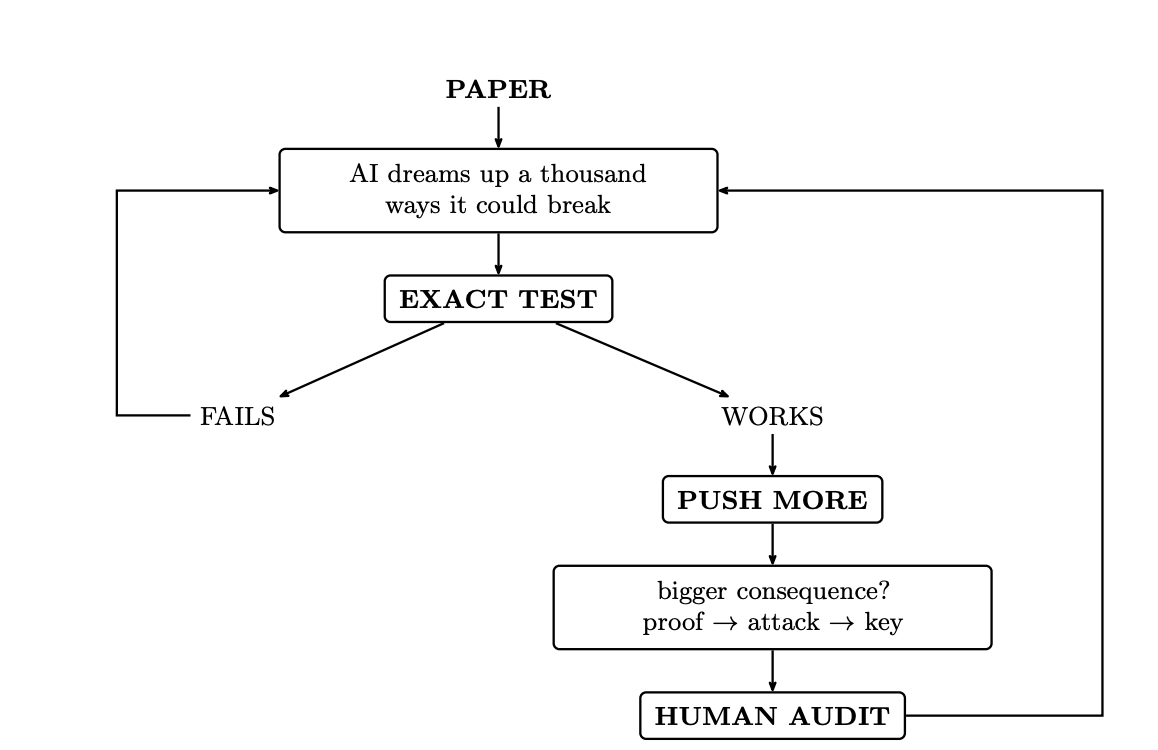
🔗 **Source:** [AI Grinding: What Happens When Cryptanalytic Ideas Become Cheap?](https://blog.lukaszolejnik.com/ai-grinding-what-happens-when-cryptanalytic-ideas-become-cheap/)
> [!note]+ Document Notes
> tags: [ai-methods, cryptanalysis, hypothesis-generation, verifiability, research-workflow, adversarial-testing]
> author: Lukasz Olejnik (with Bartosz Naskrecki)
> source: https://blog.lukaszolejnik.com/ai-grinding-what-happens-when-cryptanalytic-ideas-become-cheap/
> reference: "AI grinding: what happens when cryptanalytic ideas become cheap" - published 2026-08-25
> date created: 2026-08-25 13:45
>
> > [!info] Generated analysis - not the author's words. Sections below are machine-written
> > from the captured source. Only text inside `> [!quote]` blocks is verbatim from the author.
> > Do not quote or attribute any other line to the named author.
>
> # Title: AI grinding: what happens when cryptanalytic ideas become cheap
>
> **Attribution.** Reader's `author` field records the domain. The author is **Lukasz Olejnik**, writing in the first person, with **Bartosz Naskrecki** named as collaborator on the algebra. Published **2026-08-25**.
>
> **Commercial interest, disclosed in-line.** The post carries a subscription block: *"Lukasz Olejnik on Cyber, Privacy and Tech Policy Critique is a reader-supported publication."* Mild, and it does not shape the technical claims.
>
> **Register.** **First-person practitioner account with named, checkable results.** Three specific cryptographic breaks are described against identifiable targets, one of them a paper published in a named venue with a stated timeline. This is the strongest methods source in the batch: the method's outputs are independently verifiable by anyone who reads the papers.
>
> **Stated credential position, and it is load-bearing.** Olejnik states plainly that he does **not** have a PhD in cryptography or mathematics - he has a PhD in computer science followed by op-eds and an LL.M. in IT law, *"rather than a career proving theorems about lattices."* The whole argument depends on this being true, and he volunteers it up front.
>
<!-- deep-read:sections start -->
## Summary
**The thesis, stated in the first sentence and worth reading twice.** The strange thing about using AI for cryptanalysis is that **getting ideas is not the hard part - getting rid of bad ideas is.**
**The named method: "AI grinding."** Let AI generate hypotheses aggressively but **trust none of them**. Most ideas die. Many do not. Sometimes AI nails it almost immediately - *especially when results are verifiable, and many are.* Where they aren't, human judgment helps.
**Three concrete results, each a real break.**
1. **A CRT-based fully homomorphic encryption scheme.** Submitted in May, published in **IACR Communications in Cryptology** in August. Olejnik examined it that same August with his workflow, and **the failure surfaced the same day.** The construction relies on mathematical noise to hide secret information, but that noise passes through a CRT encoding. The question he asked was simple - what happens to the noise after that map? For *a whole family of error distributions permitted by the construction's own stated conditions*, **it disappears.** Relations meant to be noisy become exact; in the usual invertible case, **the secret key can be computed directly from the public key.** Separately, the paper's claimed transformation from ordinary Ring-LWE **does not preserve the error distribution it claims to**, so the claimed reduction does not work as stated.
2. **A lattice e-voting protocol.** Privacy against coercion depends on voters being able to fabricate convincing fake receipts. **The simulator generating those fake receipts has a statistical fingerprint that differs from genuine receipts for every permitted parameter.** A coercer holding the transcript can tell them apart - which defeats the property the protocol exists to provide.
3. **A Ring-LWR commitment scheme.** The verification rule **allows a multiplier equal to zero.** Set it to zero and the cryptographic equation becomes `0 = 0`. The same commitment then opens to *any* message, and pushing the observation further **breaks the soundness of the associated proof systems.**
**The collaboration.** Olejnik joined forces with **Bartosz Naskrecki**, who he says knows more algebra than he does. They refined both papers and, in his phrase, *"grinded AI."* An aside worth noting for what it says about cost: Naskrecki did his part **on vacation.**
**Why it works, in his account.** Algebraic structures generate hidden relations and edge cases, and **LLM agents are remarkably good at exploring those by trying many mathematical tricks and counterexamples humans might never test.** AI can be fluent, fast and wrong - and it makes exploration cheap, including for researchers entering areas outside their original background. He calls it a boon for inter- and multidisciplinary work.
**The forecast.** He expects **plenty of unexpected results will be unearthed about research papers published in previous years.**
**Bottom line.** The most methodologically important source in this batch, and its central contribution is a precondition most discussion of AI-assisted research omits: **aggressive hypothesis generation only pays where verification is cheap.** That is what makes cryptanalysis a near-ideal domain, and it is the test to apply before importing the method anywhere else.
## Main Content
### Notes
**The framing.** Getting ideas from AI for analysing ciphers, hash functions, and digital signatures is easy. **Discarding the bad ones is the hard part.** This inverts the usual complaint about AI research assistance, which is that the ideas are shallow.
**The credential disclosure.** No PhD in cryptography or mathematics. A PhD in computer science, followed by op-eds and an LL.M. in IT law rather than a theorem-proving career. His claim: AI made it possible for him to explore lattice cryptography and *"sufficiently understand the machinery to generate attack ideas, test them, discard most of them, and get results"* - breaking cryptography and invalidating proofs.
**Result 1 - the CRT-based FHE paper.** Described as *especially illustrative*.
- Timeline: submitted May, **published August, IACR Communications in Cryptology**.
- *"Same August I started examining it with the workflow I had been developing. The failure surfaced the same day."*
- The construction hides secret information behind mathematical noise. That noise passes through a **CRT encoding**.
- **The question that broke it was simple:** what happens to the noise after that map?
- **The answer:** for a whole family of error distributions permitted by the construction's stated conditions, **the noise disappears.**
- Consequences: relations that should be noisy become exact. In the usual invertible case, **the secret key can be computed directly from the public key.**
- A second, independent flaw: the paper's claimed transformation from ordinary **Ring-LWE does not preserve the error distribution it says it does**, so the claimed reduction does not work as stated.
**Result 2 - the lattice e-voting protocol.**
- The property at stake: **privacy against coercion**, which depends on voters being able to fabricate convincing fake receipts.
- The break: **the simulator generating fake receipts has a statistical fingerprint that differs from genuine receipts for every permitted parameter.**
- Consequence: a coercer holding the transcript can distinguish real from fabricated - destroying exactly the guarantee the protocol is built to provide.
**Result 3 - the Ring-LWR commitment scheme.**
- The break: **the verification rule allows a multiplier equal to zero.**
- Set it to zero and the cryptographic equation becomes, in his words, *"well, 0 = 0."*
- Consequence: **the same commitment can be opened to any message**, and pushing further **breaks the soundness of the associated proof systems.**
**The collaboration.** By this point he had joined forces with **Bartosz Naskrecki**, who *"absolutely knows more about algebra than I do."* They refined both papers and *"grinded AI."* Naskrecki worked on it **on vacation**; Olejnik declines to say where he was doing his own parts.
**The method, formalized.**
- These results led them to **formalise the workflow** and name it **AI grinding**.
- The core rule: *"let AI generate hypotheses aggressively but trust none of them."*
- Attrition is expected and fine: *"Most ideas die. Many do not."*
- **The key qualifier:** sometimes AI nails it nearly immediately, **especially when results are verifiable, and many are.** At other times human judgment helps.
- He calls it *"the future of math, cryptography, and whatnot"* and says they formalise the approach into a **specific workflow**.
- **Forecast:** he expects plenty of unexpected results to be unearthed about research papers published in previous years.
**The two closing claims.**
- *"Algebraic structures generate hidden relations and edge cases. LLM agents are remarkably good at exploring those by trying many mathematical tricks and counterexamples humans might never test."*
- *"AI can be fluent, fast and wrong. It also makes exploration cheap. Including for researchers entering areas outside their original background. It's a boon for inter and multidisciplinary work."*
## References
Primary sources, and unusually for this batch several are directly checkable:
- **The CRT-based FHE paper in IACR Communications in Cryptology** (published August 2026) - the target is identifiable from the description; the break is verifiable by anyone who reads it against the claim.
- **The forthcoming formalisation of the AI grinding workflow** - he says they formalise the approach and make a specific workflow. That document, not this post, is the methodological deliverable.
- **Ring-LWE and Ring-LWR literature** - for the reduction argument and the commitment scheme respectively.
- **Any resulting eprint or paper by Olejnik and Naskrecki** - the breaks presumably have or will have formal writeups, which is where the claims can be audited.
- **IACR's own review process documentation** - relevant to the question of how a same-day-findable flaw survived peer review.
## Paraphrase
**On the inverted bottleneck.** The standard worry about AI in research is that it produces plausible nonsense. Olejnik's claim is that this is true *and it doesn't matter*, because in his domain plausible nonsense is cheap to discard. The constraint moves from idea generation to idea elimination, and elimination is exactly what a verifiable domain is good at. The method is not "AI has good ideas." It is "AI has many ideas, and here the filter is cheap."
**On the precondition, which is the real contribution.** The sentence that carries the whole argument is *"especially when results are verifiable, and many are."* Cryptanalysis is a near-perfect domain for this: a proposed attack either works against the stated parameters or it does not, and checking is mechanical. Import the method to a domain where verification is expensive, slow, or contested - clinical claims, historical interpretation, strategy - and the same aggressive generation produces a pile of plausible assertions with no cheap filter, which is worse than nothing.
**On the credential claim.** The strongest evidence in the post is not any single break but the combination of who found them and how fast. A non-cryptographer surfaced a fatal flaw in a peer-reviewed lattice paper on the day he looked at it. If accurate, that says something about the current asymmetry between production and verification in cryptographic publishing that is more consequential than the individual results.
**On the shape of the three breaks.** They are strikingly similar in character. Each is a **boundary or degenerate case that the construction's own permitted parameters allow**: an error distribution family where noise vanishes, a parameter range where the simulator is distinguishable, a multiplier that may be zero. None requires deep new mathematics. All require systematically asking "what if this quantity takes its most inconvenient permitted value?" - which is precisely the exhaustive, tedious, unglamorous enumeration that models do tirelessly and humans skip.
**On what the human contributed.** Naskrecki is credited for algebra Olejnik lacks, and human judgment is named as necessary where results are not cheaply verifiable. The division is not "AI finds, human writes." It is closer to: AI enumerates the space, verification kills most of it, and human expertise adjudicates the residue that verification cannot settle.
**On the forecast, which is the uncomfortable part.** If the method is as cheap as described, then the existing corpus of published cryptography contains an unknown number of same-day-findable flaws, and the cost of looking has just collapsed. He says so directly.
## Newsletter
**WordPress angle - the transferable rule is about verifiability, not cryptography.**
Lukasz Olejnik does not have a cryptography PhD. He says so in the second paragraph. He then describes breaking three lattice cryptography constructions, including one published in IACR Communications in Cryptology - where the fatal flaw *surfaced the same day he looked at it.*
The construction hid its secrets behind mathematical noise. The noise passed through a particular encoding. He asked what happened to it afterwards, and for a whole family of error distributions the scheme itself permits, the answer was: it disappears. Secret key recoverable directly from the public key. Another scheme's verification rule allowed a multiplier of zero, which turns the security equation into `0 = 0` and lets one commitment open to any message.
He calls the method **AI grinding**: *let AI generate hypotheses aggressively but trust none of them.* Most die. Some don't.
Here's the sentence that actually matters, and it's easy to skim past: **"especially when results are verifiable, and many are."**
That's the whole precondition. Cryptanalysis is close to the ideal case - an attack either works against the stated parameters or it doesn't, and checking is mechanical. Generate a hundred bad ideas and the filter costs nothing. Take that same aggressive generation into a domain where verification is slow, expensive, or contested and you don't get results, you get a hundred confident assertions and no way to sort them.
So the question to ask before pointing agents at anything isn't "can AI do this?" It's **"how cheap is my filter?"** For WordPress work the honest answer is: sometimes very. A vulnerability either fires against a clean install or it doesn't. A plugin either fatals on the next core version or it doesn't - which is exactly what Austin Ginder built a probe for this week. Those are grinding-shaped problems.
Whether your architecture proposal is any good is not.
One detail worth sitting with: the three breaks are all *boundary cases the schemes' own parameters allow*. What if this error distribution is the worst permitted one? What if this multiplier is zero? None of it is deep mathematics. It's the tireless, tedious enumeration of inconvenient permitted values - the part humans skip because it's boring.
## Action Items
**DevRel**
- `#action/h1` "How cheap is my filter?" is the single most useful framing to come out of this batch for talks about AI-assisted work. It replaces capability questions with a question that has an actual answer.
- `#action/h2` The three breaks are excellent teaching examples of boundary-case reasoning, independent of AI.
**OSPO**
- `#action/h2` If the forecast holds, published security research has an unknown backlog of cheaply-findable flaws. Relevant to how any org treats "peer reviewed" as an assurance.
**Community**
- `#action/h3` The cross-disciplinary claim - that AI lowers the entry cost to fields outside your training - is worth taking seriously and worth testing before repeating.
**WordPress subteams**
- **Core** - `#action/h2` The grinding shape applies to boundary-case testing of core APIs: what is the most inconvenient value this parameter permits?
- **Core Performance, Core Program Team, Mobile, Photos, TV, Polyglots, Openverse, Themes, Marketing, Support, Design, Meta** - **Not applicable to this source.** Cryptanalysis methodology with no bearing on these teams.
- **Core AI** - `#action/h2` The verifiability precondition should govern where the project points agents. Verifiable targets first.
- **Playground** - `#action/h1` A cheap verification environment *is* the filter. Playground makes a class of WordPress problems grinding-shaped by making the check nearly free.
- **Training** - `#action/h2` Teach the precondition, not the technique. "Generate aggressively, trust nothing" is actively harmful where verification is expensive.
- **Documentation** - `#action/h3` Boundary conditions that a documented API *permits* but never intends are exactly what this method finds. Worth documenting intended ranges, not just accepted ones.
- **CLI** - `#action/h3` Scriptable verification is what makes the filter cheap.
- **Hosting** - `#action/h2` Pairs directly with Ginder's core probe in this batch: a fleet is a cheap verifier for compatibility hypotheses.
- **Tide** - `#action/h1` Tide is a verification engine. If verification is the scarce resource in AI-assisted auditing, Tide's strategic value rises sharply - this source is an argument for it.
- **Plugins** - `#action/h2` "What is the worst value this parameter legally accepts?" is a plugin-review question with a very high hit rate.
- **Accessibility** - Not applicable to this source.
**The WPOCC**
- `#action/h3` If published research carries a backlog of findable flaws, the same likely holds for widely-trusted ecosystem code. A collective-verification argument.
**FAIR**
- `#action/h3` Any cryptographic or signature scheme in a federation protocol is a grinding target. Worth having someone competent grind it before adversaries do.
**Personal / vault**
- `#action/h1` **This is the missing precondition for the CLAUDE.md audit guardrails.** That block already says to fan out by approach family, keep a registry, mark stalled routes blocked, adversarially double-check every finding, and force empirical reproduction. **It does not say when that whole apparatus is worth deploying.** The answer is: when verification is cheap. Add it.
- `#action/h1` Strongest methods source in this batch. Belongs in the next `readwise-methods-review` as an adopt-now candidate.
- `#action/h2` The boundary-case pattern - enumerate the most inconvenient permitted value of every parameter - is a concrete addition to `wp-security-reviewer`.
## Hypotheses
1. **The verifiability-precondition hypothesis.** If cheap verification is what makes aggressive generation work, then AI grinding will produce results in verifiable domains and noise in unverifiable ones. *This is the source's own qualifier, stated once and not developed. It is the most important claim in the post and the least examined.*
2. **The boundary-case hypothesis.** If all three breaks are degenerate cases the schemes' own parameters permit, then systematic enumeration of permitted-but-unintended values is the operative technique - not novel mathematics. *Strongly suggested by the three examples; not stated by the author.*
3. **The credential-substitution hypothesis.** If a non-cryptographer can break peer-reviewed lattice constructions, then AI substitutes for domain training more effectively in *verification* than in *construction*. *Testable, and consequential for how research fields staff themselves.*
4. **The publication-backlog hypothesis.** If the method is this cheap, the existing published corpus contains many findable flaws. *The author's own forecast. Falsifiable simply by others running the method and reporting.*
5. **The review-asymmetry hypothesis.** If a same-day-findable flaw survived submission-to-publication (May to August), then peer review is not currently testing the boundary cases this method targets. *Directly implied by the timeline; the author does not draw the conclusion.*
6. **The residue hypothesis.** If verification kills most candidates cheaply, then human expertise is needed only for the residue verification cannot settle. *Consistent with the Naskrecki collaboration; not stated as a division of labour.*
## Methodology
**Design: practitioner report of three results, plus a named workflow.** Not a study. Its evidentiary strength comes from a property most sources in this batch lack: **the outputs are independently checkable.** Anyone competent can read the named paper and confirm or refute the break.
**What is strongly evidenced:**
| Claim | Basis | Strength |
|---|---|---|
| The CRT/FHE break | Specific mechanism described, target identifiable, venue and dates named | **Strong** - verifiable by a third party. |
| The e-voting break | Specific mechanism (simulator fingerprint distinguishable for every permitted parameter) | **Strong** as described; target not named. |
| The Ring-LWR break | Specific mechanism (`0 = 0` via permitted zero multiplier) | **Strong** as described; target not named. |
| Same-day discovery | Author's own report | Self-reported, unverifiable, and the most load-bearing timing claim. |
| The method works | Three results | **Suggestive.** Three successes with no denominator. |
**The central methodological gap: no denominator.** He says most ideas die, and reports the survivors. **How many hypotheses were generated per confirmed break is never stated.** Three results from thirty candidates and three from three thousand are very different methods with very different costs, and the post supports neither reading. For a method whose entire premise is high-volume generation with aggressive culling, the cull rate is the number that characterises it - and it is absent.
**Other limits, in order of importance:**
- **Survivorship reporting.** By construction, we hear about the constructions that broke. Whether the workflow was run against schemes that held is not reported, and that ratio is what would distinguish a method from a lucky streak.
- **Two of three targets are unnamed.** The FHE paper is identifiable from the description; the e-voting protocol and the commitment scheme are not. Those two cannot be checked by a reader.
- **The workflow is announced, not shown.** "We formalise the approach and make a specific workflow." Nothing in this post lets a reader reproduce the method - only its results.
- **The self-assessment is uncontrolled.** "AI made it possible for me" is plausible and unfalsifiable from a single account; no counterfactual exists for what he would have found without it.
**What raises confidence despite all that.** The failure modes described are specific, mechanically stated, and of a kind that is either true or false on inspection. That is a much higher standard of checkability than any other source in this batch, and it is the reason to take the account seriously.
## Questions
1. **What is the cull rate?** Hypotheses generated per confirmed break. The single most important missing number, and the one that would let anyone else budget the method.
2. **Which papers are the second and third?** Two of three targets are undisclosed, making two-thirds of the evidence uncheckable.
3. **How much of the work was the model's and how much was Naskrecki's?** "Grinded AI" collapses a division of labour that matters enormously for whether this transfers to people without an algebraist to hand.
4. **What does the formalised workflow actually specify?** Announced, not described. That document is the deliverable; this post is the advertisement for it.
5. **Did the workflow run against schemes that held up?** Absence of negative results is the strongest reason for caution.
6. **How did a same-day-findable flaw survive May-to-August peer review?** He does not raise this, and it may be the most consequential implication in the post.
7. **Where does the method stop working?** He names verifiability as the enabling condition but does not explore its boundary. Semi-verifiable domains - where checking is possible but costly - are the interesting middle case and go unaddressed.
8. **What is the responsible-disclosure posture?** Breaking published schemes affects anyone who built on them. The post does not describe notifying authors, and for one paper published weeks earlier that timing matters.
## Future Research
- **Read the formalised workflow when it publishes.** It is the actual methodological contribution; this post is a results announcement.
- **Establish the cull rate.** Anyone running this method should report hypotheses-generated alongside breaks-confirmed. Without it, cost cannot be estimated and the method cannot be compared to alternatives.
- **Test the verifiability boundary.** Run comparable grinding in a semi-verifiable domain - protocol design, say, or performance analysis - and measure how the signal-to-noise ratio degrades as verification cost rises. **This is the most valuable open question and the one the source raises without pursuing.**
- **Systematic re-examination of published lattice cryptography.** His own forecast, and it is now cheap enough that someone will do it. The interesting result would be the base rate.
- **Characterise the boundary-case pattern.** If degenerate permitted values are where the breaks live, that is a checklist independent of AI, and it would work as a review standard.
- **Peer review under cheap adversarial analysis.** If flaws are findable in a day, review that does not run such analysis is not testing what it appears to test.
## Implications
**Practice.** The operative question before pointing agents at any problem is not "is the model capable?" but **"how cheap is my verification?"** Where a candidate answer can be mechanically checked, generate aggressively and let the filter do the work. Where it cannot, aggressive generation manufactures confident noise.
**Policy.** For research publishing: if a peer-reviewed construction contains a flaw findable in one day by a non-specialist with an agent, review processes need to incorporate exactly this kind of adversarial analysis, or "peer reviewed" stops carrying the assurance readers give it. For deployment: anyone building on recently-published cryptographic constructions has a new reason to wait.
**Security.** Directly relevant, and it cuts both ways - the same cheap grinding is available to attackers, and against the same corpus. This is the constructive counterpart to the OCN broadcast's discovery/remediation gap processed earlier in this batch: discovery keeps getting cheaper.
**Education.** The cross-disciplinary claim is genuinely significant if it holds. AI lowering the entry cost to a technical field *for verification purposes specifically* is a different and more defensible claim than lowering it generally, and it is the one his own evidence supports.
**Funding.** If verification is the bottleneck rather than generation, funding should flow to verification infrastructure. In this domain that means formal methods, reproducibility tooling, and adversarial review capacity - not more idea production.
## Learning Styles Assessment
- **Visual** - Weak. One image, no diagrams. Three cryptographic breaks described entirely in prose; each would be clearer with a diagram of where the noise goes.
- **Aural** - Not applicable to this source; text-only.
- **Verbal** - Strong. Economical, direct, and notably free of hedging.
- **Kinesthetic** - Weak. The workflow is named but not specified, so nothing here is runnable.
- **Logical** - **Strong.** Thesis stated first, three worked results, then generalisation to a named method. The structure is an argument.
- **Social** - Moderate. The collaboration with Naskrecki is described with genuine warmth and specific credit.
- **Solitary** - Moderate. Short and self-contained, but the technical content assumes real background.
- **Naturalistic** - Not applicable to this source.
**Reading level estimate.** Prose is roughly grade 12 and unusually clear for the subject. The **prerequisite is very high**: CRT, fully homomorphic encryption, Ring-LWE, Ring-LWR, error distributions, reductions, simulators, and commitment soundness all appear unglossed. The writing is accessible; the content is not. That gap is itself notable - a reader can follow the *argument* without following the *mathematics*, which is unusual and well-executed.
## Accessibility Assessment
Mapped to WCAG 2.2 AA:
1. **Perceivable - non-text content (1.1.1).** An image is present; no descriptive alt text surfaced in extraction. **Likely partial fail**, not verifiable from the scrape.
2. **Perceivable - info and relationships (1.3.1).** Pass. Clear headings ("Broken stuff," "AI Grinding") and structured paragraphs; extracted cleanly.
3. **Perceivable - contrast (1.4.3, 1.4.11).** Not assessable from the scrape. **Not assessed.**
4. **Operable - link purpose (2.4.4).** Not assessable; few links surfaced in extraction.
5. **Operable - timing, seizures (2.2, 2.3.1).** No timed or moving content. **Pass.**
6. **Understandable - language and readability (3.1).** **Split verdict, and worth crediting.** The prose is genuinely plain and the argument is followable without the mathematics - a real achievement for this subject. The technical terms are nonetheless unglossed, so the *verification* of his claims is closed to non-specialists.
7. **Robust - parsing (4.1).** Clean markup, extracted without loss. **Pass.**
**Highest-value remediation:** a one-line gloss on "error distribution" and "reduction." Those two terms carry the CRT/FHE break, and defining them would let a much wider audience follow the strongest result in the piece.
## DEIB Assessment
- **Cultural breadth.** Not substantively applicable - technical cryptanalysis. Both named participants appear to be Polish, and the work is described as done partly on vacation and partly from an undisclosed location, which quietly signals distributed, non-institutional research.
- **Inclusive language.** Good. Neutral throughout. Naskrecki is credited generously and specifically (*"absolutely knows more about algebra than I do"*), and the credit is substantive rather than perfunctory.
- **Neurodiversity support.** Good. Short, one idea per paragraph, clear section breaks, thesis stated first and restated at the end. The unglossed jargon is the main barrier.
- **Representation.** Two named researchers, both men. The broken papers' authors are **not named**, which is a deliberate and defensible choice - it makes the point without making examples of people.
- **Psychological safety.** **Notably good, and structurally so.** He breaks three published constructions and **names none of their authors.** The critique is directed at mathematics rather than at people. He also positions himself as the less expert party in his own collaboration and states his lack of credentials up front, which is disarming rather than falsely modest. The one asymmetry: the authors of the broken papers have no voice here, and one of them was published weeks earlier - being publicly broken with no notification described is a real cost borne by people who cannot respond in this venue.
## Logical Validity
**Strong reasoning.**
1. **The thesis inverts the expected claim and is better for it.** "Getting ideas is not the hard part; getting rid of bad ideas is" is specific, non-obvious, and it correctly locates the bottleneck.
2. **The enabling condition is named.** *"Especially when results are verifiable, and many are."* Most writing on AI-assisted research omits precisely this, and it is what makes the method transferable - or not.
3. **Concrete, mechanically-stated results.** Each break is described specifically enough to be checked: noise vanishing under a permitted error distribution, a distinguishable simulator, a zero multiplier producing `0 = 0`. These are true-or-false on inspection.
4. **Credentials disclosed against interest.** Stating he lacks a cryptography PhD makes his results more surprising and his claim more falsifiable.
5. **Limits acknowledged.** *"AI can be fluent, fast and wrong."* He does not oversell reliability, and he names human judgment as necessary where verification is not cheap.
6. **Collaboration credited specifically**, including where his own expertise ran out.
**Fallacies.**
1. **Missing denominator** - `#fallacy/survivorship-bias`. **The most significant flaw.** Three successes are reported with no count of attempts, and none of schemes examined that held. A method premised on high-volume generation and aggressive culling is characterised by its cull rate, which is never given. **Fix:** report hypotheses generated per confirmed break, and how many targets survived.
2. **Generalisation past the evidence** - `#fallacy/hasty-generalization`. *"This is the future of math, cryptography, and whatnot."* The results support a claim about cryptanalysis, a domain with unusually cheap verification. "And whatnot" quietly extends it to domains where the enabling condition he himself named does not hold. **Fix:** scope the claim to verifiable domains, which his own sentence already implies.
3. **Unfalsifiable counterfactual** - `#fallacy/unfalsifiable`, mild. "AI has made it possible for me to explore..." cannot be tested against what he would have achieved otherwise. Plausible, and not evidence.
4. **Two of three claims unverifiable as presented** - `#fallacy/suppressed-evidence`. The e-voting protocol and commitment scheme are undisclosed, so a reader can check only one-third of the evidence. Understandable if disclosure is pending; it still weakens the post as it stands.
5. **Implication left undrawn** - the May-to-August timeline against same-day discovery is a serious claim about peer review, and the post states the facts without stating the conclusion. Not a fallacy so much as a conspicuous silence.
**Tone of voice.** Direct, confident, and dry, with occasional understatement doing real work (*"well, 0 = 0"*). Self-deprecating about credentials without false modesty. Generous to his collaborator and pointedly ungenerous to nobody - the broken papers' authors are never named or characterised. The one register shift is the "future of math and whatnot" line, which is looser than everything around it and is also the least supported sentence in the piece.
## DARVO Analysis
**Deny** - **Not present.** Nothing is denied; the post is entirely constructive claims.
**Attack** - **Not present.** Three published works are broken and **no author is named or characterised.** The critique is of mathematics, not of people. This is deliberate and it is the correct handling.
**Reverse victim and offender** - **Not present.** No grievance, no victimhood, no redirected accusation.
**Assessment: no DARVO pattern.** A results announcement with disclosed limits and anonymised targets. Recorded as a negative finding, and as a good model for how to report breaking someone else's work.
## Conclusion
**Bottom line.** The most methodologically valuable source in this batch, and its contribution is a precondition rather than a technique.
**The results are real and checkable.** Three lattice constructions broken, including a paper published in IACR Communications in Cryptology whose fatal flaw surfaced on the day he examined it: for a whole family of error distributions the scheme's own conditions permit, the hiding noise **disappears**, and the secret key becomes computable from the public key. A second scheme's simulator is statistically distinguishable for every permitted parameter, defeating the coercion-resistance it exists to provide. A third permits a zero multiplier, turning its verification equation into `0 = 0` so that one commitment opens to any message.
**The method - AI grinding - is: generate hypotheses aggressively, trust none of them.** Most die. Some don't.
**But the sentence that makes it transferable is easy to miss:** *"especially when results are verifiable, and many are."* That is the whole precondition. Cryptanalysis is close to the ideal case - an attack works against stated parameters or it doesn't, and checking is mechanical, so a hundred bad ideas cost nothing. Move the same aggressive generation into a domain where verification is slow or contested and it manufactures confident noise. **The question to ask before deploying agents on anything is not "is the model capable?" but "how cheap is my filter?"**
**A pattern worth naming that the author does not:** all three breaks are **degenerate cases the schemes' own parameters permit**. Not new mathematics - the tireless enumeration of the most inconvenient legal value of every quantity, which is exactly the tedious work humans skip.
**Held against it:** no denominator anywhere. Three successes, no count of attempts, no schemes reported as holding up. For a method defined by aggressive culling, the cull rate is the number that characterises it, and it is absent. Two of three targets are undisclosed and therefore uncheckable. And *"the future of math, cryptography, and whatnot"* extends the claim past the verifiability condition he himself named one paragraph earlier.
**Directly for Courtney:** the CLAUDE.md audit block already specifies *how* to run agent code-analysis - fan out by approach family, keep a registry, mark stalled routes blocked, adversarially double-check, force empirical reproduction. **It does not say when that apparatus is worth deploying.** This supplies the missing precondition: when verification is cheap. That belongs in the file.
**Next steps.**
1. Add the verifiability precondition to the CLAUDE.md audit guardrails - it is the gate the existing rules assume and never state.
2. Watch for the formalised workflow; this post announces it rather than describing it.
3. Flag as an adopt-now candidate for the next `readwise-methods-review`.
## Refactor Appendix
### Literature Split Pad (H3)
> [!quote] `#atom/literature/h1`
> "The strange thing about using AI for analysing cryptography - ciphers, hash functions, digital signatures, etc. - is that getting ideas is not the hard part. Getting rid of bad ideas is."
The thesis, and a correct relocation of the bottleneck.
> [!quote] `#atom/literature/h1`
> "The idea is to let AI generate hypotheses aggressively but trust none of them. Most ideas die. Many do not. Sometimes AI is able to nail it nearly immediately, especially when results are verifiable, and many are. At other times human judgment might be of help."
The method, and - in the qualifier - the precondition that makes it work. This is the most important passage in the batch.
> [!quote] `#atom/literature/h1`
> "For a whole family of error distributions allowed by the construction's stated conditions, the answer is: it disappears."
The break, in one line. Note the crucial phrase: *allowed by the construction's stated conditions.* The flaw lives inside the permitted parameter space.
> [!quote] `#atom/literature/h1`
> "Algebraic structures generate hidden relations and edge cases. LLM agents are remarkably good at exploring those by trying many mathematical tricks and counterexamples humans might never test."
The mechanism claim: tireless enumeration of cases humans skip.
> [!quote] `#atom/literature/h2`
> "In a Ring-LWR commitment scheme, the verification rule allows a multiplier equal to zero. Set it to zero and the cryptographic equation becomes, well, 0 = 0. The same commitment can be opened to any message."
The cleanest of the three breaks, and the clearest instance of the boundary-case pattern.
> [!quote] `#atom/literature/h2`
> "AI can be fluent, fast and wrong. It also makes exploration cheap. Including for researchers entering areas outside their original background. It's a boon for inter and multidisciplinary work."
The honest limit and the cross-disciplinary claim in one breath.
> [!quote] `#atom/literature/h2`
> "I don't have a PhD in cryptography, nor math."
Credentials disclosed against interest, in the second paragraph.
> [!quote] `#atom/literature/h3`
> "Same August I started examining it with the workflow I had been developing. The failure surfaced the same day."
Submitted May, published August, broken the same day it was examined. The timeline is the implicit indictment of peer review that the post never states outright.
> [!quote] `#atom/literature/h3`
> "I expect that plenty of unexpected results will be unearthed about all the research papers published in previous years."
The forecast. Falsifiable simply by others running the method.
### Atomic Split Pad (H4)
- `#atom/zettel/z1` **Aggressive hypothesis generation only pays where verification is cheap** - The value of high-volume ideation is set entirely by the cost of the filter. Where checking is mechanical, generate freely. Where it is slow or contested, volume produces confident noise and nothing else.
- `#atom/zettel/z1` **Where verification is cheap, the bottleneck moves from having ideas to discarding them** - This inverts the usual complaint about AI research assistance. Plausible nonsense stops mattering when the filter is nearly free.
- `#atom/zettel/z1` **Flaws live inside the permitted parameter space** - All three breaks are degenerate cases the constructions themselves allow: an error distribution where noise vanishes, a parameter where the simulator is distinguishable, a multiplier of zero. The question is not "what is forbidden?" but "what is the most inconvenient value this legally accepts?"
- `#atom/zettel/z1` **Models substitute for domain expertise more readily in verification than in construction** - Checking whether a claim holds requires less internalised judgment than deciding what to build. This is why a non-cryptographer could break peer-reviewed cryptography.
- `#atom/zettel/z1` **A method defined by culling is characterised by its cull rate** - Reporting successes without attempts describes an outcome, not a method. Anyone who cannot state hypotheses-per-result cannot let others budget the approach.
- `#atom/zettel/z1` **When discovery gets cheap, the existing corpus becomes a backlog** - Everything published under the old cost of analysis is now unexamined by the new standard. This holds for research papers, audited codebases, and any body of work whose assurance rested on how expensive checking used to be.
### Fleeting Queue
- `#atom/fleeting/f1` **The missing precondition for CLAUDE.md's audit block.** That block says *how* to run agent code-analysis and never says *when it is worth it*. This supplies the gate: when verification is cheap. Highest-value edit from this batch.
- `#atom/fleeting/f1` **Interlocks with three other sources today.** Ginder's probe (cheap verification makes the fleet a filter), the OCN discovery/remediation gap (discovery keeps getting cheaper, remediation doesn't), and Theo's ladder (the check that holds without attention). All four are about where the cheap check lives.
- `#atom/fleeting/f1` **The peer-review implication he doesn't state.** Submitted May, published August, broken the same day it was examined. If review does not run adversarial analysis that costs one day, "peer reviewed" is not testing what readers assume.
- `#atom/fleeting/f1` The boundary-case pattern - enumerate the most inconvenient permitted value of every parameter - is a review checklist that works with or without AI. Add to `wp-security-reviewer`.
- `#atom/fleeting/f1` **The semi-verifiable middle is the interesting unexplored case.** Domains where checking is possible but costly. That is where most real work lives, and neither this source nor anyone else has characterised how grinding degrades there.
- `#atom/fleeting/f1` No responsible-disclosure posture described for a paper published weeks earlier. Worth noting as an ethics gap, not an accusation.
- `#atom/fleeting/f1` "Bartosz did it on vacation" - a small line that says a lot about how cheap the method has become.
## Template Library
### -> Fleeting refactor
Two-line capture: *AI grinding - generate hypotheses aggressively, trust none; three lattice constructions broken including a same-day break on an IACR-published FHE paper. The precondition is cheap verification.* File under AI methods. Revisit when the formalised workflow publishes.
### -> Literature refactor
One Literature Note: **"AI Grinding and the Verifiability Precondition"** - the method, the three breaks as worked examples, the boundary-case pattern, and the missing denominator. Cite the formalised workflow once it exists rather than this announcement.
### -> Atomic refactor
Strongest Permanent Note candidates:
1. **"Aggressive Generation Only Pays Where Verification Is Cheap"** - the best idea in the entire batch. General, actionable, and it supplies a gate that Courtney's existing audit rules assume without stating. Connects to `enforcement-boundaries` and to the credit-routing policy.
2. **"Flaws Live Inside the Permitted Parameter Space"** - subject-independent review heuristic. Pairs with the composition-failure material from Ginder and Wordfence in this same batch.
3. **"When Discovery Gets Cheap, the Corpus Becomes a Backlog"** - connects directly to the OCN discovery/remediation note and generalises past security to any assurance that rested on the old cost of checking.
### -> Things 3
- Add the verifiability precondition to the CLAUDE.md audit guardrails (**high priority - the highest-value edit from this batch**).
- Flag for the next `readwise-methods-review` as adopt-now (high priority).
- Add the boundary-case enumeration heuristic to `wp-security-reviewer` (medium priority).
- Watch for the formalised AI grinding workflow (medium priority).
<!-- deep-read:sections end -->
📄 **Full text:** [[Full Document Contents/Articles/AI Grinding What Happens When Cryptanalytic Ideas Become Cheap.md|AI Grinding: What Happens When Cryptanalytic Ideas Become Cheap? by Lukasz Olejnik (with Bartosz Naskrecki)]]
## Highlights
- The construction relies on mathematical noise to hide secret information. But that noise passes through a particular CRT encoding. The natural question was simple: **what happens to the noise after that map?** For a whole family of error distributions allowed by the construction’s stated conditions, the answer is: it disappears. ([View Highlight](https://read.readwise.io/read/01m0xmcaqk41mmty0jm943pfce))
- Note: The break, and the pattern the author never names: the flaw lives INSIDE the permitted parameter space — "allowed by the construction's stated conditions." All three of his breaks are like this (vanishing noise, distinguishable simulator, zero multiplier). None is new mathematics. All come from asking "what is the most inconvenient value this legally accepts?" — the tedious enumeration humans skip. That is a review heuristic that works with or without AI.
- Tags: atom/zettel/z1, atom/literature/h1
- These results, and several others, led us to [formalise the workflow](https://arxiv.org/abs/2608.21986?ref=blog.lukaszolejnik.com) we had been using. We call it **AI grinding**. The idea is to let AI generate hypotheses aggressively but trust none of them. Most ideas die. Many do not. Sometimes AI is able to nail it nearly immediately, especially when results are verifiable, and many are. At other times human judgment might be of help. This is the future of math, cryptography, and whatnot. We formalise the approach and make a specific workflow. I expect that plenty of unexpected results will be unearthed about all the research papers published in previous years. ([View Highlight](https://read.readwise.io/read/01m0xmc7ng3vp1e8s1cj764jre))
- Note: The method, and the precondition that makes it transferable: "especially when results are verifiable, and many are." That qualifier is the whole thing — cryptanalysis has a nearly free filter, so generating a hundred bad ideas costs nothing. Move this to a domain where checking is slow or contested and aggressive generation manufactures confident noise. The operative question before pointing agents at anything is not "is the model capable?" but "how cheap is my filter?"
CORRECTION to my own earlier note: the formalised workflow is NOT merely announced — it is published at arXiv 2608.21986, linked here. Read that, not this post, for the actual method. Caveat that stands: "and whatnot" extends the claim past the verifiability condition he named one sentence earlier.
- Tags: action/h1, atom/zettel/z1, atom/literature/h1