AI in Instructional Design: A Thinking Partner
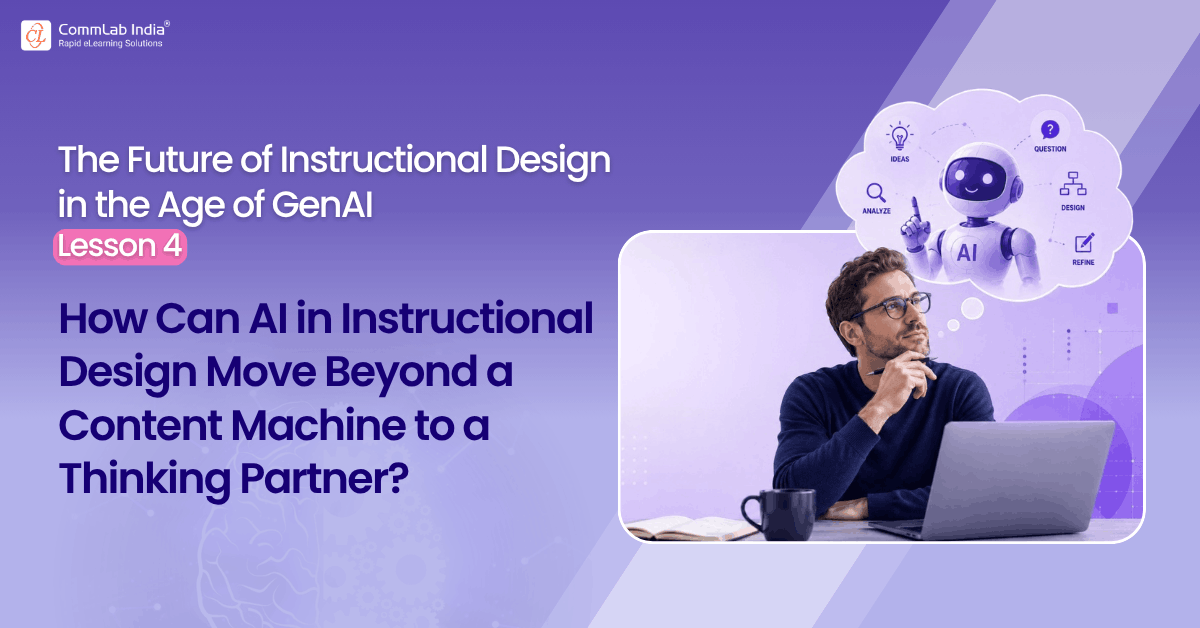
🔗 **Source:** [AI in Instructional Design: A Thinking Partner](https://www.commlabindia.com/blog/instructional-design-ai-thinking-partner)
> [!note]+ Document Notes
> tags: #instructional-design #artificial-intelligence #elearning #training-development #workplace-learning
> author: RK Prasad
> source: CommLab India
> reference: https://www.commlabindia.com/blog/instructional-design-ai-thinking-partner
> date created: 2024-12-19 14:30
>
> # 🏷️ Title: AI in Instructional Design: A Thinking Partner, Not Content Machine
>
<!-- deep-read:sections start -->
## 🧰 Action Inbox
- [H1] Develop challenge-based AI prompting framework — shift from content generation to thinking partnership #instructional-design
- [H2] Train teams on AI as collaborator vs output machine — strengthen design judgment over time #training-development
- [H3] Restructure review processes to emphasize design quality — integrate AI audit partner role #elearning
## 🧭 Table of Contents
- [[#📝 Summary]]
- [[#📖 Main Content]]
- [[#🗒️ Notes]]
- [[#📚 References]]
- [[#🗣️ Paraphrase]]
- [[#📰 Newsletter]]
- [[#✅ Action Items]]
- [[#🧪 Hypotheses]]
- [[#📊 Methodology]]
- [[#❓ Questions]]
- [[#🔮 Future Research]]
- [[#💡 Implications]]
- [[#🧠 Learning Styles Assessment]]
- [[#📊 Accessibility Assessment]]
- [[#🌍 DEIB Assessment]]
- [[#✅ Logical Validity]]
- [[#🛡️ DARVO Analysis]]
- [[#🎯 Conclusion]]
### 🔗 References
- [CommLab India AI Resources](https://www.commlabindia.com/blog/instructional-design-ai-thinking-partner)
- [Advanced Instructional Design eBook](https://www.commlabindia.com/)
## 📝 Summary
- **What happened**: CommLab India argues that instructional designers are misusing AI primarily as content generators rather than thinking partners, which risks reducing designers to content editors
- **Why it matters**: This approach diminishes the strategic judgment role of instructional designers and may weaken professional capabilities over time
- **Key stakeholders**: Instructional designers, L&D leaders, corporate training teams, eLearning professionals
- **Risks and tradeoffs**: Using AI only for content risks dependency and skill atrophy; thinking partner model requires more sophisticated prompting but builds design capabilities
- **Bottom line**: AI should strengthen human design thinking through collaboration, critique, and structured partnership rather than replace judgment with automation
## 📖 Main Content
The article challenges the dominant pattern of using AI in instructional design as a content generation tool. The author argues this reduces instructional designers from learning architects to content refiners, which threatens the profession's core value proposition.
Instead, Prasad proposes a "thinking partner" model where AI supports five distinct roles: sense-making partner (organizing complex SME material), structuring partner (proposing learning flows), decision-expansion partner (generating multiple design options), critical partner (questioning design decisions), and audit partner (reviewing final coherence).
This approach maintains the designer's central role while leveraging AI to enhance thinking quality rather than replace thinking processes. The model aims to build stronger design capabilities over time rather than creating dependency on generated content.
## 🗒️ Notes
#### [H1] AI content generation pattern reduces designer role
- Key idea: Current AI use treats technology as content machine rather than thinking collaborator
- Evidence: "When AI in instructional design is used mainly for content creation, the designer's role can slowly begin to shrink"
#### [H2] Instructional design is judgment task not writing task
- Key idea: Core professional value lies in design decisions rather than content production
- Evidence: "The real work is in deciding what the learner actually needs, what the business is asking for... These are not content-generation decisions. They are design decisions"
#### [H1] Five thinking partner roles strengthen design process
- Key idea: AI can support design thinking through sense-making, structuring, decision-expansion, critique, and audit functions
- Evidence: "It broadens the option space. That can be very useful, especially when the designer is stuck, moving too quickly, or falling into habitual patterns"
#### [H2] Thinking partner model builds capabilities over time
- Key idea: Partnership approach strengthens designer judgment rather than creating dependency
- Evidence: "IDs use AI as a thinking partner... They may become better at diagnosis, better at questioning, better at seeing alternatives"
#### [H3] L&D leaders need new training frameworks
- Key idea: Implementation requires changes to team training, prompt guides, and review processes
- Evidence: "If instructional designers are trained only to extract output from GenAI, they are likely to use it in a shallow way"
## 📚 References
- [CommLab India Blog](https://www.commlabindia.com/blog/instructional-design-ai-thinking-partner)
- [Advanced Instructional Design eBook](https://www.commlabindia.com/)
## 🗣️ Paraphrase
- AI should enhance human design thinking rather than replace it with automated content generation
- Instructional designers risk becoming content editors if they only use AI for output production
- A thinking partner model preserves designer judgment while leveraging AI for better decision-making and design quality
## 📰 Newsletter
**AI as Your Design Thinking Partner, Not Content Generator**
The latest thinking on AI in instructional design challenges the common "content machine" approach. Instead of just generating drafts, AI can strengthen your design judgment through five partner roles: sense-making complex SME material, structuring learning flows, expanding design options, critiquing weak decisions, and auditing final coherence.
This approach keeps you in the architect role while building stronger diagnostic and questioning skills over time. The key is moving from "help me produce" to "help me think better while I produce."
**Practical next step**: Try using AI to critique your next storyboard rather than generate it. Ask it to identify text-heavy screens, weak assessments, or alignment gaps.
Resources: [Learn WordPress](https://learn.wordpress.org/), [Developer Docs](https://developer.wordpress.org/), [WP-CLI](https://wp-cli.org/)
## ✅ Action Items
#### DevRel
- Education: Develop AI thinking partner workshops for instructional design teams
- Developer experience: Create prompt libraries for design critique and audit functions
- Community management: Survey instructional designers on current AI usage patterns
#### Community
- Contributors: Design templates for challenge-based AI prompting in training contexts
- Sponsors: Fund research on AI partnership models vs content generation approaches
#### WordPress
- Training: Integrate AI thinking partner concepts into lesson development workflows
- Documentation: Create guides for using AI to improve rather than replace design judgment
- Community: Share case studies of successful AI partnership implementations
## 🧪 Hypotheses
- Instructional designers using AI as thinking partners will demonstrate stronger design judgment over 6 months compared to content-generation users
- Teams trained on AI partnership models will produce higher-quality learning experiences than those using AI primarily for output generation
- Challenge-based AI prompting will result in more innovative instructional design solutions than traditional content-focused prompting
- Designers using the five-partner model will report greater professional satisfaction and skill development
### 📊 Methodology
- Controlled study comparing design quality metrics between partnership vs content-generation AI users
- Longitudinal tracking of designer capabilities using pre/post assessment of design judgment skills
- A/B testing of prompt frameworks measuring innovation and quality outcomes
### ❓ Questions
- How can organizations measure the difference between AI dependency and AI-enhanced capability building?
- What specific prompt patterns most effectively implement the critical partner and audit partner roles?
- How do we prevent the thinking partner model from becoming another form of sophisticated content generation?
### 🔮 Future Research
- Develop validated instruments for measuring design judgment quality and AI partnership effectiveness
- Investigate optimal human-AI collaboration patterns across different instructional design methodologies
- Explore how thinking partner models could apply to other creative professional domains
### 💡 Implications
- **Practice**: Instructional designers need new prompting skills focused on collaboration rather than content extraction
- **Education**: Training programs must emphasize AI partnership over AI tool usage
- **Security**: Reduced dependency on AI-generated content may improve intellectual property and quality control
- **Funding**: Investment in AI partnership training may yield better long-term ROI than content generation automation
### 🧠 Learning Styles Assessment
Reading level estimate: 12th grade (professional/technical vocabulary with clear structure)
#### 👀 Visual learners
- **Present**: Clear section headings and structured content flow
- **Improve**: Process diagrams showing five partner roles, before/after workflow comparisons
#### 🔊 Aural learners
- **Present**: No audio content currently available
- **Improve**: Podcast version discussing partnership vs content generation approaches
#### 🗣️ Verbal learners
- **Present**: Strong use of analogies (architect vs refiner, thinking partner vs content machine)
- **Improve**: More concrete examples of prompts for each partner role
#### 🧩 Kinesthetic learners
- **Present**: Actionable framework with five distinct roles to practice
- **Improve**: Step-by-step guides for implementing each partner role with sample prompts
#### 🧠 Logical learners
- **Present**: Clear progression from problem identification through solution framework
- **Improve**: Decision trees for choosing appropriate partner role for different design challenges
#### 🧑🤝🧑 Social learners
- **Present**: Professional community context and team implications
- **Improve**: Discussion prompts for L&D teams, collaborative implementation strategies
#### 🧘♀️ Solitary learners
- **Present**: Self-reflection on current AI usage patterns
- **Improve**: Self-assessment rubrics for evaluating partnership vs content generation approaches
#### 🌿 Naturalistic learners
- **Present**: Ecosystem thinking about professional development and capability building
- **Improve**: Connections to learning environment sustainability and long-term skill ecology
### 📊 Accessibility Assessment
#### Screen reader semantics
- **Present**: Proper heading hierarchy and clear content structure
- **Improve**: Could benefit from more descriptive section summaries
#### Keyboard navigation
- **Present**: Standard web navigation patterns
- **Improve**: Skip links for main content sections
#### Contrast and readability
- **Present**: Professional website with standard contrast ratios
- **Improve**: Could test specific contrast levels for compliance
#### Text resizing and reflow
- **Present**: Responsive design supports text scaling
- **Improve**: Verify reflow behavior at 200% zoom
#### Media and captions
- **Present**: Text-based content with no multimedia requiring captions
- **Improve**: Future audio versions would need transcripts
#### Forms and interactions
- **Present**: Newsletter signup with basic form labels
- **Improve**: Enhanced error messaging and validation feedback
### 🌍 DEIB Assessment
#### Cultural breadth
- **Present**: Corporate training context applicable across cultures
- **Improve**: Examples from diverse educational and cultural contexts
#### Inclusive language
- **Present**: Gender-neutral professional terminology
- **Improve**: Could include perspectives from different educational traditions
#### Neurodiversity support
- **Present**: Well-structured content with clear headings
- **Improve**: Multiple summary formats for different processing preferences
#### Representation
- **Present**: Professional focus without identity-specific examples
- **Improve**: Cases representing diverse learning and working environments
#### Psychological safety
- **Present**: Non-judgmental framing of current AI usage patterns
- **Improve**: Explicit acknowledgment of learning curve and experimentation safety
### ✅ Logical Validity
#### Strong reasoning
- **Deductive strength**: Clear logical progression from premise (AI as content generator) to conclusion (thinking partner is better)
- **Inductive strength**: Builds case through multiple examples of partnership roles
- **Causal reasoning**: Links content generation approach to skill atrophy concerns
- **Analogical strength**: Effective architect vs refiner analogy clarifies role distinction
#### Fallacies
- **False dichotomy**: Presents content generation vs thinking partner as either/or choice when hybrid approaches possible
- **Slippery slope**: Assumes content generation necessarily leads to skill degradation without considering mitigation strategies
#### Tone of voice
- **Overall tone**: Authoritative but collegial, professional advocacy for methodological shift
### 🛡️ DARVO Analysis
- **Deny**: No defensive patterns present
- **Attack**: No attacks on opposing viewpoints or practitioners
- **Reverse victim/offender**: No victim/offender reversal patterns
- **Emotional cues and rhetoric**: Uses professional concern and opportunity framing rather than fear-based rhetoric
## 🎯 Conclusion
The article makes a compelling case for reframing AI's role in instructional design from content generator to thinking partner. This shift preserves the designer's professional judgment while leveraging AI's capabilities for enhanced design thinking. The five-partner model provides a practical framework for implementation, though organizations will need to invest in new training approaches and prompt methodologies. The long-term implications favor building human capabilities rather than replacing them, which aligns with sustainable professional development in an AI-enhanced workplace.
## 🧱 Refactor Appendix
### 📚 Literature Split Pad
### [H1] AI thinking partnership strengthens design judgment
> [!quote] [AI in Instructional Design: A Thinking Partner](https://www.commlabindia.com/blog/instructional-design-ai-thinking-partner) by [[RK Prasad]] via [[CommLab India]]. Published 2026-05-13. Accessed 2024-12-19.
> "IDs use AI as a thinking partner... They may become better at diagnosis, better at questioning, better at seeing alternatives."
Framework for using AI to enhance rather than replace instructional design capabilities through structured collaboration.
[view highlight](https://www.commlabindia.com/blog/instructional-design-ai-thinking-partner#H1) #xref #articleseed ID:rw_ai_thinking_partner
### [H2] Five partner roles create structured collaboration
> [!quote] [AI in Instructional Design: A Thinking Partner](https://www.commlabindia.com/blog/instructional-design-ai-thinking-partner)
> "AI can act as a sense-making partner, structuring partner, decision-expansion partner, critical partner, and audit partner."
Operational framework defining specific AI collaboration roles across instructional design workflow.
[view highlight](https://www.commlabindia.com/blog/instructional-design-ai-thinking-partner#H2) #xref ID:rw_five_partners
---
### 🔖 Atomic Split Pad (Zettel Candidates)
#### [Z1] Content generation AI risks professional skill atrophy
- Applies when AI primarily produces deliverables rather than supporting thinking
- Reference: Content generation vs thinking partner distinction
- Links: [[Professional-Development]] [[AI-Human-Collaboration]]
#### [Z2] Design judgment distinguishes instructional design from content creation
- Core professional value lies in learning strategy decisions not text production
- Reference: "Judgment task not writing task" section
- Links: [[Instructional-Design-Process]] [[Professional-Identity]]
---
### ✏️ Fleeting Queue
- [F1] Research challenge-based prompting techniques — develop specific examples for each partner role #fleeting #inbox
- [F2] Survey current AI usage patterns among instructional designers — validate content generation dominance claim #fleeting #inbox
- [F3] Create assessment rubric for AI partnership vs dependency — measure capability building outcomes #fleeting #inbox
<!-- deep-read:sections end -->
📄 **Full text:** ![[Full Document Contents/Articles/AI in Instructional Design A Thinking Partner.md|AI in Instructional Design: A Thinking Partner by commlabindia.com]]
## Highlights
- For L&D leaders, this shift is not theoretical. It has direct implications for how teams are trained, how prompt guides are created, how review processes are structured, and how good AI use is defined in practice. If instructional designers are trained only to extract output from GenAI, they are likely to use it in a shallow way. But when they are trained to engage AI as a collaborator, critic, and reviewer, they can improve both speed and design quality. ([View Highlight](https://read.readwise.io/read/01krhj9d7vn4w93frz2g61wz5e))
- Tags: 👻 ai highlighted