Advancing Accessibility Through Community and Open Source
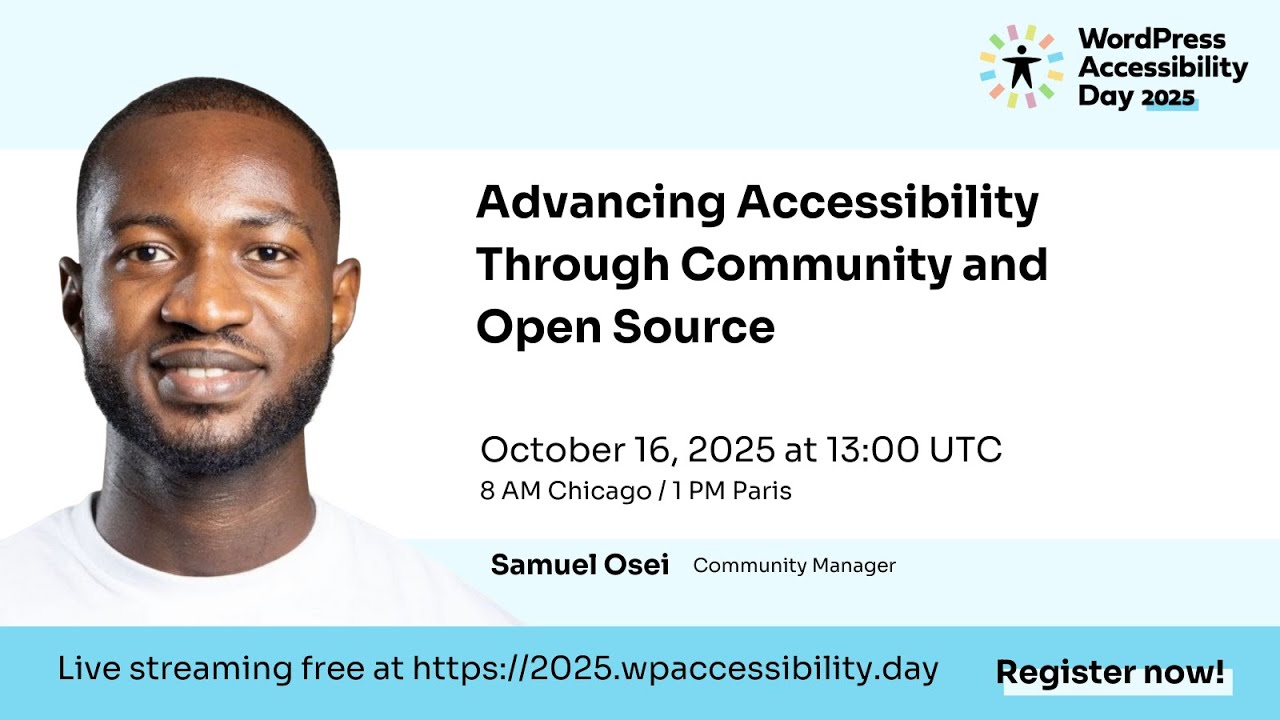
🔗 **Source:** [Advancing Accessibility Through Community and Open Source](https://www.youtube.com/watch?v=g0NY4T6AQcA)
> [!note]+ Document Notes
> tags: [accessibility, digital-inclusion, wordpress-community, devrel, disability-employment, ghana]
> author: Samuel Osei
> source: WordPress Accessibility Day 2025
> reference: https://www.youtube.com/watch?v=g0NY4T6AQcA
> date created: 2026-09-08
>
> > [!info] Generated analysis — not the author's words. Sections below are machine-written
> > from the captured source. Only text inside `> [!quote]` blocks is verbatim from the author.
> > Do not quote or attribute any other line to the named author.
>
> # 🏷️ Title: Advancing Accessibility Through Community and Open Source
>
<!-- deep-read:sections start -->
## 🧭 Table of Contents
- [📝 Summary](#-summary)
- [📖 Main Content](#-main-content)
- [🗒️ Notes](#️-notes)
- [📚 References](#-references)
- [🗣️ Paraphrase](#️-paraphrase)
- [📰 Newsletter](#-newsletter)
- [✅ Action Items](#-action-items)
- [🧪 Hypotheses](#-hypotheses)
- [📊 Methodology](#-methodology)
- [❓ Questions](#-questions)
- [🔮 Future Research](#-future-research)
- [💡 Implications](#-implications)
- [🧠 Learning Styles Assessment](#-learning-styles-assessment)
- [📊 Accessibility Assessment](#-accessibility-assessment)
- [🌍 DEIB Assessment](#-deib-assessment)
- [✅ Logical Validity](#-logical-validity)
- [🛡️ DARVO Analysis](#-darvo-analysis)
- [🎯 Conclusion](#-conclusion)
- [🔄 Refactor Appendix](#-refactor-appendix--advancing-accessibility-through-community-and-open-source)
### 🔗 References
- [TechAble contact —
[email protected]](mailto:
[email protected]) (funding and partnership inquiries, mentioned t=2320)
- [KNUST — Kwame Nkrumah University of Science and Technology](https://www.knust.edu.gh/) (program partner, t=2261)
- [IEEE Computer Society](https://www.computer.org/) (initial TechAble funder, t=2251)
- [WordPress Accessibility Day feedback form](https://2025.wpaccessibility.day/feedback) (t=2870)
- Event hashtags: #WPA11yDay, #WPAD2025 (t=2856)
## 📝 Summary
- **What happened.** Samuel Osei, a Ghanaian software engineer and WordPress Meetup organizer in Kumasi, presented at WordPress Accessibility Day 2025 (hosted by Chris Hinds, COO of Equalize Digital) on TechAble, a WordPress-based digital-skills training initiative for people with disabilities in Ghana.
- **Why it matters.** Osei ties a global accessibility statistic — the WHO's estimate that 16% of the world's population, or 1.3 billion people, experiences significant disability (t=499) — to a concrete, running program that trains people with disabilities in WordPress development, digital marketing, and graphic design (t=2524), funded initially by the IEEE Computer Society and run in partnership with KNUST's Student with Disability Association (t=2251–2269).
- **Key stakeholders.** TechAble participants (56% women, t=1631), IEEE Computer Society (funder), KNUST and its Student with Disability Association (partner/volunteers), industry mentors, WordPress's accessibility team, and WordPress Accessibility Day sponsors who were asked live to donate commercial plugin licenses.
- **Risks and tradeoffs.** The program is still pre-launch on infrastructure: no public website yet (t=2394), funding requests route through a personal email address rather than a formal channel (t=2320–2333), and the biggest cost driver is hardware/connectivity, not curriculum (t=2341–2383) — a scaling risk if device costs aren't solved before enrollment grows.
- **Bottom line.** Osei's central claim is that open source removes the financial barrier to entry that proprietary tools create (t=1483–1489), and that community — mentorship, peer buddies, industry connections — is what converts technical training into sustained employment and belonging (t=1990–2010).
## 📖 Main Content
Osei frames accessibility as a legal and ethical mandate, not a feature (t=414–426), then names four concrete barriers people with disabilities face when trying to gain digital skills: inaccessible platforms and tools (unlabeled form fields, image buttons with no alt text, t=610–708), training content without captions (t=708–807), lack of assistive-technology support baked into how software is coded (t=807–904), and limited community support that leads to isolation and attrition (t=911–1024).
He pairs each barrier with an opportunity: inclusive training opens remote jobs and entrepreneurship because digital skills are "location-independent" (t=1077–1093), builds independence and dignity through economic self-sufficiency (t=1179–1258), improves representation because people with disabilities catch accessibility issues able-bodied teams miss (t=1274–1372), and creates empowered communities where "learners become teachers" (t=1381–1452) — a grassroots-over-top-down argument for how the movement scales.
WordPress is positioned as the delivery mechanism specifically because it's free to use, modify, and distribute, removing the cost barrier proprietary software creates, and because it already has "a very active accessibility team" (t=1477–1500). That belief led to TechAble: three tracks (WordPress web development, digital marketing, graphic design, t=2522–2534), a mentorship structure pairing each participant with an industry mentor (t=1712–1719), and a deliberate 56%-women cohort achieved through "peer buddy" accountability pairing and extra facilitation attention rather than by accident (t=1639–1649, t=2417–2455).
The closing third covers five operating lessons (accessibility as ongoing work, not a checklist item; disabilities and learning styles vary; soft skills matter as much as technical skills; psychological and emotional barriers — internalized ableism, family discouragement — require direct intervention; and collaboration beats competition in social-impact work, t=1842–1985), followed by role-specific calls to action for developers, employers, educators, funders, advocates, and people with disabilities themselves (t=2009–2136), and a Q&A that surfaces the program's real operational constraints: no government support, funding routed through IEEE, and device/internet cost as the binding scale constraint in Ghana (t=2240–2383).
### 🗒️ Notes
#### ⏱️ [00:01:32](https://www.youtube.com/watch?v=g0NY4T6AQcA&t=92s) Introduction and speaker bio
- Chris Hinds (COO, Equalize Digital) introduces WordPress Accessibility Day 2025 and Samuel Osei as the Kumasi, Ghana WordPress Meetup organizer and WordPress.org support-forum volunteer.
- Q&A will run through Zoom's Q&A panel; chat is for attendee-to-attendee connection.
#### ⏱️ [00:03:46](https://www.youtube.com/watch?v=g0NY4T6AQcA&t=226s) Osei's background
- Osei is a software engineer and community manager, goes by OseiAGM online, and frames his work as sitting at the intersection of community involvement and technical expertise (t=234–284).
- Names Ghana's "global South" constraints directly: infrastructure challenges, economic barriers, and "significant accessibility gaps" (t=318–333).
#### ⏱️ [00:06:50](https://www.youtube.com/watch?v=g0NY4T6AQcA&t=410s) "Accessibility is not optional"
- States accessibility is an ethical and often legal mandate (t=420–426), then pivots to education: universities, certifications, job applications, and freelance marketplaces have moved online, so inaccessible pathways structurally exclude people from skills and the economy (t=463–486).
#### ⏱️ [00:08:12](https://www.youtube.com/watch?v=g0NY4T6AQcA&t=492s) WHO statistics
- Cites the World Health Organization figure: ~16% of the global population, 1.3 billion people, experience significant disability (t=499–505); people with disabilities face unemployment rates 2–3x higher than people without disabilities (t=517–525).
- Universal-design argument: captions help noisy-environment and second-language viewers too; keyboard navigation helps power users; simple language helps everyone parsing complex information (t=542–576).
#### ⏱️ [00:10:10](https://www.youtube.com/watch?v=g0NY4T6AQcA&t=610s) Barrier 1 — inaccessible platforms and tools
- Walks through a concrete scenario: a blind student using a screen reader hits a course registration form with unlabeled fields (reader announces "edit boxes") and a submit button that's an unlabeled image, so the form is unusable even though the course itself might be a good fit (t=642–693).
#### ⏱️ [00:11:48](https://www.youtube.com/watch?v=g0NY4T6AQcA&t=708s) Barrier 2 — training content without captions
- Names YouTube, Coursera, and Udemy as platforms that "democratized education" but says a deaf or hard-of-hearing learner is shut out entirely when a course video has no captions, regardless of motivation (t=741–771).
- States captioning is "entirely achievable" technically — the gap is awareness, priority, and care, not capability (t=783–807).
#### ⏱️ [00:13:27](https://www.youtube.com/watch?v=g0NY4T6AQcA&t=807s) Barrier 3 — lack of assistive technology support
- Poorly coded platforms conflict with screen readers, voice recognition, and switch controls; this is "particularly insidious" because it's often invisible to developers who don't use assistive tech themselves (t=846–856).
- Coins the line that a site with animations but no semantic HTML or keyboard support is "a beautiful building with no doors" (t=873–880), then argues the burden of adaptation belongs on builders, not on disabled users (t=899–911).
#### ⏱️ [00:15:11](https://www.youtube.com/watch?v=g0NY4T6AQcA&t=911s) Barrier 4 — limited community support
- Argues technical barriers compound with social isolation: without peer networks, mentorship, or representation, people give up, and "we all lose" their perspective, creativity, and potential leadership (t=1012–1024).
#### ⏱️ [00:17:10](https://www.youtube.com/watch?v=g0NY4T6AQcA&t=1030s) Reframing: opportunity, not just problem
- Shifts from "accessibility as a problem to solve" to "an opportunity to seize" (t=1051–1060), then covers four benefits: jobs/entrepreneurship, independence, representation, and empowered communities.
#### ⏱️ [00:17:49](https://www.youtube.com/watch?v=g0NY4T6AQcA&t=1069s) Jobs and entrepreneurship
- Digital skills are location-independent; gives examples of a web developer in Accra working for London/New York/Tokyo clients (t=1105–1122). Frames training people with disabilities in in-demand tech skills as meeting market demand, "not charity" (t=1163–1178).
#### ⏱️ [00:21:14](https://www.youtube.com/watch?v=g0NY4T6AQcA&t=1274s) Representation as a design input
- States the tech industry "has a diversity problem" (t=1305–1307) and that when builders aren't diverse, products reflect that through oversight, bias, and exclusion (t=1317–1325); people with disabilities in design/dev/product roles catch accessibility issues others miss.
#### ⏱️ [00:24:18](https://www.youtube.com/watch?v=g0NY4T6AQcA&t=1458s) Open source as the bridge
- States open source "democratizes access to technology and learning opportunities" (t=1467–1474); WordPress's free-to-use/modify/distribute model removes the financial barrier proprietary software creates, and its active accessibility team is cited as a direct enabler (t=1477–1500).
#### ⏱️ [00:25:04](https://www.youtube.com/watch?v=g0NY4T6AQcA&t=1504s) TechAble's mission
- Defines TechAble's mission as enhancing employability and inclusivity in the digital economy through accessible WordPress-based digital-skills training (t=1517–1527), explicitly designed to also address the other three barriers (captions, assistive tech, community), not just teach code (t=1529–1544).
#### ⏱️ [00:25:50](https://www.youtube.com/watch?v=g0NY4T6AQcA&t=1550s) Gender inclusion focus
- Cites women's tech-workforce representation at roughly 25–30% globally and names "intersectional disadvantage" for women with disabilities specifically (t=1575–1601). Reports 56% of TechAble participants are women, achieved through intentional outreach and program design, not by accident (t=1626–1649).
#### ⏱️ [00:23:39](https://www.youtube.com/watch?v=g0NY4T6AQcA&t=1419s)–[00:28:13](https://www.youtube.com/watch?v=g0NY4T6AQcA&t=1693s) Mentorship structure
- Each participant is paired with an industry mentor for one-on-one technical and career support (t=1712–1719); peer support and mentor-opened industry connections are described as "often just as valuable as the formal training itself" (t=1738–1762).
#### ⏱️ [00:29:28](https://www.youtube.com/watch?v=g0NY4T6AQcA&t=1768s) Impact reported
- Participants built their first accessible websites (t=1777–1790), gained confidence to pursue freelance/digital jobs (t=1797–1808), and reported a stronger sense of belonging in tech (t=1811–1829).
#### ⏱️ [00:30:34](https://www.youtube.com/watch?v=g0NY4T6AQcA&t=1834s) Five lessons learned
- (1) Accessibility is ongoing, not a checklist (t=1842–1853). (2) Disabilities and learning styles vary — what works for deaf participants doesn't necessarily work for blind participants (t=1858–1885). (3) Soft skills (client-finding, pricing, communication) matter as much as technical skills (t=1892–1914). (4) Psychological/emotional barriers — internalized ableism, family discouragement — need direct intervention alongside technical training (t=1918–1961). (5) Partnership and collaboration, not competition, amplify social impact (t=1962–1988).
#### ⏱️ [00:33:10](https://www.youtube.com/watch?v=g0NY4T6AQcA&t=1990s) Call to action by role
- Specific asks for developers/designers (learn and mentor), employers (recruit, don't just say you value diversity), educators (accessible formats, test with assistive tech), funders (fund scaling programs), advocates (read disabled bloggers, speak up), and people with disabilities (know your worth, connect, advocate for yourself) (t=2009–2116).
#### ⏱️ [00:35:16](https://www.youtube.com/watch?v=g0NY4T6AQcA&t=2116s) One-week challenge and close
- Challenges the audience to take one concrete accessibility action within a week — alt text, learning one new thing, a donation, or committing to accessibility in the next project (t=2124–2140).
#### ⏱️ [00:37:20](https://www.youtube.com/watch?v=g0NY4T6AQcA&t=2240s) Q&A — funding and government support
- No government support; initial funding came from the IEEE Computer Society; KNUST and its Student with Disability Association provided the university partnership and volunteers (t=2248–2271).
#### ⏱️ [00:38:36](https://www.youtube.com/watch?v=g0NY4T6AQcA&t=2316s) Q&A — the real cost driver
- States most funding goes to acquiring participant laptops and internet access, not instruction, because devices and connectivity are expensive in Ghana; building accessibility (physical venues) is a second infrastructure constraint (t=2338–2383).
#### ⏱️ [00:40:04](https://www.youtube.com/watch?v=g0NY4T6AQcA&t=2404s) Q&A — supporting women specifically
- Peer-buddy pairs check in on each other's attendance ("accountability buddy," t=2426–2434); women get extra facilitator attention and are deliberately placed in leadership roles (leading sessions, owning tasks) to build confidence (t=2444–2489).
#### ⏱️ [00:41:29](https://www.youtube.com/watch?v=g0NY4T6AQcA&t=2489s) Q&A — the three tracks and hiring pipeline
- Confirms three programs — WordPress web development, digital marketing, graphic design — chosen because they support remote work; TechAble connects graduates directly to local companies and partner-company training (e.g., a cloud-practitioner course) rather than leaving job-seeking to participants alone (t=2522–2617).
#### ⏱️ [00:45:30](https://www.youtube.com/watch?v=g0NY4T6AQcA&t=2730s) Q&A — plugin license donations and a live commitment
- Osei confirms donated commercial WordPress plugin licenses would be "an amazing opportunity" given Ghana's currency disadvantage (t=2669–2692). Chris Hinds commits on-air to running a remote accessibility training session for TechAble members after fellow attendee Taco raises the idea (t=2794–2814).
## 📚 References
- [World Health Organization — Disability](https://www.who.int/health-topics/disability) — source of the ~16%/1.3 billion global disability prevalence figure cited at t=499.
- [WordPress Accessibility Day](https://wpaccessibility.day/) — event organizer; feedback form at 2025.wpaccessibility.day/feedback (t=2870).
- [WordPress.org Accessibility Team](https://make.wordpress.org/accessibility/) — the "active accessibility team" Osei credits at t=1494.
- [Equalize Digital](https://equalizedigital.com/) — Chris Hinds's organization, co-host of the session.
- IEEE Computer Society — TechAble's initial funder (t=2251); contact channel given as
[email protected] (t=2320).
- KNUST (Kwame Nkrumah University of Science and Technology) — university partner and volunteer source via its Student with Disability Association (t=2261–2271).
## 🗣️ Paraphrase
Osei opens by asking the audience to count how many digital interactions they've already had that day, then contrasts that ease against the reality for the roughly 1.3 billion people worldwide living with a disability, for whom the same interactions can be frustrating or flatly impossible. He walks through four concrete failure modes — unlabeled form fields and buttons, uncaptioned training video, software that fights assistive technology, and the isolation of learning tech with no peer network — and insists the fix for each is a design and community choice, not a technical impossibility. His example of a blind student locked out of a course-registration form by an unlabeled submit button, and his line about developers building "a beautiful building with no doors," do the work of making an abstract accessibility argument concrete.
The second half turns from problem to program. Osei describes TechAble, the WordPress-based training initiative he leads: seeded by IEEE Computer Society funding, run in partnership with KNUST's Student with Disability Association, teaching WordPress development, digital marketing, and graphic design, and built around one-on-one mentorship and deliberate gender-inclusion design that got participation to 56% women. He closes with five hard-won lessons — accessibility is never "done," disabilities and learning needs vary widely, soft skills matter as much as code, psychological barriers need direct attention, and collaboration beats competition — before handing the audience role-specific actions and a one-week challenge to do one concrete accessibility thing.
## 📰 Newsletter
WordPress Accessibility Day 2025 closed a session with Samuel Osei, the WordPress Meetup organizer from Kumasi, Ghana, and it's worth your ten minutes even if you already know your ARIA roles. Osei runs TechAble, a WordPress-based digital-skills program for people with disabilities in Ghana — three tracks (web dev, digital marketing, graphic design), an industry mentor for every participant, and 56% of the cohort women by design, not accident. The funding story is the part most WordPress community folks will recognize: no government support, a seed grant from the IEEE Computer Society, a university partnership with KNUST, and — as of this recording — a request still open for commercial WordPress plugin/product companies to donate licenses. If your company sponsors WordPress events, this is a concrete, named place to send a donated license or a mentor. Full session, timestamps, and Q&A notes below; watch for the accessibility team, Training team, and Community team action items — several map directly onto what TechAble already needs.
## ✅ Action Items
#### DevRel
- Developer advocacy: Book Samuel Osei (OseiAGM) for a DevRel talk or demo on TechAble's WordPress accessibility curriculum; track a measurable outcome such as new contributors recruited from the Kumasi meetup.
- Education: Adapt TechAble's three-track curriculum (WordPress development, digital marketing, graphic design) into a reusable workshop template for other under-resourced-region meetups.
- Developer experience: Package Osei's screen-reader failure example (unlabeled form fields read as "edit boxes," an image submit button with no alt text) as a short WordPress accessibility quickstart doc.
- Developer marketing: Build a content push around #WPA11yDay and #WPAD2025 spotlighting TechAble's 56%-women participation stat as a WordPress community accessibility story.
- Community management: Pilot TechAble's peer-buddy accountability-pair model in other WordPress mentorship programs to raise attendance and retention.
- Internal/external/cross-project: Turn Chris Hinds's on-air commitment to a remote accessibility training session for TechAble into a documented cross-project SLA between WP Accessibility Day organizers and TechAble.
#### OSPO
- Policy & Governance: Draft a contribution charter for TechAble graduates moving into WordPress core or plugin contribution, defining decision rights for first-time contributors.
- License Compliance: Not applicable to this source — Osei discusses WordPress's free-to-use/modify/distribute model in general terms but names no license-compliance scanning or review process.
- Security Management: Not applicable to this source — no vulnerability intake, embargo policy, or signing process is discussed.
- Software Inventory: Not applicable to this source — no SBOM or software inventory practice is mentioned.
- Developer Support: Extend TechAble's one-mentor-per-participant model as a template for OSPO developer-support consultation hours.
- Community Engagement: Document the IEEE Computer Society → TechAble funding relationship as a template MoU other OSPOs could replicate for accessibility programs in the Global South.
- Strategic Alignment: Track TechAble's 56%-women KPI as a model diversity OKR reported alongside job-placement numbers, since Osei presents both as intentional design outcomes.
#### Community
- Maintainers: Not applicable to this source — the talk doesn't address WordPress core maintainer roadmap clinics or release hygiene.
- Contributors: Build a "first accessible website" onboarding rotation for TechAble graduates, modeled on WordPress's first-issue rotations and paired with Kumasi meetup mentors.
- Sponsors: Ask WP Accessibility Day's platinum sponsors (Gravity Forms, WP Engine, Woo) whether they'll donate commercial plugin licenses to TechAble, per the live donation request Chris Hinds relayed at t=2650.
- Ecosystem: Not applicable to this source — no cross-project incident drill or coordinated-disclosure process is discussed.
#### WordPress
- Core: Not applicable to this source — no core issue triage or performance budget is discussed.
- Core Performance: Not applicable to this source — no profiling or performance metric is discussed.
- Core AI: Not applicable to this source — the talk doesn't address AI guardrails or evaluation sets.
- **Core Program Team:** Not applicable to this source — no cross-team coordination ritual is named.
- Mobile: Not applicable to this source — no mobile app backlog item is discussed.
- Playground: Pilot WordPress Playground as a no-install practice environment for TechAble students who lack reliable laptops or internet, directly addressing the device-cost barrier Osei names at t=2341.
- Community: Support Osei's existing Kumasi WordPress Meetup with a WordCamp-style speaker mentorship track, since he already organizes it.
- Training: Formalize TechAble's WordPress-development track as a Learn WordPress certification pilot for participants with disabilities.
- Marketing: Feature TechAble and the 56%-women stat in WordPress.org's community marketing/social editorial calendar around accessibility-awareness dates.
- Support: Recruit Osei — who already answers questions in the WordPress.org support forums per his introduction — as a triage lead for accessibility-tagged support tickets.
- Design: Not applicable to this source — no UX audit or design token work is discussed.
- Documentation: Turn the missing-form-label/unlabeled-image-button example into a DevHub accessibility documentation pattern showing the failure and the fix.
- Photos: Not applicable to this source.
- TV: Submit this WordPress Accessibility Day 2025 session to WordPress.tv with a caption-quality review pass.
- Polyglots: Translate TechAble's WordPress-development curriculum materials for other Global South locales facing the same infrastructure and cost barriers Osei describes for Ghana.
- Accessibility: Invite Osei to contribute to the WordPress accessibility team's issue heatmap; his four-barrier framework (platforms, captions, assistive tech, community) maps directly onto WCAG review priorities.
- Meta: Not applicable to this source — no .org roadmap or API reliability item is discussed.
- CLI: Not applicable to this source.
- Hosting: Flag event hosting sponsors (GreenGeeks, SiteGround, GoDaddy) as candidates for a hosting-cost-waiver program for accessibility training initiatives like TechAble, since device/internet cost is the program's stated bottleneck.
- Tide: Not applicable to this source.
- Openverse: Not applicable to this source.
- Themes: Not applicable to this source — no theme review throughput issue is raised.
- Plugins: Route the plugin-license-donation request Osei fielded live to the Five for the Future or a plugin-sponsor outreach process.
#### The WPOCC
- Programs: Add TechAble as a case study for The WPOCC's own accessibility fellowship design — IEEE-seeded, university-partnered, mentor-paired.
- Projects: Not applicable to this source — TechAble is a training program, not a governance clinic or documentation sprint.
- Funding experiments: Model a WPOCC microgrant on TechAble's real constraint — device and connectivity funding, not just training stipends — since that's what Osei says the program actually needs to scale (t=2349–2383).
### FAIR
- Technical independence: Not applicable to this source — the talk doesn't address local metadata, provenance, or federated discovery.
- Policies and covenants: Not applicable to this source — no funding-transparency covenant or sunset clause is discussed, though the IEEE/KNUST funding-and-partnership arrangement could inform one.
- Productized governance artifacts: Not applicable to this source — no charter or operator agreement artifact is described; TechAble's own "proper channels and documentation" are explicitly still in progress (t=2323–2333).
## 🧪 Hypotheses
- H1: Programs that pair every participant with a 1:1 industry mentor produce higher completion and job-placement rates than curriculum-only training for people with disabilities.
- H2: Intentional gender-inclusion design (peer-buddy accountability pairs, added facilitator attention, deliberate leadership placement) raises retention of women with disabilities in tech training above the ~25–30% baseline female tech-workforce representation Osei cites (t=1579).
- H3: In low-income regions, device and connectivity subsidies produce more program completions per dollar spent than an equivalent amount spent on additional instruction hours.
- H4: Programs that explicitly address psychological barriers (internalized ableism, family discouragement) alongside technical skills show lower attrition than technical-only programs.
- H5: Training built on free/open-source platforms (WordPress) yields more job-ready graduates per training hour in cost-constrained regions than training built on licensed/proprietary tools, because license cost no longer gates practice time.
### 📊 Methodology
- H1: Compare completion and 6-month employment rates between a mentored TechAble cohort and a self-paced control cohort using the same curriculum; track mentor-contact hours as the independent variable.
- H2: A/B two intake cohorts — one with peer-buddy pairing and extra facilitation, one without — and compare week-4 and week-12 retention among women participants.
- H3: Run a cost-allocation experiment: hold curriculum spend constant, vary device/connectivity subsidy per participant, and regress completion rate on subsidy amount.
- H4: Administer a validated internalized-ableism or self-efficacy scale at intake and program end; compare attrition between cohorts that receive an explicit psychological-support component and those that don't.
- H5: Compare per-participant cost-to-competency (time to first deployed, working website) between the WordPress track and a hypothetical proprietary-CMS track using licensing-cost data from Ghana's market.
### ❓ Questions
- What's TechAble's actual completion rate and 6/12-month employment rate, and how do those numbers compare to Ghana's general youth-unemployment baseline?
- Once TechAble's website and "proper channels" (t=2330) go live, will the funding and reporting structure be public enough for outside donors to audit outcomes, not just intentions?
- Does the peer-buddy accountability model generalize to other underrepresented groups in tech training, or is it specific to the gender-inclusion problem TechAble was built to solve?
- How does TechAble measure "soft skills" (client-finding, pricing, communication) — informally through mentor feedback, or with any structured assessment?
- What happens to participants who complete training but aren't placed with a partner company — does TechAble track long-term outcomes for that group?
### 🔮 Future Research
- A published outcomes report for TechAble (completion rate, employment rate, income change) once the promised website and documentation are live — none of these numbers appear in this talk beyond the 56%-women figure.
- Comparative research on device/connectivity subsidy models across other Global South tech-training programs, since Osei identifies this as the actual scaling bottleneck rather than curriculum quality.
- A structured study of the "learners become teachers" grassroots-mentorship pattern Osei describes (t=1402–1452) as a scaling mechanism, to see if it holds up as programs grow past a founder-led cohort size.
- Research on whether commercial WordPress product companies will respond to direct, public license-donation requests like the one fielded live in this Q&A, and what channel (Five for the Future, direct outreach, a formal donation program) converts best.
### 💡 Implications
- **Practice:** WordPress-focused accessibility training programs should budget for hardware and connectivity as a first-class line item, not an afterthought to curriculum design — Osei states most TechAble funding already goes there (t=2349).
- **Policy:** Osei's four-barrier framework (inaccessible platforms, uncaptioned content, poor assistive-tech support, weak community support) gives WordPress's accessibility and training teams a ready-made checklist for auditing their own onboarding materials against.
- **Security:** Not discussed in this source; no security-management implications are raised.
- **Education:** The mentor-pairing and peer-buddy structures TechAble uses are directly portable to WordPress's own Training team and Learn WordPress content, especially for underrepresented-region cohorts.
- **Funding models:** Osei's live answer to the plugin-license-donation question — "that would be really awesome," with no formal channel yet (t=2669–2717) — is a concrete, unclaimed opportunity for WordPress product companies' sponsorship or Five for the Future budgets.
## 🧠 Learning Styles Assessment
- **Reading level estimate:** Flesch-Kincaid Grade Level ≈ 8, estimated from this transcript's short, mostly single-clause spoken sentences (roughly 12–15 words each) and predominantly one- to two-syllable vocabulary; a plain-language, general-audience register appropriate for a live conference talk rather than a technical paper.
#### 👀 Visual learners
- **Present:** No slide descriptions, diagrams, or on-screen visuals are captured in the transcript — this is audio-only source material.
- **Improve:** Add a labeled diagram of the four-barrier framework (platforms, captions, assistive tech, community) and a before/after screenshot of the inaccessible registration form Osei describes at t=642–693.
#### 🔊 Aural learners
- **Present:** The source is itself a spoken talk — well-served by default.
- **Improve:** Add a 3–5 minute audio summary of TechAble's mission and impact numbers for listeners who want the program specifics without the full 48 minutes.
#### 🗣️ Verbal learners
- **Present:** Strong use of concrete analogy ("a beautiful building with no doors," t=880) and a worked example (the blind student's registration-form failure, t=642–693).
- **Improve:** Add a short glossary defining "assistive technology," "screen reader," and "intersectional disadvantage" for readers unfamiliar with disability-inclusion terminology.
#### 🧩 Kinesthetic learners
- **Present:** The one-week challenge (t=2118–2140) gives a direct, doable action.
- **Improve:** Turn the four barriers into a checklist readers can run against their own WordPress site (form labels, captions, keyboard nav, community/support links).
#### 🧠 Logical learners
- **Present:** Clear numbered structure (four barriers, four opportunities, five lessons) supports sequential reasoning.
- **Improve:** A causal diagram linking each barrier to its downstream outcome (e.g., uncaptioned video → excluded learner → unmet market demand) would make the economic argument (t=1163–1178) easier to trace.
#### 🧑🤝🧑 Social learners
- **Present:** The talk itself models social learning — mentorship, peer buddies, and "learners become teachers" (t=1402–1416) are central content, not just delivery method.
- **Improve:** A discussion guide for meetups watching this talk together, with prompts tied to each of the five lessons.
#### 🧘♀️ Solitary learners
- **Present:** The one-week challenge (t=2124–2140) works as a self-paced, individual action.
- **Improve:** A self-check reflection worksheet ("which of the four barriers exists on a site I maintain?") for readers processing this alone.
#### 🌿 Naturalistic learners
- **Present:** Not applicable to this source — no sustainability, environment, or ecosystem-lifecycle framing is present in the talk.
- **Improve:** Not applicable — the talk's subject matter (digital accessibility, employment) has no natural tie-in to add without forcing one.
## 📊 Accessibility Assessment
#### Screen reader semantics
- **Present:** The existence of a full timestamped transcript indicates captions or a transcript were generated for this session.
- **Improve:** Confirm the published video carries correctly synced, human-reviewed captions (not just auto-captions) and that speaker names are announced consistently, since this transcript already labels speaker changes (Chris Hinds vs. Samuel Osei) — that labeling should also exist in the caption track for screen reader and deaf/hard-of-hearing users alike. Maps to **WCAG 2.2 SC 1.2.2 Captions (Prerecorded), Level A**.
#### Keyboard navigation
- **Present:** Not assessable from a transcript alone — no interactive UI is described in the source.
- **Improve:** If the session is republished with an interactive transcript/chapter player, verify all chapter-jump controls are keyboard-operable. Maps to **WCAG 2.2 SC 2.1.1 Keyboard, Level A**.
#### Contrast and readability
- **Present:** Not assessable from transcript text alone.
- **Improve:** If slides accompanied the talk (implied by references to "the heart of this presentation," t=384, but not described verbally), verify slide text meets 4.5:1 contrast and isn't the sole carrier of information not also spoken aloud. Maps to **WCAG 2.2 SC 1.4.3 Contrast (Minimum), Level AA**.
#### Text resizing and reflow
- **Present:** Not assessable from transcript alone.
- **Improve:** Confirm any published slide deck or transcript page reflows cleanly at 200% zoom without clipped content. Maps to **WCAG 2.2 SC 1.4.10 Reflow, Level AA**.
#### Media and captions
- **Present:** A full transcript with timestamps exists (this document's source), satisfying the baseline transcript requirement Osei himself argues for at t=783–807.
- **Improve:** Publish a downloadable transcript file alongside the video (not just auto-generated captions), and confirm no autoplay is used on the event's video hosting page. Maps to **WCAG 2.2 SC 1.2.1 Audio-only and Video-only (Prerecorded), Level A** and **SC 1.2.2 Captions, Level A**.
#### Forms and interactions
- **Present:** The Zoom Q&A intake mechanism Chris Hinds describes (t=131–133) is a real interaction point for attendees.
- **Improve:** No information in this transcript confirms the Zoom Q&A panel or the feedback form at 2025.wpaccessibility.day/feedback was tested with assistive technology — ironic given the talk's subject. Maps to **WCAG 2.2 SC 3.3.2 Labels or Instructions, Level A** and **SC 2.5.8 Target Size (Minimum), Level AA**.
#### Standards reference
- Gaps above are mapped to WCAG 2.2 AA where assessable; several categories are not assessable from a transcript-only source and are marked accordingly rather than guessed.
## 🌍 DEIB Assessment
#### Cultural breadth
- **Present:** Strong. The talk is explicitly grounded in Ghana and the "global South" (t=314–333), naming local institutions (KNUST), local economic conditions (currency, device cost, t=2673–2684), and local infrastructure realities (network access, t=2775–2792) rather than generalizing from a single-country default.
- **Improve:** Add examples from other regions running comparable programs to show the model generalizes beyond Ghana.
#### Inclusive language
- **Present:** Strong and consistent use of person-first language ("people with disabilities," "persons with disabilities") throughout; avoids deficit framing by repeatedly stating barriers are structural/technical failures, not failures of the people affected (t=899–911).
- **Improve:** None identified — language use is consistent throughout the transcript.
#### Neurodiversity support
- **Present:** The talk's own structure (numbered barriers, numbered opportunities, numbered lessons) is chunked and predictable, which aids processing.
- **Improve:** Explicitly naming learning-style diversity beyond disability category (Lesson 2, t=1878–1885) is a strength already present; extending that same individualized-pacing principle into the published materials (e.g., a written summary alongside the video) would extend the benefit to readers who process text better than audio.
#### Representation
- **Present:** Strong. The speaker himself is a Ghanaian community leader speaking on a global stage about a program that is 56% women (t=1631), directly countering the "who gets platformed" pattern the talk itself critiques (t=1305–1317).
- **Improve:** None significant identified — representation is a structural strength of this specific talk.
#### Psychological safety
- **Present:** Osei names internalized ableism, family discouragement, and "years of rejection" directly and without minimizing them (t=1923–1949), and frames the burden of adaptation as belonging to builders, not to disabled users (t=899–911) — a respectful framing rather than a blame-the-user one.
- **Improve:** None significant identified — the talk models psychological safety in how it discusses participants' struggles.
## ✅ Logical Validity
#### Strong reasoning
- **Inductive reasoning from testimony to policy claim** (t=1235–1267): Osei generalizes from observed TechAble participant outcomes (self-perception shift from "I need help" to "I have valuable skills to offer") to a broader claim about economic empowerment — reasonably scoped since he flags it as his own program's observation, not a universal claim.
- **Causal reasoning, barrier → outcome** (t=463–486, t=741–771): Each of the four barriers is tied to a specific, traceable downstream failure (inaccessible form → student can't register; no captions → course is "closed"), which is a clear and falsifiable causal chain rather than a vague assertion.
- **Analogical reasoning** (t=873–880): "A beautiful building with no doors" compresses the semantic-HTML/keyboard-navigation argument into an image that's checkable against the technical claim it stands for (a visually functional site that's structurally unusable) — a strong analogy because it maps cleanly onto the technical point rather than substituting for it.
- **To clarify further:** Pairing the WHO statistic (t=499) with a citation link or footnote (not present in the spoken talk, understandably) would let the audience verify the 16%/1.3 billion figure independently.
#### Fallacies
- **Hasty generalization / unqualified motive attribution** — Location: t=799–807. Osei states the captioning barrier "isn't technical impossibility, it's lack of awareness, lack of priority, and sometimes lack of care," which treats every uncaptioned-content case as a matter of insufficient will. **Why it's weak:** it doesn't account for resource-constrained small teams or individual creators who may lack access to affordable captioning services in their region — the same infrastructure-cost argument Osei himself makes about Ghana elsewhere in the talk (t=2341–2383). **Fix:** narrow the claim to "for well-resourced organizations, the barrier is rarely technical" and separately acknowledge that under-resourced creators face a real cost barrier, which strengthens rather than weakens the overall argument for institutional accountability.
#### Tone of voice
- Personal, direct, and advocacy-forward. Osei uses first person throughout ("I firmly believe," t=1467; "I am proud to share," t=1626), addresses the audience directly with imperative calls to action ("know your worth," t=2080), and uses rhetorical questions to build empathy ("Who helped you?" t=956) rather than lecturing. The tone stays consistent from the opening statistic through the closing challenge — urgent but not alarmist, personal but backed by named numbers (WHO stat, 56% figure, 25–30% workforce baseline).
## 🛡️ DARVO Analysis
- **Deny:** Not applicable to this source — the talk contains no accusation being responded to, so there's nothing being denied.
- **Attack:** Not applicable to this source — Osei doesn't attack any individual's or organization's credibility; his critique of "the tech industry" (t=1305–1325) is a systemic claim, not a targeted personal attack.
- **Reverse victim/offender:** Not applicable to this source — there's no attempt to recast an accused party as the victim; the talk is advocacy and program description, not a response to conflict.
- This talk is a conference presentation and Q&A with no underlying dispute, so DARVO's frame (a response to an accusation) doesn't apply to any part of the content.
## 🎯 Conclusion
Osei's bottom line is that accessibility work moves fastest when open-source tooling (removing cost barriers) is combined with structured community support (mentorship, peer buddies, industry connections) — TechAble is his working proof of that combination, not just his argument for it. The concrete next step he leaves the audience with is small and time-boxed: take one accessibility action within a week, whether that's adding alt text, learning one new accessibility concept, donating, or committing to accessibility in your next project (t=2124–2140). For readers in WordPress community and DevRel roles specifically, the two most actionable and currently unclaimed items in this talk are the plugin-license-donation request (t=2650–2717, no formal channel yet) and Chris Hinds's on-air commitment to a remote accessibility training session for TechAble (t=2794–2814) — both are concrete, dated, and traceable to follow up on.
## 🔄 Refactor Appendix — Advancing Accessibility Through Community and Open Source
> Density: 2–5 Literature atoms (H3), 0–3 Permanent candidates (H4).
> Defaults: 3 Literature, 1 Permanent. Resonance filter: if you can't
> articulate in one line why a claim matters, drop it.
>
> Konik claim-header rules: present tense, declarative, ≤10 words when
> possible, searchable, unique, mirrors annotation focus if present.
>
> Atomicity: one declarative sentence per atom. "and"/"also" → split.
>
> Tag pool: #bmf · #addendum · #xref · #articleseed · #storystem · #share · #aphorisms
### 📚 Literature Atoms (H3)
#### [H1] Accessible design is universal design, not charity
> [!quote] ID:rw_wpad2025-osei-01
> Accessibility is good design, it's universal design, and it's simply the right thing to do.
**Context & use**:
- Spoken at t=572–580, closing the universal-design argument (captions/keyboard nav/plain language helping everyone).
- Reusable as the one-line frame for why accessibility work is positioned as design quality, not a compliance add-on, in DevRel or accessibility-team messaging.
**Tags**: #xref #aphorisms
**Highlight**: [view highlight](readwise://01m21cz81kf9meyzga13bpsqwd)
<!-- atomicity: 1 idea ✓ -->
#### [H2] Open source removes the cost barrier to digital training
> [!quote] ID:rw_wpad2025-osei-02
> I firmly believe that open source democratizes access to technology and learning opportunities.
**Context & use**:
- Spoken at t=1467–1474, the pivot from "problem" to "WordPress as the vehicle" for TechAble.
- Directly relevant to OSPO/WPOCC funding-model arguments: license-free tooling is treated as an equity mechanism, not just a technical preference.
**Tags**: #xref #addendum
**Highlight**: [view highlight](readwise://01m21cz81kf9meyzga13bpsqwd)
<!-- atomicity: 1 idea ✓ -->
#### [H3] TechAble targets the technological gap for people with disabilities
> [!quote] ID:rw_wpad2025-osei-03
> TechAble is an initiative that aims to bridge the technological gap for people with disabilities.
**Context & use**:
- Spoken at t=1510–1517, the program's own mission statement in Osei's words.
- Anchor quote for any future case-study or partnership writeup referencing TechAble by name.
**Tags**: #xref
**Highlight**: [view highlight](readwise://01m21cz81kf9meyzga13bpsqwd)
<!-- atomicity: 1 idea ✓ -->
#### [H4] TechAble reached 56% women participation by design
> [!quote] ID:rw_wpad2025-osei-04
> I am proud to share that 56% of our participants are women.
**Context & use**:
- Spoken at t=1626–1631, following the intersectional-disadvantage framing for women with disabilities in tech.
- The concrete, citable number for any DEIB or Community write-up referencing TechAble's gender-inclusion outcome.
**Tags**: #xref #share
**Highlight**: [view highlight](readwise://01m21cz81kf9meyzga13bpsqwd)
<!-- atomicity: 1 idea ✓ -->
### 🧠 Permanent Candidates (H4)
#### [P1] Accessibility burden belongs to builders, not to disabled users
**Claim** (one sentence, Courtney's voice): When a platform is inaccessible, the fix obligation sits with the people who built it, not with the disabled person who has to work around it.
**Evidence pointer**: [[#H1]] — the "beautiful building with no doors" argument (t=873–911) makes the same point without the direct quote.
**Scope & conditions**: Holds for organizations with the resources to fix known accessibility gaps; doesn't excuse under-resourced individual creators from trying, but shifts primary accountability upward, per the Fallacies note above on the captioning-barrier claim.
**Links** (≥1 with annotation):
- [[WCAG 2.2 AA]] — because evidence-for the specific criteria this claim maps to in practice (1.2.2, 2.1.1, 3.3.2).
- [[DevRel action items]] — because applies-in the developer-education and documentation work this note's Action Items section recommends.
<!-- atomicity: 1 idea ✓ -->
#### [P2] Mentor-paired, peer-buddy training beats curriculum-only training for underrepresented cohorts
**Claim** (one sentence, Courtney's voice): Pairing every participant with an industry mentor and a peer accountability buddy, not just delivering curriculum, is what converts technical training into sustained community and job outcomes.
**Evidence pointer**: [[#H3]] and [[#H4]] — TechAble's mentorship structure (t=1712–1762) and its 56%-women result achieved through peer-buddy pairing (t=1639–1649, t=2426–2455).
**Scope & conditions**: Observed in one program (TechAble) without a published control-group comparison; treat as a strong hypothesis (see H1/H2 above), not a proven result, until TechAble publishes outcome data.
**Links** (≥1 with annotation):
- [[DevRel mentorship programs]] — because applies-in any DevRel or Community team designing a mentorship track.
- [[Hypotheses H1]] — because evidence-for the testable claim this note proposes methodology for.
<!-- atomicity: 1 idea ✓ -->
### ✏️ Fleeting Queue
- [F1] Check whether TechAble's website has gone live since this September 2025 talk, and whether
[email protected] is still the correct funding-inquiry contact — https://www.youtube.com/watch?v=g0NY4T6AQcA&t=2320s #xref
- [F2] Follow up on whether Chris Hinds (Equalize Digital) ran the remote accessibility training session he committed to for TechAble members — https://www.youtube.com/watch?v=g0NY4T6AQcA&t=2804s #xref
### → Things 3 (max 2 actions)
- [ ] Look up whether TechAble has a live website or updated contact channel yet, and whether any WordPress product company has donated licenses since this September 2025 talk — accessibility/DevRel follow-up #things
- [ ] Draft an outreach note to Samuel Osei (OseiAGM) proposing a WPOCC or accessibility-team connection, referencing his four-barrier framework and TechAble's mentorship model — devrel #things
<!-- deep-read:sections end -->
📄 **Full text:** [[Full Document Contents/Articles/Advancing Accessibility Through Community and Open Source.md|Advancing Accessibility Through Community and Open Source by Samuel Osei]]
## Highlights
- complex information. Accessibility is good design,
it's universal design, and it's simply the right thing to do. The digital divide for persons
with disabilities is created by a combination of technical failure
and social exclusion. The challenges we currently face can be distilled
into four critical barriers, but I want to spend time really unpacking
each one so you can understand ([View Highlight](https://read.readwise.io/read/01m21evnyvbd14egyvc93w12xq))
- Note: Osei names the digital divide as technical failure plus social exclusion — two causes, not one. That framing is what lets his TechAble program treat device cost and connectivity as accessibility problems rather than logistics.
- Tags: digital-inclusion, wordpress-community, atom/literature/h1
- reaches back to help
the next person climb up. This creates sustainable change
that doesn't depend on any single organization or initiative, but becomes woven
into the fabric of the community itself. So, the problem is clear
and the potential is huge, but how do we bridge that gap? This is where open source comes in. I firmly believe that open source
democratizes access to technology ([View Highlight](https://read.readwise.io/read/01m21evw4me7j6ansnabnnrpj0))
- Note: The sustainability argument for peer mentorship over program dependence. TechAble reached 56% women participation by design — buddy pairing and mentor matching — with device and connectivity cost, not curriculum, as the stated bottleneck.
- Tags: wordpress-community, atom/literature/h2, devrel