Am I “Cooked” by My Own Claims?
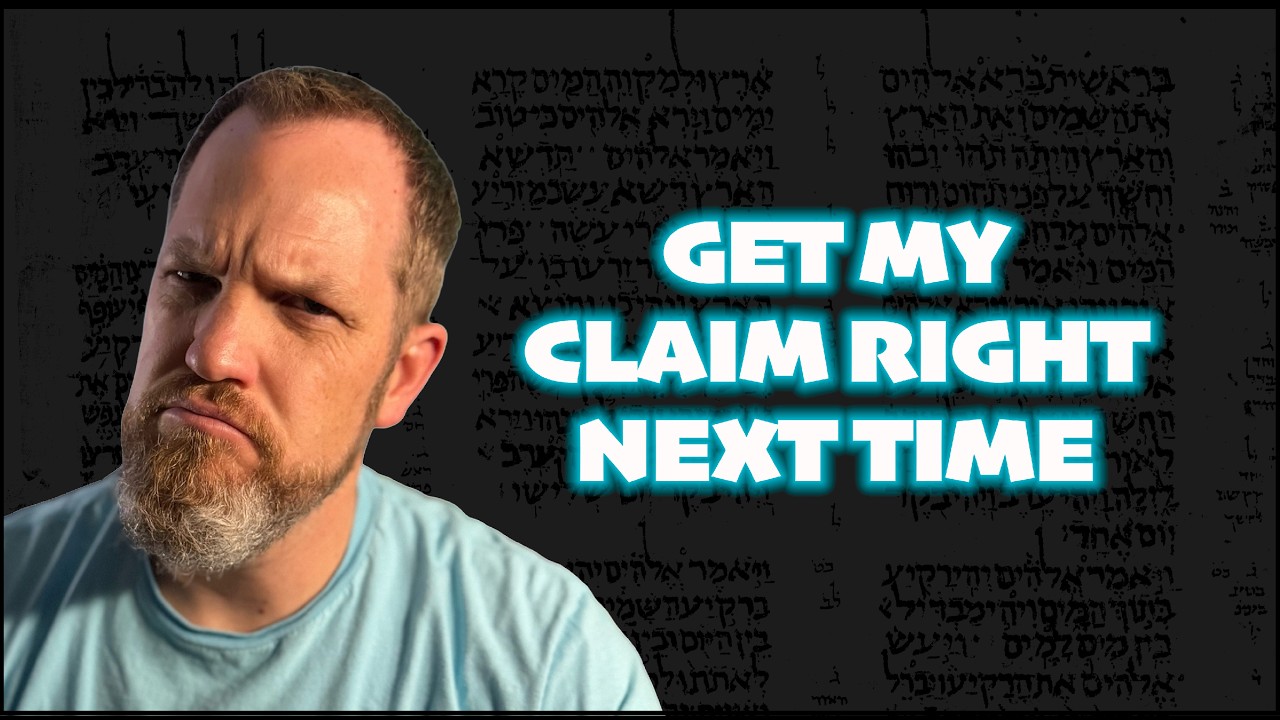
🔗 **Source:** [Am I “Cooked” by My Own Claims?](https://www.youtube.com/watch?v=DfaGUNuM1uY)
> [!note]+ Document Notes
> tags: #historical-method #biblical-studies #historiography #epistemology #source-criticism
> author: Dan McClellan
> source: YouTube
> reference: https://www.youtube.com/watch?v=DfaGUNuM1uY
> date created: 2024-12-19 12:00
>
> # 🏷️ Title: Am I "cooked" by my own claims?
>
<!-- deep-read:sections start -->
## 🧰 Action Inbox
- [H1] Examine criteria of authenticity methodology in biblical studies — outdated vs current approaches #biblical-studies
- [H2] Compare evidential standards across ancient historical figures — firsthand vs secondhand sources #historiography
- [H3] Apply cognitive science of religion to fill textual gaps — mind-religion interface research #epistemology
## 🧭 Table of Contents
- [[#📝 Summary]]
- [[#📖 Main Content]]
- [[#🗒️ Notes]]
- [[#📚 References]]
- [[#🗣️ Paraphrase]]
- [[#📰 Newsletter]]
- [[#✅ Action Items]]
- [[#🧪 Hypotheses]]
- [[#📊 Methodology]]
- [[#❓ Questions]]
- [[#🔮 Future Research]]
- [[#💡 Implications]]
- [[#🧠 Learning Styles Assessment]]
- [[#📊 Accessibility Assessment]]
- [[#🌍 DEIB Assessment]]
- [[#✅ Logical Validity]]
- [[#🛡️ DARVO Analysis]]
- [[#🎯 Conclusion]]
### 🔗 References
- [Dan McClellan YouTube Channel](https://www.youtube.com/@DanMcClellan)
- [Historical Jesus Research Methods](https://example.com)
## 📝 Summary
- Dan McClellan responds to criticism that his skepticism about Jesus's authentic sayings is inconsistent with how he treats other ancient figures
- He argues that different historical figures require different evidential standards based on available source types and chronological distance
- The core issue is distinguishing between firsthand accounts, contemporary records, and later attributions when assessing historical reliability
- McClellan maintains his approach follows standard historical methodology, not hyperskepticism
- Bottom line: Historical methodology requires case-by-case analysis of evidence types, not blanket acceptance or rejection
## 📖 Main Content
McClellan addresses accusations that he applies inconsistent skepticism when evaluating historical claims about Jesus versus other ancient figures. The critic argues that if McClellan's standards were applied consistently, we couldn't know what any ancient figure said, making all ancient history impossible.
McClellan counters by explaining that historians evaluate different types of evidence differently:
**Jesus evidence**: No firsthand accounts exist from people who actually heard Jesus speak. The Gospels are secondhand accounts written decades later by people receiving oral traditions they couldn't verify.
**Other figures comparison**:
- **Socrates**: Also no direct writings, but multiple independent sources. Plato likely knew Socrates personally, providing some firsthand knowledge, though still filtered through Plato's rhetorical goals.
- **Augustine**: Extensive texts attributed to Augustine himself, representing a much stronger evidential foundation despite later manuscript transmission.
- **Alexander/Caesar**: Later biographies rely on firsthand accounts and are supported by contemporaneous coins and inscriptions.
McClellan argues this represents standard historical methodology, not hyperskepticism. The critic's "criteria of authenticity" list appears outdated within current historical Jesus research. McClellan also brings cognitive science of religion to bridge gaps between textual claims and actual beliefs.
## 🗒️ Notes
#### ⏱️ [00:00](https://youtu.be/DfaGUNuM1uY?t=0) — [H1] Initial criticism about selective skepticism
- Key idea: Critics claim McClellan only applies skepticism when Jesus is the topic
- Evidence: "Funny how skepticism only shows up when Jesus enters the scene"
#### ⏱️ [00:30](https://youtu.be/DfaGUNuM1uY?t=30) — [H2] McClellan's position on Jesus's authentic sayings
- Key idea: Most red-letter words in New Testament are likely alterations or inventions post-death
- Evidence: "We do not have anything remotely approximating an objective or reliable way of determining which words are which"
#### ⏱️ [01:15](https://youtu.be/DfaGUNuM1uY?t=75) — [H3] Rejecting the straw man argument
- Key idea: McClellan clarifies he doesn't claim we can never know what anyone in antiquity said
- Evidence: "This is a ridiculous straw man that entirely ignores what I actually said"
#### ⏱️ [02:00](https://youtu.be/DfaGUNuM1uY?t=120) — [H1] Case-by-case analysis methodology
- Key idea: Different historical figures require different evidential approaches
- Evidence: "You have to look at figures on a case-by-case basis"
#### ⏱️ [02:45](https://youtu.be/DfaGUNuM1uY?t=165) — [H2] Jesus evidence problem explained
- Key idea: No plausible firsthand accounts exist of Jesus's words from actual witnesses
- Evidence: "We don't have anything that could plausibly be a firsthand account of something Jesus said, written by someone who actually heard him say it"
#### ⏱️ [04:30](https://youtu.be/DfaGUNuM1uY?t=270) — [H2] Socrates comparison methodology
- Key idea: Socrates evidence involves multiple sources but similar interpretive challenges
- Evidence: "The majority of what Socrates said that comes down to us through Plato is probably much like what we have about Jesus, literary creation or alteration"
#### ⏱️ [05:45](https://youtu.be/DfaGUNuM1uY?t=345) — [H1] Augustine evidence strength
- Key idea: Augustine represents much stronger evidence due to texts purportedly written by him
- Evidence: "We have manuscripts of texts that were purported to have been written by Augustine himself"
#### ⏱️ [06:30](https://youtu.be/DfaGUNuM1uY?t=390) — [H2] Alexander and Caesar evidence types
- Key idea: These figures have firsthand account-based biographies plus archaeological evidence
- Evidence: "We also have coins from their tenures. We have some inscriptions about declarations"
#### ⏱️ [07:45](https://youtu.be/DfaGUNuM1uY?t=465) — [H3] Different degrees of confidence
- Key idea: Evidence quality determines confidence levels, not binary acceptance/rejection
- Evidence: "There are different degrees to which we can say we know what they said"
#### ⏱️ [08:30](https://youtu.be/DfaGUNuM1uY?t=510) — [H1] Rejecting false dichotomy
- Key idea: The choice isn't between abandoning history or accepting everything uncritically
- Evidence: "The notion that these are the two options is just bafflingly stupid"
#### ⏱️ [09:15](https://youtu.be/DfaGUNuM1uY?t=555) — [H2] Historical method complexity
- Key idea: Historical method working often means uncertainty with better approximations
- Evidence: "Much of the time the historical method working means we're not sure but we have a better idea"
#### ⏱️ [10:30](https://youtu.be/DfaGUNuM1uY?t=630) — [H2] Outdated criteria of authenticity
- Key idea: The critic's criteria list appears AI-generated and no longer authoritative
- Evidence: "That list looks like an AI generated summary of criteria of authenticity which are not that authoritative within historical Jesus research anymore"
#### ⏱️ [12:00](https://youtu.be/DfaGUNuM1uY?t=720) — [H3] Cognitive science contribution
- Key idea: McClellan brings additional evidence through cognitive science of religion
- Evidence: "As a cognitive scientist of religion, I'm bringing an entirely different type of evidence to the questions"
#### ⏱️ [13:15](https://youtu.be/DfaGUNuM1uY?t=795) — [H1] Consistent skepticism application
- Key idea: McClellan maintains he applies consistent skepticism across topics
- Evidence: "The skepticism should always be the same. And I think I do a fairly decent job of being consistent about that"
## 📚 References
- [Dan McClellan YouTube Channel](https://www.youtube.com/@DanMcClellan)
- [Historical Jesus Research Methodology](https://example.com)
- [Cognitive Science of Religion Studies](https://example.com)
## 🗣️ Paraphrase
- Historical methodology requires evaluating evidence types individually rather than applying uniform standards across all ancient figures
- Jesus evidence consists entirely of secondhand accounts from decades later, while other figures often have firsthand sources or contemporary documentation
- The choice isn't between accepting everything or abandoning ancient history, but applying appropriate skepticism based on available evidence quality
## 📰 Newsletter
**Historical Evidence Standards: Why Context Matters in Ancient Research**
Biblical scholar Dan McClellan addresses a common criticism about applying different evidential standards to Jesus versus other ancient figures. Rather than inconsistent skepticism, this reflects proper historical methodology that evaluates evidence types case-by-case.
The key insight: firsthand accounts, contemporary records, and later attributions require different analytical approaches. Jesus research relies entirely on secondhand traditions recorded decades later, while figures like Augustine left extensive personal writings and others have archaeological corroboration.
This nuanced approach helps content creators and educators understand why scholarly consensus varies across different historical claims, even within the same time period.
Resources: [Historical Method Guides](https://example.com), [Source Criticism Tools](https://example.com), [Evidence Evaluation Frameworks](https://example.com)
## ✅ Action Items
#### DevRel
- Education: Develop workshops on evidence evaluation methodology for content creators
- Developer experience: Create decision trees for assessing source reliability in historical claims
- Community management: Establish guidelines for discussing contested historical topics
#### Community
- Contributors: Design rubrics for evaluating historical source quality
- Ecosystem: Cross-reference methodologies across different historical research communities
#### WordPress
- Documentation: Create style guides for presenting contested historical claims
- Training: Develop lesson plans on source criticism and evidence hierarchies
## 🧪 Hypotheses
- Content creators without formal historical training misunderstand standard evidential hierarchies
- Cognitive science approaches can systematically fill gaps between textual claims and actual historical beliefs
- Different evidence types (firsthand, contemporary, later attribution) require proportionally different confidence levels
- Public perception of historical "knowledge" conflates high-confidence claims with absolute certainty
### 📊 Methodology
- Survey content creators on their understanding of historical methodology standards
- Comparative analysis of evidential standards applied to Jesus versus other ancient figures in popular content
- Meta-analysis of confidence levels expressed by historians for different evidence types
### ❓ Questions
- How can historical methodology education be improved for non-specialists creating public content?
- What role should cognitive science of religion play in mainstream historical Jesus research?
- How do public expectations about historical certainty differ from scholarly standards?
### 🔮 Future Research
- Develop accessibility frameworks for communicating evidential uncertainty to general audiences
- Investigate cognitive biases affecting evaluation of religious versus secular historical claims
- Create standardized rubrics for evidence quality assessment across ancient historical figures
### 💡 Implications
- Practice: Content creators need better training in historical methodology before making authoritative claims
- Education: Historical literacy curricula should emphasize evidence evaluation over fact memorization
- Policy: Academic institutions should develop clearer public communication standards for contested historical topics
### 🧠 Learning Styles Assessment
Reading level estimate: 12th grade
#### 👀 Visual learners
- Present: None evident in audio-only format
- Improve: Evidence hierarchy diagrams, timeline comparisons, source type flowcharts
#### 🔊 Aural learners
- Present: Full audio discussion with clear verbal explanations
- Improve: Structured debate format with clear position statements
#### 🗣️ Verbal learners
- Present: Detailed analogies, technical term definitions, comparative examples
- Improve: Glossary of historiographical terms, methodological vocabulary lists
#### 🧩 Kinesthetic learners
- Present: None evident
- Improve: Evidence evaluation worksheets, source analysis exercises, methodology checklists
#### 🧠 Logical learners
- Present: Step-by-step methodology explanations, cause-effect reasoning
- Improve: Decision trees for evidence evaluation, formal logical structure diagrams
#### 🧑🤝🧑 Social learners
- Present: Response-format addressing community criticism
- Improve: Moderated discussions, peer review of evidence assessments
#### 🧘♀️ Solitary learners
- Present: Self-contained argument structure
- Improve: Reflection prompts on personal evidence evaluation biases
#### 🌿 Naturalistic learners
- Present: None evident
- Improve: Archaeological evidence connections, material culture contexts
### 📊 Accessibility Assessment
#### Screen reader semantics
- Present: Audio-only format fully accessible to screen readers
- Improve: Transcript with proper heading structure, time-stamped navigation
#### Keyboard navigation
- Present: Standard video player controls
- Improve: Chapter navigation, speed controls, bookmark functionality
#### Contrast and readability
- Present: Not applicable to audio content
- Improve: High-contrast transcript formatting
#### Text resizing and reflow
- Present: Not applicable to audio content
- Improve: Responsive transcript layout
#### Media and captions
- Present: Audio content available
- Improve: Captions with speaker identification, downloadable transcript
#### Forms and interactions
- Present: Basic video controls
- Improve: Accessible comment system, feedback forms
### 🌍 DEIB Assessment
#### Cultural breadth
- Present: Western academic historical methodology focus
- Improve: Non-Western historical traditions, global evidence evaluation approaches
#### Inclusive language
- Present: Academic terminology without definition for general audiences
- Improve: Plain-language explanations, jargon glossary
#### Neurodiversity support
- Present: Single-speaker format with consistent pacing
- Improve: Chapter breaks, content summaries, structured argument maps
#### Representation
- Present: Male academic perspective only
- Improve: Diverse scholarly voices, multiple methodological traditions
#### Psychological safety
- Present: Respectful engagement with criticism
- Improve: Clear community guidelines for historical debate
### ✅ Logical Validity
#### Strong reasoning
- Deductive strength: Strong - evidential hierarchy principles applied to specific cases
- Inductive strength: Moderate - generalizes from specific figure comparisons to broader methodology
- Causal reasoning: Strong - explains how evidence types produce different confidence levels
- Analogical strength: Strong - effective comparisons between Jesus and other historical figures
#### Fallacies
- Ad hominem: Minimal - focuses on critic's arguments rather than personal attacks
- Straw man: McClellan identifies and rejects straw man from critic effectively
#### Tone of voice
- Overall tone: Defensive but educational, maintains academic standards while responding to criticism
### 🛡️ DARVO Analysis
- Deny: No denial of core methodological approaches
- Attack: Minimal attacking, focuses on critic's misunderstanding rather than character
- Reverse victim/offender: Not applicable
- Emotional cues and rhetoric: Controlled academic frustration, maintains professional standards
## 🎯 Conclusion
McClellan successfully demonstrates that consistent historical methodology requires different evidential standards for different types of sources, not uniform skepticism or acceptance. His case-by-case approach reflects standard academic practice rather than selective bias. The key takeaway for content creators is understanding that historical confidence should be proportional to evidence quality, not driven by religious or ideological preferences.
Next steps include developing better educational resources for non-specialists and creating clearer frameworks for communicating evidential uncertainty to public audiences.
## 🧱 Refactor Appendix
### 📚 Literature Split Pad
### [H1] Historical methodology requires case-by-case evidence evaluation
> [!quote] Am I "cooked" by my own claims? by Dan McClellan via YouTube. Published 2024.
> "You have to look at figures on a case-by-case basis."
Challenges blanket evidential standards across all ancient historical figures.
[view highlight](https://youtu.be/DfaGUNuM1uY?t=120#H1) #xref #articleseed ID:rw_001
### [H2] Jesus evidence lacks firsthand witness accounts
> [!quote] Am I "cooked" by my own claims?
> "We don't have anything that could plausibly be a firsthand account of something Jesus said, written by someone who actually heard him say it."
Distinguishes Jesus evidence from other ancient figures with contemporary sources
---
## Full Transcript
[00:00] Funny how skepticism only shows up when<br>[00:02] Jesus enters the scene.<br>[00:04] >> All right, let's see it.<br>[00:06] >> I think it's likely that there are<br>[00:08] probably some things that are written in<br>[00:09] red in the New Testament that are close<br>[00:10] approximations, if not exactly what the<br>[00:11] historical Jesus said. But the<br>[00:13] overwhelming majority of the words<br>[00:14] written in red are probably alterations<br>[00:15] or inventions that came after Jesus's<br>[00:17] death. And we do not have anything<br>[00:18] remotely approximating an objective or<br>[00:20] reliable way of determining which words<br>[00:22] are which. So when people say Jesus said<br>[00:23] this and they quote the New Testament,<br>[00:24] what they really are saying is this<br>[00:25] author attributed this to Jesus. If<br>[00:27] Dan's logic works and we can't know what<br>[00:30] anyone in antiquity said ever.<br>[00:32] >> So, this is a ridiculous straw man that<br>[00:35] entirely ignores what I actually said in<br>[00:38] that video and replaces it with a more<br>[00:41] ridiculous claim that we can't ever know<br>[00:44] what anyone in antiquity ever said. And<br>[00:46] that's just not my claim. You have to<br>[00:49] look at figures on a case-bycase basis.<br>[00:52] And in the case of Jesus, we don't have<br>[00:54] anything that could plausibly be a<br>[00:57] firsthand account of something Jesus<br>[01:00] said, written by someone who actually<br>[01:02] heard him say it. We have no such<br>[01:04] witnesses whatsoever. At best, we have<br>[01:07] secondhand accounts written by people<br>[01:10] who are receiving traditions about what<br>[01:13] Jesus said, and they have no way of<br>[01:15] going and verifying the accounts that<br>[01:18] they have received. And so we can't know<br>[01:21] for sure the relationship that any of<br>[01:24] the reportage that comes down to us<br>[01:26] through the gospels might have had to<br>[01:29] words that Jesus actually said. We just<br>[01:32] don't know. But even if we did have<br>[01:34] firsthand accounts, there could have<br>[01:36] been alteration. We wouldn't know for<br>[01:40] sure that they were reporting the actual<br>[01:43] words that Jesus said as he actually<br>[01:46] said them. Now, if we had texts that<br>[01:49] purported to be Jesus's own writings,<br>[01:52] that would be a slightly different<br>[01:54] story. There would still be skepticism,<br>[01:57] but it would be a different kind of<br>[01:59] evidence. So, what we have in the<br>[02:02] gospels is a specific type of evidence<br>[02:05] and we have to treat it a specific way<br>[02:07] because it is that specific type of<br>[02:11] evidence. And when it comes to that<br>[02:12] specific type of evidence, we just don't<br>[02:15] have anything remotely approximating an<br>[02:18] objective way to demonstrate<br>[02:21] that the letters in red actually<br>[02:24] corresponded to the exact things that<br>[02:27] Jesus said. There's just not a way to do<br>[02:30] that.<br>[02:31] >> We can't know what Socrates taught. We<br>[02:33] can't know what Augustine taught. We<br>[02:34] can't know what Alexander the Great<br>[02:36] said. We can't know what Julius Caesar<br>[02:38] said because we know about these people<br>[02:40] from later sources who wrote about them.<br>[02:43] >> I would say there's a degree to which<br>[02:45] that's absolutely true and that's how<br>[02:47] historians approached these figures.<br>[02:49] However, there are also different kinds<br>[02:51] of evidence for each of these figures.<br>[02:54] You mentioned Socrates, Augustine,<br>[02:56] Alexander the Great, Julius Caesar. We<br>[03:00] don't have any writings that purport to<br>[03:02] come from Socrates. We have references<br>[03:04] to Socrates from at least four different<br>[03:08] major sources. And Plato's writings are<br>[03:11] the main source for what Socrates might<br>[03:15] have taught. But they all represent<br>[03:17] Socrates in slightly different ways. And<br>[03:20] so I think the majority view, the<br>[03:23] consensus view of classicists is that<br>[03:26] Socrates existed. And we get a kind of<br>[03:29] gist of what Socrates taught from our<br>[03:33] different sources. And Plato provides<br>[03:35] the most information, but Plato is also<br>[03:39] interpreting Socrates and representing<br>[03:41] Socrates in ways that are rhetorically<br>[03:44] useful to Plato. And so the majority of<br>[03:47] what Socrates said that comes down to us<br>[03:49] through Plato is probably much like what<br>[03:52] we have about Jesus, literary creation<br>[03:55] or alteration. Now, Plato likely did<br>[03:59] know Socrates and so had firthand<br>[04:03] knowledge of a lot of what Socrates<br>[04:04] said, unlike what we have with Jesus.<br>[04:07] But that doesn't change the fact that<br>[04:10] the majority of classes still treat with<br>[04:13] skepticism the accounts of what Socrates<br>[04:16] said that come down to us through Plato.<br>[04:19] So, the notion that we treat this<br>[04:22] evidence differently is just not true.<br>[04:24] Now, when it comes to Augustine, we have<br>[04:27] a number of very long texts that were<br>[04:30] purported to have been written by<br>[04:32] Augustine himself. And so, that's a<br>[04:34] different type of evidence. Now, the<br>[04:37] manuscripts that we have are from much<br>[04:40] later time periods and sometimes later<br>[04:42] translations. And so, there's a degree<br>[04:45] to which we have to reconstruct what we<br>[04:46] think the original text was. But once we<br>[04:49] get to that original text, there's a<br>[04:52] pretty close correspondence between that<br>[04:54] original text and what Augustine<br>[04:56] actually wrote. So we have a much much<br>[04:58] much clearer idea of what Augustine<br>[05:01] actually said because we have the words<br>[05:04] that are purported to come directly from<br>[05:06] him, written down<br>[05:08] by him or at least dictated by him. So<br>[05:12] that's a different kind of evidence when<br>[05:14] it comes to Alexander the Great and<br>[05:15] Julius Caesar. While the biographies<br>[05:17] that we have come from much later, they<br>[05:20] rely on firsthand accounts of what<br>[05:23] Alexander the Great and Julius Caesar<br>[05:26] happened to have done and said. So there<br>[05:30] is a different type of evidence<br>[05:32] available to us in those biographies. A<br>[05:34] type of evidence that the majority of<br>[05:36] scholars agree is not extant in the text<br>[05:40] of the New Testament. And so we treat<br>[05:42] Alexander the Great and Julius Caesar<br>[05:43] slightly differently. We also have coins<br>[05:47] from their uh tenurs. We have some<br>[05:50] inscriptions about declarations that<br>[05:54] seem to have come from them or from<br>[05:56] their administrations at least. So we<br>[05:58] have a lot of different kinds of<br>[05:59] evidence. And so while I think it is<br>[06:01] still true that we cannot say we know<br>[06:05] that every word attributed to these<br>[06:07] figures is exactly the words that fell<br>[06:10] from their mouth or from their pen.<br>[06:12] There are different degrees to which we<br>[06:14] can say we know what they said. And I<br>[06:17] think Augustine is the one where we have<br>[06:19] the strongest case to make for things<br>[06:20] that he said because we have manuscripts<br>[06:23] of texts that were written by Augustine.<br>[06:27] Now does that mean that there's no such<br>[06:30] thing as a text where we're like maybe<br>[06:32] Augustine didn't write this or maybe<br>[06:34] this has been elaborated on? No. That<br>[06:36] can absolutely be the case. But there is<br>[06:40] skepticism applied to all of these folks<br>[06:43] to differing degrees depending on the<br>[06:44] type of evidence that exists. So the<br>[06:47] notion that the skepticism changes only<br>[06:51] because it's Jesus is laughably<br>[06:54] ignorant. That's just not how this works<br>[06:56] at all. And this betrays that you really<br>[06:59] know nothing about<br>[07:01] the historioggraphical treatment of<br>[07:04] these figures and how historians and<br>[07:07] classicists and biblical scholars<br>[07:09] approach these figures.<br>[07:11] >> So you're left with two options. You<br>[07:13] either abandon all ancient history or<br>[07:15] you acknowledge that the historical<br>[07:16] methods actually work, which Dan<br>[07:19] selectively uses most of the time. The<br>[07:21] notion that these are the two options is<br>[07:23] just bafflingly stupid because what does<br>[07:27] it mean to say acknowledge that the<br>[07:29] historical method most of the time<br>[07:31] works? I don't think this content<br>[07:33] creator knows what the historical method<br>[07:35] is and I don't think this content<br>[07:38] creator knows what it means for the<br>[07:39] historical method to work because much<br>[07:42] of the time the historical method<br>[07:44] working<br>[07:46] means we're not sure but we have a<br>[07:49] better idea and the notion that the<br>[07:52] alternative is to just say well we're<br>[07:54] going to throw our hands up and not do<br>[07:56] history anymore is so just asinine and I<br>[08:01] don't perfectly apply the historical<br>[08:04] method. Nobody can, but I think I do a<br>[08:06] pretty consistent job. And the notion<br>[08:08] that I'm just imposing skepticism<br>[08:10] whenever it comes to Jesus and I'm not<br>[08:12] imposing skepticism when it comes to any<br>[08:14] other figures is again laughable. That's<br>[08:19] just not true. Anybody who knows an<br>[08:22] appreciable amount about my channel<br>[08:24] knows that that's just not true. I<br>[08:26] frequently apply skepticism to things<br>[08:29] where people who would consider<br>[08:31] themselves on my side of the aisle would<br>[08:33] prefer I didn't. I get criticism from<br>[08:36] all across the entire spectrum of belief<br>[08:38] and non-belief as well as support<br>[08:41] because I think a lot of people<br>[08:42] understand I'm trying my best to be<br>[08:44] consistent and a lot of people don't<br>[08:46] like that I'm trying my best to be<br>[08:48] consistent. But the notion that I am<br>[08:49] selectively applying skepticism uh I<br>[08:52] think is just ludicrous. You see, his<br>[08:55] argument is not standard historical<br>[08:56] reasoning.<br>[08:57] >> Uh, yes it is.<br>[08:59] >> And it's actually hypers skepticism. And<br>[09:01] the majority of historians reject this.<br>[09:03] >> Yeah, that's just not true.<br>[09:05] >> The historians actually evaluate things<br>[09:07] based on this criteria. Multiple<br>[09:10] independent sources, early dating,<br>[09:12] embarrassment, enemy attestation,<br>[09:14] archaeological corroboration, oral<br>[09:17] cultural reliability, not something was<br>[09:20] written later, therefore it can't be<br>[09:22] true. So that's not a criterion that I<br>[09:25] have applied. However, you'll notice<br>[09:27] that the second criterion on that list,<br>[09:29] early dating, is one of the things that<br>[09:32] points to increased skepticism for the<br>[09:36] gospel accounts because they come from<br>[09:38] several decades after the events they<br>[09:41] purport to narrate. However, that list<br>[09:43] looks like an AI generated summary of<br>[09:46] criteria of authenticity which are not<br>[09:49] that authoritative within historical<br>[09:51] Jesus research anymore. So, it sounds<br>[09:54] like this content creator is using<br>[09:56] outdated criteria and then ignoring the<br>[09:59] fact that my concerns actually are a<br>[10:03] direct outgrowth of many of those<br>[10:05] criteria and then is misrepresenting<br>[10:08] the only criterion that they imagine I<br>[10:11] am applying. So this is just an<br>[10:14] atrocious attempt to try to interrogate<br>[10:19] the criteria I am applying to the New<br>[10:22] Testament and to try to represent what<br>[10:25] actual historians actually do. This<br>[10:28] content creator is very clearly not a<br>[10:30] historian and very clearly does not know<br>[10:31] much about how historians work. If<br>[10:34] decades of distance makes something<br>[10:36] unreliable, then Dan can't know for sure<br>[10:39] what anyone in antiquity ever said.<br>[10:42] >> I mean, that's not very far off from how<br>[10:46] historians think about this, but that<br>[10:49] also misrepresents a lot of the evidence<br>[10:51] that comes down to us because we do have<br>[10:54] texts and artifacts that are<br>[10:55] contemporaneous with the figures that<br>[10:59] we're trying to interrogate. And we do<br>[11:01] have texts that were written by those<br>[11:03] figures. Now, the earliest manuscripts<br>[11:06] of those texts often have an awful lot<br>[11:09] of distance. And so, there's text<br>[11:11] critical stuff that comes into play. But<br>[11:14] frequently, those texts were actually<br>[11:16] originally written by the very figures<br>[11:18] we're trying to interrogate. But even<br>[11:21] when we trace the texts of the New<br>[11:23] Testament, or at least their<br>[11:24] manuscripts, back to when we think those<br>[11:26] texts were originally written, there<br>[11:28] still are decades of distance. And<br>[11:30] remember that early attestation<br>[11:32] criterion that was on this content<br>[11:34] creators list means that there is<br>[11:37] opportunity within the space of those<br>[11:40] decades for embellishment and for<br>[11:44] traditions to be altered and to be<br>[11:47] picked up by different people in<br>[11:49] different ways and to be passed on in<br>[11:51] different ways. So none of what's being<br>[11:53] presented here is actually complicating<br>[11:56] my position. this content creator is<br>[11:59] just misunderstanding and<br>[12:00] misrepresenting not only my position but<br>[12:03] also the criteria that they have<br>[12:07] presented.<br>[12:08] >> Yeah. With so much confidence he tells<br>[12:10] us what the early Christians taught,<br>[12:13] what Jews believed, what the scribes<br>[12:15] intended, what second temple Judaism was<br>[12:18] about. But he gets that information from<br>[12:21] the same sources we get our information<br>[12:23] from. So I would say both parts of this<br>[12:27] statement are not entirely accurate<br>[12:30] because I don't talk about what the<br>[12:32] scribes themselves actually believed. I<br>[12:35] talk about how the author of the Gospel<br>[12:37] of Mark or the author of the Gospel of<br>[12:39] John wanted to represent the scribes.<br>[12:44] And when it comes to using the same<br>[12:46] evidence as this content creator, I<br>[12:48] don't think this content creator uh<br>[12:51] explores near as much evidence as I and<br>[12:54] other historians do. But also, as a<br>[12:55] cognitive scientist of religion, I'm<br>[12:57] bringing an entirely different type of<br>[13:00] evidence to the questions as well<br>[13:03] because there is a gap between what<br>[13:05] these people believed and what is<br>[13:07] preserved in the text. Even if those<br>[13:10] people wrote the text themselves,<br>[13:11] frequently texts are not perfect<br>[13:14] reflections, isometric representations<br>[13:17] of what people believed because<br>[13:19] rhetorical goals come into play. But<br>[13:23] with the cognitive science of religion,<br>[13:24] I think we can cover a little bit of<br>[13:27] that gap by observing the way that the<br>[13:30] human mind works in relation to the<br>[13:33] package of things that we have decided<br>[13:36] to label religion. So, we can say when<br>[13:39] it comes to how people think about and<br>[13:41] talk about divine beings, here are some<br>[13:44] patterns that result from having to use<br>[13:48] a human mind that allow us to close a<br>[13:50] little bit of that gap. So, I'm bringing<br>[13:52] other types of evidence into these<br>[13:54] questions that I don't think this<br>[13:55] content creator uh really has access to<br>[13:58] or knows much about. But at the same<br>[14:00] time, the claims they're making about my<br>[14:03] claims are not actually accurate because<br>[14:06] I tend to be very very careful in<br>[14:08] ensuring I am distinguishing what<br>[14:11] someone might believe from what a text<br>[14:13] might claim particularly if there is<br>[14:17] substantial chronological distance or<br>[14:20] even socio cultural distance between a<br>[14:24] figure in a text and those actual<br>[14:27] figures in history. So the question<br>[14:29] actually becomes why does skepticism<br>[14:31] answer when Jesus is the topic?<br>[14:34] >> Uh the skepticism should always be the<br>[14:36] same. And I think I do a fairly decent<br>[14:39] job of being consistent about that.<br>[14:40] Again, I'm not perfect. Nobody can be.<br>[14:43] But the notion that the skepticism only<br>[14:45] comes into play when Jesus is in view is<br>[14:49] absolutely asinine.<br>[14:50] >> And if we can't know what Jesus said<br>[14:52] because the sources come decades later,<br>[14:55] then we can't really know what anyone in<br>[14:56] antiquity said. So yes and no. There's a<br>[15:00] degree to which there will always be<br>[15:02] uncertainty about precisely what<br>[15:05] somebody said when the best evidence we<br>[15:08] have is secondhand and comes from much<br>[15:11] later. But no, it's not just because it<br>[15:13] comes from much later. We have to look<br>[15:15] at the type of evidence that we have. We<br>[15:17] have to interrogate all the different<br>[15:19] kinds of evidence and we have to<br>[15:21] interrogate the methods and the theories<br>[15:23] that we're bringing to bear on the<br>[15:25] historical questions that we're asking<br>[15:27] of these sources. So, it's a lot more<br>[15:30] complex than this content creator is<br>[15:32] representing, but also, yeah, there's a<br>[15:35] degree to which that is true. We can't<br>[15:37] really know for sure most of the time<br>[15:40] precisely what a historical figure said,<br>[15:43] particularly<br>[15:45] when we don't have anything that we can<br>[15:48] confidently conclude is an actual<br>[15:50] firsthand account.<br>[15:51] >> And that is not scholarship.<br>[15:53] >> This content creator is obviously not in<br>[15:55] any kind of position to assess what is<br>[15:58] and isn't scholarship.<br>[16:00] >> That is Dan's own logic self-destructing<br>[16:03] on himself.<br>[16:04] >> Uh, no. This is this content creators<br>[16:06] sophomoric straw man fallacy betraying<br>[16:10] their naivity and their ignorance<br>[16:12] regarding the methods and the standards<br>[16:15] of an academic field about which they<br>[16:18] clearly know very little but on behalf<br>[16:21] of which they are presuming to speak<br>[16:23] authoritatively.<br>[16:25] But if you like this video, make sure<br>[16:26] you hit that like. You share us with a<br>[16:28] friend of you. Follow me for<br>[16:29] >> N. I'm good.
<!-- deep-read:sections end -->
📄 **Full text:** ![[Full Document Contents/Articles/Am I “Cooked” by My Own Claims|Am I “Cooked” by My Own Claims?, YouTube]]
## Highlights
- have texts that were written by those figures. Now, the earliest manuscripts of those texts often have an awful lot of distance. And so, there's text critical stuff that comes into play. But frequently, those texts were actually originally written by the very figures we're trying to interrogate. But even when we trace the texts of the New Testament, or at least their manuscripts, back to when we think those texts were originally written, there still are decades of distance. And ([View Highlight](https://read.readwise.io/read/01kkvtyjp2ws1f18a3sf2925xy))
- Tags: 👻 ai highlighted
- because I don't talk about what the scribes themselves actually believed. I talk about how the author of the Gospel of Mark or the author of the Gospel of John wanted to represent the scribes. And when it comes to using the same evidence as this content creator, I don't think this content creator uh explores near as much evidence as I and other historians do. But also, as a cognitive scientist of religion, I'm bringing an entirely different type of ([View Highlight](https://read.readwise.io/read/01kkvtyjq337rfmnewdcc2vvzw))
- Tags: 👻 ai highlighted
- answer when Jesus is the topic? >> Uh the skepticism should always be the same. And I think I do a fairly decent job of being consistent about that. Again, I'm not perfect. Nobody can be. But the notion that the skepticism only comes into play when Jesus is in view is absolutely asinine. >> And if we can't know what Jesus said because the sources come decades later, then we can't really know what anyone in antiquity said. So yes and no. There's a ([View Highlight](https://read.readwise.io/read/01kkvtyjsa9w38c86prw64fx5n))
- Tags: 👻 ai highlighted