Application for Admission of Attorney Pro Hac Vice
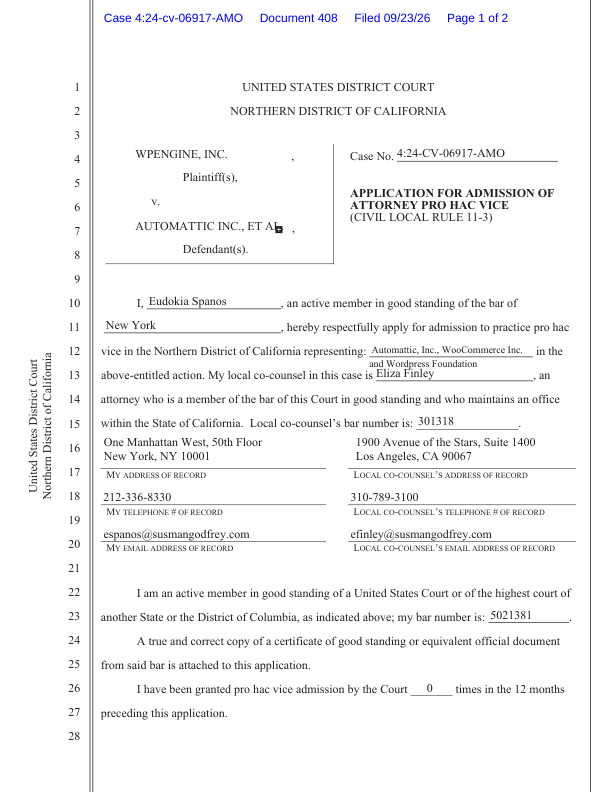
🔗 **Source:** [Application for Admission of Attorney Pro Hac Vice](https://storage.courtlistener.com/recap/gov.uscourts.cand.437474/gov.uscourts.cand.437474.408.0.pdf)
> [!note]+ Document Notes
> tags: [pro-hac-vice, court-procedure, legal-team, wp-engine-litigation, automattic]
> author: Eudokia Spanos (applicant), United States District Court, Northern District of California
> source: CourtListener RECAP (N.D. Cal. 3:24-cv-06917-AMO)
> reference: https://storage.courtlistener.com/recap/gov.uscourts.cand.437474/gov.uscourts.cand.437474.408.0.pdf
> date created: 2026-10-01 17:28
>
> > [!info] Generated analysis — not the author's words. Sections below are machine-written
> > from the captured source. Only text inside `> [!quote]` blocks is verbatim from the author.
> > Do not quote or attribute any other line to the named author.
>
> # 🏷️ Title: Application for Admission of Attorney Pro Hac Vice
>
<!-- deep-read:sections start -->
## 🧭 Table of contents
- [📝 Summary](#-summary)
- [📖 Main content](#-main-content)
- [🗒️ Notes](#️-notes)
- [📚 References](#-references)
- [🗣️ Paraphrase](#️-paraphrase)
- [📰 Newsletter](#-newsletter)
- [✅ Action items](#-action-items)
- [🧪 Hypotheses](#-hypotheses)
- [📊 Methodology](#-methodology)
- [❓ Questions](#-questions)
- [🔮 Future research](#-future-research)
- [💡 Implications](#-implications)
- [🧠 Learning styles assessment](#-learning-styles-assessment)
- [📊 Accessibility assessment](#-accessibility-assessment)
- [🌍 DEIB assessment](#-deib-assessment)
- [✅ Logical validity](#-logical-validity)
- [🛡️ DARVO analysis](#️-darvo-analysis)
- [🎯 Conclusion](#-conclusion)
- [🔄 Refactor appendix](#-refactor-appendix--application-for-admission-of-attorney-pro-hac-vice)
This is a neutral description of a court document. It is not legal advice, and the analyst is not a lawyer. Paragraph labels like ¶9 are the pipeline's extraction labels. Attorney bar numbers and contact details on the form are left out on purpose.
## 📝 Summary
- **What happened.** On 9/23/2026 (¶0, ¶28, ¶36), Eudokia Spanos, who states membership in the New York bar (¶7, ¶8), filed a two-page form, Dkt. 408, applying to appear pro hac vice in WPEngine, Inc. v. Automattic Inc., et al., N.D. Cal., Case No. 4:24-CV-06917-AMO as printed here (¶3, ¶6). The form cites Civil Local Rule 11-3 (¶6). The same PDF carries a pre-printed order block granting the application (¶30 to ¶35) dated September 23, 2026 (¶36).
- **The claim.** The applicant states, under penalty of perjury (¶27), that the applicant is an active member in good standing of a state bar (¶18, ¶19), attaches a certificate of good standing (¶20, ¶21), reports 0 pro hac vice grants in the 12 months before filing (¶22, ¶23), and agrees to follow the Local Rules (¶25 to ¶27). These are the applicant's own statements. The Court has not verified them in this text.
- **Why it matters.** The form names who the applicant will represent: Automattic, Inc., WooCommerce Inc. and the Wordpress Foundation (¶9, ¶10). It names Eliza Finley as local co-counsel who maintains an office in California (¶10, ¶11). That is one fact about the roster of the Automattic side of the case. It says nothing about the merits.
- **Key stakeholders.** The applicant; the local co-counsel; the three client entities; the Court, which signs the order block. Plaintiff WPEngine, Inc. appears only in the caption (¶3). The caption lists the Automattic entities as defendants (¶6).
- **Risks and tradeoffs.** Extraction noise scrambles the client sentence across ¶9 and ¶10, and bar numbers and contact cells sit out of order (¶12 to ¶19). The order block shows a date but no judge name (¶36, ¶37), so the capture can't show who signed or whether the docket entry reads "granted."
- **Bottom line.** A routine eligibility form. It confirms one attorney's participation and the local co-counsel arrangement, and it is a party filing, not a ruling on anything contested.
## 📖 Main content
**What pro hac vice means.** The Latin phrase means "for this occasion." An attorney admitted to practice in one jurisdiction asks a court to let the attorney appear in one case without joining that court's bar. That definition is general background, not something the form states. The form itself says only that the applicant applies "for admission to practice pro hac vice in the Northern District of California" (¶8, ¶9) and cites Civil Local Rule 11-3 (¶6, ¶33). The rule's full text isn't in the capture, and a lawyer or the Court's Local Rules would confirm its requirements.
**How the document is built.** Three parts.
- Caption (¶0 to ¶6): court, case number, party names, form title and rule cited.
- Applicant's statement and declaration (¶7 to ¶29): bar membership, local co-counsel, good standing, certificate, prior admissions, agreement to the Local Rules, signature and date.
- Proposed order (¶30 to ¶37) and form revision stamp "Updated 11/2021" (¶38).
**What the applicant states.**
- Membership: an active member in good standing of the bar of New York (¶7, ¶8), restated for a state, federal court or the District of Columbia (¶18, ¶19). The bar number cell is out of order in the capture and isn't repeated here.
- Representation: Automattic, Inc., WooCommerce Inc. and the Wordpress Foundation (¶9, ¶10). The extraction splits the sentence, with the local co-counsel's name landing inside it (¶10). The reading above reassembles it in the order the words appear. A lawyer or the docket should confirm the exact client list.
- Local co-counsel: Eliza Finley, who is stated to be a member of this Court's bar in good standing and to maintain an office in California (¶10, ¶11).
- Certificate: a copy of a certificate of good standing or equivalent is stated to be attached (¶20, ¶21). The attachment isn't part of the text.
- Prior admissions: 0 grants in the preceding 12 months (¶22, ¶23). The "0" prints before the sentence in the capture.
- Undertaking: familiarize with and abide by the Local Rules, including the Standards of Professional Conduct and the Alternative Dispute Resolution Local Rules (¶25 to ¶27).
**What the order block says.** Pre-printed text provides that the application is "granted, subject to the terms and conditions of Civil L.R. 11-3," that all papers the attorney files must indicate appearance pro hac vice, and that service on local co-counsel counts as notice to the party (¶32 to ¶35). It is dated September 23, 2026 (¶36). The judge line shows only the title "UNITED STATES DISTRICT/MAGISTRATE JUDGE" (¶37). A printed order block on a filed form doesn't by itself show the Court signed it, and this analysis doesn't assume it.
**Allegations versus orders.** The applicant's statements are assertions to the Court. The order block, if signed, is what admits the applicant. The form makes no allegation about WPE or any other party and states no fact about the dispute.
**Uncertain in this capture.**
- **Local co-counsel's bar number.** ¶12 shows a number before the sentence "Local co-counsel's bar number is: _________________." The number appears out of order, so whether it belongs in the blank is a reading, not a fact. An earlier summary called the field blank, which the text does not support.
- **Contact cells.** Addresses, phone numbers and emails are interleaved in ¶13 to ¶17 and aren't used here.
- **Dates.** The caption (¶0), the signature (¶28) and the order (¶36) all show 9/23/2026 or September 23, 2026. An earlier batch note gave 9/17/2026, which the text doesn't show.
- **Near-duplicate.** A batch note describes Dkt. 407 as a near-duplicate application. Dkt. 407 isn't in this capture, so no comparison is made.
## 🗒️ Notes
#### 📄 ¶0-¶6 Caption
- Header: Case 4:24-cv-06917-AMO, Document 408, filed 09/23/26, page 1 of 2 (¶0). The caption case number prints the same way (¶7 shows it in the table, ¶3).
- Court: United States District Court, Northern District of California (¶1, ¶2).
- WPENGINE, INC. is plaintiff; AUTOMATTIC INC., ET AL. are defendants (¶3, ¶6). Form title: Application for Admission of Attorney Pro Hac Vice, Civil Local Rule 11-3 (¶4, ¶6).
- "v." sits alone in ¶5.
#### 📄 ¶7-¶10 Applicant and clients
- Eudokia Spanos states active good standing in the bar of New York and applies for admission pro hac vice in this District (¶7 to ¶9).
- The representation clause names Automattic, Inc., WooCommerce Inc. and the Wordpress Foundation (¶9, ¶10).
- Eliza Finley is named as local co-counsel (¶10). The extraction places that name inside the client sentence.
#### 📄 ¶11-¶12 Local co-counsel status
- Local co-counsel is stated to be a member of the bar of this Court in good standing who maintains an office within California (¶11, ¶12).
- A number prints before the "bar number is" sentence and the blank follows it (¶12). The number isn't reproduced here.
#### 📄 ¶13-¶17 Address, phone and email cells
- Two-column table of addresses, telephone numbers and email addresses of record for the applicant and for local co-counsel, with labels in separate paragraphs (¶13 to ¶17).
- Contact details are omitted from this analysis by design.
#### 📄 ¶18-¶21 Good standing and certificate
- The applicant states active membership in a United States Court or the highest court of another State or the District of Columbia "as indicated above" (¶18, ¶19). A bar number cell prints inside ¶19 and is omitted here.
- A true and correct copy of a certificate of good standing or equivalent is stated to be attached (¶20, ¶21).
#### 📄 ¶22-¶23 Prior admissions
- "0" prints before the sentence: the applicant has been granted pro hac vice admission by the Court that number of times in the 12 months preceding the application (¶22, ¶23).
#### 📄 ¶24-¶29 Undertaking and signature
- Header text "United States District Court Northern District of California" (¶24).
- The applicant agrees to familiarize with and abide by the Local Rules, the Standards of Professional Conduct and the ADR Local Rules (¶25 to ¶27).
- The applicant declares under penalty of perjury that the foregoing is true and correct (¶27).
- Signature line shows the applicant's name and the date 9/23/2026 (¶28). Label "APPLICANT" (¶29).
#### 📄 ¶30-¶37 Order block
- Heading: Order Granting Application for Admission of Attorney Pro Hac Vice (¶30, ¶31).
- Text orders that the application of the applicant "is granted," subject to Civil L.R. 11-3 (¶32, ¶33).
- All papers filed by the attorney must indicate appearance pro hac vice (¶33, ¶34). Service on, and communication with, local co-counsel counts as notice to the party (¶34, ¶35).
- Dated September 23, 2026 (¶36). The signature line carries the title only: United States District/Magistrate Judge (¶37).
#### 📄 ¶38 Form stamp
- Page 2 and "Updated 11/2021" (¶38). That is the form's revision date, not a filing date.
## 📚 References
The captured link list is empty. No link in the captured markup points to any source for this document.
- [The application as downloaded from CourtListener RECAP](https://storage.courtlistener.com/recap/gov.uscourts.cand.437474/gov.uscourts.cand.437474.408.0.pdf): Dkt. 408, the document analyzed here.
- Civil Local Rule 11-3 of the Northern District of California (¶6, ¶33): cited by the form. Its text isn't in the capture and no link appears for it.
- Certificate of good standing (¶20, ¶21): stated to be attached. It isn't in the capture and isn't linked.
- Claims with no link in the captured markup: every statement on the form, since the form cites only the rule and the Court's Local Rules (¶25, ¶26).
- Primary source to check next: the CourtListener docket for Case No. 3:24-cv-06917-AMO, which would show whether Dkt. 408 is entered as granted and how it differs from Dkt. 407.
## 🗣️ Paraphrase
An attorney from New York asked the Court for permission to appear in this case without joining the Northern District bar. The form says the attorney will represent Automattic, Inc., WooCommerce Inc. and the Wordpress Foundation, and that a California-based attorney, Eliza Finley, will serve as local co-counsel.
The attorney states, under penalty of perjury, that they are in good standing, have a certificate of good standing attached, have been admitted pro hac vice 0 times in the past 12 months, and will follow the Court's Local Rules. A pre-printed order on the same pages grants the request, requires the attorney to mark all filings as pro hac vice, and says service on local co-counsel counts as notice to the party. It is dated September 23, 2026 with no judge's name in the captured text.
## 📰 Newsletter
**A new name on the Automattic side of WPE v. Automattic.** On September 23, 2026, Eudokia Spanos filed Dkt. 408, an application to appear pro hac vice for Automattic, Inc., WooCommerce Inc. and the Wordpress Foundation, with Eliza Finley as California local co-counsel. The form carries a pre-printed order block dated the same day.
Read it for the roster, not the merits. A pro hac vice form states eligibility facts: good standing, a certificate, 0 admissions in the last 12 months, and agreement to follow the Local Rules. It says nothing about the dispute. For the full picture, check the CourtListener docket for the entry and for Dkt. 407. Link: [Dkt. 408 on CourtListener](https://storage.courtlistener.com/recap/gov.uscourts.cand.437474/gov.uscourts.cand.437474.408.0.pdf).
## ✅ Action items
Not legal advice. Each line ties to the form's text or says plainly that no action follows.
#### DevRel
- Developer advocacy: no direct action. If you talk about the case, describe this as an attorney-admission form, not as a development in the dispute.
- Education: a short explainer on what pro hac vice means and what a local co-counsel does, using the three-part structure in Main content.
- Developer experience: none. The form isn't about software.
- Developer marketing: none.
- Community management: if the filing comes up in community channels, link the PDF and say it records who will appear for the Automattic entities. Keep speculation about strategy out of the thread.
- Internal/external/cross-project: none from this source.
#### OSPO
- Policy and governance: none. The form sets no open-source policy.
- License compliance: none. No license is mentioned.
- Security management: none.
- Software inventory: none.
- Developer support: point contributors who ask about the case to the public docket instead of summaries.
- Community engagement: none from this source.
- Strategic alignment: none. The form makes no claim about open-source strategy.
#### Community
- Maintainers: no direct action. Maintainers who are named in legal filings can ask counsel what they may say publicly.
- Contributors: none.
- Sponsors: none. The form doesn't discuss sponsorship.
- Ecosystem: none from this source.
#### WordPress
- Core: no direct action.
- Core Performance: none.
- Core AI: none.
- **Core Program Team:** none.
- Mobile: none.
- Playground: none.
- Community: no direct action. Community leaders may get questions about who represents the Wordpress Foundation, and the form is a neutral primary source for that one fact.
- Training: none.
- Marketing: none. Don't present an admission form as news about the case's merits.
- Support: none.
- Design: none.
- Documentation: none. A neutral "how to read a court docket" note could help contributors who follow the case.
- Photos: none.
- TV: none.
- Polyglots: none.
- Accessibility: none from this source.
- Meta: none. The form doesn't touch the .org directory.
- CLI: none.
- Hosting: none. Plaintiff WPEngine, Inc. appears only in the caption (¶3).
- Tide: none.
- Openverse: none.
- Themes: none.
- Plugins: none. WooCommerce Inc. is a named client (¶9), but the form says nothing about the plugin.
#### The WPOCC
- Programs: none directly.
- Projects: none.
- Funding experiments: none from this source.
### FAIR
- Technical independence: none. The form says nothing about package signing or provenance.
- Policies and covenants: none directly.
- Productized governance artifacts: none from this source.
## 🧪 Hypotheses
1. Dkt. 407 and Dkt. 408 differ in only one or two fields (for example the client list, the applicant's bar cell or the declaration date), and Dkt. 407 was refiled to correct one of them.
2. The docket shows Dkt. 408 as granted on 9/23/2026, the same day as the printed order date.
3. The number that prints before the local co-counsel bar sentence in ¶12 belongs in that blank, and the extraction moved it.
4. The "0" in ¶22 is a typed entry in a blank that precedes the sentence on the form, so "0 times" is the applicant's actual statement.
5. Pro hac vice applicants in this case who state 0 prior admissions in 12 months are admitted faster than applicants with several, because there is less to review.
6. An automated reader that sees only the extracted text will misassign at least one form field on a two-column attorney table like ¶13 to ¶17.
## 📊 Methodology
- **H1.** Download Dkt. 407 and Dkt. 408 from CourtListener and compare them field by field. Record every difference and check the docket text for a correction notice.
- **H2.** Read the docket entry for Dkt. 408 and note the entry text, the signing judge and the date.
- **H3.** Compare the PDF text layer with the rendered PDF page. If the number sits in the blank, the extraction moved it.
- **H4.** View the rendered form and check whether ¶22's "0" prints in the blank. A second reader confirms.
- **H5.** Sample pro hac vice applications from N.D. Cal. dockets, code each by prior-admission count, and measure time from filing to order. Pre-register the coding.
- **H6.** Run text extraction over a sample of attorney-application PDFs, compare against hand transcription, and count column misassignments.
- **Controls throughout.** One coder per form plus a second reviewer, and no contact details recorded.
## ❓ Questions
- Who signed the order block, and does the docket list Dkt. 408 as granted? The capture shows no judge name (¶37).
- Does the client list read Automattic, Inc., WooCommerce Inc. and the Wordpress Foundation in that order (¶9, ¶10)?
- How do Dkt. 407 and Dkt. 408 differ, and why were both filed?
- Does the number in ¶12 belong in the local co-counsel bar blank, or is that field empty on the rendered form?
- Is the certificate of good standing on the docket as an attachment to Dkt. 408 (¶20, ¶21)?
- What does Civil L.R. 11-3 require beyond the items on this form?
- Why does the header print 4:24-cv-06917-AMO while the order caption in other filings reads 3:24-cv-06917-AMO?
- Who else has filed pro hac vice applications in this case, and for which parties?
## 🔮 Future research
- **Compare the pair.** A side-by-side of Dkt. 407 and Dkt. 408 would resolve the near-duplicate question.
- **Roster tracking.** A tracker of appearances by party across the docket would show how the teams changed over time. This form adds one entry.
- **Local rule reading.** Read Civil L.R. 11-3 and the Standards of Professional Conduct that the form references (¶26).
- **Extraction quality.** Test whether a form-aware PDF extractor keeps the two-column table in order.
- **Order practice.** Check how often N.D. Cal. pre-printed order blocks are signed the same day as filing. This form shows one date, not a pattern.
## 💡 Implications
- **Practice.** Anyone tracking the case can cite this form for who is stated to appear for the Automattic entities and who the local co-counsel is, and shouldn't read more into it.
- **Policy.** The form shows a court-required structure: an out-of-state attorney pairs with a local co-counsel who keeps a California office (¶10, ¶11).
- **Security.** The form carries personal contact details in table cells. Those are left out here and shouldn't be copied into notes or trackers.
- **Education.** It is a compact example of an eligibility form: five statements, one undertaking, one signature.
- **Funding.** The form says nothing about funding or fees.
## 🧠 Learning styles assessment
- **Reading level estimate.** The Flesch-Kincaid Grade Level of the longest sentence (¶7 to ¶12) is about grade 15. Most of the text is form fields and labels with no sentence structure, so a computed score isn't meaningful. This is a sampled estimate, not a computed number.
#### 👀 Visual learners
- Present: a two-page form with labeled fields and a two-column address table. The capture keeps field text but not the layout.
- Improve: an annotated screenshot of the form that labels each of the five statements, plus a three-box diagram of applicant, local co-counsel and Court.
#### 🔊 Aural learners
- Present: no audio is referenced.
- Improve: a 2-minute audio explainer on what a pro hac vice application does.
#### 🗣️ Verbal learners
- Present: plain declarative sentences, such as "A true and correct copy of a certificate of good standing or equivalent official document from said bar is attached" (¶20, ¶21).
- Improve: a glossary for "pro hac vice," "local co-counsel," "good standing" and "penalty of perjury."
#### 🧩 Kinesthetic learners
- Present: none. The form is an instrument, not a procedure.
- Improve: ask readers to find Dkt. 408 on CourtListener and locate each field in the rendered PDF.
#### 🧠 Logical learners
- Present: a fixed sequence of eligibility statements, then a conditional order.
- Improve: a decision tree: good standing, certificate, local co-counsel, prior-admissions count, then the Court's order.
#### 🧑🤝🧑 Social learners
- Present: none. The form is a single-voice filing.
- Improve: a discussion prompt: "Why do courts require local co-counsel?"
#### 🧘♀️ Solitary learners
- Present: a short, self-contained document.
- Improve: a self-check: "Which statements does the applicant swear to, and which text is the Court's?"
#### 🌿 Naturalistic learners
- Present: nothing relevant.
- Improve: none needed for this topic.
## 📊 Accessibility assessment
Judged as captured. The capture is a text view converted from a PDF by Reader, so the PDF's tagging isn't visible.
#### Screen reader semantics
- Present: paragraph order is preserved and each statement is readable in sequence.
- Improve: the contact and bar-number cells are interleaved and out of order (¶12 to ¶19), which affects reading order. Whether the PDF has tagged form fields is unknowable from the capture. WCAG 1.3.1 (Info and Relationships) and 1.3.2 (Meaningful Sequence) apply if they aren't tagged. No headings are visible in the capture.
#### Keyboard navigation
- Present: not assessable from the captured text.
- Improve: the original is a fillable-style form, but whether fields are reachable by keyboard can't be checked here.
#### Contrast and readability
- Present: unknowable from text. Page styling isn't captured.
- Improve: court forms are usually black text on white, but that can't be confirmed here.
#### Text resizing and reflow
- Present: the capture reflows as plain text.
- Improve: the original is a fixed 2-page layout. WCAG 1.4.10 (Reflow) is a known weak point for form PDFs, and it can't be verified here.
#### Media and captions
- No media referenced in the captured text.
#### Forms and interactions
- Present: the document is a form. Labels sit under fields (for example ¶14, ¶16), and underscores mark blanks (¶12, ¶22).
- Improve: whether labels are programmatically tied to fields is unknowable here. WCAG 3.3.2 (Labels or Instructions) is the relevant check. Target size can't be judged from text.
#### Standards reference
- Candidate gaps against WCAG 2.2 AA, each unverified: **1.3.1** (form and table structure), **1.3.2** (sequence of the address and bar cells), **1.4.10** (reflow), **3.3.2** (labels). The form carries no images.
## 🌍 DEIB assessment
#### Cultural breadth
- Present: a US federal court form for a US dispute. The text has no multilingual content.
- Improve: a plain-language summary for non-lawyers worldwide would help readers who follow the WordPress community.
#### Inclusive language
- Present: neutral legal language. Parties appear by entity name.
- Improve: define "pro hac vice" and "co-counsel" on first use for readers outside the US legal system.
#### Neurodiversity support
- Present: a consistent structure of labeled statements followed by an order block.
- Improve: interleaved cells (¶13 to ¶19) add load. A cleaned, labeled table lowers it.
#### Representation
- Present: two named attorneys and three named client entities.
- Improve: none. The form discusses people only as roles, and this analysis uses names and roles without inferring pronouns.
#### Psychological safety
- Present: the form characterizes no one's conduct. It contains attorney contact details in table cells.
- Improve: don't copy those details into notes or social posts. Avoid speculation about why a team changed.
## ✅ Logical validity
Source type: a procedural form with a pre-printed order block. It makes no argument.
#### Strong reasoning
- **Statement-by-statement structure, ¶18 to ¶27.** Each eligibility fact has its own sentence (good standing, certificate, prior admissions, agreement to rules), which makes each one checkable against the docket and the attached certificate.
- **Sworn declaration, ¶27.** The closing "under penalty of perjury" sentence ties every statement above it to a legal consequence for a false answer. That is the form's own mechanism for reliability, and it doesn't prove the statements true.
#### Fallacies
- None found. The form makes no argument, draws no analogies and uses no rhetorical device. Checked: the representation clause (¶9, ¶10), the eligibility statements (¶18 to ¶23), the undertaking (¶25 to ¶27) and the order block (¶32 to ¶35). The limits are gaps, not fallacies: the capture doesn't show the certificate, the judge's name or the docket entry.
#### Tone of voice
- Formal, procedural and neutral. Examples: "I declare under penalty of perjury that the foregoing is true and correct" (¶27) and "IT IS HEREBY ORDERED THAT the application of is granted" (¶32, ¶33, with the applicant's name displaced by the extraction).
## 🛡️ DARVO analysis
Not applicable to this source. DARVO describes a response to an accusation, and this is an attorney-admission form. **Deny:** the form denies nothing. **Attack:** no party or person is attacked. **Reverse victim/offender:** no such move appears. The caption shows the case has plaintiff and defendants (¶3, ¶6), but this form doesn't engage the dispute.
## 🎯 Conclusion
Dkt. 408 is an application by Eudokia Spanos to appear pro hac vice for Automattic, Inc., WooCommerce Inc. and the Wordpress Foundation, with Eliza Finley as California local co-counsel. The applicant states good standing, an attached certificate, 0 prior pro hac vice grants in 12 months and agreement to the Local Rules, under penalty of perjury. A printed order block dated September 23, 2026 grants the request on its face, but the capture shows no judge name.
The extraction limits what can be read. The client sentence splits across two paragraphs, a number prints before the local co-counsel bar sentence in ¶12, and contact cells are interleaved. The form decides who may appear, and it says nothing about who is right in the case.
**Next steps for readers:** check the docket for the entry on Dkt. 408 and compare Dkt. 407, confirm the client list in the rendered PDF, and note the roster change in any litigation tracker without contact details.
## 🔄 Refactor Appendix — Application for Admission of Attorney Pro Hac Vice
> Density: 2–5 Literature atoms (H1 pad), 0–3 Permanent candidates (H4 pad).
> Emitted: 3 Literature, 1 Permanent. Resonance filter applied: caption text, contact cells
> and the form stamp were dropped as boilerplate or personal data.
>
> Konik claim-header rules: present tense, declarative, ≤10 words, searchable, unique.
>
> Atomicity: one declarative sentence per atom. "and"/"also" → split.
>
> Tag pool: #bmf · #addendum · #xref · #articleseed · #storystem · #share · #aphorisms
### 📚 Literature Split Pad
#### [H1] The application names the clients it represents
> [!quote] [¶9]
> representing: Automattic, Inc., WooCommerce Inc. in the
**Context & use**:
- ¶9, continuing into ¶10. The extraction splits the sentence, so confirm the full party list against the PDF.
- Record as the one roster fact in the filing: which parties the applicant will represent. Nothing here bears on the merits.
**Tags**: #xref
<!-- atomicity: 1 idea ✓ -->
#### [H2] The applicant reports 0 recent admissions
> [!quote] [¶22]
> I have been granted pro hac vice admission by the Court
**Context & use**:
- ¶22 and ¶23. The "0" prints before this sentence in the capture, and the blank continues in the next words.
- A party statement under penalty of perjury (¶27), not a finding by the Court.
**Tags**: #xref
<!-- atomicity: 1 idea ✓ -->
#### [H3] Service on local co-counsel counts as notice
> [!quote] [¶35]
> counsel designated in the application will constitute notice to the party.
**Context & use**:
- ¶34 and ¶35, the order block's last operative sentence. It is the practical reason the form names local co-counsel.
- Pre-printed text. The capture shows no judge's name, so don't treat it as a signed ruling.
**Tags**: #xref #share
<!-- atomicity: 1 idea ✓ -->
### 🧠 Atomic Split Pad
#### [P1] A pro hac vice form is a sworn eligibility checklist
**Claim** (one sentence, Courtney's voice): A pro hac vice application is a short checklist of eligibility facts that the applicant swears to and the Court then accepts or declines.
**Evidence pointer**: [[#H2]] · [[#H3]]
**Scope & conditions**: Holds for standard forms like this one. It breaks when a court asks for a narrative or hears an objection. This form shows what the applicant states, not whether anyone checked it.
**Links**:
- [[Court filings as primary sources]] — because extends
- [[Reading a docket]] — because applies-in case research
- [[Summaries of legal disputes]] — because contrasts on whether the filing or the claim is the subject
<!-- atomicity: 1 idea ✓ -->
### ✏️ Fleeting Queue
- [F1] Compare Dkt. 407 and Dkt. 408 for differences — https://storage.courtlistener.com/recap/gov.uscourts.cand.437474/gov.uscourts.cand.437474.408.0.pdf #fleeting #inbox
- [F2] Check the docket entry text for Dkt. 408 to see who signed and whether it reads "granted" (¶36, ¶37) #fleeting #inbox
### → Things 3 (max 2 actions)
- [ ] Add Spanos (pro hac vice) and Finley (local co-counsel) to the litigation team tracker, pending the docket order, no contact details — llm-wiki-wp-governance #things
- [ ] Read Dkt. 407 and Dkt. 408 side by side on CourtListener and note any field that differs — WPE v. Automattic case tracking #things
<!-- deep-read:sections end -->
📄 **Full text:** [[Full Document Contents/Articles/Application for Admission of Attorney Pro Hac Vice.md|Application for Admission of Attorney Pro Hac Vice by Eudokia Spanos (applicant), United States District Court, Northern District of California]]
## Highlights
- vice in the Northern District of California representing: Automattic, Inc., WooCommerce Inc. in the ([View Highlight](https://read.readwise.io/read/01m3s7xsf04wn6jp797fqdef59))
- Note: [H1] The application names the clients it represents
- Tags: atom/literature/h1