Application for Admission of Attorney Pro Hac Vice
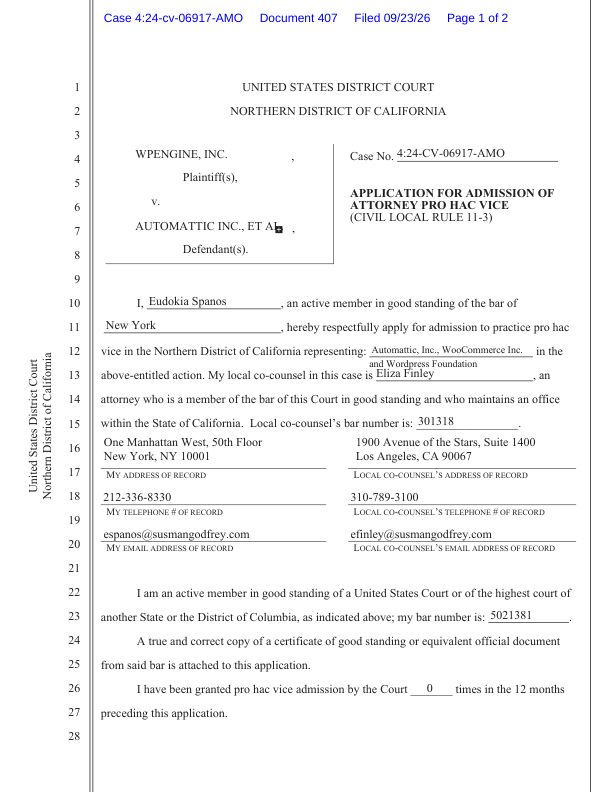
🔗 **Source:** [Application for Admission of Attorney Pro Hac Vice](https://storage.courtlistener.com/recap/gov.uscourts.cand.437474/gov.uscourts.cand.437474.407.0.pdf)
> [!note]+ Document Notes
> tags: [wpengine-v-automattic, pro-hac-vice, local-rules, litigation-counsel, federal-court-procedure]
> author: Eudokia Spanos (applicant), N.D. Cal. court form
> source: CourtListener RECAP (N.D. Cal. 3:24-cv-06917-AMO)
> reference: https://storage.courtlistener.com/recap/gov.uscourts.cand.437474/gov.uscourts.cand.437474.407.0.pdf
> date created: 2026-10-01 17:28
>
> > [!info] Generated analysis — not the author's words. Sections below are machine-written
> > from the captured source. Only text inside `> [!quote]` blocks is verbatim from the author.
> > Do not quote or attribute any other line to the named author.
>
> # 🏷️ Title: Application for Admission of Attorney Pro Hac Vice
>
<!-- deep-read:sections start -->
## 🧭 Table of contents
- [📝 Summary](#-summary)
- [📖 Main content](#-main-content)
- [🗒️ Notes](#️-notes)
- [📚 References](#-references)
- [🗣️ Paraphrase](#️-paraphrase)
- [📰 Newsletter](#-newsletter)
- [✅ Action items](#-action-items)
- [🧪 Hypotheses](#-hypotheses)
- [📊 Methodology](#-methodology)
- [❓ Questions](#-questions)
- [🔮 Future research](#-future-research)
- [💡 Implications](#-implications)
- [🧠 Learning styles assessment](#-learning-styles-assessment)
- [📊 Accessibility assessment](#-accessibility-assessment)
- [🌍 DEIB assessment](#-deib-assessment)
- [✅ Logical validity](#-logical-validity)
- [🛡️ DARVO analysis](#️-darvo-analysis)
- [🎯 Conclusion](#-conclusion)
- [🔄 Refactor appendix](#-refactor-appendix--application-for-admission-of-attorney-pro-hac-vice)
This is a neutral description of a court form. It is not legal advice, and the analyst is not a lawyer. Paragraph labels like ¶25 are the pipeline's extraction labels, not part of the filing. The filing is an application by an attorney, so everything it says is the applicant's own statement. No judge has ruled on it in the captured text. Contact details and bar numbers that appear in the form are left out on purpose.
## 📝 Summary
- **What happened.** Dkt. 407 is a two-page form application under Civil Local Rule 11-3 asking the Court to admit Eudokia Spanos, who states membership in the New York bar, to appear pro hac vice in WPEngine, Inc. v. Automattic Inc., et al. (¶5 to ¶8). The header reads "Filed 09/23/26" (¶0) and the applicant's signature line is dated 9/23/2026 (¶28). The task metadata that came with this item gave a filing date of 2026-09-17. The text doesn't explain the gap, and the docket would settle it.
- **The claim.** The applicant makes four statements: active good standing in a state bar, a certificate of good standing is attached, zero prior pro hac vice admissions in the 12 months before the application, and agreement to follow the Court's Local Rules. The applicant declares those statements true under penalty of perjury (¶18 to ¶27). Nothing in the form is an argument about the lawsuit.
- **Who it's for.** The form says the applicant represents Automattic, Inc. and WooCommerce Inc., and the words "and Wordpress Foundation" sit in the same fragmented line (¶9 to ¶10). The extraction scrambles the order of those words and the co-counsel name, so the party list is likely but should be confirmed against the PDF. Local co-counsel is Eliza Finley (¶10). The email domain printed for both lawyers is susmangodfrey.com, which points to the firm Susman Godfrey (¶17). That firm link is an inference from the domain only.
- **Why it matters.** It records one more out-of-state lawyer joining the Automattic-side defense team, and it shows the mechanism that lets an out-of-district lawyer appear: a local co-counsel, proof of standing, and a sworn statement. It says nothing about who is right in the dispute.
- **Key stakeholders.** The applicant, local co-counsel, the clients named above (Automattic, Inc., WooCommerce Inc., and probably the WordPress Foundation), and the Court, which decides whether to grant the application.
- **Risks and tradeoffs.** For a reader, the risk is over-reading a form. A grant would add a lawyer to the case, but the text shows no ruling. The extraction noise leaves the party line and one date question open.
- **Bottom line.** Procedural boilerplate with low analytic value. A reader who tracks the case needs only three facts: who applied, for whom, and that the order block in the capture is blank.
## 📖 Main content
**What the form is.** Pro hac vice ("for this occasion") admission lets a lawyer who is licensed elsewhere appear in a single case. The N.D. Cal. form (footer: "Updated 11/2021," ¶38) has two parts. Part one is the applicant's sworn application (¶7 to ¶29). Part two is a proposed "Order granting application" for a judge to sign (¶30 to ¶37).
**What the applicant states (the applicant's own assertions).**
- The applicant is an active member in good standing of the bar of New York (¶7 to ¶8, ¶18 to ¶19).
- The applicant represents the clients named in ¶9 to ¶10 in the case.
- Local co-counsel is Eliza Finley, who the form says is a member of this Court's bar in good standing and maintains an office in California (¶10 to ¶12).
- A certificate of good standing "or equivalent official document" is attached (¶20 to ¶21).
- The count of pro hac vice admissions granted by this Court in the previous 12 months is printed as 0 (¶22 to ¶23).
- The applicant agrees to learn and follow the Local Rules, including the Standards of Professional Conduct and the ADR Local Rules, and declares the foregoing true under penalty of perjury (¶25 to ¶27).
**What the proposed order says (conditional, unsigned in the capture).** If a judge signs it, the application is granted "subject to the terms and conditions of Civil L.R. 11-3." All papers the attorney files must indicate appearance pro hac vice. Service on, and communication with, the designated local co-counsel counts as notice to the party (¶32 to ¶35). The date and signature lines are blank (¶36 to ¶37). That is what a form says, not what the Court did.
**Comparison with Dkt. 408 (read from its captured text).** The captured text of Dkt. 408 matches this one line for line on the applicant, the client line, local co-counsel and the sworn statements. The differences are the document number in the header (407 vs 408), the signature date format (9/23/2026 here, "September 23, 2026" in 408), and where the "APPLICATION FOR ADMISSION OF ATTORNEY PRO HAC VICE" caption lands in the table. The text gives no reason for two filings. The docket would show whether one replaced the other.
**Extraction noise.** Three things matter. First, the client line is split across ¶9 and ¶10 with the co-counsel name in the middle. Second, the two-column address, phone and email rows appear as cells joined with a pipe character (¶13 to ¶17), and an underscore blank for local co-counsel's bar number (¶12) sits next to a number fragment. Third, the printed case number in the header is 4:24-cv-06917-AMO (¶0, ¶3), while the case is usually cited as 3:24-cv-06917-AMO. The text doesn't say why the prefix differs.
**Contested or unclear.** Nothing here is contested. The form makes no claim a party could dispute. The open points are factual: the filing date, the exact client list, and whether a judge signed the order block.
## 🗒️ Notes
#### 📄 ¶0-¶6 Caption and form title
- ¶0: the header names Case 4:24-cv-06917-AMO, Document 407, "Filed 09/23/26," and says the form runs 2 pages.
- ¶1 to ¶2: the Court is the United States District Court, Northern District of California.
- ¶3 to ¶4: the caption lists WPEngine, Inc. as plaintiff. ¶6 reads "AUTOMATTIC INC., ET AL." as defendants.
- ¶5 to ¶6: the form title and its rule reference (Civil Local Rule 11-3) land in different table cells depending on the extraction.
#### 📄 ¶7-¶12 Applicant statement, clients and local co-counsel
- ¶7 to ¶8: Eudokia Spanos applies for pro hac vice admission and states active good standing in the New York bar.
- ¶9 to ¶10: the clients are Automattic, Inc., WooCommerce Inc., and, in the scrambled fragment, the Wordpress Foundation. The co-counsel name, Eliza Finley, appears mid-sentence in ¶10.
- ¶11 to ¶12: local co-counsel is described as a member of this Court's bar in good standing with an office in California. A number fragment and a blank for the bar number appear in ¶12 and are left out here.
#### 📄 ¶13-¶17 Address, phone and email table
- ¶13 to ¶16: two columns, one for the applicant and one for local co-counsel, list a street address, telephone number and label rows. The note omits these.
- ¶17: each column ends with an email address of record. Both share one firm domain, which is the basis for the Susman Godfrey inference. The addresses themselves are omitted.
#### 📄 ¶18-¶23 Good standing, certificate and prior admissions
- ¶18 to ¶19: the applicant states active good standing in a United States court or the highest court of another state or D.C. A bar number fragment appears in ¶19 and is omitted.
- ¶20 to ¶21: a copy of a certificate of good standing "or equivalent official document" is attached. The text doesn't give the attachment's docket number.
- ¶22 to ¶23: the count of pro hac vice admissions in the preceding 12 months is printed as 0, with a blank line left in the text.
#### 📄 ¶24-¶29 Agreement, declaration and signature
- ¶24: a court-name footer fragment ("United States District Court Northern District of California").
- ¶25 to ¶27: the applicant agrees to abide by the Local Rules, the Standards of Professional Conduct and the ADR Local Rules, and declares the statements true under penalty of perjury.
- ¶28 to ¶29: signature line "Eudokia Spanos," dated 9/23/2026, labeled "APPLICANT."
#### 📄 ¶30-¶38 Proposed order and footer
- ¶30 to ¶32: "ORDER GRANTING APPLICATION FOR ADMISSION OF ATTORNEY PRO HAC VICE" restates the applicant's name in the operative sentence.
- ¶33 to ¶35: if granted, the grant is subject to Civil L.R. 11-3, papers must say pro hac vice, and service on local co-counsel counts as notice to the party.
- ¶36 to ¶37: "Dated:" and the "UNITED STATES DISTRICT/MAGISTRATE JUDGE" line are blank in the capture.
- ¶38: footer "2 Updated 11/2021" (page 2, form revision date).
## 📚 References
The captured link list is empty. No link in the captured markup points to any source for this document.
- [The application as downloaded from CourtListener RECAP](https://storage.courtlistener.com/recap/gov.uscourts.cand.437474/gov.uscourts.cand.437474.407.0.pdf): Dkt. 407, the document analyzed here.
- Civil Local Rule 11-3 (¶6, ¶33): the rule the form cites. The text doesn't quote or link it, so what the rule requires beyond this form is not established here.
- The Standards of Professional Conduct and the ADR Local Rules (¶26): named as things the applicant agrees to follow. Neither is linked or quoted.
- Attached certificate of good standing (¶20 to ¶21): the form says it is attached. Its docket number and content are not in the capture. An earlier note gave it as Dkt. 407-1. That number is unverified from this text.
- Claims with no link in the captured markup: every statement in the form, including good standing, the count of 0 prior admissions and local co-counsel's status. The form is the applicant's own declaration, so no external source is expected inside it.
- Primary sources to check next: the CourtListener docket for Case No. 3:24-cv-06917-AMO (Dkt. 407, 407 attachments, 408 and any order on either) and the Court's Local Rules.
## 🗣️ Paraphrase
- Paragraph block ¶7 to ¶12: a lawyer licensed in New York asks to appear in this case alongside a named California lawyer, on behalf of the clients listed.
- Paragraph block ¶13 to ¶17: the form lists how to reach each lawyer. That block is left out of this note.
- Paragraph block ¶18 to ¶23: the applicant says the New York license is in good standing, attaches proof, and reports no earlier admissions by this Court in the past year.
- Paragraph block ¶24 to ¶29: the applicant promises to follow the Court's rules and signs under penalty of perjury on September 23, 2026.
- Paragraph block ¶30 to ¶37: a blank order says that, if a judge grants the request, the lawyer must mark every filing "pro hac vice" and notice to local co-counsel counts as notice to the client.
## 📰 Newsletter
**A routine filing in WP Engine v. Automattic: one more lawyer asks to join the team.** On September 23, 2026, an attorney licensed in New York filed an application to appear pro hac vice for Automattic, Inc. and WooCommerce Inc. (and, per a scrambled line in the captured text, the WordPress Foundation) in the N.D. Cal. case. The form names a local co-counsel from the Court's own bar and attaches a certificate of good standing.
Read it as paperwork. It makes no argument, cites no facts about the dispute and carries no ruling in the captured text. If you follow the case, the useful step is to open the docket and check whether the Court signed the order block. For a plain-language explainer, the Court's Local Rules and the case docket on CourtListener are the primary sources.
## ✅ Action items
Not legal advice. Each line ties to the form's text or says plainly that no action follows.
#### DevRel
- Developer advocacy: no direct action. If you mention the case in a talk, describe this filing as an attorney admission form, not as news about the dispute.
- Education: no direct action. The form works as a short worked example of how a docket entry combines a party caption, a sworn statement and a proposed order.
- Developer experience: none. The form is not about software.
- Developer marketing: none. Don't present the filing as a signal about either company's strategy.
- Community management: if the filing comes up in a thread, link the PDF and say it is a procedural application. Keep speculation about staffing out of the discussion.
- Internal/external/cross-project: none from this source.
#### OSPO
- Policy and governance: no direct action. Nearest relevance: if your organization is a party to litigation, an OSPO can ask counsel who may speak publicly about filings like this one.
- License compliance: none. No license question appears.
- Security management: none.
- Software inventory: none.
- Developer support: point contributors who ask about the case to the public docket instead of secondhand summaries.
- Community engagement: none from this source.
- Strategic alignment: none. The form makes no claim about open-source strategy.
#### Community
- Maintainers: no direct action. Nearest relevance: maintainers who are named in litigation can ask counsel what they may say publicly.
- Contributors: none.
- Sponsors: none. The form doesn't discuss funding.
- Ecosystem: none from this source.
#### WordPress
- Core: no direct action.
- Core Performance: none.
- Core AI: none.
- **Core Program Team:** none.
- Mobile: none.
- Playground: none.
- Community: no direct action. Nearest relevance: community leaders may get questions about the case, and a primary-source link is better than a paraphrase.
- Training: none.
- Marketing: none. Don't turn the client list into a claim about who the WordPress Foundation's counsel is.
- Support: none.
- Design: none.
- Documentation: none. A neutral "how to read a court docket" note could help contributors who follow the case.
- Photos: none.
- TV: none.
- Polyglots: none.
- Accessibility: none from this source.
- Meta: none. The form doesn't touch the .org directory.
- CLI: none.
- Hosting: none. The plaintiff is a WordPress hosting company, but this form says nothing about hosting practice.
- Tide: none.
- Openverse: none.
- Themes: none.
- Plugins: none. WooCommerce Inc. appears as a represented party (¶9), but the form says nothing about the plugin.
#### The WPOCC
- Programs: none directly.
- Projects: none.
- Funding experiments: none from this source.
### FAIR
- Technical independence: none. The form says nothing about package signing or provenance.
- Policies and covenants: none directly. The form shows one governance-adjacent fact: whether the WordPress Foundation is a represented party is a question for the docket, and any policy that depends on that status should rest on the docket, not this extraction.
- Productized governance artifacts: none from this source.
## 🧪 Hypotheses
- The Dkt. 408 filing is a duplicate or re-submission of this application, not an application for a different client or lawyer. Basis: the captured text of the two matches except for the document number, one date format and caption layout.
- The 9/17 versus 9/23 date gap comes from an earlier submission or a metadata error, not from two filings. The form shows only 9/23.
- The client line in the PDF names the WordPress Foundation as a represented party, and the extraction only scrambled the word order.
- The order block stayed blank in the captured PDF because the PDF is the as-filed version, so a later docket entry carries any ruling.
- The 0 printed for prior admissions is the applicant's declaration for this Court only, not a count of admissions in any other court.
## 📊 Methodology
- Duplicate test (hypothesis 1): fetch Dkt. 407 and Dkt. 408 as PDFs and compare them page by page, then read the docket text for both entries and any note that one replaced the other.
- Date test (hypothesis 2): read the CourtListener docket entry for 407 for the filing date and compare it with the header date and the signature date.
- Client line test (hypothesis 3): read the PDF itself, not the extracted text, and note the order of the party names.
- Order block test (hypothesis 4): search the docket for an order on the pro hac vice applications dated after 9/23/2026.
- Scope test (hypothesis 5): read the form's wording around the blank in ¶22 to ¶23 and the Local Rule it cites. The text says "by the Court," which fits a count for this Court.
## ❓ Questions
- Which party or parties does the PDF list as clients, and does the WordPress Foundation appear in the final PDF?
- Did the Court sign the order block, and on what date?
- Why does Dkt. 408 repeat the same content, and did one filing replace the other?
- Why does the printed case number begin with 4: when the case is usually cited as 3:24-cv-06917-AMO?
- What is the docket number of the certificate of good standing the form says is attached?
- Is the filing date 9/23/2026 or 2026-09-17, and what produced the metadata date?
- What does Civil Local Rule 11-3 require of the applicant beyond what this form prints?
## 🔮 Future research
- Build a short tracker of attorney appearances and admissions in this docket from the public record, scoped by date and entry type, so readers can see how counsel teams change over time.
- Check whether the Court's order on this application, once on the docket, uses the form language or adds conditions.
- Compare the form's version (updated 11/2021, ¶38) with the current Local Rules to see whether the form still matches them.
- Document the extraction problems seen in this PDF (scrambled cells, pipe-joined tables) so later docket items are read with the same caution.
## 💡 Implications
- **Practice.** A pro hac vice application is cheap to read and easy to over-read. Treat it as proof of who appears, not as evidence about the claims.
- **Policy.** The form puts three duties on a visiting lawyer: stay in good standing, keep a local co-counsel, and follow the Local Rules. Those duties come from the form's text and the rule it cites.
- **Security.** None from this source. The form lists email and phone details of record, which are public on the docket, and this note leaves them out.
- **Education.** The two-part structure (sworn application plus proposed order) is a clear teaching example of how a motion and its proposed order travel together.
- **Funding.** None. The form has no funding content.
## 🧠 Learning styles assessment
- Reading level estimate: about grade 16 to 17 by the Flesch-Kincaid grade formula, run on the applicant statement and the order text (256 words in 8 sentences, 430 syllables, so about 32 words per sentence). The count is a heuristic: the form's blanks and fragmented lines change the sentence count, so treat the score as plus or minus 2 grades.
#### 👀 Visual learners
- Present: a two-column table for the two lawyers' details, underlined blanks and a signature line. No diagrams.
- Improve: a one-line flow (applicant, local co-counsel, certificate, sworn statement, proposed order) would show how the parts connect.
#### 🔊 Aural learners
- Present: none. The capture is text from a PDF.
- Improve: a 2 to 3 minute audio walkthrough of the form's fields would help.
#### 🗣️ Verbal learners
- Present: the legal terms "pro hac vice," "good standing" and "penalty of perjury" appear with no definitions.
- Improve: a short glossary beside the form, starting with "pro hac vice," would cover the three terms.
#### 🧩 Kinesthetic learners
- Present: the form is a fill-in template, so it works as a hands-on exercise.
- Improve: a blank copy and a checklist of which field answers which Local Rule duty.
#### 🧠 Logical learners
- Present: a fixed sequence of eligibility statements and a conditional order.
- Improve: a table that maps each statement (good standing, certificate, prior count, rule agreement) to the requirement it supports.
#### 🧑🤝🧑 Social learners
- Present: none. The form has no discussion.
- Improve: a discussion prompt for a study group, such as "Why does the Court require a local co-counsel?"
#### 🧘♀️ Solitary learners
- Present: the short length (two pages) suits one reader.
- Improve: three self-check questions: who applies, who signs the order, what the 0 counts.
#### 🌿 Naturalistic learners
- Present: none.
- Improve: no natural ties exist in the source. An ecosystem analogy (a visiting practitioner needs a local sponsor) is possible but would be the analyst's analogy, not the form's.
## 📊 Accessibility assessment
Judged as captured. The capture is a text view converted from a PDF by Reader, so the original PDF's tagging isn't visible. Contrast, focus order and zoom behavior can't be judged from text.
#### Screen reader semantics
- Present: the capture has no headings, landmarks or alt text. The form title and the order heading appear as plain lines (¶5, ¶30 to ¶31).
- Improve: tag the PDF with headings and mark the two-column address block as a table with header cells. The pipe-joined cells (¶13 to ¶17) read badly in linear order.
#### Keyboard navigation
- Present: not observable in the text.
- Improve: a fillable PDF should keep a logical tab order across the two columns.
#### Contrast and readability
- Present: not observable. The text uses all-caps labels and blanks (underscores, ¶12, ¶22) that may be hard to read with a screen magnifier.
- Improve: print the form at 4.5:1 text contrast and replace long underscore blanks with labeled fields.
#### Text resizing and reflow
- Present: fixed-layout PDF page, 2 pages, so reflow at 200% zoom isn't confirmed.
- Improve: offer a reflowable version of the Court's forms.
#### Media and captions
- No media referenced in the captured text.
#### Forms and interactions
- Present: the form has labeled fields and blanks. Sentences are broken across lines, which the extraction splits into fragments (¶9 to ¶12, ¶32 to ¶35).
- Improve: label each field with a visible name and put each sentence in one text run.
#### Standards reference
- Gaps map to WCAG 2.2 AA: 1.3.1 Info and Relationships (table and form structure), 1.3.2 Meaningful Sequence (split sentences), 1.4.3 Contrast (unverifiable here), 1.4.10 Reflow (fixed PDF layout), 2.4.6 Headings and Labels (plain-line headings), 3.3.2 Labels or Instructions (underscore blanks).
## 🌍 DEIB assessment
#### Cultural breadth
- Present: the form is a US federal court template with US legal terms (pro hac vice, good standing). It lists a New York-licensed applicant and a California local co-counsel.
- Improve: link a plain-language explanation for readers outside the US court system.
#### Inclusive language
- Present: the form uses first person ("I") for the applicant and doesn't assign gender to anyone. Legal Latin ("pro hac vice") is undefined.
- Improve: add a one-line plain-language gloss for "pro hac vice" and "good standing."
#### Neurodiversity support
- Present: the structure is consistent: statement, attachment, count, agreement, signature. Sentences run about 32 words.
- Improve: split long sentences and use a checklist layout for the four eligibility statements.
#### Representation
- Present: two named lawyers and three client organizations. The form says nothing about identity.
- Improve: none inferable. Don't draw conclusions about anyone's background from names or the firm.
#### Psychological safety
- Present: the form has a perjury declaration and a Court notice about discipline-related rules (the Standards of Professional Conduct). No content warnings are needed.
- Improve: none needed for this source.
## ✅ Logical validity
#### Strong reasoning
- Deductive structure (¶18 to ¶27): the form lists the conditions for admission and the applicant states each one is met, then declares them true under penalty of perjury. The reasoning is complete as a form, though it relies on the attached certificate (¶20 to ¶21) as proof, and that attachment isn't in the capture.
- Procedural coherence (¶32 to ¶35): the proposed order's three conditions (subject to L.R. 11-3, mark filings pro hac vice, notice via local co-counsel) follow from the form's own structure.
- To clarify further: cite the text of Civil Local Rule 11-3 so a reader can see which statements the rule requires.
#### Fallacies
- None found. The form argues nothing, so there is no inference to test. What I checked: each paragraph is a statement, an attachment reference, a count, an agreement or an order term. Nothing draws a conclusion from the statements.
- Limits: the applicant's statements are unverified in this capture. A sworn declaration is a party's statement, not a court finding.
#### Tone of voice
- Formal and fixed: "hereby respectfully apply" (¶8), "declare under penalty of perjury" (¶27), "IT IS HEREBY ORDERED" (¶32). No advocacy and no emotion.
## 🛡️ DARVO analysis
Not applicable to this source. The form is a procedural application with no accusations, so no denial, attack or role reversal can occur.
- Deny: none. The form denies nothing.
- Attack: none. No person or party is criticized.
- Reverse victim/offender: none. No victim or offender is named.
- Emotional cues and rhetoric: none. The only rhetorical device is the legal formula in ¶27 and ¶32.
## 🎯 Conclusion
Dkt. 407 is a pro hac vice application that Eudokia Spanos signed on 9/23/2026 to appear for Automattic, Inc., WooCommerce Inc. and, per a scrambled line, the Wordpress Foundation, with Eliza Finley as local co-counsel. The text shows no ruling: the order block is blank in the capture. It carries no information about the dispute.
Next steps for a reader: open the docket and confirm the filing date (9/23 vs 9/17), whether a judge signed the order, the client list, and why Dkt. 408 repeats this text. Then move on.
## 🔄 Refactor Appendix — Application for Admission of Attorney Pro Hac Vice
> Density: 2–5 Literature atoms (H1 pad), 0–3 Permanent candidates (H4 pad).
> Emitted: 4 Literature, 2 Permanent. Resonance filter applied: caption text, address and
> contact blocks, and bar numbers were dropped as boilerplate or out of scope.
>
> Konik claim-header rules: present tense, declarative, ≤10 words, searchable, unique.
>
> Atomicity: one declarative sentence per atom. "and"/"also" → split.
>
> Tag pool: #bmf · #addendum · #xref · #articleseed · #storystem · #share · #aphorisms
### 📚 Literature Split Pad
#### [H1] The applicant states active good standing in another bar
> [!quote] [¶18]
> I am an active member in good standing of a United States Court or of the highest court of
**Context & use**:
- ¶18 to ¶19, the first eligibility statement. The sentence continues into ¶19 and names the state bar.
- Good standing is the applicant's assertion here. The certificate (¶20 to ¶21) is the form's proof.
**Tags**: #xref
<!-- atomicity: 1 idea ✓ -->
#### [H2] The applicant reports prior admissions in the last year
> [!quote] [¶22]
> I have been granted pro hac vice admission by the Court _______ times in the 12 months
**Context & use**:
- ¶22 to ¶23, with the number 0 printed next to the blank. The count is a declaration for this Court.
- The form uses a 12-month window. The text doesn't say why.
**Tags**: #xref
<!-- atomicity: 1 idea ✓ -->
#### [H3] The applicant agrees to follow the Local Rules
> [!quote] [¶25]
> I agree to familiarize myself with, and abide by, the Local Rules of this Court, especially
**Context & use**:
- ¶25, the only commitment the form asks of the applicant beyond good standing. The sentence continues into ¶26.
- Note the pipeline's paragraph split at "especially."
**Tags**: #xref
<!-- atomicity: 1 idea ✓ -->
#### [H4] The proposed order conditions the grant on Local Rule 11-3
> [!quote] [¶33]
> granted, subject to the terms and conditions of Civil L.R. 11-3.
**Context & use**:
- ¶33, inside the proposed order block (¶30 to ¶37). The block is unsigned in the capture.
- Read this as form text, not a ruling. A signature and date would be the first evidence of one.
**Tags**: #xref #articleseed
<!-- atomicity: 1 idea ✓ -->
### 🧠 Atomic Split Pad
#### [P1] A pro hac vice form is a sworn eligibility checklist
**Claim** (one sentence, Courtney's voice): A pro hac vice application proves nothing about the case and everything about whether the lawyer may appear in it.
**Evidence pointer**: [[#H1]] and [[#H3]]
**Scope & conditions**: Holds for the N.D. Cal. form as captured. Another court's form may require different statements. The form doesn't test the applicant's statements, so the Court's later action is the real signal.
**Links**:
- [[Order Granting Plaintiff WPEngine's Sealing Motion TAC]] — because contrasts on content: that order rules on case material, this form only governs who appears.
- [[Dkt 408 Pro Hac Vice Application Spanos]] — because evidence-for the duplicate-filing question.
<!-- atomicity: 1 idea ✓ -->
#### [P2] Proposed orders show the Court's default terms before any ruling
**Claim** (one sentence, Courtney's voice): The blank order on a form is the cheapest way to read the terms a court attaches to a grant.
**Evidence pointer**: [[#H4]]
**Scope & conditions**: Holds only where the form includes a proposed order. It states default terms, not what a judge decided in this case.
**Links**:
- [[Order Granting Plaintiff WPEngine's Sealing Motion TAC]] — because contrasts on signed vs unsigned orders.
<!-- atomicity: 1 idea ✓ -->
### ✏️ Fleeting Queue
- [F1] Compare Dkt. 407 and Dkt. 408 PDFs page by page and note any difference beyond header number and date format #fleeting #inbox
- [F2] Confirm the filing date (9/23 vs 9/17), the client list in the PDF and whether the order block was signed #fleeting #inbox
### → Things 3 (max 2 actions)
- [ ] Check the docket for Dkt. 407 attachments, Dkt. 408 and any order on 407 — WPE v. Automattic tracking, 10 min #things
<!-- deep-read:sections end -->
📄 **Full text:** [[Full Document Contents/Articles/Application for Admission of Attorney Pro Hac Vice-2.md|Application for Admission of Attorney Pro Hac Vice by Eudokia Spanos (applicant), N.D. Cal. court form]]
## Highlights
- I agree to familiarize myself with, and abide by, the Local Rules of this Court, especially ([View Highlight](https://read.readwise.io/read/01m3s7xynxw24cww4k192eqa4b))
- Note: [H1] The applicant swears to follow the Local Rules
- Tags: atom/literature/h1