Application for Admission of Attorney Pro Hac Vice
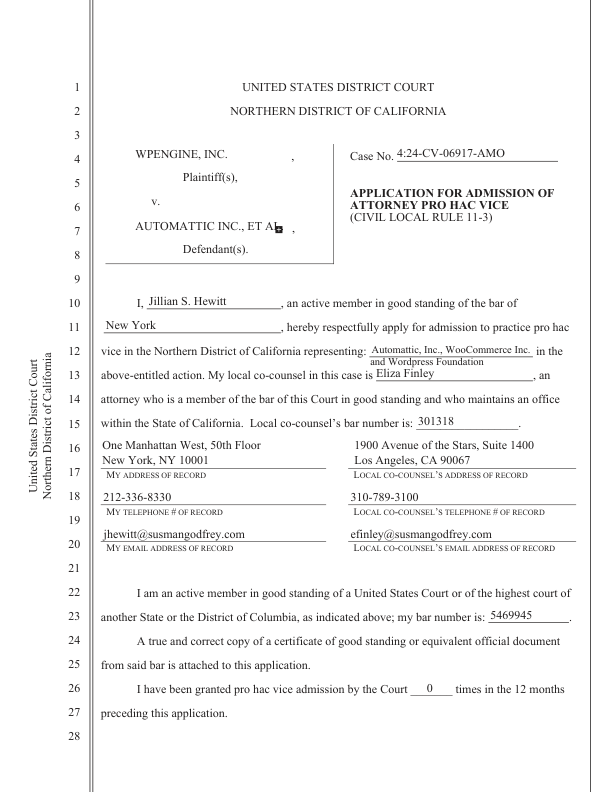
🔗 **Source:** [Application for Admission of Attorney Pro Hac Vice](https://storage.courtlistener.com/recap/gov.uscourts.cand.437474/gov.uscourts.cand.437474.406.0.pdf)
> [!note]+ Document Notes
> tags: [wp-engine-v-automattic, pro-hac-vice, court-filings, litigation-counsel, open-source-governance]
> author: Jillian S. Hewitt (applicant); order block unsigned by name, United States District Court, Northern District of California
> source: CourtListener RECAP (N.D. Cal. 3:24-cv-06917-AMO)
> reference: https://storage.courtlistener.com/recap/gov.uscourts.cand.437474/gov.uscourts.cand.437474.406.0.pdf
> date created: 2026-10-01 17:28
>
> > [!info] Generated analysis — not the author's words. Sections below are machine-written
> > from the captured source. Only text inside `> [!quote]` blocks is verbatim from the author.
> > Do not quote or attribute any other line to the named author.
>
> # 🏷️ Title: Application for Admission of Attorney Pro Hac Vice
>
<!-- deep-read:sections start -->
## 🧭 Table of contents
- [📝 Summary](#-summary)
- [📖 Main content](#-main-content)
- [🗒️ Notes](#️-notes)
- [📚 References](#-references)
- [🗣️ Paraphrase](#️-paraphrase)
- [📰 Newsletter](#-newsletter)
- [✅ Action items](#-action-items)
- [🧪 Hypotheses](#-hypotheses)
- [📊 Methodology](#-methodology)
- [❓ Questions](#-questions)
- [🔮 Future research](#-future-research)
- [💡 Implications](#-implications)
- [🧠 Learning styles assessment](#-learning-styles-assessment)
- [📊 Accessibility assessment](#-accessibility-assessment)
- [🌍 DEIB assessment](#-deib-assessment)
- [✅ Logical validity](#-logical-validity)
- [🛡️ DARVO analysis](#️-darvo-analysis)
- [🎯 Conclusion](#-conclusion)
- [🔄 Refactor appendix](#-refactor-appendix--application-for-admission-of-attorney-pro-hac-vice)
This is a neutral description of a court form. It is not legal advice, and the analyst is not a lawyer. Paragraph labels like ¶35 are the pipeline's extraction labels, not part of the original PDF. Attorney bar numbers and contact details on the form are left out on purpose.
## 📝 Summary
- **What happened.** Jillian S. Hewitt, who says they are an active member of the New York bar, applies under Civil Local Rule 11-3 to appear pro hac vice in the Northern District of California in a case captioned WPEngine, Inc. v. Automattic Inc., et al., Case No. 4:24-CV-06917-AMO (¶2 to ¶9). The form names Eliza Finley as local co-counsel (¶11 to ¶12).
- **For whom.** The applicant says they will represent "Automattic, Inc., WooCommerce Inc. and Wordpress Foundation" (¶10). The extraction scrambles that line, so the party list is reconstructed from fragments, and the spelling "Wordpress Foundation" is the form's, not a verified entity name.
- **Why it matters.** Pro hac vice admission lets a lawyer from another state appear in one case. The form is the paper trail for who may speak for these three parties in this court. It makes no argument about the dispute itself.
- **Key stakeholders.** The applicant; the local co-counsel named in ¶11; the three represented parties named in ¶10; the Court, which holds the pre-printed order block (¶32 to ¶39). WPEngine, Inc. is the plaintiff in the caption (¶2 to ¶3).
- **Risks and tradeoffs.** The source is an auto-extracted PDF with out-of-order and merged lines (¶10, ¶13). The order block shows a date but no readable judge name or signature (¶38 to ¶39), so a reader can't tell from this capture who granted it or whether the printed date is the date of the grant.
- **Bottom line.** A routine form with a pre-printed order granting the application "subject to the terms and conditions of Civil L.R. 11-3" (¶35). The applicant dated the form 9/22/2026 (¶30), and the order block carries the date September 22, 2026 (¶38). The only new information is that Hewitt is added to the counsel group for the three named parties. Reader metadata listed a filing date of 2026-09-17, which differs from both form dates and isn't explained in the text.
## 📖 Main content
**What pro hac vice means.** The Latin phrase means "for this occasion." Federal district courts normally admit their own bar members. Under the rule the form cites (¶5), a lawyer from elsewhere can ask to appear in one case if they belong in good standing to a state bar, attach proof, and designate a local lawyer. The form here is the Northern District of California's standard version, revised 11/2021 according to the footer (¶40).
**How the form is built.** The form has four parts.
- Caption (¶0 to ¶6): court, case number and party names.
- Applicant statement (¶7 to ¶19): who applies, which bar, which clients, and who the local co-counsel is. The block at ¶13 to ¶19 holds bar number, address, phone and email entries for both lawyers. This analysis leaves those out.
- Certification (¶20 to ¶31): good standing, a certificate attached (¶22 to ¶23), a count of 0 prior pro hac vice admissions in the preceding 12 months (¶24 to ¶25), an agreement to follow the Local Rules (¶27 to ¶29), and a signature date of 9/22/2026 (¶30 to ¶31).
- Order block (¶32 to ¶39): a pre-printed order that grants the application, requires that all papers the attorney files indicate an appearance pro hac vice (¶35 to ¶36), and says service on the designated local co-counsel counts as notice to the party (¶36 to ¶37).
**What the applicant asserts versus what the Court orders.** In ¶7 to ¶31 the applicant asserts: bar membership in good standing, an attached certificate, zero prior admissions in 12 months, and an agreement to abide by the Local Rules, all under penalty of perjury (¶29). Only the order block in ¶32 to ¶39 is the Court's act. The text shows the order's date but no judge's name (¶38 to ¶39), so this capture does not show who signed it.
**Terms.**
- Local co-counsel: a lawyer in the Court's own bar with an office in California (¶12), who receives service on the party's behalf (¶36 to ¶37).
- Civil L.R. 11-3: the Court's local rule on this kind of admission (¶5). The form quotes the rule number, not its text.
- Standards of Professional Conduct and ADR Local Rules: the other Local Rules the applicant promises to learn and follow (¶27 to ¶28).
**Uncertainties.**
- The case number prints as 4:24-CV-06917-AMO (¶2). The batch brief also records 3:24-cv-06917-AMO. The capture doesn't explain the difference, and it isn't resolved here.
- The text doesn't say why Hewitt is being added, whether anyone opposed the application, or what role Hewitt will have.
- The form names the represented parties but doesn't say which side of the caption each sits on. The caption lists "Automattic Inc., et al." as defendant (¶5 to ¶6). Whether the Wordpress Foundation is a defendant, a counterclaimant or both isn't stated on this form.
- The firm isn't named in prose. It appears only inside contact entries, which this analysis omits.
## 🗒️ Notes
#### 📄 ¶0-¶6 Caption
- The Court and district appear first (¶0 to ¶1): United States District Court, Northern District of California.
- The case number and the title "Application for Admission of Attorney Pro Hac Vice (Civil Local Rule 11-3)" are interleaved with the party lines because of table extraction (¶2 to ¶5).
- WPEngine, Inc. is plaintiff and Automattic Inc., et al. is defendant in the caption (¶2 to ¶6). The form has no counterclaim caption.
#### 📄 ¶7-¶9 The applicant and the bar
- Jillian S. Hewitt states membership in good standing of the New York bar (¶7 to ¶8).
- The applicant "respectfully" applies for admission to practice pro hac vice in this district (¶9 to ¶10).
- The sentence continues across ¶10 and ¶11 in the extraction, so the reading order has to be rebuilt.
#### 📄 ¶10 The represented parties
- ¶10 lists "Automattic, Inc., WooCommerce Inc." and "Wordpress Foundation" as the parties the applicant will represent.
- The line is merged with fragments of the surrounding sentence, so it isn't a clean quotation of the form's wording.
- Treat the spelling as the form's own, not as a legal entity name check.
#### 📄 ¶11-¶13 Local co-counsel
- Eliza Finley is named as local co-counsel (¶11).
- ¶12 defines the role: a member of the Court's bar in good standing who keeps an office in California.
- ¶13 merges the label for co-counsel's bar number with its fill-in value. The number is omitted here.
#### 📄 ¶14-¶19 Contact block
- Six paragraphs carry addresses, phone numbers and emails for the applicant and co-counsel, paired with their labels.
- No analysis of these paragraphs is given. The values are contact details and are left out by rule.
- Labels confirm the form asks for "address of record," "telephone # of record" and "email address of record" for both lawyers.
#### 📄 ¶20-¶21 Good standing
- The applicant states active membership in good standing of a United States Court or of the highest court of another State or the District of Columbia, "as indicated above" (¶20 to ¶21).
- A bar number follows in ¶21. It is omitted here.
#### 📄 ¶22-¶23 Certificate attached
- The applicant states that a true and correct copy of a certificate of good standing, or an equivalent official document from that bar, is attached.
- The attachment is not part of the captured text, so its date and issuer can't be checked here.
#### 📄 ¶24-¶25 Prior admissions
- The applicant reports 0 pro hac vice admissions granted by this Court in the 12 months before the application (¶24 to ¶25).
- The "0" is printed at the start of ¶24, ahead of the sentence, because of the fill-in layout.
#### 📄 ¶26-¶29 Agreement and declaration
- ¶26 repeats the court name as a page header.
- The applicant agrees to learn and abide by the Local Rules, "especially" the Standards of Professional Conduct and the Alternative Dispute Resolution Local Rules (¶27 to ¶28).
- The applicant declares under penalty of perjury that the foregoing is true and correct (¶29).
#### 📄 ¶30-¶31 Date and signature
- ¶30 shows the date 9/22/2026 and the typed name Jillian S. Hewitt next to the "Dated:" label.
- ¶31 labels the signature line "Applicant." The capture doesn't show whether a handwritten or electronic signature mark exists.
#### 📄 ¶32-¶37 The order
- The heading "Order Granting Application for Admission of Attorney Pro Hac Vice" appears in ¶32 to ¶33.
- The order states that the application of Jillian S. Hewitt "is granted, subject to the terms and conditions of Civil L.R. 11-3" (¶34 to ¶35).
- It adds that all papers the attorney files must indicate an appearance pro hac vice (¶35 to ¶36).
- It adds that service on, and communication with, local co-counsel counts as notice to the party (¶36 to ¶37).
#### 📄 ¶38-¶39 Order date and signer line
- The order block is dated September 22, 2026 (¶38).
- ¶39 is the signer title line, "United States District/Magistrate Judge." No judge name appears in the capture.
- The printed date matches the applicant's date (¶30). Whether the same-day date was filled in at signing isn't something the text shows.
#### 📄 ¶40-¶41 Footer
- ¶40 reads "2 Updated 11/2021": page number 2 and the form revision date.
- ¶41 repeats the court name as a page header. Neither carries case content.
## 📚 References
The captured link list is empty. No link in the captured markup points to any source for this document, and the form cites no case, statute or docket entry.
- [The application as downloaded from CourtListener RECAP](https://storage.courtlistener.com/recap/gov.uscourts.cand.437474/gov.uscourts.cand.437474.406.0.pdf): the document analyzed here.
- Civil Local Rule 11-3 (¶5, ¶35): the one rule the form names. Its text isn't in the capture, and no link appears for it.
- Standards of Professional Conduct and the Alternative Dispute Resolution Local Rules (¶27 to ¶28): named as rules the applicant will follow. No text or link is given.
- Claims with no link in the captured markup: every statement on the form, including bar membership, the attached certificate and the 0 prior admissions.
- Primary sources to check next: the CourtListener docket for Case No. 4:24-cv-06917-AMO, which lists this entry, its filing date and any related docket entries; and the Court's Local Rules page for the current text of Civil L.R. 11-3.
## 🗣️ Paraphrase
Hewitt, a New York lawyer, asks the Northern District of California for permission to appear in WPEngine v. Automattic for Automattic, WooCommerce Inc. and the Wordpress Foundation. Eliza Finley, a lawyer who belongs to the Court's bar and keeps an office in California, is named as local co-counsel.
The applicant says they are in good standing, that a certificate from their bar is attached, that the Court has not admitted them pro hac vice in the past 12 months, and that they will follow the Court's Local Rules. They declared this true under penalty of perjury and dated the form 9/22/2026.
The second half of the PDF is a short order, pre-printed with the date September 22, 2026. It grants the request, subject to the rule, and says every paper the lawyer files must say so. It also says serving the local co-counsel counts as notice to the party. The capture shows no judge name.
## 📰 Newsletter
**A new name on the legal team in WP Engine v. Automattic.** A short court form dated September 22, 2026 adds Jillian S. Hewitt, a New York lawyer, to the group representing Automattic, WooCommerce Inc. and the Wordpress Foundation in the Northern District of California. It's a pro hac vice application: a lawyer admitted elsewhere asks to appear in one case, with a local lawyer attached.
Read it for what it is. The form says who is on the roster and that the Court's pre-printed order grants the request on conditions. It doesn't discuss the dispute, so there is nothing here about WordPress, the plugin directory or trademarks. If you follow the case for community reasons, the docket is the place to watch for new filings. Link: [the application on CourtListener](https://storage.courtlistener.com/recap/gov.uscourts.cand.437474/gov.uscourts.cand.437474.406.0.pdf).
## ✅ Action items
Not legal advice. Each line ties to the form's text or says plainly that no action follows.
#### DevRel
- Developer advocacy: no direct action. If you mention the case in a talk, describe this entry as a counsel-admission form, not a development in the dispute.
- Education: a short explainer on pro hac vice and local co-counsel would work, using the four-part structure in Main content as the walkthrough.
- Developer experience: none. The form isn't about software.
- Developer marketing: none. Don't cite a staffing change as a signal about any party's strategy.
- Community management: if the case comes up in community channels, link the primary PDF and say the form only records who may appear. Keep guesses about why counsel was added out of the thread.
- Internal/external/cross-project: none from this source.
#### OSPO
- Policy and governance: none directly. The form names a third-party legal roster for an open-source foundation and two companies (¶10), which shows that foundations can be represented alongside companies in one case. That is an observation, not a policy recommendation.
- License compliance: none. The form raises no license question.
- Security management: none.
- Software inventory: none.
- Developer support: point contributors who ask about the case to the public docket instead of summaries.
- Community engagement: none from this source.
- Strategic alignment: none. The form makes no claim about open-source strategy.
#### Community
- Maintainers: no direct action. Maintainers named in legal filings elsewhere can ask counsel what they may say publicly.
- Contributors: none.
- Sponsors: none. The form doesn't discuss funding.
- Ecosystem: none from this source.
#### WordPress
- Core: no direct action.
- Core Performance: none.
- Core AI: none.
- **Core Program Team:** none.
- Mobile: none.
- Playground: none.
- Community: no direct action. Community leaders may field questions about the case, and this form is a neutral primary source to share.
- Training: none.
- Marketing: none. Avoid paraphrasing the form as a statement about the case's merits.
- Support: none.
- Design: none.
- Documentation: none. A neutral "how to read a court docket" note could help contributors who follow the case.
- Photos: none.
- TV: none.
- Polyglots: none.
- Accessibility: none from this source.
- Meta: none. The form doesn't touch the .org directory.
- CLI: none.
- Hosting: no direct action. The plaintiff's name is in the caption (¶2 to ¶3), but the form says nothing about hosting practice.
- Tide: none.
- Openverse: none.
- Themes: none.
- Plugins: none. WooCommerce Inc. is named as a represented party (¶10), but the form says nothing about the plugin.
#### The WPOCC
- Programs: none directly.
- Projects: none.
- Funding experiments: none from this source.
### FAIR
- Technical independence: none. The form says nothing about package signing or provenance.
- Policies and covenants: none directly. The form shows the Wordpress Foundation listed among the represented parties (¶10). Any governance document that describes the Foundation's legal exposure can cite the primary PDF instead of secondhand summaries. That is a suggestion, not something the form says.
- Productized governance artifacts: none from this source.
## 🧪 Hypotheses
1. The 9/22/2026 date on both the application (¶30) and the order block (¶38) means the Court acted the same day it received the form. Test: compare the docket's filing date and the order's entry date.
2. The Reader-metadata date of 2026-09-17 reflects either a different docket-entry date or a metadata error. Test: read the docket header for this entry.
3. Adding counsel at this stage reflects a staffing change on the legal team and not a change in the parties' positions. The form doesn't address this, so test it against the docket for adjacent notices of appearance.
4. The applicant's 0 prior admissions in 12 months (¶24) makes this application a standard first-time request under the rule, with no extra scrutiny. Test: check whether the Court's local rule sets a numeric limit on repeat admissions.
5. Local co-counsel's role (¶12, ¶36 to ¶37) means filings after this date list both lawyers on the signature block. Test: read later filings in the docket for the applicant's name and the "pro hac vice" notation.
## 📊 Methodology
- Read the docket entry for this document and record its filing date, entry date and the judge assigned, then compare them with the 9/22/2026 and 2026-09-17 dates (Hypotheses 1 and 2).
- Pull the Court's current Civil Local Rule 11-3 and check each condition the order cites (¶35) against the form's contents (certificate, local co-counsel, admissions count).
- Search later docket entries for the applicant's name to see whether the "pro hac vice" notation required by ¶35 to ¶36 appears (Hypothesis 5).
- Compare this entry with other pro hac vice applications on the same docket to see whether the format and the pre-printed order block repeat. Sibling filings in the same batch can serve as a starting set.
- Treat everything in this note as extraction-limited. Confirm any fact that matters against the PDF image itself, since the text view dropped columns and merged lines.
## ❓ Questions
- What filing date does the docket show for this entry, and why do the form's dates read 9/22/2026 while Reader's metadata says 2026-09-17?
- Which judge signed the order block? The capture shows only the title line (¶39).
- Why do the case numbers differ between 4:24-CV-06917-AMO on the form (¶2) and 3:24-cv-06917-AMO elsewhere in the batch? A lawyer or the docket would need to confirm.
- Which side of the caption does each represented party sit on? ¶10 lists three parties, and the caption lists "Automattic Inc., et al." as defendant (¶5 to ¶6).
- What role does the applicant take on the legal team? The form doesn't say.
- Did anyone oppose the application? The text shows no opposition.
- Did the Court require anything beyond the pre-printed terms? The text shows only the standard order language (¶34 to ¶37).
## 🔮 Future research
- A docket-wide roster of counsel and the dates each lawyer was added, built from the entries themselves and not from summaries.
- A reading of Civil L.R. 11-3 against this form, so the conditions the order cites (¶35) are listed in full.
- A comparison of how federal districts word pre-printed pro hac vice orders and what each requires on later filings.
- A gap check on the extraction: does the PDF image show a signature, a judge's name or a stamped filing date that the text view dropped?
## 💡 Implications
- **Practice.** A pro hac vice grant adds one more lawyer who must mark every filing, and it makes the local co-counsel the contact for notices (¶35 to ¶37).
- **Policy.** The form shows that court access for out-of-state lawyers runs through the Court's own bar and rules, with the applicant's sworn statement as the main proof (¶29).
- **Security.** None from this source.
- **Education.** The form works as a plain example of a court document with an application half and an order half in one PDF.
- **Funding models.** None. The form says nothing about fees, funding or costs.
## 🧠 Learning styles assessment
- Reading level estimate: about Flesch-Kincaid grade 13 on the 386 words of captured text, a rough figure because form fragments and labels distort sentence counts. The legal terms (pro hac vice, local co-counsel, certificate of good standing) carry most of the difficulty.
#### 👀 Visual learners
- Present: the PDF layout shows the form and the order as two stacked blocks. The text view here has no diagrams or screenshots.
- Improve: a one-page annotated image of the form with the four parts labeled, plus a before-and-after of the raw extraction against the cleaned reading order.
#### 🔊 Aural learners
- Present: no audio version or narration referenced in the captured text.
- Improve: a 2-minute spoken summary of "what a pro hac vice application says and what the order adds."
#### 🗣️ Verbal learners
- Present: the form uses defined roles (applicant, local co-counsel) but no glossary.
- Improve: a short glossary of pro hac vice, local co-counsel and certificate of good standing, with one plain sentence each.
#### 🧩 Kinesthetic learners
- Present: no labs or sandboxes.
- Improve: a worksheet that has the learner mark each form field as applicant statement, certification or Court act, using the paragraph map in Notes.
#### 🧠 Logical learners
- Present: the form is a clean sequence from statement to certification to order.
- Improve: a decision table: bar membership true, certificate attached, local co-counsel named, admissions count stated, then the order grants. It would show what each step supports.
#### 🧑🤝🧑 Social learners
- Present: no forum or discussion prompts.
- Improve: a discussion prompt for a community study group: "What does a court need to know before a lawyer from another state appears?"
#### 🧘♀️ Solitary learners
- Present: no reflection prompts or self-check.
- Improve: three self-check questions, such as "Which paragraphs are the Court's act and which are the applicant's claims?"
#### 🌿 Naturalistic learners
- Present: none.
- Improve: an analogy to a trail permit for a visitor who needs a local guide, framed as an analogy and not as a legal description.
## 📊 Accessibility assessment
The source is a PDF form, extracted to plain text. What can and can't be judged from that text:
#### Screen reader semantics
- Present: the text view has paragraph breaks only. No headings, landmarks or alt text show in the capture.
- Improve: tag the PDF with headings and form-field labels, and expose the two-column contact block in reading order. The scrambled sequence at ¶10 and ¶13 suggests the reading order is not tagged in the extraction.
#### Keyboard navigation
- Present: unknowable from text. The PDF may have fill-in fields, but the capture doesn't show tab order.
- Improve: check logical tab order in the PDF and add a skip path from the applicant block to the order block.
#### Contrast and readability
- Present: unknowable from text. Colors and type size aren't visible in the capture.
- Improve: verify 4.5:1 text contrast in the PDF image and that fill-in lines (the underscores at ¶13 and ¶24) remain readable at normal size.
#### Text resizing and reflow
- Present: fixed-layout PDF. Reflow at 200% zoom can't be judged from text.
- Improve: offer an HTML or tagged-PDF version that reflows, since the two-column contact block breaks in linear text.
#### Media and captions
- No media referenced in the captured text. No audio, video or embedded image appears.
- Improve: none needed beyond describing any seal or stamp if the PDF image carries one.
#### Forms and interactions
- Present: the form has labeled fields (address of record, telephone of record, email of record, bar number) and underscores as blanks (¶13, ¶24).
- Improve: replace underscore blanks with labeled fields, so a screen reader announces each label with its value. Merged label and value text at ¶13 shows the labeling is not machine-linked in the capture.
#### Standards reference
- Map gaps to WCAG 2.2 AA: 1.3.1 Info and Relationships and 1.3.2 Meaningful Sequence (reading order), 3.3.2 Labels or Instructions (form fields), 2.4.3 Focus Order (tab order), 1.4.3 Contrast (Minimum). The first two are the ones the extraction visibly strains.
## 🌍 DEIB assessment
#### Cultural breadth
- Present: the form is specific to one US federal district. It names a New York bar and a California office, so it spans two states and no other region.
- Improve: link to plain-language guidance on pro hac vice for readers outside the United States, since the concept has no direct equivalent in many systems.
#### Inclusive language
- Present: the form uses role terms (applicant, local co-counsel) and no gendered pronouns for any person.
- Improve: add a glossary for Latin and legal terms (pro hac vice, declare under penalty of perjury). Prefer "for this case only" in plain-language summaries.
#### Neurodiversity support
- Present: the form is short and structured as statement, certification and order. Labels sit beside values.
- Improve: the contact block's two-column layout and the merged text at ¶10 and ¶13 are hard to follow in linear form. A single-column layout with one label per line would help.
#### Representation
- Present: the form names two lawyers and three represented parties. It says nothing about identity, and this note draws no inference from names.
- Improve: none to suggest. A form of this kind isn't a place for demographic information.
#### Psychological safety
- Present: neutral, procedural tone. No content warnings are needed.
- Improve: when community spaces discuss the case, a moderator note that the form records admission only, and that speculation about individuals isn't invited.
## ✅ Logical validity
#### Strong reasoning
- The form is internally consistent on its own terms. The applicant's statements (good standing, attached certificate, 0 prior admissions, agreement to the rules) match exactly the items the order's cited rule is described as conditioning (¶20 to ¶29, ¶35). The match is the form's own structure, not an argument.
- The declaration under penalty of perjury (¶29) ties every factual statement above it to a legal consequence for a false answer. That is the form's mechanism for making unverified claims reliable.
#### Fallacies
- None in the form, because it makes no argument. The two weak points are gaps, not fallacies: the 9/22/2026 form dates against Reader's 2026-09-17 metadata, and the party-side question from ¶10 against the caption. Fix: read the docket header and confirm the Foundation's role from the pleadings.
- A reader could slide from "counsel added" to "the case changed." Nothing in the text supports that jump. Fix: describe the entry as a roster change only.
#### Tone of voice
- Formulaic and procedural. Phrases like "hereby respectfully apply" (¶9) and "I declare under penalty of perjury" (¶29) are fixed form language, not the applicant's own voice.
- The order block uses the Court's standard directive voice: "IT IS HEREBY ORDERED" (¶34).
## 🛡️ DARVO analysis
Not applicable to this source. The form contains no denial, attack, or claim of victimhood: it is a procedural application with a pre-printed order, and it makes no statement about any dispute or any person's conduct.
- Deny: none. No statement in ¶0 to ¶41 denies or minimizes anything.
- Attack: none. No party's credibility is questioned.
- Reverse victim/offender: none. No party is recast as the victim.
- Emotional cues and rhetoric: none. The only tone markers are the form's fixed courtesy phrases (¶9) and the declaration language (¶29).
## 🎯 Conclusion
The form asks to admit Jillian S. Hewitt pro hac vice for Automattic, WooCommerce Inc. and the Wordpress Foundation, names Eliza Finley as local co-counsel, reports 0 prior admissions in 12 months, and carries a 9/22/2026 date. A pre-printed order in the same PDF grants the application subject to Civil L.R. 11-3 and says every paper the attorney files must indicate an appearance pro hac vice, dated September 22, 2026. The only fact new to the dispute record is the added lawyer.
Limits: the capture shows no judge name, the party sides aren't stated, and the filing date in Reader's metadata (2026-09-17) doesn't match the form's dates. None of these is resolved here.
**Next steps for readers:** open the CourtListener docket for the filing date and signing judge, read Civil L.R. 11-3 for the conditions the order cites, and share the PDF as a primary source described as a counsel-admission form.
## 🔄 Refactor Appendix — Application for Admission of Attorney Pro Hac Vice
> Density: 2–5 Literature atoms (H1 pad), 0–3 Permanent candidates (H4 pad).
> Emitted: 4 Literature, 1 Permanent. Resonance filter applied: caption text, contact
> entries and page footers were dropped as procedural boilerplate or omitted by rule.
>
> Konik claim-header rules: present tense, declarative, ≤10 words, searchable, unique.
>
> Atomicity: one declarative sentence per atom. "and"/"also" → split.
>
> Tag pool: #bmf · #addendum · #xref · #articleseed · #storystem · #share · #aphorisms
### 📚 Literature Split Pad
#### [H1] The Court grants admission on stated conditions
> [!quote] [¶35]
> granted, subject to the terms and conditions of Civil L.R. 11-3. All papers filed by the attorney
**Context & use**:
- ¶34 to ¶37, the order block on the form; the grant is conditional on Civil L.R. 11-3.
- Record as the court-ordered part of the document. The rest is the applicant's own statements.
**Tags**: #xref
<!-- atomicity: 1 idea ✓ -->
#### [H2] Service on local co-counsel counts as notice
> [!quote] [¶37]
> counsel designated in the application will constitute notice to the party.
**Context & use**:
- ¶36 to ¶37; the sentence starts at the end of ¶36 ("Service of papers upon, and communication with, local co") and finishes here.
- The quote is the second half only, since quotes can't join text across paragraphs.
**Tags**: #xref #share
<!-- atomicity: 1 idea ✓ -->
#### [H3] The applicant declares the form true under penalty of perjury
> [!quote] [¶29]
> I declare under penalty of perjury that the foregoing is true and correct.
**Context & use**:
- ¶29, the sentence that makes the applicant's own statements sworn.
- It separates the applicant's asserted facts from the Court's order. No finding follows from it by itself.
**Tags**: #xref #aphorisms
<!-- atomicity: 1 idea ✓ -->
#### [H4] The form counts prior admissions over twelve months
> [!quote] [¶24]
> I have been granted pro hac vice admission by the Court _______ times in the 12 months
**Context & use**:
- ¶24 to ¶25, with the printed "0" at the start of ¶24 supplying the answer.
- The quote keeps the blank as the source prints it. The value is read from the "0" in the same paragraph.
**Tags**: #xref
<!-- atomicity: 1 idea ✓ -->
### 🧠 Atomic Split Pad
#### [P1] A court form splits sworn claims from court acts
**Claim** (one sentence, Courtney's voice): A pro hac vice form is easiest to read as two documents in one PDF, where the applicant swears to facts and the Court only adds a conditional order.
**Evidence pointer**: [[#H1]] · [[#H3]]
**Scope & conditions**: Holds for forms with a pre-printed order block, like this one. Breaks if the order block is unsigned in the record or the date was filled in by the applicant's side, which the capture can't show.
**Links**:
- [[Court filings as primary sources]] — because extends
- [[Reading a docket]] — because applies-in case research
- [[Summaries of legal disputes]] — because contrasts on whether the entry or the dispute is the subject
<!-- atomicity: 1 idea ✓ -->
### ✏️ Fleeting Queue
- [F1] Check the docket header for this entry's filing date and the signing judge; the capture shows neither — https://storage.courtlistener.com/recap/gov.uscourts.cand.437474/gov.uscourts.cand.437474.406.0.pdf #fleeting #inbox
- [F2] Open question: which side of the caption is each represented party on? ¶10 lists three, the caption lists "Automattic Inc., et al." as defendant #fleeting #inbox
- [F3] Resolve the 4:24 versus 3:24 case-number prefix against the docket header #fleeting #inbox
### → Things 3 (max 2 actions)
- [ ] Add Jillian S. Hewitt to the counsel roster in the WP Engine v. Automattic case notes, marked "pro hac vice, order dated 2026-09-22 per form" — litigation tracker, 5 min #things
- [ ] Read Civil L.R. 11-3 and the docket header for this entry, and note the filing date and signing judge — WPE v. Automattic case tracking #things
<!-- deep-read:sections end -->
📄 **Full text:** [[Full Document Contents/Articles/Application for Admission of Attorney Pro Hac Vice-3.md|Application for Admission of Attorney Pro Hac Vice by Jillian S. Hewitt (applicant); order block unsigned by name, United States District Court, Northern District of California]]
## Highlights
- granted, subject to the terms and conditions of Civil L.R. 11-3. All papers filed by the attorney ([View Highlight](https://read.readwise.io/read/01m3s7y9z27h6qtvp4709bbskx))
- Note: [H1] The Court grants admission on conditions, including marking every filing pro hac vice
- Tags: atom/literature/h1