Automattbot
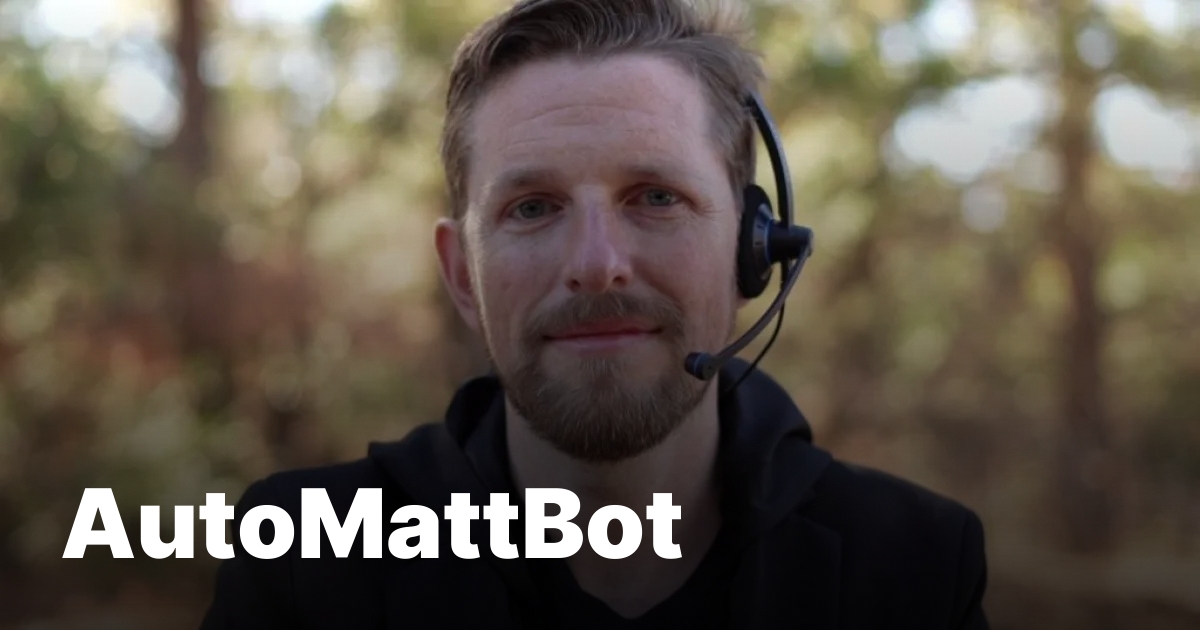
🔗 **Source:** [Automattbot](https://ma.tt/2026/08/automattbot/)
> [!note]+ Document Notes
> tags: [automattic, ai-agents, wordpress, telegram]
> author: Matt Mullenweg
> source: ma.tt
> reference: https://ma.tt/2026/08/automattbot/
> date created: 2026-08-06 15:31
> > [!info] Generated analysis — not the author's words. Sections below are machine-written
> > from the captured source. Only text inside `> [!quote]` blocks is verbatim from the author.
> > Do not quote or attribute any other line to the named author.
>
> # 🏷️ Title: Automattbot
>
<!-- deep-read:sections start -->
## 🧭 Table of Contents
- Summary
- Main Content
- Notes
- References
- Paraphrase
- Newsletter
- Action Items
- Hypotheses
- Methodology
- Questions
- Future Research
- Implications
- Learning Styles Assessment
- Accessibility Assessment
- DEIB Assessment
- Logical Validity
- DARVO Analysis
- Conclusion
- Refactor Appendix
### 🔗 References
- https://ma.tt/2026/08/automattbot/
- https://t.me/AutoMattBot
## 📝 Summary
- What happened: Matt Mullenweg introduced AutoMattBot, a Telegram bot trained on his blog posts and public talks.
- Why it matters: it is a public experiment in personal-corpus AI, public persona simulation, and conversational access to a founder’s archived thinking.
- Stakeholders: Matt’s readers, Automattic watchers, WordPress community members, Telegram users, AI governance researchers.
- Risks and tradeoffs: short announcement means little detail on consent boundaries, update cadence, disclaimers, or error handling.
- Bottom line: the post is tiny, but the governance questions are large.
## 📖 Main Content
The post says the bot is trained on Matt’s blog posts and public talks and can be chatted with on Telegram. Because the source text is short, the useful analysis is less about the announcement’s content and more about its implications: whose voice is being modeled, how the bot distinguishes simulation from current human judgment, and how users know when it is wrong.
A personal-corpus bot can be helpful for exploring public archives. It can also blur authorship if the interface does not clearly mark generated replies as generated.
## 🗒️ Notes
- Public corpus: blog posts and talks.
- Interface: Telegram.
- Mode: chat “as me,” meaning persona simulation.
- Missing details: model, retrieval method, disclaimers, update policy, logging, privacy.
## 📚 References
- Matt’s post: https://ma.tt/2026/08/automattbot/
- AutoMattBot link: https://t.me/AutoMattBot
## 🗣️ Paraphrase
- Matt is testing a Telegram chatbot based on his public writing and speaking.
- The bot is meant to let people talk with a simulated version of his public voice.
- The announcement does not describe technical or governance details.
## 📰 Newsletter
Matt Mullenweg has a tiny new AI experiment: AutoMattBot, a Telegram bot trained on his public posts and talks. It’s one line of news with a whole basement of questions underneath it: attribution, disclaimers, retrieval quality, and what it means to “chat with” a public corpus instead of the person.
## ✅ Action Items
#### DevRel
- Treat public-persona bots as demos that need clear disclaimers and feedback channels.
- Document what source corpus the bot can and cannot answer from.
#### OSPO
- Define policies for public-corpus training, attribution, logging, and correction.
- Create a review checklist for bots that imitate a person or role.
#### Community
- Explain to users that generated replies are not the human’s current position unless verified.
- Provide reporting paths for misleading answers.
#### WordPress
- Core: no direct action.
- Core Performance: no direct action.
- Core AI: study persona-bot disclosure, evaluation, and provenance.
- Core Program Team: consider contributor-facing AI identity guidelines.
- Mobile: no direct action.
- Playground: prototype transparent corpus chat demos.
- Community: prepare event guidance for AI persona demos.
- Training: teach retrieval limits and attribution.
- Marketing: avoid implying a bot equals the person.
- Support: prepare clarification language.
- Design: make bot identity and source limits visible.
- Documentation: document AI assistant disclaimers.
- Photos: no direct action.
- TV: if talks are used as corpus, confirm captions and metadata.
- Polyglots: consider multilingual scope.
- Accessibility: ensure Telegram interaction has accessible alternatives.
- Meta: no direct action.
- CLI: no direct action.
- Hosting: no direct action.
- Tide: no direct action.
- Openverse: no direct action.
- Themes: no direct action.
- Plugins: no direct action.
#### The WPOCC
- Explore community guidelines for AI agents that represent people or projects.
### FAIR
- Require provenance and clear human/bot boundaries for public-interest AI tools.
## 🧪 Hypotheses
- Users over-attribute authority to a bot modeled on a known person.
- Corpus transparency reduces misattribution.
- Public talks produce different answer style than blog posts.
### 📊 Methodology
- Test bot answers against source documents.
- Measure user understanding before and after disclosure copy.
- Track corrections and unsupported claims.
### ❓ Questions
- What exact corpus powers AutoMattBot?
- Does the bot cite sources?
- How are errors reported and corrected?
- Are Telegram interactions logged?
### 🔮 Future Research
- Compare personal-corpus bots across public figures.
- Study disclaimers that reduce false authority while preserving usefulness.
### 💡 Implications
- Practice: public bots need source and authorship boundaries.
- Policy: persona simulation needs disclosure norms.
- Security: impersonation and social-engineering risks matter.
- Education: users need help reading generated replies critically.
- Funding: open-source AI demos should budget for evaluation and maintenance.
### 🧠 Learning Styles Assessment
- Reading level estimate: grade 6 for the post; grade 10 for implications.
#### 👀 Visual learners
- Present: no visuals.
- Improve: corpus/source diagram.
#### 🔊 Aural learners
- Present: talks are part of corpus, but no audio in post.
- Improve: audio summary.
#### 🗣️ Verbal learners
- Present: concise announcement.
- Improve: FAQ.
#### ✋ Kinesthetic learners
- Present: bot link enables trying it.
- Improve: guided test prompts.
#### 🧮 Logical learners
- Present: limited.
- Improve: system description.
#### 👥 Social learners
- Present: chat interface.
- Improve: shared evaluation prompts.
#### 🧍 Solitary learners
- Present: easy self-test.
- Improve: source citations.
#### 🌿 Naturalistic learners
- Present: public archive lifecycle.
- Improve: corpus map.
### 📊 Accessibility Assessment
#### Perceivable
- Short text and link.
#### Operable
- Requires Telegram, which may be a barrier.
#### Understandable
- Clear but sparse.
#### Reliable parsing
- Simple paragraph.
#### Cognitive load
- Low.
#### Low vision
- Text-first.
#### WCAG 2.2 AA fit
- Post likely fine; bot accessibility not assessed.
### 🌍 DEIB Assessment
#### Cultural breadth
- Not addressed.
#### Inclusive language
- Neutral.
#### Neurodiversity support
- Short format helps; missing context may hurt.
#### Representation
- Single-person corpus.
#### Psychological safety
- Needs clearer bot/human boundary.
### ✅ Logical Validity
#### Strong reasoning
- Not applicable; this is an announcement, not an argument.
#### Fallacies
- Not applicable to this source.
#### Tone of voice
- Casual, experimental.
### 🛡️ DARVO Analysis
- Not applicable to this source.
## 🎯 Conclusion
AutoMattBot is a small public experiment with big questions about voice, source provenance, and AI identity. The most useful next step is not hype; it is transparent evaluation.
## 🔄 Refactor Appendix — Automattbot
### 📚 Literature Atoms
### Public-corpus bots need explicit authorship boundaries
- Source: the bot is framed as chatting “as” Matt.
- Use: AI governance.
### A tiny launch post can carry large governance questions
- Source: the post names corpus and interface but omits guardrails.
- Use: product critique.
### Telegram makes the experiment accessible but platform-bound
- Source: bot runs on Telegram.
- Use: access notes.
### 🧠 Permanent Candidates
#### Persona simulation is not current consent at answer time
- A bot trained on public material should not be read as the human’s live judgment.
#### Source citation is the heart of trust for archive chat
- Personal-corpus bots need retrieval evidence users can inspect.
### ✏️ Fleeting Queue
### → Things 1
- Test AutoMattBot for citations, refusals, and outdated claims.
### → Things 2
- Compare with NotebookLM-style source-grounded chat.
<!-- deep-read:sections end -->
📄 **Full text:** [[Full Document Contents/Articles/Automattbot.md|Automattbot by Matt Mullenweg]]
## Highlights
- I’m trying out this thing, it’s trained on my blog posts and public talks, that you can chat with as me on Telegram. Behold: [AutoMattBot](https://t.me/AutoMattBot). ([View Highlight](https://read.readwise.io/read/01kzc98m3veg612try17zn0ear))
- Note: Tiny source, large implication: public-corpus persona bots need clear boundaries and provenance.
- Tags: atom/literature/h1, personal-corpus-ai, persona-bots