Blatant Sales Pitch: AI for Writers Course
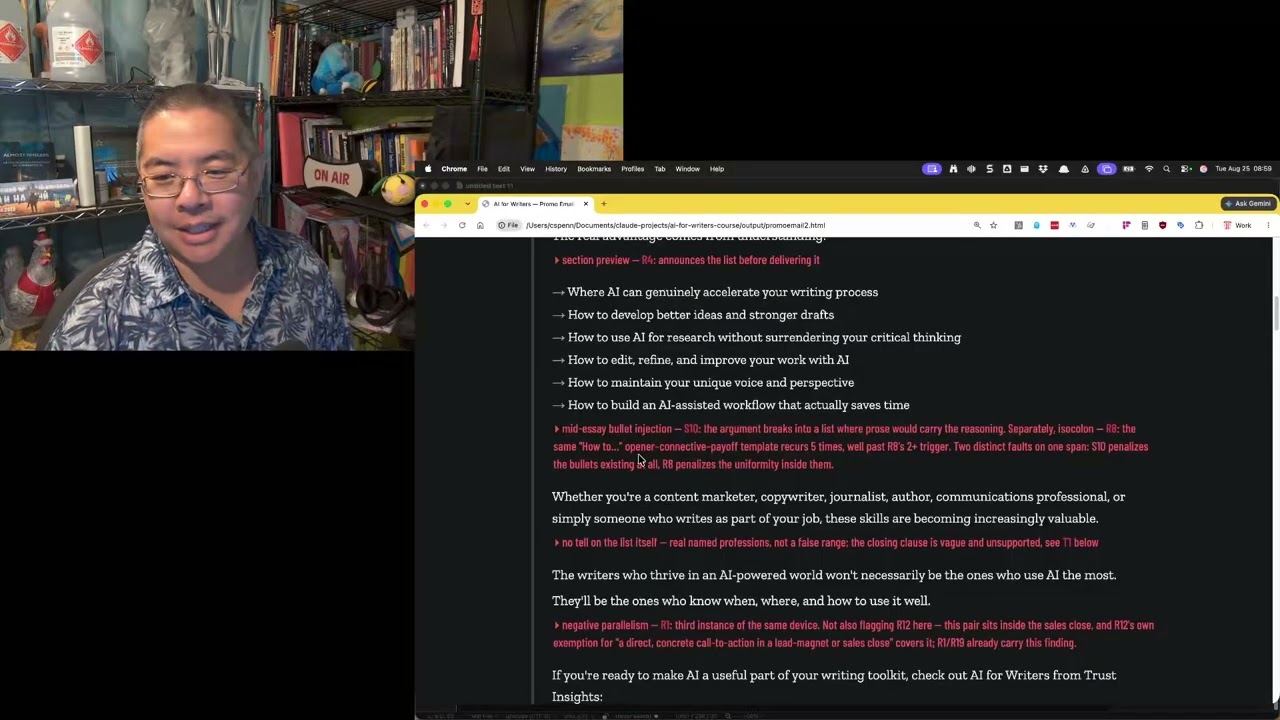
🔗 **Source:** [Blatant Sales Pitch: AI for Writers Course](https://www.youtube.com/watch?v=rZtKo3lcHxc&feature=youtu.be)
> [!note]+ Document Notes
> tags: [ai-writing-detection, editing-craft, rhetorical-analysis, prompt-repair, content-quality, ai-slop]
> author: Christopher S. Penn (Trust Insights)
> source: https://youtu.be/rZtKo3lcHxc
> reference: "Blatant Sales Pitch: AI for Writers Course" - 2026-08
> date created: 2026-08-25 12:05
>
> > [!info] Generated analysis - not the author's words. Sections below are machine-written
> > from the captured source. Only text inside `> [!quote]` blocks is verbatim from the author.
> > Do not quote or attribute any other line to the named author.
>
> # Title: Blatant Sales Pitch: AI for Writers Course
>
> **Attribution.** Reader's `author` field records only `YouTube`. The speaker is **Christopher S. Penn** of **Trust Insights** - identified from the repeated first-person attribution of the course to Trust Insights, the `trustinsights.ai` URL he reads out, and his established presence in this corpus (two Penn items appear in the 2026-08-24 methods review inventory). High confidence, not verified against the channel page.
>
> **Commercial interest - disclosed in the title itself.** The video is called *"Blatant Sales Pitch."* It exists to sell a $397 course. That is about as clean a disclosure as this genre gets, and it should be weighted accordingly: the diagnostic content is real, and it is also a demonstration designed to make you want the tool that produces it.
>
> **Structural note, and the thing that makes the video work.** Penn opens by reading an AI-generated marketing email for his own course, states up front that ChatGPT wrote it, delivers it straight - then says *"Now, this is AI slop"* and diagnoses it line by line. Using AI slop to sell a course on detecting AI slop, with the generation disclosed before the reveal, is a genuinely well-built demonstration.
>
<!-- deep-read:sections start -->
## Summary
**The demonstration.** Penn reads a competent-sounding AI-generated marketing email for his own course, discloses that ChatGPT wrote it, then declares it slop and walks through *why*, naming each tell as a specific rhetorical device rather than a vibe.
**The named tells - this is the valuable content.** In order of appearance in his walkthrough:
1. **Fact-free opening statement** - "If you're a writer, you probably noticed something changing fast." Declarative, agreeable, contains no information.
2. **Negative parallelism** - *"It's not this, it's that."* He identifies this as a form of **bicolon rhythm**.
3. **Enumeration** - the five-item list.
4. **Clipped tailing negation** - the inverted form, *"it's this, not that."*
5. **Section preview** - declarative scene-setting without facts.
6. **Mid-essay bullet injection** - dropping a list into running prose. He notes **ChatGPT does this more than Claude**.
7. **Bicolon antithesis drumbeat** - the repetition of negative parallelism *throughout* a document, which he calls the big one.
8. **An explicit exemption for calls to action** - CTAs are allowed to be declarative and fact-light without counting as tells.
**The line that carries the video.** On the drumbeat: *"When you know what to call it and you can see it, you're like, 'Oh my god, it's everywhere.'"* The claim is that naming the device is what makes it visible, and that this is why slop is hard to articulate even when it is obvious.
**The repair method.** Take the diagnostic checklist, hand it back to the model, and tell it to fix its own output. The diagnostic doubles as a revision prompt.
**The product.** *AI for Writers*, Trust Insights, live now, **$397 USD**, 3.5 hours of instruction, 22 lessons. Includes the diagnostic tools, an explanation of *why* AI writes this way ("very specific technical reasons"), the **CRAFT** framework (Create, Research, Architect, Fabulate, Tune), a deep research suite, and **skills/plugins for agentic systems** - he names Claude Code, Claude coworker, Microsoft Copilot, and Google Antigravity, with the criterion "if it supports skills."
**Bottom line.** Five minutes of sales pitch containing one genuinely useful contribution: a **named, checkable vocabulary** for AI tells that goes well beyond the usual "em dashes and *delve*" list. The specific claim about *negative parallelism* being pervasive is testable, and it turns out to be a real gap in Courtney's existing rules.
## Main Content
### Notes
**[00:00-00:03] The disclosure.** Opens by saying he will read an email and, in full disclosure, that ChatGPT generated it.
**[00:03-01:19] The AI-generated email, read straight.** Its content, as read:
- AI isn't replacing the need for great writing; it's changing how great writers work.
- The opportunity isn't handing writing over to AI and hoping; it's learning to use AI as a thinking partner, research assistant, editor, brainstorming companion, and productivity tool while keeping voice, judgment, and creativity in the driver's seat.
- Positions the course as *not* another collection of generic prompt engineering tips.
- Lists what the real advantage comes from: where AI genuinely accelerates writing, developing better ideas and stronger drafts, research without surrendering critical thinking, editing and refining, maintaining voice, building a workflow that saves time.
- Audience list: content marketer, copywriter, journalist, author, communications professional, or anyone who writes as part of their job.
- Closes: the writers who thrive won't be the ones who use AI most, but the ones who know when, where, and how to use it well.
**[01:19] The turn.** *"Now, this is AI slop."*
**[01:22-01:48] The framing problem.** His stated difficulty: humans struggle to articulate *why* something reads as AI slop. The course includes diagnostic tools that "call out AI and say yo, this is what we see."
**[01:48-03:24] The live diagnosis.** Walking the email against the diagnostic:
- **Opening statement, no facts.** "If you're a writer, you probably know something's changing fast" - he notes AI "loves to do this."
- **First negative parallelism** - "It's not this, it's that" - named as **a form of bicolon rhythm**.
- **More negative parallelism** - same structure again.
- **The five-item list is an enumeration** - flagged as its own category, discussed further in the course.
- **A normal sentence** - explicitly marked "no tell." *(Worth noting: the diagnostic marks clean passages too, not only failures.)*
- **Clipped tailing negation** - "it's this, not that," named as a distinct inverted form.
- **Section preview** - declarative without many facts.
- **Mid-essay bullet injection** - and the comparative claim: **ChatGPT is very fond of this, even more so than Claude.** "It loves to put lists and lists and lists."
- **No tell on the list itself** - the list content passes even though its injection was flagged.
- **Exemption for calls to action** - CTAs are carved out.
- **The bicolon antithesis drumbeat** - "This is a big one." Present *throughout* the document. "Boom. Boom. This not this. It's that. Do this. Do that."
- The recognition claim: once you can name it, you see it everywhere.
**[03:24-03:48] The repair loop.** Read through the diagnostics, see how many areas it fails, then **hand the checklist back to the AI**: *"Hey, fix your stuff, man. This is sloppy work here."*
**[03:48-04:38] What the course contains.**
- The diagnostic tools and how to use them.
- **Why AI writes the way it does** - "some very specific technical reasons." *(Not explained in the video; this is the course hook.)*
- The **CRAFT framework**: Create, Research, Architect, Fabulate, Tune - to teach both generating useful copy and fixing AI's worst habits.
- A deep research suite.
- **Skills and plugins for agentic systems** - Claude Code, Claude coworker, Microsoft Copilot, Google Antigravity, "if it supports skills." These run the diagnostics for you and report what's wrong.
**[04:38-05:09] The offer.** Live today. `trustinsights.ai/aiwriting` (transcript garbles the URL). **$397 US.** 3.5 hours of instruction, 22 lessons.
## References
Primary sources, preferred over this video:
- **The course itself** - the diagnostic checklist, the "specific technical reasons," and the CRAFT framework are all gated behind it. The video names them; it teaches only a fraction of the first.
- **Classical rhetoric references on bicolon, antithesis, and parallelism** - *bicolon* and *antithesis* are established rhetorical terms with a long literature. Penn is applying existing vocabulary rather than inventing it, which is a point in the method's favor and worth verifying against a rhetoric reference.
- **Research on stylometric detection of LLM output** - the academic version of this question. Whether these specific devices discriminate reliably is an empirical matter with an existing literature, none of which the video cites.
- **Courtney's own `unslop` skill and the CLAUDE.md writing rules** - the direct comparison target (see Implications).
## Paraphrase
**On why naming matters.** The video's genuine insight is not that AI writing has tells - everyone knows that - but that most people cannot *say* what the tells are, and therefore cannot check for them systematically. "It feels like AI" is not a revision instruction. "You used negative parallelism four times" is. Converting an aesthetic reaction into a named, countable feature is what makes it fixable, and it is also what makes it delegable to a tool.
**On the specific claim.** Of the eight tells, one is doing most of the work: **negative parallelism**, and its accumulation into a drumbeat. The construction *"It isn't X, it's Y"* is not itself bad writing - it is a legitimate and old rhetorical figure. What marks it is *density*. Used once it is emphasis; used six times in five paragraphs it is a rhythm the model fell into rather than a choice the writer made.
**On the exemptions, which are the sign of a real diagnostic.** He explicitly marks normal sentences as "no tell" and carves out calls to action. A checklist that flags everything is useless; one that says *this passage is fine* is doing discriminative work. That detail is more persuasive about the tool's quality than any of the positive findings.
**On the repair loop.** Handing the diagnostic back to the model is the obviously correct move and slightly undercuts the course's premise. If the checklist is the valuable artifact and the model can apply it to its own output, then the checklist - not the human judgment - is the product. Which is presumably why the course ships it as skills and plugins.
**On the demonstration's honesty.** He could have generated a strawman. Instead he generated marketing copy for his own product, read it in earnest, and then dismantled it. That costs something - the email is genuinely persuasive on first pass, which is the point.
## Newsletter
**WordPress angle - a better vocabulary for the thing you already hate.**
Everyone can tell when a blog post was written by ChatGPT. Almost nobody can say *why* in a way that survives contact with an editor. "It feels like AI" isn't a revision note.
Christopher Penn's pitch video for his new course does one genuinely useful thing before it starts selling: it names the tells as actual rhetorical devices. Not "it uses em dashes" - the real machinery.
The big one is **negative parallelism**: *"It's not this, it's that."* Once. Fine, that's a legitimate figure of speech. Six times in five paragraphs and it's a drumbeat - what Penn calls bicolon antithesis. His line lands: *"When you know what to call it and you can see it, you're like, 'Oh my god, it's everywhere.'"*
The rest of the list is equally checkable. Fact-free opening statements ("If you're a developer, you've probably noticed things changing fast"). Enumeration. Clipped tailing negation - the inverted form, "it's this, not that." Section previews that announce without informing. Mid-essay bullet injection, which he says ChatGPT does more than Claude.
And the two details that suggest it's a real diagnostic rather than a vibe check: he marks clean sentences as *no tell*, and he exempts calls to action. A checklist that flags everything isn't a checklist.
The practical move costs nothing. Take the list, hand it back to whatever model produced your draft, and tell it to fix its own output. The diagnostic works as a revision prompt.
Worth being clear about what this is: a five-minute ad for a $397 course, titled "Blatant Sales Pitch," which opens by having ChatGPT write the ad and then tears it apart. That's an honest structure, and the substance he gives away is the part worth having. The *why* - his "specific technical reasons" AI writes this way - is behind the paywall.
## Action Items
**DevRel**
- `#action/h1` The named-device vocabulary is immediately usable in editing guidance and in talks about AI writing. Far more actionable than the usual banned-words list.
- `#action/h2` "Naming the device is what makes it visible" is a good, portable framing for teaching any kind of critique.
**OSPO**
- `#action/h3` If the org publishes AI-assisted content, this vocabulary belongs in the editorial standard.
**Community**
- `#action/h2` Useful for anyone reviewing community-submitted content that increasingly arrives AI-drafted.
**WordPress subteams**
- **Documentation** - `#action/h1` Directly applicable. Docs reviewers need a way to say *what* is wrong with AI-drafted contributions, not just that something is. This supplies the vocabulary.
- **Training** - `#action/h1` Teachable content for anyone producing Learn WordPress material with AI assistance.
- **Marketing** - `#action/h2` The diagnosed email is *marketing copy*, and the tells are exactly the ones marketing drafts fall into. Uncomfortably on point.
- **Core, Core Performance, Core AI, Core Program Team, Mobile, Playground, Support, Design, Photos, TV, Openverse, Themes, Plugins, Meta, CLI, Hosting, Tide** - **Not applicable to this source.** This is writing-craft content with no technical, product, or project relevance to these teams.
- **Polyglots** - `#action/h3` Worth noting the tells are English-specific; whether they transfer to other languages is unknown and matters for translated content.
- **Accessibility** - `#action/h3` Tangential but real: fact-free openings and section previews add reading burden without adding information, which is a plain-language concern.
**The WPOCC**
- Not applicable to this source.
**FAIR**
- Not applicable to this source.
**Personal / vault**
- `#action/h1` **Verified gap in `~/.claude/CLAUDE.md`.** A grep for `parallel|not this|isn't just|bicolon` returns **zero matches**. The writing-style block bans AI words, openers, qualifier adverbs, and fact-free claims - but has **no rule against negative parallelism**, which this source identifies as the most pervasive tell. This is a concrete, checkable addition. *(Reviewer note: it also satisfies the file's own standard - a rule is only worth keeping if a draft either violates it or doesn't, and "count the 'not X, but Y' constructions" is exactly that.)*
- `#action/h1` Add the named-device list to the **`unslop`** skill. Its current job is cutting AI tells; this gives it precise names and a countable test rather than a feel.
- `#action/h2` The "hand the diagnostic back to the model" loop is directly implementable as an `unslop` step: run the checklist, then pass the findings to the drafting model as a revision instruction.
- `#action/h3` Note the *exemptions* too - clean-sentence marking and the CTA carve-out. A skill that flags everything trains people to ignore it.
## Hypotheses
1. **The naming hypothesis.** If a stylistic flaw is given a specific name, editors will detect it more consistently than when working from an aesthetic impression. *Penn's central claim, stated as personal experience. Genuinely testable with an inter-rater agreement study; not tested here.*
2. **The density hypothesis.** If negative parallelism is a legitimate figure, then the tell is *frequency*, not presence - a threshold rather than a binary. *Implied throughout, never stated as a number. The most useful open question: how many per thousand words is diagnostic?*
3. **The model-signature hypothesis.** If different models have different habits, then tell profiles discriminate between them. *Penn asserts one instance - ChatGPT does mid-essay bullet injection more than Claude. Single comparison, no data, but cleanly testable.*
4. **The self-repair hypothesis.** If a model is given a specific diagnostic of its own output, it can correct the flagged features. *Asserted; plausible, since the features are surface-level and countable. Whether repair produces good writing or merely differently-patterned writing is unaddressed.*
5. **The moving-target hypothesis (not raised by the source).** If tell-lists become widely used and get fed back into training or system prompts, the tells will shift. Any fixed checklist has a shelf life, and a $397 course sells a snapshot.
6. **The false-positive hypothesis (not raised).** Human writers use negative parallelism and enumeration too, particularly in marketing. A diagnostic tuned to flag these will flag competent human copy. The CTA exemption suggests Penn knows this; the video does not report a false-positive rate.
## Methodology
**Design: a single worked example, in a sales pitch.** One AI-generated email, diagnosed by the person selling the diagnostic. That is the entire evidentiary base.
**What it demonstrates well.** That the named devices *are present* in this text, and that a checklist can locate them. The walkthrough is specific enough to follow and check, which is more than most "how to spot AI writing" content offers.
**What it does not establish, and none of this is hidden - it simply isn't claimed:**
- **No discrimination data.** No comparison against human-written marketing copy. Since the tells (negative parallelism, enumeration, declarative openings) are *standard marketing rhetoric*, the false-positive question is central and unaddressed.
- **No threshold.** The density claim is the real one, and no number is offered. Without it the diagnostic is judgment dressed as a checklist.
- **The comparative model claim is anecdotal.** ChatGPT-vs-Claude on bullet injection, asserted from impression.
- **The mechanism is withheld.** "Very specific technical reasons why AI writes the way it does" is stated and not explained - it is the course's hook. Fair as commerce; it means the causal claim is unevaluable here.
- **n=1, and the sample is self-selected.** He generated the example he then diagnosed.
**The circularity worth naming.** The email was produced by a model and diagnosed by a checklist, both chosen by the seller. A stronger demonstration would diagnose text he did not generate - ideally a mix of AI and human copy, unlabelled.
**Weighting.** Treat the *vocabulary* as the deliverable and the *demonstration* as an advertisement. The vocabulary survives the sales context because it is checkable independently: anyone can count negative parallelisms in their own drafts tomorrow.
## Questions
1. **What is the density threshold?** One negative parallelism is a figure of speech; six is a tell. Where is the line? This is the difference between a checklist and a vibe.
2. **What is the false-positive rate on human marketing copy?** These devices are staples of persuasive writing. A diagnostic that flags good human copy is worse than none.
3. **Do the tells transfer across languages?** All eight are English rhetorical structures. Relevant to any translated content pipeline.
4. **What are the "specific technical reasons"?** Withheld. Plausibly about RLHF preferences for balanced, hedged, agreeable structures - but that is a guess, and the video invites it without supporting it.
5. **Does repair produce better writing, or differently-patterned writing?** If a model removes flagged constructions, does the result read human or merely read differently machine?
6. **How long does the list stay valid?** Tells shift as models change. A course sells a fixed snapshot of a moving target.
7. **What are the other tells?** He references "how many different areas it fails" and a fuller diagnostic. Eight are named; the checklist is longer.
## Future Research
- **Establish density thresholds empirically.** Count these constructions per thousand words across a labelled corpus of human and AI marketing copy. This is straightforward, has not been done publicly, and would convert the whole thing from craft advice to measurement.
- **Test the model-signature claim.** Same prompt across ChatGPT, Claude, and others; count bullet injections and negative parallelisms. Cheap, and directly checks Penn's one comparative assertion.
- **Measure the repair loop.** Does handing the diagnostic back reduce flagged constructions, and do blind readers rate the result better?
- **Test the naming hypothesis.** Two groups of editors, one given named devices and one given "flag AI-sounding passages," measured on agreement and consistency.
- **Track drift.** Re-run the same diagnostic against each new model generation. The rate at which tells decay is itself the interesting number.
## Implications
**Practice.** Immediately usable and free: add negative parallelism and its inverted form to any editing checklist, count rather than sense them, and hand the findings back to the drafting model as a revision instruction. None of that requires the course.
**Policy.** For anyone setting editorial standards on AI-assisted content, named devices are enforceable in a way that "sounds like AI" is not. A reviewer can point at a line; a writer can fix it; the disagreement becomes factual.
**Security.** Not applicable to this source.
**Education.** The pedagogical claim - that naming a device is what makes it visible - is well-supported by how rhetoric has always been taught, and generalizes past AI detection to critique of any kind.
**Funding.** Not applicable to this source.
**For Courtney's own configuration, and this is the actionable part.** Her CLAUDE.md writing block already covers fact-free claims ("every claim carries a fact"), openers, qualifier adverbs, and AI vocabulary. **It has no rule about sentence-level rhythm at all** - verified by grep, zero matches for parallelism or its variants. Negative parallelism is the tell this source ranks highest, it is invisible to every rule she currently has, and it is countable, which satisfies her own standard that every rule be pass/fail against a draft.
## Learning Styles Assessment
- **Visual** - Moderate, and load-bearing in a way the transcript cannot capture. He is annotating an on-screen document as he speaks; phrases like "there's no tell" and "this is a big one" refer to visible markup. A transcript-only reader loses the mapping between label and text.
- **Aural** - Strong. Conversational, well-paced, five minutes.
- **Verbal** - Strong. The named devices are the content, and they are delivered verbally.
- **Kinesthetic** - Moderate. The reader can apply the checklist to their own drafts immediately, though the full checklist is not given.
- **Logical** - Moderate-to-strong. The structure - generate, read straight, reveal, diagnose item by item, propose repair - is a clean demonstration arc. Weakened by the absence of thresholds or comparisons.
- **Social** - Weak. Single speaker, no dialogue.
- **Solitary** - Strong. Short, self-contained, no prerequisites beyond an interest in writing.
- **Naturalistic** - Not applicable to this source.
**Reading level estimate.** Spoken register roughly grade 10-11 and easy to follow. The **rhetorical vocabulary is the barrier**: bicolon, antithesis, parallelism, enumeration, and "clipped tailing negation" are used without definition. Ironically, a video about clear writing assumes terminology most of its audience will not have.
## Accessibility Assessment
Mapped to WCAG 2.2 AA:
1. **Perceivable - captions (1.2.2).** Auto-generated only, and lossy in ways that matter here: "bicolon" renders as "by colon" and "byon," "parallelism" as "powism," and **the course URL is garbled** - the one piece of information the video exists to convey. **Fails** on accuracy.
2. **Perceivable - audio description (1.2.3/1.2.5).** **Significant fail.** The diagnosis is performed against an on-screen annotated document. Labels like "no tell here," "this is a big one," and "more negative parallelism" are spatially anchored to text the viewer can see. A blind viewer gets the label list without knowing which sentences they attach to - which is most of the instructional value.
3. **Perceivable - contrast, text size (1.4.3, 1.4.4).** Not assessable from transcript; on-screen document text in a screen recording is commonly small. **Not assessed.**
4. **Operable - keyboard (2.1.1).** Platform-level via the YouTube player. **Pass.**
5. **Operable - timing, seizures (2.2, 2.3.1).** No flashing; user-controlled. **Pass.**
6. **Understandable - language (3.1).** Clear delivery undermined by undefined specialist rhetoric terms. **Partial pass.**
7. **Robust - parsing (4.1).** Transcript available and machine-readable. **Pass.**
**Highest-value remediation:** a written version of the diagnostic - the annotated email with its labels as text. It would fix the audio-description failure, the caption failure, and the URL problem simultaneously, and it is the artifact viewers actually want.
## DEIB Assessment
- **Cultural breadth.** Narrow, and structurally so. Every tell is a feature of **English** rhetoric, and the whole diagnostic is monolingual. For a global audience producing translated content, whether any of this transfers is unaddressed and non-obvious.
- **Inclusive language.** Fine. Neutral throughout. The audience list in the read email - content marketer, copywriter, journalist, author, communications professional, "or simply someone who writes as part of your job" - is deliberately broad, and the last clause does real inclusive work.
- **Neurodiversity support.** Good. Short, single-topic, concrete worked example, consistent label-then-explain rhythm. The undefined rhetorical jargon cuts against it, and the visual dependency is a real barrier for anyone processing audio-only.
- **Representation.** Single speaker, no other voices, no examples from writers other than the model's output.
- **Psychological safety.** **Good, and the structure is why.** He diagnoses *his own* marketing email rather than someone else's writing. Nobody is held up as a bad writer; the failure demonstrated is his own tool's output, produced deliberately. That is a considerate way to teach critique, and it removes the sting that "here's why this person's writing is bad" would carry. The register toward AI output is dismissive ("slop," "fix your stuff, man") but the target is a machine, not a person.
## Logical Validity
**Strong reasoning.**
1. **The demonstration is honest about its own construction.** The generation is disclosed *before* the reveal, not after. He does not pretend to have found the email in the wild.
2. **Self-directed example.** Diagnosing his own product's marketing copy avoids making an example of anyone and raises the cost of the demonstration to himself.
3. **The diagnostic marks clean passages.** "This is a normal sentence, there's no tell" appears twice. A checklist that can say *fine* is discriminating rather than pattern-matching.
4. **An explicit exemption is carved out.** CTAs are excluded. Stating where a rule does *not* apply is a mark of a rule that has been used rather than merely written.
5. **Existing vocabulary rather than invented jargon.** Bicolon, antithesis, and parallelism are real rhetorical terms with a literature behind them. Borrowing is more credible than coining.
6. **The commercial nature is in the title.** "Blatant Sales Pitch." No pretense.
**Fallacies.**
1. **Circular demonstration** - `#fallacy/circular-reasoning`. The seller generated the example, chose the checklist, and applied one to the other. Nothing independent constrains the result. The tells are genuinely present, but a demonstration constructed end-to-end by the party proving the point cannot establish that the diagnostic works on text it was not aimed at. **Fix:** diagnose unlabelled text he did not produce.
2. **Missing threshold, presented as binary** - `#fallacy/false-precision`. Negative parallelism is treated as a tell when the video's own argument is about density ("throughout the document," "drum beat"). A named device with no frequency criterion is a judgment call wearing a checklist's clothes. **Fix:** state a rate.
3. **Suppressed counter-case: false positives** - `#fallacy/suppressed-evidence`. Every named device is standard persuasive-writing technique. Human marketing copy would trip most of them. The CTA exemption implies he has thought about this; the video never raises it. **Fix:** one sentence acknowledging the overlap with competent human copy.
4. **Anecdotal comparative claim** - `#fallacy/anecdotal`. "ChatGPT is very fond of this, even more so than Claude" is asserted from impression, with no counts and no method - inside a pitch for rigor.
5. **Appeal to withheld explanation** - `#fallacy/appeal-to-mystery`. "There are some very specific technical reasons why" AI writes this way, unexplained, available in the course. Legitimate as commerce, and it means the causal half of the argument cannot be evaluated at all.
**Tone of voice.** Casual, fast, and confident, with the register of someone showing a colleague something rather than lecturing. Genuinely enthusiastic at the recognition moment ("oh my god, it's everywhere"), which is the most persuasive beat in the video. Dismissive toward AI output in a jokey register ("fix your stuff, man"). The pivot from demonstration to price is abrupt but pre-announced by the title, so it does not read as a bait-and-switch.
## DARVO Analysis
**Deny** - **Not present.** Nothing is denied. The commercial intent is in the title and the AI generation is disclosed before the reveal.
**Attack** - **Not present** in any interpersonal sense. The criticism is directed at machine output, and specifically at output he commissioned himself. No writer, competitor, or vendor is targeted.
**Reverse victim and offender** - **Not present.** No grievance, no victimhood, no redirected accusation.
**Assessment: no DARVO pattern.** A disclosed sales pitch built on a self-directed example. Recorded as a negative finding.
## Conclusion
**Bottom line.** A five-minute advertisement that gives away one genuinely valuable thing: **a named vocabulary for AI tells that is countable rather than felt.**
The list - fact-free opening statements, negative parallelism, enumeration, clipped tailing negation, section previews, mid-essay bullet injection, and the bicolon antithesis drumbeat - is more precise than the usual "watch for em dashes and *delve*" advice, because these are real rhetorical devices with names, and named things can be counted, taught, and delegated. Penn's own framing is the strongest claim in it: *once you know what to call it, you see it everywhere.*
Two details argue the diagnostic is real rather than decorative: it marks clean sentences as clean, and it exempts calls to action. Checklists that flag everything get ignored.
**Held against it:** the demonstration is fully circular - he generated the example, owns the checklist, and sells the course. No threshold is given, which matters because the actual claim is about *density*, not presence. The false-positive question against competent human marketing copy is never raised, though the CTA carve-out suggests he has considered it. And the causal explanation - why AI writes this way - is withheld as the course's hook, so half the argument is unevaluable.
**The concrete outcome for Courtney**, and it is verified rather than inferred: her CLAUDE.md writing rules cover vocabulary, openers, adverbs, and fact-density, but a grep confirms **nothing about sentence-level rhythm or negative parallelism**. That is the tell this source ranks highest, it is invisible to every rule currently in the file, and it is countable - which satisfies the file's own requirement that a rule be pass/fail against a draft. The `unslop` skill has the same gap.
**Next steps.**
1. Add negative parallelism and clipped tailing negation to CLAUDE.md's writing block and to `unslop`, phrased as a count rather than a prohibition.
2. Add the repair loop to `unslop`: run the checklist, hand the findings back to the drafting model.
3. Before trusting the list broadly, run it against known-human marketing copy. If it flags that too, it is a persuasive-writing detector, not an AI detector.
## Refactor Appendix
### Literature Split Pad (H3)
> [!quote] `#atom/literature/h1`
> "one of the things that's so difficult for us to figure out as humans is why? What are the things going on here that indicate to us this that this is AI slop?"
The problem statement, and the reason a named vocabulary is worth anything.
> [!quote] `#atom/literature/h1`
> "This is a big one. The by colon antithesis drum beat. It's not this is that. This is throughout the document. Boom. Boom. This not this. It's that. Do this. Do that. That byon rhythm. When you when you know what to call it and you can see it, you're like, 'Oh my god, it's everywhere.'"
The central claim. Note the auto-captions mangle "bicolon" into "by colon" and "byon." **The tell is density, not presence** - "throughout the document."
> [!quote] `#atom/literature/h1`
> "we have our first negative parallelism. It's not this. It's that right? Negative parallelism is a form of bicolon rhythm."
The single most useful named device, and the one absent from Courtney's current rules.
> [!quote] `#atom/literature/h2`
> "opening statement. No facts. If you're already you probably know something changing fast, right? No factree opening statements."
The fact-free opener. This one *is* already covered by her existing rules.
> [!quote] `#atom/literature/h2`
> "mid essay bullet injection. Uh this is and I'm sure you've noticed this chat GPT is very fond of this even more so than Claude. It loves to put lists and lists and lists of of things."
The one comparative model claim. Anecdotal, cleanly testable.
> [!quote] `#atom/literature/h2`
> "if you have this diagnostic checklist, you can then hand it back to AI and say, 'Hey, fix your stuff, man. This this is this is sloppy work here.'"
The repair loop - the diagnostic doubles as a revision prompt.
> [!quote] `#atom/literature/h3`
> "There's this is a normal sentence here. There's no tell"
Marks clean passages as clean. The detail that most suggests a working diagnostic rather than a pattern-matcher.
> [!quote] `#atom/literature/h3`
> "the craft framework which is create, research, architect, fabulate, and tune"
CRAFT, named but not taught.
> [!quote] `#atom/literature/h3`
> "Now, this is AI slop."
The turn, after reading his own AI-generated marketing copy straight.
### Atomic Split Pad (H4)
- `#atom/zettel/z1` **Naming a device is what makes it visible** - An aesthetic reaction cannot be checked, taught, or delegated; a named feature can be counted. Converting "this feels wrong" into "this uses X four times" is the move that turns taste into process.
- `#atom/zettel/z1` **The tell is density, not presence** - Negative parallelism is a legitimate rhetorical figure. What marks machine output is repetition without variation: a rhythm fallen into rather than a choice made. Any diagnostic built on such devices needs a threshold, not a binary.
- `#atom/zettel/z1` **A checklist that never says "fine" is not a checklist** - Discriminative power requires marking clean passages clean and carving out legitimate exceptions. A rule that flags everything trains people to ignore it.
- `#atom/zettel/z1` **A diagnostic is also a repair prompt** - Any checklist specific enough to detect a flaw is specific enough to instruct its correction. This collapses detection and revision into one artifact.
- `#atom/zettel/z1` **Style tells are a moving target** - Detection heuristics feed back into training and system prompts. Any fixed list of tells has a shelf life, and that shelf life is shorter than a course's.
- `#atom/zettel/z1` **A demonstration built end-to-end by the seller proves only internal consistency** - When the same party generates the example, owns the checklist, and applies one to the other, nothing independent constrains the outcome.
### Fleeting Queue
- `#atom/fleeting/f1` **Verified gap, act on this.** `grep -icE "parallel|not this|isn't just|bicolon" ~/.claude/CLAUDE.md` returns **0**. The writing block has no rule about sentence rhythm. Negative parallelism is the highest-ranked tell here and is invisible to every rule currently in the file.
- `#atom/fleeting/f1` Same gap in the **`unslop`** skill. Its description says "cut AI tells from any writing, must always apply" - worth checking whether it names devices or only vocabulary.
- `#atom/fleeting/f1` **Test before adopting**: run the tell list against known-human marketing copy. If it flags that too, this detects persuasive writing, not AI. The CTA exemption hints Penn knows.
- `#atom/fleeting/f1` The ChatGPT-vs-Claude bullet-injection claim is a cheap experiment: same prompt, both models, count the injections.
- `#atom/fleeting/f1` Penn is now a recurring source - two items in the 2026-08-24 methods review inventory plus this. Worth tracking as a standing methods source rather than incidental.
- `#atom/fleeting/f1` "Fabulate" in CRAFT is an unusual word choice worth understanding - it normally means *to invent or fabricate*, which is a strange thing to want from a writing tool. Possibly deliberate (controlled invention in drafting), possibly a stretch to fit the acronym.
- `#atom/fleeting/f1` The tells are English-only. Relevant to any translated-content work, and nobody addresses it.
## Template Library
### -> Fleeting refactor
Two-line capture: *AI slop has nameable rhetorical tells - negative parallelism, bicolon antithesis drumbeat, fact-free openers, mid-essay bullet injection - and the diagnostic doubles as a repair prompt.* File under writing craft. Revisit after testing against human copy.
### -> Literature refactor
One Literature Note: **"Named Tells of Machine Writing"** - the eight devices, the density caveat, the exemptions, and the repair loop. Note the circular demonstration and that the causal explanation is paywalled.
### -> Atomic refactor
Strongest Permanent Note candidates:
1. **"Naming a Device Is What Makes It Visible"** - the best idea here, and it generalizes past AI detection to critique, code review, and audit work. Directly connects to the register-labelling discipline this pipeline runs on.
2. **"The Tell Is Density, Not Presence"** - genuinely non-obvious, and the correction the source's own framing needs. Applies to any heuristic built on features that also occur legitimately.
3. **"A Checklist That Never Says Fine Is Not a Checklist"** - connects to existing vault material on review practice and on rules that must be pass/fail.
### -> Things 3
- Add negative parallelism + clipped tailing negation to CLAUDE.md's writing block, phrased as a count (**high priority - verified gap**).
- Add the named-device list and the repair loop to the `unslop` skill (high priority).
- Test the tell list against known-human marketing copy before trusting it broadly (medium priority - determines whether it's an AI detector or a persuasion detector).
- Run the ChatGPT-vs-Claude bullet-injection comparison (low priority, cheap).
<!-- deep-read:sections end -->
📄 **Full text:** [[Full Document Contents/Articles/Blatant Sales Pitch AI for Writers Course.md|Blatant Sales Pitch: AI for Writers Course by Christopher S. Penn (Trust Insights)]]
## Highlights
- there's an exemption for calls to action and then there's no tells on the thing. This is a big one. The by colon antithesis drum beat. It's not this is that. This is throughout the document. Boom. Boom. This not this. It's that. Do this. Do that. That byon rhythm. When you when you know what to call it and you can see it, you're like, "Oh my god, it's everywhere." Um, and then through if we read through the diagnostics, we can see what else ([View Highlight](https://read.readwise.io/read/01m0x5kvanns76e4vm9bvh3yxe))
- Note: The most actionable finding in this batch. "Bicolon antithesis drumbeat" (auto-captions garble it as "by colon"/"byon") = repeated negative parallelism, "It's not X, it's Y." VERIFIED GAP: grep of ~/.claude/CLAUDE.md for parallel|not this|bicolon returns ZERO. The writing block covers vocabulary, openers, adverbs, and fact-density — nothing about sentence rhythm. Note the tell is DENSITY not presence ("throughout the document"), so the rule must be a count. Also note the exemption for CTAs immediately before — a checklist that says "fine" is a real checklist.
- Tags: atom/literature/h1, action/h1, atom/zettel/z1
- the tool is doing here and how many different areas it fails. And if you have this diagnostic checklist, you can then hand it back to AI and say, "Hey, fix your stuff, man. This this is this is sloppy work here." That's part just part of what you get in the new course from Trust Insights AI for writers course. You'll get the diagnostic tools and how to use them. Uh why AI writes the way it does because there are some ([View Highlight](https://read.readwise.io/read/01m0x5m0v9a1293gnmnvqqrr25))
- Note: The repair loop: a diagnostic specific enough to detect a flaw is specific enough to instruct its correction. Directly implementable as an `unslop` step — run the checklist, hand the findings back to the drafting model as a revision instruction. Note this slightly undercuts the course's own premise: if the checklist is the artifact and the model can self-apply it, the checklist is the product, which is presumably why it ships as skills/plugins.
- Tags: action/h2, atom/zettel/z1, atom/literature/h2