CTRL-ALT-DEL: Rebooting Business for the Intelligent Web
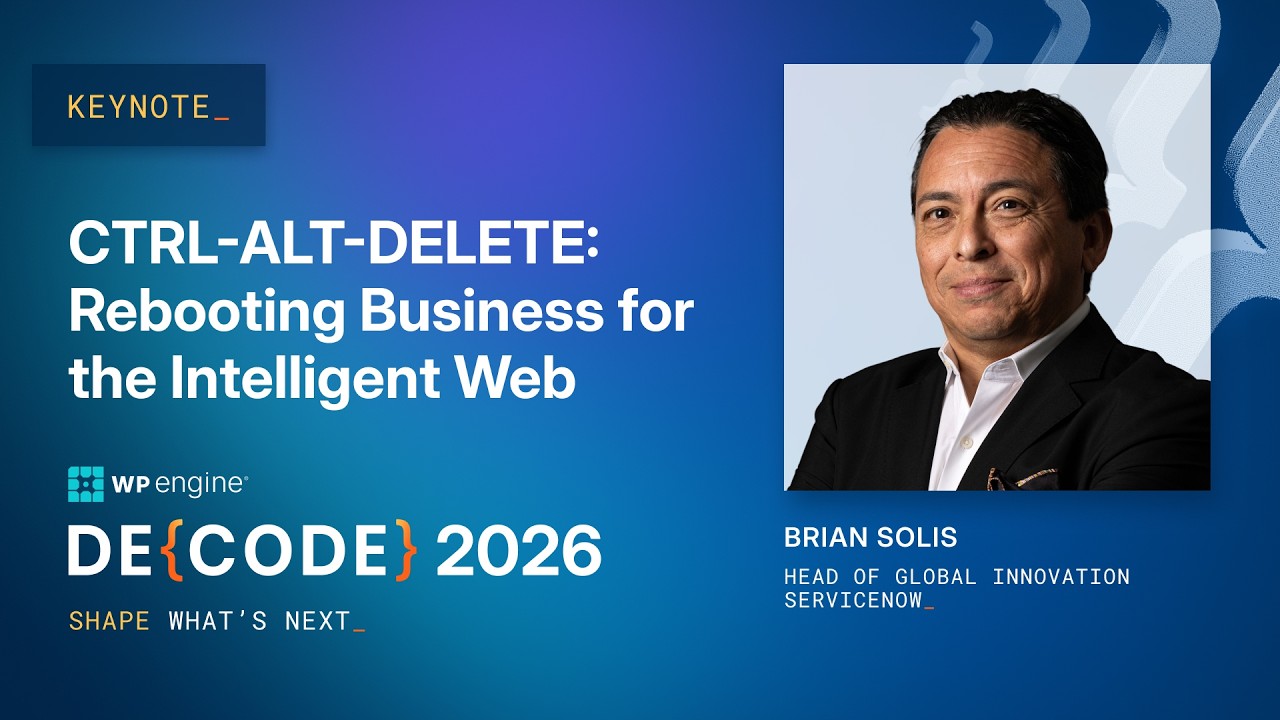
🔗 **Source:** [CTRL-ALT-DEL: Rebooting Business for the Intelligent Web](https://www.youtube.com/watch?v=Pii0oZrqhS0)
> [!note]+ Document Notes
> tags: #artificial-intelligence #web-development #digital-strategy #content-strategy #brand-strategy #intelligent-web #cognitive-darwinism #ai-agents
> author: Brian Solis
> source: Decode Conference
> reference: https://www.youtube.com/watch?v=Pii0oZrqhS0
> date created: 2024-12-19 14:30
>
> # 🏷️ Title: CTRL-ALT-DEL: Rebooting Business for the Intelligent Web
>
<!-- deep-read:sections start -->
## 🧰 Action Inbox
- [H1] Audit current content for AI slop and contextual relevance — address cognitive surrender risks #content-strategy
- [H2] Develop machine-readable content architecture for AI agents — implement agentic optimization #technical-architecture
- [H3] Define brand signal strategy to stand out from AI-generated noise — focus on empathy and intuition #brand-strategy
## 🧭 Table of Contents
- [[#📝 Summary]]
- [[#📖 Main Content]]
- [[#🗒️ Notes]]
- [[#📚 References]]
- [[#🗣️ Paraphrase]]
- [[#📰 Newsletter]]
- [[#✅ Action Items]]
- [[#🧪 Hypotheses]]
- [[#📊 Methodology]]
- [[#❓ Questions]]
- [[#🔮 Future Research]]
- [[#💡 Implications]]
- [[#🧠 Learning Styles Assessment]]
- [[#📊 Accessibility Assessment]]
- [[#🌍 DEIB Assessment]]
- [[#✅ Logical Validity]]
- [[#🛡️ DARVO Analysis]]
- [[#🎯 Conclusion]]
### 🔗 References
- [Original Video](https://www.youtube.com/watch?v=Pii0oZrqhS0)
- [Brian Solis Website](https://www.briansolis.com/)
## 📝 Summary
- **What happened**: Brian Solis presents a framework for navigating AI's impact on business and the web, introducing the concept of "cognitive Darwinism" and warning against AI slop
- **Why it matters**: AI-generated content now exceeds all human-written content in history, creating noise that demands strategic response from businesses
- **Key stakeholders**: Business leaders, marketers, creatives, agencies, SMBs navigating AI transformation
- **Risks and tradeoffs**: Using AI for automation vs augmentation; efficiency vs quality; speed vs trust-building
- **Bottom line**: Success requires being the "signal" amid AI noise by focusing on context over content, building trust, and designing for both humans and AI agents
## 📖 Main Content
Solis argues we're experiencing "cognitive Darwinism" - the negative effects of using AI to replace rather than augment human thinking. This manifests as AI slop (low-quality AI content), cognitive surrender (accepting wrong AI answers), and cognitive debt (losing critical thinking skills).
The core shift is from "content is king" to "context is king" - meaning relevance and actionability matter more than volume. AI agents are already changing how people search and make decisions, requiring businesses to optimize for both human users and AI systems.
Key challenges include the "AI tax" (extra work needed to navigate poor AI content) and declining trust in AI-generated information. However, this creates opportunities for businesses that can deliver authentic, contextual, valuable experiences.
The solution involves becoming "sourceworthy" - creating content that builds trust with both humans and AI agents, designing complete user journeys, and focusing on outcomes rather than transactions.
## 🗒️ Notes
#### ⏱️ [00:00](https://youtu.be/Pii0oZrqhS0?t=0) — [H1] Introduction to the Intelligent Web Challenge
- Key idea: AI adoption lacks instruction manuals, creating navigation challenges
- Evidence: "None of this came with an instruction manual. None of this came with a playbook"
#### ⏱️ [02:30](https://youtu.be/Pii0oZrqhS0?t=150) — [H2] Cognitive Darwinism Phenomenon
- Key idea: AI overuse creates negative cognitive effects like surrender and debt
- Evidence: Lists AI slop, cognitive surrender, cognitive offloading, cognitive debt as growing problems
#### ⏱️ [04:15](https://youtu.be/Pii0oZrqhS0?t=255) — [H1] Automation vs Augmentation Framework
- Key idea: AI should explore unknown territories rather than automate known tasks
- Evidence: "We want it to extend us. We do not want it to replace us. We do not want it to do our thinking"
#### ⏱️ [06:45](https://youtu.be/Pii0oZrqhS0?t=405) — [H2] Trust Erosion from AI Slop
- Key idea: Scaling content without human context destroys trust and engagement
- Evidence: "When we use AI to scale content without thinking of the person on the other side... we lose trust"
#### ⏱️ [08:20](https://youtu.be/Pii0oZrqhS0?t=500) — [H1] Context is King Paradigm Shift
- Key idea: Relevance and actionability matter more than content volume in AI era
- Evidence: "In an era of humans with AI, it's context that is king"
#### ⏱️ [11:30](https://youtu.be/Pii0oZrqhS0?t=690) — [H2] AI Agent Restaurant Booking Demo
- Key idea: AI agents can handle complex research and booking tasks autonomously
- Evidence: OpenAI Atlas browser successfully researched restaurants and joined waitlists
#### ⏱️ [15:00](https://youtu.be/Pii0oZrqhS0?t=900) — [H1] AI Output Surpasses Human History
- Key idea: AI-generated content now exceeds all human writing since beginning of time
- Evidence: Arc Invest research showing AI output eclipse of human output
#### ⏱️ [17:45](https://youtu.be/Pii0oZrqhS0?t=1065) — [H2] The AI Tax Problem
- Key idea: Poor AI content creates extra work for users and agents to navigate
- Evidence: Amazon struggling with AI books, Apple with AI-generated apps
#### ⏱️ [20:30](https://youtu.be/Pii0oZrqhS0?t=1230) — [H1] New Optimization Requirements
- Key idea: Must optimize for traditional search, AI engines, and agent discovery
- Evidence: "SEO, AI engine optimization, agentic optimization, and AIO"
#### ⏱️ [23:15](https://youtu.be/Pii0oZrqhS0?t=1395) — [H2] Brand as Signal Strategy
- Key idea: Brands must become signals that cut through AI noise
- Evidence: "Content gets indexed. Your brand is what's chosen"
#### ⏱️ [25:00](https://youtu.be/Pii0oZrqhS0?t=1500) — [H1] What Do You Stand For Framework
- Key idea: Return to core purpose and scale it with AI technology
- Evidence: "WDYSF - What do you stand for? Remember why you started"
#### ⏱️ [27:30](https://youtu.be/Pii0oZrqhS0?t=1650) — [H2] Role-Specific Strategies
- Key idea: Different roles require distinct approaches to AI integration
- Evidence: Specific guidance for leaders, marketers, creatives, agencies, SMBs
#### ⏱️ [30:45](https://youtu.be/Pii0oZrqhS0?t=1845) — [H1] Four-Point Action Framework
- Key idea: Build sourceworthy content, make sites machine-readable, invest in agent communities, protect outcomes
- Evidence: Concrete steps for building intelligent web presence
## 📚 References
- [Original Presentation](https://www.youtube.com/watch?v=Pii0oZrqhS0)
- [Arc Invest Research](https://ark-invest.com/)
- [OpenAI Atlas Browser](https://openai.com/)
## 🗣️ Paraphrase
- AI is creating cognitive problems as people surrender critical thinking to machines, leading to poor decision-making and eroded trust
- The web shift from content quantity to contextual quality requires optimization for both human users and AI agents simultaneously
- Success comes from being authentic signal amid AI noise by focusing on empathy, intuition, and complete user experience design
## 📰 Newsletter
🚀 **Rebooting for the Intelligent Web**
Brian Solis warns us about "cognitive Darwinism" - the negative effects when we let AI do our thinking instead of augmenting it. With AI content now exceeding all human writing in history, the web is drowning in low-quality "AI slop."
**Key shift**: Content is no longer king - *context* is. Your content must be relevant, actionable, and discoverable by both humans and AI agents.
**Action steps**: Audit your content for contextual relevance, develop machine-readable architectures, and focus on being the "signal" that cuts through AI noise with authentic human insight.
**The opportunity**: While competitors create AI slop, you can build trust by delivering meaningful experiences that help people achieve real outcomes.
Resources: [Brian Solis](https://www.briansolis.com/), [Decode Conference](https://decode.com/), [AI Strategy Resources](https://example.com/)
## ✅ Action Items
#### WordPress
- Core: Develop AI agent compatibility standards for content discovery and interaction
- Documentation: Create guidelines for machine-readable content structure and metadata
- Community: Establish best practices for contextual content creation vs AI-generated content
- Plugins: Build tools for agentic optimization and AI-ready content management
- Themes: Design templates optimized for both human users and AI agent parsing
#### OSPO
- Policy & Governance: Develop AI content attribution and quality standards
- License Compliance: Address AI training data usage and content provenance
- Security Management: Implement safeguards against AI-generated security vulnerabilities
- Community Engagement: Foster human-AI collaboration rather than replacement models
#### DevRel
- Developer advocacy: Educate on building AI-agent-friendly experiences
- Education: Create workshops on contextual content strategy and agentic optimization
- Developer experience: Develop APIs and tools for AI agent interaction
- Community management: Moderate against AI slop while encouraging thoughtful AI use
## 🧪 Hypotheses
- Businesses focusing on contextual relevance over content volume will outperform AI slop producers
- AI agents will increasingly mediate commerce decisions, requiring new optimization strategies
- Human-centered brands will build stronger trust as AI content saturates markets
- Machine-readable content architecture will become a competitive advantage
### 📊 Methodology
- A/B testing contextual vs volume-based content strategies
- Analytics tracking of AI agent vs human user engagement patterns
- Trust measurement surveys comparing AI-heavy vs human-augmented brand experiences
- Conversion rate analysis of agentic-optimized vs traditional SEO approaches
### ❓ Questions
- How can businesses measure and optimize for AI agent discovery without losing human engagement?
- What specific technical architectures best serve both human users and AI agents simultaneously?
- How do we balance content personalization for individual users versus AI agent requirements?
### 🔮 Future Research
- Development of standardized AI agent interaction protocols for web content
- Long-term cognitive effects of widespread AI content consumption
- Economic models for sustainable human-AI collaborative content creation
### 💡 Implications
- Practice: Content creators must shift from volume to contextual value creation
- Policy: Need for AI content labeling and quality standards across platforms
- Security: AI slop creates new attack vectors through misinformation and cognitive manipulation
- Education: Digital literacy must include AI interaction and evaluation skills
- Funding: Investment should prioritize contextual relevance technology over content automation
### 🧠 Learning Styles Assessment
Reading level estimate: 12th Grade (Technical business content with specialized terminology)
#### 👀 Visual learners
- Present: PowerPoint slides, AI agent demo screenshots
- Improve: Cognitive Darwinism concept diagrams, content-to-context shift visualizations
#### 🔊 Aural learners
- Present: Full presentation audio with clear narration
- Improve: Podcast summary format, key concept audio highlights
#### 🗣️ Verbal learners
- Present: Rich analogies, business terminology definitions, examples
- Improve: Glossary of AI terms, business case studies with narrative structure
#### 🧩 Kinesthetic learners
- Present: AI agent booking demonstration, actionable frameworks
- Improve: Interactive content audit checklist, hands-on optimization exercises
#### 🧠 Logical learners
- Present: Clear cause-effect relationships, structured argument progression
- Improve: Decision trees for AI vs human task allocation, ROI calculation models
#### 🧑🤝🧑 Social learners
- Present: Conference presentation format, community implications
- Improve: Discussion guides for team strategy sessions, collaborative planning frameworks
#### 🧘♀️ Solitary learners
- Present: Self-assessment frameworks, individual action items
- Improve: Personal brand audit worksheets, individual reflection prompts
#### 🌿 Naturalistic learners
- Present: Evolution metaphor (Cognitive Darwinism), ecosystem thinking
- Improve: Web ecosystem diagrams, natural selection parallels in content strategy
### 📊 Accessibility Assessment
#### Screen reader semantics
- Present: Clear heading structure, descriptive content organization
- Improve: Alt text for presentation slides, video transcript formatting
#### Keyboard navigation
- Present: Standard video player controls
- Improve: Timestamped navigation, skip-to-section functionality
#### Contrast and readability
- Present: High contrast video presentation
- Improve: Transcript text spacing, heading emphasis
#### Text resizing and reflow
- Present: Responsive video player
- Improve: Scalable transcript text, mobile-optimized formatting
#### Media and captions
- Present: Full transcript available
- Improve: Time-synced captions, downloadable transcript option
#### Forms and interactions
- Present: Basic video interaction
- Improve: Accessible feedback forms, interactive element labels
### 🌍 DEIB Assessment
#### Cultural breadth
- Present: Business-focused global perspective
- Improve: International AI adoption examples, diverse market considerations
#### Inclusive language
- Present: Professional, accessible business terminology
- Improve: Plain language summaries, jargon definitions
#### Neurodiversity support
- Present: Structured presentation format, clear transitions
- Improve: Visual section breaks, consistent formatting patterns
#### Representation
- Present: Single speaker perspective
- Improve: Diverse business case examples, varied industry applications
#### Psychological safety
- Present: Constructive critique without personal attacks
- Improve: Supportive transition strategies, change management guidance
### ✅ Logical Validity
#### Strong reasoning
- Deductive strength: Strong logical progression from AI adoption to cognitive effects to business implications
- Inductive strength: Well-supported generalization from specific examples (restaurant booking, LinkedIn AI posts)
- Causal reasoning: Clear cause-effect relationships between AI overuse and trust erosion
- Analogical strength: Effective "signal vs noise" metaphor throughout
#### Fallacies
- Appeal to novelty: Some emphasis on being first/new without addressing potential downsides
- Hasty generalization: Arc Invest statistic about AI output may oversimplify content quality comparison
#### Tone of voice
- Overall tone: Authoritative but encouraging, balancing urgency with optimism about opportunities
### 🛡️ DARVO Analysis
- Deny: No significant denial patterns present
- Attack: No attacks on accusers or critics
- Reverse victim/offender: No victim/offender reversals identified
- Emotional cues and rhetoric: Uses urgency and opportunity framing without manipulation
## 🎯 Conclusion
The intelligent web requires a fundamental shift from content volume to contextual value. Success comes from using AI as an augmentation tool rather than a replacement, focusing on building trust through authentic human insight and empathy that AI cannot replicate. Businesses must optimize for both human users and AI agents while maintaining their core purpose and values as the foundation for scaling meaningful engagement.
## 🧱 Refactor Appendix
### 📚 Literature Split Pad
Purpose: Stage CEE units that become Literature notes.
Split level: H3
### [H1] Cognitive Darwinism creates measurable business risks
> [!quote] CTRL-ALT-DEL: Rebooting Business for the Intelligent Web by [[Brian Solis]] via [[Decode Conference]]. Published 2024. Accessed 2024-12-19.
> "Cognitive surrender, cognitive offloading, cognitive debt - when we allow AI to do the thinking for us."
Business impact of AI dependency manifests in trust erosion and decision quality decline.
[view highlight](
---
## Full Transcript
[00:12] Hello everyone. Welcome to Decode where<br>[00:16] together we are going to share and shape<br>[00:20] the ideas that define the future. And<br>[00:23] how cool is that? How cool is that? So<br>[00:25] my name is Brian Solless. I have been a<br>[00:27] longtime futurist. uh hence shaping<br>[00:30] what's next. Uh and I've also been a<br>[00:32] longtime digital anthropologist uh and<br>[00:35] I'm also the uh the head of global<br>[00:36] innovation at Service Now. So I think a<br>[00:39] lot about not just what's happening<br>[00:41] today, but I think about how it's going<br>[00:43] to play out over time. I look at what's<br>[00:46] coming next and I think about how that's<br>[00:48] going to affect where we are and where<br>[00:49] we need to go. And I am so excited to be<br>[00:53] here with you today because I have<br>[00:55] PowerPoint slides to share and I know<br>[00:57] nothing says the future like PowerPoint<br>[00:59] slides. But in all seriousness, thank<br>[01:01] you for being here. And let's just jump<br>[01:04] right in. One of the things that I have<br>[01:06] been noticed in the world where we are<br>[01:08] shaping a more intelligent web, where we<br>[01:11] are living in a world of artificial<br>[01:13] intelligence, it's part of everyday<br>[01:15] lives. is the reality that none of this<br>[01:19] came with an instruction manual. None of<br>[01:21] this came with a playbook. And we're<br>[01:24] having to navigate a very intelligent<br>[01:27] technology<br>[01:28] without necessarily<br>[01:30] knowing if we're on the right track and<br>[01:32] not having someone over our shoulders<br>[01:34] guiding us. And that is causing<br>[01:38] something that I've observed that I call<br>[01:40] cognitive Darwinism. I want to talk<br>[01:41] about that because since we are the<br>[01:44] architects of the future web, since we<br>[01:47] are the architects navigating how this<br>[01:49] web is going to work for us and the<br>[01:52] people who matter to us and I guess<br>[01:54] ironically the AI agents who matter to<br>[01:56] them as well. Uh there are some real<br>[01:59] things that are happening today that we<br>[02:01] need to pay attention to. All of these<br>[02:04] words exist because the nature of which<br>[02:07] we are using artificial intelligence is<br>[02:10] already having negative effects and<br>[02:13] maybe even negative consequences on our<br>[02:16] ability to shape a more intelligent web<br>[02:19] that works for us. And each one of these<br>[02:22] words is a presentation in its own<br>[02:24] right. But the reality is is that it's<br>[02:26] all an opportunity for us to take a step<br>[02:28] back. And I know things are moving so<br>[02:30] fast and I know the headlines are so not<br>[02:34] just fast and furious but crazy. There<br>[02:37] is time to take a step back and this is<br>[02:39] that moment because the way that we're<br>[02:41] using AI, we have to be cognizant of the<br>[02:44] fact that we want it to work for us. We<br>[02:47] want it to extend us. We do not want it<br>[02:50] to replace us. We do not want it to do<br>[02:53] our thinking. We want it to augment our<br>[02:57] thinking. And that's where I'd like to<br>[02:58] begin because there's a difference<br>[03:01] between automating our thinking. So if<br>[03:03] we ask it to do something, if we prompt<br>[03:05] it to give us the answer that we're<br>[03:08] looking for, we are operating within a<br>[03:11] paradigm of the known. And I think the<br>[03:14] beauty and the magic of artificial<br>[03:16] intelligence and this intelligent web<br>[03:18] that we're shaping is using it to<br>[03:20] explore and shape the unknown. Nothing<br>[03:24] interesting in life happens with<br>[03:27] knowing. It's the learning part. It's<br>[03:30] the shaping part that makes the future<br>[03:34] so magical. And so each one of these<br>[03:36] terms is the repercussion of using AI to<br>[03:40] do what's known. So AI slop, if we're<br>[03:43] producing content with AI, then we're<br>[03:47] not adding our touch to it. If we're not<br>[03:50] actually trying to use AI to explore<br>[03:53] topics and ideas that we didn't know, if<br>[03:56] we're just exploring the world of the<br>[03:58] known, we're going to create something<br>[04:01] that is not as good as something you<br>[04:02] could have done. And that becomes the<br>[04:05] foundation for where the future of the<br>[04:07] web is already in trouble. And each one<br>[04:10] of these things also affects us as<br>[04:12] individuals. So cognitive surrender,<br>[04:15] cognitive offloading, cognitive debt.<br>[04:18] When we allow AI to do the thinking for<br>[04:20] us, we miss actually more than<br>[04:24] engagement. We actually miss the<br>[04:26] opportunity to build relationships. And<br>[04:29] I'll dive into that. We have to be<br>[04:31] mindful that what we produce with AI is<br>[04:36] meaningful to someone else. It isn't<br>[04:39] just the act of getting it done. It<br>[04:40] isn't just the act of checking the box.<br>[04:42] isn't just the act of getting something<br>[04:44] published. We have to remember that<br>[04:46] there is a human and ultimately so funny<br>[04:49] to say this out loud but it's true.<br>[04:52] Ultimately AI agents on behalf of that<br>[04:55] human who are looking for information to<br>[04:59] do something to take an action to make a<br>[05:02] decision to buy something to learn<br>[05:05] something. And when we keep that in<br>[05:07] mind, then the production of an asset or<br>[05:12] of content or of information isn't the<br>[05:15] goal. It is the engagement, the<br>[05:18] relevance, the context that is the goal<br>[05:22] because we are helping someone do<br>[05:25] something. And when we use AI to scale<br>[05:29] content without thinking of the person<br>[05:31] on the other side, this is what's<br>[05:34] largely referred to as AI slot. And the<br>[05:38] part that I want to share with you that<br>[05:40] matters to you and me is when we do<br>[05:42] this, we lose trust. And I don't think<br>[05:46] any one of us can afford to lose trust.<br>[05:49] So this is the foundation of which now<br>[05:53] we can lean back in with intent, with<br>[05:57] purpose,<br>[05:59] with imagination, with empathy, with all<br>[06:02] of the human things that AI cannot do<br>[06:06] in order to lead an intelligence<br>[06:08] renaissance<br>[06:11] that helps us use AI to scale and<br>[06:14] augment engagement that wasn't possible<br>[06:18] without AI. Now, that's a different<br>[06:21] premise. I think a lot of us came up in<br>[06:23] a time where we believed that content<br>[06:26] was king. And for sure in the early days<br>[06:29] of the web, that was true. But in an era<br>[06:32] of AI and especially in an era of humans<br>[06:36] with AI, it's context that is king.<br>[06:40] Meaning, it has to be relevant to<br>[06:42] someone else. It has to be discoverable<br>[06:45] because it's relevant to someone else.<br>[06:48] And it has to be meaningful and<br>[06:49] actionable because of the context for<br>[06:52] someone else because AI is already<br>[06:54] starting to change the search game.<br>[06:57] Publishers already are seeing and<br>[07:00] continue to expect a loss of search<br>[07:04] traffic from traditional search engines<br>[07:07] because many of us are using AI to do<br>[07:09] that research. We're using in some cases<br>[07:12] AI agents to do that research already.<br>[07:15] And like AI slop, consumers are starting<br>[07:18] to distrust the information that's<br>[07:21] coming back from AI powered search<br>[07:24] results because that context<br>[07:28] isn't there. The content is there, but<br>[07:32] the context, the relevance, the<br>[07:35] significance is not there. And at the<br>[07:38] end of the day if people are looking to<br>[07:40] make a decision or to learn something or<br>[07:42] to act on something or to buy something<br>[07:45] that context becomes paramount. So in<br>[07:48] the world as it takes new shape of how<br>[07:53] people are looking to engage not with<br>[07:55] information but to engage with the<br>[07:58] outcome of what that information leads.<br>[08:01] We have to remember that even in a world<br>[08:05] with AI and AI agents that humans are<br>[08:09] still very much part of this equation.<br>[08:12] Now we're just designing information not<br>[08:14] just to be relevant and contextual but<br>[08:17] to be discoverable and actionable in a<br>[08:21] world where AI is part of the equation.<br>[08:25] So it is looking for that information<br>[08:28] and it's going to present that<br>[08:30] information in a way that necessarily it<br>[08:34] doesn't necessarily work like the human<br>[08:36] brain.<br>[08:38] But that's okay because we can learn now<br>[08:41] how information is being disseminated<br>[08:44] and then how do we show up in the right<br>[08:48] way to help because at the end of the<br>[08:50] day that's what we're trying to do. or<br>[08:52] not. If if if all we're looking to do is<br>[08:54] is transact and convert. I mean, those<br>[08:59] are important, don't get me wrong, but<br>[09:01] there's reasons why people transact and<br>[09:02] there's reasons why people convert. And<br>[09:05] so now we're just learning how to play<br>[09:07] the game differently, but we're learning<br>[09:09] how to do it more meaningfully because<br>[09:12] none of this is going backwards. This is<br>[09:15] only going to continue to grow. But<br>[09:17] what's going to continue to grow at the<br>[09:19] same time is greater and greater<br>[09:22] irrelevance versus relevance. Just<br>[09:25] knowing the basics of where to be is the<br>[09:28] beginning. Knowing how to show up is the<br>[09:31] next step. But knowing how to engage<br>[09:35] someone and help them make that decision<br>[09:38] or help them take that next step, help<br>[09:41] them, even if it's helping their agents,<br>[09:43] help them take that next step. That's<br>[09:46] the art of this. Of course, there's a<br>[09:48] science. Of course, all of this is is<br>[09:51] techreated.<br>[09:53] But we can't forget the human equation<br>[09:56] in all of this. What makes the<br>[09:59] intelligent web so special isn't the AI,<br>[10:03] it's our ability to navigate it and to<br>[10:05] help others navigate it, to help them<br>[10:09] achieve their outcomes. So in a world<br>[10:13] where we are witnessing in real time<br>[10:18] cognitive Darwinism<br>[10:20] where people are leaning on AI maybe too<br>[10:23] much<br>[10:25] we have to be the ones who can help<br>[10:28] them. So look the reality is and I see<br>[10:30] this every day people are offloading<br>[10:33] their thinking to AI. people are<br>[10:36] offloading the insights, the synthesis,<br>[10:41] the research to AI. It's only going to<br>[10:44] scale with AI agents. So in that<br>[10:47] environment, in that realm, how do we<br>[10:53] help them<br>[10:55] take that next step?<br>[10:57] Well, we know for example<br>[11:01] that when people are searching, when<br>[11:03] people are making a decision or if<br>[11:05] they're agents are doing this on their<br>[11:06] behalf, they're trying to achieve an<br>[11:10] outcome. They're trying to do something.<br>[11:13] It's a moment of truth as it's been<br>[11:16] forever known.<br>[11:18] So, this is still the environment of<br>[11:21] which we're operating. We're just doing<br>[11:23] it a little bit differently in an AI<br>[11:25] world. So as AI agents scale how people<br>[11:30] make decisions and maybe even making the<br>[11:33] decisions on a human's behalf, we have<br>[11:36] to take the extra step now to understand<br>[11:40] not just what they're searching for<br>[11:43] to understand<br>[11:45] not just the context but also to<br>[11:48] understand then how do we make that<br>[11:51] seamless journey of research of search<br>[11:57] of<br>[11:58] dissemination and synthesis<br>[12:01] conversions how do we think about the<br>[12:03] journey so I wanted to share with you a<br>[12:07] journey<br>[12:09] I experimented myself I'm in New York<br>[12:12] and there are a lot of incredible<br>[12:15] restaurants in New York according to my<br>[12:18] Tik Tok and Instagram<br>[12:20] and I have some friends here and I<br>[12:23] wanted to uh I wanted to try to get one<br>[12:25] of osed uh reservations, impossible<br>[12:27] reservations to one of these incredible<br>[12:29] restaurants. So, I thought I'd put my AI<br>[12:31] agents to work uh to see if I couldn't<br>[12:34] get one of those reservations when I<br>[12:37] could do it by myself cuz it takes a lot<br>[12:38] of time and boy does it take a lot of<br>[12:40] effort. I grabbed OpenAI's Atlas browser<br>[12:45] uh and I put it to work and I gave the<br>[12:48] browser access to the information it<br>[12:50] needed only for this work. But I wanted<br>[12:52] to share with you what that looks like<br>[12:53] and it's going to be really fast. This<br>[12:54] could be really furious, but the idea<br>[12:56] was, find me all of the hot restaurants<br>[12:58] that are impossible to get a<br>[12:59] reservation. Here are the<br>[13:02] accounts that I have in order to book<br>[13:04] reservations for whatever is needed.<br>[13:06] Here are the time zones. Here are the<br>[13:07] days. Have at it. And this is what I<br>[13:10] want to share with you. Testing out the<br>[13:12] new open AI Atlas browser. I put it to<br>[13:15] work right away. Since it's not a<br>[13:16] traditional browser, I could take action<br>[13:18] on your behalf. So, I was headed to New<br>[13:20] York. I wanted to find reservations at<br>[13:23] the hottest restaurants that are<br>[13:24] impossible to book. So, I asked it to do<br>[13:27] the research on those restaurants and<br>[13:29] attempt to get me a reservation if we<br>[13:31] couldn't get a reservation to get me on<br>[13:33] those weight lists. It came up with the<br>[13:35] list. It asked me to log into Resi and<br>[13:37] Open Table and it not only gave me a<br>[13:41] great list. Uh, unfortunately, we<br>[13:43] couldn't book any reservations, but it<br>[13:44] did get me on the wait list and those<br>[13:46] weight lists converted into<br>[13:48] opportunities. Uh I'll post those uh<br>[13:51] experiences on Instagram. But so far<br>[13:53] this was an excellent experience.<br>[13:56] >> I am still impressed. I it actually<br>[13:58] worked. And the reason I wanted to share<br>[14:00] that with you is that as someone looking<br>[14:03] to achieve an outcome, I needed to scale<br>[14:08] that work through agents. But the whole<br>[14:12] part about recognizing why I wanted to<br>[14:15] do that was still me and finding that<br>[14:18] information on the other side of that<br>[14:21] research were still relevance. The<br>[14:23] businesses that are desirable because<br>[14:27] they do something meaningful that's in<br>[14:30] such high demand that you can't even get<br>[14:32] reservations to these places. So in a<br>[14:35] world where then this is not only the<br>[14:38] reality and in a world where AI slop is<br>[14:42] convoluting a lot of this work, how do<br>[14:46] we add value? How do we show up and how<br>[14:50] do we help people? Because whether they<br>[14:52] know it or not, that help is more<br>[14:55] important now than ever. We're not just<br>[14:57] running businesses. We're not just<br>[14:59] building online experiences. We're not<br>[15:01] just helping to grow transactions and<br>[15:04] outcomes and revenue and all of those<br>[15:06] things. We're still also human beings<br>[15:08] who also have to navigate the web in our<br>[15:11] personal and professional lives. One of<br>[15:13] the most interesting stats that had come<br>[15:15] out with by a group called Arc Invest<br>[15:17] kind of blew my mind. It had showed that<br>[15:19] just recently all AI written output in<br>[15:24] just the short amount of years that we<br>[15:26] have seen generative AI that it is<br>[15:28] already eclipsed all human written<br>[15:32] output since the beginning of time. That<br>[15:34] is wild. And I can assure you that not<br>[15:37] all of that AI written output is great.<br>[15:40] and you know it. Look, I think<br>[15:43] the the reality is if you've navigated<br>[15:46] something like LinkedIn recently, you<br>[15:48] could see all of the cognitive<br>[15:50] offloading of people who are even using<br>[15:53] AI to write their posts and AI to<br>[15:56] synthesize whatever they're trying to<br>[15:59] share with you. They're not even going<br>[16:00] through the exercise of learning it.<br>[16:02] They're just posting it. And then you<br>[16:05] have a whole another level of people who<br>[16:08] are using AI to comment where they take<br>[16:11] the post and form a comment to react to<br>[16:15] it. None of that is going to help<br>[16:18] themselves navigate the web. So when we<br>[16:22] can produce more, more stops mattering.<br>[16:27] We're now emphasizing speed and quantity<br>[16:31] over quality which is going to yield<br>[16:34] diminishing returns. And so why am I<br>[16:35] sharing this with you? Well, one cuz<br>[16:37] it's a problem and I want us not to be<br>[16:40] part of that problem. This is an<br>[16:41] opportunity for you knowing all of this<br>[16:44] that your competitors are probably going<br>[16:46] to cause what's called an AI tax. The AI<br>[16:49] tax is the work that people have to do<br>[16:53] to navigate the slop. The same is going<br>[16:56] to be true for agents. They're going to<br>[16:58] have to navigate this slop. People are<br>[17:02] already falling into the trap of what's<br>[17:04] called cognitive surrender, which means<br>[17:06] that they're willing to accept the wrong<br>[17:09] answer from AI without questioning.<br>[17:11] Well, same same is true with a lot of<br>[17:13] information out there. And that's a<br>[17:14] whole different conversation. But I want<br>[17:16] you to think about this. This is a trap<br>[17:19] that means that people are going to make<br>[17:20] a lot of bad decisions with the best of<br>[17:23] faith, but that's going to sour a lot of<br>[17:25] relationships, which is going to erode<br>[17:28] trust. Knowing this, this is an<br>[17:31] opportunity to deliver better<br>[17:32] experiences that grow more meaningful<br>[17:35] relationships and that build trust. How<br>[17:39] powerful is that? And once you know<br>[17:41] that, now it's a matter of understanding<br>[17:45] how are we going to show up. Not just<br>[17:47] where are we going to show up, but how<br>[17:49] are we going to show up? If we can be<br>[17:52] relevant, if we could be significant, if<br>[17:55] we could be meaningful in ways that<br>[17:57] humans and AI are searching in order to<br>[18:00] disseminate that information to take<br>[18:03] action, to make a decision, then it's<br>[18:06] video, it's audio, and it's some text.<br>[18:09] So we have to show up in ways that help<br>[18:12] people and help agents find us<br>[18:16] synthesize that information<br>[18:19] and then take the next step. And this is<br>[18:22] the dual reality of moving forward. The<br>[18:24] intelligent web ecosystem is this<br>[18:27] interaction and synergy between people<br>[18:30] and AI agents. Does it make our work<br>[18:32] more complex? Sure it does. Does it make<br>[18:35] you more valuable? Absolutely. And<br>[18:38] that's the real story. AI is not taking<br>[18:42] us out of the equation. We already know<br>[18:44] that the future of the web today even is<br>[18:48] more messy than it needs to be. Give you<br>[18:50] a couple of examples. Amazon is<br>[18:52] struggling with the volume of AI<br>[18:57] generated books that are trying to be<br>[18:59] sold on the platform.<br>[19:01] Apple's app store is navigating being<br>[19:06] overwhelmed by the amount of people who<br>[19:08] are trying to put claw generated apps on<br>[19:13] the app store<br>[19:15] because none of these things are good.<br>[19:18] They're just saturating the space. And<br>[19:22] so this is our opportunity to know<br>[19:24] what's bad and to know what's great, to<br>[19:27] know what people are trying to achieve,<br>[19:29] not just what they're trying to search<br>[19:30] for, what they're trying to achieve, so<br>[19:33] that we can produce the content in their<br>[19:35] way that's contextually relevant, that's<br>[19:37] meaningful, and that enables that<br>[19:40] desired outcome. So if the old equation<br>[19:43] was creating content, winning at search<br>[19:46] and earning attention, the new equation<br>[19:50] is about showing up across the board. So<br>[19:53] yeah, SEO is probably still going to be<br>[19:55] relevant, not as relevant, but we also<br>[19:59] have AI uh engine optimization. We have<br>[20:02] agentic optimization, and then we have<br>[20:06] this like AIO, which is this more<br>[20:08] general bucket of all of these things.<br>[20:10] We have to think about this. We have to<br>[20:13] plan for this and we have to design for<br>[20:15] this. It knowing is half the battle. I<br>[20:19] promise you that there are agencies,<br>[20:22] there are farms out there that are just<br>[20:25] looking at AI slop at scale and speed<br>[20:30] and quantity to saturate all of these<br>[20:33] things. And so we have to be the signal.<br>[20:37] We have to be the reprieve. I call it an<br>[20:40] ignite moment. When someone finds what<br>[20:43] they're looking for, it you feel it, it<br>[20:46] stops you. And because all of this is so<br>[20:49] messy, there are no standards yet. So be<br>[20:53] the standard.<br>[20:55] What a gift. What an opportunity to be<br>[20:59] in this moment to define the work, the<br>[21:03] technology, the content that is going to<br>[21:06] help someone navigate this web as it<br>[21:09] gets messier and messier, but also as it<br>[21:12] becomes more intelligent. You're part of<br>[21:14] the intelligent web. You are the<br>[21:16] architect of the intelligent web. We<br>[21:20] want to show up. We want to deliver<br>[21:24] better content, but we also need to<br>[21:27] understand how to navigate this world to<br>[21:31] be discoverable by machines, to be<br>[21:35] readable by machines, all of the things<br>[21:37] attached to that, permissions,<br>[21:39] efficiency.<br>[21:41] We're going to build trust in a world<br>[21:44] where humans and AI are working<br>[21:48] together. And so some of the questions<br>[21:50] as we think about our next steps is how<br>[21:53] do I become a destination for people and<br>[21:55] agents? Is it multiple destinations? Is<br>[21:58] it is it two sites? These are the things<br>[22:01] that we have to navigate because there<br>[22:03] are no standards or best practices yet.<br>[22:06] But that's the magic. You get to be that<br>[22:09] architect because on the other end of<br>[22:11] that, it isn't just the transactions and<br>[22:14] the conversions. It's trust. It's<br>[22:15] relationships. And I think the thing<br>[22:17] that is so interesting is that while<br>[22:20] it's not the same, you are if you become<br>[22:24] readable and you become discernable by<br>[22:26] machines and machines learn to value the<br>[22:30] content that you're producing, you are<br>[22:31] also building essentially a relationship<br>[22:36] and trust with AI and in doing so<br>[22:41] ultimately<br>[22:42] with people.<br>[22:45] So your brand<br>[22:47] is a signal. Your brand isn't just brand<br>[22:50] in a traditional sense. It's what you<br>[22:53] produce. It's what you share. It's what<br>[22:55] you enable. It's what you help someone<br>[22:58] accomplish. That's part of the brand.<br>[23:01] And being part of the signal. Boy, let<br>[23:04] me tell you, content is I think still<br>[23:07] perceived as king. And now you know it's<br>[23:10] about context.<br>[23:12] That's what it means to be the signal.<br>[23:14] Remember, you're a consumer. You're a<br>[23:16] human consumer. At the same time, we got<br>[23:18] to navigate a whole lot of stuff. And<br>[23:21] when you find that thing, that's what<br>[23:24] delivers the great experience. And when<br>[23:27] you find that thing, you've got to take<br>[23:29] next steps.<br>[23:31] So, this part is also part of your<br>[23:34] brand. AI becomes the UI. Whatever<br>[23:38] becomes discoverable and relevant and<br>[23:41] meaningful, well, that's the trust that<br>[23:44] becomes the click. Content gets indexed.<br>[23:47] Your brand is what's chosen. And so now<br>[23:52] I want to ask you this hashtag I live<br>[23:55] by. It's WD YSF. What do you stand for?<br>[24:01] Remember why you started.<br>[24:05] You wanted to do something. You wanted<br>[24:07] to make an impact. You wanted to help<br>[24:09] someone. You saw that opportunity.<br>[24:12] Now, we're just going to use AI machines<br>[24:17] to scale that to show up in a way that<br>[24:21] stands out because that's brand. You<br>[24:25] stand for something. I'm looking for<br>[24:28] something.<br>[24:29] That's the foundation for any<br>[24:32] relationship. So now we're going to<br>[24:34] scale that for systems that interpret,<br>[24:37] summarize, rank, recommend<br>[24:39] to take that action based on what it is<br>[24:42] you stand for and what it is you create<br>[24:44] that scales that. So leaders, your job<br>[24:46] is to decide what kind of company you<br>[24:49] become as discovery, comparison, and<br>[24:51] conversion are going to be increasingly<br>[24:54] mediated by agents. What do you stand<br>[24:56] for? go back to basics, why you started,<br>[25:01] and now we're going to scale that with<br>[25:03] technology.<br>[25:05] Marketers, you're not producing<br>[25:07] campaigns. You're shaping a new<br>[25:09] knowledge layer that AI systems will use<br>[25:12] to describe and transact with your<br>[25:15] brand. It's not just about the moment,<br>[25:18] it's the series of moments and the next<br>[25:21] steps. So what you're essentially doing<br>[25:24] is once you show up, you're just you're<br>[25:26] defining what happens next for agents<br>[25:28] and for people. So you're designing a<br>[25:30] meaningful, integrated, inclusive<br>[25:34] journey where showing up is just the<br>[25:36] beginning. It's the next steps that get<br>[25:39] them to that outcome that matter.<br>[25:43] Creatives,<br>[25:45] the opportunity is the signal. It's that<br>[25:49] IP, that originality, that voice, that<br>[25:53] experience design, that immersive<br>[25:57] experience<br>[25:59] storytelling.<br>[26:00] AI cannot commoditize that. AI cannot<br>[26:04] feel empathy. AI does not have<br>[26:08] intuition. That is you. And let's not<br>[26:10] forget, it's not just for creatives.<br>[26:12] This part is for everyone. Experience<br>[26:15] design. experience. It is a feeling. It<br>[26:19] is what you feel in any given moment.<br>[26:22] You are designing for how you want<br>[26:24] people to feel. Agencies, this is a<br>[26:29] control altdelete moment. Well, I guess<br>[26:30] it's true for all of us, but we are<br>[26:33] moving from building sites and<br>[26:37] optimizing for search<br>[26:40] to think about also<br>[26:43] discoverability and visibility, but also<br>[26:46] becoming an advisor of trust, how to<br>[26:49] build an architecture of building trust.<br>[26:52] So, that is a huge opportunity. down.<br>[26:57] You're going to be able to help other<br>[27:01] businesses design relevance, scale<br>[27:04] relevance and meaning, and to build the<br>[27:08] layer for agent ready commerce<br>[27:12] and experiences<br>[27:14] that grow relationships.<br>[27:18] If you run a small or medium business,<br>[27:22] do not fall into the AI slot business.<br>[27:26] The goal here isn't to outpublish bigger<br>[27:29] brands. It's to be the signal, to<br>[27:32] outclify them, to outserve them, to<br>[27:35] outstory them, to out experience them,<br>[27:38] out community them. Oh, what an<br>[27:40] advantage. And to outrust them. So, if I<br>[27:43] can leave you with a few things, it's<br>[27:46] this one. Build sourceworthy content.<br>[27:51] Think about that relevance, that context<br>[27:54] that comes from you being you. AI cannot<br>[27:57] feel empathy. AI cannot build intuition.<br>[28:01] That's you. And think of it as a<br>[28:04] complete journey for humans and<br>[28:06] machines. So it's not just a<br>[28:08] transaction, it's the overall journey.<br>[28:10] It's the overall experience.<br>[28:13] Two,<br>[28:14] make the site machine readable and<br>[28:17] machine actionable. Not just for people,<br>[28:21] but also for machines. Three, invest. I<br>[28:24] know this is going to sound strange. You<br>[28:26] obviously want to invest in people and<br>[28:30] the experiences that they have and the<br>[28:31] communities that you build around your<br>[28:33] brand and what it is you stand for. But<br>[28:35] you are also now building for an<br>[28:38] audience and a community of agents. And<br>[28:40] that I know sounds counterintuitive, but<br>[28:43] that is what we are designing for<br>[28:45] because the more successful agents are<br>[28:47] in helping the people that they<br>[28:48] represent, the more those agents are<br>[28:50] going to come back when needed. And the<br>[28:52] more that those agents, I'm sure we're<br>[28:55] going to live live in a world where<br>[28:56] there will be agents helping other<br>[28:58] agents take action.<br>[29:01] protect the stuff, your stuff, protect<br>[29:04] people, make sure that all of the right<br>[29:06] systems and permissions and security are<br>[29:09] in play, but also design for outcomes<br>[29:13] necessary at agentic speed. So, we are<br>[29:16] building for not just commerce, but we<br>[29:18] are also going to see a world where AI<br>[29:19] agents are going to serve or need<br>[29:22] service on behalf of the people that<br>[29:25] they represent. We already know that AI<br>[29:28] is making the web less intelligent. It's<br>[29:31] producing more noise which then gives us<br>[29:35] the opportunity to create more clarity<br>[29:39] to create signal to build trust to add<br>[29:43] value.<br>[29:45] We are building<br>[29:49] a web in which shopping, search,<br>[29:52] experiences, learning, all of the<br>[29:54] things, the outcomes, what people are<br>[29:56] trying to do<br>[29:59] to make it better. And that's why this<br>[30:03] moment is so special. That's why this<br>[30:05] moment is so powerful. That's why this<br>[30:08] moment is so magical because you are the<br>[30:11] architects of the intelligent web. You<br>[30:14] are the architects of the future<br>[30:18] today.<br>[30:20] So, let's go. Thank you.
<!-- deep-read:sections end -->
📄 **Full text:** ![[Full Document Contents/Articles/CTRL-ALT-DEL Rebooting Business for the Intelligent Web.md|CTRL-ALT-DEL: Rebooting Business for the Intelligent Web by YouTube]]
## Highlights
- knowing if we're on the right track and not having someone over our shoulders guiding us. And that is causing something that I've observed that I call cognitive Darwinism. I want to talk about that because since we are the architects of the future web, since we are the architects navigating how this web is going to work for us and the people who matter to us and I guess ironically the AI agents who matter to them as well. Uh there are some real things that are happening today that we ([View Highlight](https://read.readwise.io/read/01kr1tnc0vqtppw21yc0r4xbc8))
- Tags: 👻 ai highlighted
- the shaping part that makes the future so magical. And so each one of these terms is the repercussion of using AI to do what's known. So AI slop, if we're producing content with AI, then we're not adding our touch to it. If we're not actually trying to use AI to explore topics and ideas that we didn't know, if we're just exploring the world of the known, we're going to create something ([View Highlight](https://read.readwise.io/read/01kr1tnc15qyhwhecps2javf5e))
- Tags: 👻 ai highlighted
- that is not as good as something you could have done. And that becomes the foundation for where the future of the web is already in trouble. And each one of these things also affects us as individuals. So cognitive surrender, cognitive offloading, cognitive debt. When we allow AI to do the thinking for us, we miss actually more than engagement. We actually miss the opportunity to build relationships. And I'll dive into that. We have to be ([View Highlight](https://read.readwise.io/read/01kr1tnc1fdvhe7kxn7d3cfs15))
- Tags: 👻 ai highlighted
- next step. But knowing how to engage someone and help them make that decision or help them take that next step, help them, even if it's helping their agents, help them take that next step. That's the art of this. Of course, there's a science. Of course, all of this is is techreated. But we can't forget the human equation in all of this. What makes the intelligent web so special isn't the AI, ([View Highlight](https://read.readwise.io/read/01kr1tnc2e8nz45frenf87ptb1))
- Tags: 👻 ai highlighted
- just helping to grow transactions and outcomes and revenue and all of those things. We're still also human beings who also have to navigate the web in our personal and professional lives. One of the most interesting stats that had come out with by a group called Arc Invest kind of blew my mind. It had showed that just recently all AI written output in just the short amount of years that we have seen generative AI that it is already eclipsed all human written ([View Highlight](https://read.readwise.io/read/01kr1tnc3b7eawjjcvrgegw0vq))
- Tags: 👻 ai highlighted
- and AI agents. Does it make our work more complex? Sure it does. Does it make you more valuable? Absolutely. And that's the real story. AI is not taking us out of the equation. We already know that the future of the web today even is more messy than it needs to be. Give you a couple of examples. Amazon is struggling with the volume of AI generated books that are trying to be sold on the platform. ([View Highlight](https://read.readwise.io/read/01kr1tnc5yyqnxk0qha4gbpgnm))
- Tags: 👻 ai highlighted