Cease-and-Desist-Letter-to-Automattic-and-Request-to-Preserve-Documents-Sent
[[3. Resources/Readwise/Full Document Contents/Articles/Cease-and-Desist-Letter-to-Automattic-and-Request-to-Preserve-Documents-Sent|Full Document Contents]]
## Document Notes
---
tags:
- #WP Engine
- #Automattic
- #Litigation
Author: Rachel Herrick Kassabian
Source: Quinn Emanuel Urquhart & Sullivan, LLP
Reference: Letter dated September 23, 2024
date created: 2024-09-25 12:00
---
# Title: WP Engine's Litigation Counsel Letter to Automattic
## Table of Contents:
- [[#📝 Summary:]]
- [[#📖 Main Content:]]
- [[#🗒️ Notes:]]
- [[#📰 Newsletter:]]
- [[#✅ Action Items:]]
- [[#🧪 Hypotheses:]]
- [[#📊 Methodology:]]
- [[#❓ Questions:]]
- [[#🔮 Future Research:]]
- [[#💡 Implications:]]
- [[#🧠 Learning Styles Assessment:]]
- [[#📊 Accessibility Assessment:]]
- [[#🌍 DEIB Assessment:]]
- [[#✅ Logical Validity:]]
- [[#🔍 SEO Evaluation:]]
- [[#🎯 Conclusion:]]
## 📝 Summary:
This letter from Quinn Emanuel, on behalf of WP Engine, addresses allegations against Automattic's CEO, Matt Mullenweg, for coercive financial demands, disparaging remarks about WP Engine, and interference with their business relationships. WP Engine accuses Mullenweg of demanding millions in exchange for ceasing defamatory statements made during WordCamp US 2024 and continuing through various platforms.
## 📖 Main Content:
WP Engine claims that Automattic’s leadership made unethical demands for financial payments in exchange for silence and cooperation. Following the refusal to pay, Mullenweg allegedly carried out a smear campaign during WordCamp US and beyond, making false claims about WP Engine’s role in the WordPress community. WP Engine outlines its contributions to the WordPress ecosystem, including financial support, open-source contributions, and community sponsorships.
### 🗒️ Notes:
- **Financial Demands:** Automattic demanded millions from WP Engine under the guise of licensing fees.
- WP Engine views this as extortion, given their compliance with trademark law.
- **WordCamp Keynote:** During his keynote, Mullenweg made false claims about WP Engine:
- Accused them of not contributing to WordPress and exploiting the ecosystem.
- Suggested customers abandon WP Engine.
- **Ongoing Smear Campaign:** Mullenweg continued disparaging WP Engine post-keynote across various platforms.
- **Contributions:** WP Engine details their significant contributions to the WordPress community, refuting Mullenweg's claims.
- Contributions to open-source projects like ACF, WPGraphQL.
- Sponsorship of WordCamps worldwide.
- **Demands to Cease:** WP Engine demands Automattic cease all defamatory actions and preserve relevant communications for potential litigation.
## 📰 Newsletter:
In our latest WordPress community news, there have been some unsettling developments between WP Engine and Automattic. According to a letter from WP Engine’s legal counsel, Automattic’s CEO, Matt Mullenweg, made financial demands ahead of WordCamp US, followed by disparaging remarks during his keynote speech. WP Engine refutes these allegations and highlights its significant contributions to the WordPress ecosystem. The letter signals potential legal action if Automattic does not cease its campaign against WP Engine. Stay tuned for updates as this develops.
## ✅ Action Items:
- Outline how the WP Engine and Automattic dispute relates to transparency in open-source projects.
- Highlight WP Engine’s contributions to WordPress and open-source advocacy.
- Use this as a case study to discuss how governance and transparency in open-source communities affect contributor engagement and ecosystem sustainability.
## 🧪 Hypotheses:
1. Could such disputes between major WordPress players impact overall community participation?
2. How might these conflicts affect the perception of WordPress as an open-source project?
## 📊 Methodology:
To explore these hypotheses, conducting surveys within the WordPress community and analyzing contributor engagement metrics before and after such conflicts could be valuable.
### ❓ Questions:
- How will this legal battle influence the broader open-source ecosystem?
- Can a dispute between two large entities influence the overall health of a community project?
### 🔮 Future Research:
Further research should focus on how internal conflicts within major players in open-source communities affect overall community health and user trust.
### 💡 Implications:
Understanding the impact of these disputes could lead to new governance models in open-source projects, fostering better collaboration and transparency.
### 🧠 Learning Styles Assessment:
- **Visual:** Limited; adding infographics to represent the timeline of events could enhance understanding.
- **Aural:** Absent; audio summaries or discussions could engage auditory learners.
- **Verbal:** Strong use of language, but more examples could benefit verbal learners.
- **Physical:** No interactive components; adding hands-on tasks for community response could engage kinesthetic learners.
- **Logical:** The legal case is logically structured but could benefit from flowcharts to explain relationships.
- **Social:** Lacks collaborative opportunities; linking to forums or community discussions could help.
- **Solitary:** The content offers opportunities for personal reflection on the implications for WordPress.
### 📊 Accessibility Assessment:
- **Screen Reader Compatibility:** Likely strong, but alt-text for images in future media would improve access.
- **Keyboard Navigation:** Likely compatible due to its legal format.
- **Contrast and Readability:** Could improve with clearer headings and higher contrast.
- **Text Resizing:** Likely responsive, but confirming would enhance accessibility.
### 🌍 DEIB Assessment:
- **Cultural Relevance:** Lacks diverse perspectives; more cultural inclusivity could be introduced.
- **Inclusive Language:** No exclusionary language found.
- **Neurodiversity Support:** Could benefit from more concise language and clearer structure.
- **Representation:** Lacks representation of various identities; introducing diverse perspectives would improve inclusivity.
### ✅ Logical Validity:
- **Strong Points:** WP Engine provides evidence of its contributions to WordPress, refuting Mullenweg's claims with data.
- **Weak Points:** The letter could use more specific legal precedents to strengthen arguments about trademark use.
- **Fallacies:** Potential strawman arguments could arise if Automattic's side is misrepresented.
### 🔍 SEO Evaluation:
- **Keywords:** Strong use of WP Engine, Automattic, WordCamp, and litigation.
- **Meta Description:** Missing, could improve SEO.
- **Title Tag:** Should be concise and include keywords like "WP Engine Automattic litigation."
- **Headers:** Clear use of H1, H2, but adding more subheadings for clarity would help.
- **Content Length:** Sufficient but could benefit from further elaboration on legal precedents.
- **Internal Links:** Linking to relevant legal cases or WordPress policies would enhance SEO.
- **Image Optimization:** Adding images or diagrams could improve engagement.
## 🎯 Conclusion:
WP Engine's legal counsel outlines serious allegations against Automattic, calling for immediate cessation of harmful actions. The case sheds light on deeper issues of governance, transparency, and conflict resolution within the WordPress community.
> [!note]+ Document Notes
> tags: [#cease-and-desist, #Automattic, #WP-Engine, #legal-dispute]
> - #cease-and-desist
> - #Automattic
> - #WP-Engine
> Author: Quinn Emanuel Urquhart & Sullivan, LLP
> Source: Cease and Desist Letter
> Reference: [PDF](https://wpengine.com/wp-content/uploads/2024/09/Cease-and-Desist-Letter-to-Automattic-and-Request-to-Preserve-Documents-Sent.pdf)
> date created: 2024-09-23 12:00
>
> # Title: Cease and Desist Letter to Automattic
>
<!-- deep-read:sections start -->
## Table of Contents:
- [📝 Summary](#-summary)
- [📖 Main Content](#-main-content)
- [🗒️ Notes](#-notes)
- [🗣️ Paraphrase](#-paraphrase)
- [📖 References](#-references)
- [📰 Newsletter](#-newsletter)
- [✅ Action Items](#-action-items)
- [🧪 Hypotheses](#-hypotheses)
- [📊 Methodology](#-methodology)
- [❓ Questions](#-questions)
- [🔮 Future Research](#-future-research)
- [💡 Implications](#-implications)
- [🧠 Learning Styles Assessment](#-learning-styles-assessment)
- [📊 Accessibility Assessment](#-accessibility-assessment)
- [🌍 DEIB Assessment](#-deib-assessment)
- [✅ Logical Validity](#-logical-validity)
- [🔍 SEO Evaluation](#-seo-evaluation)
- [🎯 Conclusion](#-conclusion)
### References:
- WP Foundation Trademark Policy: [Link](https://wordpressfoundation.org/trademark-policy/)
- WordPress Revisions Function: [Link](https://developer.wordpress.org/reference/functions/wp_revisions_to_keep/)
- Jetpack Blog Post: [Link](https://jetpack.com/blog/wordpress-revisions/)
## 📝 Summary:
This letter, sent by WP Engine’s legal counsel to Automattic's CEO Matt Mullenweg, accuses Automattic of coercive tactics aimed at extorting money from WP Engine. It highlights several false claims allegedly made by Mullenweg during a keynote address and public forums. WP Engine demands an immediate cease to defamatory statements, interference with business relations, and requests the preservation of relevant documents for potential legal action.
## 📖 Main Content:
The letter accuses Automattic of wrongful and extortionate behavior, particularly in attempting to coerce WP Engine into paying large sums of money in exchange for avoiding reputational damage. Specific allegations include Mullenweg’s threats of a “nuclear” approach if demands were not met and defamatory statements made during a WordCamp keynote address. WP Engine refutes the claims, stating its significant contributions to the WordPress ecosystem and compliance with trademark laws.
### 🗒️ Notes:
- **Key Allegations Against Automattic**:
- Demands for WP Engine to pay large sums or face a smear campaign.
- Disparaging remarks made by Mullenweg about WP Engine’s contributions and use of WordPress trademarks.
- Continued public attacks post-keynote, including posts on WordPress.org, YouTube, and other platforms.
- **WP Engine’s Response**:
- Denies all accusations, citing its financial and community contributions.
- Asserts compliance with WordPress trademark guidelines.
- Highlights Mullenweg's conflicting roles within the WordPress ecosystem.
- **Demands**:
- Cease false statements.
- Stop interfering with WP Engine’s contracts and employees.
- Preserve all relevant documents and communication.
## 🗣️ Paraphrase:
1. Mullenweg’s statements during the WordCamp keynote suggested that WP Engine contributes little to the WordPress community, a claim that WP Engine strongly refutes by listing significant community contributions.
2. The letter argues that WP Engine's use of WordPress trademarks is in full compliance with trademark law and the WordPress Foundation's guidelines, countering Mullenweg’s accusations of misuse.
## 📰 Newsletter:
In the WordPress ecosystem, a dispute between WP Engine and Automattic has escalated. WP Engine has issued a cease and desist letter to Automattic, accusing CEO Matt Mullenweg of extortion and defamatory remarks. Allegedly, Mullenweg demanded large payments from WP Engine, threatening a "nuclear" approach if unmet. WP Engine counters by emphasizing its community contributions and compliance with WordPress trademarks. This case could affect the broader open-source community as it evolves. More details [here](https://wpengine.com/wp-content/uploads/2024/09/Cease-and-Desist-Letter-to-Automattic-and-Request-to-Preserve-Documents-Sent.pdf).
## ✅ Action Items:
1. As a Developer Advocate and educator, align this case with ongoing discussions on transparency and fair business practices within the open-source community.
2. Incorporate insights into the evolving challenges in managing trademarks, open-source licensing, and community relations within WordPress.
3. Reflect on how these legal disputes might shape the future of contributor engagement and corporate ethics in the WordPress ecosystem.
## 🧪 Hypotheses:
- **Future Hypothesis**: Legal conflicts over the usage of open-source trademarks will increase as commercial interests expand in the WordPress ecosystem.
### 📊 Methodology:
- Use a combination of legal document analysis and community sentiment surveys to assess the impact of trademark disputes on the open-source ecosystem.
### ❓ Questions:
- How do disputes like this affect the perception of for-profit entities within open-source communities?
- What legal precedents exist for resolving trademark conflicts in open-source software?
### 🔮 Future Research:
- Investigate the role of trademark policy in other open-source projects to identify patterns in legal disputes.
- Examine the implications of corporate influence on community-driven software development models.
### 💡 Implications:
The resolution of this legal dispute may shape how other companies navigate trademark issues in open-source software, potentially influencing policy changes and the balance between for-profit entities and community-driven projects.
### 🧠 Learning Styles Assessment:
1. **Visual Learners**: The document lacks visual aids. Adding infographics on legal and trademark processes could improve understanding.
2. **Aural Learners**: No audio options are provided. Adding an audio summary would enhance accessibility.
3. **Verbal Learners**: The document is rich in legal language, but some jargon might benefit from simpler explanations or a glossary.
4. **Physical Learners**: No actionable tasks are included. Adding real-world case studies could offer kinesthetic engagement.
5. **Logical Learners**: The letter presents a strong logical progression, particularly in legal reasoning and evidence.
6. **Social Learners**: No opportunities for discussion or collaboration. Linking to forums for legal debate could foster social engagement.
7. **Solitary Learners**: Encouraging personal reflection on the ethical considerations of open-source involvement could engage intrapersonal learners.
8. **Naturalistic Learners**: No connection to environmental contexts, which may not apply to this legal dispute.
### 📊 Accessibility Assessment:
- **Screen Reader Compatibility**: Lacks alt-text for any links or references, which should be added for full compatibility.
- **Keyboard Navigation**: Document is non-interactive, but online postings should ensure keyboard navigation is optimized.
- **Text Resizing**: The text structure in the letter may need adjustment for accessibility.
### 🌍 DEIB Assessment:
- **Inclusive Language**: Legal jargon could be simplified to be more accessible to non-expert readers.
- **Cultural Relevance**: The document is centered on legal matters with minimal cultural impact, but awareness of international copyright and trademark law may benefit global readers.
### ✅ Logical Validity:
The letter uses sound deductive reasoning when detailing legal allegations, such as trademark misuse and defamation. The argument against Automattic’s actions is logically coherent but could be bolstered by additional factual evidence from third parties.
**Logical Fallacy**: No immediate fallacies were identified in the structure, but some emotional appeal could be inferred from the language describing Mullenweg’s “nuclear” approach, which might detract from the logical tone.
### 🔍 SEO Evaluation:
1. **Keywords**: The content is rich in legal and community-specific keywords (e.g., trademark policy, WordPress community).
2. **Meta Description**: Adding a meta description summarizing the legal dispute could improve SEO performance.
3. **Title Tag**: Titles could be enhanced by including "legal dispute" or "trademark conflict" to improve discoverability.
## 🎯 Conclusion:
The letter highlights serious legal allegations against Automattic, with potential ramifications for the broader WordPress community. WP Engine's response emphasizes its compliance with legal standards and contributions to the ecosystem.
<!-- deep-read:sections end -->
## Highlights
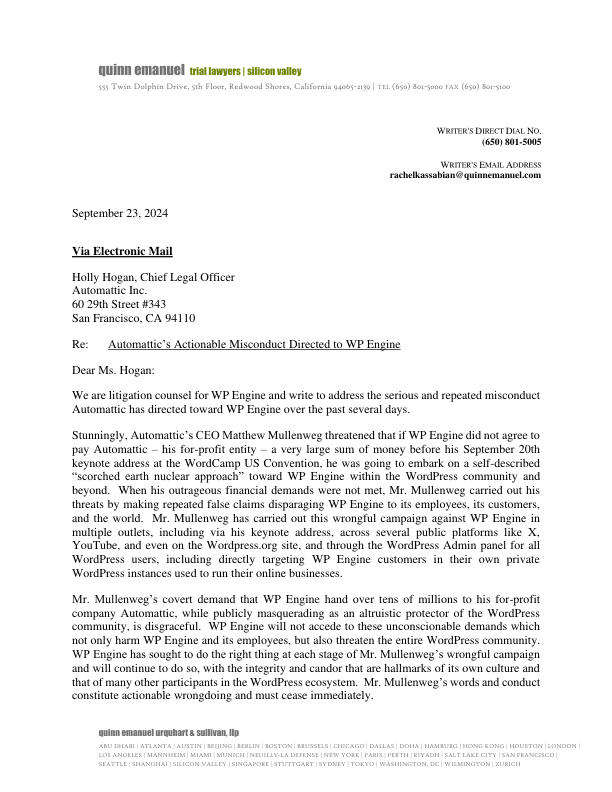
- Mr. Mullenweg has carried out this wrongful campaign against WP Engine in multiple outlets, including via his keynote address, across several public platforms like X, YouTube, and even on the Wordpress.org site, and through the WordPress Admin panel for all WordPress users, including directly targeting WP Engine customers in their own private WordPress instances used to run their online businesses. ([View Highlight](https://read.readwise.io/read/01j8m6cf9sfzs57wefj9pp0atw))
- Mr. Mullenweg’s covert demand that WP Engine hand over tens of millions to his for-profit company Automattic, while publicly masquerading as an altruistic protector of the WordPress community, is disgraceful. ([View Highlight](https://read.readwise.io/read/01j8m6cxptske29fxjzp5rs7vq))
- JetPack ([View Highlight](https://read.readwise.io/read/01j8m6kzsdh0getmhbq4ztfky8))
- Matthew Mullenweg must immediately cease and desist from interfering with WP Engine’s contractual relationships with its employees, including ceasing and desisting from providing false and misleading information to WP Engine’s employees to encourage those employees to end their employment relationships with WP Engine. ([View Highlight](https://read.readwise.io/read/01j8m6nsb94a21g9g8t5mej227))
- Automattic’s and WordPress Foundation’s trademarks and trademark applications, including WORDPRESS and WOOCOMERCE, as well as any materials pertaining to the use, registration, or enforcement of those trademarks that may be relevant to this dispute; ([View Highlight](https://read.readwise.io/read/01j8m6qsgznv6bhpaj2zwf30gs))
- Automattic’s CEO Matthew Mullenweg threatened that if WP Engine did not agree to pay Automattic – his for-profit entity – a very large sum of money before his September 20th keynote address at the WordCamp US Convention, he was going to embark on a self-described “scorched earth nuclear approach” toward WP Engine within the WordPress community and beyond. When his outrageous financial demands were not met, Mr. Mullenweg carried out his threats by making repeated false claims disparaging WP Engine to its employees, its customers, and the world. ([View Highlight](https://read.readwise.io/read/01j8gzdn8q3w8wj4fqjy81kqbw))
- Wordpress.org ([View Highlight](https://read.readwise.io/read/01j8m68g8vx3jt4apcyh836y1y))
- Mr. Mullenweg’s covert demand that WP Engine hand over tens of millions to his for-profit company Automattic, while publicly masquerading as an altruistic protector of the WordPress community, is disgraceful. WP Engine will not accede to these unconscionable demands which not only harm WP Engine and its employees, but also threaten the entire WordPress community. WP Engine has sought to do the right thing at each stage of Mr. Mullenweg’s wrongful campaign and will continue to do so, with the integrity and candor that are hallmarks of its own culture and that of many other participants in the WordPress ecosystem. Mr. Mullenweg’s words and conduct constitute actionable wrongdoing and must cease immediately. ([View Highlight](https://read.readwise.io/read/01j8gyn2thn1qadsbw52yfn70w))
- In parallel and throughout September 19 and 20, Mr. Mullenweg embarked on a series of harassing text messages and calls to WP Engine’s board member and also its CEO, threatening that if WP Engine did not agree to pay up prior to the start of Mr. Mullenweg’s livestreamed keynote address at 3:45pm on September 20, he would go “nuclear” on WP Engine, including by smearing its name, disparaging its directors and corporate officers, and banning WP Engine from WordPress community events. ([View Highlight](https://read.readwise.io/read/01j8gynqdbsga4kcr9qk2p3zmg))
- Mr. Mullenweg continued to send a barrage of texts throughout the evening of September 19 and the morning of September 20, attempting to pressure WP Engine into capitulating to Automattic’s financial demands: ([View Highlight](https://read.readwise.io/read/01j8gys4xkk2n2mdqgr22bmedj))
- As for Mr. Mullenweg’s claim that WP Engine is misusing the WordPress trademark, that too is false, and reflects a profound misunderstanding of both trademark law and WordPress Foundation’s trademark policy. First, WP Engine’s use of “WP” is explicitly permitted by WordPress Foundation’s trademark policy: “The abbreviation ‘WP’ is not covered by the WordPress trademarks and you are free to use it in any way you see fit.”2 Moreover, WP Engine’s use of the WordPress mark is entirely compliant with governing trademark law. For more than a decade, WP Engine has fairly used that term to describe its services, as other members of the WordPress ecosystem do. ([View Highlight](https://read.readwise.io/read/01j8gz8v3afwpgwz4cd8z7ek8f))
- Automattic’s and WordPress Foundation’s trademarks and trademark applications, including WORDPRESS and WOOCOMERCE, as well as any materials pertaining to the use, registration, or enforcement of those trademarks that may be relevant to this dispute; ([View Highlight](https://read.readwise.io/read/01j8gzaeyswbagj2v41c77szxd))