Certificate of Good Standing
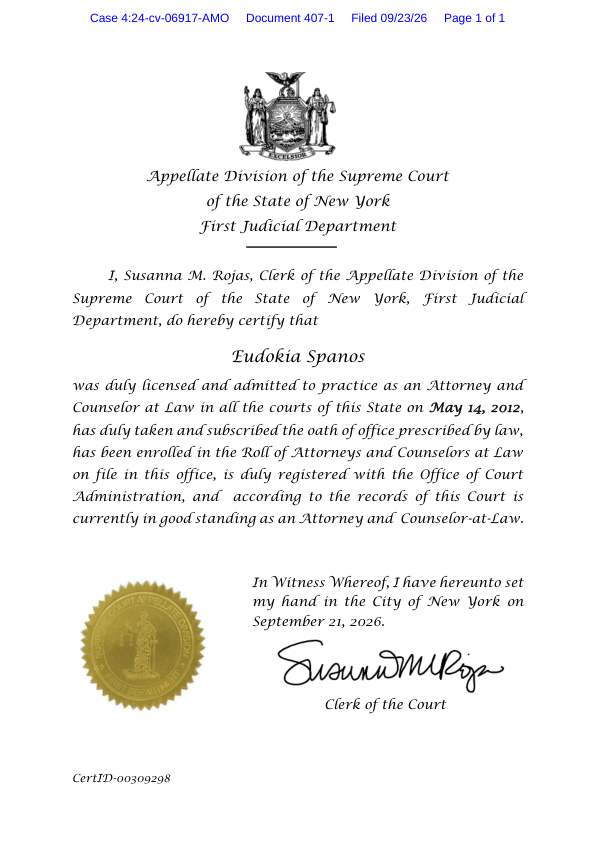
🔗 **Source:** [Certificate of Good Standing](https://storage.courtlistener.com/recap/gov.uscourts.cand.437474/gov.uscourts.cand.437474.407.1.pdf)
> [!note]+ Document Notes
> tags: [pro-hac-vice, attorney-admission, certificate-of-good-standing, court-exhibits, wpengine-v-automattic]
> author: Susanna M. Rojas, Clerk, Appellate Division of the Supreme Court of the State of New York, First Judicial Department
> source: CourtListener RECAP (N.D. Cal. 3:24-cv-06917-AMO)
> reference: https://storage.courtlistener.com/recap/gov.uscourts.cand.437474/gov.uscourts.cand.437474.407.1.pdf
> date created: 2026-10-01 17:30
>
> > [!info] Generated analysis — not the author's words. Sections below are machine-written
> > from the captured source. Only text inside `> [!quote]` blocks is verbatim from the author.
> > Do not quote or attribute any other line to the named author.
>
> # 🏷️ Title: Certificate of Good Standing
>
<!-- deep-read:sections start -->
## 🧭 Table of contents
- [📝 Summary](#-summary)
- [📖 Main content](#-main-content)
- [🗒️ Notes](#️-notes)
- [📚 References](#-references)
- [🗣️ Paraphrase](#️-paraphrase)
- [📰 Newsletter](#-newsletter)
- [✅ Action items](#-action-items)
- [🧪 Hypotheses](#-hypotheses)
- [📊 Methodology](#-methodology)
- [❓ Questions](#-questions)
- [🔮 Future research](#-future-research)
- [💡 Implications](#-implications)
- [🧠 Learning styles assessment](#-learning-styles-assessment)
- [📊 Accessibility assessment](#-accessibility-assessment)
- [🌍 DEIB assessment](#-deib-assessment)
- [✅ Logical validity](#-logical-validity)
- [🛡️ DARVO analysis](#️-darvo-analysis)
- [🎯 Conclusion](#-conclusion)
- [🔄 Refactor appendix](#-refactor-appendix--certificate-of-good-standing)
This is a neutral description of a court exhibit. It is not legal advice, and the analyst is not a lawyer. Paragraph labels like ¶3 are the pipeline's extraction labels, not part of the original document.
## 📝 Summary
- **What happened.** The captured text is Dkt. 407-1, an attachment to Dkt. 407 in WPEngine, Inc. v. Automattic Inc. (N.D. Cal., Case No. 3:24-cv-06917-AMO). It is a one-page certificate from the Appellate Division of the Supreme Court of the State of New York, First Judicial Department (¶0). The Clerk, Susanna M. Rojas, certifies that Eudokia Spanos is an attorney in good standing (¶1 to ¶3) and signs in New York City on September 21, 2026 (¶4).
- **The claim.** The certificate states five facts in one sentence (¶3): admission to practice in all New York State courts on May 14, 2012, the oath of office, enrollment in the Roll of Attorneys and Counselors at Law, registration with the Office of Court Administration, and current good standing "according to the records of this Court." The Clerk attests to these facts. The document contains no argument.
- **Why it matters.** The text never mentions a pro hac vice application, the federal case, or any purpose. The link to a pro hac vice application comes from the docket metadata the pipeline supplied (an attachment to Dkt. 407), not from this page. Courts commonly ask for a certificate like this when a lawyer admitted elsewhere seeks to appear in the case. That is background, not something the page says, and a lawyer or the local rules would confirm it.
- **Key stakeholders.** The Clerk of the New York Appellate Division, First Judicial Department, who issues the certificate. Eudokia Spanos, the certified attorney. The Northern District of California, where the exhibit sits on the docket. The parties in the case are not named anywhere in the text.
- **Risks and tradeoffs.** The text is a PDF-to-text conversion of 148 words in 7 labeled paragraphs. It certifies New York standing only, as of one date. It says nothing about any other jurisdiction, any role in this case, or the merits. Paragraph ¶6 is a certificate identifier string, which this analysis omits as a document identifier.
- **Bottom line.** A routine attestation exhibit with low analytic value. The Clerk certifies New York good standing as of September 21, 2026. Whether Dkt. 407 is a pro hac vice application, and what the Court did with it, are questions for the docket.
## 📖 Main content
**What the document is.** A certificate of good standing is an official statement from the court that licenses a lawyer. This one comes from the Appellate Division of the Supreme Court of the State of New York, First Judicial Department (¶0, ¶1). The page is a form: a header naming the court, a certification clause naming the Clerk, the attorney's name alone on a line, one long sentence of facts, a signing clause, a signature label, and an identifier.
**What it certifies.** The single operative sentence (¶3) lists five items.
- The attorney "was duly licensed and admitted to practice" in all courts of New York State on May 14, 2012.
- The attorney took and subscribed the oath of office prescribed by law.
- The attorney is enrolled in the Roll of Attorneys and Counselors at Law on file in the Clerk's office.
- The attorney is registered with the Office of Court Administration.
- According to the court's records, the attorney is currently in good standing.
The first four items are historical facts about admission. The fifth is the one that changes over time, and the signing clause fixes it to a date: "I have hereunto set my hand in the City of New York on September 21, 2026" (¶4).
**What the document does not say.**
- It doesn't mention WPEngine, Automattic, or the N.D. Cal. case.
- It doesn't mention pro hac vice admission or any application.
- It doesn't say whom Spanos represents.
- It gives no disciplinary history beyond the "good standing" status, and it doesn't define that term.
- It doesn't speak to admission in any other state or federal court.
**Terms.**
- **Pro hac vice:** Latin for "for this occasion." It means a court permits a lawyer licensed elsewhere to appear in one case. The term isn't in the captured text.
- **Certificate of good standing:** an attestation by the licensing court that a lawyer's license is active as of a stated date.
- **Roll of Attorneys and Counselors at Law:** the New York court's register of admitted attorneys, named in ¶3.
**Uncertain in this source.** The capture is machine-converted, but all seven paragraphs read cleanly and no table or fragmented text appears. The purpose and the parent filing (Dkt. 407) can't be confirmed from this page. Nothing here is contested.
## 🗒️ Notes
#### 📄 ¶0-¶2 Issuer and subject
- ¶0 names the issuer: the Appellate Division of the Supreme Court of the State of New York, First Judicial Department.
- ¶1 is the certification clause. The text is written in the first person: "I, Susanna M. Rojas, Clerk of the Appellate Division ... do hereby certify that." The next paragraph supplies the object of the clause.
- ¶2 is the certified person's name alone: Eudokia Spanos.
#### 📄 ¶3 The five facts
- One sentence of about 69 words. It states admission on May 14, 2012, the oath, enrollment on the Roll, registration with the Office of Court Administration, and current good standing.
- The good-standing clause is the only one attributed to a source: "according to the records of this Court."
- The sentence says nothing about the date of the oath, the date of enrollment, or the registration year.
#### 📄 ¶4-¶6 Signing and identifier
- ¶4 is the "In Witness Whereof" clause. It places the signing in the City of New York on September 21, 2026.
- ¶5 reads "Clerk of the Court," the signature label. No signature image appears in the text capture.
- ¶6 is a certificate identifier string. This analysis omits it as a document identifier.
## 📚 References
The captured link list for this source is empty, and the captured text contains no links. No link in the captured markup points to any source for this document.
- [The certificate as downloaded from CourtListener RECAP](https://storage.courtlistener.com/recap/gov.uscourts.cand.437474/gov.uscourts.cand.437474.407.1.pdf): Dkt. 407-1, the document analyzed here.
- Dkt. 407 (the parent filing): its text isn't in the capture, and no link appears for it. This analysis doesn't describe its content.
- Claims with no link in the captured markup: every statement on the certificate. The attestation rests on the court's own records, which the page doesn't link.
- Primary source to check next: the CourtListener docket for Case No. 3:24-cv-06917-AMO, which lists Dkt. 407 and any order on it.
## 🗣️ Paraphrase
The Clerk of New York's First Department Appellate Division states that Eudokia Spanos became a New York lawyer on May 14, 2012, took the required oath, is on the court's roll of attorneys, is registered with the state's Office of Court Administration, and, by the court's records, is in good standing today. The Clerk signed this in New York City on September 21, 2026.
The page doesn't say why it was written. The docket places it as an attachment to Dkt. 407, and that placement is the only hint of its purpose.
## 📰 Newsletter
**A one-page exhibit in WP Engine v. Automattic: a New York good-standing certificate.** Dkt. 407-1 isn't a ruling or an argument. It's the New York Appellate Division's Clerk certifying that Eudokia Spanos is an attorney in good standing as of September 21, 2026. The page doesn't say what it supports. Docket placement, as an attachment to Dkt. 407, suggests a lawyer admission filing, and the docket would confirm it.
Read it for what it is: housekeeping. It adds nothing about the claims between WPE and Automattic. If you follow the case, the filings worth your time are the substantive motions and rulings. Link: [the certificate on CourtListener](https://storage.courtlistener.com/recap/gov.uscourts.cand.437474/gov.uscourts.cand.437474.407.1.pdf).
## ✅ Action items
Not legal advice. Each line ties to the certificate's text or says plainly that no action follows.
#### DevRel
- Developer advocacy: no direct action. If you mention this exhibit in a talk, call it an attorney-standing certificate, not a development in the dispute.
- Education: none. A single-page form isn't a teaching case, though it can illustrate what a docket attachment looks like.
- Developer experience: none. The exhibit isn't about software.
- Developer marketing: none. Don't cite the filing as evidence about either company.
- Community management: if the filing comes up in community channels, link it and say it's an attorney-standing certificate. Keep speculation about case strategy out of the thread.
- Internal/external/cross-project: none from this source.
#### OSPO
- Policy and governance: none. The certificate says nothing about contribution or governance policy.
- License compliance: none. No license appears.
- Security management: none.
- Software inventory: none.
- Developer support: point contributors who ask about the case to the public docket instead of summaries.
- Community engagement: none from this source.
- Strategic alignment: none. The certificate makes no claim about open-source strategy.
#### Community
- Maintainers: no direct action. Nearest relevance: maintainers named in legal filings can ask their own counsel what they may say publicly.
- Contributors: none.
- Sponsors: none. The certificate doesn't discuss funding.
- Ecosystem: none from this source.
#### WordPress
- Core: no direct action.
- Core Performance: none.
- Core AI: none.
- **Core Program Team:** none.
- Mobile: none.
- Playground: none.
- Community: no direct action. Nearest relevance: community leaders who get questions about the case can share the docket as the neutral primary source.
- Training: none.
- Marketing: none.
- Support: none.
- Design: none.
- Documentation: none.
- Photos: none.
- TV: none.
- Polyglots: none.
- Accessibility: none from this source.
- Meta: none. The exhibit doesn't touch the .org directory.
- CLI: none.
- Hosting: no direct action. The case involves a WordPress hosting company, but this page says nothing about hosting practice.
- Tide: none.
- Openverse: none.
- Themes: none.
- Plugins: none.
#### The WPOCC
- Programs: none directly.
- Projects: none.
- Funding experiments: none from this source.
### FAIR
- Technical independence: none. The certificate says nothing about package signing or provenance.
- Policies and covenants: none directly.
- Productized governance artifacts: none from this source.
## 🧪 Hypotheses
1. Dkt. 407 is a pro hac vice application for Eudokia Spanos, and this certificate is its good-standing attachment. The docket entry for Dkt. 407 would confirm or refute that.
2. The certificate's date (September 21, 2026) falls within the recency window the Northern District of California's local rules set for such certificates. The local rules would settle that.
3. The Court acted on Dkt. 407 within weeks of the certificate's date. The docket would show the entry date of any order.
4. Certificates of this type follow a fixed form, so the same five-fact sentence appears in certificates from the same court for other attorneys. A sample of other First Department certificates on public dockets would test that.
5. A reader who sees only this page can't identify the party the attorney represents. The page names no party, and a blind reading test would confirm it.
## 📊 Methodology
- **H1.** Open the CourtListener docket for Case No. 3:24-cv-06917-AMO. Read the title and filer of Dkt. 407 and confirm the relationship to Dkt. 407-1.
- **H2.** Find the local rule on good-standing certificates in the court's published rules. Compare the rule's recency window to the date in ¶4. Ask a lawyer to confirm the reading.
- **H3.** Read the docket entries after Dkt. 407 and record the date of any order granting or denying it. Compare that date to September 21, 2026.
- **H4.** Collect 5 to 10 First Department certificates attached to public federal dockets. Compare wording sentence by sentence to ¶3.
- **H5.** Show the page, with the docket metadata removed, to 5 readers and ask which party the attorney represents. Count the correct answers (expected: none).
- **Controls throughout.** One reader per check plus a second reviewer. Use public dockets only.
## ❓ Questions
- What is Dkt. 407, who filed it, and on whose behalf does Spanos appear? The docket confirms it. This page doesn't say.
- Which party's counsel is Spanos, and what role is proposed in the case? Not stated in the text.
- Does an order on Dkt. 407 exist, and when was it entered? A lawyer or the docket would need to check.
- What recency window, if any, does the Northern District of California require for certificates of good standing?
- Does "good standing" here carry a defined meaning in New York practice? The page uses the term without defining it.
- Is Spanos admitted anywhere else, and do other certificates appear on the docket? This certificate doesn't say.
- Why is a signature absent from the text capture at ¶5? It could be an image the extraction dropped, or it could be absent from the PDF. The capture can't answer.
## 🔮 Future research
- **Track Dkt. 407.** Read the parent filing and any order to learn what this certificate supports.
- **Compare certificates.** Check how other jurisdictions' certificates word standing and date it, using public federal dockets.
- **Admission patterns in high-profile disputes.** Count how many out-of-district attorneys appear in a case like this and when they join. This exhibit is one data point.
- **Extraction quality.** Test whether form-style certificates convert cleanly in RECAP text compared with pleading-paper filings. This one converted without fragments.
## 💡 Implications
- **Practice.** Anyone summarizing the case can cite the certificate for one thing only: New York good standing for one attorney on one date.
- **Policy.** The certificate shows how a court attests to a license at a point in time. Standing can change after the signing date, so a date-stamped attestation has a shelf life.
- **Security.** The page carries an identifier string and a name but no other personal data. This analysis leaves out the identifier.
- **Education.** The five-fact sentence is a compact example of an attestation form that students of court procedure can read in a minute.
- **Funding.** None. The certificate says nothing about money or funding.
## 🧠 Learning styles assessment
- **Reading level estimate.** The operative sentence (¶3) runs 81 tokens and about 124 syllables by a rough count. The Flesch-Kincaid Grade Level formula (0.39 x words per sentence + 11.8 x syllables per word - 15.59) returns about 34 for that one sentence, which is off the grade scale. The rest of the page is labels and short clauses with no scoreable sentences. This is a sampled estimate, not a validated score.
#### 👀 Visual learners
- Present: a short form with a stacked layout in the PDF (header, name, sentence, date, label). The text capture keeps the order but not the layout.
- Improve: a labeled annotation of the five facts in ¶3 would help, as would a two-line timeline showing admission on May 14, 2012 and certification on September 21, 2026.
#### 🔊 Aural learners
- Present: no audio is referenced.
- Improve: a 1-minute narration that reads the five facts aloud and explains the date stamp.
#### 🗣️ Verbal learners
- Present: formal definitions are implicit in the clause "duly licensed and admitted to practice" and in the roll and registry names.
- Improve: a short glossary for "pro hac vice," "Roll of Attorneys and Counselors at Law," "Office of Court Administration," and "good standing."
#### 🧩 Kinesthetic learners
- Present: none. The certificate isn't a procedure.
- Improve: have readers find Dkt. 407 and 407-1 on CourtListener and match each attachment to its parent.
#### 🧠 Logical learners
- Present: a one-sentence list of five facts with a date that anchors the last one.
- Improve: a small table with columns "Fact," "Source of the fact," and "As of date," so the difference between admission history and current standing is visible.
#### 🧑🤝🧑 Social learners
- Present: none. A single-voice attestation.
- Improve: a discussion prompt for a law or open-source governance study group: "What does a court attest to, and what does it leave out?"
#### 🧘♀️ Solitary learners
- Present: a self-contained page that needs no other source to read.
- Improve: a self-check: "Which of the five facts in ¶3 can change after the signing date?"
#### 🌿 Naturalistic learners
- Present: nothing relevant.
- Improve: none needed for this topic.
## 📊 Accessibility assessment
Judged as captured. The capture is a text view converted from a PDF by Reader, so the original PDF's tagging isn't visible.
#### Screen reader semantics
- Present: paragraph order is preserved and each of the seven paragraphs reads cleanly in sequence.
- Improve: no headings are visible in the capture. Whether the PDF carries a title, language attribute, or tagged structure is unknowable from the text. WCAG 1.3.1 (Info and Relationships) and 3.1.1 (Language of Page) apply to the PDF itself.
#### Keyboard navigation
- Present: not assessable from the captured text.
- Improve: no interactive elements appear in the capture.
#### Contrast and readability
- Present: unknowable from text. Page styling isn't captured.
- Improve: court certificates are usually dark text on a light page, but that can't be confirmed here. WCAG 1.4.3 (Contrast, Minimum) can't be tested from this source.
#### Text resizing and reflow
- Present: the capture reflows as plain text.
- Improve: the original is a fixed one-page PDF. WCAG 1.4.10 (Reflow) is a known weak point for fixed-layout PDFs, and it can't be verified here.
#### Media and captions
- No media referenced in the captured text.
#### Forms and interactions
- Present: none. No form field appears.
- Improve: none needed.
#### Standards reference
- Candidate gaps against WCAG 2.2 AA, each unverified: **1.3.1** (structure), **1.4.10** (reflow), **3.1.1** (language), and **1.1.1** (Non-text Content) if the signature or a seal is an image without alternative text. The capture shows none of these directly.
## 🌍 DEIB assessment
#### Cultural breadth
- Present: a US state-court attestation inside a US federal case. The text has no multilingual content.
- Improve: a plain-language note explaining the US system of state bar admission for readers outside the US.
#### Inclusive language
- Present: neutral legal register. The page uses the person's name and no gendered pronoun.
- Improve: expand terms such as "Attorney and Counselor at Law," "subscribed," and "Roll" for readers outside the US legal system.
#### Neurodiversity support
- Present: a short, fixed structure with one idea per paragraph.
- Improve: the single 69-word sentence in ¶3 carries five facts. Splitting it into a list would lower the reading load.
#### Representation
- Present: one named Clerk and one named attorney. No parties are named.
- Improve: none. The page isn't a place for balanced quoting or varied roles.
#### Psychological safety
- Present: the page characterizes no one's conduct and states only standing and admission facts.
- Improve: readers shouldn't infer anything about the attorney, the case, or the parties from this page beyond what it says.
## ✅ Logical validity
Source type: an official attestation. It makes no argument and offers no analysis. Its credibility rests on the issuing court's records, which this page doesn't reproduce.
#### Strong reasoning
- **Date-anchored claim, ¶3 and ¶4.** The status that can change (good standing) is stated "currently," and the signing clause fixes "currently" to September 21, 2026. That keeps the claim checkable.
- **Source attribution, ¶3.** The clause "according to the records of this Court" names where the standing claim comes from. It makes clear the Clerk attests to the court's records, not to the person's conduct elsewhere.
#### Fallacies
- None found. The document contains no argument, analogy, or rhetorical device. Checked: the certification clause (¶1), the five-fact sentence (¶3), and the signing clause (¶4). The limits are scope gaps, not fallacies. The certificate covers New York standing only, as of one date, and it defines no terms.
#### Tone of voice
- Formal attestation register with no advocacy. Examples: "do hereby certify that" (¶1) and "In Witness Whereof" (¶4).
## 🛡️ DARVO analysis
Not applicable to this source. DARVO describes a response to an accusation, and this page is a clerk's attestation that responds to nothing. **Deny:** the page denies nothing. **Attack:** no one is attacked or discredited. **Reverse victim/offender:** no such move appears. Nothing on the page alleges conduct by anyone.
## 🎯 Conclusion
The Clerk of the New York Appellate Division, First Judicial Department, certifies that Eudokia Spanos is an attorney in good standing as of September 21, 2026. The page lists five facts and signs with a place and date. It states no purpose, names no party, and says nothing about the federal case.
The pro hac vice reading comes from docket metadata, which places this page as an attachment to Dkt. 407. It isn't in the text. Nothing here bears on the merits of WPE v. Automattic, and no direct action follows for WordPress or open-source work.
**Next steps for readers:** open the CourtListener docket to read Dkt. 407 and any order on it, and ask a lawyer how the local rules treat certificates like this one.
## 🔄 Refactor Appendix — Certificate of Good Standing
> Density: short source, full-structure note. Emitted: 3 Literature atoms (H1 pad), 1 Permanent candidate (P1 pad).
> Resonance filter applied: the court header, signature label and certificate identifier
> were dropped as procedural boilerplate.
>
> Konik claim-header rules: present tense, declarative, ≤10 words, searchable, unique.
>
> Atomicity: one declarative sentence per atom. "and"/"also" → split.
>
> Tag pool: #bmf · #addendum · #xref · #articleseed · #storystem · #share · #aphorisms
### 📚 Literature Split Pad
#### [H1] The certificate states a fixed admission date
> [!quote] [¶3]
> admitted to practice as an Attorney and Counselor at Law in all the courts of this State on May 14, 2012
**Context & use**:
- ¶3, the first of five facts. The Clerk of the New York Appellate Division, First Department, signs the certificate (¶1, ¶4).
- Record as a historical fact that doesn't change. It says nothing about the attorney's current status or any other jurisdiction.
**Tags**: #xref
<!-- atomicity: 1 idea ✓ -->
#### [H2] The certificate rests on the issuing court's own records
> [!quote] [¶3]
> according to the records of this Court is currently in good standing as an Attorney and Counselor-at-Law
**Context & use**:
- ¶3, the operative attestation. It's the only claim in the exhibit that can change over time.
- States standing as of the signing date, not a finding about anything else.
**Tags**: #xref
<!-- atomicity: 1 idea ✓ -->
#### [H3] The signing clause fixes the standing to a date
> [!quote] [¶4]
> In Witness Whereof, I have hereunto set my hand in the City of New York on September 21, 2026.
**Context & use**:
- ¶4. The date turns "currently in good standing" into a dated statement.
- Use as the anchor when checking any recency requirement in the local rules.
**Tags**: #xref #share
<!-- atomicity: 1 idea ✓ -->
### 🧠 Atomic Split Pad
#### [P1] An attestation is a dated snapshot
**Claim** (one sentence, Courtney's voice): A certificate of standing tells you what a record showed on the signing date and nothing about the days after.
**Evidence pointer**: [[#H2]] · [[#H3]]
**Scope & conditions**: Holds for status attestations such as good standing, license status, or account status. Breaks when the document carries an expiry date or a continuing duty to update. This certificate states neither.
**Links**:
- [[Court filings as primary sources]] — because extends
- [[Reading a docket]] — because applies-in checking an attachment against its parent filing
- [[Summaries of legal disputes]] — because contrasts on whether a document is evidence of status or evidence of the claim
<!-- atomicity: 1 idea ✓ -->
### ✏️ Fleeting Queue
- [F1] Look up Dkt. 407 on CourtListener to confirm it is the pro hac vice application this certificate supports, https://storage.courtlistener.com/recap/gov.uscourts.cand.437474/gov.uscourts.cand.437474.407.1.pdf #fleeting #inbox
- [F2] Open question: does the Northern District of California set a recency window for good-standing certificates? #fleeting #inbox
### → Things 3 (max 2 actions)
- [ ] Confirm the nature of Dkt. 407 and any order on it in the WPE v. Automattic docket index, llm-wiki-wp-governance, 5 min #things
<!-- deep-read:sections end -->
📄 **Full text:** [[Full Document Contents/Articles/Certificate of Good Standing.md|Certificate of Good Standing by Susanna M. Rojas, Clerk, Appellate Division of the Supreme Court of the State of New York, First Judicial Department]]
## Highlights
- was duly licensed and admitted to practice as an Attorney and Counselor at Law in all the courts of this State on May 14, 2012, has duly taken and subscribed the oath of office prescribed by law, has been enrolled in the Roll of Attorneys and Counselors at Law on file in this office, is duly registered with the Office of Court Administration, and according to the records of this Court is currently in good standing as an Attorney and Counselor-at-Law. ([View Highlight](https://read.readwise.io/read/01m3s7y3ty8kgh2bgwmt13rbav))
- Note: [H1] The certificate rests on the issuing court's own records
- Tags: atom/literature/h1