ChatGPT and AI Literacy: How Students Learn Through Use
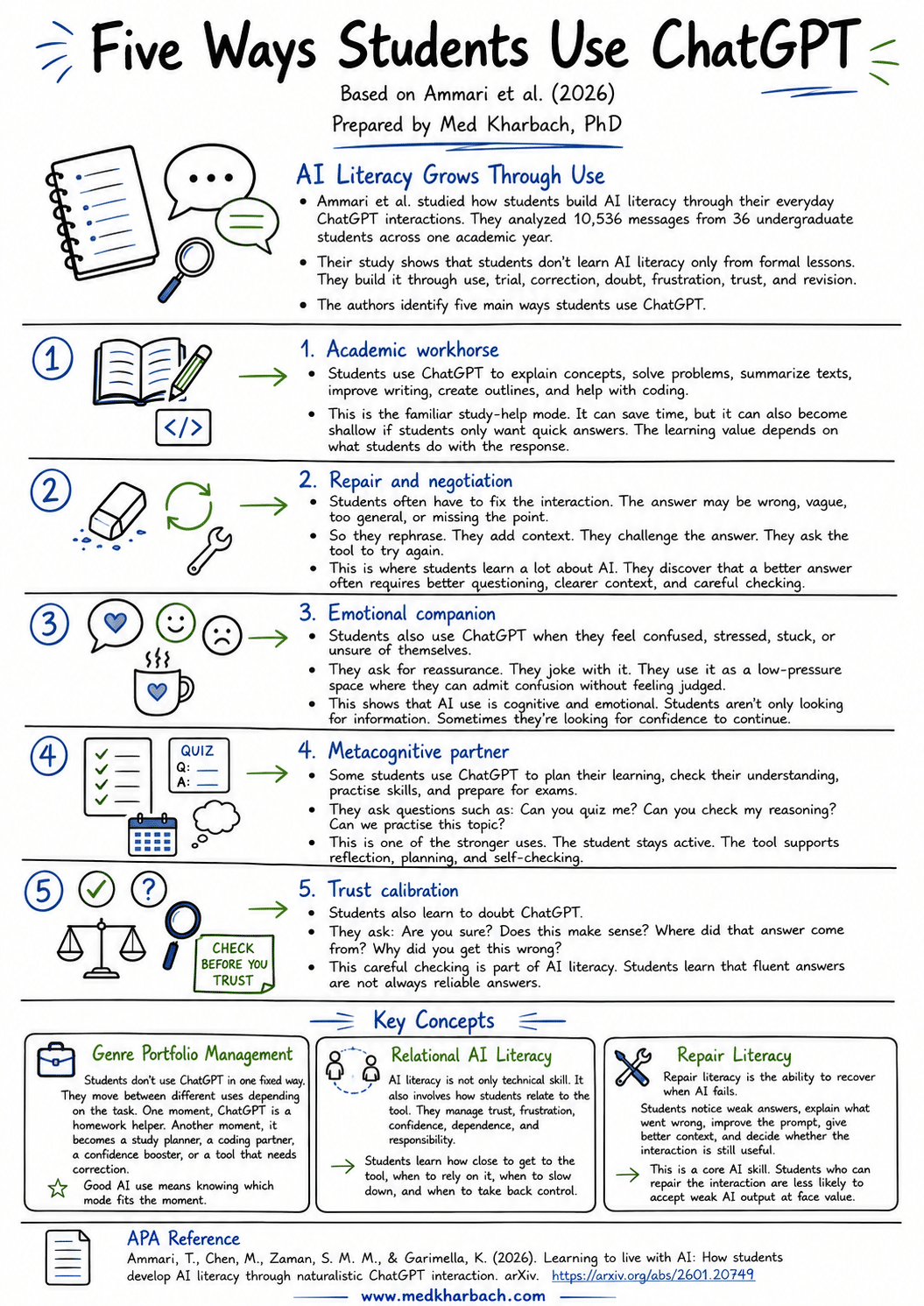
🔗 **Source:** [ChatGPT and AI Literacy: How Students Learn Through Use](https://www.educatorstechnology.com/2026/06/chatgpt-and-ai-literacy.html)
> [!note]+ Document Notes
> tags: [ai-literacy, education, chatgpt, students, ai-in-education, pedagogy]
> author: [MISSING]
> source: Educators Technology (educatorstechnology.com)
> reference: https://www.educatorstechnology.com/2026/06/chatgpt-and-ai-literacy.html
> date created: 2026-06-28 09:00
>
> # 🏷️ Title: ChatGPT and AI Literacy: How Students Learn Through Use
>
<!-- deep-read:sections start -->
## 🧭 Table of Contents
- [📝 Summary](#-summary)
- [📖 Main Content](#-main-content)
- [🗒️ Notes](#️-notes)
- [📚 References](#-references)
- [🗣️ Paraphrase](#️-paraphrase)
- [📰 Newsletter](#-newsletter)
- [✅ Action Items](#-action-items)
- [🧪 Hypotheses](#-hypotheses)
- [📊 Methodology](#-methodology)
- [❓ Questions](#-questions)
- [🔮 Future Research](#-future-research)
- [💡 Implications](#-implications)
- [🧠 Learning Styles Assessment](#-learning-styles-assessment)
- [📊 Accessibility Assessment](#-accessibility-assessment)
- [🌍 DEIB Assessment](#-deib-assessment)
- [✅ Logical Validity](#-logical-validity)
- [🛡️ DARVO Analysis](#-darvo-analysis)
- [🎯 Conclusion](#-conclusion)
### 🔗 References
- [Critical AI literacy — EDIA framework (Hawkins et al., 2025)](https://medkharbach.com/critical-ai-literacy-edia-framework/)
- [AI voice increases student trust (Cohn et al., 2024)](https://medkharbach.com/ai-voice-increases-student-trust-what-teachers-should-know/)
- [Collaborative AI literacy and metacognition (Sidra et al., 2026)](https://medkharbach.com/collaborative-ai-literacy-and-metacognition/)
- [Why AI literacy for teachers goes beyond ChatGPT (Bilbao-Eraña et al., 2025)](https://medkharbach.com/why-ai-literacy-for-teachers-goes-far-beyond-knowing-how-to-use-chatgpt/)
- [Ammari, Chen, Zaman & Garimella (2026), arXiv:2601.20749](https://arxiv.org/abs/2601.20749)
## 📝 Summary
- **What happened.** A blog post on Educators Technology unpacks Ammari, Chen, Zaman & Garimella's 2026 study, *Learning to live with AI*. The researchers analyzed 10,536 ChatGPT messages from 36 undergraduates across one academic year and identified five ways students actually use the tool: academic workhorse, repair and negotiation, emotional companion, metacognitive partner, and trust calibration.
- **Why it matters.** It reframes AI literacy as something students build through naturalistic daily use, not only through formal lessons or policy statements. The post turns the findings into a classroom discussion tool (a sketchnote) and gives teachers concrete prompts.
- **Key stakeholders.** Students, classroom teachers, instructional designers, education researchers, and anyone shipping AI-in-education tooling or curriculum (including WordPress-based learning platforms and the WordPress Training/Learn team).
- **Risks and tradeoffs.** Use-based learning can flatten into copy-paste dependence. Emotional reliance on an agreeable tool can erode judgment. The study is small (36 students) and observational, so causal and generalizable claims are limited.
- **Bottom line.** AI literacy grows through guided, reflective, and repaired use. The teacher's job shifts from banning or warning toward helping students name their modes and question fluent answers.
## 📖 Main Content
The post argues that students are already developing AI literacy in front of teachers — in messy chat windows, late-night study sessions, and moments of confusion. Ammari et al. give educators something most AI-literacy debates lack: a corpus of real student-ChatGPT interactions observed over a full year.
The five uses form the spine of the argument:
1. **Academic workhorse.** Explaining concepts, solving problems, summarizing, improving writing, outlining, coding help. The post stresses that the *learning* lives in what the student does after the answer appears — checking it against course materials and applying it versus pasting it in. This connects to Hawkins et al. (2025) on feedback literacy: output alone doesn't teach; the student's response to output is where learning begins.
2. **Repair and negotiation.** Students notice vague, wrong, or off-task answers and rephrase, add context, supply examples, or challenge the tool. Ammari et al. call this *repair literacy*. Students who can repair an interaction resist accepting weak answers at face value.
3. **Emotional companion.** Students turn to ChatGPT for reassurance, low-judgment space, and confidence before re-engaging a hard task. The post refuses to romanticize this — ChatGPT is not a teacher, counsellor, or friend — and flags dependence and agreeableness as the risks. Cohn et al. (2024) on design cues and anthropomorphic trust supplies the tool-side mechanism; Ammari et al. supply the student side.
4. **Metacognitive partner.** The pedagogically strongest mode: students plan learning, self-quiz, check reasoning, and rehearse. The student stays active. Sidra et al. (2026) tie productive use to the student's ability to monitor, evaluate, and stay responsible for the thinking.
5. **Trust calibration.** Students learn to doubt, ask for sources, and question why the tool erred. This makes the abstract instruction "verify AI output" concrete — verification begins as hesitation and strengthens through repeated encounters with error.
The post then adds two synthesizing ideas from the study: **genre portfolio management** (students fluidly switch modes by task) and **relational AI literacy** (students manage trust, frustration, confidence, dependence, and control). It ties teacher implications to Bilbao-Eraña et al. (2025): teachers need pedagogical language to guide judgment, purpose, and responsibility, not just tool proficiency.
### 🗒️ Notes
- Sample: **10,536 messages from 36 students** over one academic year — naturalistic, not lab-prompted.
- The five-use taxonomy is the headline contribution; the sketchnote visualizes it for classroom use.
- Repeated load-bearing claim: the *post-answer* student behavior, not the answer, is the locus of learning.
- "Repair literacy" and "trust calibration" are the two terms most actionable for assessment design.
- Emotional-companion use is the section the author predicts will make educators uncomfortable; handled with explicit caveats.
- Genre portfolio management = the meta-skill of choosing the right mode for the task.
- The author positions the artifact (sketchnote) as a discussion prompt, not a summary — pedagogy over reportage.
- Contested/uncertain: small N, single institution implied, no control group, self-selected tool logs. Causality is not established.
## 📚 References
- Ammari, T., Chen, M., Zaman, S. M. M., & Garimella, K. (2026). *Learning to live with AI: How students develop AI literacy through naturalistic ChatGPT interaction*. arXiv. https://arxiv.org/abs/2601.20749 *(primary source)*
- Hawkins et al. (2025) on feedback literacy — https://medkharbach.com/critical-ai-literacy-edia-framework/
- Cohn et al. (2024) on AI voice and student trust — https://medkharbach.com/ai-voice-increases-student-trust-what-teachers-should-know/
- Sidra et al. (2026) on collaborative AI literacy and metacognition — https://medkharbach.com/collaborative-ai-literacy-and-metacognition/
- Bilbao-Eraña et al. (2025) on AI literacy for teachers — https://medkharbach.com/why-ai-literacy-for-teachers-goes-far-beyond-knowing-how-to-use-chatgpt/
## 🗣️ Paraphrase
- **Opening.** Students are building AI literacy right now, informally, in private chat sessions where they'd rather not ask a person for help.
- **Why this study.** Ammari et al. observed real use over a year — 10,536 messages, 36 students — filling a gap in literacy debates that usually rely on policy or anecdote.
- **Core claim.** Literacy grows through use, not only formal lessons. Students experiment, get weak answers, repair prompts, over-trust, then doubt.
- **Use 1.** Academic help can support or flatten learning; the deciding factor is what the student does after the answer.
- **Use 2.** Repair and negotiation — rephrasing and challenging the tool — is itself learning and inoculates against weak answers.
- **Use 3.** Emotional-companion use is real but risky; reassurance can curdle into dependence on an agreeable system.
- **Use 4.** Metacognitive partnering (quizzing, reasoning checks, rehearsal) keeps the student active and is the mode worth encouraging.
- **Use 5.** Trust calibration — doubting, sourcing, questioning errors — makes "verify output" concrete.
- **Synthesis.** Genre portfolio management and relational literacy describe how students move across modes and manage the relationship; good pedagogy helps them name and choose.
## 📰 Newsletter
**This week in AI literacy (with a WordPress chaser):** A tidy new study (Ammari et al., 2026) watched 36 students send 10,536 ChatGPT messages over a year and found five recurring uses — homework mule, prompt-repair negotiator, late-night confidant, study buddy, and skeptic-in-training. The takeaway that should cheer every Trainer and Docs contributor: learning doesn't live in the answer, it lives in what the student does next. For the WordPress crowd, that's a strong nudge for Learn.WordPress.org tutorials that teach *repair* and *verification* habits, not just "here's a prompt." If you build LMS sites (LearnDash, TutorLMS, Sensei) or course content on WordPress, the five-use taxonomy is a ready-made rubric for AI-use reflection prompts. Pair it with an accessible sketchnote and you've got a classroom-ready handout. Primary source is on [arXiv](https://arxiv.org/abs/2601.20749) — free, open, and refreshingly empirical.
## ✅ Action Items
#### DevRel
- Developer advocacy: draft a talk on "AI literacy as a developer skill" mapping the five-use taxonomy to coding-assistant workflows.
- Education: build a Learn workshop where contributors practice prompt repair and output verification, not just prompt-writing.
- Developer experience: add a "verify the model's output" checklist to any AI-assisted docs or quickstart.
- Developer marketing: position AI-tooling content around judgment and repair, not magic.
- Community management: seed a discussion thread asking which of the five uses contributors recognize in their own work.
- Internal/external/cross-project: align AI-literacy messaging across DevRel, Training, and Docs.
#### OSPO
- Policy & Governance: draft contributor guidance on responsible AI-assistant use in PRs and issues.
- License Compliance: note provenance/attribution risks when AI output enters licensed code or docs.
- Security Management: flag over-trust of fluent AI answers as a social-engineering / supply-chain literacy gap.
- Software Inventory: track which contributor tools embed AI assistants.
- Developer Support: offer office hours on verifying AI-generated contributions.
- Community Engagement: fund AI-literacy education tie-ins upstream.
- Strategic Alignment: add an AI-literacy KPI to OSPO education reporting.
#### Community
- Maintainers: add an "AI-assisted contribution" norms section to governance templates.
- Contributors: create a "repair the prompt" pairing exercise for onboarding.
- Sponsors: scope a microgrant for AI-literacy curriculum.
- Ecosystem: coordinate a cross-project AI-use disclosure norm.
#### WordPress
- Core: clarify expectations for AI-assisted patches and review verification.
- Core Performance: not directly applicable to this education source.
- Core AI: use the five-use taxonomy as a lens for evaluation sets and responsible-AI guardrails in any Core AI feature.
- **Core Program Team:** coordinate a cross-team AI-literacy education sprint (Training + Docs + Core AI).
- Mobile: not directly applicable.
- Playground: build a Playground lesson that demonstrates prompt repair and output verification interactively.
- Community: add an AI-literacy session kit to the meetup/WordCamp library.
- Training: turn the five uses into a Learn.WordPress lesson plan with reflection prompts and a self-check quiz.
- Marketing: narrative on "WordPress teaches judgment, not just tools."
- Support: add guidance on spotting over-trusted AI answers in support replies.
- Design: design an accessible version of the five-use sketchnote.
- Documentation: add an examples-first "verify AI output" pattern to the style guide.
- Photos: not directly applicable.
- TV: caption and index any AI-literacy talk submissions.
- Polyglots: translate the five-use taxonomy handout; align glossary terms (repair literacy, trust calibration).
- Accessibility: ensure the sketchnote has descriptive alt text and a text equivalent.
- Meta: not directly applicable.
- CLI: not directly applicable.
- Hosting: not directly applicable.
- Tide: not directly applicable.
- Openverse: source openly licensed classroom imagery for AI-literacy lessons.
- Themes: not directly applicable.
- Plugins: note LMS plugins (Sensei, LearnDash, TutorLMS) as distribution channels for AI-use reflection rubrics.
#### The WPCC
- Programs: scope a fellowship track on AI-literacy education for the community.
- Projects: run a documentation sprint converting the taxonomy into reusable lesson assets.
- Funding experiments: matched microgrant for AI-literacy curriculum authors.
### FAIR
- Technical independence: keep AI-literacy learning materials portable and locally hosted, not locked to one platform.
- Policies and covenants: transparency on which AI tools curriculum examples assume.
- Productized governance artifacts: an AI-use reflection rubric as a shareable scorecard.
## 🧪 Hypotheses
- **H1.** Students explicitly taught prompt-repair strategies will show higher rates of answer revision (and lower verbatim copy-paste) than a control group.
- **H2.** Students who use ChatGPT in metacognitive mode (self-quizzing, reasoning checks) will outperform academic-workhorse-only users on delayed retention tests.
- **H3.** Higher emotional-companion reliance correlates with lower trust-calibration behavior (more uncritical acceptance of agreeable answers).
- **H4.** Explicit instruction in the five-use taxonomy increases students' ability to name and switch modes deliberately (genre portfolio management).
- **H5.** Trust-calibration behavior increases with cumulative exposure to model errors, independent of formal instruction.
- **H6.** Teachers given pedagogical language for AI judgment shift assessment design toward process-visible tasks (compare outputs, document corrections).
### 📊 Methodology
- **Source study design:** observational analysis of 10,536 naturalistic ChatGPT messages from 36 undergraduates over one academic year; inductive/thematic coding yielding a five-use taxonomy plus the constructs repair literacy, trust calibration, and genre portfolio management.
- **Data sources:** student-submitted/logged chat transcripts; qualitative coding.
- **To test H1–H6:** mixed-methods — randomized controlled instruction trials (H1, H4, H6), pre/post and delayed-retention assessments (H2), correlational analysis of coded transcripts with trust-behavior measures (H3, H5), and discourse analysis of repair sequences. Larger, multi-institution samples to address generalizability.
### ❓ Questions
- Does repair literacy transfer across tools (ChatGPT → coding assistants → search) or stay tool-specific?
- What teacher moves most reliably convert academic-workhorse use into metacognitive use?
- Can emotional-companion use be redirected toward productive confidence without fostering dependence?
- How do these patterns differ for multilingual students or those with disabilities?
- What's the minimum viable AI-literacy lesson that measurably improves verification behavior?
### 🔮 Future Research
- Longitudinal, multi-institution replication with a larger and more diverse N.
- Controlled trials isolating the effect of explicit repair / verification instruction.
- Cross-cultural and multilingual studies of the five-use taxonomy.
- Studies linking AI-use modes to learning outcomes, not just self-reported habits.
- Design research on tool affordances that nudge trust calibration over agreeableness.
### 💡 Implications
- **Practice:** Assessment should make thinking visible — compare outputs, explain prompts, document corrections. Teach repair and verification as named skills.
- **Policy:** Move institutional AI policy from prohibition toward guided, reflective use; supply teachers with pedagogical language.
- **Security:** Over-trust of fluent output is a literacy and social-engineering risk; verification habits are a defensive skill.
- **Education:** Embed the five-use taxonomy in curricula and teacher training (Learn.WordPress, LMS content).
- **Funding:** Justify grants for AI-literacy curriculum and teacher professional development over one-off tool training.
### 🧠 Learning Styles Assessment
- **Reading level estimate:** Flesch–Kincaid Grade ~9–10 (short declarative sentences, some abstraction like "metacognitive" and "trust calibration"); Flesch Reading Ease ~55–60. Accessible to general educator audiences.
#### 👀 Visual learners
- Present: one sketchnote figure (the five uses) with a caption.
- Improve: add a labeled five-mode diagram, a before/after "copy-paste vs. repair" comparison, and an iconography legend.
#### 🔊 Aural learners
- Present: none (text-only post).
- Improve: add a 2–4 minute audio summary or TTS of the five uses.
#### 🗣️ Verbal learners
- Present: clear definitions (repair literacy, trust calibration, genre portfolio management) and analogies (workhorse, companion).
- Improve: add a short glossary and worked classroom-dialogue examples.
#### 🧩 Kinesthetic learners
- Present: discussion prompts teachers can run.
- Improve: add a hands-on lab — students annotate their own chat logs by mode.
#### 🧠 Logical learners
- Present: a numbered five-use structure with cause/effect reasoning.
- Improve: add a decision tree for "which mode am I in?" and a risk/benefit table per use.
#### 🧑🤝🧑 Social learners
- Present: explicit class-discussion questions.
- Improve: add a peer-review rubric and small-group comparison activity.
#### 🧘♀️ Solitary learners
- Present: reflective questions ("when do you trust ChatGPT too quickly?").
- Improve: add a self-check journal and a self-paced reflection worksheet.
#### 🌿 Naturalistic learners
- Present: none (no environmental framing).
- Improve: use an ecosystem analogy for the "portfolio" of modes; tie to lifecycle thinking about tool habits.
### 📊 Accessibility Assessment
#### Screen reader semantics
- Present: H2/H3 heading structure, a figure with figcaption.
- Improve: ensure the sketchnote `alt` text conveys all five uses, not just "ChatGPT and AI Literacy." Maps to **WCAG 1.1.1 Non-text Content**.
#### Keyboard navigation
- Present: standard linked text, no custom widgets observed.
- Improve: confirm visible focus and logical tab order on the live page. **WCAG 2.4.7, 2.1.1**.
#### Contrast and readability
- Present: standard body text on light background (assumed).
- Improve: verify 4.5:1 on links and captions. **WCAG 1.4.3**.
#### Text resizing and reflow
- Present: responsive image markup (srcset).
- Improve: confirm no clipping at 200% zoom / 320px reflow. **WCAG 1.4.10, 1.4.4**.
#### Media and captions
- Present: a static image with a caption; no audio/video.
- Improve: provide a text-equivalent list of the sketchnote content. **WCAG 1.1.1**.
#### Forms and interactions
- Present: not applicable — no forms in the content body.
- Improve: ensure site-level search/comment fields have labels. **WCAG 3.3.2, 1.3.1**.
#### Standards reference
- Primary gaps map to **WCAG 2.2 AA**: 1.1.1 (image alt/text equivalent) is the highest-value fix; verify 1.4.3, 1.4.10, 2.4.7 on the live page.
### 🌍 DEIB Assessment
#### Cultural breadth
- Present: framing is general and not region-locked.
- Improve: add multilingual and cross-cultural examples; the study's 36-student sample limits generalizability.
#### Inclusive language
- Present: gender-neutral, plain phrasing; jargon is defined.
- Improve: add a one-line plain-language summary per use for newcomers.
#### Neurodiversity support
- Present: chunked sections, consistent numbered structure, predictable headings.
- Improve: add icon+text labels and a short TL;DR for working-memory support.
#### Representation
- Present: "students" treated as a broad group; no stereotyping.
- Improve: name how patterns may differ for disabled, multilingual, or first-generation students.
#### Psychological safety
- Present: respectful, non-alarmist framing; the emotional-companion section is handled with care and caveats.
- Improve: add a note pointing students in genuine distress to human support, not the tool.
### ✅ Logical Validity
#### Strong reasoning
- **Inductive (para 2–3, 24):** generalizes a five-use taxonomy from 10,536 observed messages — strong because grounded in naturalistic data rather than anecdote. Clarify by reporting per-use frequencies.
- **Causal/conditional (para 8):** "The difference lies in what the student does after the answer appears" — a well-scoped claim about the locus of learning. Strengthen with outcome data linking post-answer behavior to retention.
- **Analogical (para 6–18):** mode labels (workhorse, companion, partner) aid comprehension; strong as scaffolding, not as proof.
#### Fallacies
- **Appeal to authority / borrowed credibility (para 9, 16, 19, 28):** citing Hawkins, Cohn, Sidra, Bilbao-Eraña lends weight but doesn't independently verify Ammari et al.'s claims. *Fix:* note where the cited works corroborate vs. merely relate.
- **Hasty generalization risk (para 2, 24):** 36 students at (apparently) one institution generalized to "students." *Fix:* state sample limits and scope claims to the studied population.
- **Idealization / no-true-Scotsman drift (para 18–19):** metacognitive use is framed as the use "I want to see more often," subtly privileging the author's preferred mode. *Fix:* present outcome evidence rather than preference.
#### Tone of voice
- Reflective, practitioner-facing, lightly hortatory ("I think teachers should take this seriously"). Balanced by explicit caveats ("We shouldn't romanticize this"). First-person and direct.
### 🛡️ DARVO Analysis
- **Deny:** None. The author concedes risks (dependence, flattening, agreeableness) rather than denying them.
- **Attack:** None. No accusers to attack; the piece is constructive, not defensive.
- **Reverse victim/offender:** None. No recasting of blame.
- DARVO is not applicable to this source — it's an analytical education post with no adversarial or defensive rhetoric.
## 🎯 Conclusion
- **Bottom line.** AI literacy grows through guided, reflective, and repaired use. Ammari et al.'s five-use taxonomy (workhorse, repair, companion, metacognitive partner, trust calibration) gives teachers a concrete map, and the locus of learning is what the student does *after* the answer appears.
- **Next steps for readers.** Turn the taxonomy into reflection prompts and assessments that make thinking visible; teach repair and verification as named skills; build an accessible text-equivalent of the sketchnote; and read the open-access primary source on arXiv before adapting it for curriculum.
## 🔄 Refactor Appendix — ChatGPT and AI Literacy: How Students Learn Through Use
> Density: 2–5 Literature atoms (H3), 0–3 Permanent candidates (H4).
> Defaults: 3 Literature, 1 Permanent. Resonance filter: if you can't
> articulate in one line why a claim matters, drop it.
### 📚 Literature Atoms (H3)
#### [H1] Learning lives in what students do after the answer
> [!quote] ID:rw_h1
> The difference lies in what the student does after the answer appears.
**Context & use**:
- Para 8 (academic-workhorse section).
- The single most reusable claim: relocates the pedagogical target from the AI output to the student's follow-up behavior.
**Tags**: #xref #aphorisms
**Highlight**: [view highlight](readwise://)
<!-- atomicity: 1 idea ✓ -->
#### [H2] Repair literacy inoculates against weak answers
> [!quote] ID:rw_h2
> Students who can repair an AI interaction are far less likely to accept weak answers at face value.
**Context & use**:
- Para 12 (repair and negotiation).
- Names a teachable skill — rephrasing and challenging the tool — that resists uncritical acceptance.
**Tags**: #xref
**Highlight**: [view highlight](readwise://)
<!-- atomicity: 1 idea ✓ -->
#### [H3] Emotional reliance risks dependence on agreeable AI
> [!quote] ID:rw_h3
> The risk comes when reassurance turns into dependence, or when students accept overly agreeable responses because the tool makes them feel better.
**Context & use**:
- Para 15 (emotional companion).
- The key risk framing — agreeableness corrupts judgment; relevant to anthropomorphism and trust design.
**Tags**: #xref #share
**Highlight**: [view highlight](readwise://)
<!-- atomicity: 1 idea ✓ -->
#### [H4] Trust calibration is the fifth literacy use
> [!quote] ID:rw_h4
> The fifth use Ammari et al. identify is trust calibration.
**Context & use**:
- Para 20 (trust calibration).
- Anchors the taxonomy's most defensive skill — doubting, sourcing, questioning errors — and makes "verify output" concrete.
**Tags**: #xref
**Highlight**: [view highlight](readwise://)
<!-- atomicity: 1 idea ✓ -->
#### [H5] AI literacy is relational, not only technical
> [!quote] ID:rw_h5
> AI literacy is technical, but it’s also relational.
**Context & use**:
- Para 29 (relational AI literacy).
- Reframes literacy to include managing trust, frustration, confidence, dependence, and control.
**Tags**: #xref #articleseed
**Highlight**: [view highlight](readwise://)
<!-- atomicity: 1 idea ✓ -->
### 🧠 Permanent Candidates (H4)
#### [P1] AI literacy is a post-answer behavior, not a property of the answer
**Claim** (one sentence, Courtney's voice): A learner's AI literacy is measured by what they do after the model responds, not by the quality of the response itself.
**Evidence pointer**: [[#H1]]
> [!quote]
> The difference lies in what the student does after the answer appears.
**Scope & conditions**: Holds for formative/learning contexts; breaks for pure productivity tasks where the output is the deliverable.
**Links**:
- [[Feedback literacy]] — because extends
- [[Verification as a defensive skill]] — because applies-in security education
- [[Copy-paste dependence]] — because contrasts on learner agency
<!-- atomicity: 1 idea ✓ -->
#### [P2] Naming AI-use modes lets learners choose them deliberately
**Claim** (one sentence, Courtney's voice): Teaching students an explicit vocabulary of AI-use modes turns unconscious habit into deliberate, switchable strategy.
**Evidence pointer**: [[#H5]]
**Scope & conditions**: Holds when the taxonomy is taught and practiced; weak as mere labeling without reflection activities.
**Links**:
- [[Genre portfolio management]] — because evidence-for
- [[Metacognition]] — because extends
<!-- atomicity: 1 idea ✓ -->
### ✏️ Fleeting Queue
- [F1] Build a Learn.WordPress lesson mapping the five uses to reflection prompts — https://arxiv.org/abs/2601.20749 #fleeting #inbox
- [F2] Open question: does repair literacy transfer across tools or stay tool-specific? #fleeting #inbox
### → Things 3 (max 2 actions)
- [ ] Draft an AI-use reflection rubric from the five-use taxonomy — Training/Docs #things
- [ ] Read the Ammari et al. arXiv primary source and log per-use frequencies — research #things
<!-- deep-read:sections end -->
📄 **Full text:** [[Full Document Contents/Articles/ChatGPT and AI Literacy How Students Learn Through Use.md|ChatGPT and AI Literacy: How Students Learn Through Use by educatorstechnology.com]]
## Highlights
- This use can support learning, but it can also flatten it. A student who asks ChatGPT to explain a difficult concept, then checks the explanation against course materials and tries to apply it, is doing something productive. A student who copies a quick answer into an assignment has gained very little. The difference lies in what the student does after the answer appears. ([View Highlight](https://read.readwise.io/read/01kw81j70m5y9rsc7ebghze05n))
- Note: Core thesis: literacy lives in post-answer behavior, not the answer itself.
- Tags: atom/literature/h1, ai-literacy
- That repair work is a form of learning. Students discover that AI systems don’t respond magically to intention. They respond to wording, context, examples, constraints, and follow-up. Ammari et al. call attention to this as repair literacy, and I think teachers should take this seriously. Students who can repair an AI interaction are far less likely to accept weak answers at face value. ([View Highlight](https://read.readwise.io/read/01kw81j9rr8ps1g3rfvgxmck48))
- Note: Repair literacy → resistance to weak answers.
- Tags: ai-literacy, atom/literature/h2
- We shouldn’t romanticize this. ChatGPT is not a teacher, counsellor, mentor, or friend. At the same time, the emotional side of learning is real. Students often need confidence before they can re-engage with a difficult task. The risk comes when reassurance turns into dependence, or when students accept overly agreeable responses because the tool makes them feel better. ([View Highlight](https://read.readwise.io/read/01kw81jck6ccbcwhk95v05nrcb))
- Note: Reassurance → dependence risk; sycophancy hazard.
- Tags: atom/literature/h3, ai-literacy
- The fifth use Ammari et al. identify is trust calibration. Students learn to doubt ChatGPT. They ask whether the answer makes sense. They ask where the information came from. They question why the tool got something wrong. This is AI literacy in action. ([View Highlight](https://read.readwise.io/read/01kw81jeze7d4fq7f4jrn16jed))
- Note: Trust calibration = the fifth use; doubt as literacy.
- Tags: atom/literature/h3, ai-literacy
- The study also gives us a stronger way to talk about relational AI literacy. AI literacy is technical, but it’s also relational. Students manage trust, frustration, confidence, dependence, and control. They learn when to lean on the tool and when to slow down. They learn when the interaction is helping and when it’s taking over. ([View Highlight](https://read.readwise.io/read/01kw81jh27gm12j2nnerasv34w))
- Note: Zettel candidate: AI literacy is relational, not only technical.
- Tags: atom/zettel/z1, ai-literacy