Church of Isolation: Why We Thought Separation Made Us Special
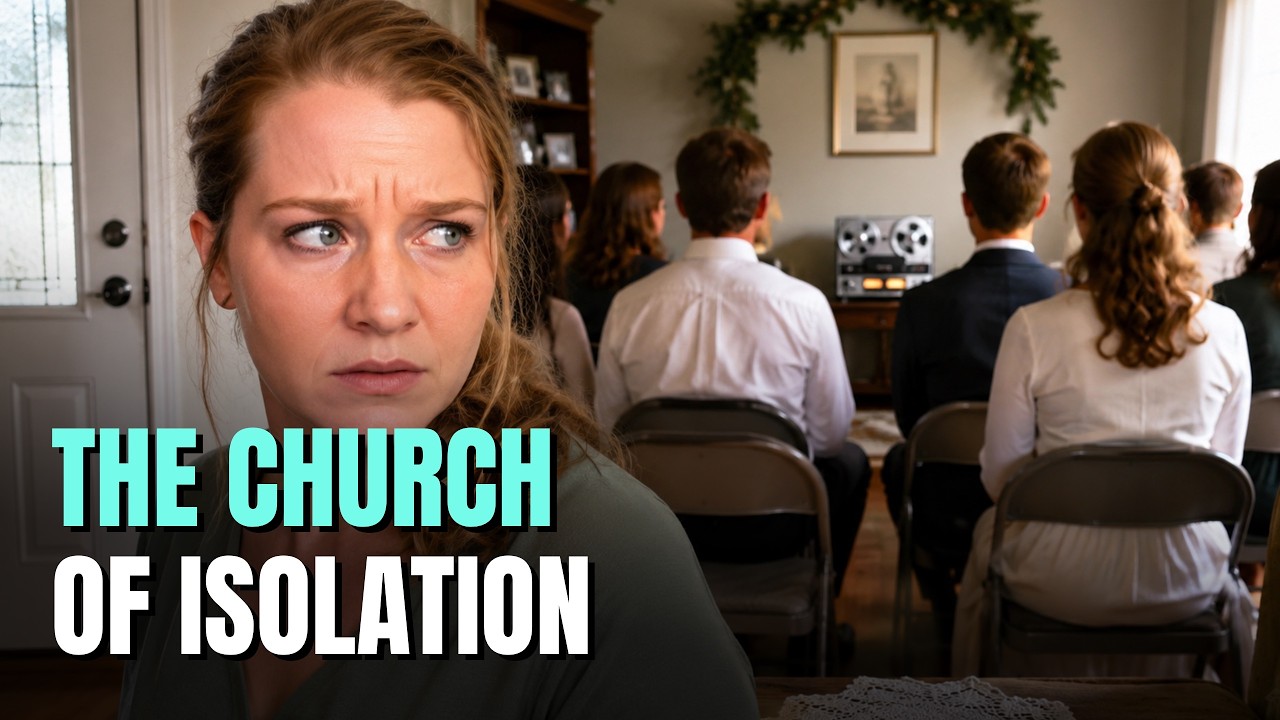
🔗 **Source:** [Church of Isolation: Why We Thought Separation Made Us Special](https://www.youtube.com/watch?v=lA1qplmZ1no)
> [!note]+ Document Notes
> tags: [religious-deconstruction, high-control-groups, spiritual-abuse, oral-history, branhamism, tape-home-church, religious-isolation, exit-narratives]
> author: Leaving the Message
> source: YouTube — Leaving the Message
> reference: https://www.youtube.com/watch?v=lA1qplmZ1no
> date created: 2026-09-03 08:51
>
> > [!info] Generated analysis — not the author's words. Sections below are machine-written
> > from the captured source. Only text inside `> [!quote]` blocks is verbatim from the author.
> > Do not quote or attribute any other line to the named author.
>
> > [!warning] Re-upload of a clip already in this vault
> > The auto-caption transcript of this video is **word-for-word identical** (1,560 words, 100% eight-word-sequence overlap, checked programmatically) to "How Brainwashing Felt Normal When You Were Born Into It" (YouTube 1IemxRBZsqo, published 2026-09-01, deep-read the same day as Reader doc `01m1fjjdr0d4r4kvme1afecbyz`). Same 8:20 runtime, same channel. Both uploads are still playable, so this is a second title on the same footage, not a replacement. The analysis below is that note re-anchored to this document with a new title, timestamped segments from this capture's caption spans, and the channel facts that settle the movement identification. Nothing new was invented to fill 18 sections; read the earlier note's atoms as the canonical ones and treat this doc as the alias.
> > **Movement now confirmed, not inferred.** The 2026-09-01 note identified "the Message" as the William Branham tape ministry from internal evidence. This upload's description links william-branham.org and patreon.com/branham, which settles it.
> > **No scripture is cited.** "The bride" and "more revelation" are Message vocabulary, not references; nothing to verify.
>
> > [!warning] Auto-captioned; speakers unnamed
> > Verified: this video has **no manual subtitle track** — English auto-captions only. Speaker changes
> > appear as bare `>>` with no names, so attributing any line to a specific person is guesswork.
> > Quotations below are reconstructions; check the audio before publishing any of them.
>
> # 🏷️ Title: Church of Isolation: Why We Thought Separation Made Us Special
>
<!-- deep-read:sections start -->
## 🧭 Table of Contents
- [📝 Summary](#-summary)
- [📖 Main Content](#-main-content)
- [🗒️ Notes](#️-notes)
- [📚 References](#-references)
- [🗣️ Paraphrase](#️-paraphrase)
- [📰 Newsletter](#-newsletter)
- [✅ Action Items](#-action-items)
- [🧪 Hypotheses](#-hypotheses)
- [📊 Methodology](#-methodology)
- [❓ Questions](#-questions)
- [🔮 Future Research](#-future-research)
- [💡 Implications](#-implications)
- [🧠 Learning Styles Assessment](#-learning-styles-assessment)
- [📊 Accessibility Assessment](#-accessibility-assessment)
- [🌍 DEIB Assessment](#-deib-assessment)
- [✅ Logical Validity](#-logical-validity)
- [🛡️ DARVO Analysis](#-darvo-analysis)
- [🎯 Conclusion](#-conclusion)
### 🔗 References
- Source: https://www.youtube.com/watch?v=lA1qplmZ1no (8:20, published 2026-09-02, 772 views at capture, channel "Leaving the Message")
- Same footage, first upload: https://www.youtube.com/watch?v=1IemxRBZsqo ("How Brainwashing Felt Normal When You Were Born Into It", published 2026-09-01, 2,345 views, still playable). Reader doc `01m1fjjdr0d4r4kvme1afecbyz`, deep-read 2026-09-01.
- Channel description links william-branham.org, patreon.com/branham, and the host's book *Weaponized Religion: From Christian Identity to the NAR* (Amazon paperback 1735160962 / Kindle B0DCGGZX3K).
## 📝 Summary
**What this is.** Two people who grew up in "the Message" talk about what the inside felt like — specifically about *tape home church*, the practice of dressing for Sunday service, setting up chairs in someone's living room, singing, and then pressing play on a recorded sermon. One host has been out for some time; the guest is newly out.
**Which movement.** The transcript never names it, so this is an identification from evidence rather than a stated fact: "the message," sermons on tape from "the 1940s, 50s and 60s," "we're called to be the bride," "we're called to get more revelation," and a strong anti-denominational elitism together point to the movement built around **William Branham's recorded ministry** (Branham died in 1965, which matches the tape era). Treat that as a well-supported inference, not something the speakers say.
**The insight worth keeping.** The guest describes moving between congregations and changing dress, behaviour, and permitted activity each time — and not finding it strange. *"Looking back, you know, I should have been a lot more confused than I was. I guess that's part of the brainwashing."* The evidence of formation is not that the doctrine was consistent. It is that the inconsistency produced no friction.
**The structural observation.** Isolation was not experienced as isolation. It was experienced as election: *"we are elite. You know, we have our own path... we're called to be the bride and we stick to ourselves."* Outreach was viewed negatively. The guest's exit begins not with a doctrinal objection but with a comparative one — visiting other churches, seeing community work, and asking *why don't we do that?*
**The methodological note the host makes explicitly.** Newly-out perspective is different from long-out perspective, and it decays: *"the way that the brainwashing, the mind control works, you don't even realize what is happening to you as it begins to unravel."* So the conversation is deliberately framed as capturing something before it becomes inaccessible to the person who has it.
**Bottom line.** Short, warm, and analytically sharper than it presents itself. Its real contribution is the observation that unnoticed contradiction is the artifact to look for — which transfers well beyond religion.
## 📖 Main Content
**The texture of normal.** The conversation opens on scale — two-and-a-half hour sermons through childhood, unremarkable at the time. *"You're just going with the flow basically. You're not questioning things."* The guest's retrospective puzzlement is not about the length but about the mutability: families would relocate and reconfigure themselves around a new congregation, changing how they dressed, how they acted, what was permitted and forbidden, and then do it again somewhere else. Total conformity to two mutually inconsistent regimes, without the inconsistency registering.
**Tape home church.** The host raises the topic explicitly to get it on record, noting that outsiders find it unintelligible. Both describe the same practice. Get up early, clean the house, eat, dress fully — *"just like we were going to walk out the door and go to church."* People arrive. Chairs are arranged in the living room. Someone plays piano; everyone sings. Then a recorded sermon is played. Sometimes there is live preaching too, but the tape is the centre. Songs again, fellowship, food if someone cooked, and home.
**The seclusion argument.** The host frames the contrast sharply: an ordinary congregation gathers partly to be present in a place — outreach, community, the church as a site of local good. Tape home church is the inverse. *"To sit in seclusion in your home where you can't have any impact on the community whatsoever and press play on a tape from the 1940s, 50s and 60s."* He reaches for *WandaVision* as the analogy — someone maintained inside a reconstructed past, a black-and-white world — and notes the recurring fantasy and horror trope of a person stuck in a bygone mindset. The literal point underneath is that the sermons described events predating the listener's birth.
**Why the seclusion held.** The guest offers a causal account rather than only a description. Exploration was discouraged; visiting a denominational church was suspect; growth and outreach were "negatively looked on." The compensating frame was chosenness: *"we are elite... we have our own path. That's not what we're called to do. We're called to get more revelation... we're called to be the bride."* Small and separate was not a deficiency to be explained away but the ideal state — *"we're not involved with the outside world... I think it's kind of a good thing in their eyes."*
**Where the questioning starts.** Notably, not with doctrine. The guest had already drifted "out into the world," began visiting other churches, and saw the difference in community involvement. The question that formed was practical and moral: *"why are we elite? why aren't we helping people? why aren't we doing more outreach?"* — especially against a movement that "preached all day long, save those souls." The gap that opened was between stated mission and observable behaviour.
**A caveat the guest supplies themselves.** They repeatedly scope their claims — "most of the churches that I went to," "at least it wasn't at most of the churches that I went to for any amount of time." That is careful testimony, and worth crediting: they decline to generalize to the whole movement from their own sample.
### 🗒️ Notes
Segmented by conversational movement; timestamps from this capture's caption spans (the channel's own chapter list matches within a few seconds).
#### ⏱️ [00:00](https://www.youtube.com/watch?v=lA1qplmZ1no&t=0) Scale as normal
Two-and-a-half hour sermons throughout childhood. Unremarked at the time — "you're just going with the flow."
#### ⏱️ [00:20](https://www.youtube.com/watch?v=lA1qplmZ1no&t=20) The mutability that should have registered
Moving between churches meant changing dress, behaviour, and permissions wholesale. *"I should have been a lot more confused than I was. I guess that's part of the brainwashing."*
#### ⏱️ [01:00](https://www.youtube.com/watch?v=lA1qplmZ1no&t=60) Total investment
Read all the books, listened to all the tapes, fell asleep to tapes, took notes every service, read the Bible through. *"Never never occurred to me that anything was wrong."*
#### ⏱️ [01:33](https://www.youtube.com/watch?v=lA1qplmZ1no&t=93) The host's framing of the recording's purpose
Newly-out perspective differs from long-out perspective and degrades as one shifts — so capturing it now documents the process from inside.
#### ⏱️ [02:09](https://www.youtube.com/watch?v=lA1qplmZ1no&t=129) Tape home church, described
Sunday clothes, cleaned house, chairs in the living room, piano and singing, press play on a recorded sermon, sing again, fellowship. Sometimes live preaching alongside.
#### ⏱️ [04:17](https://www.youtube.com/watch?v=lA1qplmZ1no&t=257) Seclusion versus outreach
Contrast drawn with congregations oriented toward community work — homeless ministry named as an example from the family's current church. *WandaVision* invoked for the stuck-in-the-past dynamic.
#### ⏱️ [06:01](https://www.youtube.com/watch?v=lA1qplmZ1no&t=361) Isolation experienced as election
Exploration discouraged, denominational visits suspect, outreach negatively viewed. Compensating frame: elite, own path, more revelation, the Bride, keep to ourselves.
#### ⏱️ [07:01](https://www.youtube.com/watch?v=lA1qplmZ1no&t=421) The exit question
Formed comparatively, not doctrinally: why the mission language without the corresponding action? Guest scopes the claim to churches they personally attended.
## 📚 References
**Citation audit: the document contains zero links** — verified by extracting every `<a href>` from the stored HTML (0 matches). Expected for a YouTube transcript capture, but it means nothing here is followable from the source.
**Named within the source:**
- *WandaVision* — invoked as an analogy for a person maintained inside a reconstructed past.
- "The message" — the movement, referred to only by that name.
- No people are named. Neither speaker identifies themselves or the other in the captured transcript.
**Not cited by the source, supplied here as context — and flagged as inference:**
The combination of "the message," recorded sermons from the 1940s–60s treated as the service, "the Bride," "more revelation," and anti-denominational elitism identifies this as the movement surrounding **William Branham** (1909–1965) and his tape ministry. The speakers never say so. This identification is offered because it makes the rest legible, and it should be verified against the channel's own description before being repeated as fact.
**Worth reading against this, none of it referenced in the video:**
- The academic literature contests "brainwashing" as a causal model — Eileen Barker, James Richardson, and Massimo Introvigne argue for gradual commitment and exit processes rather than a coercive-persuasion mechanism. This does not invalidate the speakers' use of the word; see Methodology.
- Steven Hassan's BITE model is the framework most ex-members actually reach for, and it maps closely onto what is described here (behaviour, information, thought, and emotional control).
## 🗣️ Paraphrase
**On what was ordinary.** Sitting through two-and-a-half hour sermons was simply what childhood was. At that age you go with the flow; you do not question. What is strange in retrospect is not the length but the switching — a family would move, reshape everything about how they dressed and behaved to fit one congregation, then move again and reshape everything differently. None of it produced confusion at the time. The guest's own reading of that is that the absence of confusion is itself what the formation accomplished.
**On how complete the investment was.** All the books read, all the tapes listened to, tapes playing while falling asleep, notes taken at every service, the whole Bible read through. It never occurred to them that anything was wrong. Looking back from outside, the extent of it is what startles.
**On why this conversation is happening now.** The host points out that the guest is newly out, and that this perspective is genuinely different from his own — because the way the conditioning works, you cannot see it clearly while it is coming apart. Recording it now captures something that will not be available later.
**On tape home church.** In small towns without a congregation, church happened in a living room. Everyone got up early, cleaned, ate, and dressed exactly as if leaving for a service — hair done, suit and tie. People arrived, chairs were set out, someone played piano and everyone sang. Then a recorded sermon was played. Sometimes there was live preaching as well. More singing, then fellowship and food. Both speakers note how incomprehensible this looks from outside.
**On what was lost in it.** An ordinary congregation, the host argues, gathers partly to do something where it is — build community, help locally. This was the reverse: sitting apart in a house with no possible effect on the surrounding town, listening to a recording made decades before anyone in the room was born.
**On why it felt right.** The guest's account is that separation was taught as status. Exploring elsewhere was discouraged; visiting a denominational church was suspect; outreach was regarded poorly. What replaced it was chosenness — we are elite, we have our own path, we are called to more revelation, we are the Bride, we keep to ourselves. Smallness and disconnection were the ideal, not a problem.
**On what broke it.** Not an argument about doctrine. Having already moved away somewhat, the guest visited other churches and saw sustained community involvement. The question that formed was why a movement that preached constantly about saving souls did so little for anyone outside it. They are careful to add that this describes the churches they personally attended, over the time they attended them.
## 📰 Newsletter
*Routing note: Robertson's Home (faith writing), not courtneyr.dev.*
**The thing to notice isn't the weird part**
There's a short conversation up on Leaving the Message this week (posted twice, under two titles, a day apart) between someone who's been out a while and someone who just got out. Most of it is about *tape home church* — dressing in your Sunday best, cleaning the house, arranging chairs in the living room, singing with the piano, and then pressing play on a sermon recorded in the 1950s. [It's eight minutes](https://www.youtube.com/watch?v=lA1qplmZ1no).
The strangeness is easy to see from outside and both speakers know it. That's not the useful part.
The useful part is one sentence: *"Looking back, I should have been a lot more confused than I was."*
She's describing how her family would move towns, join a congregation, and reorganize everything — how they dressed, how they behaved, what was allowed — and then move again and reorganize differently. Two incompatible sets of rules, adopted completely, back to back. And it produced no friction at all.
That's the diagnostic. Not "were the beliefs true." Not even "were they harmful." **Did contradiction register?** A system that's holding you doesn't need to be internally consistent — it needs you not to notice when it isn't. Which means the artifact to look for, when you're examining anything you were formed inside, is the place where you should have been confused and weren't.
The other thing worth sitting with: nobody in that world experienced isolation as isolation. It arrived as election — *we are elite, we have our own path, we're called to be the Bride, we stick to ourselves.* Outreach was looked down on. That's an elegant piece of engineering, whether or not anyone designed it: the cost is reframed as the privilege, so the thing that should prompt the question becomes the thing that answers it.
And note where her questioning actually started. Not with doctrine. She visited other churches, saw them running actual community programs, and asked why a movement that preached constantly about saving souls wasn't doing any of it. The gap that opened was between stated mission and observable behaviour — which is, I'd argue, where most of these gaps open.
One caution on the word "brainwashing." Both speakers use it, and it's doing honest descriptive work for them — it names something real about not being able to see the process from inside. Sociologists of religion have argued for decades that it's a poor *causal* model, and that exits and entries look more like gradual commitment than a switch being flipped. Both things are true. Take the description seriously and hold the mechanism loosely.
## ✅ Action Items
#### DevRel
- **#action/h3** — Not applicable to this source.
#### OSPO
- **#action/h2** — "Isolation experienced as election" is a real pattern in technical communities too: a project that frames its inaccessibility as rigour, or its small size as purity, has the same self-sealing structure. Worth holding when assessing project health.
#### Community
- **#action/h1** — The diagnostic transfers directly: *where should members have found something contradictory and did not?* Unnoticed inconsistency is a stronger signal about a community's grip than stated satisfaction is.
- **#action/h2** — Note the exit trigger: a gap between stated mission and observable behaviour, noticed by comparison with a peer group. Communities that discourage members from participating elsewhere remove the comparison that would surface that gap.
#### WordPress
- **Core** — **#action/h3** Not applicable.
- **Core Performance** — **#action/h3** Not applicable.
- **Core AI** — **#action/h3** Not applicable.
- **Core Program Team** — **#action/h3** Not applicable.
- **Mobile** — **#action/h3** Not applicable.
- **Playground** — **#action/h3** Not applicable.
- **Community** — **#action/h2** See Community above; the "discouraging outside participation removes the comparison class" mechanism is directly relevant to how contributor communities relate to adjacent ecosystems.
- **Training** — **#action/h3** Not applicable.
- **Marketing** — **#action/h3** Not applicable.
- **Support** — **#action/h3** Not applicable.
- **Design** — **#action/h3** Not applicable.
- **Documentation** — **#action/h3** Not applicable.
- **Photos** — **#action/h3** Not applicable.
- **TV** — **#action/h2** Relevant as caption practice: this is a two-speaker conversation with auto-captions and bare `>>` speaker changes, which makes it substantially harder to follow for caption-dependent viewers. Speaker labels are cheap and matter most in dialogue.
- **Polyglots** — **#action/h3** Not applicable.
- **Accessibility** — **#action/h2** Good teaching case for why unlabeled speaker changes in multi-voice content is an accessibility problem, not a style preference.
- **Meta** — **#action/h3** Not applicable.
- **CLI** — **#action/h3** Not applicable.
- **Hosting** — **#action/h3** Not applicable.
- **Tide** — **#action/h3** Not applicable.
- **Openverse** — **#action/h3** Not applicable.
- **Themes** — **#action/h3** Not applicable.
- **Plugins** — **#action/h3** Not applicable.
#### The WPOCC
- **#action/h3** — Not applicable to this source.
### FAIR
- **#action/h3** — Not applicable to this source.
#### Personal / faith
- **#action/h1** — Apply the diagnostic to your own NAR formation: not "what did I believe that was false," but **where should I have been confused and wasn't?** The mutability the guest describes — different rules at different churches, adopted without friction — is worth looking for specifically.
- **#action/h2** — Note the structural parallel: NAR and the Message both carry Latter Rain–adjacent restorationism, "more revelation," and an elect-remnant frame. The isolation-as-election mechanism is likely shared even though the movements differ.
- **#action/h3** — Hold "brainwashing" as description, not mechanism, when writing about this; the sociological literature contests the causal model without contesting the experience.
- **#action/h3** — Possible Robertson's Home piece: the exit that starts from a mission/behaviour gap rather than a doctrinal one.
## 🧪 Hypotheses
1. **Unnoticed contradiction predicts depth of formation better than stated conviction does.** Testable by asking former members of high-control groups to recall rule changes and rating whether the change registered at the time.
2. **Isolation framed as election is more durable than isolation framed as protection.** Election converts the cost into a benefit; protection leaves it a cost. Testable across group ideologies with differing rationales for separation.
3. **Exits triggered by mission/behaviour gaps precede exits triggered by doctrinal disagreement.** The guest's sequence — leave socially, observe comparison, then question — suggests behavioural noticing comes first. Testable against ex-member exit narratives.
4. **Discouraging participation in adjacent groups is the load-bearing control**, because it removes the comparison class that makes the gap visible. Testable by whether groups permitting outside contact show earlier average exits.
5. **Mediated authority (recorded sermon) reduces local accountability more than absent authority does.** A tape cannot respond to its congregation, so it forecloses the feedback a live preacher faces. Testable by comparing doctrinal drift in tape-based versus live congregations.
6. **The newly-out perspective decays measurably within months.** The host asserts this explicitly; testable by longitudinal re-interview of the same person.
### 📊 Methodology
**Genre: oral history / peer testimony, and it should be evaluated as testimony.** There is no claim to representativeness, no sampling, and no data. Two people describe what they experienced. The right questions are whether the account is internally coherent, appropriately scoped, and honest about its limits — not whether it generalizes.
**On those terms it does well.** The guest repeatedly scopes claims to their own experience — "most of the churches that I went to," "at least it wasn't at most of the churches that I went to for any amount of time." That is careful, and it is the kind of hedge testimony often omits. The host explicitly marks that the guest's newly-out perspective differs from his own, which is a recognition that neither is the authoritative account.
**The methodological insight is genuinely good.** Framing the recording as capturing a perspective before it becomes inaccessible treats memory as perishable and situated. That is a real oral-history instinct, arrived at from inside the experience rather than from training.
**The term doing the most work is the least examined.** "Brainwashing" and "mind control" are used as explanations — *"I guess that's part of the brainwashing"* — and in that role they risk being unfalsifiable, since any behaviour, including the failure to notice anything wrong, can be attributed to them. The sociology of religion has argued since the 1980s (Barker, Richardson, and later Introvigne) that coercive-persuasion models poorly describe entry and exit, which look more like gradual commitment. **This does not diminish the testimony.** The speakers are describing something real — the inability to perceive a process from inside it — and reaching for the vocabulary their community uses. The honest reading is: strong as description, weak as causal mechanism, and the video makes no claim to be offering a mechanism.
**What is missing, unavoidably.** No perspective from anyone still inside; no numbers on how common tape home church was; no dates, locations, or named congregations. This is one conversation, and it presents itself as one conversation.
### ❓ Questions
- **Which movement, stated rather than inferred?** The evidence strongly indicates the Branham tape ministry, but the speakers never name it, and my identification should be checked against the channel's own framing.
- **How widespread was tape home church?** Both speakers treat it as recognizable-to-insiders and baffling-to-outsiders, but there is no sense of scale.
- **What did the tapes' content do over time?** Sermons about events predating the listeners' birth were the weekly diet — with what cumulative effect on how the present was understood?
- **Was the discouragement of outreach explicit doctrine or emergent culture?** The guest hedges: *"even if the pastors don't realize it."* That distinction matters for whether it was designed or self-organizing.
- **What happened to the piano?** A small thing, but the musical apparatus was fully reproduced in the living room while the preaching was outsourced to a recording. Which parts of worship had to be live, and why those?
- **Does the newly-out perspective actually decay?** The host asserts it. It is testable and, if true, has real consequences for how ex-member testimony should be collected.
### 🔮 Future Research
- **Systematic oral-history collection at the point of exit**, given the host's claim that the perspective is perishable. This video is an instance of the method; nobody appears to be doing it at scale.
- **Comparative study of mediated versus live religious authority** — tape, radio, broadcast, streamed — and effects on local doctrinal accountability.
- **Trace the Latter Rain lineage** connecting the Message and the New Apostolic Reformation, to establish whether the isolation-as-election mechanism is inherited or convergent.
- **Read the ex-member literature against this**: Hassan's BITE model as the practitioner framework, and the Barker/Richardson/Introvigne critique as the academic counterweight, to see which better describes the account given here.
- **Womanist and feminist analyses of high-control religious formation**, largely absent from popular deconstruction content and relevant given how much of the described labour (house cleaning, dress, hair, piano) fell to women.
- **Measure whether groups permitting outside religious contact show earlier average exit**, which would test the comparison-class hypothesis directly.
### 💡 Implications
**Practice.** The transferable diagnostic is *look for unnoticed contradiction, not for false belief*. For anyone examining a formation they were inside — religious, corporate, political — the productive question is where the rules changed without producing friction.
**Policy.** For churches and organizations receiving people leaving high-control groups: the account suggests the first thing that opens is a mission/behaviour gap, noticed by comparison. Congregations that visibly do local work are legible to someone in that position in a way that doctrinal argument is not.
**Security.** Not applicable in the technical sense. The adjacent point is that information control — discouraging contact with comparison groups — is the load-bearing mechanism here, which is a recognizable pattern in any closed information environment.
**Education.** A useful short artifact for teaching how formation works from the inside, precisely because it is descriptive rather than polemical. Pair it with the academic critique of the brainwashing model so students get both the experience and the contested mechanism.
**Funding.** Not applicable, though it is worth noting this is unfunded peer testimony doing work that no institution is currently doing — capturing exit narratives at the moment of exit.
### 🧠 Learning Styles Assessment
**Estimated reading level of the transcript:** roughly grade 8–9. The language is plain, conversational, and unhedged by jargon. The one demanding element is insider vocabulary used without explanation — "the message," "the Bride," "more revelation," "tape home church" — which the speakers explicitly acknowledge will baffle outsiders.
#### 👀 Visual learners
**Poorly served.** This is two people talking. The one visual affordance is the *WandaVision* reference, which does real work — a black-and-white world maintained around someone — but it is borrowed rather than shown. A photograph of a living room set up with chairs would communicate more than the several minutes spent describing one.
#### 🔊 Aural learners
**Very well served — the native channel.** Two voices, laughter, interruption, shared recognition. The conversational texture *is* the content; the affect around "that's so strange" carries meaning the words alone do not.
#### 🗣️ Verbal learners
**Well served.** The key insight arrives as a precise verbal formulation — "I should have been a lot more confused than I was" — and the speakers are good at finding the phrase that names an experience.
#### 🧩 Kinesthetic learners
**Unexpectedly well served.** The tape-home-church account is procedural and embodied: get up early, clean the house, eat, dress, do hair, arrange chairs, play piano, press play. It is described as a sequence of physical actions, which makes an alien practice concrete.
#### 🧠 Logical learners
**Moderately served, with one gap.** There is a real causal argument — isolation is sustained by an elitism frame, and questioning begins when a comparison class becomes available. But "that's part of the brainwashing" functions as an explanatory terminus rather than a mechanism, which a logically-minded listener will notice.
#### 🧑🤝🧑 Social learners
**Extremely well served — the strongest channel.** The format is the point. Two people discovering shared reference points in real time ("I've waited to have somebody else who did this like me"), with the recognition itself doing therapeutic work. The content is inseparable from the fact that it is a conversation rather than a monologue.
#### 🧘♀️ Solitary learners
**Well served.** Short, self-contained, and undemanding — an eight-minute listen that requires no preparation.
#### 🌿 Naturalistic learners
**Not served, and a genuine absence.** Small towns, moving between them, houses and living rooms — the material is thoroughly placed, but place never becomes a subject. The rural geography that made tape home church necessary in the first place goes unexamined, and it is arguably causal.
### 📊 Accessibility Assessment
Assessed against WCAG 2.2 Level AA as applicable to published video.
#### Screen reader semantics
**Not applicable to the video asset**; the player is YouTube's. No on-screen text is described in the transcript, so there is no evident text-alternative gap of the kind slide-based content creates.
#### Keyboard navigation
**Not applicable to the source**; inherited from the platform. **SC 2.1.1** is YouTube's.
#### Contrast and readability
**Not assessable from the transcript.** Would require frame inspection against **SC 1.4.3**. Flagged unassessed rather than passed.
#### Text resizing and reflow
**Largely moot.** The content is speech, not displayed text, so **SC 1.4.4** and **SC 1.4.10** have little to bite on.
#### Media and captions
**Two defects, both verified.** First: **no manual subtitle track exists** — confirmed by querying available subtitles, which returned English *automatic* captions only and reported the video "has no subtitles." **SC 1.2.2 Captions (Prerecorded)** is therefore not properly met; auto-captions are the default, not an authored track. Second, and more consequential for this format: **speaker changes are marked only as bare `>>` with no names.** In a two-person conversation where the whole point is the difference between a long-out and a newly-out perspective, a caption-dependent viewer cannot reliably tell who is speaking — which degrades not just fidelity but the argument itself. The captions do usefully mark non-speech sounds (`[laughter]`, `[music]`), which is a partial credit.
#### Forms and interactions
**Not applicable.** No forms or interactive controls in the source.
#### Standards reference
WCAG 2.2 Level AA. **Not met:** 1.2.2 — auto-captions only, and unlabeled speaker changes in multi-voice content. **Not applicable / moot:** 1.4.4, 1.4.10, 1.1.1. **Unassessed:** 1.4.3. The cheap high-value fix is an authored caption track with speaker labels.
### 🌍 DEIB Assessment
#### Cultural breadth
**Narrow by design, and appropriately so.** This is insider testimony about one specific North American religious subculture, and it does not claim otherwise. The speakers explicitly flag that outsiders will find the practice unintelligible, which is an act of translation rather than an assumption of shared context. What is missing is any sense of whether the movement or the practice exists outside that setting.
#### Inclusive language
**Plain and non-derogatory toward people, including those still inside.** Notably, the guest declines to attribute bad intent to leadership — *"even if the pastors don't realize it"* — which distinguishes structural critique from personal condemnation. That restraint is meaningful in a genre that often does the opposite. "Brainwashing" is applied to the process and to themselves, not wielded against individuals still in the movement.
#### Neurodiversity support
**Mixed.** Short and conversational, which helps. Working against it: heavy unexplained in-group vocabulary, a rambling structure the host himself flags twice ("another squirrel," "sorry for the rabbit trail"), and meaning that often depends on reading tone — laughter and snorts carrying the judgment rather than the words. Literal processors will get less than the audio conveys.
#### Representation
**Two voices from within one tradition; no external or dissenting perspective.** That is legitimate for oral history. Worth observing, though, that the labour described — cleaning the house, doing hair, dressing the family, playing piano — is overwhelmingly women's work in the account, and the video does not remark on it. The gendered division that made tape home church possible passes without comment, which is a missed thread given one speaker appears to be a woman describing exactly that work.
#### Psychological safety
**Genuinely good, and structurally so.** The conversational format creates the safety: the host's disclosure of his own tape-home-church experience precedes and licenses the guest's. *"I've waited to have somebody else who did this like me"* names the isolation of not having anyone who shares the reference. Nobody is pressed, laughter defuses rather than mocks, and the guest is allowed to hedge. For a viewer newly out and encountering this, the register models that recognition is available — which for this audience is most of the value. The one caution is that "brainwashing" applied to one's own past self can be self-diminishing; here it is used matter-of-factly rather than shamefully, which mitigates it.
### ✅ Logical Validity
#### Strong reasoning
- **The central observation is genuinely sharp.** Treating the *absence* of confusion as the evidence — rather than the content of the beliefs — locates the phenomenon correctly. Contradiction that produces no friction is a better indicator of formation than doctrinal error is.
- **Claims are properly scoped.** "Most of the churches that I went to," "at least it wasn't at most of the churches that I went to for any amount of time." The guest repeatedly refuses to generalize beyond their sample.
- **Intent is separated from effect.** *"Even if the pastors don't realize it"* allows the structure to be criticized without requiring anyone to have designed it maliciously — a more defensible and more interesting claim.
- **The exit account is causal and specific.** Comparison class becomes available → mission/behaviour gap becomes visible → question forms. That is a mechanism, not just a narrative.
- **Perspective limits are acknowledged.** The host names that the guest's newly-out view differs from his own rather than treating either as definitive.
#### Fallacies
- **Unfalsifiable explanatory terminus — #fallacy/unfalsifiable.** *"I guess that's part of the brainwashing"* is offered as the explanation for the absence of confusion. Because the concept can absorb any observation — noticing, not noticing, leaving, staying — it cannot be tested, and it stops the inquiry exactly where the interesting question begins. The speakers are using community vocabulary for a real experience rather than advancing a theory, so this is a soft finding. **Fix:** the mechanism they actually describe elsewhere — removal of the comparison class — is testable and does the explanatory work better.
- **Idealized comparison class — #fallacy/false-dilemma.** The host's contrast is between tape home church and *"a normal Christian who goes to church on Sunday"* characterized by outreach, community building, and helping the homeless. That is the good case, not the average one; plenty of conventional congregations are inward-facing too. The contrast is rhetorically effective and somewhat overdrawn. **Fix:** the point survives intact as "congregations that are present in their communities," without the implication that this is what normal means.
- **Hasty generalization, largely pre-empted — #fallacy/hasty-generalization.** Claims about what "the message" teaches derive from two people's experience of the congregations they attended. Flagged for completeness rather than as a real charge: the guest hedges nearly every such claim explicitly, which is more care than the genre usually shows.
#### Tone of voice
Warm, informal, and mutually recognizing — laughter, interruption, self-deprecation about digressions. The register is two people comparing notes rather than a testimony delivered to an audience, and that is the source of its credibility: nobody is performing outrage. The risk is that the same informality makes the analytically sharpest moment — the observation about unnoticed contradiction — pass in a few seconds, unmarked, between jokes about Sunday clothes.
### 🛡️ DARVO Analysis
**Not applicable to this source, though the concept is adjacent to the subject matter.**
- **Deny** — Nothing is denied. The speakers are describing their own past rather than defending against an accusation.
- **Attack** — No individual is attacked. The guest explicitly withholds attribution of intent to leadership — *"even if the pastors don't realize it"* — criticizing the structure while declining to indict the people running it.
- **Reverse victim and offender** — Absent. Neither speaker claims victim status rhetorically, and neither casts anyone as an aggressor; the register is descriptive throughout.
**Worth recording as adjacent rather than present:** DARVO is a well-documented institutional response *to* accounts like this one — leavers characterized as bitter, deceived, or spiritually compromised, with the institution positioned as the wronged party. Nothing of that appears here because no institutional response is included. If this channel's material ever draws a formal response from the movement, that response is where the pattern would be worth checking.
## 🎯 Conclusion
**Bottom line.** An eight-minute conversation carrying one genuinely portable idea: the artifact of formation is not false belief, it is contradiction that failed to register. Everything else here — the Sunday clothes, the chairs in the living room, the tape from 1953 — is texture around that observation.
**What holds up.** The diagnostic itself. The structural account of isolation experienced as election rather than as cost. The exit mechanism, which starts from a mission/behaviour gap made visible by a comparison class. Careful scoping of claims to personal experience. Separating structural effect from leadership intent. And the host's oral-history instinct that the newly-out perspective is perishable and worth capturing now.
**What does not.** "Brainwashing" functions as an explanatory terminus that cannot be falsified, and the video's own better mechanism — remove the comparison class and the gap stays invisible — is left implicit. The contrast case is the idealized outward-facing congregation rather than the average one. And the gendered labour that made tape home church run is described in detail and never remarked on.
**Next steps.**
1. Verify the movement identification against the channel's own description before repeating "Branham" anywhere — the transcript never names it and my reading is inference from evidence.
2. Apply the diagnostic personally: not *what did I believe that was false*, but *where should I have been confused and wasn't*. The mutability described here — different rules at different congregations, adopted without friction — is the specific thing to look for.
3. Hold "brainwashing" as description and not mechanism if any of this reaches published writing; the sociological critique contests the causal model without contesting the experience.
4. Do not quote from this note's `[!quote]` blocks without checking the audio — auto-captions only, and speakers are unlabeled.
## 🔄 Refactor Appendix — Church of Isolation: Why We Thought Separation Made Us Special
### 📚 Literature Atoms (H3)
#### [H1] The absence of confusion is the artifact
> [!quote] ID:rw_01m1kmx586z5b19heqkkg5zd37
> "We would move here and we would change so many things to conform to that church and then we would move to a different church and totally different thing... So looking back, I should have been a lot more confused than I was. I guess that's part of the brainwashing."
Two incompatible rule-sets adopted completely, back to back, producing no friction. The diagnostic question about any formation is not whether the beliefs were true but whether contradiction registered. A system holding you does not need to be consistent — it needs you not to notice when it isn't.
Tags: `#atom/literature/h1`
#### [H2] Isolation is sustained by being experienced as election
> [!quote] ID:rw_01m1kmx586z5b19heqkkg5zd37
> "It was we are elite. You know, we have our own path. That's not what we're called to do. We're called to get more revelation and we're called to be the bride and we stick to ourselves."
The cost is reframed as the privilege, so the thing that should prompt a question becomes the thing that answers it. Smallness and disconnection are the ideal state rather than a deficiency needing explanation — which makes the arrangement self-sealing without anyone having to enforce it.
Tags: `#atom/literature/h2`
#### [H2] The exit starts from a mission/behaviour gap, not a doctrinal one
> [!quote] ID:rw_01m1kmx586z5b19heqkkg5zd37
> "Why are we elite? Why aren't we helping people? Why aren't we doing more outreach?... because we preach all day long, save those souls, but the outreach isn't there."
Questioning began after a comparison class became available, not from an argument about belief. Which implies the load-bearing control is discouraging outside contact — it removes the comparison that would make the gap visible.
Tags: `#atom/literature/h2`
#### [H3] The newly-out perspective is perishable
> [!quote] ID:rw_01m1kmx586z5b19heqkkg5zd37
> "The way that the brainwashing, the mind control works, you don't even realize what is happening to you as it begins to unravel and as you begin to shift. So it's actually really fortunate that we're capturing this right now."
Supporting context, and a real oral-history instinct arrived at from inside the experience: the vantage point of someone mid-exit is different from the vantage of someone long out, and it does not survive the transition.
Tags: `#atom/literature/h3`
### 🧠 Permanent Candidates (H4)
#### [P1] Unnoticed contradiction measures formation better than stated belief
When examining any system you were shaped inside — religious, corporate, political, professional — the productive question is not which claims were false but where the rules changed without producing friction. Belief can be revised on evidence; the failure to register inconsistency is a property of the formation itself and is invisible from within by construction. Look for the moment you should have been confused and were not.
Links: [[Faith deconstruction]] · [[High-control groups]] · [[Testimony vs diagnosis]]
Tags: `#atom/zettel/z1`
#### [P2] A cost reframed as a privilege stops generating questions
Isolation described as election, scarcity described as rigour, exclusion described as standards: when a system's costs are presented as evidence of its superiority, the ordinary feedback loop is severed, because the very thing that would prompt scrutiny is what supplies the reassurance. This is why such arrangements need no active enforcement to persist, and why they are hardest to see from inside.
Links: [[Isolation as election]] · [[Community governance]] · [[Open source gatekeeping]]
Tags: `#atom/zettel/z1`
#### [P3] Removing the comparison class is the load-bearing control
Gaps between what an institution says and what it does become visible only against an alternative. Discouraging members from participating elsewhere — framed as loyalty, purity, or focus — is therefore more structurally powerful than any doctrinal claim, because it disables the mechanism by which every other claim could be checked. The tell is not what a group forbids you to believe but where it discourages you from looking.
Links: [[Information control]] · [[Exit mechanisms]] · [[Contributor communities]]
Tags: `#atom/zettel/z1`
### ✏️ Fleeting Queue
- The piano was live and the preaching was recorded. Which parts of worship *had* to be embodied, and what does that ranking reveal about where authority was located? `#atom/fleeting/f1`
- All the described labour — cleaning, hair, dress, piano, cooking — is women's work, described in detail by a woman, and never remarked on by either speaker. `#atom/fleeting/f1`
- NAR and the Message likely share Latter Rain roots. Is isolation-as-election inherited from a common source or convergently evolved? `#atom/fleeting/f1`
- A tape cannot respond to its congregation. Mediated authority forecloses the feedback loop a live preacher faces — worth developing separately from this note. `#atom/fleeting/f1`
- Nobody is collecting exit narratives at the moment of exit at any scale, and the host is right that the vantage decays. That is a fundable project. `#atom/fleeting/f1`
### → Things 3 (max 2 actions)
1. **Apply the unnoticed-contradiction diagnostic to your own NAR formation** — write down the places where rules changed and it produced no friction. That list is the actual data. `#action/h1`
2. **Verify the movement identification against the channel's description** before using "Branham" or "the Message" in any published writing; the transcript never names it. `#action/h2`
<!-- deep-read:sections end -->
📄 **Full text:** [[Full Document Contents/Articles/Church of Isolation Why We Thought Separation Made Us Special.md|Church of Isolation: Why We Thought Separation Made Us Special by Leaving the Message]]
## Highlights
- should have been a lot more confused ([View Highlight](https://read.readwise.io/read/01m1kn6zcm8fx7y7fea054bp0f))
- Note: H1 — The absence of confusion is the artifact: total conformity to two incompatible rule sets, back to back, produced no friction. Formation shows up as unnoticed contradiction, not as consistent doctrine. #atom/literature/h1
- Tags: atom/literature/h1
- whatsoever and press play on a tape from ([View Highlight](https://read.readwise.io/read/01m1kn72b594kppj72h8a8fby2))
- Note: H4 — Tape home church as the inverse of a congregation: dressed for service, chairs in a living room, a recorded 1940s–60s sermon, and no possible effect on the town outside. The host's WandaVision analogy for living inside a reconstructed past. #atom/literature/h4
- Tags: atom/literature/h4
- elite. You know, we have our own path. ([View Highlight](https://read.readwise.io/read/01m1kn6ftx57y1tsc68vdw75fk))
- Note: H2 — Isolation is sustained by being experienced as election: separation reframed as chosenness ("elite," "our own path," "the bride"), so the cost answers the question it should have raised. #atom/literature/h2
- Tags: atom/literature/h2
- why don't we do that in the message ([View Highlight](https://read.readwise.io/read/01m1kn6k2t3h07bfkzh2c71xfw))
- Note: H3 — The exit starts from a mission/behaviour gap, not a doctrinal objection: constant "save those souls" preaching next to zero outreach, seen only after visiting other churches. #atom/literature/h3
- Tags: atom/literature/h3