Claude Code Just Got a Brain Upgrade Inspired by Beads
> [!note]+ Document Notes
> tags: [claude-code, ai-development, task-management]
> author: AI Jason
> source: YouTube
> reference: https://www.youtube.com/watch?v=-xOAYPjhigY
> date created: 2024-12-19 10:30
>
> # 🏷️ Title: Claude Code Just Got a Brain Upgrade Inspired By Beads
>
<!-- deep-read:sections start -->
## 🧰 Action Inbox
- [H1] Upgrade to Claude Code v2.1.6+ — new task management features #upgrade
- [H2] Test multi-session task sharing — distributed development workflow #experiment
- [H3] Compare with beads and Ralph Wigum — choose right tool for project #evaluation
## 🧭 Table of Contents
- [📝 Summary](#-summary)
- [📖 Main Content](#-main-content)
- [🗒️ Notes](#️-notes)
- [📚 References](#-references)
- [🗣️ Paraphrase](#️-paraphrase)
- [📰 Newsletter](#-newsletter)
- [✅ Action Items](#-action-items)
- [🧪 Hypotheses](#-hypotheses)
- [📊 Methodology](#-methodology)
- [❓ Questions](#-questions)
- [🔮 Future Research](#-future-research)
- [💡 Implications](#-implications)
- [🧠 Learning Styles Assessment](#-learning-styles-assessment)
- [📊 Accessibility Assessment](#-accessibility-assessment)
- [🌍 DEIB Assessment](#-deib-assessment)
- [✅ Logical Validity](#-logical-validity)
- [🛡️ DARVO Analysis](#-darvo-analysis)
- [🎯 Conclusion](#-conclusion)
### 🔗 References
- [Claude Code](https://claude.ai/code)
- [Beads Tool](https://github.com/beads/beads)
## 📝 Summary
- Claude Code upgraded to-dos to a full task management system with JSON file storage
- Tasks can run in parallel with sub-agents and be shared across multiple sessions
- Inspired by the beads tool but works differently with multiple JSON files vs SQLite database
- Doesn't replace Ralph Wigum Loop for autonomous continuous improvement workflows
- Requires Claude Code v2.1.6+ and offers version control integration with GitHub
## 📖 Main Content
Claude Code has introduced a significant upgrade to its task management capabilities, transforming simple to-dos into a sophisticated system that stores each task as a separate JSON file. This enhancement enables parallel execution through sub-agents and allows multiple Claude Code sessions to share the same task list, making it particularly valuable for complex projects requiring coordination across multiple sessions.
The upgrade was inspired by the beads tool, which stores tasks in an SQLite database and syncs them to a JSONL file for version control. However, Claude Code's implementation differs by using multiple JSON files instead of a single database file.
While powerful, this system operates differently from the Ralph Wigum Loop philosophy. The new task management focuses on picking specific tasks from a list, whereas Ralph Wigum follows a continuous improvement approach guided by a northstar prompt. For autonomous workflows that continuously evolve projects beyond predefined tasks, the Ralph Wigum Loop may still be more appropriate.
## 🗒️ Notes
#### ⏱️ [00:00](https://youtu.be/-xOAYPjhigY?t=0) — [H1] Claude Code Upgrades To-Dos to Tasks
- Key idea: Major upgrade transforms simple to-dos into sophisticated task management
- Evidence: "Each task has its own JSON file that can be updated and committed to GitHub"
#### ⏱️ [00:15](https://youtu.be/-xOAYPjhigY?t=15) — [H2] Parallel Execution and Session Sharing
- Key idea: Tasks can run simultaneously and be shared across multiple sessions
- Evidence: "These tasks can run in parallel with sub agents and multiple Claude Code sessions can share the same task list"
#### ⏱️ [00:30](https://youtu.be/-xOAYPjhigY?t=30) — [H2] Ralph Wigum Loop Still Relevant
- Key idea: New system doesn't make Ralph Wigum Loop obsolete
- Evidence: "Does this make it obsolete? Not quite"
#### ⏱️ [00:45](https://youtu.be/-xOAYPjhigY?t=45) — [H2] Opus 4.5 Autonomous Capabilities
- Key idea: Newer models can run autonomously longer with better state tracking
- Evidence: "Ability to run autonomously for much longer, keeping track of its state better than other models"
#### ⏱️ [01:15](https://youtu.be/-xOAYPjhigY?t=75) — [H3] Context Window Limitations Still Apply
- Key idea: 200k context window still has smart and dumb zones
- Evidence: "It will output dumb results over the 80% mark"
#### ⏱️ [01:45](https://youtu.be/-xOAYPjhigY?t=105) — [H2] Beads Tool Inspiration
- Key idea: Beads tool directly inspired Claude Code's task management upgrade
- Evidence: "The beads tool is what greatly inspired the Claude code team to upgrade to-dos to this new task management system"
#### ⏱️ [02:30](https://youtu.be/-xOAYPjhigY?t=150) — [H1] Demonstration: XDL Tool Enhancement
- Key idea: Practical example using XDL tool for downloading X/Twitter videos
- Evidence: "Three major changes I want to add to a tool called XDL to help you download videos from X or Twitter using a CLI"
#### ⏱️ [03:00](https://youtu.be/-xOAYPjhigY?t=180) — [H3] Version Requirements
- Key idea: Requires Claude Code v2.1.6 or higher for task management
- Evidence: "You need to be on Claude Code version 2.1.6 or higher, which contains these task management related tools"
#### ⏱️ [03:30](https://youtu.be/-xOAYPjhigY?t=210) — [H2] Task Dependencies and Blocking
- Key idea: System handles task dependencies automatically
- Evidence: "It's added some dependencies. So tasks that are blocked by other tasks and it's put them here"
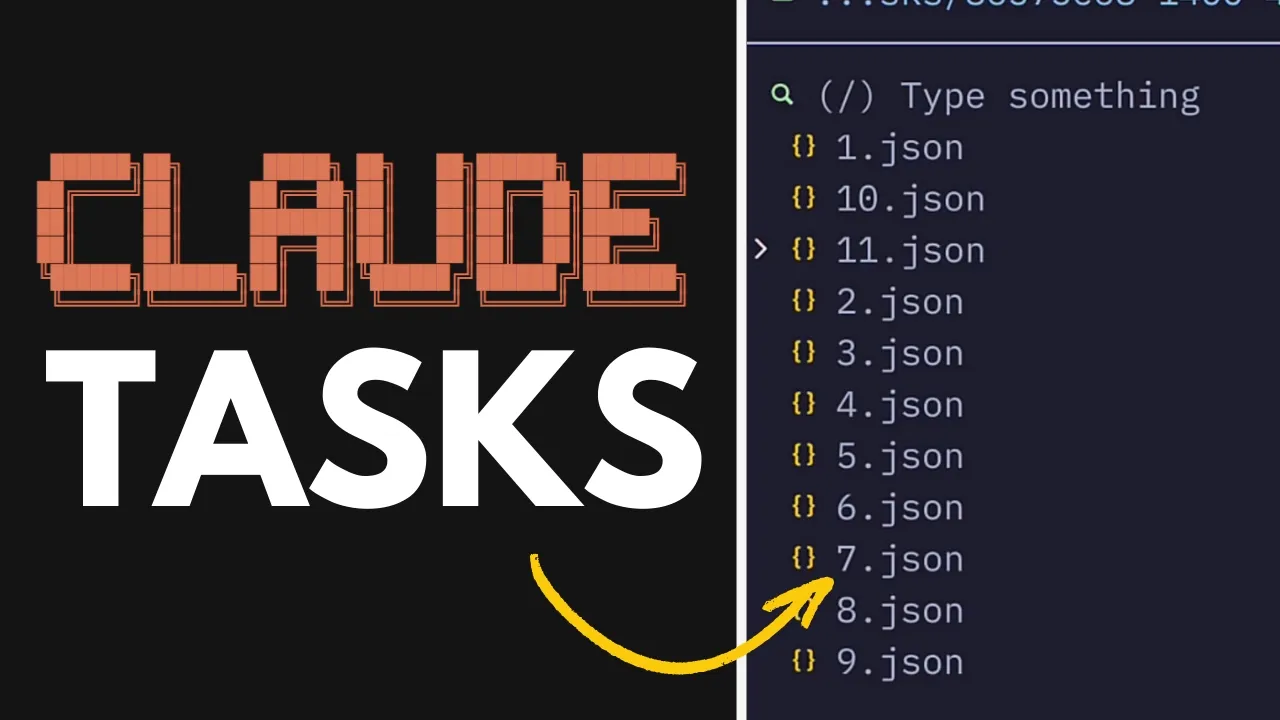
#### ⏱️ [04:00](https://youtu.be/-xOAYPjhigY?t=240) — [H2] JSON File Structure
- Key idea: Each task stored as individual JSON file with metadata
- Evidence: "All the tasks that have been created with an ID, subject, description, and what other tasks block this task"
#### ⏱️ [04:30](https://youtu.be/-xOAYPjhigY?t=270) — [H1] Sub-Agent Parallel Execution
- Key idea: Multiple sub-agents work on non-blocked tasks simultaneously
- Evidence: "Task one is being done, and so is task 8, 9, and 10 since they're not blocked by other tasks"
#### ⏱️ [05:00](https://youtu.be/-xOAYPjhigY?t=300) — [H3] Context Efficiency
- Key idea: Sub-agent approach dramatically reduces context usage
- Evidence: "Only 18% was used because all the tasks were done in sub agents"
#### ⏱️ [05:30](https://youtu.be/-xOAYPjhigY?t=330) — [H1] Multi-Session Task Sharing
- Key idea: Multiple Claude sessions can access same task list simultaneously
- Evidence: "Run this environment variable claude code task list ID and give it the ID that matches the directory of the task list I want to use"
#### ⏱️ [06:30](https://youtu.be/-xOAYPjhigY?t=390) — [H2] Version Control Integration
- Key idea: Tasks can be committed and shared across machines via GitHub
- Evidence: "You could start working on a task on one machine, stop, commit those tasks to GitHub... and then on another machine, pull those tasks and continue from exactly where you left off"
#### ⏱️ [07:15](https://youtu.be/-xOAYPjhigY?t=435) — [H2] Differences from Beads Tool
- Key idea: Claude Code uses multiple JSON files vs beads' SQLite database
- Evidence: "Beads stores the tasks in an SQLite database for very fast retrieval and it also syncs database tasks to a single JSONL file not multiple JSON files"
#### ⏱️ [08:00](https://youtu.be/-xOAYPjhigY?t=480) — [H2] Ralph Wigum Loop Philosophy Difference
- Key idea: Different approaches to task management and autonomy
- Evidence: "With the Ralph loop, you have a single prompt and you have a list of tasks... But with this new task management system, you have a list of tasks and you ask the model to go ahead and pick the next one"
#### ⏱️ [09:00](https://youtu.be/-xOAYPjhigY?t=540) — [H3] Autonomous Loop Limitations
- Key idea: New system not ideal for continuous autonomous improvement
- Evidence: "If you want an autonomous loop that can go for as long as you want where the model follows a northstar... then the new tasks management system isn't [suitable]"
## 📚 References
- [Claude Code](https://claude.ai/code)
- [Beads Task Management Tool](https://github.com/beads/beads)
- [Better Stack Error Tracking](https://betterstack.com)
## 🗣️ Paraphrase
- Claude Code has evolved from simple to-do lists to a comprehensive task management system where each task is stored as a separate JSON file, enabling version control integration and multi-session collaboration
- The system allows parallel execution through sub-agents that can work on non-dependent tasks simultaneously, significantly reducing context window usage and improving efficiency for complex projects
- While inspired by the beads tool, Claude Code's approach differs in implementation details and serves different use cases than the Ralph Wigum Loop, with each method having distinct advantages for specific workflows
## 📰 Newsletter
🚀 **Claude Code Gets Major Task Management Upgrade**
The popular AI coding assistant just rolled out a game-changing feature that transforms how developers handle complex projects. The new task system stores each task as a JSON file, enabling GitHub integration and multi-session collaboration.
**Key Benefits:**
- **Parallel Processing**: Sub-agents tackle multiple tasks simultaneously
- **Team Collaboration**: Share task lists across sessions and machines
- **Version Control**: Commit progress and resume work anywhere
- **Context Efficiency**: Dramatically reduced token usage
**Getting Started**: Upgrade to Claude Code v2.1.6+ and start converting your project plans into managed task lists. Perfect for developers juggling multiple features or working in distributed teams.
**Learn More**: Check out the comparison with beads and Ralph Wigum Loop to choose the right approach for your workflow.
Resources: [Claude Code](https://claude.ai/code), [Task Management Guide](https://docs.claude.ai/tasks), [Version Control Integration](https://docs.claude.ai/git)
## ✅ Action Items
#### DevRel
- Developer advocacy: Create comparison guide between Claude Code, beads, and Ralph Wigum Loop approaches
- Education: Develop workshop curriculum for task management system adoption
- Developer experience: Test multi-session workflows and document best practices
- Developer marketing: Highlight context efficiency gains in technical content
- Community management: Gather feedback on task visualization and kanban tool needs
#### OSPO
- Policy & Governance: Review JSON file storage implications for enterprise compliance
- License Compliance: Evaluate task sharing across organizational boundaries
- Security Management: Assess multi-session access controls and audit trails
- Software Inventory: Document task management dependencies in SBOM
- Developer Support: Create training materials for version control integration
- Community Engagement: Support open source alternatives like beads tool
- Strategic Alignment: Measure productivity gains from parallel sub-agent execution
#### Community
- Maintainers: Develop task template libraries for common development patterns
- Contributors: Create onboarding guides for distributed task-based development
- Sponsors: Fund development of visualization tools and kanban interfaces
- Ecosystem: Coordinate integration with existing project management tools
#### WordPress
- Core: Evaluate task management for core development coordination
- Core Performance: Use parallel execution for performance testing workflows
- Core AI: Implement task-based approach for AI feature development
- Community: Create task templates for WordCamp and meetup organization
- Training: Develop lesson plans for AI-assisted development workflows
- Documentation: Document best practices for collaborative coding with AI
- CLI: Integrate task management with WP-CLI development workflows
## 🧪 Hypotheses
- Teams using Claude Code's task management will complete complex projects 30-50% faster due to parallel execution
- Multi-session task sharing will become standard practice for distributed development teams
- JSON file approach will prove more maintainable than SQLite database for small to medium projects
- Context efficiency gains will enable handling of larger codebases within token limits
### 📊 Methodology
- Study design: Compare project completion times between traditional and task-based development workflows
- Data sources: Track context usage, task completion rates, and developer satisfaction across teams
- Experiments: A/B test different task granularities and dependency structures
### ❓ Questions
- How will task visualization and management UIs evolve to match beads' capabilities?
- What's the optimal task granularity for different types of development projects?
- How will this integration affect existing CI/CD pipelines and development workflows?
### 🔮 Future Research
- Performance comparison study between JSON files vs SQLite database approaches
- Investigation of task management patterns across different programming languages
- Development of standardized task interchange formats for cross-tool compatibility
### 💡 Implications
- Practice: Fundamental shift toward AI-assisted parallel development workflows
- Policy: Need for new code review processes accommodating multi-session development
- Security: Enhanced audit trails through version-controlled task management
- Education: Training programs must incorporate collaborative AI development patterns
- Funding: Investment in tooling infrastructure for distributed AI-assisted development
### 🧠 Learning Styles Assessment
Reading level estimate: 12th Grade (Flesch-Kincaid)
#### 👀 Visual learners
- Present: Screenshots of task interface, JSON file structure, multi-session setup
- Improve: Task dependency diagrams, workflow visualizations, comparison charts
#### 🔊 Aural learners
- Present: Video demonstration with narration explaining each step
- Improve: Audio summary of key differences between task management approaches
#### 🗣️ Verbal learners
- Present: Clear explanations of technical concepts, analogies to traditional project management
- Improve: Glossary of task management terminology, comparison narratives
#### 🧩 Kinesthetic learners
- Present: Step-by-step demonstration of task creation and execution
- Improve: Hands-on tutorial with sample project, interactive task management exercises
#### 🧠 Logical learners
- Present: Systematic comparison of different approaches, clear dependency relationships
- Improve: Decision tree for choosing task management approach, performance metrics
#### 🧑🤝🧑 Social learners
- Present: Multi-session collaboration demonstration
- Improve: Team collaboration guides, discussion prompts for tool selection
#### 🧘♀️ Solitary learners
- Present: Individual project demonstration, self-contained examples
- Improve: Personal productivity assessment, solo developer workflows
#### 🌿 Naturalistic learners
- Present: Workflow evolution analogy, ecosystem of tools
- Improve: Development lifecycle connections, tool ecosystem relationships
### 📊 Accessibility Assessment
#### Screen reader semantics
- Present: Clear heading structure, descriptive video narration
- Improve: Alt text for screenshots, detailed code structure descriptions
#### Keyboard navigation
- Present: Video controls accessible via keyboard
- Improve: Interactive elements in supplementary materials need keyboard access
#### Contrast and readability
- Present: High contrast in video interface demonstrations
- Improve: Transcript formatting with proper contrast ratios
#### Text resizing and reflow
- Present: Video responsive across devices
- Improve: Supplementary text content needs reflow testing
#### Media and captions
- Present: Clear audio narration available
- Improve: Add closed captions, provide downloadable transcript
#### Forms and interactions
- Present: Clear demonstration of interface interactions
- Improve: Accessible documentation for command-line interfaces
### 🌍 DEIB Assessment
#### Cultural breadth
- Present: Technical content applicable across regions
- Improve: Examples from diverse development contexts, international team scenarios
#### Inclusive language
- Present: Technical terminology clearly defined
- Improve: Avoid gaming references that may not translate culturally
#### Neurodiversity support
- Present: Structured demonstration with clear steps
- Improve: Chunk information more clearly, provide summary cards
#### Representation
- Present: Focus
---
## Full Transcript
[00:00] The clause code team have recently<br>[00:01] upgraded to-dos to tasks, which is huge<br>[00:05] news because it means each task has its<br>[00:07] own JSON file that can be updated and<br>[00:09] committed to GitHub. These tasks can run<br>[00:12] in parallel with sub agents and multiple<br>[00:14] Claude Code sessions can share the same<br>[00:17] task list. Perfect for complex projects<br>[00:19] that have multiple tasks and need lots<br>[00:21] of sessions. But what does this mean for<br>[00:24] the super popular Ralph Wigum Loop? Does<br>[00:27] this make it obsolete? Not quite. Hit<br>[00:29] subscribe and let's get into it.<br>[00:32] Opus 4.5 changed the game in many ways.<br>[00:34] One thing it can do that you might not<br>[00:36] know about is its ability to run<br>[00:38] autonomously for much longer, keeping<br>[00:41] track of its state better than other<br>[00:43] models. Which means the classic to-do<br>[00:45] list you've seen in Claude Code before<br>[00:47] is pretty much not needed for small<br>[00:49] tasks. But for longer tasks, it still<br>[00:52] has a 200k context window, meaning it<br>[00:55] does have a smart zone and a dumb zone.<br>[00:57] So, it will output dumb results over the<br>[01:00] 80% mark. Check out my Ralph Wigum video<br>[01:03] to learn more about the smart and dumb<br>[01:06] area for a model based on its context.<br>[01:08] Now, at this stage, you may grab a tool<br>[01:10] like beads, which stores tasks inside an<br>[01:14] SQite database and puts them in a JSON L<br>[01:17] file to be committed for version<br>[01:18] control. The beads tool is what greatly<br>[01:21] inspired the Claude code team to upgrade<br>[01:23] to-dos to this new task management<br>[01:26] system which does a bunch of things from<br>[01:28] storing tasks in JSON files to letting<br>[01:31] you run them in multiple sessions and<br>[01:33] much more. But as cool as this upgrade<br>[01:35] is, it does work a bit differently from<br>[01:38] beads and Ralph Wigan. In fact, let me<br>[01:40] show you. So, here is a plan file<br>[01:43] written by Claude Code containing three<br>[01:45] major changes I want to add to a tool<br>[01:48] called XDL to help you download videos<br>[01:51] from X or Twitter using a CLI. And for<br>[01:54] tasks to work, you need to be on Claude<br>[01:56] Code version 2.1.6 or higher, which<br>[02:00] contains these task management related<br>[02:02] tools. So, I'm going to ask Claude to<br>[02:04] turn the plan file into a set of tasks<br>[02:07] to complete. And you can see here it's<br>[02:09] created the tasks. It's added some<br>[02:12] dependencies. So tasks that are blocked<br>[02:13] by other tasks and it's put them here.<br>[02:16] So it's highlighted in yellow the tasks<br>[02:18] that block the specific tasks. And if we<br>[02:20] go to the broad directory on the root of<br>[02:23] our machine, we can see a tasks folder<br>[02:26] with another folder for our project. And<br>[02:29] if we open it, we can see all the tasks<br>[02:31] that have been created with an ID,<br>[02:34] subject, description, and what other<br>[02:36] tasks block this task, all the tasks<br>[02:39] that are blocked by this task. And now<br>[02:41] we're going to ask Claude to run each<br>[02:43] task in a sub agent, which it's gone<br>[02:45] ahead and done. So task one is being<br>[02:47] done, and so is task 8, 9, and 10 since<br>[02:50] they're not blocked by other tasks. And<br>[02:52] we can also see up here the different<br>[02:54] sub aents working on different tasks.<br>[02:56] And now that all the tasks are done, I<br>[02:59] could check how much context was used<br>[03:00] and we can see only 18% was used because<br>[03:03] all the tasks were done in sub agents.<br>[03:06] But here's something else you can do<br>[03:07] with the new task management system. If<br>[03:09] I wanted to run multiple sessions of<br>[03:11] claws, in this case in different split<br>[03:13] panes, but you could have them in<br>[03:15] different tabs or different servers<br>[03:17] having access to the same task list.<br>[03:19] What I could do is run this environment<br>[03:21] variable claude code task list ID and<br>[03:25] give it the ID that matches the<br>[03:27] directory of the task list I want to<br>[03:29] use. So here Claude should have access<br>[03:31] to all the tasks in that directory and I<br>[03:34] could do the same in this session. So<br>[03:36] here I could ask one session to go<br>[03:38] through the tasks and another session to<br>[03:41] verify the task has been completed. If I<br>[03:43] run the session on the left, the session<br>[03:45] on the right should be able to see the<br>[03:47] progress of each task. And now that it's<br>[03:50] done on this side, this session over<br>[03:52] here can go ahead to verify that the<br>[03:54] task has been completed. This is<br>[03:56] actually really cool because you could<br>[03:57] start working on a task on one machine,<br>[04:00] stop, commit those tasks to GitHub or<br>[04:03] whatever version control system you<br>[04:04] prefer and then on another machine, pull<br>[04:07] those tasks and continue from exactly<br>[04:09] where you left off. which if you have<br>[04:11] experience with beads then you'll know<br>[04:13] this is similar to how it works but not<br>[04:16] exactly because beads stores the tasks<br>[04:19] in an SQLite database for very fast<br>[04:22] retrieval and it also syncs database<br>[04:24] tasks to a single JSONL file not<br>[04:27] multiple JSON files. So you can add this<br>[04:30] single file to your project and share it<br>[04:32] with your team members. This is also a<br>[04:34] bit different from the Ralph Wigum loop<br>[04:37] purely because of the philosophy. So<br>[04:39] with the Ralph loop, you have a single<br>[04:41] prompt and you have a list of tasks and<br>[04:43] these tasks are supposed to help you<br>[04:45] achieve that prompt which you send to<br>[04:47] the model over and over again. But with<br>[04:50] this new task management system, you<br>[04:52] have a list of tasks and you ask the<br>[04:54] model to go ahead and pick the next one<br>[04:56] that it needs to do. So it reads through<br>[04:59] all the tasks to find out which one is<br>[05:01] next. This is somewhat alleviated if you<br>[05:04] have a sub agent working on a single<br>[05:06] task. But if you want an autonomous loop<br>[05:08] that can go for as long as you want<br>[05:11] where the model follows a northstar<br>[05:12] which is in your prompt MD file to<br>[05:14] continuously improve the project even<br>[05:17] with tasks you haven't added then the<br>[05:19] new tasks management system isn't view.<br>[05:22] There's also the issue of documentation<br>[05:24] because at the time of recording all the<br>[05:26] information about this feature is inside<br>[05:29] a single tweet and compared to beads<br>[05:31] there isn't much in the way of a<br>[05:32] visualization tool or a canban type tool<br>[05:35] to see the progress of each task but I'm<br>[05:38] sure the claude code community is<br>[05:40] working on this right now and with all<br>[05:43] these new tool management systems<br>[05:45] creating new software you're going to<br>[05:47] need a way to make sure you're not<br>[05:49] shipping errors to your users and this<br>[05:51] is where better stack comes in which<br>[05:53] gives you a way to track errors on the<br>[05:55] back end and front end of your project<br>[05:58] using an AI native error tracker as well<br>[06:01] as a status page to inform your users if<br>[06:04] your site goes down and a great incident<br>[06:07] management system. So go ahead and check<br>[06:09] out Better Stack
<!-- deep-read:sections end -->
📄 **Full text:** ![[Full Document Contents/Articles/Claude Code Just Got a Brain Upgrade Inspired by Beads|Claude Code Just Got a Brain Upgrade Inspired by Beads, Better Stack]]
## Document Notes
## Highlights
- contains these task management related tools. So, I'm going to ask Claude to turn the plan file into a set of tasks to complete. And you can see here it's created the tasks. It's added some dependencies. So tasks that are blocked by other tasks and it's put them here. So it's highlighted in yellow the tasks that block the specific tasks. And if we go to the broad directory on the root of our machine, we can see a tasks folder with another folder for our project. And if we open it, we can see all the tasks ([View Highlight](https://read.readwise.io/read/01khfp4fssdfmqpjc2nxa4wy3e))
- Tags: 👻 ai highlighted