Claude Turns Flight Data Into "Look Behind You"
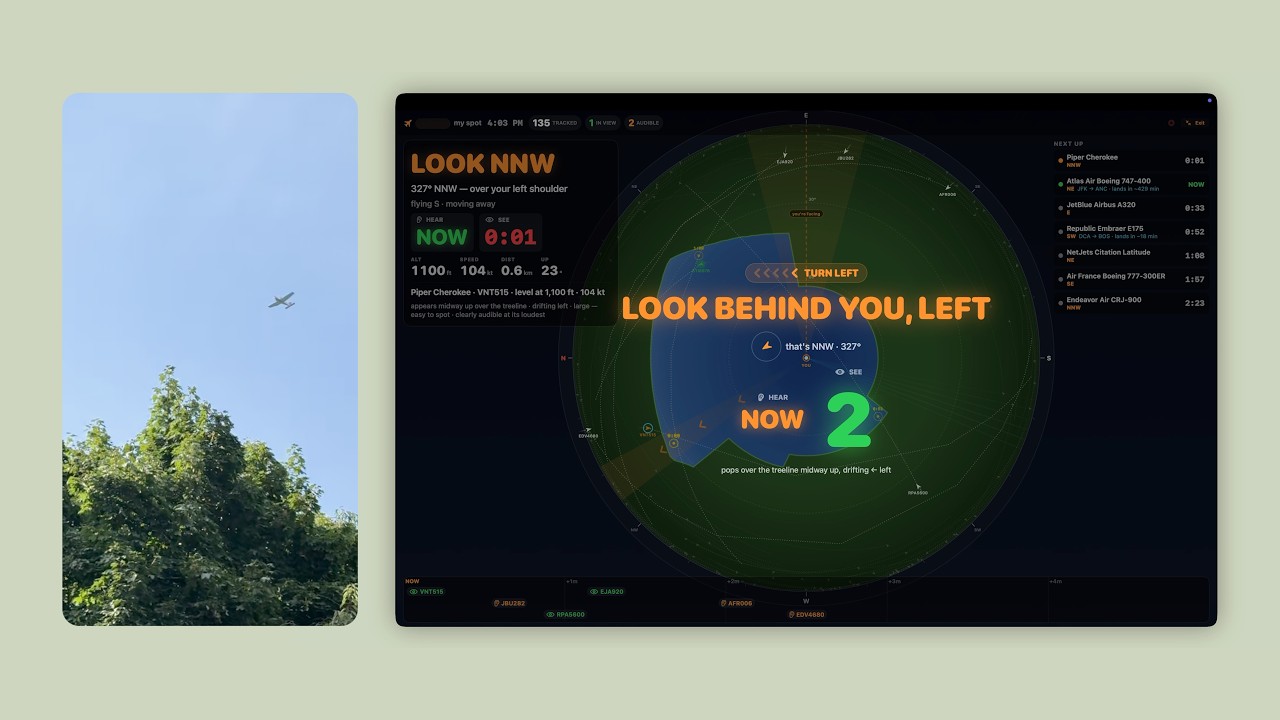
🔗 **Source:** [Claude Turns Flight Data Into "Look Behind You"](https://www.youtube.com/watch?v=NkJPtSLLDLs)
> [!note]+ Document Notes
> tags: [anthropic, claude, product-demo, ads-b, spatial-audio, real-time-data, accessibility, ai-narration]
> author: Claude (Anthropic YouTube channel)
> source: YouTube — @claude
> reference: https://www.youtube.com/watch?v=NkJPtSLLDLs
> date created: 2026-09-01 21:25
>
> > [!info] Generated analysis — not the author's words. Sections below are machine-written
> > from the captured source. Only text inside `> [!quote]` blocks is verbatim from the author.
> > Do not quote or attribute any other line to the named author.
>
> > [!warning] Thin source — 82 words of narration, no on-screen context captured
> > The transcript is a single ~60-second spoken narration with no title card text, no
> > description, and no speaker identification. Channel confirmed as Anthropic's "Claude" account
> > via YouTube oEmbed (`author_name: Claude`, `@claude`). Everything below about *what the demo
> > is* (an ADS-B-fed real-time narration) is inferred from the content of the speech — aircraft
> > type, altitude, speed, bearing, distance, route, ETA are all ADS-B fields — not stated by the
> > source. "A33300" is the ASR rendering of A330-300. Sections that a one-minute clip cannot
> > support say so rather than inventing material.
>
> # 🏷️ Title: Claude turns flight data into "look behind you"
>
<!-- deep-read:sections start -->
## 🧭 Table of Contents
- [📝 Summary](#-summary)
- [📖 Main Content](#-main-content)
- [🗒️ Notes](#️-notes)
- [📚 References](#-references)
- [🗣️ Paraphrase](#️-paraphrase)
- [📰 Newsletter](#-newsletter)
- [✅ Action Items](#-action-items)
- [🧪 Hypotheses](#-hypotheses)
- [📊 Methodology](#-methodology)
- [❓ Questions](#-questions)
- [🔮 Future Research](#-future-research)
- [💡 Implications](#-implications)
- [🧠 Learning Styles Assessment](#-learning-styles-assessment)
- [📊 Accessibility Assessment](#-accessibility-assessment)
- [🌍 DEIB Assessment](#-deib-assessment)
- [✅ Logical Validity](#-logical-validity)
- [🛡️ DARVO Analysis](#-darvo-analysis)
- [🎯 Conclusion](#-conclusion)
### 🔗 References
- Source: https://www.youtube.com/watch?v=NkJPtSLLDLs (Anthropic "Claude" channel, published 2026-09-01, ~1 min)
- No links in the stored document (verified: zero `<a>` tags).
## 📝 Summary
**What this is.** A one-minute demo clip from Anthropic's Claude channel. A synthesized voice tells a listener standing outdoors where to look and listen for an approaching airliner, then identifies it: a Delta Airbus A330-300 descending through 2,600 ft at 200 knots, 1.7 km to the north-northwest, inbound from Rome to New York, landing in about five minutes.
**What it demonstrates (inferred).** Every fact the voice states — operator, type, altitude, groundspeed, bearing, distance, origin/destination, ETA — is a field available from public ADS-B transponder data (the same feed sites like Flightradar24 and ADS-B Exchange consume). The demo's contribution isn't the data; it's the *rendering*: second person, present tense, timed to the listener's position and senses. "Look northwest. You should be able to hear it now. It comes into view in about 3 seconds."
**Why the framing matters.** Flight trackers give you a map and a data card. This gives you an instruction. The transformation from "here is a table" to "turn your head now" is the entire product idea, and it depends on three inputs the clip never shows: the listener's location and heading, the local terrain/tree line ("it stays hidden behind the trees"), and timing latency low enough that "3 seconds" is true.
**Stakeholders.** Anthropic (product marketing); aviation-data enthusiasts; accessibility community (audio-first spatial guidance is a long-standing assistive-tech goal); privacy people (a device that knows exactly where you're standing and which way you're facing).
**Risks.** None articulated by the source. Inferred: a demo this short can hide the failure modes — wrong-plane identification when two aircraft are close, latency drift, the "you'll hear it but not see it" fallback quietly covering a case where the visual cue failed.
**Bottom line.** A well-chosen demo of *data → embodied instruction*. As a source it contains one idea and no evidence about how well it works. Treat it as a product sketch, not a claim.
## 📖 Main Content
The clip has two beats.
**Beat one — direction.** The voice gives compass directions ("Look northwest," "Listen north"), sensory cues ("You should be able to hear it now"), a countdown ("comes into view in about 3 seconds"), a visual anchor ("Midway up over the tree line, drifting left"), and a fallback when the visual fails ("It stays hidden behind the trees. So, you'll hear it, but not see it").
**Beat two — identification.** Once the aircraft is present, the voice delivers the data card in prose: operator, type, altitude, speed, heading relative to the listener, distance and bearing, route, and ETA.
The order is deliberate: attention first, information second. A flight-tracker app inverts this — it shows the data and leaves you to find the plane.
The demo never shows the input side. Whether the location is GPS, whether heading comes from a phone compass or a head-worn device, whether the tree-line occlusion is computed from terrain data or a camera — none of it is visible in the transcript. The narration implies all three exist.
## 🗒️ Notes
- [00:00] "Look northwest. You should be able to hear it now. It comes into view in about 3 seconds." — three sensory channels (direction, audio, timing) in one sentence.
- [00:06] "Midway up over the tree line, drifting left." — elevation and motion relative to a local landmark, implying terrain awareness.
- [00:10] "Listen north. It stays hidden behind the trees. So, you'll hear it, but not see it." — occlusion handling; the fallback is stated before it's needed.
- [00:18] "You should be able to hear it now." — second audio cue; suggests two aircraft or a re-cue after the occluded one.
- [00:21] "It's a Delta Airbus A33300 [A330-300], descending through 2,600 ft at 200 knots." — ADS-B altitude and groundspeed rendered as approach-phase description.
- [00:27] "passing about 1.7 km to your north-northwest from Rome to New York. Landing in about 5 minutes." — distance/bearing relative to listener, route from flight-plan lookup, ETA.
## 📚 References
**Stated by the source:** none. No sources, links, or citations in a one-minute narration.
**Inferred data sources (not stated):**
- ADS-B transponder broadcasts (Mode S Extended Squitter, 1090 MHz) supply ICAO hex, callsign, position, altitude, groundspeed, track. Public aggregators: ADS-B Exchange, OpenSky Network, Flightradar24.
- Route (Rome → New York) requires a flight-plan or schedule lookup keyed on callsign; not in the ADS-B message itself.
- Aircraft type (A330-300) requires an ICAO-hex → registration → type database lookup.
**Link audit.** Zero `<a>` tags in `html_content`. Nothing to check.
## 🗣️ Paraphrase
Turn toward the northwest and listen; you'll hear the plane before you see it, and it'll appear in about three seconds, midway above the trees, moving left. Now there's another one to the north, but the trees will block it, so this one you'll only hear. That sound is a Delta A330-300 coming down through 2,600 feet at about 200 knots, about a mile to your north-northwest, flying in from Rome to New York, on the ground in roughly five minutes.
## 📰 Newsletter
**The plane-spotting demo that's really about verbs**
Anthropic's Claude channel dropped a one-minute clip this week where a voice tells you to look northwest, wait three seconds, and there's your Delta A330 from Rome. Every fact it recites has been free on Flightradar24 for a decade. What's new is the sentence structure: not "here's a data card," but "look up now."
That's the whole trick, and it's a trick WordPress people should recognize. Your site has the data. The question is whether you're handing visitors a table or an instruction. A plugin changelog is a table. "Update before Friday, this one patches an auth bypass" is an instruction. Same data.
Two caveats worth carrying. First, a sixty-second demo shows the happy path. It can't tell you what happens when two aircraft are on similar bearings, or when latency turns "three seconds" into "a while ago." Second, to say "look northwest" the system has to know where you're standing and which way you're facing. That's a lot of information about you, delivered to a model, for a plane.
- Watch: https://www.youtube.com/watch?v=NkJPtSLLDLs
## ✅ Action Items
**DevRel**
- The "data → embodied instruction" reframe is a reusable demo pattern: take a public feed developers already know and show the *sentence* it becomes. Candidate for any DevRel talk on agentic UX. `#action/h3`
**OSPO**
- Not applicable to this source. No open-source component is identified.
**Community**
- Not applicable to this source.
**WordPress teams** (Core, Core Performance, Core AI, Core Program Team, Mobile, Playground, Community, Training, Marketing, Support, Design, Documentation, Photos, TV, Polyglots, Accessibility, Meta, CLI, Hosting, Tide, Openverse, Themes, Plugins)
- **Core AI / Accessibility:** the clip is a concrete example of audio-first spatial guidance. If Core AI ever scopes screen-reader-adjacent features, this is the interaction model to study — instruction before information. `#action/h3`
- **Mobile:** the location + heading dependency is the privacy question a WordPress mobile app would face before shipping anything similar. Note it. `#action/h3`
- All other teams: not applicable to this source.
**The WPOCC**
- Not applicable to this source.
**FAIR**
- Not applicable to this source.
## 🧪 Hypotheses
1. **Instruction-first ordering raises task success over data-first.** Users told "look northwest, three seconds" locate the aircraft faster than users shown a map with the same data. Testable with a small field study and a stopwatch.
2. **Occlusion cues reduce user distrust when the visual fails.** Announcing "you'll hear it but not see it" *before* the miss keeps confidence higher than a silent miss. Testable with a between-groups design.
3. **Perceived latency tolerance is under two seconds for countdown phrasing.** "In about 3 seconds" stops being believable if the system's end-to-end delay exceeds roughly the countdown itself. Measurable.
4. **Multi-aircraft disambiguation is the primary failure mode.** In busy approach corridors (this appears to be a New York approach), two aircraft within 30° bearing and similar altitude will produce wrong identifications at a non-trivial rate. Testable with logged ADS-B replays.
5. **Blind and low-vision users rate the narration as useful for orientation but not for the aircraft ID.** The data card is trivia; the bearing-and-timing instruction is the assistive value. Testable by interview.
### 📊 Methodology
**Genre: product demo, single take, no evaluation.** There is no method to assess — the clip shows one scenario, one outcome, no comparison, no failure. That is standard for a marketing clip and should be read as such.
**What would make it evidence:** the number of trials the narration was tested over, the identification accuracy, the latency distribution, and the location/heading source. None appear.
**How this analysis proceeded:** inferred the data pipeline from the fields spoken (all seven are standard ADS-B or ADS-B-adjacent lookups), confirmed the channel via oEmbed, and refused to attribute design intent the clip doesn't state. The "look behind you" in the title is Anthropic's framing; the clip itself never says "behind."
### ❓ Questions
- **What supplies location and heading?** Phone GPS and compass, or a wearable? The answer determines both the privacy surface and the achievable accuracy.
- **How is tree-line occlusion computed?** Terrain elevation data, a camera, or a hand-authored scene for the demo?
- **What's the end-to-end latency?** ADS-B aggregators typically run 5–30 s behind live; "in about 3 seconds" implies either a local receiver or scripted timing.
- **Was this live or staged?** A demo can be recorded against a replayed ADS-B log with the narration pre-generated. Nothing in the clip distinguishes the two.
- **Why "look behind you" in the title when the narration says "look northwest"?** Marketing register versus system output — worth noting as a tell that the title was written for humans, the narration for the demo.
### 🔮 Future Research
- **Compare against existing assistive spatial-audio work.** Microsoft Soundscape (discontinued 2023, open-sourced) did 3D audio beacons for blind pedestrians. Whether this demo advances that or repackages it is answerable by reading Soundscape's design docs.
- **ADS-B latency by source.** Measure the delay from broadcast to availability across OpenSky, ADS-B Exchange, and a local RTL-SDR receiver. This bounds whether countdown phrasing is honest.
- **Failure-mode catalog for narrated tracking.** Multi-target confusion, stale position, wrong route lookup (codeshare callsigns), and type misidentification (hex → registration mismatches) — each has a known base rate in the hobbyist community.
- **Privacy analysis of heading data.** Continuous heading plus location is a richer behavioral signal than location alone. What's the retention policy for a feature like this?
### 💡 Implications
**Practice.** The transferable design pattern: lead with the instruction the user needs *now*, follow with the information they can absorb *after*. Applies to alerts, changelogs, error messages, onboarding.
**Policy.** A consumer product that continuously knows where you stand and face needs a stated retention and sharing policy before launch. The clip is silent.
**Security.** ADS-B is unauthenticated and spoofable; a narration system that trusts it inherits that. Low stakes for plane-spotting, high stakes if the same pattern is reused for anything safety-relevant.
**Education.** A clean teaching example for "what does an LLM add when the data is already public?" Answer: the sentence, the timing, and the second person.
**Funding.** Not applicable to this source.
## 🧠 Learning Styles Assessment
**Estimated reading level of the transcript:** Grade 6–7 (short imperative sentences, one technical clause with units).
| Learner type | Fit | Notes |
|---|---|---|
| **Visual** | Moderate | The video presumably shows the sky and the aircraft; the transcript captures none of it. The narration itself is designed to direct vision. |
| **Aural** | Strong | The product *is* audio guidance. The clip is its own best case. |
| **Verbal** | Moderate | Eighty-two words. Precise, but there's little to read. |
| **Kinesthetic** | Strong | The narration demands physical action — turn, look, listen. Rare for a video to require the viewer to move. |
| **Logical** | Weak | No argument, no structure beyond direction → identification. |
| **Social** | Weak | Solo listener, no interaction. |
| **Solitary** | Strong | One person, one sky, one voice. |
| **Naturalistic** | Moderate | Outdoors, tree line, sky — but the subject is a machine, not nature. |
## 📊 Accessibility Assessment
#### Alternative text and non-text content
**Not applicable to the source's own assets.** No informational imagery beyond the sky; the narration describes what the sighted viewer sees, which is itself an alt-text pattern. **SC 1.1.1** is met by design.
#### Keyboard navigation
**Not applicable; inherited from YouTube.** **SC 2.1.1** is the platform's.
#### Contrast and readability
**Not assessable from the transcript.** Any title cards would need frame inspection against **SC 1.4.3**. Flagged unassessed.
#### Text resizing and reflow
**Not applicable.** No baked-in text captured. **SC 1.4.4 / 1.4.10** have nothing to act on.
#### Media and captions
**Mostly met, one defect.** Captions exist (the transcript is derived from them) and the speech is clean apart from "A33300" for A330-300 — a domain-term error that changes the meaning for a deaf viewer who knows aircraft. **SC 1.2.2** is met to a good but not perfect standard. **SC 1.2.3 Audio Description:** the narration *is* audio description of the scene, so the requirement is effectively satisfied by the content.
#### Forms and interactions
**Not applicable.** No controls in the source.
#### Standards reference
WCAG 2.2 Level AA. **Met:** 1.1.1, 1.2.3 (by the nature of the content). **Mostly met:** 1.2.2 (one domain-term caption error). **Not applicable:** 1.4.4, 1.4.10, 2.1.1. **Unassessed:** 1.4.3.
**Beyond the clip:** the product idea itself — audio-first spatial guidance — is one of the oldest assistive-technology goals. The demo doesn't mention accessibility once. That's a missed framing, not a defect in the clip.
## 🌍 DEIB Assessment
#### Cultural breadth
**Minimal by scope.** A New York approach corridor, a Delta flight from Rome, English narration, metric distance with imperial altitude and knots (aviation convention). Nothing excludes; nothing reaches either.
#### Inclusive language
**Neutral.** Second-person imperative throughout; no gendered or evaluative language.
#### Neurodiversity support
**Good.** Short, sequential, one instruction per sentence, explicit timing ("about 3 seconds"), and a pre-announced fallback for when the visual cue fails. This is close to a model for instruction design for listeners who need predictability.
#### Representation
**Not assessable.** No people appear in the transcript. The synthesized voice's characteristics aren't captured.
#### Psychological safety
**Not applicable to this source.** No interpersonal content.
## ✅ Logical Validity
**Strong reasoning.** Not applicable in the argumentative sense — the clip makes no argument. As *instruction design* it is coherent: attention cue → timing → visual anchor → fallback → identification. Each sentence has one job.
**Fallacies.** None in the narration itself. In the *framing* — title and channel — there is a mild **demonstration-as-evidence** move: a single successful trial presented as a capability. This is inherent to demo clips and not a fault of the narration; it becomes a fallacy only if a viewer treats it as proof of reliability. `#fallacy/anecdotal`
**Tone of voice.** Calm, directive, confident. No hedging except "about" on the two numeric estimates (3 seconds, 5 minutes), which is exactly where hedging belongs.
## 🛡️ DARVO Analysis
**Not applicable to this source.** No conflict, no accusation, no defense. A machine voice gives directions. None of Deny / Attack / Reverse victim-offender has any surface to attach to.
## 🎯 Conclusion
**Bottom line.** One idea, cleanly shown: public flight data becomes a timed, second-person instruction. The idea is good and the clip proves nothing about reliability — it can't, at sixty seconds.
**What holds up.** Instruction before information. Pre-announced fallback for occlusion. Hedged numbers where hedging belongs.
**What doesn't.** No input side shown (location, heading, terrain). No failure case. No accessibility framing for a product that's essentially audio description of the sky. Title says "behind you," narration never does.
**Next steps.**
1. Treat this as a product sketch in any writing; don't cite it as evidence the system works.
2. If the instruction-first pattern is worth a note, ground it in a second source — the clip alone is too thin for a Permanent.
3. Watch for a longer Anthropic post on the same demo; the input pipeline is the interesting part and this clip omits it.
## 🔄 Refactor Appendix — Claude turns flight data into "look behind you"
### 📚 Literature Atoms (H3)
#### [H2] The demo's contribution is the sentence, not the data
> [!quote] ID:rw_01m1fjjphcg4z0xmykhb4yk6gk
> "Look northwest. You should be able to hear it now. It comes into view in about 3 seconds."
Every fact spoken later is a standard ADS-B field. What the clip adds is timing, direction, and second person — rendering a data card as an instruction the body can act on.
Tags: `#atom/literature/h2`
#### [H3] The fallback is announced before the failure
> [!quote] ID:rw_01m1fjjphcg4z0xmykhb4yk6gk
> "Listen north. It stays hidden behind the trees. So, you'll hear it, but not see it."
Instruction design detail: the system tells the listener which sense to trust before the visual cue fails, so a miss reads as expected rather than as error.
Tags: `#atom/literature/h3`
### 🧠 Permanent Candidates (H4)
#### [P1] Lead with the instruction the user needs now; follow with the information they can absorb after
A data card and a directive can carry identical facts and produce different outcomes. Ordering the directive first — where to attend, when, with which sense — lets the person act before they understand, and the understanding arrives once the action has succeeded. The pattern applies to alerts, error messages, changelogs, and onboarding as much as to a plane overhead. *Too thin on one source — hold as candidate until a second source grounds it.*
Links: [[Attention Capacity Is Stable but the Effort It Costs Has Been Repriced]] · [[Instruction design]] · [[Alert fatigue]]
Tags: `#atom/zettel/z1`
### ✏️ Fleeting Queue
- Microsoft Soundscape did 3D audio beacons for blind pedestrians and was shut down in 2023. Is this demo the same idea with an LLM voice? Read Soundscape's design notes before saying so. `#atom/fleeting/f1`
- "Look behind you" in the title, "look northwest" in the audio. The title was written for the feed; the narration for the demo. Small tell about how these clips get packaged. `#atom/fleeting/f1`
- Location plus continuous heading is a behavioral signal, not just a position. Nobody in a one-minute demo is going to mention retention. `#atom/fleeting/f1`
- ADS-B is unauthenticated. Fine for plane-spotting; a pattern to watch if the same narration layer is ever reused for anything safety-relevant. `#atom/fleeting/f1`
### → Things 3 (max 2 actions)
1. **Search for a longer Anthropic writeup of this demo** (blog or docs) before drawing on it — the input pipeline is the substantive part and the clip omits it. `#action/h3`
2. **Skim Microsoft Soundscape's open-sourced design docs** to place this demo against prior assistive spatial-audio work. `#action/h3`
<!-- deep-read:sections end -->
📄 **Full text:** [[Full Document Contents/Articles/Claude Turns Flight Data Into Look Behind You.md|Claude Turns Flight Data Into "Look Behind You" by Claude (Anthropic)]]
## Highlights
- Look northwest. You should be able to hear it now. It comes into view in about 3 seconds. Midway up over the tree line, drifting left. ([View Highlight](https://read.readwise.io/read/01m1fsvvez25att98m311jrty3))
- Note: #atom/literature/h2 — The demo's contribution is the sentence, not the data: direction, sense, and timing in one line. Every fact spoken later is a standard ADS-B field.
- Tags: atom/literature/h2