Complaint-Wp-Engine-v-Automattic-Et-Al-With-Exhibit
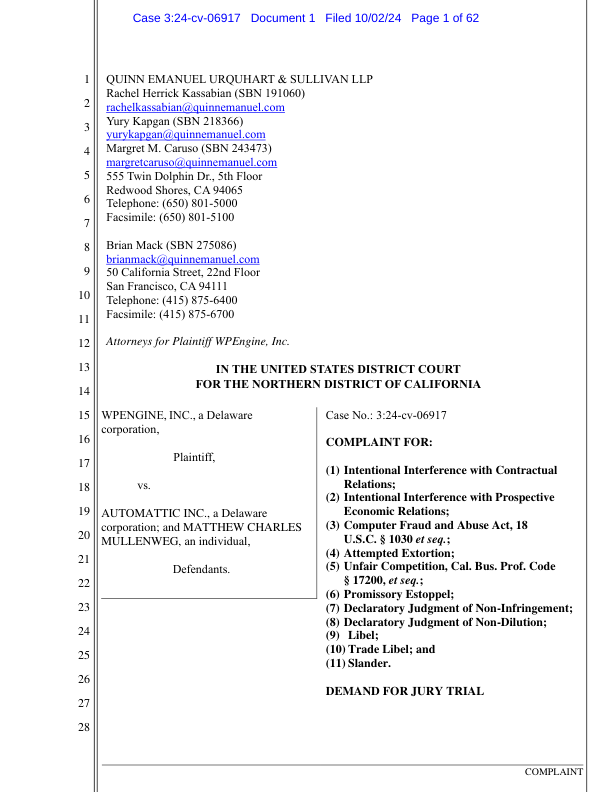
[[3. Resources/Readwise/Full Document Contents/Articles/Complaint-Wp-Engine-v-Automattic-Et-Al-With-Exhibit|Full Document Contents]]
## Document Notes
---
tags: #legal #wordpress #trademark #opensource #community-governance
Author: Quinn Emanuel Urquhart & Sullivan LLP
Source: Complaint by WP Engine, Inc. against Automattic Inc. and Matthew Mullenweg
Reference: [Complaint Document](Complaint-WP-Engine-v-Automattic-et-al-with-Exhibit.pdf)
date created: 2024-10-02 16:30
---
# Title: WP Engine v. Automattic and Matthew Mullenweg - Legal Dispute Analysis
## Table of Contents:
- [[#📝 Summary:]]
- [[#📖 Main Content:]]
- [[#Introduction and Background]]
- [[#Timeline of Key Events]]
- [[#Detailed Allegations Against Automattic and Mullenweg]]
- [[#Analysis of Trademark Management]]
- [[#Legal Implications and Claims]]
- [[#Impact on WordPress Community]]
- [[#🗒️ Notes]]
- [[#📖 References]]
- [[#🗣️ Paraphrase]]
- [[#📰 Newsletter]]
- [[#✅ Action Items]]
- [[#🧪 Hypotheses]]
- [[#📊 Methodology]]
- [[#❓ Questions]]
- [[#🔮 Future Research]]
- [[#💡 Implications]]
- [[#🧠 Learning Styles Assessment]]
- [[#📊 Accessibility Assessment]]
- [[#🌍 DEIB Assessment]]
- [[#✅ Logical Validity]]
- [[#🔍 SEO Evaluation]]
- [[#🎯 Conclusion]]
## 📝 Summary:
This document details a lawsuit filed by WP Engine (WPE) against Automattic Inc. and Matthew Mullenweg, alleging misconduct involving misuse of WordPress trademarks, extortion, unfair competition, and intentional interference with contractual relations. WP Engine claims that Automattic and Mullenweg have used their influence over WordPress resources to harm WP Engine financially and damage its reputation within the WordPress community.
## 📖 Main Content:
### Introduction and Background
- **Context of WordPress**: WordPress is a widely used open-source content management system that powers over 43% of all websites worldwide. The open-source nature of WordPress means that anyone can use, modify, and distribute the software, which has encouraged extensive community collaboration and development.
- **Role of Automattic and Mullenweg**: Automattic Inc., founded by Matthew Mullenweg, is a for-profit entity deeply involved in the WordPress ecosystem. Automattic oversees various services and products, including WordPress.com, WooCommerce, and other commercial ventures.
- **WP Engine’s Role**: WP Engine is a platform that has built its business around WordPress, providing hosting and related services to WordPress users. WP Engine claims that it has heavily contributed to the WordPress community both financially and through community engagement.
### Timeline of Key Events
- **2003**: Founding of WordPress by Mullenweg, with the vision of an open, accessible platform.
- **2010**: Trademarks for WordPress were transferred from Automattic to the WordPress Foundation, ostensibly to protect them for the community.
- **2011-2018**: WP Engine emerged as a key player, heavily investing in WordPress-related infrastructure and projects.
- **September 2024**: Automattic, under Mullenweg's direction, allegedly demanded payments from WP Engine for a trademark license. WP Engine refused, leading to public defamation and restrictions on WP Engine’s access to WordPress.org resources.
### Detailed Allegations Against Automattic and Mullenweg
- **Misuse of WordPress Trademarks**: The complaint claims that, despite publicly transferring the trademarks to the WordPress Foundation, Automattic retained a secret, irrevocable, royalty-free license, allowing them to continue controlling the trademarks. WP Engine alleges this action was deceptive and allowed Automattic to profit at the expense of other community members.
- **Extortion Attempt**: WP Engine alleges that Automattic and Mullenweg threatened them with reputational harm unless they paid an excessive license fee to Automattic. This fee, which was to be calculated as a significant percentage of WP Engine’s gross revenue, was allegedly intended as a means of controlling competition rather than protecting trademarks.
- **Blocking Access to WordPress Resources**: The complaint also states that Automattic and Mullenweg retaliated against WP Engine by blocking their access to essential WordPress.org functions, effectively cutting WP Engine off from important community resources, including plugin and theme updates, which are integral to maintaining WordPress-based websites.
### Analysis of Trademark Management
- **Initial Trademark Transfer to the Foundation**: In 2010, Automattic transferred the WordPress trademarks to the WordPress Foundation, a nonprofit entity. This transfer was portrayed as a move to ensure that the trademarks would serve the community’s interest, safeguarding them from potential commercial misuse.
- **Exclusive License Back to Automattic**: However, WP Engine alleges that an exclusive, irrevocable license was secretly retained by Automattic, allowing it to use the trademarks freely while maintaining effective control. This duality—a public transfer but continued private control—allegedly misled the community and investors who believed the trademarks were held independently.
- **Implications for Community Trust**: The complaint argues that Automattic’s actions eroded community trust. The license arrangement was not transparently disclosed in the WordPress Foundation’s tax filings or public communications, raising concerns about governance practices and potential conflicts of interest within the WordPress leadership.
### Legal Implications and Claims
- **Intentional Interference with Contractual Relations**: WP Engine claims that Automattic’s actions intentionally interfered with WP Engine’s business relationships, including relationships with its customers and contributors.
- **Computer Fraud and Abuse Act Violation**: By blocking access to WordPress.org, WP Engine alleges that Automattic violated provisions of the Computer Fraud and Abuse Act (CFAA), which prohibits unauthorized access to computer systems.
- **Attempted Extortion**: The demand for an excessive licensing fee, combined with threats of reputational damage, forms the basis of WP Engine’s extortion claim. WP Engine argues that Automattic used the promise of open access as a bait-and-switch tactic to coerce payments once WP Engine became reliant on WordPress.
- **Unfair Competition and Libel Claims**: The complaint also alleges unfair competition under California law, as well as libel, trade libel, and slander for the false statements made by Mullenweg during his public remarks and postings, which WP Engine argues were intended to harm its reputation and business.
### Impact on WordPress Community
- **Retaliation Against Contributors**: WP Engine claims that Mullenweg's actions go against the core principles of open source, particularly the values of openness and accessibility. Blocking WP Engine’s access to WordPress.org not only impacted WP Engine but also set a troubling precedent for other contributors who might fear retaliation.
- **Community Trust Issues**: The lawsuit points out that many WordPress community members were led to believe that the trademarks and assets of WordPress were independently managed for the community's benefit. The allegations challenge this perception, potentially leading to diminished trust in both the WordPress Foundation and Automattic.
- **Stifling Innovation**: The alleged misconduct of Automattic and Mullenweg could discourage innovation and participation within the WordPress community. WP Engine argues that the threat of similar actions against other businesses might deter contributions, harming the community's growth and the ecosystem's sustainability.
### 🗒️ Notes
- **Open Source Community Principles**:
- WordPress has thrived due to its open-source nature, which promotes accessibility and community engagement.
- Automatt
> [!note]+ Document Notes
> tags: [#legal, #wordpress, #trademark, #opensource, #community-governance]
> Author: Quinn Emanuel Urquhart & Sullivan LLP
> Source: Complaint by WP Engine, Inc. against Automattic Inc. and Matthew Mullenweg
> Reference: [Complaint Document](Complaint-WP-Engine-v-Automattic-et-al-with-Exhibit.pdf)
> date created: 2024-10-02 16:30
>
> # Title: WP Engine v. Automattic and Matthew Mullenweg - Legal Dispute Analysis
>
<!-- deep-read:sections start -->
## Table of Contents:
1. [📝 Summary](#-summary)
2. [📖 Main Content](#-main-content)
1. [Introduction and Background](#introduction-and-background)
2. [Timeline of Key Events](#timeline-of-key-events)
3. [Detailed Allegations Against Automattic and Mullenweg](#detailed-allegations-against-automattic-and-mullenweg)
4. [Analysis of Trademark Management](#analysis-of-trademark-management)
5. [Legal Implications and Claims](#legal-implications-and-claims)
6. [Impact on WordPress Community](#impact-on-wordpress-community)
7. [🗒️ Notes](#-notes)
3. [📖 References](#-references)
4. [🗣️ Paraphrase](#-paraphrase)
5. [📰 Newsletter](#-newsletter)
6. [✅ Action Items](#-action-items)
7. [🧪 Hypotheses](#-hypotheses)
8. [📊 Methodology](#-methodology)
9. [❓ Questions](#-questions)
10. [🔮 Future Research](#-future-research)
11. [💡 Implications](#-implications)
12. [🧠 Learning Styles Assessment](#-learning-styles-assessment)
13. [📊 Accessibility Assessment](#-accessibility-assessment)
14. [🌍 DEIB Assessment](#-deib-assessment)
15. [✅ Logical Validity](#-logical-validity)
16. [🔍 SEO Evaluation](#-seo-evaluation)
17. [🎯 Conclusion](#-conclusion)
## 📝 Summary:
This document details a lawsuit filed by WP Engine (WPE) against Automattic Inc. and Matthew Mullenweg, alleging misconduct involving misuse of WordPress trademarks, extortion, unfair competition, and intentional interference with contractual relations. WP Engine claims that Automattic and Mullenweg have used their influence over WordPress resources to harm WP Engine financially and damage its reputation within the WordPress community.
## 📖 Main Content:
### Introduction and Background
- **Context of WordPress**: WordPress is a widely used open-source content management system that powers over 43% of all websites worldwide. The open-source nature of WordPress means that anyone can use, modify, and distribute the software, which has encouraged extensive community collaboration and development.
- **Role of Automattic and Mullenweg**: Automattic Inc., founded by Matthew Mullenweg, is a for-profit entity deeply involved in the WordPress ecosystem. Automattic oversees various services and products, including WordPress.com, WooCommerce, and other commercial ventures.
- **WP Engine’s Role**: WP Engine is a platform that has built its business around WordPress, providing hosting and related services to WordPress users. WP Engine claims that it has heavily contributed to the WordPress community both financially and through community engagement.
### Timeline of Key Events
- **2003**: Founding of WordPress by Mullenweg, with the vision of an open, accessible platform.
- **2010**: Trademarks for WordPress were transferred from Automattic to the WordPress Foundation, ostensibly to protect them for the community.
- **2011-2018**: WP Engine emerged as a key player, heavily investing in WordPress-related infrastructure and projects.
- **September 2024**: Automattic, under Mullenweg's direction, allegedly demanded payments from WP Engine for a trademark license. WP Engine refused, leading to public defamation and restrictions on WP Engine’s access to WordPress.org resources.
### Detailed Allegations Against Automattic and Mullenweg
- **Misuse of WordPress Trademarks**: The complaint claims that, despite publicly transferring the trademarks to the WordPress Foundation, Automattic retained a secret, irrevocable, royalty-free license, allowing them to continue controlling the trademarks. WP Engine alleges this action was deceptive and allowed Automattic to profit at the expense of other community members.
- **Extortion Attempt**: WP Engine alleges that Automattic and Mullenweg threatened them with reputational harm unless they paid an excessive license fee to Automattic. This fee, which was to be calculated as a significant percentage of WP Engine’s gross revenue, was allegedly intended as a means of controlling competition rather than protecting trademarks.
- **Blocking Access to WordPress Resources**: The complaint also states that Automattic and Mullenweg retaliated against WP Engine by blocking their access to essential WordPress.org functions, effectively cutting WP Engine off from important community resources, including plugin and theme updates, which are integral to maintaining WordPress-based websites.
### Analysis of Trademark Management
- **Initial Trademark Transfer to the Foundation**: In 2010, Automattic transferred the WordPress trademarks to the WordPress Foundation, a nonprofit entity. This transfer was portrayed as a move to ensure that the trademarks would serve the community’s interest, safeguarding them from potential commercial misuse.
- **Exclusive License Back to Automattic**: However, WP Engine alleges that an exclusive, irrevocable license was secretly retained by Automattic, allowing it to use the trademarks freely while maintaining effective control. This duality—a public transfer but continued private control—allegedly misled the community and investors who believed the trademarks were held independently.
- **Implications for Community Trust**: The complaint argues that Automattic’s actions eroded community trust. The license arrangement was not transparently disclosed in the WordPress Foundation’s tax filings or public communications, raising concerns about governance practices and potential conflicts of interest within the WordPress leadership.
### Legal Implications and Claims
- **Intentional Interference with Contractual Relations**: WP Engine claims that Automattic’s actions intentionally interfered with WP Engine’s business relationships, including relationships with its customers and contributors.
- **Computer Fraud and Abuse Act Violation**: By blocking access to WordPress.org, WP Engine alleges that Automattic violated provisions of the Computer Fraud and Abuse Act (CFAA), which prohibits unauthorized access to computer systems.
- **Attempted Extortion**: The demand for an excessive licensing fee, combined with threats of reputational damage, forms the basis of WP Engine’s extortion claim. WP Engine argues that Automattic used the promise of open access as a bait-and-switch tactic to coerce payments once WP Engine became reliant on WordPress.
- **Unfair Competition and Libel Claims**: The complaint also alleges unfair competition under California law, as well as libel, trade libel, and slander for the false statements made by Mullenweg during his public remarks and postings, which WP Engine argues were intended to harm its reputation and business.
### Impact on WordPress Community
- **Retaliation Against Contributors**: WP Engine claims that Mullenweg's actions go against the core principles of open source, particularly the values of openness and accessibility. Blocking WP Engine’s access to WordPress.org not only impacted WP Engine but also set a troubling precedent for other contributors who might fear retaliation.
- **Community Trust Issues**: The lawsuit points out that many WordPress community members were led to believe that the trademarks and assets of WordPress were independently managed for the community's benefit. The allegations challenge this perception, potentially leading to diminished trust in both the WordPress Foundation and Automattic.
- **Stifling Innovation**: The alleged misconduct of Automattic and Mullenweg could discourage innovation and participation within the WordPress community. WP Engine argues that the threat of similar actions against other businesses might deter contributions, harming the community's growth and the ecosystem's sustainability.
### 🗒️ Notes
- **Open Source Community Principles**:
- WordPress has thrived due to its open-source nature, which promotes accessibility and community engagement.
- Automattic’s control of trademarks and retaliatory measures against WP Engine contradict these principles, threatening the integrity of the open-source model.
- **Corporate Influence and Ethics**:
- The relationship between Automattic, the WordPress Foundation, and the community highlights potential conflicts of interest that can arise when for-profit entities control key open-source assets.
- WP Engine’s claims of trademark misuse and extortion point to the need for stronger governance structures in open-source projects to prevent undue corporate influence.
## 📖 References:
- WP Engine, Inc. v. Automattic Inc. and Matthew Mullenweg, Complaint Document
## 🗣️ Paraphrase:
1. WP Engine alleges that despite Automattic publicly transferring WordPress trademarks to the nonprofit WordPress Foundation to ensure open community access, Automattic secretly retained a license that kept trademark control within its reach.
2. WP Engine details that Mullenweg gave WP Engine an ultimatum to pay millions of dollars for a trademark license or face public defamation, which was followed by a retaliatory public campaign when WP Engine refused.
## 📰 Newsletter:
🚨 **Legal Battle in the WordPress World!** WP Engine has filed a lawsuit against Automattic and Matthew Mullenweg, alleging improper use of WordPress trademarks and coercive behavior. This lawsuit challenges the perception of open access within the WordPress ecosystem, raising critical questions about community governance and transparency. If you're interested in how this will shape the future of WordPress, you won't want to miss this! [Full Complaint Here](Complaint-WP-Engine-v-Automattic-et-al-with-Exhibit.pdf)
## ✅ Action Items:
- Draft a white paper on best practices for trademark management in open-source communities to ensure transparency and community trust.
- Advocate for governance reforms within the WordPress Foundation, including independent audits and community oversight of trademarks.
- Create educational resources on contributors' rights in open-source projects to empower community members against possible overreach by centralized entities.
## 🧪 Hypotheses:
1. If WordPress trademarks were managed with community oversight, there would be an increase in community trust and contributions.
2. An independent audit of the WordPress Foundation’s governance practices would reveal discrepancies between public commitments and internal agreements.
### 📊 Methodology:
- **Data Collection**: Gather surveys from WordPress contributors and businesses involved in the ecosystem to assess their trust levels and perceptions regarding trademark governance.
- **Research Design**: Utilize case studies of other successful open-source projects with transparent trademark policies, such as the Linux Foundation, to create a comparative analysis.
- **Analysis Techniques**: Use thematic analysis to identify recurring themes in survey responses related to governance, trust, and community engagement.
### ❓ Questions:
1. How do existing WordPress trademark management practices compare to other open-source foundations?
2. What impact do allegations of misuse and control of trademarks have on businesses that build on the WordPress platform?
### 🔮 Future Research:
- Examine governance models that allow for balanced power between community interests and for-profit entities within open-source ecosystems.
- Investigate the relationship between transparency in trademark management and the level of contributions to open-source projects.
### 💡 Implications:
Research into transparent governance practices could lead to improved models that other open-source communities adopt, reducing conflicts and encouraging broader contributions. It may also inform policy changes within the WordPress Foundation to ensure that the values of openness and accessibility are upheld.
### 🧠 Learning Styles Assessment:
- **Visual Learners**: Add diagrams illustrating the structure of the WordPress governance model, the roles of Automattic and the Foundation, and how control over trademarks has shifted.
- **Aural Learners**: Suggest adding an audio summary of key issues.
- **Verbal Learners**: Enhance the narrative with stories of other open-source projects facing similar challenges.
- **Physical Learners**: Provide exercises that allow community members to simulate governance decisions.
- **Logical Learners**: Use flowcharts to depict the legal processes described.
- **Social Learners**: Create opportunities for group discussions on open-source governance.
- **Solitary Learners**: Include reflection prompts on contributors' roles and the impact of governance on community dynamics.
- **Naturalistic Learners**: Use ecosystem analogies to explain community balance.
### 📊 Accessibility Assessment:
- **Screen Reader Compatibility**: Ensure all documents are accessible and properly tagged.
- **Keyboard Navigation**: Add navigation shortcuts to improve usability for those with limited motor skills.
- **Contrast and Readability**: Review the document design for high contrast to ensure accessibility for users with visual impairments.
### 🌍 DEIB Assessment:
- **Cultural Relevance**: Expand the analysis to include how different cultural approaches to governance might influence community engagement.
- **Inclusive Language**: Simplify complex legal terminology to ensure inclusivity for readers with varying levels of familiarity.
- **Representation**: Ensure that the content highlights the impact of governance issues on contributors from various backgrounds.
### ✅ Logical Validity:
- **Positive Reasoning**:
- **Balanced Views**: WP Engine’s claims are supported by historical context and examples, creating a logically consistent argument against Automattic’s influence.
- **Logical Fallacies**:
- **False Dilemma**: Automattic’s choice presented to WP Engine—pay or lose access—was oversimplified. Introducing community-based mediation could have provided a third path.
### 🔍 SEO Evaluation:
- **Keywords**: Keywords like "WordPress trademark lawsuit," "open-source governance," and "Automattic control" are well integrated.
- **Meta Description**: Suggest revising to succinctly capture the dispute's essence for enhanced click-through rates.
- **Title Tag**: Incorporate specific terms such as "WP Engine vs Automattic" for clarity and search visibility.
## 🎯 Conclusion:
The lawsuit between WP Engine and Automattic exposes significant concerns around the governance of WordPress trademarks, raising broader questions about the balance of power in open-source communities. Ensuring transparent and community-focused trademark management could lead to increased trust, equitable participation, and long-term sustainability for WordPress and similar projects.
<!-- deep-read:sections end -->
## Highlights
- 1. This is a case about abuse of power, extortion, and greed. The misconduct at issue here is all the more shocking because it occurred in an unexpected place—the WordPress open source software community built on promises of the freedom to build, run, change, and redistribute without barriers or constraints, for all. ([View Highlight](https://read.readwise.io/read/01j982b2g8wtf2jq466hf9vmk7))
- Mullenweg’s recent actions have exposed and highlighted his long history of obfuscating the true facts about his control and manipulation of the WordPress Foundation and wordpress.org—which he presents as a not-for-profit “dot-org” enterprise, but which in fact he solely owns and directs with an iron fist to further his own commercial interests in Automattic and associated commercial businesses, to the detriment of Defendants’ competitors. ([View Highlight](https://read.readwise.io/read/01j982fm5bngtbc9cz4aegkcm1))
- he wrongful acts described herein, including at least the decisions and conduct to extort, interfere with, and otherwise violate the legal rights of WPE and the libelous and slanderous activity, took place at least in part in California, where Mullenweg and other key Automattic employees and agents work and where the instrumentalities -3- COMPLAINT ([View Highlight](https://read.readwise.io/read/01j982n7vd8z7ekt55rxyh25fj))
- 06917 Document 1 Filed 10/02/24 Page 5 of 62 1 2 3 4 5 6 7 8 9 10 11 12 13 14 15 16 17 18 19 20 21 22 23 24 25 26 27 28 of the company are located. In addition, on information and belief, at least some of the computers and servers used to carry out the blocking of WPE’s access to wordpress.org were located in C ([View Highlight](https://read.readwise.io/read/01j982nbyxbazfccr84c1c565r))
- In addition, Mullenweg acknowledged that “[a]s a longtime contributor to WordPress Core, WP Engine has played an integral role in supporting the WordPress project for more than a decade.13 Indeed, as also acknowledged by Mullenweg, WPE, at the very least, “sponsors 11 contributors for a total of 40 hours per week across 5 teams.”14 ([View Highlight](https://read.readwise.io/read/01j9831xrp12tsrmh0zjzq8csn))
- Indeed, during a livestream on September 26, 2024 on the X platform, when asked why he had not attempted to enforce Automattic’s trademarks against WPE a decade ago, Mullenweg admitted that he’d known about WPE’s use of the Challenged Terms for “years,” but opted not to take action.19 ([View Highlight](https://read.readwise.io/read/01j9833b6dndth0ab9203b0rsk))
- On September 9, 2010, Mullenweg posted on his blog that “Automattic has transferred the WordPress trademark to the WordPress Foundation, the nonprofit dedicated to promoting and ensuring access to WordPress and related open source projects in perpetuity.”20 He did that around the same time of public concern over his level of control and potential for abuse. Mullenweg’s public announcement did not mention, however, that he had also caused the nonprofit WordPress Foundation to grant an exclusive, fully-paid, royalty-free, perpetual, irrevocable, worldwide, sublicensable license and related security agreement to the WordPress mark right back to Mullenweg’s for-profit Automattic. ([View Highlight](https://read.readwise.io/read/01j9835bxvqsrs1vk8y2xv8fyy))
- It appears Mullenweg also did not disclose the license agreement in the WordPress 20 https://ma.tt/2010/09/wordpress-trademark/. See also https://wordpress.org/book/2015/11/the- wordpress-foundation/ (“Automattic registered the WordPress trademarks in 2006, but some contributors — who had helped build the software or started their own local communities — felt that they had as much right to the trademarks as Automattic. Some community members believed that the community owned the codebase and thus should own the trademarks, not the corporate entity.”).
-14- COMPLAINT ([View Highlight](https://read.readwise.io/read/01j98360n3301btshtta0py88s))
- Case 3:24-cv-06917 Document 1 Filed 10/02/24 Page 16 of 62 1 2 3 4 5 6 7 8 9 10 11 12 13 14 15 16 17 18 19 20 21 22 23 24 25 26 27 28 Foundation’s filings with the IRS, and none of WordPress Foundation’s fourteen years of publicly available federal reporting to the IRS indicates that the WordPress Foundation was compensated in any form for granting an exclusive, fully-paid, royalty-free, perpetual, irrevocable, worldwide, sublicensable license for trademarks Defendants now claim are incredibly valuable. ([View Highlight](https://read.readwise.io/read/01j983691qnxfg6p9cwst9xdc1))
- In 2010, Mullenweg stated that “it’s not often you see a for-profit company donate one of their most valuable core assets and give up control.”21 ([View Highlight](https://read.readwise.io/read/01j983r7w0g3cqr2y9k84kt4pe))
- espite its .org top level domain, which is commonly understood to be used for nonprofit entities, Mullenweg recently acknowledged that he controls wordpress.org, as in the following message he posted on Slack on September 22, 2024: ([View Highlight](https://read.readwise.io/read/01j983v5y37c5z8ppn8rrdzgpg))
- WordPress Blog & Podcast on September 27, 2024, Mullenweg also stated that he has “been running wordpress.org for 21 years,” which means that he has been running the wordpress.org website since he founded WordPress in 2003, such that wordpress.org was never owned by the nonprofit WordPress Foundation and existed years before there even was a Foundation.23 ([View Highlight](https://read.readwise.io/read/01j983w3qxc1cfdyde8sq5vawn))
- Mullenweg claims that the WordPress community is “united by the spirit of open source, and the freedom to build, transform, and share without barriers. Everyone is welcome.”24 ([View Highlight](https://read.readwise.io/read/01j983xqjxrtb6vwnpvf3derc6))
- u ([View Highlight](https://read.readwise.io/read/01j983xr8nwwgz77dyshdv469m))
- 4 The website further states that WordPress “provides the 23 https://x.com/TheWPMinute/status/1839774203018662028.
24 https://wordpress.org/ (emphasis added).
-18- COMPLAINT ([View Highlight](https://read.readwise.io/read/01j983y2sxajv2w3k9ve01sq39))
- opportunity for anyone to create and share.”25 ([View Highlight](https://read.readwise.io/read/01j983y45cpe3d48fr0tx84x22))
- Defendants describe their commitment to open source, which has led it to adopt “four core freedoms” related to its product offerings: (1) “freedom to run [the software] for any purpose”; (2) freedom to “change [the software] make it do what you wish”; (3) “freedom to redistribute” the software; and (4) “freedom to distribute copies of your modified versions to others.”26 Defendants explain that they are “committed to being as inclusive and accessible as possible ([View Highlight](https://read.readwise.io/read/01j9841c1fm0hnxgg60fjvh4xm))
- We want users, regardless of device or ability, to be able to publish content and maintain a website or application built with WordPress.” ([View Highlight](https://read.readwise.io/read/01j9840qc3g5j6sqgt8xfd50ys))
- WordPress promises that “wordpress.org offers free hosting to anyone who wishes to develop a plugin in our directory.”28 ([View Highlight](https://read.readwise.io/read/01j9846deyzrs1tyrgv40w4k1n))
- , WordPress promises that “wordpress.org offers free hosting to anyone who wishes to develop a plugin in our directory.”28 The wordpress.org website is a control point over distribution 25 https://wordpress.org/about/ (emphasis added).
26 Id.
27 https://wordpress.org/about/accessibility/ (emphasis added).
28 https://developer.wordpress.org/plugins/wordpress-org/ (emphasis added).
-19- COMPLAINT ([View Highlight](https://read.readwise.io/read/01j9846qwbgd9655bp6sff9bt8))
- Nowhere on the website d ([View Highlight](https://read.readwise.io/read/01j9849kd8ybn2d7xbpn7c21mn))
- The developer website states that a plugin submitted for publication on wordpress.org “will be queued, and as soon as we get to it, we will manually download and review your code. If we find no issues with the security, documentation, or presentation, your plugin will be approved. If we determine there are issues, you will receive a second email with details explaining what needs to be fixed.”30 Nowhere does the website say that the plugin will be approved only if the developer pays money to WordPress. The “Frequently Asked Questions” also contains language that describes the conditions under which plugins are not accepted.31 Again, nothing states that plugins will not be accepted for failure to pay money to wordpress.org. The “Frequently Asked Questions” section of the website also states that “[p]lugins are closed for guideline violations, security issues, or by author requests.”32 Nowhere on the website does WordPress state that Plugins can be closed simply because Mullenweg decided so. ([View Highlight](https://read.readwise.io/read/01j9849c4dec7tds4pf910hj0b))
- 1 2 3 4 5 6 7 8 9 10 11 12 13 14 15 16 17 18 19 20 21 22 23 24 25 26 27 28 for WordPress plugins. ([View Highlight](https://read.readwise.io/read/01j9846v9002hzreakw1v0d3nt))
- Consistent with the doctrine of nominative fair use, nearly all third-party developers of WordPress plugins prominently display “WordPress” on their websites when referring to the software and platform on which their plugins are built, as do providers that host WordPress websites, when describing the WordPress software and platform. As ([View Highlight](https://read.readwise.io/read/01j984b930w8jv7dbvngrzpvjp))
- In the days leading up to Mullenweg’s September 20, 2024 keynote address at the WordCamp US Convention, Automattic suddenly began demanding that WPE pay Automattic large sums of money, and, if it refused, Automattic would wage war against WPE. This demand was accompanied by allegations about WPE’s business that were not only baseless but also bore no rational relation to the payment demand. ([View Highlight](https://read.readwise.io/read/01j984awmwf2x85hwjkqnxf2a7))
- During the course of calls on September 17 and 19, for instance, Automattic CFO Mark Davies told a WPE board member that Automattic would “go to war” if WPE did not agree to pay its competitor Automattic a significant percentage of WPE’s gross revenues—tens of millions of dollars—on an ongoing basis. ([View Highlight](https://read.readwise.io/read/01j984bn3xr6ykj9sc9kywewbk))
- services. 59.
Mullenweg’s actions also reflect a clear abuse of his conflicting roles as (1) a director of the nonprofit WordPress Foundation, (2) with ownership and control of the for-profit wordpress.org website and control over access to the open-source WordPress software that is accessed through his wordpress.org site, and (3) as the CEO of at least two for-profit businesses that compete with WPE and that claim to have an exclusive, royalty free license to the Challenged Marks that are necessarily used by the WordPress community to refer to the open-source WordPress software on which the relevant websites are built ([View Highlight](https://read.readwise.io/read/01j984z3w5bt9ygfe08xqwfpmq))
- l ([View Highlight](https://read.readwise.io/read/01j984z4naee5tm1bpvsvvtp8p))
- WPE has contributed tens of millions of dollars in ongoing support for the broader community through events, sponsorships, and the development of educational resources, including sponsorship of WordCamps worldwide and producing 36 https://wordpress.org/documentation/article/become-a-wordpress-contributor/.
-25- COMPLAINT ([View Highlight](https://read.readwise.io/read/01j9854cvtav6gyw4kwknh9v1g))
- DE{CODE}; educating and empowering the WordPress community through content like the WordPress Roundup and the Building WordPress series; hosting, funding and actively maintaining multiple open source projects (e.g., ACF, Genesis, WPGraphQL, faust.js) within the ecosystem used by millions of websites around the world; providing free developer tools such as Local (with more than 100,000 monthly active users) and sponsoring development of WP-CLI, a command-line interface for WordPress; and producing informative webinars, podcasts, and tutorials. WPE significantly outpaces multiple other contributors relative to its revenue. ([View Highlight](https://read.readwise.io/read/01j98544pc2vnhrx95r24d1ct0))
- Mullenweg’s public statements reveal that Automattic is knowingly misusing its asserted trademark rights. These statements suggest Defendants had no genuine belief that their recently manufactured trademark infringement accusation against WPE has any merit, as also evidenced by their 14 years of inaction ([View Highlight](https://read.readwise.io/read/01j9857mj9qy24w526jka2hbd3))
- Mullenweg’s speculation that WPE might retaliate against employees for supporting the WordPress ecosystem is not just false and wholly unsubstantiated—it is also absurd. WPE’s business depends on the WordPress ecosystem. It would be nonsensical for WPE to retaliate against employees who support it; the entire company supports the WordPress ecosystem. ([View Highlight](https://read.readwise.io/read/01j985989xc38yfbhm3bdy5f0j))
- For example, on September 21, 2024, Mullenweg authored a post on wordpress.org entitled “WP Engine is not WordPress.” The post falsely states: “What WP Engine gives you is not WordPress, it’s something that they’ve chopped up, hacked, butchered to look like WordPress, but actually they’re giving you a cheap knock-off and charging you more for it” because WPE allegedly “disables revisions by default.” In truth, WPE’s WordPress installations are identical to the wordpress.org ZIP file which defines WordPress. His allegations that WPE “disables revisions by default” and therefore WPE is delivering a “cheap knock-off” are simply false, as Mullenweg would well know. ([View Highlight](https://read.readwise.io/read/01j985a1gdknsz5e0t58qcerpj))
- In another act of retaliation for WPE’s refusal to hand over tens of millions of dollars to Automattic, on or about September 24, 2024, Mullenweg blocked WPE from updating the WordPress plugins that it publishes through wordpress.org. By blocking access to wordpress.org, Defendants prevented WPE employees from accessing a host of functionality typically available to the WordPress community on wordpress.org, including, for example, the ability to submit and edit code contributions, participate in support forums designed to notify the community of issues, submit new versions of WPE-managed or WPE-led plugins, participate in WordPress development teams, interact with other WordPress community members through the WordPress Slack channel, and open or comment on support tickets. ([View Highlight](https://read.readwise.io/read/01j985j66c0b9z3d89c7n1pf19))
- 72. At the same time, Mullenweg withdrew login credentials for individual employees at WPE, preventing them from logging into their personal accounts to access other wordpress.org resources, including the community Slack channels which are used to coordinate contributions to WordPress Core, the Trac system which allows contributors to propose work to do on WordPress, and the SubVersion system that manages code contributions. ([View Highlight](https://read.readwise.io/read/01j985gxq5pzbabz7a6cecqf7w))
- ngful acts, and even asked
WPE to “please sue me.”
In other posts on the social media platform X, Mullenweg seems to have
justified his blocking of WPE from wordpress.org in part because of “Stripe issues” with WPE: ([View Highlight](https://read.readwise.io/read/01j985nxrfbs924rmvf11ydjxy))
- he Pressable homepage tells WPE c ([View Highlight](https://read.readwise.io/read/01j985rbx8dayjs45sjg57af20))
- the Pressable homepage tells WPE customers that Pressable will pay for the costs of breaching their current contracts with WPE: ([View Highlight](https://read.readwise.io/read/01j985rdv1qzqdfkq624qm0x4v))
- On September 27, 2024, in reaction to this public outcry, Mullenweg announced that he was temporarily restoring access—but not permanently. I ([View Highlight](https://read.readwise.io/read/01j985s1v9tb7dt61zr1fzjmxm))
- WPE later learned that in July 2024, Automattic had filed new trademark registration applications, seeking registration for the first time of phrases commonly used in the WordPress ecosystem such as “Managed WordPress” and “Hosted WordPress.” ([View Highlight](https://read.readwise.io/read/01j985yn2bcm23g18dd867eexb))
- For instance, on September 26, 2024, Mullenweg gave an interview on the X platform during which he gave the CEO’s personal cell phone number to the interviewer and encouraged him to contact her. She was in fact contacted by the interviewer. ([View Highlight](https://read.readwise.io/read/01j98653aqp8cyer2nez1je1n1))
- Mullenweg promised in the interview that “his public attacks would continue.” I ([View Highlight](https://read.readwise.io/read/01j9866wedmfc4y53kp5jzrdhr))
- Because WPE has effectively lost control of its ability to maintain its code on wordpress.org, users and customers of WPE will have outdated and/or potentially vulnerable WPE plugins. ([View Highlight](https://read.readwise.io/read/01j986gepnedfkrs9f0hy9yk8z))
- building a community around principals of “freedom” and “openness” with the express promise that anyone in the world is able to contribute to be part of the WordPress ecosystem. As a result of these promises, tens of millions of users have decided to use WordPress as their preferred content management tool and publishing platform on the Internet. Over 43% of websites are built on WordPress. ([View Highlight](https://read.readwise.io/read/01j986xk7pye79cd3e71xhp4az))
- After WPE refused to accede to Defendants’ attempts to extort money from WPE, Defendants caused damage to WPE’s computer hosting service and its access to wordpress.org’s systems by impairing the integrity and availability of data, programs, systems and information therein. ([View Highlight](https://read.readwise.io/read/01j9874nw4p3pw1v42j2ge2mc7))
- Defendants also carried out these threats by (1) spreading false and disparaging statements about WPE and its investors at the September 20, 2024 keynote; (2) denying WPE and its customers and users access to wordpress.org; (3) blocking WPE from updating its plugins on wordpress.org; (4) terminating WPE employees’ wordpress.org accounts and blocking them from the contributor Slack channel. ([View Highlight](https://read.readwise.io/read/01j9876ppn5tv4vtsvjtgj5sjr))
- Such conduct is an actual and imminent threat to WPE, including, but not limited to, lost business, lost goodwill, and reputational harm. Unless Defendants are restrained by a preliminary and permanent injunction, WPE will suffer severe, irreparable harm in that it will be forced to terminate or breach contracts with its clients. WPE is informed and believes, and on that basis alleges, that unless the court grants injunctive relief, Defendants will continue to restrict WPE’s access to the WordPress platform. ([View Highlight](https://read.readwise.io/read/01j9879v64mv6a69ccgerbwvr4))
- Over the last several decades, Defendants have made clear and unambiguous promises to the WordPress plugin developer community regarding the openness and accessibility of the WordPress platform. ([View Highlight](https://read.readwise.io/read/01j987c0s6hvj3syeqzxc0tfsn))
- . WPE had no intent to confuse the buying public, -51- COMPLAINT ([View Highlight](https://read.readwise.io/read/01j987gx9jjbe4m5da9p7a563e))
- as it uses the Challenged Terms in good faith in order to refer to the WordPress open source software and/or the WooCommerce software that its customers’ websites use. ([View Highlight](https://read.readwise.io/read/01j987h0dtzwvz4swftpy9h19b))
- In truth, WPE’s WordPress installations are identical to the wordpress.org ZIP file which defines WordPress, and WPE’s services use the identical WordPress GPL code that everyone else does. WPE’s product is not “chopped up, hacked, butchered to look like WordPress.” Nor ([View Highlight](https://read.readwise.io/read/01j987mmsmywh1xmtvvbajczjr))
- or is WPE’s product “a cheap knock off” or a “bastardized simulacra of WordPress’s GPL code.” ([View Highlight](https://read.readwise.io/read/01j987mrcwa3n7msmem2k1kfqn))
- st ([View Highlight](https://read.readwise.io/read/01j987n13bvsxtg54kwj7t1k8e))
- The statement that WPE “feed[s] off” WordPress “without giving anything back” was false. Additionally, the statement that WPE was only contributing “40 hours per week” and “75 grand” was false. In reality, WPE’s contributions back to WordPress far exceed this: WPE has bet its entire business on WordPress and has been deeply dedicated to advancing the use and adoption of WordPress through innovation, investment, and active community involvement. W ([View Highlight](https://read.readwise.io/read/01j987pjek2t6x2cdjbg7gsnfd))
- e ([View Highlight](https://read.readwise.io/read/01j987q95vxpxce4pjke3zempg))
- As you know, our Client owns all intellectual property rights globally in and to the world-famous WOOCOMMERCE and WOO trademarks; and the exclusive commercial rights from the WordPress Foundation to use, enforce, and sublicense the world-famous WORDPRESS trademark, among others, and all other associated intellectual property rights.
Washington, D.C. 20005-3960 T: +1.202.654.6200 F: +1.202.654.6211 perkinscoie.com JAMES R. DAVIS II
[email protected] D: +1.202.661.5828 ([View Highlight](https://read.readwise.io/read/01j987xymghdmxhgw6hc3djmcj))
- As noted above, our Client owns all intellectual property rights in and to the world-famous WOOCOMMERCE and WOO trademarks and the exclusive commercial rights to the world famous WORDPRESS trademark, among others, and all other associated intellectual property rights, in connection with software for Internet publishing and managing website content, website development, and other related goods and services. These rights include the following U.S. incontestable federal trademark registrations: • WORDPRESS, U.S. Reg. No. 3201424 • WORDPRESS, U.S. Reg. No. 4764217 • WORDPRESS, U.S. Reg. No. 4865558 • WOOCOMMERCE, U.S. Reg. No. 5561427 • , U.S. Reg. No. 5561428 • WOO, U.S. Reg. No. 5561425 • , U.S. Reg. No. 5561426 ([View Highlight](https://read.readwise.io/read/01j987ybzeshqfhem2wm5xyvkc))