Content Modeling: A Guide to Improving Your Content Creation
Full Document Contents/Articles/Content Modeling A Guide to Improving Your Content Creation.md, Content Modeling: A Guide to Improving Your Content Creation, webstacks.com.
> [!note]+ Document Notes
> tags: [ContentModeling, CMS, DigitalStrategy, HeadlessCMS, WebDevelopment]
> Author: Eric Izazaga
> Source: Website
> Reference: [Content Modeling: What It Is, What It Isn't, and Why Websites Need It](https://example.com)
> date created: 2024-09-11 17:30
>
> # Title: Content Modeling: What It Is, What It Isn't, and Why Websites Need It
>
<!-- deep-read:sections start -->
## Table of Contents:
- [📝 Summary](#-summary)
- [📖 Main Content](#-main-content)
- [What is a content model?](#what-is-a-content-model)
- [Why is content modeling important?](#why-is-content-modeling-important)
- [Who is responsible for creating and managing content models?](#who-is-responsible-for-creating-and-managing-content-models)
- [What do content models look like?](#what-do-content-models-look-like)
- [Common Misconceptions](#common-misconceptions)
- [Getting Started with Content Modeling](#getting-started-with-content-modeling)
- [What is COPE (Create Once, Publish Everywhere)?](#what-is-cope-create-once-publish-everywhere)
- [How Content Modeling Empowers Marketing Teams](#how-content-modeling-empowers-marketing-teams)
- [🗒️ Notes](#-notes)
- [🗣️ Paraphrase](#-paraphrase)
- [✅ Action Items](#-action-items)
- [❓ Questions](#-questions)
- [🔮 Future Research](#-future-research)
- [✅ Logical Validity](#-logical-validity)
- [🎯 Conclusion](#-conclusion)
## 📝 Summary:
Content modeling involves creating a structure for all content types on a website. It breaks down content into reusable components, allowing for efficient content management and multichannel distribution. It involves collaboration across teams like developers, designers, and content creators. Good content models enable reusability, efficient management, and flexibility. A robust content model is vital for organizations aiming to optimize content production and improve SEO while ensuring content can adapt to different platforms and user needs.
## 📖 Main Content:
### What is a content model?
- A content model documents all the content types on a website, breaking them down into their attributes.
- It includes media such as blog posts, images, PDFs, and videos, and maps how content types relate to one another.
- Content models create a structured framework for managing and presenting content.
### Why is content modeling important?
- Helps visualize how content is interconnected, improving content organization in CMS.
- Teams can identify content gaps, enhancing SEO and addressing FAQs.
- Promotes consistency across platforms by defining content types and attributes.
### Who is responsible for creating and managing content models?
- **Cross-functional teams**: Developers, designers, and content creators all contribute to content models.
- Developers build the technical infrastructure, while designers use the model to create user-friendly interfaces.
- Content creators rely on the model to produce consistent, reusable content.
### What do content models look like?
- **Mid-fidelity content models** outline the structure without dictating design, focusing on relationships between content types and attributes.
- The process starts with mapping content types and their relationships.
- Content types are reusable templates for creating structured content (e.g., blog post templates or author profiles).
### Common Misconceptions
- Content modeling is often misunderstood as a navigational scheme or sitemap—it is neither.
- The content model is a reusable framework for content, not a map of pages or their layout.
- **Misconception**: Every new content instance needs a new type. **Reality**: Content types should be reusable across various contexts.
### Getting Started with Content Modeling
1. **Identify the ecosystem**: Gather all content on the website using tools like Google search or Screaming Frog.
2. **Organize the ecosystem**: Create a taxonomy that prioritizes content based on user needs.
3. **Create content models**: Break down content types into attributes and define relationships between them.
### What is COPE (Create Once, Publish Everywhere)?
- **COPE** encourages creating content once and repurposing it across multiple channels.
- A blog post can be reformatted into social media posts, videos, or infographics, maximizing content reach without duplicating efforts.
### How Content Modeling Empowers Marketing Teams
- A well-structured content model helps B2B companies present essential content effectively.
- It supports the long sales cycles typical in B2B marketing by providing relevant information at each stage of the buyer’s journey.
## 🗒️ Notes:
- Content modeling is a **collaborative process** involving developers, designers, and content creators.
- **Benefits** include reusability, efficient management, and adaptability for different platforms.
- **COPE** strategy emphasizes the repurposing of content for multichannel distribution.
- **Misconception**: Content modeling is just for website navigation—it’s actually about structuring reusable content for various contexts.
## 🗣️ Paraphrase:
1. **Original**: "A content model helps teams work out the finer details and practicalities of how you write and manage content and how you will present it on the page."
- **Paraphrase**: Content models assist teams in organizing the specifics of content creation, management, and presentation on web pages.
2. **Original**: "Content modeling does not occur overnight or at the snap of a finger. It requires rigorous planning, gathering requirements, and building data models, which consumes time."
- **Paraphrase**: Content modeling is a detailed process that involves thorough planning and building data structures, which takes time to complete.
## 📰 Newsletter:
🎨 **What is Content Modeling?** 🎨
Have you heard of **content modeling**? It’s the backbone of an efficient content production process, helping organizations structure all types of content (blog posts, videos, PDFs) into reusable formats. By defining relationships between different content elements, teams can improve content management, boost SEO, and make content easier to distribute across platforms.
Want to save time and improve consistency in your content? Dive into the **COPE (Create Once, Publish Everywhere)** strategy! Repurpose your blog posts into bite-sized content for social media, videos, and more.
📊 Ready to start content modeling? We’ve got all the tips you need to get started. Check out this guide!
## ✅ Action Items:
- **Evaluate** current content structure on your website to identify content types and gaps.
- **Collaborate** with cross-functional teams (developers, designers, content creators) to build a robust content model.
- **Adopt** the COPE strategy to repurpose content across different channels, improving reach and engagement.
- **Consider** implementing a headless CMS like Contentful for enhanced content management flexibility.
## ❓ Questions:
- How can content modeling help teams create a unified workflow between developers, designers, and content creators?
- What challenges might arise when trying to implement a COPE strategy within a traditional CMS?
- How can content models improve SEO and user experience across different channels?
## 🔮 Future Research:
- Investigate how **content modeling** impacts website performance when scaled to enterprise levels.
- Explore the **long-term benefits** of adopting COPE strategies in B2B content marketing.
- Study the **impact of headless CMS** solutions on content reuse and modular content creation.
## ✅ Logical Validity:
- **Strong Inductive Reasoning**: The article logically argues that content modeling improves content efficiency and reuse, backed by examples like COPE. The argument is well-supported by real-world use cases.
- **Causal Reasoning**: The author effectively links content modeling to better SEO outcomes by structuring content types for easy discovery, supporting the argument with a clear cause-and-effect relationship.
No major fallacies were detected in the article. The arguments are logically consistent and well-supported by practical examples.
## 🎯 Conclusion:
Content modeling is an essential process for organizations aiming to improve content management and multichannel distribution. By creating reusable content types and adopting strategies like COPE, businesses can streamline their content workflows, enhance SEO, and provide consistent user experiences. Though time-consuming to implement, the benefits of a robust content model extend across teams and platforms.
<!-- deep-read:sections end -->
## Highlights
- Enables content reusability
By identifying content types for your content model, you enable reusability. For example, you may create an author content type that contains the content attributes name, age, image, and designation. You can then reuse this type for any piece of content that the author writes. ([View Highlight](https://read.readwise.io/read/01j7gxcwapcfyr47hg70k6edck))
- Allows for efficient content management
A robust content model takes time to build but allows you to efficiently manage the system as your content grows. Take an example of a website that has a bunch of blog posts explaining the features of a product that you sell. ([View Highlight](https://read.readwise.io/read/01j7gxd78p8jx5m98qddkb1yeq))
- Is responsive, adaptive, and flexible
A content model captures each content type and attribute at a granular level. This helps multiple teams (UI designers, developers, content creators) to focus on the details when designing or building a feature. The result is a unified workflow for content creation that produces responsive, adaptive, and flexible content. ([View Highlight](https://read.readwise.io/read/01j7gxddbgtz2b8380s0ky1mwb))
- Authors create content items using content types identified during content modeling. For instance, an artist uses a brush content type to create a logo, an illustration, or a sketch. The content item is defined once but used by different authors for a wide range of use cases. ([View Highlight](https://read.readwise.io/read/01j7gx9wq8247qxk6ptncnfrxd))
- Content Modeling: What It Is, What It Isn't, and Why Websites Need It
Content is king—But modeling helps content rule. Continue to read to discover how content modeling can help improve your content production process!
Eric Izazaga
April 11, 2022
3 minutes

Content modeling is a tough sell to many organizations used to publishing content from scratch. If that sounds like you, take a step back and see how building an infrastructure of content models will improve content production.
What is a content model?
A [content model documents all the types of content](https://gathercontent.com/blog/why-you-need-a-content-model-how-to-make-colleagues-take-notice#:~:text=Content%20modeling%20involves%20building%20a,that%20aren't%20published%20yet.) you have on your website. It breaks content types down into their parts, describes them in detail, and maps out how they relate to one another.
Content modeling involves building a taxonomy structure for all content. It goes beyond just website pages—it also includes blog posts, images, videos, PDFs, and other media types.
A content model helps teams work out the finer details and practicalities of how you write and manage content and how you will present it on the page.
Why is content modeling important?
Content modeling is important because it allows strategists and developers to visualize how your content works together. Understanding the purpose and connections between content is vital for keeping your content management system organized.
Building a content model typically ends up in the hands of a technical team member like a developer or a content manager.
However, it’s important for the whole team (e.g., content strategists, content creators, content marketing professionals, and other stakeholders whose jobs impact content management) to understand how and where their content is used.
Content modeling can also help you see the gaps in your existing content. As you can visualize how web pages and other pieces of content work together, you’ll start to see areas where you can improve content production to fill in the gaps, answer FAQs, and improve SEO.
Who is responsible for creating and managing content models?
Content models require cross-team collaboration. The process of content modeling involves many teams, including:
• *Developers:* Content models help developers in configuring the CMS and adjusting their approach to achieve the desired results. Developers build out the technical framework of a website in line with the details provided by the content models.
• *Designers:* Content models facilitate designers in creating UI/UX designs that accommodate all the multimedia and text content available for the page. As designers work to create templates for multiple interfaces, they should be aware of the content structure of a website so that the designs could cater to the content easily and smoothly.
• *Content creators:* Content teams use content models as guidelines to generate content for a web application. Content models result in a consistent and model-intuitive approach for content creators to complete the writing process while keeping the target audience in mind.
In the end, it is critical for each team and every other stakeholder whose jobs impact content management to understand how and where content is used.
What do content models look like?
The first step in content modeling is sketching out a content map that functions as the bones of the content infrastructure.
We'll list out the content types and then break them down into the attributes they’re made up of, adding lines and labels to show the relationships between them. The mapping process helps teams identify all content types and attributes corresponding to each.

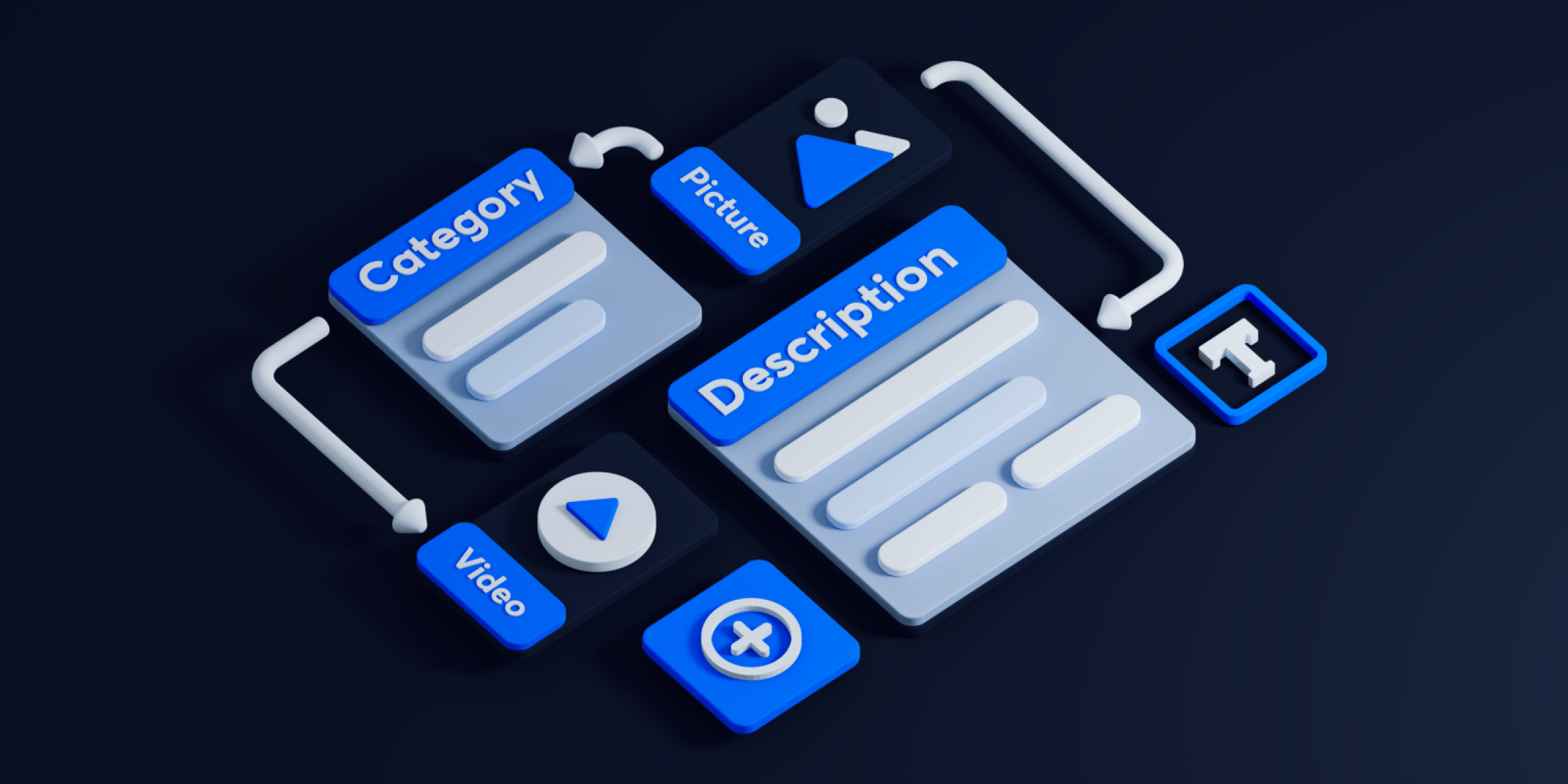
Above is an example of a mid-fidelity content model, which offers some idea of what a finished layout might look like but doesn’t dictate design. A high-fidelity content model might resemble a wireframe, while the most basic content models simply list the hierarchy of content elements on a page.
What is a content type?
A content type is a reusable collection of data used to create structured content. Using a single template, you can create multiple pieces of content that follow the same format. In a content model, content types are defined first to find their relationships with other content types.
For example, in the context of a project lifecycle, a project plan template can be a content type that is used to create a timeline for the execution of that project. When you start a new project, you reuse the same template to create a new timeline.
What makes a good content model?
There are good content models and there are bad ones. Here are common traits that make a content model good for cross-functional teams.
Enables content reusability
By identifying content types for your content model, you enable reusability. For example, you may create an author content type that contains the content attributes name, age, image, and designation. You can then reuse this type for any piece of content that the author writes.
Allows for efficient content management
A robust content model takes time to build but allows you to efficiently manage the system as your content grows. Take an example of a website that has a bunch of blog posts explaining the features of a product that you sell.
When you make changes to the product’s features, a robust content model will allow you to efficiently generate changes to all blog posts. Teams are required to do it manually without content models.
Is responsive, adaptive, and flexible
A content model captures each content type and attribute at a granular level. This helps multiple teams (UI designers, developers, content creators) to focus on the details when designing or building a feature. The result is a unified workflow for content creation that produces responsive, adaptive, and flexible content.
Supports multi-channel distribution
A content model forces teams to pay attention to how and where content is distributed and consumed. It enforces modularity and adaptiveness, enabling content distribution across multiple channels seamlessly.
Emphasize usability for authors
Authors create content items using content types identified during content modeling. For instance, an artist uses a brush content type to create a logo, an illustration, or a sketch. The content item is defined once but used by different authors for a wide range of use cases.
What is Not a Content Model?
Think of a content model as the cup you pour coffee into. The liquid is anything you place inside a content model—the content.
Anything poured into the cup (content model) should have a defined output, which in this case is consuming the coffee (creating consumable content).
[A content model is not](https://www.webstacks.com/blog/7-content-modeling-pitfalls-you-must-avoid):
• A site map depicting a top-down view of website pages
• A navigational scheme for describing how users get from point A to B
• Page types outlining how content should be laid out on a page.
When working with content models, forget about pages and websites altogether. Maybe you start there.
Content needs to be meaningful to use in different contexts beyond—that requires a fully functional content model.
Common Content Modeling Misconceptions
Content modeling empowers multiple teams to develop user experiences seamlessly, and without starting ([View Highlight](https://read.readwise.io/read/01j7gx0mexz0e0a0c93av1sr6d))