Defendants’ and Counterclaimants’ Administrative Motion to Seal
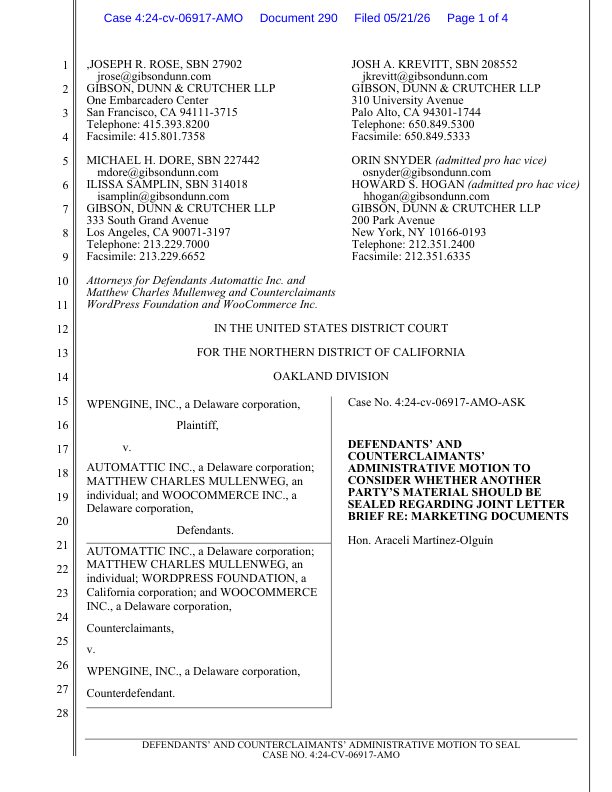
🔗 **Source:** [Defendants’ and Counterclaimants’ Administrative Motion to Seal](https://storage.courtlistener.com/recap/gov.uscourts.cand.437474/gov.uscourts.cand.437474.290.0.pdf)
> [!note]+ Document Notes
> tags: [wp-engine-automattic, discovery-dispute, sealing-motion, protective-order, marketing-documents, wordpress-governance, confidential-designation, civil-procedure]
> author: Gibson Dunn & Crutcher LLP (for WordPress Parties)
> source: CourtListener RECAP - N.D. Cal. 4:24-cv-06917-AMO
> filing_type: motion
> docket: 290.0
>
> # 🏷️ Administrative Motion to Seal WP Engine's Confidential Marketing Materials
>
> # 🧭 Table of Contents
> 1. [References](#references)
> 2. [Summary](#summary)
> 3. [Main Content](#main-content)
> 4. [Governance Digest](#governance-digest)
> 5. [Analysis Sections](#analysis-sections)
> 6. [Refactor Appendix](#refactor-appendix)
>
> # 🔗 References
> - **Dockets**: 290.0 (this motion)
> - **Local Rules**: N.D. Cal. Civil L.R. 7-11, 79-5(f), 79-5(f)(3), 5-5(a)
> - **Federal Rules**: Fed. R. Civ. P. 5(b)
> - **Court Orders**: Protective Order (Paragraphs 7.2, 7.3)
>
> # 📝 Summary
>
> This administrative motion seeks court approval to seal WP Engine's confidentially-designated marketing documents that WordPress Parties must reference in their joint letter brief about marketing evidence. The filing demonstrates the procedural complexity arising when one party's confidential business materials become central to the other side's legal arguments about WordPress ecosystem governance. WordPress Parties (Automattic, Mullenweg, WordPress Foundation, WooCommerce) are caught between their obligation to cite relevant evidence and the protective order prohibiting public disclosure of WP Engine's competitively sensitive materials. The motion reveals that marketing documents—likely showing WP Engine's commercial positioning relative to WordPress—are significant enough evidence to warrant a joint letter brief, suggesting these materials may illuminate the governance/commercialization tensions at the heart of this dispute.
>
> # 📖 Main Content
>
<!-- deep-read:sections start -->
## 🗒️ Notes
**Procedural Posture**: WordPress Parties invoke Civil Local Rule 79-5(f), which allows a "Filing Party" to seek sealing when referencing materials designated confidential by another party (the "Designating Party"). This is defensive sealing—not to protect their own secrets, but to comply with WP Engine's confidentiality designations.
**Scope of Sealed Materials**: Six documents/exhibits entirely under seal, plus highlighted portions of the joint letter brief and Hogan declaration. WP Engine designated materials as both "CONFIDENTIAL" and "HIGHLY CONFIDENTIAL-ATTORNEYS' EYES ONLY," indicating varying sensitivity levels.
**Strategic Context**: The underlying joint letter brief concerns "marketing documents," suggesting these materials address how parties position themselves commercially within the WordPress ecosystem—directly relevant to claims about trademark use, market confusion, and competitive practices.
**Governance Implications**: Marketing materials likely reveal how commercial entities navigate the open-source/commercial boundary that WordPress Foundation ostensibly polices through trademark control. The confidential designation suggests competitively sensitive information about business strategies within the WordPress ecosystem.
**Procedural Safeguards**: WordPress Parties file provisionally under seal and notify WP Engine of its right to respond under Civil L.R. 79-5(f)(3), demonstrating careful compliance with protective order requirements while preserving their ability to reference relevant evidence.
# 📚 References
- Civil Local Rule 79-5(f) (sealing motions for another party's confidential materials)
- Protective Order Paragraphs 7.2-7.3 (confidentiality designations)
- Declaration of Howard Hogan (supporting sealing motion)
- Joint Letter Brief regarding marketing documents (underlying substantive filing)
# 🗣️ Paraphrase
WordPress defendants need to discuss WP Engine's marketing materials in a court filing, but WP Engine marked those materials as confidential business secrets during discovery. Rather than risk violating the court's protective order by accidentally making WP Engine's secrets public, WordPress defendants are asking the judge whether those materials should stay sealed. They're essentially saying: "We need to talk about these documents to make our legal arguments, but the other side says they're secret, so please tell us whether we can discuss them publicly or if they should remain confidential." This creates a procedural hurdle where parties must seek permission before referencing evidence that one side considers commercially sensitive.
# 📰 Governance Digest
WordPress defendants want to use WP Engine's marketing documents in their legal arguments, but those documents are marked confidential. They're asking the judge whether to keep them secret or make them public. This suggests WP Engine's marketing materials contain juicy details about how commercial companies position themselves in the WordPress world—exactly the kind of information that could shed light on whether the WordPress Foundation actually maintains independent control over WordPress trademarks, or whether commercial interests drive decisions. The fact that marketing docs need their own court filing hints that how these companies sell WordPress services might be central to determining who really controls the WordPress ecosystem.
# 🧪 Hypotheses
1. **Marketing Materials Reveal Governance Contradictions**: WP Engine's confidential marketing likely shows commercial positioning that contradicts WordPress Foundation's claimed independent governance role.
2. **Confidentiality Designations Are Strategic**: WP Engine's broad confidentiality claims may seek to prevent public exposure of how commercial entities actually operate within WordPress governance structures.
3. **Evidence Centrality**: Marketing documents are sufficiently important to WordPress Parties' defense that they warrant procedural complexity, suggesting these materials directly address core governance/trademark claims.
4. **Protective Order Effectiveness**: The careful sealing procedure demonstrates that discovery protective orders successfully balance transparency needs with legitimate business confidentiality in open-source governance disputes.
# 📊 Methodology
**Procedural Basis**: Administrative motion under Civil Local Rule 79-5(f) with supporting Declaration of Howard Hogan. The methodology relies on protective order compliance rather than independent factual investigation.
**Evidentiary Foundation**: Howard Hogan declaration presumably establishes personal knowledge of confidentiality designations and necessity for referencing sealed materials in substantive briefing.
**Legal Framework**: Motion applies established civil procedure for handling another party's confidential materials in litigation context, demonstrating institutional mechanisms for balancing transparency with business confidentiality.
# ❓ Questions
1. What specific marketing claims or positioning statements make WP Engine's materials worth the procedural complexity of a sealing motion?
2. How do WP Engine's marketing materials contradict or support WordPress Foundation's claims of independent trademark governance?
3. Will WP Engine oppose unsealing under Civil L.R. 79-5(f)(3), and what arguments might they advance?
4. Do the marketing documents reveal coordination between WP Engine and Silver Lake that affects WordPress ecosystem governance?
5. How broadly has WP Engine designated discovery materials as confidential, and is this designation reasonable?
# 🔮 Future Research
**Litigation Threads**: Monitor WP Engine's response to sealing motion and substantive arguments in the joint letter brief about marketing documents. Track judicial resolution of confidentiality disputes and their impact on public understanding of governance issues.
**WordPress Governance**: Investigate how commercial entities' marketing strategies affect open-source project governance, particularly trademark enforcement and ecosystem control. Examine whether protective orders in governance disputes systematically favor commercial confidentiality over public transparency.
**Discovery Patterns**: Analyze broader confidentiality designation patterns in this litigation to determine whether parties are over-designating materials to limit public scrutiny of governance practices.
# 💡 Implications
**Practice**: Establishes procedural template for handling confidential business materials in open-source governance disputes, balancing litigation needs with commercial confidentiality.
**Policy**: Highlights tension between public interest in understanding open-source governance and legitimate business confidentiality needs in commercial disputes.
**Security**: Demonstrates protective order effectiveness in preventing inadvertent disclosure of competitively sensitive information during complex litigation.
**Education**: Shows WordPress community that governance disputes involve commercially sensitive information that may not become publicly available despite litigation's generally public nature.
# 🧠 Learning Styles Assessment
**Visual**: Document structure with clear attachment tables and procedural flowcharts supports visual learners. **Aural**: Limited audio learning opportunities in written motion format. **Verbal**: Legal terminology and procedural language may challenge general readers. **Kinesthetic**: No hands-on elements available. **Logical**: Strong logical progression through procedural requirements and rule citations. **Social**: References collaborative "Joint Letter Brief" but limited social learning aspects. **Solitary**: Suitable for individual analysis and research. **Naturalistic**: Limited pattern recognition opportunities in procedural filing.
**Reading Level**: Graduate/professional level due to legal terminology and procedural complexity.
# 📊 Accessibility Assessment
**Text Extraction**: Fully text-extractable PDF with proper OCR. **Structure**: Clear headings, numbered sections, and organized attachment tables. **Artifacts**: Minimal table formatting artifacts; docket headers present but non-intrusive. **WCAG 2.2 AA**: Meets standards with clear hierarchy and readable fonts, though legal terminology may challenge comprehension.
# 🌍 DEIB Assessment
**Cultural Breadth**: Limited cultural considerations in procedural filing. **Inclusive Language**: Uses standard legal terminology without exclusionary language. **Neurodiversity Support**: Clear structure and explicit section organization support diverse cognitive approaches. **Representation**: Legal team diversity not apparent from filing. **Psychological Safety**: Formal legal tone maintains professional boundaries.
# ✅ Logical Validity
**Strong Reasoning**: Sound application of Civil Local Rules with appropriate procedural safeguards. Clear identification of confidentiality designations and compliance requirements.
**Fallacies**: None identified - procedural motion follows established legal framework without argumentative overreach.
**Tone**: Professional, procedural, appropriately formal for court filing without unnecessary complexity or advocacy.
# 🛡️ DARVO Analysis
Not applicable to this procedural filing - administrative motion focuses on discovery compliance rather than substantive dispute characterization.
# 🎯 Conclusion
This sealing motion reveals that WP Engine's marketing materials are central enough to WordPress Parties' defense strategy to warrant complex procedural maneuvering. The careful attention to confidentiality compliance suggests these documents contain competitively sensitive information about commercial positioning within the WordPress ecosystem—exactly the kind of evidence that could illuminate whether WordPress Foundation exercises truly independent governance or operates under commercial influence. Watch for WP Engine's response to the sealing motion and the substantive arguments in the underlying joint letter brief, which should reveal how marketing strategies intersect with governance claims in this high-stakes dispute over WordPress ecosystem control.
# 🧱 Refactor Appendix
## 📚 Literature Atoms
> [!quote] "Civil Local Rule 79-5(f) authorizes a 'Filing Party' to seek to seal a document where it is a document (or contains references to a document) that 'has been designated as confidential by another party' (i.e., a 'Designating Party')."
Establishes procedural framework for protecting another party's confidential materials while maintaining litigation transparency.
> [!quote] "Paragraphs 7.2 and 7.3 of the Protective Order prohibit a party from filing in the public record any discovery material (or documents containing references to same) that has been designated as 'CONFIDENTIAL' or 'HIGHLY CONFIDENTIAL-ATTORNEYS' EYES ONLY.'"
Demonstrates protective order effectiveness in preventing inadvertent disclosure during complex litigation.
> [!quote] "the WordPress Parties seek the Court's consideration of whether these materials should be sealed, and provisionally file them under seal solely to comply with the Protective Order and to facilitate WP Engine filing a statement regarding sealing"
Shows defensive sealing strategy—compliance-driven rather than strategic concealment.
#### 🧠 Permanent Candidates
- **Defensive Sealing**: Procedural mechanism for complying with another party's confidentiality designations while preserving right to reference relevant evidence
- **Marketing Document Centrality**: Evidence that commercial positioning materials are significant to governance dispute resolution
- **Protective Order Compliance**: Institutional balance between litigation transparency and business confidentiality protection
## ✏️ Fleeting Queue
- Connection between marketing strategies and trademark governance claims
- WP Engine's confidentiality designation patterns as potential over-designation
- Silver Lake involvement in WP Engine marketing positioning
- WordPress Foundation independence claims versus commercial marketing realities
<!-- deep-read:sections end -->
📄 **Full text:** ![[Full Document Contents/Articles/Defendants’ and Counterclaimants’ Administrative Motion to Seal.md|Defendants’ and Counterclaimants’ Administrative Motion to Seal by Joseph P. Rose, Michael H. Dore, Ilissa Samplin, Josh A. Krevitt, Orin Snyder, Howard S. Hogan, Matt...]]
## Highlights
- 7 8 9 10 11 12 13 14 15 16 17 18 19 20 N.D. Cal. Civil Local Rule 79-5(f) authorizes a "Filing Party" to seek to seal a document where it is a document (or contains references to a document) that "has been designated as confidential by another party" (i.e., a "Designating Party"). The Letter Brief and certain other supporting documents—namely, the Declaration of Howard Hogan (the "Hogan Declaration") and Exhibits 1 through 5 to the Hogan Declaration—contain citations and references to materials that WP Engine—not the WordPress Parties—has designated as "CONFIDENTIAL" or "HIGHLY CONFIDENTIAL-ATTORNEYS' EYES ONLY" pursuant to Paragraphs 7.2 and 7.3 of the Protective Order. Paragraphs 7.2 and 7.3 of the Protective Order prohibit a party from filing in the public record any discovery material (or documents containing references to same) that has been designated as "CONFIDENTIAL" or "HIGHLY CONFIDENTIAL-ATTORNEYS' EYES ONLY." Pursuant to Civil Local Rule 79-5(f), the WordPress Parties seek the Court's consideration of whether these materials should be sealed, and provisionally file them under seal solely to comply with the Protective Order and to facilitate WP Engine filing a statement regarding sealing pursuant to N.D. Cal. Civil Local Rule 79-5(f)(3) (should WP Engine choose to do so). ([View Highlight](https://read.readwise.io/read/01ksfvf6hhfrz0b39cg6wmjbv8))
- Note: Docket 290: WordPress Parties seek to seal WPE-designated material referenced in the Hogan Declaration.
- Tags: wp-engine-automattic, legal