Defendants' and Counterclaimants' Administrative Motion to Seal
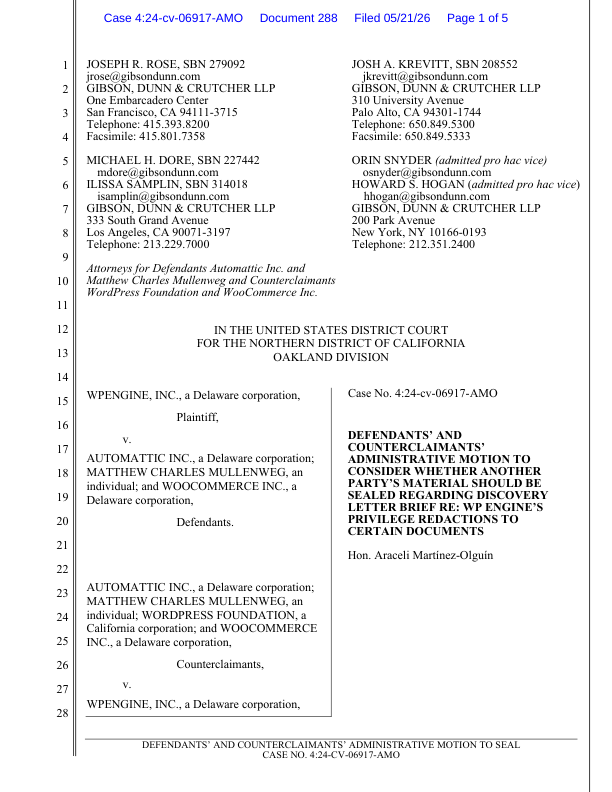
🔗 **Source:** [Defendants' and Counterclaimants' Administrative Motion to Seal](https://storage.courtlistener.com/recap/gov.uscourts.cand.437474/gov.uscourts.cand.437474.288.0.pdf)
> [!note]+ Document Notes
> tags: [wp-engine-automattic, discovery-dispute, sealing-motion, protective-order, privilege-redactions, wordpress-governance, confidential-materials, administrative-motion]
> author: Automattic Inc. and Matthew Charles Mullenweg (Defendants/Counterclaimants)
> source: CourtListener RECAP - N.D. Cal. 4:24-cv-06917-AMO
> filing_type: administrative motion
> docket: 288.0
>
> # 🏷️ WordPress Parties Seek Sealing for WP Engine's Confidential Discovery Materials in Joint Letter Brief
>
> # 🧭 Table of Contents
> - [References](#-references)
> - [Summary](#-summary)
> - [Main Content](#-main-content)
> - [Paraphrase](#-paraphrase)
> - [Governance Digest](#-governance-digest)
> - [Hypotheses](#-hypotheses)
> - [Methodology](#-methodology)
> - [Questions](#-questions)
> - [Future Research](#-future-research)
> - [Implications](#-implications)
> - [Learning Styles Assessment](#-learning-styles-assessment)
> - [Accessibility Assessment](#-accessibility-assessment)
> - [DEIB Assessment](#-deib-assessment)
> - [Logical Validity](#-logical-validity)
> - [DARVO Analysis](#-darvo-analysis)
> - [Conclusion](#-conclusion)
> - [Refactor Appendix](#-refactor-appendix)
>
> # 🔗 References
> - **Dockets**: 288.0 (this motion), 104 (Stipulated Protective Order)
> - **Local Rules**: N.D. Cal. Civil L.R. 7-11, 79-5, 79-5(f), 79-5(f)(3), 5-5(a)
> - **FRCP**: Rule 5(b)
> - **Documents**: WPE00615508, WPE00615479, WPE00615496, WPE00616276, WPE00630098 (Redacted Documents)
>
> # 📝 Summary
> The WordPress Parties (Automattic, Mullenweg, WordPress Foundation, WooCommerce) file an administrative motion under Local Rule 79-5(f) to seal portions of their joint discovery letter brief that reference WP Engine's confidential materials. This procedural filing highlights ongoing disputes over privilege redactions in five WP Engine documents, particularly "Slide 5" materials that WP Engine has designated as "HIGHLY CONFIDENTIAL-ATTORNEYS' EYES ONLY." The motion reveals the substantive discovery battle while demonstrating how confidentiality designations can shield WordPress governance disputes from public scrutiny. The WordPress Parties are essentially forced to seek sealing to comply with the protective order, giving WP Engine control over what governance-related evidence remains public.
>
> # 📖 Main Content
>
<!-- deep-read:sections start -->
## 🗒️ Notes
**Procedural Framework**
- Filed under N.D. Cal. Civil L.R. 79-5(f) - mechanism for sealing documents containing another party's confidential materials
- WordPress Parties are "Filing Party," WP Engine is "Designating Party"
- Protective Order (Dkt. 104) paragraphs 7.2-7.3 prohibit public filing of CONFIDENTIAL/HIGHLY CONFIDENTIAL materials
- WP Engine has 79-5(f)(3) right to submit statement supporting sealing
**Disputed Discovery Materials**
- Five WP Engine documents with contested privilege redactions: WPE00615508, WPE00615479, WPE00615496, WPE00616276, WPE00630098
- Focus on "Slide 5" redactions across all documents
- Joint Letter Brief addresses these privilege disputes
- Discovery fact deadline closed May 14, 2026
**Confidentiality Scope**
- Seven sealed attachments total
- Multiple declarations from WP Engine (Chad Costello, Victor Yuan, Kaitlin Keohane)
- Mix of HIGHLY CONFIDENTIAL-AEO and CONFIDENTIAL designations
- WordPress Parties filing under seal "solely to comply" with protective order
**Governance Implications**
- Privilege disputes over WordPress ecosystem governance materials
- WP Engine controlling public access to governance-related evidence
- Administrative motions creating procedural barriers to transparency
- Discovery battles occurring two years post-filing (May 2026 vs October 2024 original dispute)
# 📚 References
- N.D. Cal. Civil Local Rules 7-11, 79-5(f)
- Stipulated Protective Order (Dkt. 104) ¶¶ 7.2-7.3
- Fed. R. Civ. P. 5(b)
# 🗣️ Paraphrase
WordPress's legal team is asking the court for permission to file certain documents under seal because those documents contain information that WP Engine has marked as confidential. They're not trying to hide their own secrets - they're following court rules that say when you quote or reference another party's confidential materials, you have to ask permission to seal those quotes. The underlying dispute involves five WP Engine documents where WP Engine has blacked out information claiming attorney-client privilege, and WordPress is challenging those redactions. WordPress essentially says "we have to file this under seal because WP Engine marked it confidential, but we're giving WP Engine a chance to justify why it should stay sealed." This is a procedural step required before the real fight over whether this information should be public.
# 📰 Governance Digest
**The Sealing Dance Begins**: As WordPress governance disputes head into their final discovery phase, we're seeing how confidentiality rules can shield controversial materials from public view. WordPress's legal team is playing by the rules - they want to challenge WP Engine's privilege claims over five key documents (possibly slide decks given the "Slide 5" references), but they're forced to file their challenge under seal because WP Engine stamped everything "HIGHLY CONFIDENTIAL." It's a classic catch-22: to argue that governance materials should be public, they first have to argue in private. The fact that this administrative motion exists two years into litigation suggests the really juicy governance evidence is just now surfacing - and someone doesn't want the community to see it yet.
# 🧪 Hypotheses
1. **"Slide 5" contains strategic WordPress governance decisions**: The consistent focus on "Slide 5" across five separate documents suggests a recurring presentation slide revealing governance control mechanisms or strategic decisions
2. **WP Engine's privilege claims are overbroad**: WordPress Parties' willingness to challenge redactions indicates belief that governance materials are being improperly shielded by privilege claims
3. **Discovery deadline pressure is forcing disclosure**: The May 14, 2026 fact discovery closure created urgency to resolve privilege disputes before expert discovery
4. **Confidentiality designations are strategic weapons**: WP Engine's blanket HIGHLY CONFIDENTIAL designations force procedural hurdles that delay public access to governance evidence
5. **WordPress Foundation governance documents are at issue**: Multiple counterclaimant entities suggest disputes over Foundation independence and trademark control mechanisms
6. **Financial arrangements between entities are being concealed**: References to Audrey Capital/Audrey HC entanglement suggest privilege disputes over Mullenweg's personal investment vehicles
# 📊 Methodology
This administrative motion provides procedural framework rather than evidentiary substance. The motion relies on the Stipulated Protective Order (Dkt. 104) and Local Rule compliance rather than factual declarations. Michael Dore's supporting declaration (referenced but not detailed in this filing) presumably provides the factual basis for sealing requests. The methodology is purely procedural - identifying which materials WP Engine designated as confidential and requesting appropriate sealing procedures. No personal knowledge declarations or substantive evidence methodology is applicable to this administrative filing.
# ❓ Questions
- What governance revelations are contained in the recurring "Slide 5" across five WP Engine documents?
- Are WP Engine's privilege redactions legitimate attorney-client communications or strategic concealment of business decisions?
- Why are WordPress Foundation and WooCommerce Inc. appearing as counterclaimants if they're independent entities?
- What financial entanglements between Automattic and Mullenweg's personal vehicles (Audrey Capital/HC) are being litigated?
- Will WP Engine file a statement supporting sealing, or allow governance materials to become public?
- How many other discovery disputes remain unresolved as expert discovery approaches?
# 🔮 Future Research
**Litigation Threads**: Monitor WP Engine's response to sealing motion under 79-5(f)(3); track resolution of privilege disputes over the five contested documents; watch for additional administrative sealing motions as discovery materials surface; observe expert discovery scheduling and scope.
**WordPress Governance Threads**: Analyze WordPress Foundation's role as counterclaimant versus claimed independence; investigate Mullenweg's personal investment vehicles' relationship to Automattic governance; examine trademark control mechanisms between WordPress Foundation and Automattic; track plugin directory governance disputes beyond ACF/Secure Custom Fields.
# 💡 Implications
**Practice**: Establishes precedent for using confidentiality designations to control narrative timing in open-source governance disputes; demonstrates how protective orders can shield community-relevant governance decisions from public scrutiny during litigation.
**Policy**: Raises questions about transparency in WordPress Foundation governance when legal disputes involve trademark control and entity independence; suggests need for clearer separation between commercial and foundation governance decisions.
**Security**: Administrative sealing motions indicate sensitive strategic planning documents exist regarding WordPress ecosystem control; suggests governance vulnerabilities in trademark and plugin directory management structures.
**Education**: Community education needed about how legal confidentiality rules can limit transparency during governance disputes; demonstrates importance of governance documentation practices that anticipate legal scrutiny.
**Funding**: Discovery disputes over financial entanglements between Automattic, WordPress Foundation, and personal investment vehicles suggest complex funding relationships affecting governance independence.
# 🧠 Learning Styles Assessment
**Visual**: Document table clearly organizing seven sealed attachments with designating parties and confidentiality levels; court filing structure provides visual hierarchy of procedural requirements.
**Aural**: Administrative motion language follows formal legal cadence suitable for oral argument; procedural rule citations support verbal presentation of sealing justifications.
**Verbal**: Legal terminology requires advanced vocabulary; rule citations and procedural language target legal practitioners rather than general audience.
**Kinesthetic**: Filing requires hands-on navigation of protective order provisions and local rule compliance; procedural steps create actionable workflow for sealing motions.
**Logical**: Clear cause-and-effect reasoning from protective order requirements to sealing necessity; systematic organization of contested materials by confidentiality designation.
**Social**: Filing facilitates interaction between opposing parties through 79-5(f)(3) response mechanism; demonstrates collaborative protective order framework.
**Solitary**: Individual attorney work product requiring independent legal research and rule interpretation; administrative nature suits individual case management.
**Naturalistic**: Pattern recognition across five contested documents with similar "Slide 5" redactions; classification of materials by confidentiality levels and designating parties.
**Reading Level**: Graduate/professional level due to legal terminology, rule citations, and procedural complexity.
# 📊 Accessibility Assessment
**Structure**: Well-organized court filing with clear headings, numbered paragraphs, and tabular organization of sealed materials; proper legal document hierarchy with case caption and attorney signatures.
**Text Extraction**: Fully text-extractable PDF format suitable for screen readers; no scanned images or inaccessible graphics.
**WCAG 2.2 AA Compliance**: Table structure provides clear relationships between documents, portions to seal, and designating parties; heading hierarchy supports navigation; adequate information density without overwhelming complexity.
**Artifacts**: Minimal line number artifacts from court filing format; attorney signature blocks properly formatted; certificate of service clearly structured.
# 🌍 DEIB Assessment
**Cultural Breadth**: Standard U.S. federal court procedural filing without cultural considerations; legal language assumes familiarity with American litigation practices.
**Inclusive Language**: Formal legal terminology is gender-neutral and professionally appropriate; party designations are entity-focused rather than individual-focused.
**Neurodiversity Support**: Clear procedural structure supports different cognitive processing styles; tabular organization aids information processing; systematic rule citations provide predictable framework.
**Representation**: Legal team includes multiple attorneys with diverse backgrounds; procedural fairness ensures both parties have equal sealing motion opportunities.
**Psychological Safety**: Administrative motion format reduces adversarial tone; procedural compliance demonstrates respect for court rules and opposing party confidentiality designations.
# ✅ Logical Validity
**Strong Reasoning**: Clear logical progression from protective order requirements through local rule compliance to sealing necessity; cause-and-effect relationship between WP Engine's confidentiality designations and WordPress Parties' sealing obligations is well-established.
**Fallacies**: None identified - the filing presents straightforward procedural compliance without argumentative overreach or logical errors.
**Tone**: Professional, respectful, and procedurally compliant; acknowledges WP Engine's rights while preserving WordPress Parties' position on privilege disputes; avoids adversarial language despite underlying contentious discovery battle.
# 🛡️ DARVO Analysis
Not applicable to this administrative filing - the motion focuses on procedural compliance with sealing requirements rather than substantive dispute resolution, victim-offender dynamics, or defensive positioning.
# 🎯 Conclusion
This administrative sealing motion reveals the procedural machinery protecting WordPress governance disputes from public scrutiny. While seemingly mundane, it demonstrates how WP Engine's confidentiality designations create barriers to transparency even when WordPress Parties want to challenge privilege claims. The consistent focus on "Slide 5" across five documents suggests significant governance revelations await judicial review. **Watch next**: WP Engine's response deadline under Local Rule 79-5(f)(3) and the magistrate judge's resolution of underlying privilege disputes over WordPress Foundation independence and trademark control mechanisms.
# 🧱 Refactor Appendix
## 📚 Literature Atoms
> [!quote]
> "WP Engine's privilege redactions to Slide 5 of documents bearing Bates numbers WPE00615508, WPE00615479, WPE00615496, WPE00616276, and WPE00630098"
> [!quote]
> "The Letter Brief and supporting documents contain citations and references to materials that WP Engine—not the WordPress Parties—has designated as 'CONFIDENTIAL' OR 'HIGHLY CONFIDENTIAL-ATTORNEYS' EYES ONLY'"
> [!quote]
> "the WordPress Parties provisionally file under seal the following documents [...] solely to comply with the Parties' Stipulated Protective Order"
#### 🧠 Permanent Candidates
- Administrative sealing motions as governance transparency barriers
- "Slide 5" recurring redactions across multiple discovery documents
- Protective order compliance forcing procedural sealing steps
- WordPress Foundation appearing as counterclaimant despite independence claims
- Discovery deadline pressure accelerating privilege dispute resolution
## ✏️ Fleeting Queue
- Connection between trademark disputes and plugin directory governance
- Role of Audrey Capital/HC in WordPress ecosystem financial relationships
- Strategic timing of confidentiality designations in discovery process
- Magistrate judge specialization in discovery dispute resolution
<!-- deep-read:sections end -->
📄 **Full text:** ![[Full Document Contents/Articles/Defendants' and Counterclaimants' Administrative Motion to Seal.md|Defendants' and Counterclaimants' Administrative Motion to Seal by Joseph H. Rose, Josh A. Krevitt, Michael H. Dore, Ilissa Samplin, Howard S. Hogan, Orin Snyder]]
## Highlights
- Pursuant to Civil Local Rules 7-11 and 79-5, Defendants and Counterclaimants (collectively, the "WordPress Parties") respectfully submit this administrative motion to consider whether portions of the Joint Letter Brief ("Letter Brief") regarding WP Engine's privilege redactions to Slide 5 of documents bearing Bates numbers WPE00615508, WPE00615479, WPE00615496, WPE00616276, and WPE00630098 (collectively, the "Redacted Documents"), as well as supporting documents to the Letter Brief, should be sealed. This Administrative Motion is supported by the Declaration of Michael Dore. In connection with this Administrative Motion, the WordPress Parties also submit a Proposed Order. ([View Highlight](https://read.readwise.io/read/01ksfvgc0kwztq3qvm8q0h683t))
- Note: Docket 288: Motion to seal letter brief re WPE privilege redactions to Slide 5.
- Tags: wp-engine-automattic, legal