FAIR, WordPress, and Knowing When to Stop
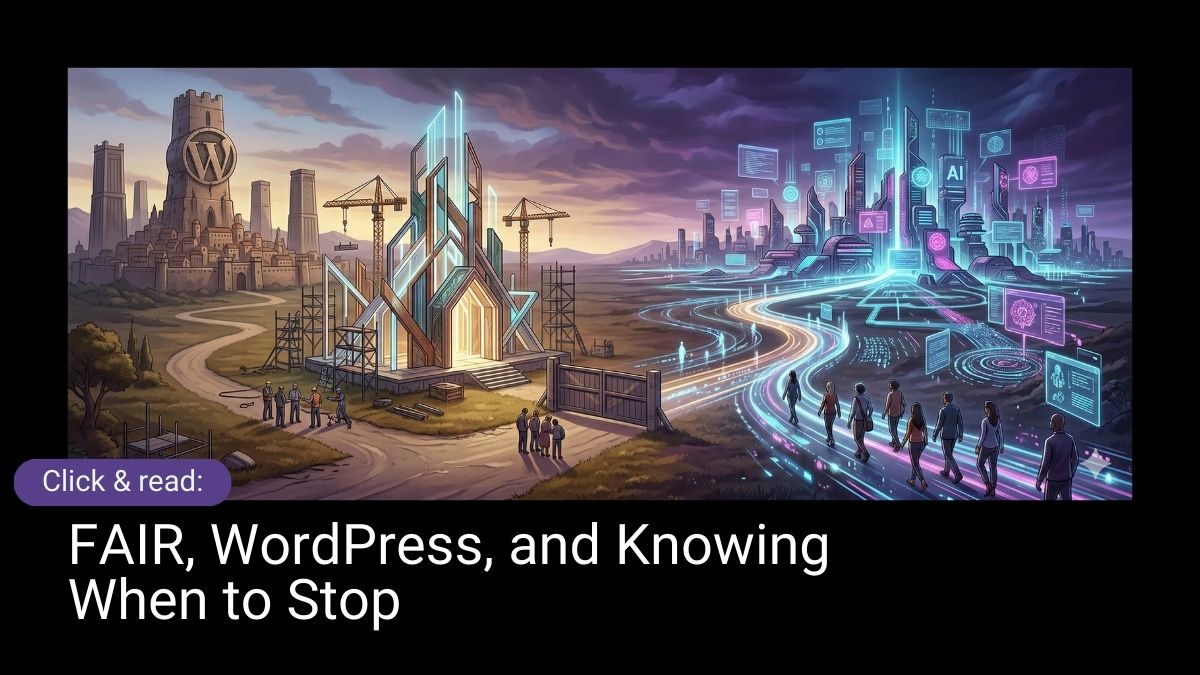
🔗 **Source:** [FAIR, WordPress, and Knowing When to Stop](https://joost.blog/fair-wordpress-and-knowing-when-to-stop/)
> [!note]+ Document Notes
> tags: [wordpress, open-source, governance, infrastructure, package-management]
> author: Joost de Valk
> source: joost.blog
> reference: https://joost.blog/fair-wordpress-and-knowing-when-to-stop/
> date created: 2024-12-19 14:30
>
> # 🏷️ Title: FAIR, WordPress, and Knowing When to Stop
>
<!-- deep-read:sections start -->
## 🧰 Action Inbox
- [H1] Study FAIR's technical architecture for future package management projects — viable working model developed #open-source
- [H2] Analyze hosting company incentives for infrastructure investment — economic misalignment identified #governance
- [H3] Evaluate AI impact on WordPress competitive landscape — strategic focus shift needed #wordpress
## 🧭 Table of Contents
- [📝 Summary](#-summary)
- [📖 Main Content](#-main-content)
- [🗒️ Notes](#️-notes)
- [📚 References](#-references)
- [🗣️ Paraphrase](#️-paraphrase)
- [📰 Newsletter](#-newsletter)
- [✅ Action Items](#-action-items)
- [🧪 Hypotheses](#-hypotheses)
- [📊 Methodology](#-methodology)
- [❓ Questions](#-questions)
- [🔮 Future Research](#-future-research)
- [💡 Implications](#-implications)
- [🧠 Learning Styles Assessment](#-learning-styles-assessment)
- [📊 Accessibility Assessment](#-accessibility-assessment)
- [🌍 DEIB Assessment](#-deib-assessment)
- [✅ Logical Validity](#-logical-validity)
- [🛡️ DARVO Analysis](#-darvo-analysis)
- [🎯 Conclusion](#-conclusion)
### 🔗 References
- [FAIR Project](https://joost.blog/fair-wordpress-and-knowing-when-to-stop/)
- [Linux Foundation](https://www.linuxfoundation.org/)
## 📝 Summary
- Joost de Valk and Karim announce they're ending FAIR's WordPress initiative due to lack of ecosystem investment
- FAIR was a Linux Foundation project to create neutral, community-governed WordPress package management
- Hosting companies refused to invest despite technical success, citing cost and risk concerns
- Authors acknowledge Matt Mullenweg's point about ecosystem contribution imbalances while criticizing his methods
- AI disruption shifts strategic priorities away from governance battles toward adaptation challenges
- FAIR will continue with TYPO3 community support focusing on digital sovereignty needs
## 📖 Main Content
FAIR (a neutral package management system under the Linux Foundation) has achieved technical success but is ending its WordPress focus due to lack of ecosystem investment. Despite creating a viable alternative to WordPress.org's centralized infrastructure, hosting companies and major players refused financial commitment.
The authors maintain their criticism of WordPress leadership's harmful methods while gaining uncomfortable empathy for the underlying economic problem: companies benefit from WordPress without proportional contribution. This misaligned incentive structure became clear when hosts wouldn't invest in neutral stability infrastructure.
AI's transformation of web publishing changes the competitive landscape fundamentally. WordPress now competes with AI-native builders and automated content systems, making governance battles less strategically relevant than adaptation challenges.
FAIR continues with TYPO3, addressing European digital sovereignty needs. The WordPress experiment clarified that without ecosystem funding, structural neutrality cannot materialize through individual effort alone.
## 🗒️ Notes
#### Introduction — [H1] FAIR WordPress Initiative Ends
- Key idea: Despite technical success, FAIR stops WordPress work due to lack of ecosystem investment
- Evidence: "Even when you build a credible alternative, you still need a broader ecosystem willing to step up"
#### FAIR's Purpose — [H2] Structural Risk Response
- Key idea: FAIR addressed WordPress ecosystem fragility from centralized control
- Evidence: "When key infrastructure or distribution mechanisms are dependent on a single commercial entity, the entire ecosystem becomes fragile"
#### Technical Achievement — [H3] Working Model Created
- Key idea: Project achieved viable technical alternative in short timeframe
- Evidence: "Over the second half of the year, the project achieved technical success. Today, it is a viable technical alternative"
#### Economic Reality — [H1] Host Investment Refusal
- Key idea: Hosting companies refuse infrastructure investment despite revenue dependence
- Evidence: "Investment means commitment. It means cost. It means stepping into political tension. And most of all, it means risk"
#### Uncomfortable Empathy — [H2] Understanding Matt's Frustration
- Key idea: Authors recognize validity of contribution imbalance concerns while opposing methods
- Evidence: "Too many companies benefit from WordPress without contributing proportionally. That the burden of maintaining core infrastructure falls on too few shoulders"
#### AI Disruption — [H1] Competitive Landscape Shift
- Key idea: AI transforms web publishing, changing WordPress's competitive context
- Evidence: "WordPress is no longer just competing with other CMS platforms. It's competing with AI-native site builders, automated content systems"
#### Strategic Pivot — [H2] Energy Redirection Needed
- Key idea: Governance battles less important than AI adaptation challenges
- Evidence: "The ecosystem needs to adapt to AI. To rethink workflows. To rethink value"
#### Decision Rationale — [H3] Constraint Recognition
- Key idea: Ending FAIR WordPress work is responsible constraint acknowledgment, not surrender
- Evidence: "Without hosting integration, including meaningful financial and structural support from key ecosystem players, the project is not viable"
#### Incentive Analysis — [H1] System-Level Understanding
- Key idea: Open source success requires aligned economic incentives, not just individual motivation
- Evidence: "Open source is not just code. It is a system of incentives"
#### TYPO3 Continuation — [H2] Digital Sovereignty Value
- Key idea: European community sees FAIR's value for digital independence
- Evidence: "In Europe, the concept of digital sovereignty is an incredibly hot topic, and an important part of that is being able to rely on package management servers"
#### Future Focus — [H3] Product Building Priority
- Key idea: Shift from governance battles to ecosystem advancement through products
- Evidence: "On building products that move the ecosystem forward, instead of fighting over its control structures"
#### Key Lesson — [H1] Neutrality Funding Requirement
- Key idea: Neutral infrastructure requires ecosystem funding commitment to materialize
- Evidence: "If the ecosystem won't fund neutrality, neutrality won't materialize"
## 📚 References
- [FAIR WordPress Project Announcement](https://joost.blog/fair-wordpress-and-knowing-when-to-stop/)
- [Linux Foundation](https://www.linuxfoundation.org/)
- [Yoast (Joost's former company)](https://yoast.com/)
## 🗣️ Paraphrase
- FAIR created a technically successful neutral package management system for WordPress but lacked the commercial backing needed for viability
- The WordPress ecosystem's economic incentives don't align for structural reform, with beneficiaries unwilling to invest in neutral infrastructure
- AI's disruption of web publishing makes governance battles less strategically important than helping the ecosystem adapt to new competitive realities
## 📰 Newsletter
The FAIR project - a promising attempt at creating neutral WordPress infrastructure under the Linux Foundation - is ending its WordPress focus due to a crucial lesson about open source economics.
Despite achieving technical success with a viable package management alternative, FAIR couldn't secure the hosting company investment needed for real-world viability. This highlights a fundamental challenge: when ecosystem benefits aren't matched by ecosystem investment, structural improvements remain aspirational.
The shift comes as AI transforms web publishing entirely, making adaptation more urgent than governance reform. FAIR continues with TYPO3, where European digital sovereignty needs create clearer value alignment.
For WordPress professionals, this underscores the importance of sustainable contribution models and the reality that technical excellence alone doesn't guarantee ecosystem adoption.
Resources: [Learn WordPress](https://learn.wordpress.org/), [Developer Docs](https://developer.wordpress.org/), [WP-CLI](https://wp-cli.org/)
## ✅ Action Items
#### OSPO
- Policy & Governance: Study FAIR's neutral governance model for future infrastructure projects
- Software Inventory: Analyze package management federation approaches for digital sovereignty
- Community Engagement: Document lessons on ecosystem investment alignment for neutral infrastructure
- Strategic Alignment: Evaluate AI disruption impact on open source CMS competitive positioning
#### WordPress
- Core: Assess AI integration priorities given competitive landscape shifts
- Meta: Review .org infrastructure resilience and community governance feedback mechanisms
- Community: Address contributor safety and trust concerns highlighted in governance criticism
- Hosting: Examine sustainable contribution models that align hosting revenue with infrastructure investment
#### Community
- Maintainers: Document sustainable funding models for neutral infrastructure projects
- Sponsors: Create transparent frameworks linking ecosystem benefits to proportional investment
- Ecosystem: Develop cross-project coordination for AI adaptation strategies
## 🧪 Hypotheses
- Neutral open source infrastructure requires proportional investment from commercial beneficiaries to achieve viability
- AI disruption of web publishing reduces the strategic importance of traditional CMS governance battles
- European digital sovereignty requirements create stronger incentives for federated package management than US market dynamics
- Technical excellence in open source infrastructure projects is insufficient without economic alignment
### 📊 Methodology
- Case study analysis comparing FAIR's WordPress vs TYPO3 adoption patterns
- Survey hosting companies on infrastructure investment decision criteria
- Competitive analysis of WordPress vs AI-native web publishing tools
- Economic modeling of open source contribution incentive structures
### ❓ Questions
- How can open source projects create sustainable funding models that align commercial benefits with infrastructure investment?
- What governance structures could address power concentration concerns while maintaining ecosystem stability?
- How should WordPress prioritize AI adaptation versus governance reform given limited resources?
### 🔮 Future Research
- Comparative study of digital sovereignty requirements across different regional markets
- Analysis of successful neutral infrastructure funding models in other open source ecosystems
- Investigation of AI's impact on traditional CMS competitive positioning and value propositions
### 💡 Implications
- Practice: Open source infrastructure projects need clear economic sustainability models before technical development
- Policy: Digital sovereignty requirements may drive adoption of federated package management systems in European markets
- Security: Centralized infrastructure dependency creates systemic risk that neutral alternatives could address
- Education: Community education needed on sustainable contribution models linking commercial benefits to infrastructure support
- Funding: Investment decisions for neutral infrastructure require coordinated commitment from multiple ecosystem stakeholders
### 🧠 Learning Styles Assessment
Reading level estimate: 12th Grade
#### 👀 Visual learners
- Present: Clear section headings and logical flow structure
- Improve: Ecosystem stakeholder diagrams, FAIR architecture visuals, AI impact flowcharts
#### 🔊 Aural learners
- Present: Conversational tone and narrative structure
- Improve: Podcast discussion of lessons learned, audio summary of key insights
#### 🗣️ Verbal learners
- Present: Clear definitions of technical terms, analogies to economic systems
- Improve: Glossary of governance and infrastructure terms, comparison frameworks
#### 🧩 Kinesthetic learners
- Present: Concrete examples of hosting company decisions and project outcomes
- Improve: Decision-making frameworks, investment evaluation checklists
#### 🧠 Logical learners
- Present: Clear cause-and-effect reasoning for project decisions
- Improve: Economic incentive flow diagrams, decision trees for infrastructure investment
#### 🧑🤝🧑 Social learners
- Present: Community perspectives and stakeholder viewpoints
- Improve: Discussion prompts about governance models, collaborative analysis frameworks
#### 🧘♀️ Solitary learners
- Present: Reflective analysis and personal decision-making process
- Improve: Self-assessment questions about project sustainability, individual reflection prompts
#### 🌿 Naturalistic learners
- Present: Ecosystem metaphors and systemic thinking
- Improve: Natural system analogies for open source governance, environmental sustainability connections
### 📊 Accessibility Assessment
#### Screen reader semantics
- Present: Clear heading hierarchy and semantic structure
- Improve: More descriptive link text, summary sections for key insights
#### Keyboard navigation
- Present: Standard web navigation structure
- Improve: Skip navigation links, focus management for long-form content
#### Contrast and readability
- Present: Standard text formatting and structure
- Improve: Ensure sufficient contrast ratios, readable font sizes
#### Text resizing and reflow
- Present: Responsive design principles
- Improve: Test content reflow at 200% zoom, prevent horizontal scrolling
#### Media and captions
- Present: Text-based content without media barriers
- Improve: Alt text for any diagrams or visual content additions
#### Forms and interactions
- Present: Comment form with standard labeling
- Improve: Enhanced form validation and error messaging
#### Standards reference
- Map content structure to WCAG 2.2 AA requirements for information hierarchy
### 🌍 DEIB Assessment
#### Cultural breadth
- Present: European and US market perspectives mentioned
- Improve: Global South perspectives on digital sovereignty, broader regional analysis
#### Inclusive language
- Present: Professional tone with minimal jargon
- Improve: Define technical terms more consistently, avoid business-centric assumptions
#### Neurodiversity support
- Present: Clear section structure and logical flow
- Improve: More frequent subheadings, summary boxes for key points
#### Representation
- Present: Focus on organizational rather than individual perspectives
- Improve: Include diverse stakeholder voices, community member perspectives
#### Psychological safety
- Present: Respectful disagreement with WordPress leadership
- Improve: Content warnings for governance conflict discussions, clearer separation of criticism from personal attacks
### ✅ Logical Validity
#### Strong reasoning
- Deductive strength: Strong logical flow from economic incentives to project viability conclusions
- Inductive strength: Sound generalization from hosting company conversations to ecosystem patterns
- Causal reasoning: Clear causal links between investment requirements and infrastructure sustainability
- Analogical strength: Effective comparison between different open source ecosystem dynamics
#### Fallacies
- Appeal to consequences: "AI disruption makes governance less important" - could be false dilemma between adaptation and governance
- Hasty generalization: Limited hosting company sample may not represent entire ecosystem sentiment
#### Tone of voice
- Overall tone: Reflective, analytical, and constructively critical with professional resignation
### 🛡️ DARVO Analysis
- Deny: No significant denial patterns detected - authors acknowledge their own limitations
- Attack: Criticism of WordPress leadership methods while avoiding personal attacks
- Reverse victim/offender: No victim/offender reversal patterns present
- Emotional cues and rhetoric: Measured disappointment rather than defensive rhetoric, focus on systemic rather than personal issues
## 🎯 Conclusion
FAIR's WordPress experiment provides a crucial lesson about open source infrastructure: technical excellence alone cannot overcome misaligned economic incentives. The project's shift to TYPO3, where digital sovereignty creates clearer value alignment, demonstrates the importance of matching solutions to ecosystem readiness.
For WordPress practitioners, this highlights the need for sustainable contribution models and the reality that structural change requires coordinated investment from commercial beneficiaries. The focus shift toward AI adaptation over governance battles reflects broader strategic priorities in a rapidly evolving web publishing landscape.
The FAIR experience ultimately reinforces that successful open source infrastructure depends not just on community goodwill, but on economic structures that align benefits with responsibilities across the entire ecosystem.
## 🧱 Refactor Appendix
### 📚 Literature Split Pad
Purpose: Stage CEE units that become Literature notes.
Split level: H3
### [H1] Open source infrastructure requires aligned economic incentives
> [!quote] [FAIR, WordPress, and Knowing When to Stop](https://joost.blog/fair-wordpress-and-knowing-when-to-stop/) by [[Joost de Valk]] via [[joost.blog]]. Published 2026-02-26. Accessed 2024-12-19.
> "Open source is not just code. It is a system of incentives."
FAIR's failure shows technical success insufficient without ecosystem investment alignment.
[view highlight](https://joost.blog/fair-wordpress-and-knowing-when-to-stop/#economic-incentives) #xref #articleseed ID:rw_fair_incentives
### [H2] Neutral infrastructure needs proportional commercial investment
> [!quote] [FAIR, WordPress, and Knowing When to Stop](https://joost.blog/fair-wordpress-and-knowing-when-to-stop/)
> "You cannot build alternative infrastructure of this magnitude on goodwill alone."
Hosting companies' refusal to invest despite benefits demonstrates misaligned contribution models.
[view highlight](https://joost.blog/fair-wordpress-and-knowing-when-to-stop/#investment-reality) #xref ID:rw_neutral_funding
---
### 🔖 Atomic Split Pad (Zettel Candidates)
Purpose: Promote reusable claims into Atomic notes.
Split level: H4
#### [Z1] Technical excellence alone cannot overcome economic misalignment
- Applies to open source infrastructure projects requiring commercial adoption
- FAIR WordPress example demonstrates pattern
- Links: [[Open-Source-Economics]] [[Infrastructure-Sustainability]]
#### [Z2] AI disruption shifts strategic priorities from governance to adaptation
- Relevant for traditional platform competition in rapidly evolving markets
- WordPress vs AI-native builders competitive context
- Links: [[Platform-Competition]] [[AI-Disruption]] [[Strategic-Focus]]
---
### ✏️ Fleeting Queue
<!-- deep-read:sections end -->
[[3. Resources/Readwise/Full Document Contents/Articles/FAIR, WordPress, and Knowing When to Stop|Full Document Contents]]
## Document Notes
---
tags: #wordpress #open-source #governance #infrastructure #package-management
author: Joost de Valk
source: joost.blog
reference: https://joost.blog/fair-wordpress-and-knowing-when-to-stop/
date created: 2024-12-19 14:30
---
# 🏷️ Title: FAIR, WordPress, and Knowing When to Stop
## 🧰 Action Inbox
- [H1] Study FAIR's technical architecture for future package management projects — viable working model developed #open-source
- [H2] Analyze hosting company incentives for infrastructure investment — economic misalignment identified #governance
- [H3] Evaluate AI impact on WordPress competitive landscape — strategic focus shift needed #wordpress
## 🧭 Table of Contents
- [[#📝 Summary]]
- [[#📖 Main Content]]
- [[#🗒️ Notes]]
- [[#📚 References]]
- [[#🗣️ Paraphrase]]
- [[#📰 Newsletter]]
- [[#✅ Action Items]]
- [[#🧪 Hypotheses]]
- [[#📊 Methodology]]
- [[#❓ Questions]]
- [[#🔮 Future Research]]
- [[#💡 Implications]]
- [[#🧠 Learning Styles Assessment]]
- [[#📊 Accessibility Assessment]]
- [[#🌍 DEIB Assessment]]
- [[#✅ Logical Validity]]
- [[#🛡️ DARVO Analysis]]
- [[#🎯 Conclusion]]
### 🔗 References
- [FAIR Project](https://joost.blog/fair-wordpress-and-knowing-when-to-stop/)
- [Linux Foundation](https://www.linuxfoundation.org/)
## 📝 Summary
- Joost de Valk and Karim announce they're ending FAIR's WordPress initiative due to lack of ecosystem investment
- FAIR was a Linux Foundation project to create neutral, community-governed WordPress package management
- Hosting companies refused to invest despite technical success, citing cost and risk concerns
- Authors acknowledge Matt Mullenweg's point about ecosystem contribution imbalances while criticizing his methods
- AI disruption shifts strategic priorities away from governance battles toward adaptation challenges
- FAIR will continue with TYPO3 community support focusing on digital sovereignty needs
## 📖 Main Content
FAIR (a neutral package management system under the Linux Foundation) has achieved technical success but is ending its WordPress focus due to lack of ecosystem investment. Despite creating a viable alternative to WordPress.org's centralized infrastructure, hosting companies and major players refused financial commitment.
The authors maintain their criticism of WordPress leadership's harmful methods while gaining uncomfortable empathy for the underlying economic problem: companies benefit from WordPress without proportional contribution. This misaligned incentive structure became clear when hosts wouldn't invest in neutral stability infrastructure.
AI's transformation of web publishing changes the competitive landscape fundamentally. WordPress now competes with AI-native builders and automated content systems, making governance battles less strategically relevant than adaptation challenges.
FAIR continues with TYPO3, addressing European digital sovereignty needs. The WordPress experiment clarified that without ecosystem funding, structural neutrality cannot materialize through individual effort alone.
## 🗒️ Notes
#### Introduction — [H1] FAIR WordPress Initiative Ends
- Key idea: Despite technical success, FAIR stops WordPress work due to lack of ecosystem investment
- Evidence: "Even when you build a credible alternative, you still need a broader ecosystem willing to step up"
#### FAIR's Purpose — [H2] Structural Risk Response
- Key idea: FAIR addressed WordPress ecosystem fragility from centralized control
- Evidence: "When key infrastructure or distribution mechanisms are dependent on a single commercial entity, the entire ecosystem becomes fragile"
#### Technical Achievement — [H3] Working Model Created
- Key idea: Project achieved viable technical alternative in short timeframe
- Evidence: "Over the second half of the year, the project achieved technical success. Today, it is a viable technical alternative"
#### Economic Reality — [H1] Host Investment Refusal
- Key idea: Hosting companies refuse infrastructure investment despite revenue dependence
- Evidence: "Investment means commitment. It means cost. It means stepping into political tension. And most of all, it means risk"
#### Uncomfortable Empathy — [H2] Understanding Matt's Frustration
- Key idea: Authors recognize validity of contribution imbalance concerns while opposing methods
- Evidence: "Too many companies benefit from WordPress without contributing proportionally. That the burden of maintaining core infrastructure falls on too few shoulders"
#### AI Disruption — [H1] Competitive Landscape Shift
- Key idea: AI transforms web publishing, changing WordPress's competitive context
- Evidence: "WordPress is no longer just competing with other CMS platforms. It's competing with AI-native site builders, automated content systems"
#### Strategic Pivot — [H2] Energy Redirection Needed
- Key idea: Governance battles less important than AI adaptation challenges
- Evidence: "The ecosystem needs to adapt to AI. To rethink workflows. To rethink value"
#### Decision Rationale — [H3] Constraint Recognition
- Key idea: Ending FAIR WordPress work is responsible constraint acknowledgment, not surrender
- Evidence: "Without hosting integration, including meaningful financial and structural support from key ecosystem players, the project is not viable"
#### Incentive Analysis — [H1] System-Level Understanding
- Key idea: Open source success requires aligned economic incentives, not just individual motivation
- Evidence: "Open source is not just code. It is a system of incentives"
#### TYPO3 Continuation — [H2] Digital Sovereignty Value
- Key idea: European community sees FAIR's value for digital independence
- Evidence: "In Europe, the concept of digital sovereignty is an incredibly hot topic, and an important part of that is being able to rely on package management servers"
#### Future Focus — [H3] Product Building Priority
- Key idea: Shift from governance battles to ecosystem advancement through products
- Evidence: "On building products that move the ecosystem forward, instead of fighting over its control structures"
#### Key Lesson — [H1] Neutrality Funding Requirement
- Key idea: Neutral infrastructure requires ecosystem funding commitment to materialize
- Evidence: "If the ecosystem won't fund neutrality, neutrality won't materialize"
## 📚 References
- [FAIR WordPress Project Announcement](https://joost.blog/fair-wordpress-and-knowing-when-to-stop/)
- [Linux Foundation](https://www.linuxfoundation.org/)
- [Yoast (Joost's former company)](https://yoast.com/)
## 🗣️ Paraphrase
- FAIR created a technically successful neutral package management system for WordPress but lacked the commercial backing needed for viability
- The WordPress ecosystem's economic incentives don't align for structural reform, with beneficiaries unwilling to invest in neutral infrastructure
- AI's disruption of web publishing makes governance battles less strategically important than helping the ecosystem adapt to new competitive realities
## 📰 Newsletter
The FAIR project - a promising attempt at creating neutral WordPress infrastructure under the Linux Foundation - is ending its WordPress focus due to a crucial lesson about open source economics.
Despite achieving technical success with a viable package management alternative, FAIR couldn't secure the hosting company investment needed for real-world viability. This highlights a fundamental challenge: when ecosystem benefits aren't matched by ecosystem investment, structural improvements remain aspirational.
The shift comes as AI transforms web publishing entirely, making adaptation more urgent than governance reform. FAIR continues with TYPO3, where European digital sovereignty needs create clearer value alignment.
For WordPress professionals, this underscores the importance of sustainable contribution models and the reality that technical excellence alone doesn't guarantee ecosystem adoption.
Resources: [Learn WordPress](https://learn.wordpress.org/), [Developer Docs](https://developer.wordpress.org/), [WP-CLI](https://wp-cli.org/)
## ✅ Action Items
#### OSPO
- Policy & Governance: Study FAIR's neutral governance model for future infrastructure projects
- Software Inventory: Analyze package management federation approaches for digital sovereignty
- Community Engagement: Document lessons on ecosystem investment alignment for neutral infrastructure
- Strategic Alignment: Evaluate AI disruption impact on open source CMS competitive positioning
#### WordPress
- Core: Assess AI integration priorities given competitive landscape shifts
- Meta: Review .org infrastructure resilience and community governance feedback mechanisms
- Community: Address contributor safety and trust concerns highlighted in governance criticism
- Hosting: Examine sustainable contribution models that align hosting revenue with infrastructure investment
#### Community
- Maintainers: Document sustainable funding models for neutral infrastructure projects
- Sponsors: Create transparent frameworks linking ecosystem benefits to proportional investment
- Ecosystem: Develop cross-project coordination for AI adaptation strategies
## 🧪 Hypotheses
- Neutral open source infrastructure requires proportional investment from commercial beneficiaries to achieve viability
- AI disruption of web publishing reduces the strategic importance of traditional CMS governance battles
- European digital sovereignty requirements create stronger incentives for federated package management than US market dynamics
- Technical excellence in open source infrastructure projects is insufficient without economic alignment
### 📊 Methodology
- Case study analysis comparing FAIR's WordPress vs TYPO3 adoption patterns
- Survey hosting companies on infrastructure investment decision criteria
- Competitive analysis of WordPress vs AI-native web publishing tools
- Economic modeling of open source contribution incentive structures
### ❓ Questions
- How can open source projects create sustainable funding models that align commercial benefits with infrastructure investment?
- What governance structures could address power concentration concerns while maintaining ecosystem stability?
- How should WordPress prioritize AI adaptation versus governance reform given limited resources?
### 🔮 Future Research
- Comparative study of digital sovereignty requirements across different regional markets
- Analysis of successful neutral infrastructure funding models in other open source ecosystems
- Investigation of AI's impact on traditional CMS competitive positioning and value propositions
### 💡 Implications
- Practice: Open source infrastructure projects need clear economic sustainability models before technical development
- Policy: Digital sovereignty requirements may drive adoption of federated package management systems in European markets
- Security: Centralized infrastructure dependency creates systemic risk that neutral alternatives could address
- Education: Community education needed on sustainable contribution models linking commercial benefits to infrastructure support
- Funding: Investment decisions for neutral infrastructure require coordinated commitment from multiple ecosystem stakeholders
### 🧠 Learning Styles Assessment
Reading level estimate: 12th Grade
#### 👀 Visual learners
- Present: Clear section headings and logical flow structure
- Improve: Ecosystem stakeholder diagrams, FAIR architecture visuals, AI impact flowcharts
#### 🔊 Aural learners
- Present: Conversational tone and narrative structure
- Improve: Podcast discussion of lessons learned, audio summary of key insights
#### 🗣️ Verbal learners
- Present: Clear definitions of technical terms, analogies to economic systems
- Improve: Glossary of governance and infrastructure terms, comparison frameworks
#### 🧩 Kinesthetic learners
- Present: Concrete examples of hosting company decisions and project outcomes
- Improve: Decision-making frameworks, investment evaluation checklists
#### 🧠 Logical learners
- Present: Clear cause-and-effect reasoning for project decisions
- Improve: Economic incentive flow diagrams, decision trees for infrastructure investment
#### 🧑🤝🧑 Social learners
- Present: Community perspectives and stakeholder viewpoints
- Improve: Discussion prompts about governance models, collaborative analysis frameworks
#### 🧘♀️ Solitary learners
- Present: Reflective analysis and personal decision-making process
- Improve: Self-assessment questions about project sustainability, individual reflection prompts
#### 🌿 Naturalistic learners
- Present: Ecosystem metaphors and systemic thinking
- Improve: Natural system analogies for open source governance, environmental sustainability connections
### 📊 Accessibility Assessment
#### Screen reader semantics
- Present: Clear heading hierarchy and semantic structure
- Improve: More descriptive link text, summary sections for key insights
#### Keyboard navigation
- Present: Standard web navigation structure
- Improve: Skip navigation links, focus management for long-form content
#### Contrast and readability
- Present: Standard text formatting and structure
- Improve: Ensure sufficient contrast ratios, readable font sizes
#### Text resizing and reflow
- Present: Responsive design principles
- Improve: Test content reflow at 200% zoom, prevent horizontal scrolling
#### Media and captions
- Present: Text-based content without media barriers
- Improve: Alt text for any diagrams or visual content additions
#### Forms and interactions
- Present: Comment form with standard labeling
- Improve: Enhanced form validation and error messaging
#### Standards reference
- Map content structure to WCAG 2.2 AA requirements for information hierarchy
### 🌍 DEIB Assessment
#### Cultural breadth
- Present: European and US market perspectives mentioned
- Improve: Global South perspectives on digital sovereignty, broader regional analysis
#### Inclusive language
- Present: Professional tone with minimal jargon
- Improve: Define technical terms more consistently, avoid business-centric assumptions
#### Neurodiversity support
- Present: Clear section structure and logical flow
- Improve: More frequent subheadings, summary boxes for key points
#### Representation
- Present: Focus on organizational rather than individual perspectives
- Improve: Include diverse stakeholder voices, community member perspectives
#### Psychological safety
- Present: Respectful disagreement with WordPress leadership
- Improve: Content warnings for governance conflict discussions, clearer separation of criticism from personal attacks
### ✅ Logical Validity
#### Strong reasoning
- Deductive strength: Strong logical flow from economic incentives to project viability conclusions
- Inductive strength: Sound generalization from hosting company conversations to ecosystem patterns
- Causal reasoning: Clear causal links between investment requirements and infrastructure sustainability
- Analogical strength: Effective comparison between different open source ecosystem dynamics
#### Fallacies
- Appeal to consequences: "AI disruption makes governance less important" - could be false dilemma between adaptation and governance
- Hasty generalization: Limited hosting company sample may not represent entire ecosystem sentiment
#### Tone of voice
- Overall tone: Reflective, analytical, and constructively critical with professional resignation
### 🛡️ DARVO Analysis
- Deny: No significant denial patterns detected - authors acknowledge their own limitations
- Attack: Criticism of WordPress leadership methods while avoiding personal attacks
- Reverse victim/offender: No victim/offender reversal patterns present
- Emotional cues and rhetoric: Measured disappointment rather than defensive rhetoric, focus on systemic rather than personal issues
## 🎯 Conclusion
FAIR's WordPress experiment provides a crucial lesson about open source infrastructure: technical excellence alone cannot overcome misaligned economic incentives. The project's shift to TYPO3, where digital sovereignty creates clearer value alignment, demonstrates the importance of matching solutions to ecosystem readiness.
For WordPress practitioners, this highlights the need for sustainable contribution models and the reality that structural change requires coordinated investment from commercial beneficiaries. The focus shift toward AI adaptation over governance battles reflects broader strategic priorities in a rapidly evolving web publishing landscape.
The FAIR experience ultimately reinforces that successful open source infrastructure depends not just on community goodwill, but on economic structures that align benefits with responsibilities across the entire ecosystem.
## 🧱 Refactor Appendix
### 📚 Literature Split Pad
Purpose: Stage CEE units that become Literature notes.
Split level: H3
### [H1] Open source infrastructure requires aligned economic incentives
> [!quote] [FAIR, WordPress, and Knowing When to Stop](https://joost.blog/fair-wordpress-and-knowing-when-to-stop/) by [[Joost de Valk]] via [[joost.blog]]. Published 2026-02-26. Accessed 2024-12-19.
> "Open source is not just code. It is a system of incentives."
FAIR's failure shows technical success insufficient without ecosystem investment alignment.
[view highlight](https://joost.blog/fair-wordpress-and-knowing-when-to-stop/#economic-incentives) #xref #articleseed ID:rw_fair_incentives
### [H2] Neutral infrastructure needs proportional commercial investment
> [!quote] [FAIR, WordPress, and Knowing When to Stop](https://joost.blog/fair-wordpress-and-knowing-when-to-stop/)
> "You cannot build alternative infrastructure of this magnitude on goodwill alone."
Hosting companies' refusal to invest despite benefits demonstrates misaligned contribution models.
[view highlight](https://joost.blog/fair-wordpress-and-knowing-when-to-stop/#investment-reality) #xref ID:rw_neutral_funding
---
### 🔖 Atomic Split Pad (Zettel Candidates)
Purpose: Promote reusable claims into Atomic notes.
Split level: H4
#### [Z1] Technical excellence alone cannot overcome economic misalignment
- Applies to open source infrastructure projects requiring commercial adoption
- FAIR WordPress example demonstrates pattern
- Links: [[Open-Source-Economics]] [[Infrastructure-Sustainability]]
#### [Z2] AI disruption shifts strategic priorities from governance to adaptation
- Relevant for traditional platform competition in rapidly evolving markets
- WordPress vs AI-native builders competitive context
- Links: [[Platform-Competition]] [[AI-Disruption]] [[Strategic-Focus]]
---
### ✏️ Fleeting Queue
## Highlights
- AIR was never about “taking over” WordPress. It was never about forking, nor did it exist for the sake of ego or power. It was a response to a structural problem. ([View Highlight](https://read.readwise.io/read/01kjfqrgf3zajff0gwnanv83zz))
- He has often argued that too many companies benefit from WordPress without contributing proportionally. That the burden of maintaining core infrastructure falls on too few shoulders. That the incentives are misaligned. ([View Highlight](https://read.readwise.io/read/01kjfqraxacc50evf7v67amrrx))
- Tags: 👻 ai highlighted
## 🌱 Spawned Notes
- [[Lit · Open source infrastructure requires aligned economic incentives]]
- [[Lit · Neutral infrastructure needs proportional commercial investment]]
- [[Zet · Technical excellence alone cannot overcome economic misalignment]]
- [[Zet · AI disruption shifts strategic priorities from governance to adaptation]]