Flipper One — we need your help
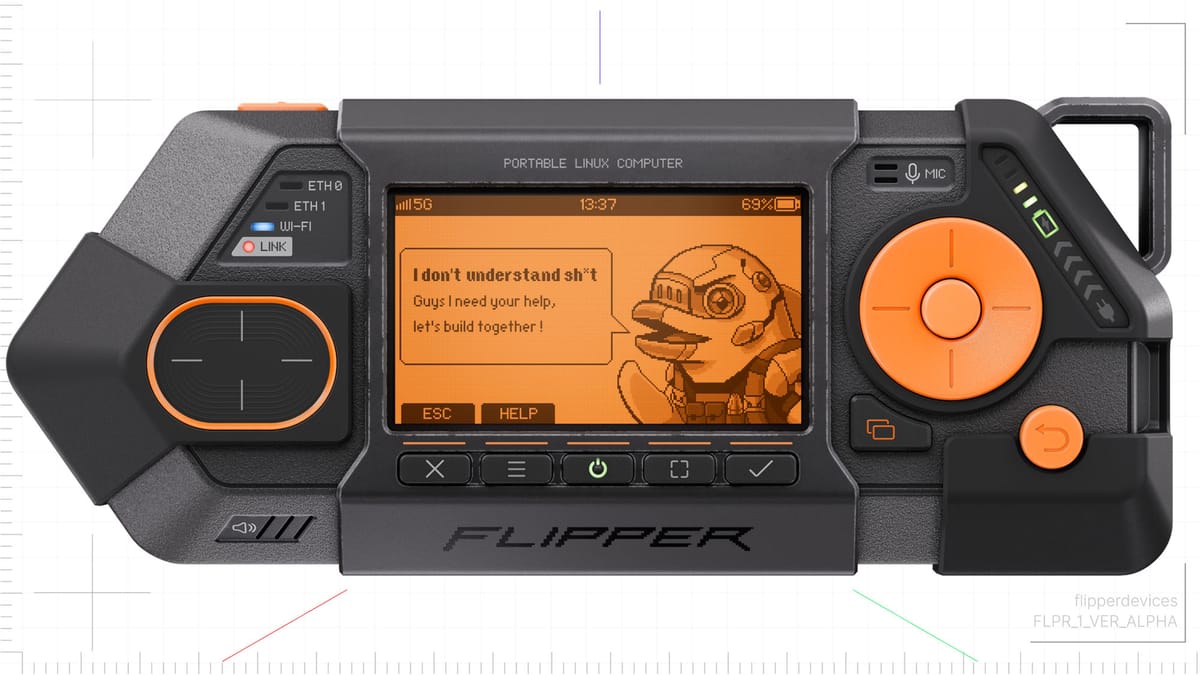
🔗 **Source:** [Flipper One — we need your help](https://blog.flipper.net/flipper-one-we-need-your-help/)
> [!note]+ Document Notes
> tags: [flipper-one, linux-cyberdeck, open-hardware, rk3576-mainline, developer-portal, co-processor-architecture]
> author: Pavel Zhovner
> source: Flipper Devices
> reference: https://blog.flipper.net/flipper-one-we-need-your-help/
> date created: {{date:YYYY-MM-DD}} {{time:HH:mm}}
>
> # 🏷️ Title: Flipper One — we need your help
>
<!-- deep-read:sections start -->
## 🧭 Table of Contents
- [📝 Summary](#-summary)
- [📖 Main Content](#-main-content)
- [🗒️ Notes](#️-notes)
- [📚 References](#-references)
- [🗣️ Paraphrase](#️-paraphrase)
- [📰 Newsletter](#-newsletter)
- [✅ Action Items](#-action-items)
- [🧪 Hypotheses](#-hypotheses)
- [📊 Methodology](#-methodology)
- [❓ Questions](#-questions)
- [🔮 Future Research](#-future-research)
- [💡 Implications](#-implications)
- [🧠 Learning Styles Assessment](#-learning-styles-assessment)
- [📊 Accessibility Assessment](#-accessibility-assessment)
- [🌍 DEIB Assessment](#-deib-assessment)
- [✅ Logical Validity](#-logical-validity)
- [🛡️ DARVO Analysis](#-darvo-analysis)
- [🎯 Conclusion](#-conclusion)
## 📝 Summary
- Flipper Devices announces Flipper One, an open Linux cyberdeck completely different from Flipper Zero, targeting IP networks rather than offline protocols.
- The project aims to build the most open and best-documented ARM computer with full mainline Linux kernel support, eliminating binary blobs and vendor lock-in.
- Key innovations include a co-processor architecture (8-core RK3576 CPU + RP2350 MCU), expandable M.2 modules, novel Flipper OS with profiles, and FlipCTL UI framework for small screens.
- The team is opening their entire development process through a public Developer Portal and asking for community help with kernel upstreaming, testing, and development.
- Major risks include technical complexity, financial constraints (RAM crisis), and uncertainty around novel architecture decisions.
## 📖 Main Content
Flipper One represents a fundamental departure from Flipper Zero, targeting Layer 1 (IP-connected) protocols rather than Layer 0 (offline point-to-point) systems. The device functions as an expandable Linux cyberdeck with multiple network interfaces, M.2 expansion slots, and a unique dual-processor architecture.
**Core Architecture**: The system runs on both a high-performance 8-core RK3576 SoC with Linux and a low-power RP2350 MCU that manages display, power, and boot processes. This allows the device to remain functional even when Linux is powered down - addressing a key limitation of traditional single-board computers.
**Open Hardware Philosophy**: Partnering with Collabora, Flipper is pushing full RK3576 support into mainline Linux kernel, aiming to eliminate vendor-specific binary blobs and board support packages that plague ARM Linux ecosystem. Only remaining binary blob is the DDR trainer for RAM initialization.
**Software Innovation**: Flipper OS introduces "profiles" - full OS snapshots with different package configurations that users can switch between, clone, and restore. FlipCTL provides a menu-based UI framework designed for small LCD screens, wrapping existing Linux utilities in navigable interfaces.
**Expansion System**: Universal M.2 port supports multiple interfaces (PCIe, USB 3.0, SATA) and module sizes, enabling cellular modems, SDR modules, SSDs, and AI accelerators. GPIO connector with threaded mounting system allows DIY modules on standard perfboard.
**Network Capabilities**: Five independent network interfaces (2x Gigabit Ethernet, Wi-Fi 6E, cellular via M.2, USB Ethernet) enable complex routing, bridging, and analysis scenarios. Device can function as router, VPN gateway, inline sniffer, or USB network adapter.
## 🗒️ Notes
**Open Development Process**: Team is publishing internal task trackers, architectural debates, and unfinished documentation through Developer Portal - unprecedented transparency for hardware company.
**Community Hiring**: Actively seeking Developer Portal Manager to bridge development team and community contributions.
**Technical Challenges**: USB-C DisplayPort Alt Mode signal integrity issues, mainline kernel gaps for NPU and hardware video decoding, desktop environment selection debates.
**Satellite Connectivity**: Planning NTN (Non-Terrestrial Networks) satellite modem support through M.2 modules, seeking partnerships with providers like Skylo.
**AI Integration**: Built-in NPU for local LLM execution focused on device-specific assistance and configuration generation when offline.
**Testing Program**: Active MediaTek MT7921AUN Wi-Fi chipset testing, seeking community validation for monitor mode and packet injection capabilities.
## 📚 References
- [Flipper One Developer Portal](https://dev.flipper.net)
- [Collabora RK3576 mainline status](https://collabora.com/news-and-blog/news-and-events/collabora-brings-rk3576-to-mainline-linux.html)
- [RK3576 open source roadmap](https://dev.flipper.net/hardware/cpu/rk3576-roadmap)
- [M.2 Port specification](https://dev.flipper.net/hardware/modules/m2-port)
- [GPIO port documentation](https://dev.flipper.net/hardware/modules/gpio-port)
## 🗣️ Paraphrase
Flipper Devices is launching their most ambitious project yet - Flipper One, a completely open Linux cyberdeck that breaks from typical ARM vendor practices. Unlike Flipper Zero's focus on offline protocols, this targets networked systems with multiple connectivity options and expandable hardware. The team is taking an unprecedented approach by opening their entire development process and actively seeking community help with kernel upstreaming and testing. While technically risky, the project aims to create the most documented and truly open ARM computer available.
## 📰 Newsletter
**Flipper One: The Open Linux Cyberdeck We've Been Waiting For**
The Flipper team just dropped something massive - Flipper One, an expandable Linux cyberdeck that could revolutionize portable computing. This isn't Flipper Zero 2.0; it's a completely different beast targeting IP networks with 5 network interfaces, M.2 expansion slots, and a unique dual-processor design.
What's really exciting? They're partnering with Collabora to get the RK3576 SoC into mainline Linux kernel - no more vendor binary blobs or custom BSPs! Plus, they're building Flipper OS with switchable "profiles" and FlipCTL, a UI framework actually designed for small screens (finally!).
The kicker? They've opened their entire development process through a public Developer Portal and are actively seeking community help. Check out their Wi-Fi testing program and kernel contribution opportunities - this could be the most community-driven hardware project we've seen.
[Developer Portal](https://dev.flipper.net) | [RK3576 Roadmap](https://dev.flipper.net/hardware/cpu/rk3576-roadmap)
## ✅ Action Items
#### DevRel
- **Community onboarding**: Create contribution guides for different skill levels (hardware, kernel, testing, documentation).
- **Developer advocacy**: Organize RK3576 mainline kernel hackathons and upstreaming workshops.
- **Documentation**: Establish technical writing standards for Developer Portal and module specifications.
#### OSPO
- **License compliance**: Review Collabora partnership agreements and open hardware licensing for mechanical designs.
- **Community governance**: Establish contribution policies and decision-making processes for Developer Portal.
- **Supply chain transparency**: Document component sourcing and vendor relationships for M.2 ecosystem.
#### Community
- **Testing coordination**: Organize MediaTek MT7921AUN Wi-Fi chipset testing program across different use cases.
- **Hardware partnerships**: Facilitate M.2 module development partnerships with SDR and cellular modem vendors.
- **Educational content**: Develop tutorials for co-processor architecture and FlipCTL development.
#### WordPress
- **Developer tools**: Consider FlipCTL-style menu interfaces for headless WordPress management on small screens.
- **Community patterns**: Study Flipper's open development model for WordPress Core contributor onboarding.
## 🧪 Hypotheses
- Open development processes increase community contribution quality and project sustainability compared to traditional closed hardware development
- Dual-processor architecture with always-on MCU significantly improves user experience for portable Linux devices
- Mainline Linux kernel support without vendor BSPs reduces long-term maintenance costs and improves security
- Profile-based OS snapshots solve the "configuration drift" problem common in multi-purpose Linux devices
- Small-screen UI frameworks can make Linux tools accessible on portable devices without full desktop environments
- Universal M.2 expansion ports enable more diverse hardware ecosystems than proprietary expansion systems
## 📊 Methodology
- **Community engagement metrics**: Track Developer Portal contributions, pull request quality, and contributor retention across sub-projects
- **Technical validation studies**: Benchmark RK3576 mainline performance against BSP implementations, measure co-processor communication latency
- **User experience testing**: Compare FlipCTL navigation efficiency against traditional terminal interfaces on small screens
- **Market analysis**: Survey existing cyberdeck and portable Linux communities for feature priorities and pain points
- **Partnership assessment**: Evaluate Collabora collaboration model for replicability in other open hardware projects
## ❓ Questions
- Can the DDR trainer binary blob be eliminated through community reverse engineering or vendor negotiation?
- How will profile switching performance compare to traditional containerization approaches?
- What specific MediaTek MT7921AUN limitations exist for advanced Wi-Fi security testing?
- How sustainable is the open development model financially compared to traditional hardware development?
- What legal frameworks protect community contributors' work on open hardware designs?
## 🔮 Future Research
- Long-term sustainability models for community-driven hardware development
- Co-processor architecture patterns for other embedded Linux applications
- FlipCTL framework adoption potential across headless Linux device ecosystem
- RK3576 mainline upstreaming lessons for other ARM SoC vendors
- Profile-based OS management systems for multi-purpose computing devices
## 💡 Implications
- **Open hardware**: Demonstrates viability of fully open ARM computing without vendor lock-in
- **Community development**: Establishes new model for transparent hardware development processes
- **Linux ecosystem**: Advances mainline kernel support reducing fragmentation in ARM space
- **Education**: Provides comprehensive documentation and learning resources for embedded Linux development
- **Vendor relations**: Pressures other ARM vendors to open closed-source components through community advocacy
## 🧠 Learning Styles Assessment
Reading level estimate: Grade 12-14 (Flesch-Kincaid), technical but accessible to informed general audience.
#### 👀 Visual learners
- **Present**: Architecture diagrams, co-processor communication flows, M.2 module mounting visuals
- **Improve**: Add PCB layout images, kernel upstreaming flowcharts, network topology examples
#### 🔊 Aural learners
- **Present**: None identified
- **Improve**: Podcast series on open hardware development, audio developer portal tours
#### 🗣️ Verbal learners
- **Present**: Clear definitions of technical terms, analogies comparing to Raspberry Pi ecosystem
- **Improve**: Expand glossary for co-processor architecture, more Layer 0 vs Layer 1 explanations
#### 🧩 Kinesthetic learners
- **Present**: Developer Portal with hands-on contribution opportunities, Wi-Fi testing program
- **Improve**: Virtual hardware simulators, step-by-step kernel compilation guides
#### 🧠 Logical learners
- **Present**: Clear project structure with sub-teams, technical specifications, systematic roadmaps
- **Improve**: Decision matrices for technical choices, quantified success metrics
#### 🧑🤝🧑 Social learners
- **Present**: Community contribution model, Developer Portal collaboration
- **Improve**: Contributor forums, mentorship matching for different expertise areas
#### 🧘♀️ Solitary learners
- **Present**: Comprehensive documentation, individual contribution paths
- **Improve**: Self-assessment tools for contribution readiness, independent study guides
#### 🌿 Naturalistic learners
- **Present**: None identified
- **Improve**: Environmental impact analysis of open vs closed hardware development
## 📊 Accessibility Assessment
#### Screen reader semantics
- **Present**: Clear heading structure, descriptive link text
- **Improve**: Add alt text for architecture diagrams, ARIA labels for complex technical drawings
#### Keyboard navigation
- **Present**: Standard blog navigation
- **Improve**: Keyboard shortcuts for Developer Portal sections, skip links for technical specifications
#### Contrast and readability
- **Present**: Good text contrast on white background
- **Improve**: Dark mode option for technical documentation, syntax highlighting accessibility
#### Text resizing and reflow
- **Present**: Responsive design handles zoom well
- **Improve**: Test complex technical diagrams at high magnification levels
#### Media and captions
- **Present**: Video content embedded
- **Improve**: Captions for hardware demonstration videos, transcript for technical explanations
#### Forms and interactions
- **Present**: Newsletter signup form
- **Improve**: Accessible contribution submission forms for Developer Portal
## 🌍 DEIB Assessment
#### Cultural breadth
- **Present**: Global developer community focus, international shipping considerations
- **Improve**: Multi-language Developer Portal, regional hardware compliance documentation
#### Inclusive language
- **Present**: Technical language clearly defined, neutral terminology
- **Improve**: Avoid assumptions about prior ARM/Linux experience, expand beginner-friendly explanations
#### Neurodiversity support
- **Present**: Well-structured content with clear headings
- **Improve**: Content warnings for complex technical diagrams, simplified architecture overviews
#### Representation
- **Present**: Focus on technical merit and open collaboration
- **Improve**: Highlight diverse contributor backgrounds in Developer Portal examples
#### Psychological safety
- **Present**: Welcoming tone for community contributions, "help wanted" framing
- **Improve**: Clear contributor code of conduct, mentorship programs for underrepresented groups
## ✅ Logical Validity
#### Strong reasoning
- **Co-processor architecture rationale**: Well-supported comparison to SBC limitations where "when Linux is off, the device is dead" - addresses real user pain point
- **Mainline kernel argument**: Strong case against vendor BSPs with specific examples of fragmentation and maintenance issues
- **Layer 0 vs Layer 1 distinction**: Clear logical separation justifying why Flipper One doesn't replace Flipper Zero
#### Fallacies
- **Appeal to emotion**: "We're genuinely terrified" - while honest, could be seen as emotional manipulation for community support
- **False dichotomy**: Presents open vs closed hardware as binary choice, doesn't acknowledge middle-ground approaches
- **Hasty generalization**: "Every vendor bolts on their own custom mess" - overstates uniformity of ARM vendor practices
#### Tone of voice
- **Conversational authority**: Combines technical expertise with accessible explanation ("honestly?", "the day after that")
- **Vulnerable transparency**: Admits uncertainty and fears while maintaining confidence in technical decisions
- **Community-focused**: Consistently frames challenges as collaborative opportunities rather than company problems
## 🛡️ DARVO Analysis
No DARVO patterns detected. The article presents challenges and asks for help without deflecting responsibility or repositioning the company as victim. Acknowledges genuine technical and financial risks while taking accountability for ambitious project scope.
## 🎯 Conclusion
Flipper One represents a significant evolution in open hardware development, both technically and procedurally. The dual-processor architecture and mainline Linux kernel approach address real limitations in current ARM computing platforms. The unprecedented transparency of opening the entire development process could establish new standards for community-driven hardware projects.
The project's success will depend on community adoption of the Developer Portal, successful RK3576 mainline upstreaming with Collabora, and execution of novel concepts like Flipper OS profiles and FlipCTL framework. The financial and technical risks are substantial, but the potential impact on open hardware ecosystems and Linux embedded development could be transformative.
For developers and organizations interested in truly open computing platforms, this project warrants close attention and potential contribution. The community-driven approach offers rare opportunity to influence fundamental hardware and software design decisions.
## 🧱 Refactor Appendix
### 📚 Literature Split Pad
### Flipper One targets IP networks unlike Flipper Zero's offline protocols
> [!quote] [Flipper One — we need your help](https://blog.flipper.net/flipper-one-we-need-your-help/) by [[Pavel Zhovner]] via [[Flipper Devices]]. Published 2026-05-21. Accessed {{date:YYYY-MM-DD}}.
> "Layer 0 — Offline point-to-point access-control protocols... Layer 1 — Everything that's IP-connected: Wi-Fi, Ethernet, 5G, and satellite."
Clear market segmentation strategy differentiating complementary products rather than generational upgrade.
[view highlight](https://blog.flipper.net/flipper-one-we-need-your-help/#layer-distinction) #xref #articleseed ID:rw_flipper_layer_distinction
### ARM Linux ecosystem suffers from vendor fragmentation and binary blobs
> [!quote] [Flipper One — we need your help](https://blog.flipper.net/flipper-one-we-need-your-help/)
> "Every vendor bolts on their own custom mess: closed boot blobs, vendor-specific patches, 'board support packages' that nobody outside the chip maker can really understand."
Identifies core technical problem justifying mainline kernel partnership with Collabora.
[view highlight](https://blog.flipper.net/flipper-one-we-need-your-help/#arm-fragmentation) #xref ID:rw_arm_fragmentation
### Co-processor architecture enables always-on functionality for portable Linux devices
> [!quote] [Flipper One — we need your help](https://blog.flipper.net/flipper-one-we-need-your-help/)
> "The device can run on the MCU alone. Even when Linux is off, you can control Flipper One with its buttons and LCD screen, configure the boot process."
Novel approach addressing fundamental SBC limitation where device becomes unusable when main OS crashes or powers down.
[view highlight](https://blog.flipper.net/flipper-one-we-need-your-help/#co-processor-benefits) #xref #articleseed ID:rw_coprocessor_architecture
### Open development processes provide educational value beyond product polish
> [!quote] [Flipper One — we need your help](https://blog.flipper.net/flipper-one-we-need-your-help/)
> "We believe the educational value of building openly is worth more than the polish of pretending it was easy."
Philosophy driving unprecedented transparency in hardware development through public Developer Portal.
[view highlight](https://blog.flipper.net/flipper-one-we-need-your-help/#open-development-value) #xref #articleseed ID:rw_open_development_value
---
### 🔖 Atomic Split Pad (Zettel Candidates)
#### Dual-processor architecture improves portable Linux device reliability
- RK3576 CPU + RP2350 MCU design enables device functionality even when Linux crashes or powers down
- Addresses fundamental SBC limitation through hardware-level redundancy
- Links: [[Embedded-Systems-Architecture]] [[Linux-Device-Reliability]]
#### Mainline kernel support reduces long-term hardware maintenance costs
- Eliminates vendor-specific BSP dependencies and binary blob updates
- Ensures automatic security updates and feature additions through upstream development
- Links: [[Linux-Kernel-Ecosystem]] [[Hardware-Maintenance-Strategy]]
#### Community-driven hardware development scales through transparent processes
- Public Developer Portal enables distributed contribution across multiple sub-projects
- Educational documentation attracts contributors beyond traditional hardware development teams
- Links: [[Open-Hardware-Development]] [[Community-Scaling-Patterns]]
#### Profile-based OS snapshots solve configuration drift in multi-purpose devices
- Flipper OS profiles enable clean switching between different tool configurations
- Eliminates need for SD card shuffling or system reinstallation after experimentation
- Links: [[Operating-System-Design]] [[Device-Configuration-Management]]
---
### ✏️ Fleeting Queue (Extract by Selection)
- MediaTek MT7921AUN Wi-Fi testing program needs community validation for security applications — context/https://blog.flipper.net/flipper-one-we-need-your-help/ #fleeting #inbox
- RK3576 DDR trainer blob represents last remaining closed-source component in boot chain — context/https://blog.flipper.net/flipper-one-we-need-your-help/ #fleeting #inbox
- FlipCTL framework could apply to any embedded Linux device needing HMI interface — context/https://blog.flipper.net/flipper-one-we-need-your-help/ #fleeting #inbox
- Universal M.2 port design enables community module ecosystem development — context/https://blog.flipper.net/flipper-one-we-need-your-help/ #fleeting #inbox
- NTN satellite connectivity requires industry partnership for practical implementation — context/https://blog.flipper.net/flipper-one-we-need-your-help/ #fleeting #inbox
<!-- deep-read:sections end -->
## Highlights
- We're genuinely terrified" - while honest, could be seen as emotional manipulation for community support
- Note: 🔍 Fallacy: Appeal to Emotion #fallacy/appeal-to-emotion
- Every vendor bolts on their own custom mess" - overstates uniformity of ARM vendor practices
- Note: 🔍 Fallacy: Hasty Generalization #fallacy/hasty-generalization