Hannah Ritchie: The Future Is Not Bleak
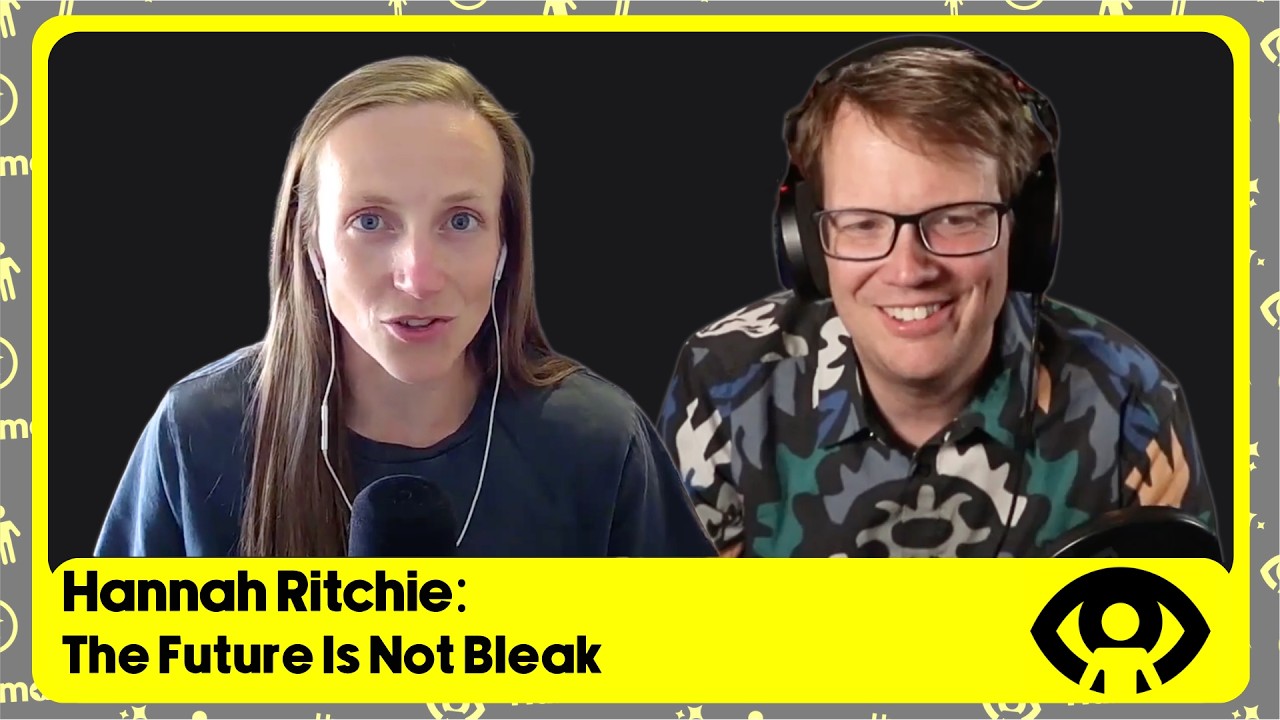
🔗 **Source:** [Hannah Ritchie: The Future Is Not Bleak](https://www.youtube.com/watch?v=VFU6nqbMylM)
> [!note]+ Document Notes
> tags: [climate-optimism, data-literacy, decarbonization, population-trends, food-systems, renewable-energy]
> author: Hannah Ritchie
> source: Humans (Hank Green), YouTube
> reference: https://www.youtube.com/watch?v=VFU6nqbMylM
> date created: 2026-09-05
>
> > [!info] Generated analysis — not the author's words. Sections below are machine-written
> > from the captured source. Only text inside `> [!quote]` blocks is verbatim from the author.
> > Do not quote or attribute any other line to the named author.
>
<!-- deep-read:sections start -->
## Summary
- Hank Green interviews Hannah Ritchie, deputy editor of Our World in Data (OWID), an Oxford-based nonprofit that aggregates and publishes global research data, on his podcast "Humans."
- OWID has grown from roughly 5 staff pre-COVID to about 25 today, mixing researchers, data scientists, web developers, and designers.
- Ritchie describes her personal shift from a teenage/early-university "doom spiral" about environmental collapse to data-driven optimism, crediting Hans Rosling's work on human development data as the turning point.
- Core argument, developed across her books "Not the End of the World" and the newly released "Clearing the Air": media coverage and public perception systematically overweight dramatic, rare causes of harm (homicide, terrorism) and underweight large, slow-moving problems (heart disease, cancer, child mortality) and the incremental progress made against them.
- Key data points covered: cause-of-death vs. media-coverage mismatch, childhood leukemia survival flipping from ~10% to ~80-90% over 50 years, population and fertility dynamics, biodiversity loss driven mainly by food and land use rather than climate change, solar's cost collapse via "learning curves," and cement's outsized (7-8%) share of global emissions.
- Stakeholders: OWID's research and data-provider network, global health funders and governments (95% of global aid budgets vs. 5% from philanthropy), climate and agriculture policymakers, and the general public whose risk perception is shaped by media coverage patterns.
- Bottom line, in Ritchie's own closing framing: humans have solved large problems before through sustained, deliberate effort rather than accident, and food/agriculture remains the most underappreciated environmental lever left to pull.
## Main Content
Hannah Ritchie's central claim is that misinformation runs in both directions — not just false claims that things are fine, but a "doom narrative" that convinces people progress is impossible, which she says is itself a form of misinformation the world cannot afford if it wants to fix problems. She grounds this in OWID's core function: translating research and data that already exists (often locked behind paywalls or jargon) into a form the public can act on.
She traces her own change in outlook to Hans Rosling's TED talks on human development data (child mortality, maternal mortality, extreme poverty), which showed her broad global improvement she had not previously been exposed to. Applying the same lens to environmental data, she found solved precedents — the ozone hole and acid rain — that get little contemporary attention precisely because they were successfully addressed.
The conversation moves through several data-grounded corrections to common assumptions: that population growth is the main lever on future emissions (she argues it isn't, per a paper by economist Dean Spears, because the timeline for decarbonization by 2050 makes even a several-billion-person difference in 2100 population largely irrelevant to emissions); that biodiversity loss is primarily a climate problem (she says food production and land use are the larger driver); and that solar's rapid price collapse is inexplicable (she attributes it to solar being a modular, iterable technology like computing, versus fossil fuels as commodities extracted from the ground and nuclear as large one-off builds that don't accumulate learning). She also flags under-discussed decarbonization targets — cement (7-8% of global emissions, more than double aviation) — and argues a full process redesign is likely to beat bolt-on carbon capture.
Ritchie closes with two takeaways: a macro one (humans solve large problems through deliberate, sustained effort, not by accident) and a micro one (food and agriculture are the least-discussed and most consequential environmental lever, driving deforestation, biodiversity loss, overfishing, freshwater use, land use change, and water pollution, plus a quarter to a third of climate emissions).
## Notes
#### ⏱️ [00:08](https://www.youtube.com/watch?v=VFU6nqbMylM?t=8) Introduction and premise
- Hank Green frames the episode around how "knowable" basic global facts feel today and credits the data infrastructure (OWID) that makes this possible.
- Ritchie is introduced as OWID's deputy editor; the org pulls together data from agencies, governments, and academics into free, shareable charts and articles.
#### ⏱️ [01:35](https://www.youtube.com/watch?v=VFU6nqbMylM?t=95) What OWID actually does
- Team grew from roughly 5 people pre-COVID to about 25 today: researchers, data scientists, web developers, and designers together.
- Ritchie frames OWID's job as translation and bridging: research and data already exist but sit in jargon-filled papers or hard-to-digest spreadsheets.
#### ⏱️ [06:38](https://www.youtube.com/watch?v=VFU6nqbMylM?t=398) Media coverage vs. actual causes of death
- OWID compared mentions in the New York Times, Washington Post, and Fox News to actual US causes of death.
- Heart disease and cancer dominate actual deaths; homicide and terrorism dominate media coverage, creating a stark mismatch.
- Adjusting for years-of-life-lost narrows but does not close the gap, since younger deaths (homicide, car accidents) get disproportionate coverage.
#### ⏱️ [09:14](https://www.youtube.com/watch?v=VFU6nqbMylM?t=554) Cancer survival: incremental, not headline, progress
- Hank Green's own Hodgkin's lymphoma outcome: 5-year survival is 95% in the US and 89% globally — better odds worldwide than he expected.
- Childhood leukemia: roughly 90% died from it 50 years ago; today survival rates run 80-90%, achieved through accumulated small treatment improvements rather than one breakthrough drug.
#### ⏱️ [13:38](https://www.youtube.com/watch?v=VFU6nqbMylM?t=818) Data quality problems: infant mortality example
- Comparing "which country has the lowest infant mortality" is harder than it looks because countries define live birth differently (e.g., a baby born at 24 weeks).
- Small definitional differences produce large ranking swings, and countries have incentives to define metrics favorably.
#### ⏱️ [16:09](https://www.youtube.com/watch?v=VFU6nqbMylM?t=969) From pessimism to Hans Rosling
- Ritchie says 15 years earlier (high school into early university) she held an extremely negative worldview, driven by climate anxiety, and actively sought out confirming bad news ("doom spiral").
- Hans Rosling's data-driven talks on child mortality, maternal mortality, and extreme poverty were the turning point that showed her broad global progress she hadn't seen before.
#### ⏱️ [21:43](https://www.youtube.com/watch?v=VFU6nqbMylM?t=1303) Solved environmental precedents: ozone and acid rain
- Ritchie cites the ozone hole and acid rain as environmental problems the world "largely solved," noting they get little modern attention precisely because they were fixed.
#### ⏱️ [24:56](https://www.youtube.com/watch?v=VFU6nqbMylM?t=1496) PEPFAR cuts and early data lag
- Discussion of recent US foreign aid cuts (referenced as "PEPFAR" cuts); Ritchie notes data typically lags a year or more, so full 2024-2025 effects aren't yet visible in macro trends, though smaller studies already show reduced HIV medication access.
#### ⏱️ [26:50](https://www.youtube.com/watch?v=VFU6nqbMylM?t=1610) Foreign aid: government vs. philanthropy
- Global aid budgets: roughly 95% from national governments, roughly 5% from philanthropy — contrary to a public perception that billionaires fund most of it.
- Survey data shows people drastically overestimate the share of national budgets spent on foreign aid; correcting the estimate tends to increase support.
#### ⏱️ [29:55](https://www.youtube.com/watch?v=VFU6nqbMylM?t=1795) Population and fertility history
- Historically, women had five to seven children, but child mortality ran near 50%, so surviving children per family were not hugely different from today.
- Agriculture decoupled fertility from mortality, driving population growth; falling fertility (opportunity cost of career and lifestyle alternatives, per Ritchie) is now slowing and will eventually reverse growth.
#### ⏱️ [34:21](https://www.youtube.com/watch?v=VFU6nqbMylM?t=2061) Why population size won't decide the climate outcome
- Citing a paper by economist Dean Spears, Ritchie says even a scenario with 4-5 billion more people by 2100 makes little difference to emissions, because the world needs to be substantially decarbonized by 2050 — well before demographic shifts could meaningfully change total population.
#### ⏱️ [36:59](https://www.youtube.com/watch?v=VFU6nqbMylM?t=2219) Biodiversity loss: food and land, not climate
- The largest driver of biodiversity loss is food production and land use — deforestation, farmland expansion, pesticide and fertilizer use, overfishing — not climate change directly, though climate change contributes for some species.
#### ⏱️ [38:15](https://www.youtube.com/watch?v=VFU6nqbMylM?t=2295) Animal agriculture scale
- Land farm animals killed for food: roughly 85 billion per year, most of them chickens; adding fish brings the total into the hundreds of billions to trillions.
- Cows are identified as the largest single animal-related climate problem among foods.
#### ⏱️ [43:30](https://www.youtube.com/watch?v=VFU6nqbMylM?t=2610) Why solar got cheap and nuclear didn't
- Solar and batteries are "technologies" — modular and built repeatedly, producing incremental learning-curve cost drops (roughly 20% price drop per doubling of global installed capacity).
- Fossil fuels are commodities extracted from the ground with a cost floor; nuclear plants are large one-off builds that don't accumulate the same iterative learning.
#### ⏱️ [56:38](https://www.youtube.com/watch?v=VFU6nqbMylM?t=3398) Cement's outsized emissions
- Cement accounts for roughly 7-8% of global greenhouse gas emissions, more than double aviation's share, yet receives far less public attention.
- The likely winning solution is redesigning the manufacturing process itself rather than bolting carbon capture onto existing cement plants.
#### ⏱️ [58:49](https://www.youtube.com/watch?v=VFU6nqbMylM?t=3529) Health innovations: the malaria vaccine gap
- More than 500,000 people, mostly children, still die of malaria annually despite an existing vaccine, largely due to the long lag between development and rollout.
#### ⏱️ [59:37](https://www.youtube.com/watch?v=VFU6nqbMylM?t=3577) Closing takeaways
- Macro: long-term data shows humans are capable of solving large problems, but only through deliberate, persistent effort, never by accident.
- Micro: food and agriculture are the most underappreciated environmental drivers — the largest factor in deforestation, biodiversity loss, overfishing, freshwater use, land use, and water pollution, and a quarter to a third of climate emissions.
#### ⏱️ [62:36](https://www.youtube.com/watch?v=VFU6nqbMylM?t=3756) Biofuels vs. solar land-use comparison
- Global biofuel (liquid fuel for cars) production uses large amounts of land but supplies less than 5% of world transport fuel.
- Putting solar panels on that same land instead could generate as much electricity as the whole world currently produces; a third of it could electrify all transport, leaving two-thirds for food production or rewilding.
## References
- [Our World in Data](https://ourworldindata.org)
- Hannah Ritchie, "Not the End of the World" (book, referenced)
- Hannah Ritchie, "Clearing the Air" (book, referenced as newly released)
- Dean Spears population-emissions paper (referenced, not linked in source)
- Hans Rosling TED talks on human development data (referenced, not linked in source)
## Paraphrase
- Ritchie argues the doom narrative around climate and other large problems is its own kind of misinformation: real progress on child mortality, cancer survival, and past environmental crises (ozone, acid rain) happened, but incrementally and without the kind of single dramatic headline that would make it visible against a media landscape built to cover rare, acute events instead.
- On population and biodiversity specifically, she reframes two common assumptions: population size will barely move the climate needle because decarbonization has to happen well before demographic shifts could compound, and biodiversity loss is chiefly a food-and-land-use problem rather than a climate problem, which shifts where policy and personal-choice attention should go.
## Newsletter
Hank Green sits down with Hannah Ritchie, deputy editor of Our World in Data, for an hour of data that reframes what "the world is getting worse" actually looks like up close. Highlights: media coverage of causes of death versus what actually kills people is wildly mismatched; childhood leukemia survival flipped from a 90% death rate to 80-90% survival over 50 years through incremental treatment gains, not one drug; and biodiversity loss is mostly a food-and-land-use story, not a climate one. Ritchie also walks through why solar keeps getting cheaper (it's a technology, not a commodity) while nuclear hasn't (one-off builds don't compound learning), and why population size will barely move the climate needle by 2100. If you build content, dashboards, or talks around "is progress real," this is a dense, citable source.
## Action Items
#### DevRel
- Consider an OWID-style "chart with a subtitle that survives being screenshotted" pattern for any developer-facing metrics dashboard — Ritchie's team treats subtitle wording as core, not decorative, work.
#### Community
- Share OWID's cause-of-death-vs-media-coverage framing in community discussions about risk perception or moderation policy, where the same mismatch (rare dramatic incidents vs. common quiet harms) often distorts priorities.
#### WordPress
- Marketing/Editorial: when writing progress or "state of the ecosystem" content, apply Ritchie's incremental-progress framing — look for the slow multi-year trend line, not just this quarter's headline number.
#### The WPOCC
- Programs: OWID's translation-and-bridge model (research → accessible public data) is a useful template for any WPOCC effort to make governance or funding data legible to a non-specialist audience.
## Hypotheses
- News coverage volume for a cause of death correlates inversely with that cause's actual mortality share, replicable beyond the US sample OWID used (UK, other high-media-consumption countries).
- Countries with looser or more favorable live-birth definitions will systematically outrank peers with stricter definitions on infant mortality league tables, independent of true underlying mortality.
- Public support for foreign aid spending increases measurably after respondents are shown the actual (small) percentage of national budget it represents, replicating the effect Ritchie describes.
- Emissions trajectories to 2100 under Dean Spears' high-fertility and baseline population scenarios will differ by less than 5% if decarbonization proceeds on the stated 2050 timeline, testable via existing integrated assessment models.
## Methodology
- Replicate the OWID media-coverage-vs-mortality comparison for a non-US country to test whether the mismatch pattern generalizes.
- Run a survey experiment testing whether correcting people's estimate of foreign-aid-as-percent-of-budget shifts stated support, replicating the effect Ritchie describes.
- Use published integrated assessment model outputs to check the Dean Spears population-emissions claim against a 2050 decarbonization timeline versus a delayed one.
## Questions
- If food and agriculture drive most non-climate environmental harm, why does public and policy attention concentrate so heavily on energy and transport instead?
- What specific process redesign for cement manufacturing is Ritchie referring to, and what is its current technology readiness level versus carbon capture retrofits?
- How much of solar's "learning curve" cost advantage is inherent to the technology itself (as she argues) versus a product of policy support (subsidies, mandates) in the early rollout countries she mentions (China and others)?
## Future Research
- A published comparison of solar, wind, and nuclear cost trajectories controlling for policy support levels (not just technology type) would sharpen Ritchie's "modular technology vs. one-off build" explanation.
- Longitudinal tracking of the PEPFAR-cut effects Ritchie flags as still-emerging in the data would let researchers quantify the human cost once 2024-2025 data becomes available.
- Research quantifying the real-world adoption rate and price trajectory of lab-grown or alternative meat products would test Ritchie's stated hope that cost-competitive alternatives, not persuasion, will shift food-related emissions.
## Implications
- For climate policy: if population size is nearly irrelevant to 2100 emissions under a 2050 decarbonization timeline, population-control framing as a climate strategy is a misallocation of attention and political capital.
- For conservation policy and funding: biodiversity funding and messaging that centers climate change over food-system and land-use reform may be targeting the smaller driver.
- For public health funding: sudden foreign-aid cuts (e.g., PEPFAR) show effects with a reporting lag of a year or more, meaning policymakers evaluating near-term data will systematically underestimate real-time harm.
- For energy policy: nuclear's cost trajectory reflects structural learning-curve limitations (few large one-off builds), which argues for modular reactor designs if nuclear is to compete with solar's iterative cost declines.
## Learning Styles Assessment
- Reading level: conversational interview register with technical asides; roughly Flesch-Kincaid grade 8-9, mixing plain language with domain terms (learning curve, decarbonization, fertility rate) that are defined in context.
#### Visual learners
- Present: none in the transcript itself, though the conversation repeatedly references OWID charts (media-coverage comparison, solar deployment vs. projections, cancer survival curves) that exist on the OWID site.
- Improve: embed the actual referenced OWID charts alongside a written recap so visual learners aren't relying on a verbal description of a graph.
#### Aural learners
- Present: this is the native format — a full podcast conversation with natural back-and-forth.
#### Verbal/logical learners
- Present: Ritchie frequently reasons through cause-and-effect chains (e.g., population → fertility → mortality → emissions) that logical learners can follow as a decision tree.
- Improve: a one-page causal diagram linking the population/emissions and biodiversity/food arguments would help logical learners see both threads without holding 66 minutes of audio in working memory.
## Accessibility Assessment
#### Screen reader semantics
- Not assessable from a bare transcript; depends on the hosting page's markup.
#### Media and captions
- The source is an auto-generated transcript with visible artifacts (e.g., "in60" for "into the future," "Richie" for "Ritchie" in places, stray "60" tokens); the original video's captions likely need a manual accuracy pass, especially around numeric claims (percentages, dates) that are easy to mishear or mistranscribe.
#### Standards reference
- WCAG 2.2 AA caption accuracy (1.2.2) matters more than usual given the density of statistics in this transcript — a mistranscribed percentage (95% vs. 89%, for example) changes the substantive claim, not just the wording.
## DEIB Assessment
#### Cultural breadth
- The conversation repeatedly compares US-specific outcomes (Hank Green's own cancer survival odds, US foreign aid perception) against global averages, which models a useful habit of checking whether a personal or national experience generalizes.
#### Representation
- Discussion of global health and poverty data draws on outcomes across high-, middle-, and low-income countries (infant mortality definitions, malaria deaths, HIV medication access), though the two speakers are both from wealthy countries (US, UK-based OWID).
#### Psychological safety
- Hank Green discloses his own Hodgkin's lymphoma diagnosis and treatment as part of the conversation; the framing stays factual and comparative rather than dwelling on personal medical distress.
#### Improvement
- A companion resource pointing listeners without personal data literacy background toward OWID's own explainer content on reading charts and subtitles would extend the episode's accessibility to readers less familiar with data interpretation caveats.
## Logical Validity
### Strong reasoning
- Causal: the population-emissions argument (Dean Spears paper) uses a scenario comparison — same policy timeline, different fertility assumptions — to isolate population's actual marginal effect on 2100 emissions, which is a stronger design than simply asserting population doesn't matter.
- Comparative: the biodiversity-loss claim is supported by naming specific mechanisms (deforestation, farmland expansion, pesticide/fertilizer use, overfishing) rather than asserting "food is bad for the environment" as an unsupported generalization.
### Fallacies
- Availability heuristic (implicit, described rather than committed by the source): Ritchie's entire media-coverage argument is essentially a description of this bias in the public and press, not a fallacy in her own reasoning.
- Base-rate neglect: the discussion of foreign aid perception describes a real, measured public error (drastically overestimating aid share of budget) rather than the source committing the error itself.
### Tone of voice
- Measured, hedged where evidence is uncertain ("I'm pretty confident," "there's data to back this up"), and willing to state a counter-intuitive conclusion (population size barely matters for 2100 emissions) directly rather than softening it.
## DARVO Analysis
Not applicable to this source — this is a data-focused interview about global development, climate, and public health trends with no accusation, denial, or victim/offender dynamic between named parties for the DARVO framework to apply to.
## Conclusion
Ritchie's throughline is that both optimism and pessimism about global problems need to be checked against the actual data trend line, not against which story got the most media coverage or "felt" true at the time. The interview's most citable claims — the cause-of-death/media-coverage mismatch, the childhood leukemia survival flip, the population-emissions near-irrelevance by 2100, and food/land-use as the dominant biodiversity driver — are all attributed to specific studies or OWID's own comparative work rather than asserted as general vibes. Readers should follow up by checking the underlying OWID charts and the referenced Dean Spears paper before citing the numbers elsewhere, since this transcript is a spoken summary rather than the primary source itself.
## 🔄 Refactor Appendix — Hannah Ritchie: The Future Is Not Bleak
### 📚 Literature Atoms (H3)
#### [H2] Media coverage vs. actual causes of death
> [!quote] ID:rw_01m1sdh2cw25j1yegn0shawmpd
> ">> and then what health topics do news organizations cover? Right? So we basically looked at, you know, mentions in the New York Times, the Washington Post, Fox News, and we compared that to what people actually die from. And the difference is very stark, right? So people are dying from heart disease. They're dying from cancer. There are these really big diseases that most people die from, right? And the stuff that's covered in the media are homicides, terrorism, these kind of"
OWID's direct comparison between media mentions and actual US mortality causes, setting up the episode's central thesis that attention and reality are mismatched. Caveat: the transcript cuts off mid-sentence, so the full list of "these kind of" causes isn't captured here.
Tags: `#atom/literature/h2`
#### [H1] Childhood leukemia: incremental progress, not one drug
> [!quote] ID:rw_01m1sdh2cw25j1yegn0shawmpd
> "if a child had leukemia, there's kind of a 90% chance that they would die from that. And today those odds are completely flipped, right? Where you're talking about 80 to 90% survival rates. And again, if you look at the line of those mortality rates over time, there's no big one step change is these incremental. >> Isn't that so weird? >> Yeah. >> Yeah. You would think that we would have come up with a drug. >> Yeah. But it's like we came up with a drug and another drug and a better drug and we rolled it out and then we did this and we added this and we got better"
The clearest concrete proof point for Ritchie's "progress is real but invisible" thesis: a 90%-death to 80-90%-survival flip over 50 years, driven by accumulation rather than a single breakthrough.
Tags: `#atom/literature/h1`
#### [H1] Population size barely moves 2100 emissions
> [!quote] ID:rw_01m1sdh2cw25j1yegn0shawmpd
> ">> Yeah. No, I think population size will have little bearing at all on our ability to solve climate change or other problems. >> Whoa. >> And that is because and there's data to back this up. >> I would be shocked if there wasn't with you. Yeah. There's a paper by Dean Spears and a colleague and basically what they did was they took population projections and they had a couple of scenarios and so they had a scenario"
The episode's most counter-intuitive claim, sourced to a named but unlinked paper (Dean Spears and a colleague). Caveat: the paper itself isn't cited with a title or link in this transcript, so it needs independent verification before repeating the figure.
Tags: `#atom/literature/h1`
#### [H2] Solar is a technology, fossil fuels are a commodity
> [!quote] ID:rw_01m1sdh2cw25j1yegn0shawmpd
> "as as resources decline. So, I think that's a key difference. Fossil fuels are commodities that you have to dig out the ground. solar when batteries are basically technologies where you can get these they're kind of like computing like some of the >> lots of predictions of solar power were incredibly wrong as you said the kind of hockey stick of hope >> and this was very very widespread like most people this took most people by surprise >> the people that I spoke to that didn't take it by surprise and they were kind of laughed at at the time were looking"
The mechanism underneath solar's cost collapse: modular technologies compound learning-curve gains the way computing did, while commodities and one-off builds don't. Explains why forecasters kept underestimating deployment.
Tags: `#atom/literature/h2`
#### [H1] Food and agriculture are the largest environmental driver
> [!quote] ID:rw_01m1sdh2cw25j1yegn0shawmpd
> "driver. Deforestation, biodiversity loss, over fishing, freshwater use, land use, water pollution, the largest driver is food and agriculture. And even when it comes to climate change, it's a quarter to a third of our our emissions. So I think if we're to solve these wide [clears throat] range of environmental problems, tackling that is really key. >> Why do you think that that one is so hard for us to latch on to? Like we think so much more about the packaging around the food than the food itself."
Ritchie's closing "micro" takeaway and the episode's most actionable claim: food/agriculture leads nearly every environmental category except climate itself, where it's still a quarter to a third of emissions.
Tags: `#atom/literature/h1`
### 🧠 Permanent Candidates (H4)
#### [P1] Incremental progress is invisible because it has no single headline moment
Progress that accumulates through many small steps (a drug, then a better drug, then a protocol change) never produces the one dramatic event that media coverage and public attention are built to notice — so problems get solved without most people registering that they were solved. This generalizes past climate and health to any slow-moving improvement (poverty reduction, workplace safety, software reliability) where the absence of a crisis is mistaken for the absence of a problem. *Candidate; illustrated here by one strong case (leukemia survival) plus OWID's broader body of work.*
Links: [[Progress That Has No Headline]] · [[Media Coverage Bias]] · [[Data Literacy MOC]]
#### [P2] Modular, iterable technologies compound cost declines; one-off builds don't
Wright's-law-style learning curves apply to technologies assembled repeatedly at scale (solar panels, batteries, computer chips) but not to commodities extracted from fixed physical stock (fossil fuels) or to large one-off infrastructure (nuclear plants). The dividing line for forecasting future cost isn't "clean vs. dirty" energy, it's "iterable manufacturing vs. one-off extraction or construction." *Candidate; well-documented in energy economics literature on learning curves, applied here to a specific solar/nuclear/fossil comparison.*
Links: [[Learning Curves]] · [[Wright's Law]] · [[Renewable Energy Forecasting]]
### ✏️ Fleeting Queue
- The Dean Spears population-emissions paper is named but not linked or titled in this transcript — track it down before citing the "population barely matters" figure anywhere public. `#atom/fleeting/f1`
- Cement's 7-8% emissions share (more than double aviation) is a strong, under-discussed newsletter hook worth a standalone sourced check. `#atom/fleeting/f1`
- The PEPFAR-cuts discussion (data lags a year-plus behind policy changes) is a reusable pattern for any "why don't we see the harm yet" question about recent policy shifts. `#atom/fleeting/f1`
- Transcript artifacts ("in60," "Richie" for "Ritchie") suggest a numbers-heavy source where a caption accuracy pass matters more than usual — same auto-caption fragility noted in other batch sources. `#atom/fleeting/f1`
### → Things 3 (max 2 actions)
- [ ] Source and verify the Dean Spears population-emissions paper by title/DOI before repeating the "population size barely matters for 2100 emissions" claim in any WPOCC or DevRel content. `#action/h1`
- [ ] Check the cement 7-8%-of-emissions figure and the "process redesign beats bolt-on carbon capture" claim against a primary source for potential newsletter use. `#action/h2`
<!-- deep-read:sections end -->
📄 **Full text:** [[Full Document Contents/Articles/Hannah Ritchie The Future Is Not Bleak.md|Hannah Ritchie: The Future Is Not Bleak by Hannah Ritchie]]
## Highlights
- >> and then what health topics do news organizations cover? Right? So we basically looked at, you know, mentions in the New York Times, the Washington Post, Fox News, and we compared that to what people actually die from. And the difference is very stark, right? So people are dying from heart disease. They're dying from cancer. There are these really big diseases that most people die from, right? And the stuff that's covered in the media are homicides, terrorism, these kind of ([View Highlight](https://read.readwise.io/read/01m1sjjh0j2ef4f0bqvm8wc7ba))
- Note: H2 — OWID's direct comparison of media mentions (NYT, WaPo, Fox News) against actual US causes of death sets up the episode's central thesis: attention and reality are mismatched, and that mismatch drives both doom and misplaced priorities. #atom/literature/h2
- Tags: atom/literature/h2
- if a child had leukemia, there's kind of a 90% chance that they would die from that. And today those odds are completely flipped, right? Where you're talking about 80 to 90% survival rates. And again, if you look at the line of those mortality rates over time, there's no big one step change is these incremental. >> Isn't that so weird? >> Yeah. >> Yeah. You would think that we would have come up with a drug. >> Yeah. But it's like we came up with a drug and another drug and a better drug and we rolled it out and then we did this and we added this and we got better ([View Highlight](https://read.readwise.io/read/01m1sjjkcge4y924nxtqbfmrzx))
- Note: H1 — the strongest concrete evidence claim in the episode: childhood leukemia mortality flipped from ~90% dead to 80-90% survival over 50 years, achieved through accumulated incremental treatment gains rather than one breakthrough drug. This is the clearest proof point for Ritchie's "progress is real but invisible" thesis. #atom/literature/h1
- Tags: atom/literature/h1
- >> Yeah. No, I think population size will have little bearing at all on our ability to solve climate change or other problems. >> Whoa. >> And that is because and there's data to back this up. >> I would be shocked if there wasn't with you. Yeah. There's a paper by Dean Spears and a colleague and basically what they did was they took population projections and they had a couple of scenarios and so they had a scenario ([View Highlight](https://read.readwise.io/read/01m1sjjp09b3hmdf1dkqy1xpcx))
- Note: H1 — the episode's most counter-intuitive claim, sourced to a named paper (Dean Spears and a colleague): population size will barely affect the ability to solve climate change, because decarbonization has to happen on a timeline (2050) too fast for demographic shifts to matter. #atom/literature/h1
- Tags: atom/literature/h1
- as as resources decline. So, I think that's a key difference. Fossil fuels are commodities that you have to dig out the ground. solar when batteries are basically technologies where you can get these they're kind of like computing like some of the >> lots of predictions of solar power were incredibly wrong as you said the kind of hockey stick of hope >> and this was very very widespread like most people this took most people by surprise >> the people that I spoke to that didn't take it by surprise and they were kind of laughed at at the time were looking ([View Highlight](https://read.readwise.io/read/01m1sjjr3tz3j4m9tzpxw10425))
- Note: H2 — the mechanism claim underneath the whole solar-cost-collapse discussion: fossil fuels are commodities with a cost floor, while solar and batteries are modular technologies that compound learning-curve improvements like computing did. Explains why forecasters kept underestimating solar deployment. #atom/literature/h2
- Tags: atom/literature/h2
- driver. Deforestation, biodiversity loss, over fishing, freshwater use, land use, water pollution, the largest driver is food and agriculture. And even when it comes to climate change, it's a quarter to a third of our our emissions. So I think if we're to solve these wide [clears throat] range of environmental problems, tackling that is really key. >> Why do you think that that one is so hard for us to latch on to? Like we think so much more about the packaging around the food than the food itself. ([View Highlight](https://read.readwise.io/read/01m1sjjtgdy7mwsghk4df3bt8y))
- Note: H1 — Ritchie's closing "micro" takeaway and arguably the episode's single most actionable claim: food and agriculture are the largest driver of nearly every environmental problem except climate change itself (where they're still a quarter to a third of emissions), yet get the least public attention relative to energy and transport. #atom/literature/h1
- Tags: atom/literature/h1