He Lost 50% of His Google Traffic to AI Overviews
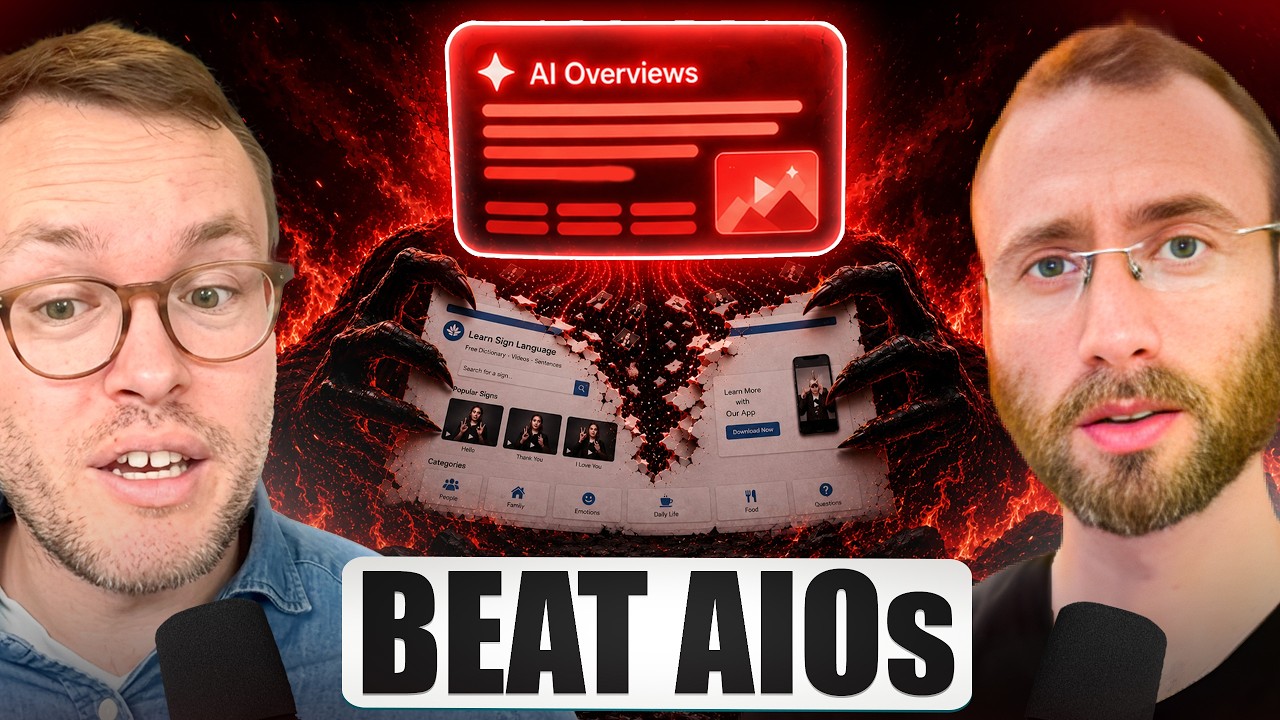
🔗 **Source:** [He Lost 50% of His Google Traffic to AI Overviews](https://www.youtube.com/watch?v=5-NEW1iJZPY)
> [!note]+ Document Notes
> tags: [ai-overviews, search-traffic, youtube-seo, content-strategy, sign-language]
> author: "Podcast interview with SignLab"
> source: "https://www.youtube.com/watch?v=5-NEW1iJZPY"
> reference: "01kya7ehkbfad62npcq6s5hthq"
> date created: 2026-07-24
>
> # 🏷️ Title: He Lost 50% of His Google Traffic to AI Overviews (Here's How He Recovered)
>
<!-- deep-read:sections start -->
## 🧭 Table of Contents
References; summary; main content; notes; paraphrase; newsletter; actions; hypotheses; methodology; questions; research; implications; assessments; logic; DARVO; conclusion; refactor appendix; templates.
## 🔗 References
- Video: https://www.youtube.com/watch?v=5-NEW1iJZPY
- Reader document: 01kya7ehkbfad62npcq6s5hthq
## 📝 Summary
SignLab reports losing about half its Google clicks when AI Overviews displayed its sign-language videos without meaningful referrals. It did not recover the same search traffic; it replaced part of the loss through YouTube distribution, stronger bottom-of-funnel content, topical authority, and multilingual agent-assisted workflows with partner review. The case warns publishers to separate traffic recovery from channel substitution.
## 📖 Main Content
The company had a programmatic sign-language dictionary that fed app discovery. AI Overviews increased visibility while reducing clicks. SignLab bulk-published adapted videos to YouTube, added introductions and calls to action, refined titles and descriptions, and developed market-specific content. The interview stresses search fundamentals, user intent, selective links, and human partner review even when agents draft multilingual content.
### 🗒️ Notes
- 00:00–14:00 — 50% click loss, attribution concerns, AI-search experiments, and channel shift
- 14:00–28:00 — bulk YouTube publishing, video format, titles, descriptions, and calls to action
- 28:00–42:00 — zero-click harm, content quality, topical authority, and bottom-funnel strategy
- 42:00–56:00 — multilingual agent workflows, local differences, review loops, and selection bias
- 56:00–66:00 — human partner oversight, 80/20 lessons, and what the team would repeat
- Scope: This note analyzes the captured transcript. Linked claims and allegations are not treated as independently verified without primary records.
## 📚 References
- Primary captured source: https://www.youtube.com/watch?v=5-NEW1iJZPY
- Verify cited studies, legal filings, historical links, statistics, quotations, and allegations against original records before publication.
## 🗣️ Paraphrase
The recovery was not a restoration of the old Google funnel. The company moved discoverability to channels that expose sources more clearly and rebuilt conversion-focused content. Automation made localization cheaper, while local partners kept brand and cultural review in the process.
## 📰 Newsletter
**Why this matters for WordPress:** SignLab reports losing about half its Google clicks when AI Overviews displayed its sign-language videos without meaningful referrals. It did not recover the same search traffic; it replaced part of the loss through YouTube distribution, stronger bottom-of-funnel content, topical authority, and multilingual agent-assisted workflows with partner review. The case warns publishers to separate traffic recovery from channel substitution. Open-web teams should turn the key claim into a small reproducible check, report limits beside results, and keep affected contributors in the decision. [Watch the source](https://www.youtube.com/watch?v=5-NEW1iJZPY).
## ✅ Action Items
- DevRel: turn claims into reproducible examples; OSPO: review governance and dependency effects; Community: include affected people in review; WordPress — Core: assess platform relevance; Core Performance: measure cost and latency; Core AI: define model tests; Core Program Team: coordinate milestones; Mobile: test small screens; Playground: build a safe reproduction; Community: gather contributor feedback; Training: create a lesson; Marketing: state limits; Support: collect failure patterns; Design: review workflows; Documentation: record behavior and caveats; Photos: not applicable unless visual assets are needed; TV: consider a short explainer; Polyglots: preserve cultural context; Accessibility: test WCAG 2.2 AA; Meta: review site and API effects; CLI: expose repeatable checks; Hosting: test deployment constraints; Tide: automate relevant quality checks; Openverse: review open-asset implications; Themes: test presentation effects; Plugins: publish compatibility guidance. The WPOCC: consider community-governance effects. FAIR: note effects on federated open-source collaboration.
## 🧪 Hypotheses
1. If channel substitution should not be reported as recovery of the original referral channel., a bounded comparison will show a measurable change in error, trust, or decision quality.
2. The effect will differ by user expertise, task complexity, and access to independent review.
3. Publishing source limits next to the result will reduce later overgeneralization.
## 📊 Methodology
Define the unit of analysis, baseline, outcome, failure classes, cost, time, and affected groups before testing. Preserve inputs and report null results. For testimony or commentary, triangulate with primary documents and responses from named parties. For technical demonstrations, reproduce the code and compare maintainability, accessibility, and performance as well as the showcased score.
## ❓ Questions
- Which claim would change the conclusion if false?
- What evidence is first-hand, reproduced, inferred, or alleged?
- Who gains authority or revenue under the proposed account?
- Which costs fall outside the measured outcome?
## 🔮 Future Research
Replicate across contexts; compare short- and long-term effects; test alternative explanations; obtain primary records; and track whether gains or harms persist in operational use.
## 💡 Implications
Practice: run bounded trials and preserve dissent. Policy: require traceable evidence for high-impact claims. Security: inspect authority, data, and failure paths. Education: teach source comparison. Funding: tie spending to measured outcomes and public reporting.
## 🧠 Learning Styles Assessment
- Visual: map claim, evidence, mechanism, and counterclaim.
- Aural: compare the speaker’s case with a sourced response.
- Verbal: restate the thesis without promotional or adversarial language.
- Kinesthetic: reproduce the technical or documentary check.
- Logical: separate observations, premises, inferences, and conclusions.
- Social: discuss with people who hold differing views.
- Solitary: keep a prediction and error log.
- Naturalistic: inspect resource and environmental effects where relevant.
- Reading level: approximately grade 10–12; technical and theological terms need definitions.
## 📊 Accessibility Assessment
- Perceivable: captions, transcript, alt text, and sufficient contrast (WCAG 1).
- Operable: keyboard access, visible focus, and adequate target size (WCAG 2).
- Understandable: clear headings, definitions, and consistent navigation (WCAG 3).
- Compatible: semantic markup and valid names, roles, and values (WCAG 4).
- Cognitive: short sections, summaries, and explicit argument structure.
- Motion and media: user controls and no forced motion.
- Testing: automated checks plus keyboard, screen-reader, zoom, reflow, and cognitive review against WCAG 2.2 AA.
## 🌍 DEIB Assessment
- Cultural breadth: state geographic, denominational, institutional, and language scope.
- Inclusive language: criticize claims and conduct without stereotyping groups.
- Neurodiversity support: predictable structure, definitions, and examples.
- Representation: seek the views of people affected and those criticized.
- Psychological safety: allow dissent without forcing public disclosure of harm or belief.
## ✅ Logical Validity
The case provides a concrete before-and-after narrative and acknowledges that old traffic was not won back. It lacks analytics exports, controlled attribution, cost data, and a breakdown of which intervention caused which gain. The title risks implying recovery of the same traffic source.
- Strong reasoning: the source offers a clear claim and identifiable mechanism.
- Fallacy check: watch for hasty generalization, selection bias, false cause, motive attribution, title overstatement, and analogy used as proof.
- Fix: add primary evidence, comparison data, definitions, uncertainty, and counterevidence.
- Tone: conversational and persuasive; adversarial sections need extra care.
## 🛡️ DARVO Analysis
No complete DARVO sequence is established by the transcript alone. Where allegations or conflict appear, evaluate denial, criticism, and claims of harm separately before assigning the pattern.
## 🎯 Conclusion
Channel substitution should not be reported as recovery of the original referral channel. The next step is a source-level check against a baseline or primary record.
## 🧱 Refactor Appendix
### Literature Split Pad
- Thesis: SignLab reports losing about half its Google clicks when AI Overviews displayed its sign-language videos without meaningful referrals. It did not recover the same search traffic; it replaced part of the loss through YouTube distribution, stronger bottom-of-funnel content, topical authority, and multilingual agent-assisted workflows with partner review. The case warns publishers to separate traffic recovery from channel substitution.
- Evidence state: transcript analyzed; linked claims require primary-source checks.
- Cross-links: [[ai-overviews]] [[search-traffic]] [[youtube-seo]] [[content-strategy]] [[sign-language]]
#### Atomic Split Pad
- Channel substitution should not be reported as recovery of the original referral channel.
- Zero-click answers can preserve impressions while breaking the publisher’s conversion path.
- Agent-assisted localization works best when local partners retain review and shared ownership.
#### Fleeting Queue
- What evidence would falsify the thesis?
- Which existing vault note should receive each atom?
- Revisit after a primary-source response or material product change.
<!-- deep-read:sections end -->
📄 **Full text:** [[Full Document Contents/Articles/He Lost 50% of His Google Traffic to AI Overviews.md|He Lost 50% of His Google Traffic to AI Overviews by Podcast interview with SignLab]]
## Highlights
- that is relevant to them and then Google kind of blocks that and that feels extraordinarily unfair. >> What did Google search console look like when this when this happened? Were were your rankings remaining stable? Were impressions remaining stable but it was just clicks were just going down. >> It it was both. So the way that I remember it and we can go go in and look at exactly how it happened but it was our rankings were remaining similar uh but what you had was you had the videos ([View Highlight](https://read.readwise.io/read/01kya7majrvscr6azs16mf6tjy))
- Note: Central transcript passage selected during deep read.
- Tags: ai-overviews, atom/literature/h1
- and then we could upload more but not like an unlimited amount and we were still thinking I think it was like 120 uh videos a day this might have changed and I might be slightly off on the details but then at least we could have as many videos as we wanted. >> So, B, so your your rep with ads didn't didn't talk to anybody behind the scenes. It was more like your rep told you just what you had to do, which was just like verify your business details. >> I think there is a way that you can go ([View Highlight](https://read.readwise.io/read/01kya7mc6z9xh4m9ksqf5c36vd))
- Note: Supporting transcript passage selected during deep read.
- Tags: ai-overviews, atom/literature/h2
- and and and so why did uh why did putting your videos on YouTube fix that? >> It didn't >> or help fix it? It didn't. >> It didn't. It made it better. It made it better. >> Why did it make it better? >> So So So to go back, don't quote me on the number. It went in a thousand. But it was certainly a lot less, right? And you can think about if you see a video inside Google system in in Google AI overviews and you you get the answer to your question, right? This is how you sign alone in sign language and then ([View Highlight](https://read.readwise.io/read/01kya7me1283bmrnycxgxavvsj))
- Note: Supporting transcript passage selected during deep read.
- Tags: atom/literature/h3, ai-overviews
- understandable and you know using best practices for search engine optimization to do all of at autonomously I find across all these different assets and be a be so confident in it that it is good across all these different languages that's not something we could do before like that's really just come in the last 6 months so I think >> so Dave Dave has been deeply involved with this uh translation process ([View Highlight](https://read.readwise.io/read/01kya7mkynq5fv42zdhze0zbqk))
- Note: Supporting transcript passage selected during deep read.
- Tags: ai-overviews, atom/literature/h3
- quite strongly for this more gray hat, dark hat strategies that we we talked about in the beginning. Uh, I think we also we're very close to spending a lot of money on like the LLM monitoring softwares where I think that has been proven to be I'm not saying it's it's snake oil. I'm I'm sure it's it's somewhat true, but it has not been instrumental in any way to to our strategy like the basic fundamental ([View Highlight](https://read.readwise.io/read/01kya7mh0evs7hz05md3a6cwqx))
- Note: Supporting transcript passage selected during deep read.
- Tags: atom/literature/h3, ai-overviews