How Christian Zionism and Christian Antisemitism Are Tearing MAGA Apart
🔗 **Source:** [How Christian Zionism and Christian Antisemitism Are Tearing MAGA Apart](https://matthewdtaylor.substack.com/p/how-christian-zionism-and-christian?utm_source=%2Finbox&utm_medium=reader2)
> [!note]+ Document Notes
> tags: [christian-nationalism, christian-zionism, antisemitism, political-theology, coalition-politics, eschatology]
> author: Matthew D. Taylor
> source: Reckonings (Substack)
> reference: https://matthewdtaylor.substack.com/p/how-christian-zionism-and-christian
> date created: 2026-07-29 12:30
>
> > [!info] Generated analysis — not the author's words. Sections below are machine-written
> > from the captured source. Only text inside `> [!quote]` blocks is verbatim from the author.
> > Do not quote or attribute any other line to the named author.
>
> # 🏷️ Title: How Christian Zionism and Christian Antisemitism Are Tearing MAGA Apart
>
<!-- deep-read:sections start -->
## 🧭 Table of Contents
- [📝 Summary](#-summary)
- [📖 Main Content](#-main-content)
- [🗒️ Notes](#️-notes)
- [📚 References](#-references)
- [🗣️ Paraphrase](#️-paraphrase)
- [📰 Newsletter](#-newsletter)
- [✅ Action Items](#-action-items)
- [🧪 Hypotheses](#-hypotheses)
- [📊 Methodology](#-methodology)
- [❓ Questions](#-questions)
- [🔮 Future Research](#-future-research)
- [💡 Implications](#-implications)
- [🧠 Learning Styles Assessment](#-learning-styles-assessment)
- [📊 Accessibility Assessment](#-accessibility-assessment)
- [🌍 DEIB Assessment](#-deib-assessment)
- [✅ Logical Validity](#-logical-validity)
- [🛡️ DARVO Analysis](#-darvo-analysis)
- [🎯 Conclusion](#-conclusion)
### 🔗 References
- [Original post](https://matthewdtaylor.substack.com/p/how-christian-zionism-and-christian) — Reckonings, 15 June 2026, part four of an ongoing series
- Parts One, Two, and Three of the series (linked inline; the author recommends reading the whole series for context)
- *Nostra Aetate* (Vatican II, 1965) — the document on non-Christian religions central to the Catholic section
- Israel Allies Foundation, "Israel's Christian Allies" annual list — cited as a ranking of globally aligned Christian Zionists
- [Trump and antisemitism (Wikipedia)](https://en.wikipedia.org/wiki/Donald_Trump_and_antisemitism) — linked by the author
- [Politico, November 2022 — Trump dinner with Nick Fuentes and Kanye West](https://www.politico.com/news/2022/11/25/trump-white-nationalist-nick-fuentes-kanye-00070825) — linked by the author
- [Jerusalem Post on Ivanka Trump's conversion](https://www.jpost.com/judaism/article-870345) — linked by the author
## 📝 Summary
- **What happened.** Taylor analyses an ideological split inside Trump's coalition, ostensibly about the US–Israel alliance and a war with Iran, and argues it is better understood as a conflict between two currents of American Christian nationalism: Christian Zionism and Christian antisemitism.
- **Why it matters.** The analytic payoff is a category correction. Asking which side "the Christian nationalists" are on has no answer, because they are on both. Taylor's argument is that treating Christian nationalism as one bloc makes its most consequential internal fracture invisible.
- **Key stakeholders.** Named factions on both sides — Carlson, Fuentes, Owens, Greene, Bannon, Kelly on the America First side; Huckabee, White-Cain, Graham, Cruz and Trump's evangelical advisers on the Christian Zionist side. Also American Jewish communities, whom Taylor says face increasing threats from one wing.
- **Risks and tradeoffs.** This is politically charged material by an author with a clear position, published as commentary rather than peer-reviewed work. It names living individuals and attributes theological motives to them. Several load-bearing claims — the influence of White-Cain's circle on Iran policy, the Catholic overlap among America First figures — are explicitly flagged by Taylor as his own inference ("I believe," "I'm convinced," "the overlap is notable"), which is honest but does not make them established.
- **Bottom line.** Taylor's thesis is that philosemitism and antisemitism are not opposites but twin Christian fixations on Jews, both traceable through Christian history, which is why one coalition can contain both and why one person can hold both at once.
## 📖 Main Content
- **The framing question is the method.** Taylor opens by asking which side of the intra-MAGA fight the Christian nationalists are on, then answers that the question exposes the inadequacy of a monolithic conception — they are on both sides. This is a methodological correction aimed at analysts as much as at readers.
- **The historical grounding is the strongest part.** He traces both impulses to the "parting of the ways," the centuries-long separation of Christianity from Judaism, which he says left Christians with "a menacing ambivalence toward Jews and Judaism." From that ambivalence he derives two trajectories: philosemitism, characterised as a possessive embrace often expressed as a desire to guide and control; and antisemitism, running through supersessionism, pogroms, conspiracy theories, and the Holocaust. Framing these as two outputs of one ambivalence rather than as opposites is the piece's central analytic move.
- **The three-way taxonomy carries over from earlier posts.** Taylor's prior argument is that American Christian nationalism contains three theological movements in tension: Christian Reconstructionism (Protestant, Calvinist), Reactionary anti-Vatican II Catholicism, and Independent Charismaticism (Pentecostal-charismatic). What held them together is shared opposition — to "wokeness," LGBTQ rights, secularism — with Trump as, in his phrase, a blunt instrument. Eschatology and Israel is where he says they clash hardest.
- **The Christian Zionist wing is described as newly configured.** Taylor's specific contribution here is that the standard account — Christian Zionism driven by Rapture theology and Dispensationalism — describes the twentieth-century version. He argues Trump's core evangelical advisers are a newer charismatic type whose agenda concerns reenacting Old Testament–style Israelite victories rather than awaiting the Rapture, and are therefore "more accelerationist and hard-charging." He distinguishes theological Zionists from geopolitical ones, naming Biden as an example of the latter.
- **The policy chain is asserted, not demonstrated.** Taylor lists first-term actions — moving the embassy to Jerusalem, recognising West Bank settlements, acknowledging sovereignty over the Golan Heights, withdrawing from the JCPOA — and argues the usually-omitted causal factor is the gravitational pull of Christian Zionism. He acknowledges AIPAC and the long Trump–Netanyahu relationship, then says the theological channel is what gets left out. The strong version — that the US would not be at war with Iran without this advisory circle — he marks explicitly as conviction.
- **The antisemitic wing is described as less organised.** Taylor identifies it with Neo-Nazis, Groypers, the KKK, the Alt Right, some militias, and online conspiracy communities, and notes it is therefore less politically influential despite being, in his account, responsible for driving violent attacks. He connects the "America First" branding to its documented history of non-interventionism, racism, and antisemitism.
- **The coexistence argument applies to Trump personally.** Because the two impulses are two sides of one coin, Taylor argues they can inhabit the same person, and characterises Trump as that kind of person — citing the Ivanka conversion alongside antisemitic memes, the Fuentes and West dinner, and Charlottesville. This is the piece's most citation-dense passage and also its most contested.
- **The theological detail on the anti-Israel side is specific.** Christian Reconstructionism is postmillennial — building the kingdom now rather than awaiting a rapture, which Taylor calls "cosmic Christian triumphalism." He quotes Doug Wilson directly: "the Christian Church is the heir of all God's promises to Israel… the church is Israel," and identifies that as classic replacement theology. On the Catholic side he notes mainstream post-*Nostra Aetate* Catholicism opposes antisemitism while remaining amillennial and not theologically pro-Israel, and that reactionary anti-Vatican II Catholics implicitly reject *Nostra Aetate*.
- **The demographic observation is carefully hedged.** Taylor notes a striking Catholic overlap among prominent America First figures associated with antisemitic content — naming Bannon, Yiannopoulos, Owens, Fuentes, Kelly, Posobiec — then immediately qualifies: these are not the only such voices, plenty are Protestant, plenty are not Christian at all. The hedge is doing necessary work and he supplies it unprompted.
- **A trend claim cuts against the wing he considers currently dominant.** Younger evangelicals were already moving away from supporting Israel before Gaza, a trend he says has accelerated — leading him to suggest Christian Zionism "could have a short shelf-life in far-right politics" despite its present influence.
- **Contested and uncertain.** Several referenced events — Charlie Kirk's assassination, a US invasion of Iran — are treated as established context. The causal weight assigned to theological advisers over conventional geopolitical and domestic-political factors is argued but not demonstrated. And the piece is part four of a series whose earlier arguments it assumes.
### 🗒️ Notes
- **The intra-coalition lineup as given.** Anti-Israel / anti-Iran-war: Tucker Carlson, Nick Fuentes, Candace Owens, Marjorie Taylor Greene, Steve Bannon, Megyn Kelly — a group Taylor says now prefers "America First" to "MAGA," with some having begun to disavow Trump. Pro-Israel: Mike Huckabee, Paula White-Cain, Franklin Graham, Ted Cruz, and Trump's evangelical advisers.
- **"The parting of the ways."** Taylor's term for the historians' account of Christianity's separation from Judaism, and the origin point he assigns to both trajectories.
- **Philosemitism defined pointedly.** "A theological embrace of Jews, a sort of suffocating and possessive 'love' often expressed in a desire to guide and control them." The scare quotes around "love" are the author's.
- **Supersessionism.** Also called replacement theology — the claim that Christianity inherits the covenants made with the Jews and functionally replaces Judaism. Taylor's framing: continued Jewish existence is a threat to that supremacist vision.
- **Named Christian Zionist advisers.** Mike Huckabee (a Southern Baptist Taylor notes sometimes self-describes as "Bapti-costal"), Paula White-Cain, Mario Bramnick, Lance Wallnau, Jentezen Franklin, Jim Garlow.
- **The New Apostolic Reformation** is named as Taylor's research specialism and as overlapping with this advisory circle.
- **Christian Zionism is described as almost exclusively Protestant** — a structural point that explains why the Catholic wing lands where it does.
- **Doug Wilson and Pete Hegseth** are linked as mentor and mentee within Christian Reconstructionism. Andrew Torba (Gab founder) and Andrew Isker are named as Wilson acolytes; Joel Webbon is quoted at second hand.
- **The Catholic position is given three tiers.** Mainstream post-*Nostra Aetate* Catholicism opposes antisemitism; the tradition is amillennial and so sees no role for a reconstituted Jewish Israel; reactionary anti-Vatican II Catholics implicitly reject *Nostra Aetate*. Taylor associates the third with "JD Vance, Opus Dei, and the Catholic Integralists."
- **Forward pointer.** Taylor says a longer forthcoming essay walks through the sequence — Gaza, Charlie Kirk's assassination, the Iran decision — that severed the coalition's ties.
## 📚 References
- *Nostra Aetate* — Vatican II declaration, 1965, the primary text for the Catholic section
- Israel Allies Foundation — "Israel's Christian Allies" annual rankings
- Joint Comprehensive Plan of Action (JCPOA) — the Iran nuclear agreement referenced
- Taylor, *The Violent Take It by Force* — his book on the New Apostolic Reformation, the movement he names as his specialism
- Parts One through Three of this Substack series — the "lively spectrum" and "three-way tug-of-war" arguments this post builds on
- PRRI and Pew religion-and-politics survey series — the standard sources for the younger-evangelical trend claim, not cited by the author
## 🗣️ Paraphrase
- There is a low-grade ideological civil war inside Trump's coalition, ostensibly about Israel and the Iran war.
- On one side: Carlson, Fuentes, Owens, Greene, Bannon, Kelly, now preferring the "America First" label. On the other: Huckabee, White-Cain, Graham, Cruz and Trump's evangelical advisers.
- Asking which side the Christian nationalists are on has no answer, because they are on both.
- That is a sign the monolithic conception of Christian nationalism is inadequate.
- Both impulses go back to Christianity's separation from Judaism, which left an ambivalence toward Jews.
- One branch became philosemitism — a possessive embrace that wants to guide and control.
- The other became antisemitism, running through supersessionism, pogroms, conspiracy theory, and the Holocaust.
- Taylor's earlier posts argue American Christian nationalism holds three movements in tension: Reconstructionist, reactionary Catholic, and Independent Charismatic.
- Shared enemies held them together; eschatology and Israel is where they split.
- Trump's closest spiritual adviser, Paula White-Cain, comes from the charismatic faction, which is hardline Christian Zionist.
- These are a newer breed — less about the Rapture, more about reenacting Israel's Old Testament victories, and more accelerationist for it.
- Taylor's view is that this circle explains Trump's Israel policy record better than AIPAC or the Netanyahu friendship alone.
- He is convinced the US would not be at war with Iran without these advisers telling Trump it is what his base wants.
- The other faction — Neo-Nazis, Groypers, the KKK, Alt Right, militias, online conspiracists — is less organised and less influential.
- "America First" has a long history tied to non-interventionism, racism, and antisemitism, and Trump activated that constituency.
- Because the two impulses are one coin, they can coexist in one person, and Taylor says Trump is such a person.
- Younger evangelicals were already moving away from Israel before Gaza, so Christian Zionism may have a short shelf-life.
- Reconstructionists are postmillennial — build the kingdom now — which Taylor calls cosmic Christian triumphalism.
- Doug Wilson says the church is Israel, which is replacement theology stated plainly.
- Mainstream Catholicism opposes antisemitism but is not pro-Israel; reactionary Catholics go further and implicitly reject *Nostra Aetate*.
- A striking number of prominent America First figures with antisemitic content are Catholic, though Taylor stresses many are not.
- This is not moderates versus extremists — it is extremists versus extremists.
- The contradiction was always in the coalition; the Iran war exposed it.
## 📰 Newsletter
If you've been trying to work out why Trump's coalition is fighting with itself over Israel, Matthew D. Taylor has the most useful frame I've read on it — and the useful part isn't the politics, it's the category correction.
His opening question is: which side of this fight are the Christian nationalists on? His answer is that the question has no answer, because they're on both, and that this tells you the monolithic conception of Christian nationalism is broken. If you treat it as one bloc, its most consequential internal fracture is invisible to you.
The historical argument underneath is the part worth keeping. Taylor traces both philosemitism and antisemitism to the same source — the centuries-long separation of Christianity from Judaism, which left what he calls "a menacing ambivalence." One branch became a possessive embrace that wants to guide and control; the other became supersessionism and worse. His point is that these are not opposites. They're twin fixations, which is exactly why one coalition can hold both and one person can hold both at once.
There's genuinely new detail too: he argues the standard "Christian Zionism is Rapture theology" account is a twentieth-century picture, and that Trump's current evangelical advisers are a charismatic breed more interested in reenacting Old Testament military victories than in waiting for the Rapture — and more accelerationist for it.
Read it knowing what it is: commentary from someone with a position, part four of a series, naming living people and attributing theological motives to them. Taylor flags his biggest causal claims as his own conviction rather than established fact, which is more than most writing in this genre does. ([Reckonings](https://matthewdtaylor.substack.com/p/how-christian-zionism-and-christian))
## ✅ Action Items
#### DevRel
- Developer advocacy: not applicable to this source.
- Education: the category correction — that treating a movement as monolithic hides its live fractures — is a transferable analytical lesson worth teaching in any community-analysis context.
- Developer experience: not applicable to this source.
- Developer marketing: not applicable to this source.
- Community management: the observation that shared enemies hold otherwise-incompatible factions together, until a positive question forces a choice, describes a dynamic common to any coalition including open source ones.
- Internal/external/cross-project: not applicable to this source.
#### OSPO
- Policy & Governance: only as analogy — coalitions united by opposition rather than by shared goals fracture when forced to decide something affirmative.
- License Compliance: not applicable to this source.
- Security Management: not applicable to this source.
- Software Inventory: not applicable to this source.
- Developer Support: not applicable to this source.
- Community Engagement: not applicable to this source.
- Strategic Alignment: not applicable to this source.
#### Community
- Maintainers: the shared-enemy cohesion pattern is worth recognising in project politics; it predicts where a coalition will break.
- Contributors: not applicable to this source.
- Sponsors: not applicable to this source.
- Ecosystem: not applicable to this source.
#### WordPress
- Core through Plugins: not applicable to this source. Political-theology commentary routed to the faith-and-theology wiki, with no WordPress-project bearing. Recording the subteam list as inapplicable rather than omitting it, per template requirements.
#### The WPOCC
- Programs: not applicable to this source.
- Projects: not applicable to this source.
- Funding experiments: not applicable to this source.
### FAIR
- Technical independence: not applicable to this source.
- Policies and covenants: not applicable to this source.
- Productized governance artifacts: not applicable to this source.
**Vault routing:** faith-and-theology wiki. Per the Field Notes scope gate, hard-excluded from the professional newsletter pipeline.
## 🧪 Hypotheses
- If philosemitism and antisemitism are twin outputs of one ambivalence rather than opposites, then individuals and communities will show measurable co-occurrence of both attitudes rather than a negative correlation.
- If the current Christian Zionist advisory circle is charismatic rather than Dispensationalist, then their published rhetoric will emphasise Old Testament conquest narratives over Rapture and end-times sequencing, relative to twentieth-century evangelical Zionist material.
- If Christian Zionism has a short shelf-life, then support for Israel among evangelicals under 40 will continue declining independently of the older cohort, and the gap will widen over time.
- If theological advisers exert the causal influence Taylor assigns them, then policy shifts will follow changes in advisory composition more closely than they follow shifts in donor pressure or public opinion.
- If replacement theology drives the anti-Israel wing, then postmillennial and amillennial communities will show higher rates of anti-Israel positioning than premillennial ones, controlling for general political alignment.
- If the coalition's cohesion depended on shared opposition, then its fractures will appear specifically on affirmative policy questions rather than on oppositional ones.
### 📊 Methodology
- **Attitude co-occurrence survey.** Field validated philosemitism and antisemitism scales to the same respondents in relevant religious populations. A positive or null correlation supports the two-sides-of-one-coin thesis; a strong negative correlation refutes it. This is the single most decisive test available and it is straightforwardly runnable.
- **Rhetorical corpus comparison.** Assemble sermons and publications from twentieth-century Dispensationalist Zionists and from the named contemporary charismatic advisers. Code for Rapture/end-times sequencing versus conquest-narrative framing. Tests the new-breed claim directly.
- **Cohort trend analysis.** Use existing PRRI and Pew time series on evangelical support for Israel, disaggregated by age, to test the short-shelf-life prediction against actual trend data rather than impression.
- **Advisory-composition event study.** Build a timeline of changes in White House faith-office and evangelical-adviser composition; test whether Israel-policy shifts cluster around those changes more tightly than around donor or polling shifts.
- **Eschatology and positioning survey.** Sample congregations by millennial position (pre-, post-, a-) and measure Israel positioning, controlling for party identification, to isolate the theological variable from the political one.
- **Coalition fracture coding.** Code intra-coalition public disputes over a defined period as oppositional or affirmative in content; test whether fractures concentrate in the affirmative category.
- **Data sources.** PRRI American Values Atlas; Pew Religious Landscape Study; sermon and podcast archives; Israel Allies Foundation published rankings; White House staff records.
### ❓ Questions
- What is the actual evidence that the advisory circle rather than conventional geopolitical calculation drove Iran policy? Taylor marks this as conviction — what would demonstrate it?
- Is the Catholic overlap among named America First figures statistically meaningful, or an artifact of a small hand-picked list? Taylor raises the caveat but does not resolve it.
- How does the framework handle Jewish members of these coalitions, who go unmentioned entirely?
- Does the philosemitism-as-possessive-love characterisation apply to all Christian Zionism, or only its hardline forms? The piece slides between the two.
- If younger evangelicals are leaving Christian Zionism, where do they land — toward the antisemitic wing, toward disengagement, or elsewhere? The prediction has very different implications depending on the answer.
- What do the figures named say about their own theological motivations, and how does that compare with the motives attributed here?
- How much of the intra-coalition fight is genuinely theological rather than a proxy for a straightforward interventionism dispute?
### 🔮 Future Research
- Empirical work on whether philosemitic and antisemitic attitudes co-occur at the individual level, which would settle the piece's central claim one way or the other.
- The shift within Christian Zionism from Dispensationalist to charismatic-conquest framing, tracked longitudinally through movement literature.
- Comparative study of how religiously heterogeneous political coalitions fracture, using this case alongside others.
- Whether declining evangelical support for Israel reflects theological change or general political realignment among younger cohorts.
- Reception study of how the figures named respond to being categorised this way — the accuracy of attributed motive is testable by asking.
### 💡 Implications
- **Practice.** For anyone analysing religious-political movements, the operative correction is to stop asking what a movement believes and start asking which of its internal factions is ascendant. Monolithic treatments predict badly.
- **Policy.** If theological commitments shape foreign policy through advisory channels, then analysis that models only donors, polling, and geopolitics is missing a variable. Whether it is as large as Taylor claims is exactly what the event study would test.
- **Security.** Taylor connects the less-organised wing to increasing threats against American Jewish communities. That is a claim with immediate protective implications and it deserves better sourcing than it gets here.
- **Education.** The historical framing — that philosemitism and antisemitism emerge from one ambivalence rather than standing as opposites — is genuinely clarifying and is the most teachable content in the piece.
- **Funding models.** Another instance of the independent-scholarship-via-Substack structure, with the same tradeoff: speed and accessibility, no peer review, and a series format that assumes prior instalments.
### 🧠 Learning Styles Assessment
- Reading level estimate: Flesch-Kincaid Grade Level approximately 13–14. Long sentences carrying multiple proper nouns and theological terms; the density of names and movements is the main comprehension load rather than the syntax.
#### 👀 Visual learners
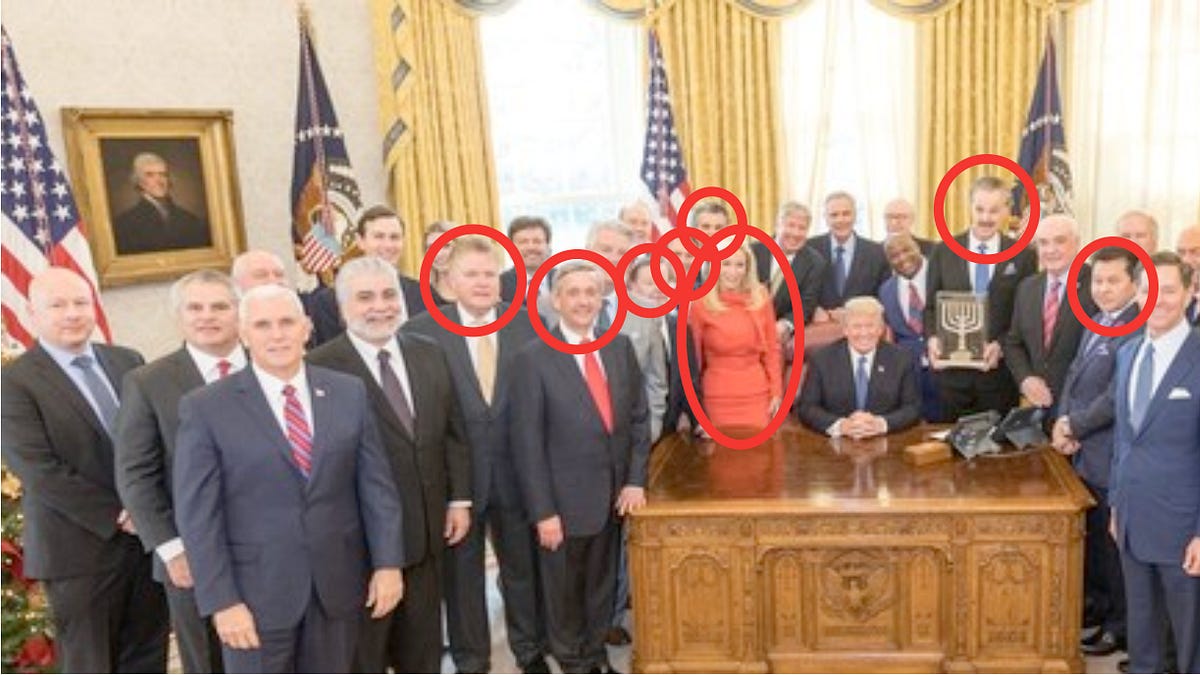
- Present: the piece references a 2018 photograph of Trump with his Christian advisers, with figures circled — a genuinely effective visual device, though the image itself did not survive the capture.
- Improve: the argument is fundamentally a taxonomy and would be far clearer as a diagram — three theological movements, their eschatological positions, and their resulting Israel stance in one figure. The named-figure lists would work better as a table than as prose.
#### 🔊 Aural learners
- Present: none in the captured text.
- Improve: an audio version would help considerably given the length, and the piece's argumentative structure would narrate well.
#### 🗣️ Verbal learners
- Present: strong — key terms are glossed inline as they arrive (supersessionism as replacement theology, postmillennial as building the kingdom now, "the parting of the ways" attributed to historians). The two-sides-of-the-same-coin metaphor is used consistently.
- Improve: "amillennial," "philosemitism," "Groypers," and "Dispensationalism" are used with lighter or no glossing than the terms above.
#### 🧩 Kinesthetic learners
- Present: extensive inline linking lets readers follow claims to sources, which is real participation.
- Improve: no checklist or applied exercise. A "how to identify which faction a given figure belongs to" heuristic would make the taxonomy operational.
#### 🧠 Logical learners
- Present: the strongest dimension. Clear thesis, historical mechanism, taxonomy, application, and — notably — explicit epistemic markers where Taylor is inferring rather than reporting ("I believe," "I'm convinced," "the overlap is notable and important").
- Improve: no data anywhere. The younger-evangelical trend, the increasing threats, and the causal weight of the advisory circle are all empirical claims presented without figures, and all three have available data sources.
#### 🧑🤝🧑 Social learners
- Present: series format with links to prior parts; Substack comments; direct address to readers outside MAGA media ecosystems.
- Improve: no engagement with how the categorised figures describe themselves, and no dissenting analyst quoted — so the reader gets a position rather than a conversation.
#### 🧘♀️ Solitary learners
- Present: Taylor explicitly says he has tried to make this an accessible entry point for new readers while recommending the full series, which is considerate series design.
- Improve: a summary of parts one through three would make it genuinely standalone; as written, the three-way taxonomy arrives as a reference to prior work.
#### 🌿 Naturalistic learners
- Present: minimal — the "lively spectrum" and "tug-of-war" images are the closest thing to systems framing.
- Improve: the coalition dynamics are genuinely ecological — competing factions, shared resources, an environment that shifted. Making that explicit would strengthen the analysis rather than decorate it.
### 📊 Accessibility Assessment
#### Screen reader semantics
- Present: clear section headings that summarise their own content ("The Christian Zionist Extremists Around Trump," "The Often-overlooked Christian Antisemitism Faction"), which supports navigation well; `<em>` used semantically for emphasis on "both."
- Improve: inline links are numerous and several have non-descriptive text ("chimed in," "opined," "having dinner"), which produces an unhelpful link list out of context. Link text should describe the destination.
#### Keyboard navigation
- Present: cannot verify from captured text; standard Substack template.
- Improve: with this link density, visible focus indication matters more than usual — confirm it.
#### Contrast and readability
- Present: cannot verify from captured text.
- Improve: verify link contrast against body text; Substack's default link styling relies partly on colour, which is a 1.4.1 concern for the many inline citations here.
#### Text resizing and reflow
- Present: cannot verify from captured text.
- Improve: confirm the long name-list paragraphs reflow without clipping at 200% zoom.
#### Media and captions
- Present: a referenced photograph of Trump with advisers, with figures circled.
- Improve: this is the significant gap. The image carries evidentiary weight — it is offered as telling "the whole story" — and there is no indication of alt text describing who is circled. A blind reader loses the evidence entirely. Descriptive alt text naming the circled figures is required, not optional, when an image is used as an argument.
#### Forms and interactions
- Present: subscription elements implied by the Substack template.
- Improve: ensure the subscribe input has a visible label and announced states.
#### Standards reference
- Gaps map to WCAG 2.2 AA: 1.1.1 Non-text Content (the evidentiary photograph) — primary gap; 2.4.4 Link Purpose (In Context); 1.4.1 Use of Colour; 1.4.3 Contrast (Minimum); 1.4.10 Reflow; 3.3.2 Labels or Instructions.
### 🌍 DEIB Assessment
#### Cultural breadth
- Present: the piece works across Protestant, Catholic, and Orthodox-adjacent traditions and takes the internal diversity of each seriously rather than flattening them — the three-tier treatment of Catholic positions is careful work.
- Improve: entirely American in scope despite the phenomena being transnational; Christian Zionism outside the US, and the position of Israeli and diaspora Jewish communities within these debates, are absent.
#### Inclusive language
- Present: careful and consistent distinctions that matter — theological Zionism separated from geopolitical Zionism, mainstream Catholicism separated from reactionary anti-Vatican II Catholicism, the antisemitic faction explicitly described as a minority wing. Terms are glossed as introduced.
- Improve: "Trumpy," "prickly Calvinists," "wild-eyed," and "shock jock" are dismissive registers applied to people being analysed, which sits awkwardly in a piece whose credibility rests on analytic distance.
#### Neurodiversity support
- Present: descriptive section headings, explicit signposting of the series structure, and terms glossed at first use all reduce load.
- Improve: the density of proper nouns is high — roughly thirty named individuals across several factions — and holding the mapping in working memory is genuinely demanding. A summary table would substantially reduce that.
#### Representation
- Present: this is the piece's most notable gap and it is worth stating plainly. The subject is Christian attitudes toward Jews, and no Jewish voice appears. American Jewish communities are discussed as objects of others' theology and as recipients of threats, never as participants with their own analysis. Taylor names his own vantage point as a researcher of the New Apostolic Reformation, which helps, but a piece about how Christians construct Jews would be strengthened by how Jews describe that construction.
- Improve: cite or link Jewish scholarship on Christian Zionism and on philosemitism — a substantial literature exists, and the two-sides-of-one-coin argument is not original to Taylor.
#### Psychological safety
- Present: the careful factional distinctions protect mainstream Catholics, mainstream evangelicals, and the majority of Christians from being swept into the critique, which is genuine care in a piece that could easily have generalised.
- Improve: no content warning precedes discussion of the Holocaust, pogroms, Neo-Nazis, and violent attacks on Jewish communities. Given the subject matter and the likely readership, that is a real omission.
### ✅ Logical Validity
#### Strong reasoning
- **Category correction as method.** Opening with a question that has no answer — which side are the Christian nationalists on — and using its unanswerability as evidence that the category is malformed is a genuinely elegant move. It demonstrates the inadequacy rather than asserting it.
- **Historical mechanism, not just correlation.** Deriving both philosemitism and antisemitism from a single documented ambivalence produced by "the parting of the ways" explains why the two co-occur, which a simple opposites model cannot. Explanatory economy of this kind is a real mark in the argument's favour.
- **Explicit epistemic marking.** "I believe it is largely because of this circle," "I'm convinced we don't get to where we are today," "the overlap is notable and important." Taylor consistently flags inference as inference. This is the single best feature of the piece's construction and it is rare in political commentary.
- **Self-supplied counter-evidence.** He raises AIPAC and the decades-long Trump–Netanyahu relationship as alternative explanations before arguing his own factor is the overlooked one, rather than pretending the alternatives do not exist.
- **A prediction that cuts against his own emphasis.** Noting that Christian Zionism "could have a short shelf-life" undercuts the significance of the wing he spends most of the piece establishing as dominant. Arguments that volunteer their own expiry date are more credible than those that do not.
- **Careful qualification on the Catholic overlap.** Immediately following the pattern observation with "these aren't the only voices… plenty are Protestant, and plenty aren't Christian at all" pre-empts the obvious misreading. The hedge is supplied unprompted and it is the correct one.
#### Fallacies
- **Small-sample pattern claim — the Catholic overlap, block 25.** "A remarkable number of prominent America First figures associated with antisemitic content are Catholic: Steve Bannon, Milo Yiannopoulos, Candace Owens, Nick Fuentes, Megyn Kelly, Jack Posobiec." *Weakness:* six hand-selected names, no denominator, no base rate for Catholic representation among right-wing media figures generally. Taylor's own hedge acknowledges the problem without resolving it, and "striking pattern" does argumentative work the evidence does not support. *Fix:* establish the base rate, or present it as a hypothesis worth testing rather than as a pattern observed.
- **Causal overreach — the Iran claim, block 14.** "I'm convinced we don't get to where we are today — the US at war with Iran at Netanyahu's urging — without this cohort of Christian Zionist extremists advising Trump." *Weakness:* a counterfactual about a major foreign-policy decision, resting on adviser proximity. Proximity is not influence, and the alternative explanations he himself raises are not eliminated. *Fix:* the epistemic marker ("I'm convinced") is honest and does most of the necessary work; what would strengthen it is evidence of the advisory channel operating on this specific decision.
- **Motive attribution — the philosemitism definition, block 6.** "A theological embrace of Jews, a sort of suffocating and possessive 'love' often expressed in a desire to guide and control them." *Weakness:* the scare quotes and "suffocating" assign an interior motive to a wide class of people, some of whom would describe their position very differently. The definition is doing evaluative work while presenting as descriptive. *Fix:* separate the behavioural description — support conditioned on theological expectations about Jewish futures — from the characterisation of the affect behind it.
- **Guilt by association, structural — block 17.** Listing "Neo-Nazis, the Groypers, the KKK, the Alt Right, some militias, and a lot of the conspiracy theory world" alongside named mainstream figures like Carlson, Greene, and Kelly within a single faction. *Weakness:* the grouping is by policy position on Israel, but the enumeration invites transfer of the most extreme members' attributes to the others. *Fix:* distinguish the anti-interventionist position from the antisemitic one explicitly; the piece's own argument requires that these are separable, since it elsewhere treats America First positioning and antisemitism as correlated rather than identical.
- **Assumed context — blocks 29 and elsewhere.** Charlie Kirk's assassination and a US invasion of Iran are referenced as established background without sourcing. *Weakness:* readers cannot verify load-bearing context, and a reader encountering the piece later has no way to date or check these. *Fix:* link them as everything else is linked.
- **Argument by accumulation — block 19.** The Trump-holds-both-impulses paragraph stacks the Ivanka conversion, antisemitic memes, the Fuentes and West dinner, and "very fine people on both sides." *Weakness:* the items are of very different evidentiary weight, and presenting them as a sequence lets the strongest carry the weakest. *Fix:* separate the documented from the interpretive; the documented items are strong enough alone.
#### Tone of voice
- Analytical and considerably cooler than the companion excerpt on Christian supremacy — this piece is doing taxonomy rather than jeremiad, and the register shifts accordingly. Taylor writes as an explainer to readers outside MAGA media ecosystems, with frequent orienting asides. The epistemic hedging is consistent and genuine rather than performative. Where the register slips is in characterising individuals — "Trumpy influencers," "prickly Calvinists," "wild-eyed," "shock jock," "waitin' on the Rapture" — flashes of editorialising in an otherwise measured piece. The closing lines tighten into rhetorical parallelism ("Is it pro-Israel? Yes… Is it antisemitic? Yes"), which is effective and marks the transition from analysis to argument.
### 🛡️ DARVO Analysis
- **Deny.** Not present in the author's own rhetoric — Taylor is making claims, not answering them. He does describe denial behaviour in his subjects, particularly the reactionary Catholic "implicit rejection" of *Nostra Aetate*, which he characterises as unstated rather than avowed.
- **Attack.** Present, and directed at named living individuals — which distinguishes this piece from the companion excerpt, where no one is named. The attacks are largely positional (what people believe and advocate) rather than characterological, but the dismissive descriptors noted above cross that line in places. Because individuals are named, they can in principle respond, which is a fairer structure than anonymous categorisation even though it raises the stakes.
- **Reverse victim/offender.** Not present in Taylor's argument. Notably, he declines an available move: he could have framed the philosemitic wing as straightforwardly protective of Jewish communities and the antisemitic wing as straightforwardly hostile, casting one as ally. Instead he argues both trajectories objectify, which refuses the simpler victim-ally framing. That is analytically harder and more honest.
- **Emotional cues and rhetoric.** The Holocaust reference at the end of the antisemitism trajectory is the piece's heaviest emotional weight and is deployed as historical endpoint rather than as accusation against present-day figures — a restrained handling. "Duking it out," "civil war," and "tearing apart" supply conflict framing throughout. The closing parallelism is the most rhetorically constructed passage.
- **Related fallacies.** The structural guilt-by-association in the faction enumeration and the small-sample Catholic pattern are catalogued above; both are the kind of move that reads as damning without establishing what it implies.
- **Analytical note.** Across this batch the DARVO framework has been near-empty on technical and scholarly sources and substantive on the litigation ones. This piece sits between: no defensive rhetoric, but real attack content, aimed at named people, in a genre where the subjects have no right of reply within the text. Worth weighing that structural asymmetry when citing it.
## 🎯 Conclusion
- **Bottom line.** Taylor argues the fight inside Trump's coalition over Israel and Iran is a conflict between two currents of American Christian nationalism — Christian Zionism and Christian antisemitism — and that these are not opposites but twin outputs of a single historical ambivalence toward Jews and Judaism. The methodological claim underneath is that treating Christian nationalism as monolithic makes its most consequential fracture invisible. He offers a genuinely new detail: that Trump's evangelical advisory circle is charismatic and conquest-oriented rather than Dispensationalist and Rapture-oriented, and therefore more accelerationist.
- **Next steps for readers.** Take the category correction and the historical mechanism; both are the durable content and both survive the piece's weaker moments. Treat the causal claims about Iran policy as the author's stated conviction, which is how he labels them. Discount the Catholic-overlap observation until someone establishes a base rate — six names with no denominator is a hypothesis, not a pattern. Note what is structurally missing: no Jewish voice appears in a piece about how Christians construct Jews, and the substantial Jewish scholarship on philosemitism goes uncited. If the argument matters to you, read parts one through three, because the three-way taxonomy this instalment leans on is established there rather than here.
## 🔄 Refactor Appendix — How Christian Zionism and Christian Antisemitism Are Tearing MAGA Apart
> Density: 2–5 Literature atoms (H3), 0–3 Permanent candidates (H4).
> Defaults: 3 Literature, 1 Permanent. Resonance filter: if you can't
> articulate in one line why a claim matters, drop it.
>
> Konik claim-header rules: present tense, declarative, ≤10 words when
> possible, searchable, unique, mirrors annotation focus if present.
>
> Atomicity: one declarative sentence per atom. "and"/"also" → split.
>
> Tag pool: #bmf · #addendum · #xref · #articleseed · #storystem · #share · #aphorisms
### 📚 Literature Atoms (H3)
#### [H1] Philosemitism and antisemitism share one historical root
> [!quote] ID:rw_01kyqbcjafav7xf84g8dzy1c1e
> Philosemitism and antisemitism are two sides of the same coin — both trajectories traceable through Christian history
**Context & use**:
- The closing argument of the piece.
- The central analytic claim, and the one that explains an otherwise puzzling fact: how one coalition, and one person, holds both. Testable by attitude co-occurrence surveys.
**Tags**: #xref #aphorisms #articleseed
**Highlight**: [view highlight](https://read.readwise.io/read/01kyqbcjafav7xf84g8dzy1c1e)
<!-- atomicity: 1 idea ✓ -->
#### [H2] Monolithic categories hide a movement's live fractures
> [!quote] ID:rw_01kyqbcvn16039d7dn4g0pc3az
> this illustrates the inadequacy of a monolithic conception of Christian nationalism, because Christian nationalists are on both sides
**Context & use**:
- Early in the piece, answering its own framing question.
- The methodological lesson, and the most transferable content here — it applies to analysing any coalition, including secular and technical ones.
**Tags**: #xref #share
**Highlight**: [view highlight](https://read.readwise.io/read/01kyqbcvn16039d7dn4g0pc3az)
<!-- atomicity: 1 idea ✓ -->
#### [H3] Coalitions signal to one faction while paying another
> [!quote] ID:rw_01kyqbd868evjbmfa22chxngs2
> He managed to activate the America First crowd while giving his Christian Zionist advisers policy win after policy win
**Context & use**:
- The paragraph on how the coalition was held together.
- Describes the maintenance mechanism for an incompatible coalition: rhetoric to one wing, policy to the other. The most citation-dense and most contested passage in the piece.
**Tags**: #xref
**Highlight**: [view highlight](https://read.readwise.io/read/01kyqbd868evjbmfa22chxngs2)
<!-- atomicity: 1 idea ✓ -->
### 🧠 Permanent Candidates (H4)
#### [P1] Opposite-seeming attitudes toward a group can share one origin
**Claim** (one sentence, Courtney's voice): Idealisation and hostility toward the same group are often two outputs of a single unresolved relationship rather than opposing positions, which is why they co-occur in one person.
**Evidence pointer**: [[#H1]]
> [!quote]
> Philosemitism and antisemitism are two sides of the same coin
**Scope & conditions**: Holds where a group's identity was formed partly in relation to the other group, so the relationship is constitutive rather than incidental. Breaks where the attitudes have genuinely independent causes — ordinary prejudice acquired without any such history is just prejudice, not an inverted attachment.
`proof_state: working`
**Links**:
- [[Ambivalence as a stable state]] — because extends
- [[Othering]] — because contrasts on whether idealisation counts as othering
- [[Christian nationalism]] — because applies-in the case at hand
## Tests / falsifiers
- Field validated philosemitism and antisemitism scales to the same respondents. A strong negative correlation refutes the claim; a positive or null correlation supports it.
- If the co-occurrence appears only in populations with the shared history and not in others, the constitutive-relationship condition is confirmed.
<!-- atomicity: 1 idea ✓ -->
#### [P2] Coalitions held together by shared enemies break on affirmative questions
**Claim** (one sentence, Courtney's voice): A coalition whose cohesion comes from what it opposes will hold until it must decide something affirmative, at which point the fracture appears along its constituent members' actual commitments.
**Evidence pointer**: [[#H2]]
**Scope & conditions**: Holds where members were recruited by opposition rather than by shared positive goals. Breaks where an affirmative programme was agreed at formation, and where the coalition's decision procedure lets one faction decide without the others' assent — the fracture then surfaces as exit rather than as conflict.
**Links**:
- [[Negative coalition formation]] — because extends
- [[Open source governance disputes]] — because applies-in a secular case
- [[Shared enemies as social glue]] — because evidence-for
<!-- atomicity: 1 idea ✓ -->
### ✏️ Fleeting Queue
- [F1] Read parts one through three of this series — the three-way taxonomy is established there, not here — https://matthewdtaylor.substack.com/p/how-christian-zionism-and-christian #fleeting #inbox
- [F2] Find Jewish scholarship on philosemitism; the two-sides-of-one-coin argument is not original to Taylor and the piece cites none of it #fleeting #inbox
- [F3] Check PRRI/Pew time series on evangelical support for Israel by age — Taylor asserts the trend without data and the data exists #fleeting #inbox
- [F4] Base rate check: what share of prominent right-wing media figures are Catholic generally? Six names with no denominator is not a pattern #fleeting #inbox
- [F5] The shared-enemies-break-on-affirmative-questions pattern applies directly to open source governance splits — worth a standalone note #fleeting #inbox
### → Things 3 (max 2 actions)
- [ ] Read the full four-part Christian nationalism series and write one consolidated note — faith-and-theology wiki #things
- [ ] Pull PRRI/Pew data on evangelical Israel support by age cohort to check the short-shelf-life claim — research #things
<!-- deep-read:sections end -->
📄 **Full text:** [[Full Document Contents/Articles/How Christian Zionism and Christian Antisemitism Are Tearing MAGA Apart.md|How Christian Zionism and Christian Antisemitism Are Tearing MAGA Apart by Matthew D. Taylor]]
## Highlights
- Actually, this illustrates the inadequacy of a monolithic conception of Christian nationalism, because Christian nationalists are on *both* sides. Here we observe a deep fracture within Trump’s Christian support base — probably the most serious ideological divide to emerge within his coalition since 2017. It’s more than a debate about Iran or Israel. It’s a civil war between Christian Zionism and Christian antisemitism, two very powerful currents of historic American Christian nationalism. ([View Highlight](https://read.readwise.io/read/01kyqbcvn16039d7dn4g0pc3az))
- Note: The methodological correction: treating Christian nationalism as one bloc makes its internal fractures invisible, and those fractures are where the movement is actually moving.
- Tags: christian-nationalism, atom/literature/h1, category-critique, political-analysis
- Because antisemitism and philosemitism are two sides of the same coin, they can coexist within the same person — and Donald Trump is that kind of person. He can pivot from [waxing poetic](https://www.jpost.com/judaism/article-870345) about his daughter Ivanka’s conversion to Judaism to posting [antisemitic memes](https://en.wikipedia.org/wiki/Donald_Trump_and_antisemitism) and [having dinner](https://www.politico.com/news/2022/11/25/trump-white-nationalist-nick-fuentes-kanye-00070825) with outright Nazis like Nick Fuentes and Kanye West. He managed to activate the America First crowd while giving his Christian Zionist advisers policy win after policy win — dog-whistling with comments like “very fine people on both sides” about the pro-Confederacy far-right crowds at the “Unite the Right” rally in Charlottesville chanting “Jews will not replace us.” ([View Highlight](https://read.readwise.io/read/01kyqbd868evjbmfa22chxngs2))
- Note: The coalition-management mechanism: signalling to one faction while delivering policy to the other. Note this is the most citation-dense paragraph and the most contested.
- Tags: christian-nationalism, atom/literature/h2, coalition-politics
- Philosemitism and antisemitism are two sides of the same coin — both trajectories traceable through Christian history, both finding extreme embodiment on the American far right, and now duking it out within Trump’s coalition. Evangelical Christian Zionism is pulling Trump further into supporting Netanyahu’s long-desired war against Iran. And the reactionary Catholic and hardline Calvinist backlash is helping fuel a surge of antisemitic Christian content online, driving increasing threats against the American Jewish community. ([View Highlight](https://read.readwise.io/read/01kyqbcjafav7xf84g8dzy1c1e))
- Note: The central analytic claim: philosemitism and antisemitism are not opposites but twin Christian fixations on Jews, which is why one coalition can hold both.
- Tags: christian-nationalism, philosemitism, antisemitism, atom/zettel/z1, atom/literature/h1