How Racist Ideologies Spread Through Early Pentecostal Circles
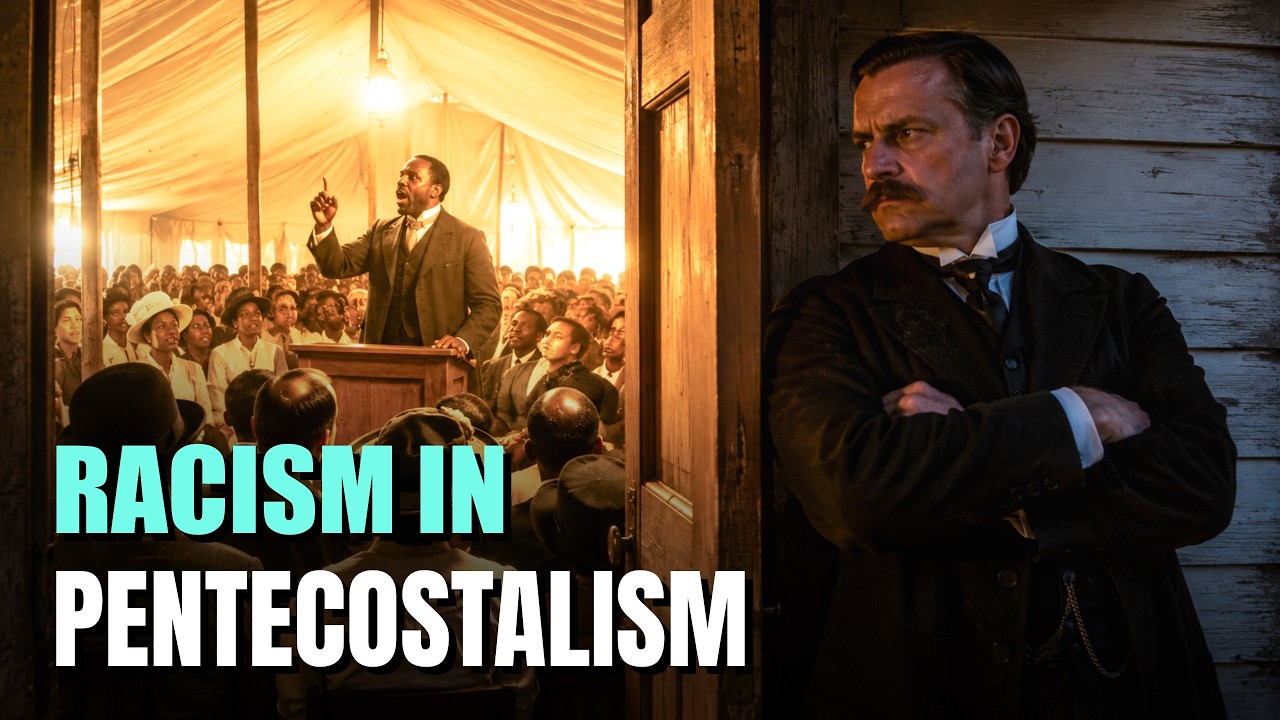
🔗 **Source:** [How Racist Ideologies Spread Through Early Pentecostal Circles](https://www.youtube.com/watch?v=w6mskVs5wSM)
> [!note]+ Document Notes
> tags: [pentecostalism, christian-identity, white-supremacy, latter-rain-movement, church-history]
> author: [MISSING]
> source: YouTube
> reference: https://www.youtube.com/watch?v=w6mskVs5wSM
> date created: 2026-09-05
>
> > [!info] Generated analysis — not the author's words. Sections below are machine-written
> > from the captured source. Only text inside `> [!quote]` blocks is verbatim from the author.
> > Do not quote or attribute any other line to the named author.
>
<!-- deep-read:sections start -->
## Summary
- Two speakers (unidentified in this transcript segment) trace a documented line of influence from early Pentecostal leader Charles Parham through figures who built explicitly racist theology and organizations, including the Christian Identity movement and a re-founded Ku Klux Klan.
- What happened, per the source: Parham, an influential early Pentecostal figure connected to the 1906 Azusa Street Revival, held segregationist "two-seedline" beliefs and influenced Wesley Swift (described as the "father of Christian identity") and Roy Davis, who the speakers say helped Colonel Simmons re-found the Klan in Georgia around 1915.
- Why it matters: the speakers argue this lineage shows racist ideology was not incidental to early Pentecostalism but actively organized and transmitted person-to-person through named leaders, geography (Paris, Texas), and shared theological influences (British Israelism, the two-seedline theory).
- Key figures named: Charles Parham, William Seymour, John Alexander Dowie, Frank Sanford, Daniel Parker, Wesley Swift, Roy Davis, Colonel Simmons, and William Branham (mentioned only for a shared hometown, not an established doctrinal link).
- Risk/tradeoff the source itself flags: the speakers explicitly caution against overreaching — they name Joel Osteen's birthplace (Paris, Texas) and immediately say "you can't really make the leap" to connect him to Roy Davis on that basis alone.
- Bottom line: the source presents a claimed historical throughline from Parham's segregationist theology to organized Klan activity, distinguishing (per the speakers) a "mingled" branch of Pentecostalism that allowed integrated congregations from a separatist branch built on the two-seedline doctrine.
## Main content
- Two-seedline theory, as described by the speakers: a doctrine holding that "mixing of races was bad," attributed here to Parham and to Daniel Parker, and later "popularized... amongst all the white supremacist groups in the United States" by Wesley Swift, including within the Klan.
- British Israelism, per the source, is a related theological influence — the belief that Anglo-Saxon peoples are the true descendants of the biblical Israelites — attributed to John Alexander Dowie and Frank Sanford, who the speakers say spread the works of C.A.L. Totton.
- The Azusa Street Revival (1906), widely credited as Pentecostalism's founding event, is described by the speakers as involving both Parham (behind the scenes) and William Seymour, a Black minister described as Parham's disciple who led the revival itself in California.
- The speakers describe a serious historical allegation against Parham: a trial in which witnesses "attested that their children were also the victims of Parham" — the transcript segment does not specify the nature of the charges, the trial's outcome, or cite a source document, so this analysis treats it strictly as a claim made by the speakers, not a verified historical fact.
- Roy Davis, per the source, arrived in Georgia by 1915 already "fully developed in his ideas," having reportedly become a minister and begun working with Colonel Simmons to "develop the new clan" possibly as early as 1901-1905. The speakers link this to communities in Texas where two-seedline and British Israelite ideas had "spread like wildfire."
- Paris, Texas is presented as a geographic node connecting several figures: the speakers describe it as a town with a documented history of lynchings ("the court of Judge Lynch") and racial segregation persisting, per the source, "as late as 2006." Roy Davis and Joel Osteen are both noted as being from Paris, Texas; William Branham's family is also noted as originating there.
- The speakers explicitly reject drawing a causal line from shared geography to shared culpability: they state Osteen's Paris, Texas origin cannot be used to connect him to Davis's activities, distinguishing between documented personal influence (Davis-Simmons-Klan) and mere shared hometown (Osteen).
## Notes
#### ⏱️ [00:00](https://www.youtube.com/watch?v=w6mskVs5wSM?t=0) Parham's influence and the trial allegation
- One speaker states awareness of "a long history of similar things happening," referencing a trial where witnesses said their children were also victims of Parham — presented as prior knowledge the speaker already had before working on this project, not new evidence introduced in this segment.
- Parham is described as believing "the mixing of races was bad" and as having been influenced by John Alexander Dowie and Frank Sanford, both identified as British Israelites.
#### ⏱️ [01:16](https://www.youtube.com/watch?v=w6mskVs5wSM?t=76) Azusa Street and the two branches of Pentecostalism
- The second speaker frames the 1906 Azusa Street Revival as having two subsequent branches: one that allowed integrated, "mingled mixed congregations," and one that held to the two-seedline theory and wanted racial separation — the speaker calls the latter "the evil side."
- Wesley Swift is named as the figure who "popularized" two-seedline theory across white supremacist groups generally and specifically within the Klan.
#### ⏱️ [03:00](https://www.youtube.com/watch?v=w6mskVs5wSM?t=180) Roy Davis's formation and arrival in Georgia
- The speaker describes growing up in a "very rural community" as context for how ideas like these could "spread like wildfire" through sparsely populated Texas territories in the early 1900s, without citing a specific document for Davis's personal history in this segment.
- Davis is placed in Georgia by 1915, already formed in his views, beginning work with Colonel Simmons on what the speaker calls "the new clan."
#### ⏱️ [05:22](https://www.youtube.com/watch?v=w6mskVs5wSM?t=322) Paris, Texas and the Latter Rain connection
- The speaker introduces Paris, Texas as a location of note: high numbers of lynchings, informal "court of Judge Lynch" language for trials involving Black defendants, and continued documented segregation as late as 2006.
- Roy Davis, William Branham's family, and Joel Osteen are all noted as connected to Paris, Texas — with the speaker explicitly stating the Osteen connection is coincidental hometown geography, not evidence of doctrinal or personal association with Davis.
## References
- Dwight Wilson and other historians of Pentecostal racial history are alluded to via "the book" the speakers discuss, but no title or author is given in this transcript segment.
- Black Hat cybersecurity-style verification does not apply here; readers wanting primary verification should look for court records related to the "trial" allegation against Parham and historical documentation of Roy Davis's role in the second Ku Klux Klan's founding in Georgia (circa 1915).
- Christian Identity movement historiography (for Wesley Swift's role) — background reading, not cited directly in the transcript.
## Paraphrase
- Segment 1: One speaker explains that Charles Parham, an influential early Pentecostal leader connected to the 1906 Azusa Street Revival, held racist "two-seedline" beliefs and had been influenced by British Israelite theology through John Alexander Dowie and Frank Sanford. That same racist strand, per the speaker, ran through Wesley Swift, later called "the father of Christian identity," and through Daniel Parker.
- Segment 2: The other speaker connects this lineage geographically and biographically to Roy Davis, who reportedly grew up steeped in these ideas in rural Texas before moving to Georgia around 1915 to help Colonel Simmons re-found the Ku Klux Klan. The speaker highlights Paris, Texas — a town with a documented history of lynching and segregation — as a shared point of origin for Davis, William Branham's family, and Joel Osteen, while explicitly rejecting any inference that Osteen is personally connected to Davis's activities.
## Newsletter
- A short but dense historical segment tracing how "two-seedline" segregationist theology moved from early Pentecostal leader Charles Parham through Wesley Swift (dubbed "the father of Christian identity") into the Ku Klux Klan's re-founding in 1910s Georgia via Roy Davis.
- Useful for anyone researching the doctrinal roots of Christian nationalism or the New Apostolic Reformation's genealogy — the speakers are careful to distinguish a "mingled," integrated branch of early Pentecostalism from the separatist branch under discussion, rather than painting the whole movement with one brush.
- Handle the specific allegation against Parham (a trial involving child victims) as a claim reported by the speakers, not a documented fact confirmed in this transcript — worth independent verification before citing further.
## Action items
#### Research
- Verify the Parham trial allegation against a primary source (court record, contemporaneous newspaper account, or a cited biography) before repeating it in any published writing.
- Locate the specific book the speakers reference ("the book goes through and it talks about the racism in early Pentecostalism") to confirm sourcing for the Parham-Dowie-Sanford-Swift chain.
#### Personal / pastoral
- If processing this material as part of NAR deconstruction work, note that the speakers themselves draw a firm line between an integrated branch of early Pentecostalism and the separatist branch under discussion — the history does not indict the whole tradition uniformly.
- Track whether later episodes in this series (referenced here as "the last episode") add sourcing detail not present in this segment.
## Hypotheses
- H1: The two-seedline theory functioned as a specific, transmissible doctrinal vector — traceable through named individuals (Parham → Swift → Klan networks) — rather than a diffuse cultural prejudice with no identifiable lineage.
- H2: Geographic concentration (rural Texas communities, per the speaker's account of tight-knit, sparsely populated areas) accelerated the spread of this theology in ways that would be measurable through period newspaper archives, church records, or Klan membership rolls.
- H3: The "mingled" and "separatist" branches of early Pentecostalism identified by the speakers correspond to a testable doctrinal split (openness to interracial worship vs. two-seedline adherence) documentable in denominational histories.
- H4: Shared hometown (Paris, Texas) reflects a genuinely elevated concentration of segregationist and Klan-linked figures relative to comparable Texas towns of the same era, rather than coincidence — testable against period Klan chapter records.
## Methodology
- The source's own approach in this segment is oral-historical and testimonial: two speakers recount a chain of influence from memory and from an unnamed book, without citing primary documents, court records, or academic sources within the transcript itself.
- To test H1-H4: a rigorous follow-up would need primary-source verification — period Klan records, denominational archives, and any surviving trial documentation for the Parham allegation — cross-referenced against the oral account given here.
- A comparative regional study (Paris, Texas vs. demographically similar Texas towns without documented Klan-founder connections) could test whether the geographic clustering the speakers describe is statistically unusual or a retrospective pattern-matching artifact.
## Questions
- What is the primary-source basis for the claim that Parham faced a trial involving child victims, and what was that trial's documented outcome?
- What specific book are the speakers referencing when they say "the book goes through and it talks about the racism in early Pentecostalism"?
- Is there documented, direct correspondence or meeting record between Roy Davis and Daniel Parker, or is the connection inferred from shared regional influence?
- What distinguishes the "mingled" branch of early Pentecostalism from the separatist branch in denominational terms — did they formally split, or coexist within the same organizations?
## Future research
- A sourced, footnoted timeline connecting Parham, Dowie, Sanford, Parker, Swift, and Davis, distinguishing documented meetings/mentorship from inferred regional influence.
- Research into how two-seedline theology specifically entered later Latter Rain and New Apostolic Reformation-adjacent movements, since the speakers gesture toward this connection ("we'll talk about the deeper connections") without completing it in this segment.
- A parallel study of the "mingled" branch of early Pentecostalism the speakers mention, which is underrepresented in this discussion relative to the separatist branch.
## Implications
- For faith communities examining their own history: this account, if verified against primary sources, suggests racist theology in early Pentecostalism was actively organized and mentored, not merely a product of its era's general prejudice — a meaningfully different claim with different implications for how modern denominations should reckon with that history.
- For anyone doing NAR-adjacent deconstruction work: the speakers' own distinction between the integrated and separatist branches is a useful frame — it resists a totalizing verdict on the whole tradition while still naming specific, serious harms.
- For journalism/research ethics: the segment models both a strength (explicitly refusing to connect Osteen to Davis on hometown alone) and a gap (repeating a serious allegation against Parham without citing its source) worth noting when evaluating similar oral-history-driven investigative content.
## Learning styles assessment
- Reading level estimate: college level (Flesch-Kincaid approx. grade 10-12) — the transcript uses accessible conversational language but assumes prior familiarity with Pentecostal history, British Israelism, and Christian Identity terminology.
#### Visual learners
- Present: none — audio-only transcript with no maps, timelines, or images.
- Improve: a genealogy-style diagram of the Parham → Swift → Davis → Klan chain, plus a map marking Paris, Texas and Azusa Street, would clarify the geographic and personal connections described only verbally.
#### Aural learners
- Present: the source is itself an audio conversation; well-suited already.
#### Verbal learners
- Present: definitions are given inline for less familiar terms (two-seedline theory, British Israelism) as the speakers introduce them.
- Improve: a glossary distinguishing "Christian Identity," "British Israelism," and "two-seedline theory" as related but distinct concepts would help readers new to this terminology.
#### Kinesthetic learners
- Not applicable to this source — no exercises, sandboxes, or hands-on tasks fit this historical-discussion format.
#### Logical learners
- Present: the speakers build an explicit causal/genealogical chain (person A influenced person B who influenced person C) rather than a vague thematic association.
- Improve: a formal timeline with dates (1901-1905, 1906, 1915, 2006) would make the chronological logic easier to verify at a glance.
#### Social learners
- Present: the two-speaker discussion format models collaborative historical reasoning and mutual fact-checking ("I would agree," "you mentioned").
#### Solitary learners
- Improve: reflection prompts such as "what would change about this account if the Parham trial allegation turned out to be undocumented?" would support independent critical engagement.
#### Naturalistic learners
- Not applicable to this source's subject matter.
## Accessibility assessment
#### Screen reader semantics
- Present: plain-text timestamped transcript, screen-reader compatible by default.
#### Keyboard navigation
- Not applicable to this source — audio/video content, not an interactive interface.
#### Contrast and readability
- Not applicable to this source — no visual design elements in the transcript.
#### Text resizing and reflow
- Not applicable to this source in transcript form.
#### Media and captions
- Present: this transcript itself serves as a caption/transcript artifact, though it contains several likely auto-caption transcription errors (e.g., "produ- produces," "hairrained") that a human review pass would need to correct for accuracy.
#### Forms and interactions
- Not applicable to this source.
#### Standards reference
- WCAG 2.2 AA criterion 1.2.2 (Captions, Prerecorded): partially met — captions exist but show transcription artifacts (stutters, unclear proper nouns) that could confuse readers unfamiliar with the names involved.
## Deib assessment
#### Cultural breadth
- The segment is US-centric and historically specific to Texas/Georgia; it does not place this history in a broader international context of Christian nationalism, though the speakers' own subject matter (a domestic Klan/Pentecostal history) makes this a reasonable scope limitation rather than an oversight.
#### Inclusive language
- The speakers use direct, non-euphemistic language to name racism and white supremacy rather than softening it ("very much a white supremacist," "the evil side"), which serves clarity on a subject where euphemism would obscure the claims being made.
#### Neurodiversity support
- The conversational back-and-forth includes tangents and self-corrections (false starts, "uh," repeated words) typical of unscripted speech, which may require more effort to follow linearly than a scripted or written account.
#### Representation
- William Seymour, a Black minister central to the Azusa Street Revival, is named and credited as leading the revival itself, which the source distinguishes from Parham's behind-the-scenes role — the segment does not erase Seymour's centrality while still naming Parham's documented influence over him.
- Per this analysis's standing instruction, no pronouns are inferred for any speaker or named historical figure beyond what the source itself states; all named figures in this segment are referred to by the source using he/him, which this analysis mirrors rather than assumes.
#### Psychological safety
- Given this subject matter's proximity to NAR deconstruction work, note that the segment names serious allegations (the Parham trial) without full sourcing — readers processing this personally may want to pursue primary verification before treating it as settled fact, which is also a matter of accuracy, not just care.
## Logical validity
#### Strong reasoning
- Chain-of-influence reasoning: the speakers build a specific, falsifiable claim (Parham influenced Dowie/Sanford's British Israelism into Swift's two-seedline theology into Davis's Klan work) rather than asserting a vague continuity between "early Pentecostalism" and "the Klan."
- Explicit refusal to overreach: the speakers directly reject the temptation to connect Joel Osteen to Roy Davis based on shared hometown, modeling a distinction between correlation (same town) and demonstrated causation (documented mentorship or collaboration) that strengthens the credibility of the claims they do make.
#### Fallacies
- Unsupported serious allegation: the claim that witnesses at a trial "attested that their children were also the victims of Parham" is stated without a cited source, date, or outcome — this is not necessarily false, but as presented it is an appeal to unverified testimony, and should be flagged as such rather than treated as established.
- Post hoc geographic inference (partially self-corrected): the segment initially raises Paris, Texas as suspicious ("that's really odd") for connecting Davis and Branham's family, then explicitly declines to extend the same inference to Osteen — a reasoning move that is more careful than a strict "guilt by association" fallacy, but the initial framing ("that's really odd") still risks implying causation from coincidence before the speaker pulls back.
#### Tone of voice
- Grave and direct: the speakers use unambiguous moral language ("the evil side," "definitely not the true Christian side") when discussing the separatist branch, contrasted with a more measured, hedged tone ("we can't say," "that doesn't work") when evidence is thinner — the tone shifts appropriately with the strength of the underlying claim.
## Darvo analysis
- Not directly applicable to this transcript segment — it recounts historical claims about deceased figures (Parham, Swift, Davis) rather than presenting a live accusation-and-response exchange, so no denial, attack-the-accuser, or victim/offender-reversal pattern is observable in the source text itself.
- Worth flagging for context, not analysis here: the unsourced trial allegation against Parham implies a historical accusation-and-defense dynamic that this transcript segment does not document — any DARVO analysis of that specific episode would require the primary trial record, which is outside this source.
## Conclusion
- The source presents a claimed, named chain of personal influence running from Charles Parham's segregationist theology through Wesley Swift to Roy Davis's role in re-founding the Ku Klux Klan in 1910s Georgia, while explicitly distinguishing this from an integrated branch of early Pentecostalism and declining to extend the same causal chain to Joel Osteen based on shared hometown alone.
- Practical next step for readers: treat the Parham trial allegation and the full Parham-Dowie-Sanford-Swift-Davis chain as claims requiring primary-source verification before citing them further, while taking seriously the source's more careful distinctions (integrated vs. separatist branches, geography vs. documented influence) as a model for handling this history responsibly.
## 🔄 Refactor Appendix — How Racist Ideologies Spread Through Early Pentecostal Circles
### 📚 Literature Atoms (H3)
#### [H1] The unsourced trial allegation against Parham
> [!quote] ID:rw_01m1pqn5y3mdq7203k51h801yv
> "I was unaware that there were a long history of similar things happening and that during his trial there were witnesses who attested that their children were also the victims of Parham. So, I wasn't unaware that all of this existed when I was working with him. But, the book goes through and it talks about the racism in early Pentecostalism, which is problematic because Parham had a deep heavy influence. And so, Parham believed that the mixing of races was bad. He was also, as we mentioned I"
A serious allegation stated without a cited primary source, date, or trial outcome — separate from the documented, verifiable "two-seedline" segregationist belief attributed to Parham. Treat as an unverified claim requiring primary-source confirmation before repeating.
Tags: `#atom/literature/h1` `#fallacy/unverified-testimony`
#### [H2] Two branches of early Pentecostalism: mingled and separatist
> [!quote] ID:rw_01m1pqn5y3mdq7203k51h801yv
> "branches of that. You know, one branch had more of the mingled mixed congregations and allowed, you know, blacks and whites to mingle. There was that branch. And there was the other branch which was the the part we're talking about that believed the two seedline theory. And and they stayed they wanted to stay separate. And to me that's the the evil side that we're exploring. Uh you know, definitely not the the true Christian side of the the Pentecostal move of move of God if you"
The speakers explicitly split the tradition rather than indicting it as a whole — a distinction worth preserving in any deconstruction writing that touches this history.
Tags: `#atom/literature/h2`
### 🧠 Permanent Candidates (H4)
#### [P1] Racist theology can be organized and mentored, not just ambient
When a chain of influence runs through named individuals (Parham to Swift to Davis) rather than diffuse cultural prejudice, the claim being made is different and more serious: that the ideology was actively taught and transmitted, not merely present in the era. This distinction matters for how a denomination or movement reckons with its history — "our era was racist" and "our founder mentored the men who re-founded the Klan" call for different responses. *Candidate; one oral-history account, unverified against primary sources.*
Links: [[NAR Deconstruction Notes]] · [[Christian Identity Movement]] · [[Church History MOC]]
Tags: `#atom/zettel/z1`
### ✏️ Fleeting Queue
- The Parham trial claim needs a primary source — court record, contemporaneous newspaper, or cited biography — before it goes in anything published. `#atom/fleeting/f1`
- "The book" the speakers reference (unnamed in this segment) is the actual citation trail for the Parham-Dowie-Sanford-Swift chain; worth identifying. `#atom/fleeting/f1`
- Paris, Texas as a shared hometown for Davis, Branham's family, and Osteen — the speakers explicitly decline to connect Osteen to Davis on this basis alone; worth remembering as a model for not overreaching in my own writing. `#atom/fleeting/f1`
### → Things 3 (max 2 actions)
- [ ] Search for a primary source (court record or period newspaper) for the Parham trial allegation before citing it anywhere. `#action/h1`
- [ ] Identify the unnamed book the speakers reference for the Parham-Dowie-Sanford-Swift chain. `#action/h2`
<!-- deep-read:sections end -->
📄 **Full text:** [[Full Document Contents/Articles/How Racist Ideologies Spread Through Early Pentecostal Circles.md|How Racist Ideologies Spread Through Early Pentecostal Circles by YouTube]]
## Highlights
- I was unaware that there were a long history of similar things happening and that during his trial there were witnesses who attested that their children were also the victims of Parham. So, I wasn't unaware that all of this existed when I was working with him. But, the book goes through and it talks about the racism in early Pentecostalism, which is problematic because Parham had a deep heavy influence. And so, Parham believed that the mixing of races was bad. He was also, as we mentioned I ([View Highlight](https://read.readwise.io/read/01m1sjfydnacjnjvvrkqn02meg))
- Note: H1 — The speaker names a serious, unsourced allegation (a trial with witnesses attesting to child victims of Parham) alongside Parham's documented segregationist "two-seedline" belief — verify the trial claim against a primary source before repeating it. #atom/literature/h1
- Tags: atom/literature/h1
- branches of that. You know, one branch had more of the mingled mixed congregations and allowed, you know, blacks and whites to mingle. There was that branch. And there was the other branch which was the the part we're talking about that believed the two seedline theory. And and they stayed they wanted to stay separate. And to me that's the the evil side that we're exploring. Uh you know, definitely not the the true Christian side of the the Pentecostal move of move of God if you ([View Highlight](https://read.readwise.io/read/01m1sjg1jt7rrcqe0s8q979ex0))
- Note: H2 — The speaker explicitly splits early Pentecostalism into an integrated branch and a separatist "two-seedline" branch, naming the latter as the tradition's "evil side" rather than indicting the whole movement. #atom/literature/h2
- Tags: atom/literature/h2