How We Built Grok Bot in a Month | Roman Ugarte
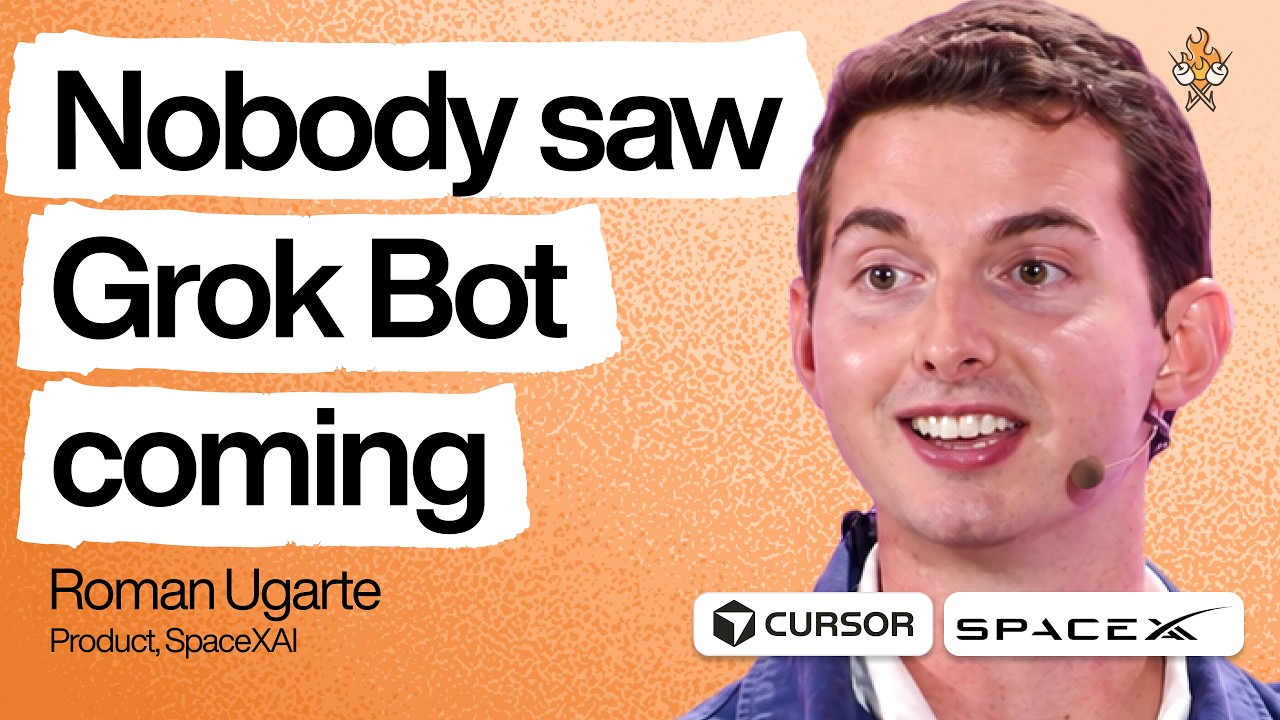
🔗 **Source:** [How We Built Grok Bot in a Month | Roman Ugarte](https://www.youtube.com/watch?v=maSdsTLaMuU)
> [!note]+ Document Notes
> tags: [ai-agents, agentic-computing, product-development, startup-culture, delegation-to-ai]
> author: "[MISSING]"
> source: Lenny's Podcast (YouTube)
> reference: https://www.youtube.com/watch?v=maSdsTLaMuU
> date created: 2026-09-08
>
> > [!info] Generated analysis — not the author's words. Sections below are machine-written
> > from the captured source. Only text inside `> [!quote]` blocks is verbatim from the author.
> > Do not quote or attribute any other line to the named author.
>
> # 🏷️ Title: How we built Grok Bot in a month | Roman Ugarte (SpaceXAI)
>
<!-- deep-read:sections start -->
## 🧭 Table of Contents
- [[#📝 Summary]]
- [[#📖 Main Content]]
- [[#🗒️ Notes]]
- [[#📚 References]]
- [[#🗣️ Paraphrase]]
- [[#📰 Newsletter]]
- [[#✅ Action Items]]
- [[#🧪 Hypotheses]]
- [[#📊 Methodology]]
- [[#❓ Questions]]
- [[#🔮 Future Research]]
- [[#💡 Implications]]
- [[#🧠 Learning Styles Assessment]]
- [[#📊 Accessibility Assessment]]
- [[#🌍 DEIB Assessment]]
- [[#✅ Logical Validity]]
- [[#🛡️ DARVO Analysis]]
- [[#🎯 Conclusion]]
- [[#🔄 Refactor Appendix — How we built Grok Bot in a month | Roman Ugarte (SpaceXAI)]]
## 🔗 References
- Source: Lenny's Podcast (YouTube channel/site field captured as "YouTube"; the host is addressed only as "Lenny" in the dialogue and the show is identified via a closing mention of "lennispodcast.com" — full host name not stated in the captured transcript, so author is [MISSING]), "How we built Grok Bot in a month | Roman Ugarte (SpaceXAI)" — https://www.youtube.com/watch?v=maSdsTLaMuU
- `paras2.py --links` returned zero results — this is a YouTube transcript capture with no HTML anchors, so there is nothing to check for uncited claims; the absence is a property of the capture format, not a finding about the source's sourcing.
- No links, citations, or footnotes exist inside the transcript itself — every claim in the episode is asserted by the two speakers (host and guest) in conversation, with no third-party data cited by either.
## 📝 Summary
- **What happened:** Roman Ugarte — described in the intro as employee #15 at Cursor, now leading product for "Grockbot" at SpaceX AI — walks the host through Grockbot's build: a small, physically isolated team built a working prototype in about a month, ran a ~3-week internal beta (including 200-300 hand-run onboarding calls), then launched publicly and has been iterating for about 3 weeks as of recording.
- **Why it matters:** The episode is presented as a case study in shipping an agentic "AI teammate" product fast, and it names two specific architectural bets — running every agent entirely in the cloud (never tethered to the user's own machine) and giving each bot its own persistent computer for GUI-level tasks that lack APIs/MCPs — as the decisions the guest credits with the product's traction.
- **Key stakeholders:** the guest (product lead, financially and reputationally invested in the product's success), the host (a podcaster who states he is a paying, heavy user and interviews AI-industry guests as his format), SpaceX AI / Cursor as the corporate entity, and listeners evaluating whether to adopt the product or its architectural choices.
- **Risks and tradeoffs:** every success claim in the episode is self-reported by the people who built and are promoting the product, with zero third-party or quantitative corroboration (no DAU, retention, revenue, or churn figures appear anywhere in the transcript) — see Logical Validity and DARVO Analysis below for what that structurally implies about the conversation's evidentiary weight.
- **Bottom line:** the episode is a genuine, detailed account of a real product-development process (small isolated team, manual onboarding as a research method, an explicit "unshipping" discipline) whose process claims are plausible and specific, but its success claims ("hottest AI product in the world," "changed my life") are asserted, not measured, by two parties with a direct interest in the product's reputation.
## 📖 Main Content
The episode is a long-form interview on Lenny's Podcast with Roman Ugarte, who joined Cursor as its 15th employee and now leads product for "Grockbot," an agentic assistant built inside SpaceX AI (the Cursor parent organization, per the guest's own account of an "acquisition" and brand transition). The host frames the guest as building "the hottest AI product in the world right now" and states he personally uses it "a 100 times a day."
The origin story: the team wanted to build something for general "knowledge work" beyond Cursor's developer audience, and deliberately built it as a wholly new product rather than a new surface inside Cursor. A small team (the guest calls it "a handful of people") worked in physical and organizational isolation — a separate part of the office, private Slack channels — for about a month, from first line of code to an internally-shippable prototype. The guest attributes the speed directly to the isolation: a larger group working toward a 6-12 month roadmap "just wouldn't have really gotten to the place that we ended up landing at."
> [!quote] ID:rw_01m20gxxh3awyvqrqm0tag0fcq
> "a screen and you can hop between but it is kind of a shipping your org chart style thing that I think users are reacting negatively to. And so we decided let's just start completely from scratch."
That quote captures the guest's stated reasoning for not bolting the product onto Cursor: competitors who add each new AI form factor as another tab in an existing surface are, in his framing, visibly "shipping their org chart" rather than a single coherent vision — an explicit critique of what the guest frames as a common competitor pattern, though no specific competitor is named at that point.
After the internal build, the team ran roughly a two-week period of manually onboarding 200-300 early users, including the host. The guest frames this as deliberate research, not just support: sitting on calls where a user got stuck let the team fix friction "before tomorrow's onboarding," and — notably — the team said they avoided leading witnesses on how to use the product (e.g., not prescribing a "chief of staff bot" pattern) so they could observe which usage patterns emerged organically before deciding whether to encode them into the product. The guest cites one specific emergent pattern: users independently converged on designating one of their multiple bots as a "chief of staff" that fanned tasks out to the others, complete with screenshots of users joking with their promoted bot about raises and token budgets.
A recurring design principle described is deliberate opacity: the product does not show users tool calls, browser clicks, or chain-of-thought — only a Slack-style "active" indicator.
> [!quote] ID:rw_01m20gxxh3awyvqrqm0tag0fcq
> "reason for that is we think as these models get smarter, the same way that your teammate, you know, you wouldn't ask for second by- second updates of exactly all the buttons they're pressing and websites they're going to, I think it's too much to ask your bots to do that, too."
The guest reports that some users asked for more visibility (a bot to-do list, task prioritization) but that "nobody wanted the like long stream of just text streaming out and chain of thought sequences" — treated in the episode as validating the opacity-by-design choice, though this is the guest's own characterization of user feedback, not a cited survey or support-ticket count.
The guest names an "unshipping" discipline as central to the internal-beta-to-launch period: the team removed developer-facing debug affordances (exposed model "thinking," raw memory writes) that had leaked into the early build, on the theory that what a user needs to see and what a builder needs to see are different things, and that the surface area should shrink over time rather than grow.
> [!quote] ID:rw_01m20gxxh3awyvqrqm0tag0fcq
> "is things going away not new things getting added but you know these scaffolding product overhang style things that get built in because the models have not yet gotten smart enough to just do it themselves. Those things will get moved away over time and we need to feel comfortable making kind of hard decisions that might upset a small set of users"
Two architectural decisions are framed as the core of the product's differentiation from competitors (OpenAI's "co-work" and OpenAI Codex are both named by the host as points of comparison, though not quoted directly by the guest). First: every agent runs entirely in the cloud, with no dependency on the user's own machine being awake or reachable.
> [!quote] ID:rw_01m20gxxh3awyvqrqm0tag0fcq
> "we made a really early decision that this should just all be in the cloud. And if it's in the cloud and it's this persistent colleague that has its own computer, it can do its own work. It has the same state everywhere you interact with it."
Second: each bot gets its own dedicated computer (a cloud VM, by implication, though the guest does not name the underlying infrastructure) so it can complete tasks lacking well-supported APIs or MCP integrations — the guest gives a concrete internal example of the sales team hitting UI-automation limits (e.g., imprecise mouse clicks inside a Salesforce dashboard) that the infrastructure team then fixed one by one, each fix producing an immediate, visible unlock for that team. The guest explicitly credits Anthropic-adjacent "OpenClaw" (the earlier open-source, self-hosted agent-on-your-own-computer pattern the host and guest both reference) as the conceptual predecessor, crediting it with proving "if you can just give your bot access to the tools that you do that you use to do your job" the model doesn't need to be smarter to be useful — and framing Grockbot's contribution as productizing that pattern for people who won't run a VPN and a home Mac mini.
On go-to-market, the guest draws an explicit analogy to Cursor's own early adoption curve — individual developers using it nights and weekends until they "demand it" at work — and predicts the same pattern for general knowledge work, but frames the current strategic focus as business/team adoption rather than the individual "aha moment" phase. On differentiation and moats, the guest argues that neither Cursor nor Grockbot were built by "working backwards from some strategy diagram" about defensibility; instead, both were built by obsessively shipping "a thing that isn't solvable now" as soon as it becomes solvable, with any resulting data or distribution advantage being a byproduct, not the design goal.
> [!quote] ID:rw_01m20gxxh3awyvqrqm0tag0fcq
> "much better and so I think what I was expressing in that was when you have a teammate that you only 90% trust uh and you give something to which luckily I do not have the experience of here because I work with great people but if you delegate something to someone and you're like I know I'm going to have to be thinking about this while you're doing it"
This passage unpacks the guest's own tweet ("an AI that does 100% of the job feels categorically different from one that gets you 90% there," referenced by the host but not quoted verbatim by either speaker in the transcript) — the guest's point is that partial delegation still costs the delegator cognitive overhead, so the qualitative jump from 90% to (subjectively) 100% task completion is what he says made Grockbot feel different to him personally.
Two internal "values" phrases are named directly by the guest as recurring internal language: "deleting the product" (removing scaffolding rather than adding features) and "just do the thing" (an anti-permission-seeking bias for internal execution). Neither is presented with a specific example of a decision made under that banner beyond the unshipping discussion already covered.
## 🗒️ Notes
#### ⏱️ [00:00](https://www.youtube.com/watch?v=maSdsTLaMuU&t=0) Cold open and framing
- Host claims Grockbot is "the hottest AI product in the world right now" and that he uses it "a 100 times a day."
- Host reports attending a "Grockbot meetup" with "hundreds of people," "standing room only" — an eyewitness account, not a ticketed-attendance figure.
#### ⏱️ [00:52](https://www.youtube.com/watch?v=maSdsTLaMuU&t=52) Guest introduction
- Guest: Roman Ugarte, employee #15 at Cursor, "core team" of Grockbot from early prototype.
#### ⏱️ [04:19](https://www.youtube.com/watch?v=maSdsTLaMuU&t=259) Origin story and timeline
- Small, isolated team, ~1 month from first line of code to internal-beta-ready prototype.
- ~3 weeks internal beta before public (GA) launch; ~3 weeks public as of recording.
- Guest attributes speed to team isolation and forced "micro decisions every day," explicitly contrasting this with a hypothetical larger group planning a 6-12 month roadmap.
#### ⏱️ [09:07](https://www.youtube.com/watch?v=maSdsTLaMuU&t=547) Decision not to build inside Cursor
- Guest frames competitor multi-surface products as "shipping your org chart" (quoted above).
- Codex (OpenAI) is named by the host as having taken the opposite path (consolidating into one surface); the guest does not respond to this comparison directly with a named critique.
#### ⏱️ [12:39](https://www.youtube.com/watch?v=maSdsTLaMuU&t=759) Manual onboarding as research
- 200-300 people onboarded by hand over ~2 weeks, including the host.
- Deliberate non-leading approach: team avoided prescribing usage patterns (e.g., "create a chief of staff bot") to observe organic emergence, then only later "slightly encouraged" patterns that emerged unprompted.
- Named emergent pattern: users promoting one bot to "chief of staff" that fans out tasks to the others.
- Named example of an "unconventional profile" user: a coffee-shop owner (friend of a friend) who became "a rich source of feedback," used as evidence the team tested for blind spots beyond its own Silicon Valley/developer bubble.
#### ⏱️ [30:00](https://www.youtube.com/watch?v=maSdsTLaMuU&t=1800) Opacity-by-design and the "unshipping" period
- Deliberate choice to hide tool calls, browser actions, and chain-of-thought from the user, showing only an "active" indicator.
- "Unshipping" framed as the core internal-beta-to-launch activity: removing debug-era visibility (exposed model "thinking," raw memory data) that had leaked into the early build.
- Guest names a recurring internal test for scope discipline: "what is the launch post?" — if a feature isn't tweet-worthy or directly user-felt, "maybe we shouldn't be working on it."
#### ⏱️ [37:00](https://www.youtube.com/watch?v=maSdsTLaMuU&t=2220) Two architectural bets
- Bet 1: fully cloud-resident agents, no dependency on the user's own machine (quoted above).
- Bet 2: each bot gets its own computer for GUI-level tasks lacking APIs/MCPs, illustrated with an internal sales-team example (Salesforce UI automation) and credited conceptually to the "OpenClaw" self-hosted pattern.
- Host cites a named anecdote (a person called "Claire Vo," described as a prominent OpenClaw proponent) switching entirely from OpenClaw to Grockbot — a single named-individual anecdote, not aggregate migration data.
#### ⏱️ [61:00](https://www.youtube.com/watch?v=maSdsTLaMuU&t=3660) The "90% trust" framing and delegation
- Guest unpacks his own tweet about 100% vs. 90% task completion (quoted above) as the core of why the product felt different to him personally.
#### ⏱️ [77:00](https://www.youtube.com/watch?v=maSdsTLaMuU&t=4620) Speed and culture
- Guest credits sustained "startup feeling" despite scaling from Cursor's ~15-person start to "over a thousand," now inside the larger SpaceX AI org.
- Named internal values: "deleting the product" and "just do the thing" (anti-permission-seeking bias).
- Guest argues moats are "discovered, not planned" — neither Cursor nor Grockbot were built by working backward from a defensibility strategy.
#### ⏱️ [95:00](https://www.youtube.com/watch?v=maSdsTLaMuU&t=5700) Practical advice and lightning round
- Advice for new users: grant Grockbot access to existing tools (Slack, email) and ask it what it can do, rather than seeking "hacky pro tips" — framed as a deliberate anti-power-user-knob philosophy.
- Book recommendations: Kurt Vonnegut's Cat's Cradle; The War of Art by Steven Pressfield.
- Favorite AI product named (besides Grockbot): Exa (semantic search).
## 📚 References
- Not applicable in the citation sense — this is a spoken conversation with zero embedded hyperlinks, footnotes, or third-party citations (confirmed via `paras2.py --links`, which returned no results). The items below are named-but-unlinked entities mentioned in the transcript, listed here as a reading/verification aid rather than sourced citations from the episode itself.
- Lenny's Podcast — https://www.lennispodcast.com (site named by the host at the episode's close; not hyperlinked in the transcript).
- Cursor — the coding-assistant product the guest joined as employee #15; named repeatedly as the parent product line.
- OpenClaw / "Hermes" — named by both speakers as the self-hosted, own-computer agent pattern that conceptually preceded Grockbot's own-computer design; neither is linked or defined further in the transcript.
- Cat's Cradle (Kurt Vonnegut) and The War of Art (Steven Pressfield) — book recommendations named in the lightning round.
- Exa (formerly Metaphor) — semantic search product named as the guest's favorite non-Grockbot AI product.
## 🗣️ Paraphrase
A Cursor veteran now leading product for an internal-to-external agentic assistant explains how a small, deliberately isolated team built a working prototype in about a month, then spent roughly three weeks manually onboarding a few hundred early users — partly as a support function, partly as a research method to see which usage patterns emerged without the team leading the witness. Two decisions get credited with the product's differentiation: agents live entirely in the cloud rather than depending on the user's own machine, and each agent gets its own computer so it can do UI-level work that lacks clean API integrations, rather than being boxed into a chat-plus-connectors model. The team describes an active "unshipping" discipline — removing debug-era visibility rather than adding features — and a deliberate choice to hide the agent's internal mechanics from users, on the theory that people don't want a live feed of their colleague's every click. The guest frames the product's edge less as a single clever idea and more as starting from a blank page instead of retrofitting an existing coding-tool interface, plus a fast, hands-on onboarding process that functioned as continuous user research. Both the host and guest speak enthusiastically about outcomes — meetup turnout, personal daily use, a named user's full migration from a competing tool — but no attendance count, usage metric, retention figure, or revenue number appears anywhere in the conversation.
## 📰 Newsletter
**A vendor's-eye view of how a fast-moving AI product actually got built — worth reading for the process, not the hype.**
This Lenny's Podcast conversation with Roman Ugarte (Cursor employee #15, now product lead on "Grockbot") is a genuinely detailed process account: a month from first commit to internal beta, a deliberately isolated small team, 200-300 hand-run onboarding calls used as real user research, and a documented "unshipping" discipline where debug-era visibility got stripped out before launch rather than left in as a feature. The two architectural bets worth flagging for anyone building agent tooling — fully cloud-resident agents (no dependency on the user's machine) and giving each agent its own computer for UI-level tasks without clean APIs — are concrete and specific enough to evaluate on their own merits. Read the enthusiasm (a "hottest AI product in the world" framing, a named user's full migration from a competing self-hosted tool) as what it is: two people with a direct stake in the product's reputation, on a podcast whose format is friendly, un-adversarial interviews — no usage, retention, or revenue numbers are cited anywhere in the episode.
## ✅ Action Items
#### DevRel
- Onboarding-as-research is a directly reusable pattern: the guest's account of running the first 200-300 onboardings by hand, specifically to observe organic usage patterns before encoding any of them into the product, is a concrete developer-advocacy/education technique — worth comparing against any current WordPress plugin or theme onboarding flow that ships opinionated defaults before real usage data exists.
- Talks/demos: the "what is the launch post?" scope-discipline test (if a feature isn't tweet-worthy or user-felt, don't build it) is a reusable framing for pitching feature prioritization internally.
#### OSPO
Not applicable to this source. No licensing, governance, SBOM, or compliance content — this is a product-and-culture interview about a closed, commercial product.
#### Community
- The "chief of staff bot" pattern emerging organically from users, observed rather than prescribed by the team, is a directly relevant case study for any community-facing product team deciding whether to build a feature based on early, unprompted user behavior versus imposing a top-down pattern.
#### WordPress
Not applicable to this source. The episode never mentions WordPress, PHP, or any CMS; it is a general AI-agent product interview with no WordPress-specific content to route into Core, Performance, Accessibility, or any other contributor team.
#### The WPOCC
Not applicable to this source. No governance, fellowship, or funding content.
### FAIR
Not applicable to this source.
## 🧪 Hypotheses
1. A small, physically and organizationally isolated team building toward a short (≤1 month) internal-beta deadline will ship a usable prototype faster than a larger team working toward a 6-12 month roadmap, because the guest attributes Grockbot's speed specifically to that isolation and deadline pressure.
2. Manually onboarding early users (rather than self-serve signup) surfaces emergent usage patterns a team would not have designed for, and teams that avoid prescribing those patterns during onboarding will discover more organic product-market-fit signal than teams that lead users toward a predetermined workflow.
3. Hiding agent internal-process details (tool calls, chain-of-thought) from end users increases perceived trust and reduces perceived cognitive load compared to exposing that detail by default, for a general (non-developer) knowledge-work audience specifically — as distinct from a developer audience, who the episode implies may want more visibility.
4. Agents that run entirely in the cloud (not tethered to a user device) achieve higher task-completion rates for asynchronous, multi-step delegation than agents dependent on a user's local machine being reachable, because device-dependency introduces the specific "jank" failure modes the guest names (phone-initiated tasks needing a home computer awake, etc.).
5. Products that grant each AI agent its own persistent computer (rather than only API/MCP access) will unlock more real-world business workflows in domains with poorly-supported integrations (the guest's named example: sales tooling) than API-only agent architectures.
## 📊 Methodology
There is no methodology in the source beyond a single first-person, unstructured retrospective account by one product lead, in a friendly interview format with no adversarial questioning. All claims about internal decisions, timelines, and user reactions are self-reported by the guest, filtered through the host's questions; no support-ticket data, usage telemetry, survey results, or independent user testimony is cited or quoted. The host's own claims (meetup attendance, "100 times a day" usage, a named individual's tool migration) are similarly first-person anecdote, not measurement. This analysis treats every quantitative-sounding statement in the episode (timelines, headcounts like "15 people," "200-300" onboardings) as self-reported process detail rather than independently verified fact, while flagging that no outcome metric (DAU, retention, revenue, NPS) appears anywhere in the transcript.
## ❓ Questions
- What is the actual daily/weekly active user count, retention curve, or revenue figure behind "hottest AI product in the world" — none is stated, and the claim as given is unfalsifiable without it.
- The guest says early access users were deliberately not shown a prescribed "chief of staff bot" pattern so the team could observe organic emergence — how was that observation actually operationalized (interviews? Slack message review? usage logs?), and how many of the 200-300 onboarded users actually converged on that pattern versus other patterns not discussed?
- The "own computer per bot" architecture is credited with unlocking sales-team workflows against tools lacking APIs — what is the actual cost/latency/failure-rate tradeoff of GUI-automation-based task completion versus API-based completion, which the episode never quantifies?
- The guest states the team explicitly did not want to "lead the witness" during onboarding, but also says the team later gave "a bit more of an opinionated take" once a pattern seemed to be working — what specific threshold or signal triggered that shift from observation to encouragement?
- Multiple named entities (a coffee-shop owner user, a person named "Claire Vo," a "Shub" on the go-to-market team) are cited as evidence without any way for a listener to verify these accounts independently — are these episodes typically fact-checked or corroborated by the podcast's production process?
## 🔮 Future Research
- A comparative study of "isolated small team, hard deadline" versus "larger team, longer roadmap" product-development approaches across multiple AI-agent launches, to test whether the guest's speed attribution generalizes beyond this one case.
- Empirical measurement (not present in this source) of user trust and task-completion perception under opacity-by-design (hidden tool calls/chain-of-thought) versus full-visibility agent interfaces, ideally controlling for user technical sophistication given the episode's own hint that developers may want more visibility than the general audience it targeus.
- A cost/reliability comparison of dedicated-VM "own computer per agent" architectures against API/MCP-only agent architectures for the specific class of GUI-only enterprise tools (e.g., Salesforce) the episode names as the motivating case.
- Independent, non-vendor-sourced usage or retention data for the product discussed, since none exists in this source and the episode's success framing currently rests entirely on host and guest testimony.
## 💡 Implications
- **Practice:** product teams considering a "cloud-only, agent has its own computer" architecture have a concrete worked example (the sales-tooling UI-automation case) to evaluate against their own integration gaps, though without cost or reliability data to weigh against the added infrastructure complexity.
- **Practice:** the "manually onboard early users to observe emergent patterns before building for them" method is a reusable, low-cost research technique independent of whether this specific product succeeds.
- **Security/trust:** hiding agent internal mechanics by design (no visible tool calls or chain-of-thought) has a corresponding trust cost — a user who wants to audit exactly what an agent did to their Salesforce dashboard or email has, per this product's own design philosophy, deliberately been given less visibility into that; the episode does not address any auditability or incident-review implications of that choice.
- **Education:** the "what is the launch post?" test and the "deleting the product" discipline are both transferable scope-management heuristics regardless of whether Grockbot itself is judged a success.
- **Funding/community:** not addressed in the source; no governance, community, or funding content appears.
## 🧠 Learning Styles Assessment
- **Reading level estimate:** approximately Flesch-Kincaid grade 8-9 for the underlying speech — conversational, first-person, frequent restarts and filler typical of unedited transcript speech (raw ASR artifacts like "curs," "Grodbot," "Rockblot" for the product name appear throughout and were left as captured, per the pipeline's verbatim-transcript rule).
#### 👀 Visual learners
- Present: none — this is an audio-only podcast transcript with no diagrams, screenshots, or visual aids in the captured content, despite the guest describing visually rich concepts (a Slack-style "active" indicator, a dashboard of digests).
- Improve: a simple architecture diagram contrasting "agent tethered to local device" versus "agent with its own cloud computer" would make the episode's core technical claim far easier to evaluate than prose alone.
#### 🔊 Aural learners
- Present: well served — this is a spoken-format source in its native medium.
- Improve: none needed for this medium.
#### 🗣️ Verbal learners
- Present: moderately served — concepts like "colleague pill," "infovore," and "no-look pass" are vivid but used without formal definition; a listener has to infer meaning from context.
- Improve: a glossary of the episode's internal jargon (bot, agent, computer, skill, chief of staff) would help listeners unfamiliar with the product's specific vocabulary.
#### 🧩 Kinesthetic learners
- Present: the guest's own advice segment (grant tool access, ask the bot what it can do) is a concrete, actionable first step.
- Improve: none — this is the episode's strongest kinesthetic-learning content, though it remains generic ("ask it what it can do") rather than a specific reproducible walkthrough.
#### 🧠 Logical learners
- Present: the "two decisions" framing (cloud-only, own computer) gives a clean causal structure for the episode's central claim.
- Improve: a table separating the episode's process claims (timeline, headcounts, decisions made) from its outcome claims (success framing, adoption) would make the evidentiary gap between the two categories immediately visible.
#### 🧑🤝🧑 Social learners
- Present: well served — the entire episode is a two-person dialogue with the host actively synthesizing and reflecting back the guest's points.
- Improve: none needed.
#### 🧘♀️ Solitary learners
- Present: moderately served — a listener can extract the process lessons (unshipping, manual onboarding as research) independent of the product being discussed.
- Improve: a written summary separating transferable process lessons from product-specific marketing would better serve someone who wants the former without sitting through the latter.
#### 🌿 Naturalistic learners
Not applicable to this source.
## 📊 Accessibility Assessment
#### Screen reader semantics
- Not assessable from the captured plain-text/timestamp transcript; the live YouTube page's caption track and video-player controls are outside this capture's scope.
#### Keyboard navigation
- Not assessable from the captured content.
#### Contrast and readability
- Not assessable from the captured content — no visual/UI elements were captured, only spoken-word transcript.
#### Text resizing and reflow
- Not assessable from the captured content.
#### Media and captions
- Present: the source itself is a caption/transcript capture (auto-generated, per the visible ASR errors — "curs" for "Cursor," "Grodbot" and "Rockblot" for the product name, "Kerbonagget" for "Kurt Vonnegut").
- Improve: the auto-generated transcript contains enough recognition errors on proper nouns (product name, author name) that a human-reviewed caption pass would materially improve accessibility for a deaf/hard-of-hearing viewer trying to follow specific names.
#### Forms and interactions
Not applicable to this source.
#### Standards reference
- Cannot map to WCAG 2.2 AA criteria without access to the live YouTube page's DOM and player; the only observable accessibility-relevant fact from this capture is caption presence with meaningful transcription-error density on proper nouns (relevant to WCAG 1.2.2/1.2.4 caption accuracy, though this analysis cannot confirm whether YouTube's own caption track differs from this particular transcript capture).
## 🌍 DEIB Assessment
#### Cultural breadth
- Narrow — a Silicon Valley/San Francisco-centric conversation between two men in the AI industry; the one explicitly named counter-example (a coffee-shop owner "friend of a friend" user) is offered by the guest specifically as evidence the team tried to test outside its own bubble, which the guest himself names: "we absolutely live in this kind of Silicon Valley AI bubble."
#### Inclusive language
- Neutral throughout; no gendered generalizations observed. One named individual ("Claire Vo") is referred to with she/her pronouns as stated by the host; this analysis does not infer pronouns for anyone whose pronouns are not stated in the source, and none are stated for the guest or host.
#### Neurodiversity support
- The unedited, run-on nature of live conversational transcript (long sentences, false starts, filler words, self-interruptions) makes the raw source demanding to parse without the segment structure this analysis imposes.
- Improve: chaptered timestamps with topic labels (partially provided by YouTube's own auto-chapters, not visible in this capture) would materially help a listener who processes long unstructured audio with difficulty.
#### Representation
- The episode centers two named men (host and guest); one named woman ("Claire Vo") and one unnamed individual identified by role ("a coffee shop owner") are referenced but not interviewed directly. This analysis does not infer identity characteristics beyond what the source states.
#### Psychological safety
- The interview format is friendly and collaborative throughout, with no adversarial questioning, pushback on specific claims, or requests for evidence — see DARVO Analysis and Logical Validity below for what that format implies about the conversation's reliability as an evaluative (versus promotional) source.
## ✅ Logical Validity
#### Strong reasoning
- The guest's account of manual onboarding as a deliberate research method — specifically avoiding prescriptive guidance so organically emergent patterns (the "chief of staff bot") could be observed before being encoded into the product — is methodologically sound as a qualitative research technique, and it is described with enough specificity (a named example, a stated rationale for not leading the witness) to be evaluated on its own terms independent of the product's overall success.
- The "two decisions" causal claim (cloud-only agents, agent-owns-a-computer) is stated with concrete supporting detail (a named internal example: the sales team's Salesforce automation problem) rather than left as pure assertion, which is a genuine strength relative to the episode's largely unsupported success claims elsewhere.
#### Fallacies
- **Appeal to popularity / unfalsifiable superlative.** "Grockpot is the hottest AI product in the world right now" (host) and "It has changed my life. I use it a 100 times a day" (host) are presented as established fact-setting for the conversation, but neither is backed by any usage, ranking, or comparison data — it is the host's personal report used to frame the entire episode's premise. `#fallacy/appeal-to-popularity`
- **Anecdotal generalization.** The claim that a named individual ("Claire Vo") switched entirely from OpenClaw to Grockbot is offered by the host as "a huge... milestone of just how much things have shifted" — a single named person's tool choice is treated as evidence of a broader market shift without any aggregate migration data. `#fallacy/hasty-generalization`
- **Unverifiable third-party corroboration used as evidence.** The guest's claim that early internal users (sales, recruiting) loved the product enough to generate "outpour of... love and appreciation" is offered as validation, but the only cited artifact (Slack messages, screenshots) is described, not shown or quantified, and comes from a source (the guest) with a direct interest in the product's internal reception being read positively.
- **Mutual-interest interview structure not disclosed as a limitation.** The host states outright that he is a heavy user ("I use it a 100 times a day") and interviews the product's own team; this is not concealed, but it also means no claim in the episode is tested by anyone with an incentive to find problems with it — a structural, not intentional, source of one-sidedness. `#fallacy/appeal-to-authority` (of the guest and host's own enthusiasm, functioning as evidence)
#### Tone of voice
Enthusiastic, informal, and mutually validating throughout — both speakers use superlatives ("amazing," "incredible," "so cool") frequently, and the host repeatedly affirms the guest's framing ("I love this term," "that's a really valuable lesson") rather than probing it.
## 🛡️ DARVO Analysis
Not strictly applicable — there is no accusation being denied, no victim/offender reversal, and no defensive posture in this source; it is a promotional interview, not a response to a critique. That said, the conversation's structure is worth naming precisely because it is the mirror image of a DARVO dynamic: rather than deflecting scrutiny, the format simply contains none to deflect. The host, by his own account a heavy personal user, asks no adversarial questions, requests no evidence for any success claim, and does not raise any of the product's known limitations (cost, reliability, the auditability tradeoff of hiding agent internals) at any point. This is a structural absence of critical friction rather than an active rhetorical maneuver, and it is the single most important thing for a reader to weigh when extracting claims from this episode.
## 🎯 Conclusion
The episode's durable, evaluable content is process detail: a small isolated team, a one-month build, manual onboarding used as real research, an explicit "unshipping" discipline, and two named architectural bets (fully cloud-resident agents; each agent gets its own computer for GUI-level work). Those claims are specific enough to be useful regardless of the product's ultimate fate. The episode's success claims — "hottest AI product in the world," personal use frequency, a named individual's full migration from a competing tool — are asserted by two people with a direct interest in the product's reputation, in a format with no adversarial questioning and no cited usage, retention, or revenue data anywhere in the transcript. Practical next step for a reader: extract the process lessons (isolated-team speed, onboarding-as-research, opacity-by-design tradeoffs, own-computer-per-agent architecture) as testable hypotheses for other agent products, and treat every superlative in the episode as marketing until independently corroborated.
## 🔄 Refactor Appendix — How we built Grok Bot in a month | Roman Ugarte (SpaceXAI)
### 📚 Literature Atoms (H3)
#### [H1] A new surface beats retrofitting an existing product for a new use case
> [!quote] ID:rw_01m20gxxh3awyvqrqm0tag0fcq
> "a screen and you can hop between but it is kind of a shipping your org chart style thing that I think users are reacting negatively to. And so we decided let's just start completely from scratch."
Establishes the guest's stated rationale for building a wholly new product rather than adding a new mode to Cursor: bolting new capabilities onto an existing surface as separate tabs reads to users as an unresolved internal org-chart negotiation rather than one coherent product vision.
Tags: `#xref`
**Highlight**: [view highlight](readwise://01m20gxxh3awyvqrqm0tag0fcq)
<!-- atomicity: 1 idea ✓ -->
#### [H2] Hiding agent internal mechanics is a deliberate trust-and-simplicity design choice
> [!quote] ID:rw_01m20gxxh3awyvqrqm0tag0fcq
> "reason for that is we think as these models get smarter, the same way that your teammate, you know, you wouldn't ask for second by- second updates of exactly all the buttons they're pressing and websites they're going to, I think it's too much to ask your bots to do that, too."
Names the product's opacity-by-design principle — no visible tool calls, browser actions, or chain-of-thought — and the human-colleague analogy used to justify it, with the caveat (noted in Main Content) that this was validated only by the guest's own read of onboarding feedback, not measured data.
Tags: `#xref`
**Highlight**: [view highlight](readwise://01m20gxxh3awyvqrqm0tag0fcq)
<!-- atomicity: 1 idea ✓ -->
#### [H3] Fully cloud-resident agents remove device-tether failure modes
> [!quote] ID:rw_01m20gxxh3awyvqrqm0tag0fcq
> "we made a really early decision that this should just all be in the cloud. And if it's in the cloud and it's this persistent colleague that has its own computer, it can do its own work. It has the same state everywhere you interact with it."
Names the first of the guest's two credited architectural bets: agents run entirely in the cloud rather than depending on a user's own device being awake or reachable, which the guest frames as eliminating a specific class of "jank" (phone-initiated tasks needing a home computer on, etc.).
Tags: `#xref`
**Highlight**: [view highlight](readwise://01m20gxxh3awyvqrqm0tag0fcq)
<!-- atomicity: 1 idea ✓ -->
#### [H4] An AI that completes 100% of a task is categorically different from one that gets 90% there
> [!quote] ID:rw_01m20gxxh3awyvqrqm0tag0fcq
> "much better and so I think what I was expressing in that was when you have a teammate that you only 90% trust uh and you give something to which luckily I do not have the experience of here because I work with great people but if you delegate something to someone and you're like I know I'm going to have to be thinking about this while you're doing it"
The guest's own unpacking of his referenced tweet: partial task completion still costs the delegator ongoing cognitive overhead (having to keep thinking about it), so a qualitative — not just quantitative — jump happens somewhere near full, trustable delegation. Caveat: this is a subjective, first-person account of what "felt" different, not a measured completion-rate comparison.
Tags: `#xref`
**Highlight**: [view highlight](readwise://01m20gxxh3awyvqrqm0tag0fcq)
<!-- atomicity: 1 idea ✓ -->
#### [H5] "Deleting the product" — remove scaffolding rather than only adding features
> [!quote] ID:rw_01m20gxxh3awyvqrqm0tag0fcq
> "is things going away not new things getting added but you know these scaffolding product overhang style things that get built in because the models have not yet gotten smart enough to just do it themselves. Those things will get moved away over time and we need to feel comfortable making kind of hard decisions that might upset a small set of users"
Names one of the two internal values the guest cites directly: debug-era or capability-gap scaffolding should be actively removed as models improve, even at the cost of upsetting a subset of users who relied on it — framed as a discipline distinct from ordinary feature-cutting.
Tags: `#xref`
**Highlight**: [view highlight](readwise://01m20gxxh3awyvqrqm0tag0fcq)
<!-- atomicity: 1 idea ✓ -->
#### [H6] Competitive moats are discovered through obsessive shipping, not planned in advance
> [!quote] ID:rw_01m20gxxh3awyvqrqm0tag0fcq
> "from some strategy diagram or like you know a maybe more abstract notion of how a company should work. I don't think that would have created this outcome or this product. I think what really created the magic of cursor uh was an obsession with building a useful thing today"
The guest's direct answer to a moat/defensibility question: neither Cursor nor Grockbot were designed by working backward from a strategic-moat framework; the guest attributes both products' success to a repeated cycle of pulling a near-future capability into the present product, then treating any resulting data or distribution advantage as a byproduct rather than the design target.
Tags: `#xref`
**Highlight**: [view highlight](readwise://01m20gxxh3awyvqrqm0tag0fcq)
<!-- atomicity: 1 idea ✓ -->
### 🧠 Permanent Candidates (H4)
#### [P1] Separate a source's process claims from its outcome claims before trusting either
**Claim** (one sentence, Courtney's voice): When a vendor or builder narrates their own product's development, weigh the specific, mechanism-level process claims (what was built, in what order, with what internal rationale) as more trustworthy than the outcome claims (how well it's working, how loved it is), because the former is falsifiable against the builder's own stated logic while the latter is almost always self-reported and unmeasured in these formats.
**Evidence pointer**: [[#H1]] · [[#H3]] · [[#H5]] · [[#H6]]
**Scope & conditions**: Applies specifically to founder/builder interviews and podcast-style promotional formats where no adversarial questioning occurs; would not apply to an earnings call, an audited case study, or a format where a third party has verified the outcome claims.
**Links**:
- [[How we built Grok Bot in a month | Roman Ugarte (SpaceXAI)]] — because evidence-for the source this candidate generalizes from
<!-- atomicity: 1 idea ✓ -->
#### [P2] A friendly-interview format is a structural, not incidental, source of one-sidedness
**Claim** (one sentence, Courtney's voice): A podcast or interview where the host discloses personal enthusiasm for the guest's product should be read as structurally incapable of surfacing counter-evidence, independent of either party's honesty, because neither side has an incentive to introduce friction into the conversation.
**Evidence pointer**: [[#H2]] · [[#H4]]
**Scope & conditions**: Holds for any interview format without an adversarial or fact-checking role; does not imply the claims made are false, only that the format cannot be relied on to have tested them — a distinction this analysis draws out fully in DARVO Analysis and Logical Validity above.
**Links**:
- [[How we built Grok Bot in a month | Roman Ugarte (SpaceXAI)]] — because evidence-for the source this candidate generalizes from
<!-- atomicity: 1 idea ✓ -->
### ✏️ Fleeting Queue
- No usage, retention, or revenue metric appears anywhere in this 90-minute-plus conversation about a product framed as extraordinarily successful — worth flagging as a pattern to watch for across other AI-product interviews in this same podcast format. `#xref`
- The "own computer per agent" architecture's cost and reliability tradeoffs versus API/MCP-only agents is never quantified in the source and would be a genuinely useful independent comparison if such data exists elsewhere. `#xref`
### → Things 3 (max 2 actions)
- [ ] Cross-check whether any independent (non-podcast, non-vendor) usage or reliability data exists for this product before citing its "hottest AI product" framing anywhere Courtney writes publicly. `#things`
- [ ] Evaluate the "manual onboarding as organic-pattern research" method against Courtney's own plugin/theme onboarding flows as a reusable technique, independent of this product's outcome. `#things`
<!-- deep-read:sections end -->
📄 **Full text:** [[Full Document Contents/Articles/How We Built Grok Bot in a Month Roman Ugarte.md|How We Built Grok Bot in a Month | Roman Ugarte by [MISSING]]]
## Highlights
- a screen and you can hop between but it is kind of a shipping your org chart style thing that I think users are reacting negatively to. And so we decided let's just start completely from scratch. Let's see where we can get from there. There might be some really amazing opportunities to bring people from other surfaces into this more botnative experience, but it's really important for people to just have like an amazingly simple and amazingly powerful experience. >> That is a really valuable lesson for people to take away here just that that is might be the solution instead of ([View Highlight](https://read.readwise.io/read/01m20hb377tadggjr7zxmzh3y8))
- Note: H1 — the guest's stated rationale for building an entirely new product rather than bolting new capability onto Cursor: a multi-surface product reads as "shipping your org chart," not one coherent vision. #atom/literature/h1
- Tags: atom/literature/h1
- fit. And you just see that like typing indicator in the little green, you know, active uh active um circle kind of Slack like that it's it's active, it's doing work, it'll get back to you soon. But you don't see the internal mechanics, you don't see the tool calls, you don't see exactly every little click it's making on its own computer. And we really wanted to take a strong stance that users did not need to see all of those mechanics. And so that's where we started. And we did get some feedback that's like, I would love to see my bot's to-do list. I would love to see ([View Highlight](https://read.readwise.io/read/01m20hb71p3xkabm3ph87ma19a))
- Note: H2 — the product's deliberate opacity-by-design principle: no visible tool calls, browser clicks, or chain-of-thought, only a Slack-style "active" indicator, validated only by the guest's own read of onboarding feedback rather than measured data. #atom/literature/h2
- Tags: atom/literature/h2
- this runtime lives. And we made a really early decision that this should just all be in the cloud. And if it's in the cloud and it's this persistent colleague that has its own computer, it can do its own work. It has the same state everywhere you interact with it. It opens up a lot of really amazing opportunities to text your bot, kick it off from your phone. in the future, you should be able to call your bot from anywhere and it should be able to do real work. Like this is its own entity ([View Highlight](https://read.readwise.io/read/01m20hb9x2f0s2rjpadz3qjat6))
- Note: H3 — the first of the guest's two credited architectural bets: agents run entirely in the cloud, never tethered to the user's own device. #atom/literature/h3
- Tags: atom/literature/h3
- much better and so I think what I was expressing in that was when you have a teammate that you only 90% trust uh and you give something to which luckily I do not have the experience of here because I work with great people but if you delegate something to someone and you're like I know I'm going to have to be thinking about this while you're doing it and I know it like probably is not going to be quite there and I'm going to have intervene and kind of steer it slightly. You're not that's not 90% task completion. You're still doing the thing ([View Highlight](https://read.readwise.io/read/01m20hbcvf5rac8nz4gjz0hv22))
- Note: H4 — the guest's own unpacking of his "100% vs. 90%" tweet: partial delegation still costs the delegator ongoing cognitive overhead, so full delegation is a qualitative, not just quantitative, jump. #atom/literature/h4
- Tags: atom/literature/h4
- is things going away not new things getting added but you know these scaffolding product overhang style things that get built in because the models have not yet gotten smart enough to just do it themselves. Those things will get moved away over time and we need to feel comfortable making kind of hard decisions that might upset a small set of users or a small set of us internally to do the bigger thing of make the product simple, make the product powerful and adapt to where the ([View Highlight](https://read.readwise.io/read/01m20hbfpv5cnqnanpk3vz1xbv))
- Note: H5 — the "deleting the product" value: remove capability-gap scaffolding as models improve, even at the cost of upsetting some users. #atom/literature/h5
- Tags: atom/literature/h5
- from some strategy diagram or like you know a maybe more abstract notion of how a company should work. I don't think that would have created this outcome or this product. I think what really created the magic of cursor uh was an obsession with building a useful thing today and I think it was constantly this exercise of you can kind of see where the world is going three months from now six months from now models are going to ([View Highlight](https://read.readwise.io/read/01m20hbjk36dtr6h3mtg2y1pmd))
- Note: H6 — moats are discovered through obsessive shipping, not planned from a strategy diagram; the guest's direct answer to the episode's moat question. #atom/literature/h6
- Tags: atom/literature/h6