How to Run a Successful Launch Week With Josh Dailey
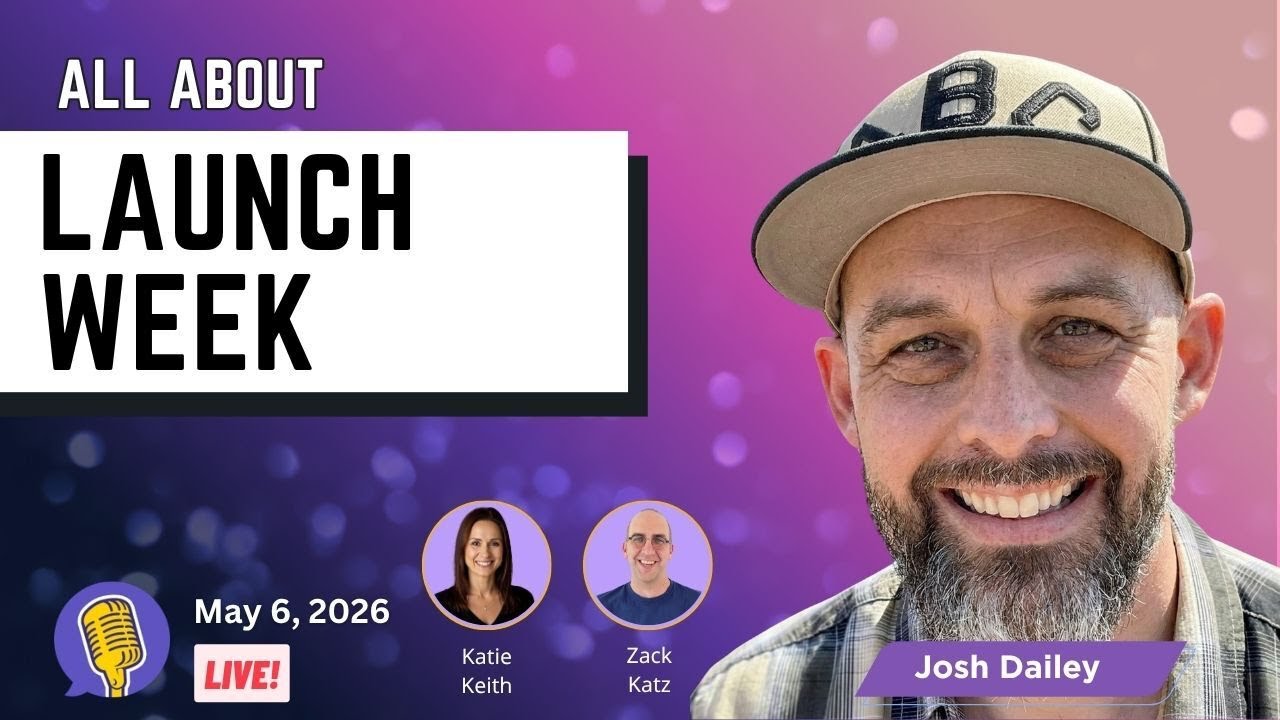
🔗 **Source:** [How to Run a Successful Launch Week With Josh Dailey](https://www.youtube.com/watch?v=3FMmN1KfRy4)
> [!note]+ Document Notes
> tags: #product-marketing #launch-strategy #saas-growth #wordpress #content-marketing #ai-tools #customer-onboarding
> author: WP Product Talk
> source: YouTube
> reference: https://youtu.be/3FMmN1KfRy4
> date created: 2024-12-21 14:30
>
> # 🏷️ Title: How to Run a Successful Launch Week with Josh Dailey
>
<!-- deep-read:sections start -->
## 🧰 Action Inbox
- [H1] Create launch week brief with narrative, goals, and ICP alignment — strategic foundation #product-marketing
- [H2] Map all marketing channels into daily campaign structure — content planning #launch-strategy
- [H3] Build organized Asana board with pre-launch, daily, and post-launch tasks — project management #saas-growth
## 🧭 Table of Contents
- [[#📝 Summary]]
- [[#📖 Main Content]]
- [[#🗒️ Notes]]
- [[#📚 References]]
- [[#🗣️ Paraphrase]]
- [[#📰 Newsletter]]
- [[#✅ Action Items]]
- [[#🧪 Hypotheses]]
- [[#📊 Methodology]]
- [[#❓ Questions]]
- [[#🔮 Future Research]]
- [[#💡 Implications]]
- [[#🧠 Learning Styles Assessment]]
- [[#📊 Accessibility Assessment]]
- [[#🌍 DEIB Assessment]]
- [[#✅ Logical Validity]]
- [[#🛡️ DARVO Analysis]]
- [[#🎯 Conclusion]]
### 🔗 References
- [DocsBot](https://docsbot.ai)
- [WP Product Talk](https://wpproducttalk.com)
- [Gravity Kit](https://gravitykit.com)
## 📝 Summary
- **What happened:** Josh Dailey from DocsBot explains how to execute a successful 5-day launch week campaign that maintains daily customer engagement instead of single-day launch momentum
- **Why it matters:** Traditional single-day launches often result in brief attention spikes followed by silence, while launch weeks create sustained engagement and better feature adoption
- **Key stakeholders:** SaaS founders, product marketers, WordPress product owners seeking better feature rollout strategies
- **Risks and tradeoffs:** Requires 3+ months preparation, significant content creation, and careful coordination across all marketing channels
- **Bottom line:** Launch weeks work best for products that integrate into daily workflows, requiring strategic planning, organization, and clear ownership rather than ad-hoc execution
## 📖 Main Content
Launch weeks represent a strategic shift from single-day product releases to sustained 5-day campaigns that maintain customer attention and drive feature adoption. Josh Dailey, Chief Growth Officer at DocsBot, demonstrates how this approach transforms product marketing from brief announcement moments into comprehensive onboarding experiences.
The core concept addresses a fundamental challenge in SaaS marketing: development has become faster than marketing can keep up with. Where development bottlenecks once constrained product releases, marketing now struggles to communicate value and drive adoption of rapidly-shipped features. Launch weeks solve this by creating concentrated campaigns that educate customers about new capabilities while building narrative momentum.
DocsBot's approach involved releasing AI-powered "skills" that perform actual tasks rather than just providing information. This paradigm shift required extensive customer education, making the sustained engagement model essential. Each day built upon the previous, moving from basic lead capture through calendar integrations to a skill builder that lets users create custom actions.
The strategy works particularly well for products that integrate into daily workflows, where customers can immediately apply new features. However, it may be less suitable for utility plugins or tools used infrequently, though the organizational principles remain valuable.
## 🗒️ Notes
#### ⏱️ [00:00](https://youtu.be/3FMmN1KfRy4?t=0) — [H1] Launch week concept introduction
- Key idea: Five releases over five days creates sustained momentum versus single launch day
- Evidence: "Five releases, five emails, five days of attention instead of one"
#### ⏱️ [04:23](https://youtu.be/3FMmN1KfRy4?t=263) — [H2] Josh Dailey background and experience
- Key idea: Growth-focused marketer with WordPress product experience at scale
- Evidence: "Helped launch and grow Infinite Uploads, grew Smush to over a million active users"
#### ⏱️ [06:45](https://youtu.be/3FMmN1KfRy4?t=405) — [H1] DocsBot's launch week history and motivation
- Key idea: Launch weeks serve as forcing functions for completion and customer education
- Evidence: "Marketing is the new bottleneck because development is happening so fast"
#### ⏱️ [09:12](https://youtu.be/3FMmN1KfRy4?t=552) — [H2] Customer paradigm shift challenge
- Key idea: Moving customers from simple Q&A bots to AI agents that perform tasks
- Evidence: "From AI that gives answers to agents that can actually perform tasks for your users"
#### ⏱️ [12:30](https://youtu.be/3FMmN1KfRy4?t=750) — [H3] Email marketing frequency comparison
- Key idea: B2C companies email daily while B2B SaaS rarely promotes existing features
- Evidence: "Bombas emails daily about socks, yet we have hundreds of features customers don't know about"
#### ⏱️ [15:18](https://youtu.be/3FMmN1KfRy4?t=918) — [H2] Including previously launched features
- Key idea: Launch weeks can re-promote existing features within new narrative context
- Evidence: "Lead capture was released earlier but fit the 'AI that acts' campaign narrative"
#### ⏱️ [18:45](https://youtu.be/3FMmN1KfRy4?t=1125) — [H1] Launch week as onboarding flow
- Key idea: Condensed educational campaign similar to new user onboarding sequences
- Evidence: "Creating an onboarding flow for new features with daily email triggers"
#### ⏱️ [22:10](https://youtu.be/3FMmN1KfRy4?t=1330) — [H3] SaaS vs plugin deployment differences
- Key idea: SaaS features can be pre-deployed and activated, unlike WordPress plugins requiring updates
- Evidence: "All features were in dashboard weeks ahead, users choose to activate and use them"
#### ⏱️ [25:35](https://youtu.be/3FMmN1KfRy4?t=1535) — [H2] Content creation and repurposing benefits
- Key idea: Launch weeks generate months of reusable content across all marketing channels
- Evidence: "Biggest KPI was content creation rather than immediate sales"
#### ⏱️ [30:22](https://youtu.be/3FMmN1KfRy4?t=1822) — [H1] Asana board organization walkthrough
- Key idea: Strategic brief with narrative, goals, and ICP alignment drives campaign execution
- Evidence: "Brief context must match our ICP and business strategy, not generic GPT output"
#### ⏱️ [35:15](https://youtu.be/3FMmN1KfRy4?t=2115) — [H2] AI as employee management analogy
- Key idea: AI tools require detailed instructions like managing junior employees
- Evidence: "We're managing bots like employees, they're only as good as the instructions we give"
#### ⏱️ [38:40](https://youtu.be/3FMmN1KfRy4?t=2320) — [H3] Channel-specific content mapping
- Key idea: Each marketing channel gets specific content tailored to platform and audience
- Evidence: "Every channel plugged into daily cards: social, video, blog posts, webinar countdown"
#### ⏱️ [42:18](https://youtu.be/3FMmN1KfRy4?t=2538) — [H2] Success metrics and content blitz approach
- Key idea: Organic growth through founder-led content sharing, plus SEO benefits
- Evidence: "Founder-led positioning drives more traffic than any other channel"
#### ⏱️ [46:55](https://youtu.be/3FMmN1KfRy4?t=2815) — [H1] Final advice: planning, organization, ownership
- Key idea: Success requires clear success metrics, structured processes, and distributed ownership
- Evidence: "Build your plan including what success looks like, be organized, ownership matters"
## 📚 References
- [DocsBot Platform](https://docsbot.ai)
- [WP Product Talk Podcast](https://wpproducttalk.com)
- [Gravity Kit](https://gravitykit.com)
- [Barn2 Plugins](https://barn2.com)
- [Freemius](https://freemius.com)
## 🗣️ Paraphrase
- Launch weeks create sustained customer engagement by spreading releases across five days instead of concentrating everything into a single announcement that quickly loses momentum
- The strategy works best for products that integrate into daily workflows, requiring extensive customer education to shift from old paradigms to new capabilities
- Success depends on thorough strategic planning with clear narrative goals, organized project management across all marketing channels, and distributed team ownership of specific deliverables
## 📰 Newsletter
**Transform Your Product Launches: From Single Days to Sustained Weeks**
Ready to move beyond the launch-day crickets? Josh Dailey from DocsBot just shared how launch weeks create five days of customer attention instead of one brief moment.
Here's the game-changer: treat your launch week like an onboarding flow. Each day builds the story, educates your audience, and drives adoption of features they might never discover otherwise.
**Key takeaways for WordPress product owners:**
- Start with a strategic brief covering narrative, goals, and target audience alignment
- Map every marketing channel (social, email, blog, video) into daily content plans
- Pre-deploy SaaS features and educate users on activation rather than forcing updates
The content creation alone pays dividends—one week generates months of reusable materials across all your marketing channels.
**Ready to get organized?** Use tools like Asana to map pre-launch, daily campaign, and follow-up tasks. Remember: AI can help execute, but strategic thinking remains your competitive advantage.
Resources: [DocsBot Case Study](https://docsbot.ai), [WP Product Talk](https://wpproducttalk.com), [Project Management Tools](https://asana.com)
## ✅ Action Items
#### DevRel
- Developer education: Create comprehensive feature adoption campaigns spanning multiple days rather than single announcements
- Community engagement: Use launch weeks to drive forum participation and user-generated content around new capabilities
- Developer experience: Build onboarding sequences that mirror launch week structure for new feature discovery
#### WordPress
- Core: Apply launch week principles to major feature rollouts, creating sustained education campaigns
- Community: Develop launch week templates for WordCamp organizers and meetup leaders
- Marketing: Create campaign frameworks that WordPress product owners can adapt for their own launches
- Documentation: Structure feature documentation to support sequential revelation over concentrated dumps
#### Community
- Maintainers: Use launch week organization principles for coordinating complex feature releases across contributor teams
- Contributors: Apply content creation strategies to generate multiple formats from single development efforts
- Sponsors: Develop sustained engagement campaigns rather than one-time announcement approaches
## 🧪 Hypotheses
- Launch weeks generate higher feature adoption rates than single-day announcements due to sustained educational exposure
- Products requiring paradigm shifts (like AI tools) benefit more from launch week approaches than incremental feature additions
- Content creation during launch weeks provides 3-6 months of reusable marketing materials across all channels
- Organized project management systems enable better AI tool utilization for campaign execution
### 📊 Methodology
- A/B test single-day launch versus 5-day launch week for similar feature complexity
- Track feature adoption rates, email engagement, and content consumption across different launch approaches
- Survey customer comprehension of new features after concentrated versus distributed launch communications
### ❓ Questions
- How do launch weeks perform for utility plugins versus workflow-integrated products?
- What's the optimal frequency for launch weeks without causing audience fatigue?
- How can WordPress plugin developers adapt launch week strategies given update distribution constraints?
### 🔮 Future Research
- Comparative analysis of launch week effectiveness across different SaaS product categories
- Long-term customer lifetime value impact of launch week versus traditional launch approaches
- Integration of AI-powered personalization in launch week content delivery
### 💡 Implications
- **Practice:** Product marketers should budget 3+ months for launch week preparation and coordinate across all marketing channels
- **Strategy:** Launch weeks work best for products requiring customer education about new paradigms or workflow changes
- **Content:** Single launch weeks can generate quarter-long content pipelines when properly organized and executed
- **Organization:** Structured project management becomes essential for coordinating multi-day, multi-channel campaigns
### 🧠 Learning Styles Assessment
Reading level estimate: 12th grade
#### 👀 Visual learners
- Present: Asana board screenshots, campaign structure diagrams
- Improve: Flow charts showing launch week timeline, channel mapping visuals
#### 🔊 Aural learners
- Present: Podcast format discussion with multiple perspectives
- Improve: Audio summary of key takeaways, campaign planning checklist narration
#### 🗣️ Verbal learners
- Present: Clear definitions of launch week concepts, marketing terminology explanations
- Improve: Glossary of campaign terms, analogies to familiar marketing concepts
#### 🧩 Kinesthetic learners
- Present: Step-by-step Asana board creation walkthrough
- Improve: Interactive campaign planning templates, hands-on workshop materials
#### 🧠 Logical learners
- Present: Structured timeline approach, clear cause-and-effect relationships
- Improve: Decision trees for launch week suitability, ROI calculation frameworks
#### 🧑🤝🧑 Social learners
- Present: Multi-host discussion format, community examples
- Improve: Team collaboration templates, peer review processes for campaigns
#### 🧘♀️ Solitary learners
- Present: Individual planning frameworks, self-assessment questions
- Improve: Personal reflection prompts, solo campaign planning worksheets
#### 🌿 Naturalistic learners
- Present: Organic growth strategies, ecosystem thinking about marketing channels
- Improve: Content lifecycle analogies, sustainable marketing practices
### 📊 Accessibility Assessment
#### Screen reader semantics
- Present: Clear heading structure, descriptive timestamps
- Improve: More detailed alt text for any visual examples, ARIA labels for complex content
#### Keyboard navigation
- Present: Standard navigation patterns, logical tab order
- Improve: Skip links for long content sections, keyboard shortcuts for timestamp navigation
#### Contrast and readability
- Present: High contrast text, readable font sizes
- Improve: Ensure all timestamp links meet contrast requirements
#### Media and captions
- Present: YouTube video with automatic captions
- Improve: Professional transcript, chapter markers for accessibility
### 🌍 DEIB Assessment
#### Cultural breadth
- Present: Examples from multiple business contexts and company sizes
- Improve: International launch week examples, cultural considerations for timing
#### Inclusive language
- Present: Gender-neutral business terms, defined technical jargon
- Improve: Plain language summaries, avoid corporate buzzwords
#### Representation
- Present: Multiple perspectives from different company backgrounds
- Improve: More diverse case studies, various industry applications
### ✅ Logical Validity
#### Strong reasoning
- Deductive strength: Clear cause-and-effect between sustained engagement and feature adoption
- Inductive strength: Examples from multiple successful launch week implementations
- Analogical strength: Effective comparison to onboarding flows and email sequences
#### Fallacies
- Survivorship bias: Focus on successful launch weeks without discussing failures
- Hasty generalization: Assuming all SaaS products benefit equally from launch week approach
#### Tone of voice
- Overall tone: Practical and experienced, with concrete examples and actionable advice
### 🛡️ DARVO Analysis
- No concerning patterns detected
- Content focuses on constructive marketing strategies
- Maintains professional, educational approach throughout
## 🎯 Conclusion
Launch weeks represent a strategic evolution from single-day product announcements to sustained engagement campaigns that drive feature adoption and customer education. The approach requires significant upfront planning and coordination but generates months of reusable content while maintaining customer attention across five consecutive days.
Success depends on three core principles: strategic planning with clear narratives and success metrics, organized project management across all marketing channels, and distributed ownership among team members. The strategy works particularly well for SaaS products requiring customer education about paradigm shifts or new workflow integrations.
WordPress product owners should adapt these principles to their specific deployment constraints, potentially using launch weeks to re-engage customers with existing features while building anticipation for new releases. The key insight remains: sustained, organized communication drives better adoption than sporadic announcements, regardless of product type.
## 🧱 Refactor Appendix
###
---
## Full Transcript
[00:01] What if your product launch
wasn't a single moment, but<br>[00:05] a full week of momentum?<br>[00:08] Most teams pour everything into
one big release day, and then<br>[00:10] watch the inbox go quiet afterward.<br>[00:13] What happens when you flip that?<br>[00:15] Five releases, five emails, five
days of attention instead of one.<br>[00:20] Today, on WP Product Talk, we are
breaking down how to run a launch week<br>[00:24] that drives attention and keeps it.<br>[00:28] This is WP Product Talk.<br>[00:32] This is WP Product Talk, the place
where every week, we bring you insights,<br>[00:38] product marketing, business management
and growth, customer experience,<br>[00:43] product development, and more.<br>[00:46] It's your go-to podcast for
WordPress product owners by<br>[00:50] WordPress product owners.<br>[00:51] And now, enjoy the show.<br>[01:01] Hello, hello.<br>[01:02] I'm Zack Katz with Gravity Kit.<br>[01:04] And I'm Katie Keith from Barn2.<br>[01:07] And before we get started, uh, if
you benefit at all from WP Product<br>[01:11] Talk, we'd love your support.<br>[01:12] The easiest way to show your
support for the show is to hit<br>[01:14] subscribe right now in YouTube.<br>[01:16] It only takes a second and makes
a big difference to the show.<br>[01:19] Thank you so much.<br>[01:21] And huge thanks to Freemius for
being our exclusive growth partner.<br>[01:25] Freemius helps software makers
to grow, monetize, and succeed.<br>[01:30] They are a merchant of record platform,
which basically means that they handle<br>[01:34] everything around selling software,
from checkout, payment, subscriptions,<br>[01:38] to licensing and updates, and even
global tax compliance, so you can<br>[01:43] focus on building amazing products.<br>[01:46] All right.<br>[01:46] So let's jump into today's
topic, launch weeks.<br>[01:50] Uh, so I was watching my inbox last
week, and I saw every day an email<br>[01:55] coming in from DocsBot talking
about a really cool new feature,<br>[02:01] and it was r- impressive to see.<br>[02:03] Every day I was thinking about DocsBot.<br>[02:05] Every day I was impressed.<br>[02:07] Every day I was like, "Oh, I think they've
got stuff going on over at DocsBot."<br>[02:11] And it made me feel like
there was so much momentum.<br>[02:16] And behind those emails is Josh Dailey.<br>[02:19] Josh, welcome to the show.<br>[02:22] Uh Oh, one more.<br>[02:25] Briefly.<br>[02:28] Josh, hi.<br>[02:28] Thanks for joining us.<br>[02:29] Hey.<br>[02:29] Please tell us, uh,
tell us about yourself.<br>[02:32] Thank you, Zack and Katie,
both just absolute legends.<br>[02:36] I'm so excited to be
on here with you today.<br>[02:39] But yeah, I'm, um, the chief growth
officer for DocsBot, where I'm<br>[02:45] leading the go-to-market strategy.<br>[02:48] Uh, before this timeframe, I
helped launch and grow a variety of<br>[02:52] WordPress products, including Infinite
Uploads, that's since been acquired.<br>[02:57] Um, we grew, uh, Smush, uh, to
over a million active users.<br>[03:02] I was involved with that product, um,
when they originally had acquired and<br>[03:07] launched that, or relaunched that.<br>[03:10] And then, um, my last
role was at WP Engine.<br>[03:15] I was, uh, over the, um,
e-commerce solution, helping<br>[03:20] to grow and scale that product.<br>[03:22] It became the fastest growing
segment of the business.<br>[03:25] And then today, obviously, I'm focused
on applying the same growth systems<br>[03:31] and marketing str- uh, processes,
strategies to agentic workflows<br>[03:36] with a much smaller team now.<br>[03:38] So it's been a really fun and exciting
kind of time, uh, in marketing.<br>[03:46] Very cool, uh, story, and you've
worked on, uh, some great products.<br>[03:52] Um, for-<br>[03:52] Thanks<br>[03:53] ...
for those of you who are, uh, watching
live on YouTube, we encourage you<br>[03:57] to leave your comments or questions
or feedback in the comments section.<br>[04:00] We'll highlight them as the
show goes on, and we'll discuss<br>[04:03] your questions on the show.<br>[04:05] Um, so Josh, I'd love to dive into
what you just accomplished with<br>[04:11] DocsBot with your launch week, um,
what your thought process was like.<br>[04:17] Uh, I'd love to learn more about the
history of launch weeks at DocsBot.<br>[04:20] Is this a new thing?<br>[04:21] Is this something you did before?<br>[04:23] Like, uh, pl- you know, can you g- set
the scene for what, what, what you were<br>[04:27] thinking, uh, over the launch week?<br>[04:29] Yeah.<br>[04:29] You guys have had Aaron on here before.<br>[04:31] He's our founder, um, and he was a
solo founder for a long time and was,<br>[04:39] uh, you know, having to kind of do
all these things on his own and spent<br>[04:44] a couple years actually doing that.<br>[04:46] And in 2025, he did the first DocsBot
week, so that was a- about a year ago<br>[04:51] now that he did his first DocsBot week.<br>[04:55] And it was really, at that time, a
forcing function for him to complete<br>[04:59] some tasks that were at, like,
90% of the way there, you know?<br>[05:03] And when you're trying to roll out
things alone as a, a solopreneur, a<br>[05:08] lot of times it's really hard to know,
do I jump on this support ticket?<br>[05:12] Do I take this sales call?<br>[05:14] Do I, um, build this f- this feature,
or how do I market it and make sure?<br>[05:20] So all of these things kind of compound.<br>[05:22] Um, and so he was like: "I'm gonna just
take a step back for a second. I'm gonna<br>[05:27] keep doing the r- run the business efforts
on the side here, but I'm gonna put a<br>[05:32] bunch of effort for a month or two into,
um, creating a strategy and plan and<br>[05:38] then rolling out everything at once."<br>[05:41] One, it gets compounding interest
from the customers and, and as you had<br>[05:46] mentioned, it kind of helps, uh, keep
you in people's face day after day after<br>[05:52] day for a little bit, which we all know,
like, you send that one email and you're<br>[05:56] like, "This is gonna be the greatest
thing ever," and then crickets, you know?<br>[06:00] It's very, very frustrating when
you're kind of working on that stuff.<br>[06:04] So DocsBot week was kind of
an idea inspired by some stuff<br>[06:09] he had seen around Cloudflare.<br>[06:11] They had, like, even recently,
they did another, uh, week of<br>[06:15] launches around AI features.<br>[06:18] And so for us, that's kind of the, the
idea behind it was this forcing function.<br>[06:24] For us this year, though, why I wanted
to kind of continue that legacy forward<br>[06:29] was because in marketing, there's been
an experience where things have been<br>[06:35] flipped on their head that we don't really
understand how to approach right now.<br>[06:41] Where development used to be the
bottleneck, marketing is the new<br>[06:44] bottleneck, um, because things are being
developed so quickly, features are being<br>[06:50] launched so fast that, um, trying to
communicate the message and why you're<br>[06:56] doing what you're doing, the strategy,
why you're doing what you're doing, the<br>[07:00] narrative, keeping that, um, up to date
and in front of even just your customers,<br>[07:06] forget trying to get in new customers,
but just trying to keep all the stuff that<br>[07:10] you're, you're delivering and the value
that it can add, and people are still<br>[07:15] stuck on, let's say for DocsBot, it's
like- AI that gives answers and creates<br>[07:20] a checklist that now, um, you still are
having to function to, to go do, to these<br>[07:27] agents that can actually perform tasks
for your users at the end of the day.<br>[07:32] Like, that's a, a huge pivot in market.<br>[07:35] And so how do you make sure that
your customers are getting the full<br>[07:38] value out of what you're, you're,
um, working on and delivering?<br>[07:42] So that's kind of a little bit of the,
the story about, um, where that came from.<br>[07:50] Yeah.<br>[07:50] Like, I was... Josh and I, when we
were talking yesterday in preparation<br>[07:55] for today, uh, I was saying that
one of the only times that I have<br>[08:00] emails coming into my inbox from
e-commerce is, like, the outside world.<br>[08:05] Uh, outside of WordPress, uh, I, my
favorite socks are Bombas, and I go<br>[08:10] to bombas.com and I buy some socks.<br>[08:12] And then every single day after
that, I get an email from Bombas,<br>[08:17] daily email about socks, about
the other things that they sell.<br>[08:21] Uh, every week there's, like,
a new sale on a sock bundle<br>[08:24] that hadn't existed before.<br>[08:26] I- until you unsubscribe, you get
unlimited number of emails about socks.<br>[08:31] And yet we have hundreds or thousands
of features that our customers don't<br>[08:36] know about that we have- I'm sorry,<br>[08:37] how many socks do you have?<br>[08:39] Do you have<br>[08:41] more socks or domain names?<br>[08:43] Ooh, more socks.<br>[08:45] Ooh.<br>[08:46] At least they're cheap.<br>[08:47] That's a good question, though.<br>[08:50] Um, and- Bombas are<br>[08:52] premium socks, though.<br>[08:53] I mean, you should get
sponsored- Okay ... by Bombas.<br>[08:56] We should get sponsored by Bombas.<br>[08:58] Yeah.<br>[08:58] And Aaron, uh, from DocsBot says,
"Love Bombas." Yep, I agree.<br>[09:03] So Bombas, if you're, if you're, if you're
listening, uh, Freemius does global tax<br>[09:07] compliance, and Bombas covers your feet.<br>[09:12] Yeah.<br>[09:13] Um- Our exclusive sock partner.<br>[09:16] Absolutely.<br>[09:18] Yeah.<br>[09:18] So-<br>[09:18] I- ... the,<br>[09:19] the, the lack, the, the reticence
that we feel as, uh, e-commerce<br>[09:25] providers is, I think, unwarranted.<br>[09:28] I think we could send way more emails.<br>[09:30] I think people like to know
about the features that they,<br>[09:33] uh, that they're missing.<br>[09:35] And having a launch week is a great way,
uh, to consolidate, like, all the things<br>[09:39] that you may have already launched.<br>[09:41] Josh, uh, did you include
anything that you might have<br>[09:44] already launched in launch week?<br>[09:47] Ooh.<br>[09:48] Yeah, for sure.<br>[09:48] So, um, one of the things that
was interesting is we had kind<br>[09:53] of already rolled out some things
that were, uh, action-based.<br>[09:59] And since our campaign was all around AI
that acts was, was the narrative and the<br>[10:04] message we were, we were going out with.<br>[10:06] And, uh- Lead capture was one of those
tools that we were saying, "Hey, this<br>[10:13] is really the first iteration of what it
looks like for us." It's this pre-sales<br>[10:18] kind of function where the, the bot can,
uh, understand when the user is, um, is<br>[10:27] warm and ready to, to, uh, kind of talk-
take that next step with your team, get<br>[10:33] on a sales call, that kind of thing.<br>[10:35] And so we had this lead capture
function that we had released<br>[10:39] earlier in the quarter, and we
rolled that forward to day one.<br>[10:44] Um, partly because the event,
the way that we had structured<br>[10:49] it was to stack on top of itself.<br>[10:52] So we had different features, but
these features, like lead capture,<br>[10:56] were just to communicate a bigger
story around skills and, and actions.<br>[11:01] Um, and we can get more into that.<br>[11:03] But yeah, so, so I don't think it's
... It's funny because, uh, y- like you<br>[11:08] were just talking about in terms of
emails and, and how we don't do enough<br>[11:12] of them, it's like we are the loudest
voice in our own heads all the time.<br>[11:18] There's so many other things going on.<br>[11:20] We've sponsored Web Agency
Summit same week as DocsBot Week.<br>[11:25] And, and a bunch of, of people
that, that we know and love<br>[11:29] and support are a part of that.<br>[11:31] And so we don't even think that DocsBot
Week probably, uh, was overshadowed by<br>[11:38] some of these other events at different,
at different points, and more power to it.<br>[11:42] But really this is a compounding,
like, um, uh, content engine for us<br>[11:51] to say, "Here's a whole bunch of stuff
that we put together," blog posts,<br>[11:56] video content, um, social content that
will be cut up, re-shared, reused in<br>[12:03] different ways, and a lot of messaging
that still has to go forward for us.<br>[12:09] And so our biggest, uh, KPI in this or,
you know, key performance indicator for<br>[12:16] us was more about the content that we
created and how much of that we could<br>[12:20] produce rather than how many sales we
left the week with, because we know<br>[12:25] that there's still a lot of education
to take place around actions and getting<br>[12:30] people involved, and we have some ideas
rolling forward that were a part of<br>[12:35] our, our, uh, board to get that done.<br>[12:40] Yeah.<br>[12:41] Now, what do you think are the benefits
of doing it in a concentrated way<br>[12:46] like that rather than drip-feeding
new features over a longer period,<br>[12:50] like every month, for example?<br>[12:53] Mm-hmm.<br>[12:54] Well, hopefully we continue dripping
content, you know, o- over the months<br>[12:59] as well, and that stays a part of
the rhythm of what we're doing.<br>[13:03] But, um, one of the big benefits from
a, um- In, in AI, I think there's<br>[13:10] a, a, uh, a tension that we're all
experiencing is the education piece.<br>[13:18] I think we get in our heads an old
paradigm, which is that, uh, that<br>[13:26] things work a certain way based
off of the internet that we knew.<br>[13:31] For DocsBot in particular, there's this
whole other world of, of development<br>[13:36] and things taking place that require
a ton of education and getting people<br>[13:41] to think outside of the box of what
they're, they've been confined to.<br>[13:46] And sitting with you guys might be
actually like this is an unfair room<br>[13:52] where we feel like we're behind, but
we're actually probably way at the<br>[13:56] front of-- forefront of all of the,
of this conversation, and you're<br>[14:01] sitting with people who know what
they're doing technically and are<br>[14:05] experimenting and exploring this stuff.<br>[14:07] But the majority of small businesses
and other products like are still<br>[14:12] just dabbling probably in the LLM
side of things and, and like your<br>[14:17] ChatGPTs and, and just getting some
help writing a blog post maybe or<br>[14:21] that kind of, that kind of use case.<br>[14:24] But that leap to actions, we said the
reason this is gonna be critical for<br>[14:30] us is because trying to understand
on day four we released, um, skills<br>[14:36] and a skill builder, uh, that codes
a-actions into your agent, uh, like<br>[14:46] bespoke and you just tell it what
to build and it builds that, right?<br>[14:50] That kind of thought in the
SaaS world is just insane.<br>[14:55] Like, we were always confined to the
opinionated choices of the business<br>[15:00] that we were doing business with.<br>[15:02] Like you-- if you give me a Stripe
integration for my billing, then I use<br>[15:09] the Stripe integration, and if I wanna
use something else, I either have to<br>[15:12] ask you to develop that and wait for
that to be developed or I, uh, move<br>[15:19] to a different provider that's chosen
PayPal or, or what are these other ones.<br>[15:24] For us to release lead capture,
Stripe Calendly, TidyCal, like these<br>[15:31] different actions were more to, as a
education piece of saying, "This is<br>[15:36] actually what's possible. This is not
what you're confined and constrained<br>[15:40] to." So now you can go build any skill
that you want to, but these are good<br>[15:44] examples of what skills would look like
if you were to go out and to do that.<br>[15:49] And so for us this year, it was more a
part of the necessity of the narrative<br>[15:54] and building up the, the storyline to
get to why actions matter, why skill<br>[16:01] building matters, why these things
are a paradigm shift for us, and how<br>[16:05] do we get people thinking out of the
old way of thinking about, about your<br>[16:10] SaaS and into a new way of saying, "I
can pretty much have whatever I need<br>[16:16] in order to integrate with and, and I
don't have to wait for you to do that."<br>[16:24] That's, uh, you know, one of the things
about having a campaign, a daily campaign.<br>[16:31] Y- steering a, a boat of how people think
about your company is an interesting way<br>[16:36] of thinking about, uh, a launch week.<br>[16:38] It's like you're not launching a product
so much as you're laun- relaunching how<br>[16:44] people are s- are seeing your company,
and that's a, that's a really, uh...<br>[16:48] Like shifting that thought does
take concerted effort and c-<br>[16:52] and a, a dedicated campaign.<br>[16:55] So you- Think,<br>[16:56] think about this, Zack, like
this piece of it for you.<br>[17:00] I know we've said, you know, we,
we were kind of talking about this.<br>[17:04] We said, "Hey, we haven't, you know,
we don't have experience in, in this."<br>[17:08] But think about it as creating an
onboarding flow for new features.<br>[17:13] Like you've both created great onboarding
flows, I'm sure, that have a trigger<br>[17:19] of emails every day or every couple
days that kind of compound into telling<br>[17:24] a narrative and helping somebody
go from point A to point B to make<br>[17:27] sure that adoption is good and churn
doesn't happen and all of those things.<br>[17:32] And that really is what a week is,
is just a, a condensed kind of like<br>[17:37] onboarding flow, and that's why
it takes so much effort and work<br>[17:42] ahead because we all think very
strategically about that onboarding flow.<br>[17:47] I don't... I, I think ours took three
months to create, um, when we were<br>[17:51] working on it and going back and forth
about what needs to be in the onboarding<br>[17:55] flow, how much, you know, of a case
study, and how much of, you know, um,<br>[18:00] the actual features and value do we
show and all these things, and you kind<br>[18:05] of go back and forth on these things.<br>[18:07] That's a really good like image of
what the way that I was thinking<br>[18:11] about kind of the DocsBot week idea.<br>[18:15] Mm-hmm.<br>[18:16] Yeah.<br>[18:17] So you mentioned, like,
skills a minute ago.<br>[18:20] Is everything you released during
that week part of your product?<br>[18:24] The reason I ask is that when I
announced this episode on Twitter<br>[18:29] yesterday, somebody responded with
a really good comment, which is that<br>[18:34] DocsBot is a SaaS, and so whenever you
release something, the user doesn't<br>[18:39] necessarily need to do something.<br>[18:41] Whereas with a WordPress plugin,
it would actually be quite annoying<br>[18:45] for your users if you did a
release every day for five days.<br>[18:48] That's not best practice.<br>[18:50] So I suppose we could do it in a more
of a marketing sense, like we may do one<br>[18:56] big release and then drip feed the news
about what's in that release potentially.<br>[19:01] That would fit with what you were just
saying about the onboarding angle.<br>[19:05] But I'm curious to know
about the technical stuff.<br>[19:07] Did you actually release a new feature
in the plugin, or was it something<br>[19:11] else like you mentioned when we
met at PressConf that you do a lot<br>[19:15] of free tools that aren't part of
DocsBot, they're just useful things?<br>[19:20] Yeah.<br>[19:20] Actually, this... So last year there
were a lot of free tools that were<br>[19:24] a part of DocsBot week in 2025.<br>[19:27] This year, um, all of the features
were released ahead, so they were all<br>[19:35] in the, the, um, dashboard by the time
that we were pushing the emails out.<br>[19:40] Right.<br>[19:41] And they may have been out a month
or two weeks or a week ahead when<br>[19:47] the launch actually took place.<br>[19:49] And so the, they've been
sitting in the dashboard.<br>[19:52] We just may not have done the same kind
of like notifications or release schedule<br>[19:57] that we normally do, um, around that.<br>[20:01] But because these all fit
together so well, it wasn't as,<br>[20:05] as difficult for us, uh, to, um...<br>[20:12] 'Cause they were all things that you
have to activate and choose to action<br>[20:15] on, uh, which would be different
than what you're talking about.<br>[20:18] If something in a, in a SaaS software,
it was a force function for, for the,<br>[20:23] the user where it's like, now you
have this and it's running already.<br>[20:27] That would be scary.<br>[20:28] But these are, are more around like
we can't predict what if you're gonna<br>[20:33] use a Stripe integration to help with
billing or a calendar integration.<br>[20:39] And I, I feel like I'm kind of
talking way up here for a second,<br>[20:43] um, uh, because we haven't really
got into what we covered too much.<br>[20:50] Um, but they were... These actions are
like if a customer comes in and says, "I<br>[20:56] wanna see my invoicing Uh, the invoice
can populate right inside the chat window.<br>[21:02] It doesn't make you click away
or look at something else.<br>[21:05] There's these beautiful cards.<br>[21:07] Or it says, "I wanna cancel my account,"
you could actually trigger a retention<br>[21:11] play beforehand and then allow the
bot, if they meet all the criteria and<br>[21:16] policies, to go perform the cancellation.<br>[21:21] Um, and so these kinds of things are
things that if we just, um, um, make<br>[21:28] them available, they're not just gonna
be running by default for the user.<br>[21:33] Well, and even if you do make them
available and people log into DocsBot,<br>[21:37] they might not be looking for them.<br>[21:38] Uh, Aaron has a comment that says,
"Good point, but it's amazing<br>[21:42] how slow adoption of new features
is with current customers." And-<br>[21:46] Yeah<br>[21:46] ...
you know, the overlap of launch
week with onboarding is a really<br>[21:49] interesting one, uh, where, um...<br>[21:52] And I also think, like, the hype
engine of a launch week is an<br>[21:57] interesting concept as well.<br>[21:59] Uh, Gravity Kit, uh, we're about
to release Gravity View 3.0, uh,<br>[22:03] we've been working on it a while.<br>[22:05] Um, it's largely a refactor,
uh, behind the scenes, but<br>[22:09] there are some new features.<br>[22:10] Every week we launch new functionality
to, uh, our products, and every<br>[22:15] week they're kind of in- included
in our newsletter, and people<br>[22:18] might see them in the change logs.<br>[22:20] We put a lot of effort into those things.<br>[22:22] We have a, a, a blog roundup every week
saying when... What we've done that's new.<br>[22:27] But we don't email people, uh, regularly
saying, "Hey, check out this specific<br>[22:33] new feature that you're gonna love,"
even though there are many new features<br>[22:37] that people might be wanting to have an
email about and learn about and highlight<br>[22:41] and say, "Hey, here's what's coming.<br>[22:43] Get excited.<br>[22:44] And then once you launch,
here's what's out.<br>[22:47] Here's how to enable it." Like, the
hype and then the onboarding are kind<br>[22:51] of two parts of the same spectrum of
just, like, getting people informed<br>[22:55] about what you are offering and then, um,
or excited about what you're offering.<br>[23:00] L- let them, like, have them thinking
about it and then having them actually<br>[23:03] implement them with your tools.<br>[23:05] So I, I love the idea of just,
like, reframing how we... Well,<br>[23:10] how I- I, I'm a software developer.<br>[23:12] I think about, like, building new
features and then I just, like,<br>[23:15] hand it off to marketing and, and
assume that everything's gonna work.<br>[23:19] But, like, reframing the whole concept
of what we're doing as it doesn't matter<br>[23:25] what we launch if people don't know
about it and people don't activate it.<br>[23:29] Yeah.<br>[23:30] Yeah.<br>[23:31] And w- we've felt that, I think, on the
marketing side of that, to your point.<br>[23:35] As development's picked up pace-<br>[23:38] Mm-hmm<br>[23:38] ...
we've felt like, man, our... We
care about the whole life cycle,<br>[23:42] and adoption's really important for
people not to churn and, and for<br>[23:45] them to find value in the product.<br>[23:48] And we're struggling to, um, spend
enough time on one thing before the next<br>[23:54] thing comes out in order to get Get that
kind of acknowledgement And it's hard<br>[23:58] not to move on, 'cause you, so you release
a new produ- a, a new feature, and it's a<br>[24:02] really cool feature and customers love it,
but you have another feature coming up.<br>[24:06] Well, guess what?<br>[24:07] You've gotta keep on promoting
the other features as well.<br>[24:10] Yeah.<br>[24:10] They might not know about that in
a week from now if you don't tell<br>[24:13] them about it again and again.<br>[24:15] And that's where, like, the, I
think it's Jeff Bezos, it's, uh,<br>[24:20] talks about, like, day one and,
like, every day is launch day.<br>[24:24] And so you, you, you...<br>[24:26] it's a mindset that says, like, "Okay, we
gotta keep on promoting what we've got.<br>[24:30] We gotta keep on building as if, like..."
There's a whole thing with day one.<br>[24:34] I don't know if this is the a- actual
reference that I'm meaning to give, but<br>[24:38] always promoting, always acting as if
you're, you're launching your product<br>[24:42] today, uh, is a good way to do it.<br>[24:45] Um- Right ... Ian, our co-host,
says, "Still thinking about<br>[24:48] Bombas socks, to be honest."<br>[24:50] You've just distracted everything now.<br>[24:53] His feet are cold and clammy.<br>[24:55] He needs, you know, you know,
some performance fabric.<br>[24:58] That's right.<br>[25:00] We all need some performance fabric today.<br>[25:02] Can't say<br>[25:02] I've studied Ian's feet.<br>[25:05] No.<br>[25:05] No.<br>[25:07] He probably wears sandals.<br>[25:08] He's a relaxed guy.<br>[25:11] Uh,<br>[25:12] and Aaron also s- This<br>[25:13] is, this is the outtake
I want you to publish.<br>[25:17] Aaron says, "Building is easier than
marketing now with AI." That is so true,<br>[25:21] and one of the things that we're working
on is integrating marketing more with AI,<br>[25:27] and h- trying to figure it out in a way
that doesn't feel artificial and doesn't<br>[25:31] feel AI generated and still feels human.<br>[25:34] But, like, AI kinda queues up
onboarding flows for specific people.<br>[25:38] Ideally, for example, if we know that
this customer uses a Stripe integration,<br>[25:44] Josh, like, if we know that a customer
already uses Stripe, then we push that a<br>[25:48] little harder if we have a Stripe feature.<br>[25:50] Yeah.<br>[25:50] That type of segmentation becomes
more important when we are trying<br>[25:53] to focus the attention that our
customers are, uh, being emailed about.<br>[25:58] Well, how do you know that they're
using a Stripe integration on<br>[26:02] a product without SAS elements?<br>[26:04] Well, that's-<br>[26:05] Most of us aren't putting that sort
of tracking in our plugins yet.<br>[26:08] That's where the telemetry comes in.<br>[26:10] Mm. Um, we're, we, we have a thing, uh,
we have a initiative at Gravity Kit, we<br>[26:15] haven't implemented it yet, but one of the
things we have as WordPress product owners<br>[26:19] is we have tons of blind spots for how
people are actually using our products,<br>[26:23] and we're about to integrate PostHog
with all of our products, uh, so that we<br>[26:27] understand the settings people have, we
understand if there are rage clicks, is a<br>[26:32] thing, where, like, people click expecting
something to happen and it doesn't happen.<br>[26:36] Like, understanding the product better
is important for segmentation, but then<br>[26:41] it also has a privacy thing as well.<br>[26:44] I, um- So it's<br>[26:45] gotta be opted in.<br>[26:46] Yeah, I, I was thinking about, um,
you may or may not remember- There's<br>[26:53] still, like, the guerrilla marketing
tactics, but you may not remember that<br>[26:56] early this year we sent out a survey
for DocsBot, and the features that we<br>[27:01] created from that, uh, for this week
were directly correlated to the, to<br>[27:06] the answers that we got in our survey.<br>[27:09] So, um, we, you know, a lot of our
customers are using Stripe or we're<br>[27:14] actually looking at, uh, developing
next a EDD integration because a lot<br>[27:21] of our users, um, use that, you know.<br>[27:25] And so there's, there's different
approaches we could take and go<br>[27:28] like, "Well, you know, Shopify
might be better or WooCommerce<br>[27:31] might have a bigger, broader base."<br>[27:33] But for us right now, for our users, it's
a lot of, uh, easy digital download stuff.<br>[27:39] So we're, we're looking at an
integration, uh, skill for, for that.<br>[27:45] Yeah.<br>[27:45] I guess part of launch week is
figuring out what you wanna build<br>[27:48] and then what you wanna launch.<br>[27:50] Yeah.<br>[27:51] Yep.<br>[27:51] Uh, Josh, you were very gracious in being
willing to show us kind of what it means<br>[27:57] to actually run a launch week campaign.<br>[28:00] Uh, c- uh, you ready to,
to give us a little tour?<br>[28:04] Yes.<br>[28:05] So this is gonna be... I, I had already
cleared the board and so I tried my<br>[28:10] best to rebuild what, uh, what we had
created, but I'm gonna give you the<br>[28:15] most, um, vulnerable insights that I
can from this, this sheet and how we got<br>[28:22] to where we got to in our Asana board.<br>[28:25] And, um, that's kind of the nice part
of working with Aaron, uh, is in build<br>[28:31] in public, there's a lot more freedom
for me to share some of this stuff than,<br>[28:35] than if we were trying to keep a bunch
of stuff behind gar- walled gardens-<br>[28:41] Yeah,<br>[28:41] that's great ... as they say.<br>[28:42] But yeah, so this here, what we're looking
at is our Asana board for DocsBot week,<br>[28:48] and we have, you know, other, um, thing...<br>[28:52] Let me get here, see
if I can find my mouse.<br>[28:55] Here we go.<br>[28:56] So we got, um, you know, this DocsBot
week board that we created, and what I<br>[29:02] started out by doing was saying, "All
right, we need a, a brief about the<br>[29:07] context and everything else that we're
gonna do." So inside of this, we have<br>[29:13] a description of the campaign, the
narrative, and, um, a little bit about the<br>[29:19] goals of what we're trying to communicate
and to who based off of our ICPs.<br>[29:25] This right here seems like a small thing
to do, um, but who would've thought<br>[29:33] that if, for all my corporate homies
out there who've, who've been in the<br>[29:37] corporate world before, when you had to
create brief after brief after brief for<br>[29:42] leadership and to provide these up to
the CEOs, that really that's the work<br>[29:48] that AI can't do for you The thought work
is the work that we still have to own.<br>[29:55] Mm-hmm.<br>[29:55] And so one of the things that Aaron and
I did at the beginning of the year, uh,<br>[30:00] was we had an on-site, and we created
kind of, um, a overview of what we're<br>[30:08] trying to accomplish and all these things.<br>[30:10] Like, we looked at every employee,
which is basically us and a, and<br>[30:15] a couple of freelance people.<br>[30:17] We looked at, um, our marketing, who's
the market we have, you know, how<br>[30:23] many people across each feature and
what they're using and those things.<br>[30:27] But then coming down here, you could
see, all right, we have channels.<br>[30:31] We've got, um, our SEO and GPT referrals.<br>[30:36] We've got free tools.<br>[30:37] We've got social and paid ads and, um,
affiliate marketing, and these are all<br>[30:42] the things that, that matter to us.<br>[30:45] So in creating DocsBot week, I was able
to take everything from our marketing<br>[30:52] strategy for the year and to plug that
back through and say, "I want my, my,<br>[30:58] um, brief context to match our ICP
and what you know about our business."<br>[31:05] So those, those things
were paired together.<br>[31:07] But that-- coming up with that strategy is
not something where you just say, "Give me<br>[31:11] a business plan, GPT," and it, and it's,
it's kind of like the most frustrating<br>[31:16] part of, of, uh, talking to people about
AI right now is because most people<br>[31:21] are still using it like a slot machine
and don't give good enough prompts, and<br>[31:26] they're frustrated with why and then just
say it doesn't work, kind of an idea.<br>[31:32] And both of you as DocsBot users know how
important the, um, the instructions are.<br>[31:38] I mean, y- it gets you about 70%.<br>[31:40] If you wanna push that extra 10% of
the way there, you have to really<br>[31:44] work on your instructions and do that.<br>[31:46] From a marketing perspective,
exact s- same thing applies.<br>[31:50] Um, we have to know our businesses and
to, um, be able to plug that information<br>[31:57] back into our brief and then, uh, be able
to develop some of our, our, uh, metrics<br>[32:05] that we want us to drive off of and those
things, those all have to come from us.<br>[32:09] So that's where I'd say you gotta start
thinking like an owner, especially if<br>[32:13] you're a young marketer out there- That's
the best advice I could give to you right<br>[32:18] now is like, don't just think like an
employee with a task and a checklist.<br>[32:22] Start thinking like an owner and, and,
uh, a manager, because we're to the point<br>[32:27] where we're managing bots, and they're
like employees and they're doing tasks<br>[32:32] for you, but they're only gonna be as
good as a junior level employee, um, if<br>[32:36] you don't give it the right instructions.<br>[32:38] So-<br>[32:39] I love that- That's- I love this Josh,
because intentionality is so important.<br>[32:43] When you can do anything pretty much
immediately, within a day you can<br>[32:48] build out a plugin that does X, Y,
Z. But if you don't know why you're<br>[32:52] building that plugin, for whom you're
building the plugin, and how you will<br>[32:55] market it, and why you're gonna market
it that way, the AI is just gonna do<br>[33:00] a generic thing that may or may not
be appropriate for your business.<br>[33:03] So I love that you're, you-
first step, think about what<br>[33:06] you want the outcomes to be.<br>[33:08] Totally.<br>[33:09] Yeah.<br>[33:09] We're gonna be bloat software down
the road if we're not careful.<br>[33:14] Like, especially if SaaS stays a,
a thing, which we, we already know<br>[33:20] that everything's become token cost.<br>[33:22] But like, as opinionated software stays
kind of important because you have the,<br>[33:29] um, these other external teams owning
the security and the privacy and, like,<br>[33:35] the important parts of that, and able
to kind of do the maintenance side.<br>[33:39] Um, I think we're gonna be
in SaaS land for a while.<br>[33:43] Um, but the, the, uh... Uh,
if, if they don't, um...<br>[33:51] I lost the train of thought there, sorry.<br>[33:55] Um,<br>[33:58] what was, what was I rambling on there?<br>[34:00] So you've got, you've got your,
uh, content brief that's before.<br>[34:03] So then what's the next step of, uh,
of putting together the DocsBot week?<br>[34:07] Yeah.<br>[34:08] So we go into, um, I had some bonus
features because there were things<br>[34:14] like you had mentioned that you said,
"Are there things that, uh, don't fit<br>[34:18] the story?" So we tried to release
those as, as just bonus features or<br>[34:23] sub features if we were gonna do that.<br>[34:25] Um, then I went<br>[34:26] in- Josh, you just made me f- re-
sorry to interrupt, but I just<br>[34:28] realized Apple has started doing
launch weeks where instead- Oh, yeah<br>[34:32] of having launch days, they used
to do launch days on Tuesdays, and<br>[34:36] now it's every week, uh, or every
day in a, on their launch week<br>[34:39] they're releasing something else,
and they kind of end with a bang.<br>[34:43] And, uh- Oh,<br>[34:43] wow.<br>[34:44] Yeah.<br>[34:44] So that's-<br>[34:45] I didn't see their last, uh, presentation.<br>[34:48] That's interesting.<br>[34:49] Well, that's the thing-
'Cause I've only- Like the-<br>[34:50] remember- Before WWDC, their developer
conference where they launched some new<br>[34:53] stuff, and before their iPhone event where
they launched some new stuff, they now,<br>[34:58] th- they've been dropping things that they
don't feel fit into that narrative In the<br>[35:02] week be- before the launch of the, like,
of what they actually wanna talk about.<br>[35:07] So they, so they announced some
other smaller stuff, and then they<br>[35:09] talk about the big things that they
wanna talk about, and they've r- been<br>[35:13] starting to do the launch week process
of releasing, like, uh, per day.<br>[35:16] Yeah.<br>[35:17] Yeah.<br>[35:17] Yeah, yeah.<br>[35:18] That's great.<br>[35:19] Well, it's definitely-
That's- ... becoming more of a thing.<br>[35:21] Like, I think...<br>[35:22] Is it the whole of Automattic?<br>[35:24] I think it's all of Automattic are
doing Radical Speed Month at the moment.<br>[35:29] So it's a bit different to launch
week, but the overall theme of it<br>[35:32] is getting stuff done faster and
really committing to shipping things.<br>[35:37] So I think particularly for an o- a large
organization like Automattic that maybe<br>[35:41] hasn't moved as fast as it might have
done in the past, I think that's really<br>[35:45] positive and, and interested to see what
they do launch after Radical Speed Month.<br>[35:50] It's gonna be radical.<br>[35:52] Oh, yeah.<br>[35:52] Yeah.<br>[35:52] It will.<br>[35:53] It sounds like a drug, doesn't<br>[35:54] it?<br>[35:54] Radical speed.<br>[35:56] Yeah.<br>[35:56] Yeah.<br>[35:56] I've been a big fan of, of the approach
that they've taken on a lot of the,<br>[36:02] um, ways they're approaching AI.<br>[36:04] And even down to developing
a team to be in New York, and<br>[36:09] they all have to be on site.<br>[36:11] Like, to move at that pace, um,
it, it shows a commitment to that.<br>[36:17] And you... I've, I've said this for a
while, um, after being in, in bigger<br>[36:22] teams, is like the only way to really
stay up with the pace of AI was to almost<br>[36:30] create a team that wasn't beholden to
all of the legal stuff and the, the,<br>[36:35] you know, the normal corporate way of
doing things and letting them just run<br>[36:38] wild behind the scenes, and then only
release the best things out of that, but<br>[36:43] give them the space to be creative and
to use all the tools and do the stuff<br>[36:48] that, that, uh, uh, that, that they can.<br>[36:52] I mean, that's- Yeah ... I, and I think,
um, Matt's done that well with, with,<br>[36:57] um, Automattic in giving that team
kind of just freedom to go and autonomy<br>[37:01] to go at that, moving pretty quickly.<br>[37:04] But- So you, you focused on
the story you wanted to tell<br>[37:07] with DocsBot week, launch week?<br>[37:10] Yep.<br>[37:11] And then we did, um, just
basically put together a c- a<br>[37:16] s- schedule going, "All right.<br>[37:18] Here's all the pre-launch
tasks we have to do.<br>[37:21] Here's the kickoff week," which
was 23rd and 24th, that we<br>[37:25] needed to get information out.<br>[37:27] And then I just put at the top of
every day what we were covering.<br>[37:30] So we had lead capture, Stripe
skill- Calendar actions on day three.<br>[37:36] The skill builder was the big reveal,
that one we just kind of teased at and<br>[37:40] hinted at, and then MCP everywhere.<br>[37:44] And then I also still have wrap-up
things that I have to do that you<br>[37:47] can see are not checked off, so
post-launch things that I'm gonna do.<br>[37:51] But inside of each of these underneath,
if you remember in my on-site, like,<br>[37:56] marketing strategy, then I took every
channel that we have available to us<br>[38:02] and plugged it into a card and said,
"All right, for social we wanna do..."<br>[38:07] This was around lead capture.<br>[38:09] For social, we hadn't talked
much about how you do web hooks<br>[38:13] or a Zapier integration for, um,
connecting your leads that you<br>[38:19] collect into Salesforce, let's say.<br>[38:22] So being able to create that.<br>[38:24] So we created a, a social around that.<br>[38:26] We created a video around that.<br>[38:28] We created a blog post announcement.<br>[38:30] Um, and then we also did, like, a
countdown to the, the webinar to continue<br>[38:36] to grow how many people had subscribed.<br>[38:39] And we had set a pretty modest
goal for, for sub- subscriptions<br>[38:44] to the webinar of 100.<br>[38:46] We wanted 100 people to sign up to say
they were going, and we were able to<br>[38:50] break that, which was, was really cool.<br>[38:53] Nice.<br>[38:53] Um, so yeah, this is, this is, like,
the dirty underbelly of practical<br>[39:00] and, and it would be nice if it was
magic, but it's literally just get<br>[39:04] organized, take this, the information.<br>[39:07] Like, the ways that I was using AI
to augment this would've been our bot<br>[39:12] has access to Asana, so after the, the
whole week was mapped out in a Google<br>[39:17] Doc, I said, "Take this doc and create
all of the tasks for me," and it was<br>[39:21] able to go generate all the tasks and
spread them across the days that they<br>[39:26] needed to be in and that kind of stuff.<br>[39:28] So that was a nice help, but it was still
our strategy and thought and narrative<br>[39:33] that had to be developed inside of that.<br>[39:37] It looks kind of like a
Black Friday campaign to me.<br>[39:39] Yeah.<br>[39:40] It most reminds me of that.<br>[39:41] So it's almost like doing a mini
Black Friday week at a different time-<br>[39:45] Yeah ... of year, and creating that
buzz that wouldn't happen otherwise.<br>[39:49] Yeah.<br>[39:50] Yeah,<br>[39:50] exactly.<br>[39:50] And are you gonna be taking this
strategy forward and using it...<br>[39:55] Like, are you gonna be doing
launch weeks many times a, a year?<br>[39:59] Like, are you gonna do launch
months like, uh, Automattic does?<br>[40:02] Like, what's... Because it seems to
help organize marketing, like, is this<br>[40:08] something you're gonna use more often?<br>[40:11] I think right now, um, we'll have to,
like, debrief on that to figure out if<br>[40:16] that's the approach we wanna wanna take.<br>[40:18] Yeah, it's<br>[40:18] a lot of work.<br>[40:19] Yeah,<br>[40:19] yeah.<br>[40:20] Uh, but with that said, I think, um- The
approach, like you said, Katie, of, of<br>[40:31] it looks like other things you've done.<br>[40:33] On the i- internally, it's like, yeah, you
could take this, apply it to a quarter,<br>[40:38] you could take this and apply it to a, a
holiday week that's like a classic for...<br>[40:43] We just don't see a lot of success around
holiday weeks, to be honest, for, because<br>[40:47] of the, the, um, persona that we go after.<br>[40:51] The, the-<br>[40:51] People aren't working as well.<br>[40:53] Yeah.<br>[40:53] Yeah.<br>[40:53] As much then.<br>[40:54] They're<br>[40:54] taking their<br>[40:54] holiday weeks.<br>[40:55] Yeah, yeah.<br>[40:55] So like we've find a, a much better
appeal a little bit earlier in the<br>[41:02] year and, and that kind of thing.<br>[41:04] Yeah.<br>[41:04] But also it's just, you know- Oh, sorry
Josh, you've been overridden by the boss.<br>[41:07] He says- Yeah ... two
times a year for sure.<br>[41:09] Sorry, Josh.<br>[41:12] We haven't had a chance
to talk about it yet.<br>[41:14] Yeah, outranked there.<br>[41:15] Aaron's gonna have to get me some
Bomba socks if I'm gonna be doing<br>[41:18] another- Yeah ... another one.<br>[41:21] And, oh, I'm sorry, we have something
else coming in from, oh, Zack Katz.<br>[41:26] Five times for sure.<br>[41:30] Five times for sure.<br>[41:35] Man, my life.<br>[41:37] I like what Katie sa- I saw your post on
X that said, "Is anybody actually working<br>[41:41] half as less now that AI's out?" And I was
like, "I don't know anybody working less.<br>[41:46] I know a lot of people working more
right now, but I don't know anybody-"<br>[41:49] We're just achieving more.<br>[41:51] We're more efficient.<br>[41:52] We're not sat on the beach.<br>[41:53] Right.<br>[41:54] Exactly.<br>[41:55] Maybe that's our problem.<br>[41:56] In terms of, like, what you found was,
uh, successful during launch week, I'd<br>[42:00] love to hear more about that because,
like, I know different channels have<br>[42:03] very different responses to things.<br>[42:05] Uh, can you, can you talk about
what you feel, feel like worked?<br>[42:10] Yeah, what do I think worked?<br>[42:12] Um, I find... So for us right now,
because our growth has been largely<br>[42:19] organic, we, we still are shy on ads.<br>[42:23] We have not done that.<br>[42:25] Um, like, we've done a few ads, but
we have not really done any ads.<br>[42:30] Uh, that's a next wave for us and
something we've already been talking<br>[42:33] about doing is, like, paid, paid ads.<br>[42:37] Um, but because of that, the, the
founder-led kind of positioning, we<br>[42:43] get more traffic from sharing across
both our LinkedIns and, and X and that<br>[42:50] kind of stuff than we do any other way.<br>[42:54] The other thing I'm really excited
about that I can't validate as, like,<br>[42:58] we've, um, seen success from it yet,
we do have historic precedence on this<br>[43:04] though, is because we're launching a
skill builder, there's a really cool,<br>[43:11] um, um, semantic SEO play that we get
to kind of go after a whole bunch of<br>[43:20] keywords now that we couldn't before.<br>[43:22] And so, um, we- Added some really cool
new pages to our website, and we're<br>[43:28] able to, like, put brand names in
because we can build skills for all<br>[43:33] of those brand names now, and every
one of those are getting a page, and<br>[43:37] we're spinning all of those pages out.<br>[43:39] Um, right now this week has been
kind of a, a big effort on that, and<br>[43:43] so that's kind of a, a fun thing.<br>[43:46] And then just having what I would
call a content blitz gives me a lot<br>[43:50] of stuff to share without having
to think about what to create.<br>[43:53] So over the, the next several months,
um, video, video, video, video, video.<br>[44:00] You know, like, it's all there.<br>[44:02] We... I don't have to, like, go back and
create some, but I also do have video<br>[44:06] topics now that I can, can, uh, create.<br>[44:10] So those are kind of the things that
I would say have been most helpful.<br>[44:14] I don't know if success is the, the
right word, but for me that, as a<br>[44:18] measures of success, the amount of
content that we ha- we were trying<br>[44:22] to produce, we were able to check
off every one of our, our categories.<br>[44:27] We have another, uh, um, marketing
person on our team that, um,<br>[44:34] helped with some of the video.<br>[44:36] You might have seen Justice in
there, and he did some video<br>[44:39] work that is really helpful.<br>[44:41] He did some of the writing and that
kind of stuff, and so having all<br>[44:44] of those pieces together to be able
to share out is gonna be really<br>[44:48] helpful for the rest of this year.<br>[44:50] Yeah.<br>[44:51] We do a monthly call at Gravity Kit,
and part of why we do the, do it,<br>[44:55] of course, is to get in touch with
our customers and have them be able<br>[44:58] to ask questions and stuff, and it's
forcing ourselves to do video content.<br>[45:02] It's forcing ourselves- Oh,
yeah ... to come up and prepare maybe<br>[45:05] a demonstration of a feature that has
documentation that's written and it has<br>[45:09] screenshots, but it doesn't have video.<br>[45:11] And then we say, "Okay, like, let's focus
around this for this call so that we can<br>[45:15] break it down into pieces and reuse it
in our docs, reuse it in our marketing."<br>[45:20] So it's a great content event.<br>[45:21] It's a great<br>[45:21] idea.<br>[45:22] Yeah.<br>[45:22] Katie, you do a bunch of stuff.<br>[45:24] Wha- what- I do,<br>[45:25] but it never work.<br>[45:26] Like- ... we're doing walkthroughs and
stuff of new features, but it never<br>[45:31] works in the context of putting it
in our knowledge base, for example,<br>[45:35] because when you take something out
of a live stream, I suppose you'd<br>[45:38] have to maybe plan a lot better.<br>[45:40] It feels random.<br>[45:41] Like, it doesn't have a good beginning,
middle, and an end in the same way that<br>[45:46] a self-contained video was, would do.<br>[45:48] So we haven't done a great job at
repurposing live stream content.<br>[45:52] It remains on YouTube forever,
but I have no idea if people<br>[45:55] come back and watch it later.<br>[45:57] Well, that's where I got less
precious and decided, well, A,<br>[46:01] I, I freeze up whenever I give an
online demonstration of software.<br>[46:05] Like, it... I just, like,
have a existential dread<br>[46:07] moment and I can't handle it.<br>[46:09] Our growth person, Casey, doesn't
have that problem, so he does the live<br>[46:14] demo, he talks it through, and I ask
him questions So just identifying that<br>[46:18] that's not my strength and handing that
off to somebody else means that Casey<br>[46:22] can talk through a, a, a flow that
he's prepared in advance for how, like<br>[46:27] that he has a thought that this will
be reused by our docs so that when he<br>[46:32] demonstrates it, it's more comprehensive
in a way that can be broken up.<br>[46:36] So yeah, like- Mm-hmm ... one additional
thought around like how will this video<br>[46:40] be reused, uh, unlocks that for us.<br>[46:43] Yeah.<br>[46:43] Like one thing for me was if only one
person speaks, then there's a weird<br>[46:48] floating head who's not involved, so- I<br>[46:50] turn my head off.<br>[46:51] Yeah.<br>[46:52] Yeah.<br>[46:52] And<br>[46:52] then I come back on, I pop
back in and I ask a question,<br>[46:55] then I turn my head off again.<br>[46:56] Yeah, that works better 'cause it's
things like that that- Yeah ... in,<br>[46:59] in isolation, it's like, well,
why is that other person there if<br>[47:01] they're not speaking in this snippet?<br>[47:03] No, it's really awkward,
yeah, if, if I don't do that.<br>[47:05] Mm-hmm.<br>[47:07] Have you tried, uh, Riverside?<br>[47:11] We have tried... Well,
I've seen Riverside.<br>[47:12] I haven't tried it.<br>[47:13] Um, do you recommend it?<br>[47:16] I mean, I, I'm not sure the interf-
back end of, of Restream, but from an<br>[47:20] editing perspective, it gives you all
the video and screen sharing and all of<br>[47:26] that stuff, um, as separate files so that
when you go back to edit, you can remove<br>[47:32] people or add people in that weren't
up on the screen, um- Oh, that's cool<br>[47:36] and just show the screens
that you need to do.<br>[47:38] So the editing functionality
of it is, is pretty nice.<br>[47:42] We just had the subscription
for, uh, DocsBot Week, and so<br>[47:45] I'm familiarizing myself with it.<br>[47:48] But, uh, yeah, I'm, I'm not sure
how it compares to something like<br>[47:52] Restream or, or, um, other softwares,
but I enjoyed the experience with it.<br>[47:58] Yeah, Restream's gotten a lot better
and I think, uh, we use StreamYard.<br>[48:02] Uh, they've both... The AI clip
generation has gotten a lot<br>[48:06] better, where it was pretty-<br>[48:07] Yeah<br>[48:07] ...
horrible before, and now it's
actually usable for sharing<br>[48:10] on things like social media.<br>[48:13] Yeah.<br>[48:13] Yeah.<br>[48:15] The other, the one other thing
I'd add to that is we didn't use<br>[48:19] a lot of, uh, streaming stuff.<br>[48:22] Um, I did... We have a software that
is very basic for recording, um, for<br>[48:31] recording, uh, video, like screen sharing
stuff, and that sandbox has really helped<br>[48:39] me a ton because I get way too edity.<br>[48:42] Like I go back in and I'm like-
Oh, gosh ... trying to fix things<br>[48:45] and like having explosions and-
It's so... Video is just like a<br>[48:48] perfectionist-<br>[48:49] Yeah<br>[48:49] like<br>[48:49] favorite<br>[48:50] worst thing.<br>[48:50] Yeah, yeah.<br>[48:51] Yeah.<br>[48:51] Yeah.<br>[48:51] So for-<br>[48:51] And<br>[48:51] it's so scary 'cause you can't
edit it later if it's on YouTube.<br>[48:55] You, it, it doesn't... It's not a feature.<br>[48:57] Right.<br>[48:58] Yeah.<br>[48:58] So we just did... I, I recorded
all of our dem- overview videos<br>[49:03] except for the webinar pre-recorded,
and then had small edits that I<br>[49:08] was able to make ahead of time<br>[49:10] And that is one thing that we did,
uh, Casey and I, for, uh, when<br>[49:14] we launched something recently.<br>[49:15] I forget what it was e- exactly,
but we had pre-recorded our webinar,<br>[49:20] and then we were there live chatting
with our customers and, and h- like<br>[49:23] talking about it with our customers
in the live chat while we were<br>[49:26] playing the pre-recorded webinar.<br>[49:28] That's not something we had done
before, but it allowed us to have a more<br>[49:31] professional presentation while also
making it so we were more interactive.<br>[49:35] And I... We got really good engagement
on that 'cause we promoted it.<br>[49:38] Yeah.<br>[49:39] Did you see, did you see our nightmare
experience on the live stream?<br>[49:43] Uh, no.<br>[49:43] Did<br>[49:43] you guys see<br>[49:43] that?<br>[49:44] I didn't.<br>[49:44] No.<br>[49:44] What, what happened?<br>[49:45] If, if you're doing a live demo, it's,
it's prone to have some fail, you know?<br>[49:51] Yeah.<br>[49:51] And so we were doing
the skill builder live.<br>[49:53] First one worked great.<br>[49:55] Second one looked like the
skill kept failing, but the API<br>[50:01] keys for, uh, OpenAI were down.<br>[50:06] Oh, no.<br>[50:06] So we're trying to- Yeah ... generate
an image, and it just kept giving<br>[50:10] a 429 error- Oh, I did see that.<br>[50:11] Yeah ... over.<br>[50:12] We're like, "Well, I guess we're not
gonna be able to demo this," and then<br>[50:15] something with work- And it looks
like a problem with your software It<br>[50:17] looks like a problem with the product.<br>[50:19] So- Mm ... I w- I went back and edited
that, so the edited version's up now.<br>[50:23] But I do have a, a failed one on
our YouTube you can see failed.<br>[50:28] So it's<br>[50:29] good<br>[50:29] to see that- And<br>[50:30] that, that, you know, that could be
its own clip, uh- Yeah ... that would<br>[50:33] get... that could go viral, is with
the, you know, "Damn it, OpenAI."<br>[50:37] Exactly.<br>[50:38] Everything, everything started
working instantly as we<br>[50:41] turned off the live stream.<br>[50:42] That's cool.<br>[50:43] And then we were- went back live
and it started working, so we<br>[50:46] were able to capture kind of
a, an ending that made sense.<br>[50:50] But yeah.<br>[50:50] One of the things we have to do
as businesses is appear human.<br>[50:54] Yeah.<br>[50:55] Uh, in the world of AI, I
think we have to, like...<br>[50:57] Our, our customers, you know, people love,
uh, on Saturday Night Live, when people<br>[51:01] break during a skit and start laughing.<br>[51:03] Uh- Oh, yeah ... 'cause, you know,
the comedy is one thing, but seeing<br>[51:06] actual people performing it is another.<br>[51:08] So seeing a demo fail, I think, is a, a
thrill that your customers probably will<br>[51:13] remember for the rest of their lives.<br>[51:14] I hope<br>[51:15] so, and I hope they don't
remember it for the wrong<br>[51:17] reason.<br>[51:17] I think I went to reassure
him that no one remembers.<br>[51:20] I mean, nobody will remember
it, and it'll be fun, uh, for<br>[51:23] you to remember in retrospect.<br>[51:25] Yeah.<br>[51:25] Uh, Josh, we wrap up every show
with a quick roundtable question,<br>[51:30] uh, which is, what is your best
advice for anyone thinking about<br>[51:32] running their own launch week?<br>[51:36] Yeah, I think we touched
on it a little bit already.<br>[51:38] Um, but I would say build your
plan and- That includes what<br>[51:45] success looks like for it.<br>[51:47] So not just kind of like, "Here's
what I'm gonna do," but how the<br>[51:50] outcomes that we wanna see from this.<br>[51:52] And for us, like I said, that was content
heavy, uh, more so than just signups, like<br>[51:59] w- how much pieces of content we wanted
to get out and things that we could share.<br>[52:03] The second thing is be organized, and
that sounds like cliche, especially if,<br>[52:08] if you're a, a business owner, you're
like, "Yeah, what does be organized<br>[52:12] mean?" In, in my sense, this is the part
where it's like it doesn't just make it<br>[52:17] easier for you to work with humans, it
actually makes it easier for you to work<br>[52:21] agentically in, in, um, AI workflows.<br>[52:26] Because, uh, how many of us are going
through the nightmare of saying, "I<br>[52:31] don't have enough structured content to
make agents actually work well for me"?<br>[52:36] And so being organized even in this
small way gives you the ability<br>[52:40] to use agents more effectively and
efficiently, plus keeps your team happier.<br>[52:46] And then the last thing
is ownership matters.<br>[52:49] So especially for small teams where
I like to get my hands into a lot of<br>[52:55] stuff, being back on a small team has
forced me to step back and go like,<br>[53:00] "Justice, I trust you with this.<br>[53:02] Aaron, I trust you with this, and I'm
gonna do this, and we have to own this<br>[53:07] stuff, and it has to get done by this
timeframe." And, and having that kind of<br>[53:12] ownership with smaller teams is really
important, I think, to, to be able to<br>[53:17] deliver on something that has so many
moving parts at the same time, or else<br>[53:22] you'll run yourself, you know, ragged.<br>[53:26] Yeah.<br>[53:26] How about you, Kitty?<br>[53:28] Um, my advice is to think about
what type of product you sell and in<br>[53:33] what ways your audience might want
to engage with this sort of thing.<br>[53:37] Docs Bot, Bot is an excellent example
for a launch week because it forms a<br>[53:42] fundamental part of somebody's workflow,
and it's also in a really rapidly<br>[53:46] changing area where people can constantly
take advantage of improvements to,<br>[53:52] um, implement in their own docs bots.<br>[53:54] Whereas in contrast, let's say if you
had an import plugin, people aren't<br>[53:59] importing stuff every day, and it would
probably be- Right ... quite annoying<br>[54:02] to be getting an email every day.<br>[54:04] But it doesn't mean none of this
is relevant, it's just maybe you<br>[54:07] don't communicate it every day.<br>[54:09] Maybe you do a daily thing behind
the scenes t- like maybe Automattic<br>[54:13] are doing more of that with
their, um, radical speed stuff.<br>[54:17] Um, you can still work quickly and
follow the principles of getting<br>[54:20] stuff released really quickly,
uh, but that may be different in<br>[54:24] terms of your marketing approach.<br>[54:25] So I say analyze your product and
consider the best way to tailor what<br>[54:30] we've heard today to your audience.<br>[54:34] That's good advice.<br>[54:35] And, uh, one of my best advices is
to not be precious of what's worthy<br>[54:41] of an email Uh, emails Yeah Just we,
like you were saying earlier, Josh,<br>[54:47] it's, uh, we, we put out so much focus
and effort behind the perfect email.<br>[54:51] Well, sorry, uh, nobody like, you know,
a large portion of your audience is not<br>[54:55] gonna open that email, less of they are
gonna read it, fewer are gonna click that.<br>[54:59] So, um, don't worry about that.<br>[55:02] Uh, but also, I'm going to commit
to thinking, shifting how I<br>[55:06] think about launch weeks and how
I think about future releases.<br>[55:10] For my next feature release, uh, at
GravityKit, why not tease it a little bit?<br>[55:15] Why not build up anticipation?<br>[55:17] Like, uh, we do so much cool
stuff behind the scenes that<br>[55:20] our customers don't know about.<br>[55:21] Yeah.<br>[55:22] Build up anticipation 'cause
everybody has more fun, and, uh, and<br>[55:27] including the team when you launch
it if there's a build up to it.<br>[55:30] So I'm gonna do it for future
releases, not just, uh, for<br>[55:34] marketing pushes as well.<br>[55:35] Like, so shifting the whole
concept of what we're doing here.<br>[55:41] That's amazing.<br>[55:42] Yeah.<br>[55:42] Well, that's a wrap, Josh.<br>[55:44] Thank you so much for joining
us and for, uh, taking the<br>[55:47] time and for, like, presenting.<br>[55:48] This is, this is really great.<br>[55:50] Uh, where can people find you online?<br>[55:53] Yeah.<br>[55:54] So, uh, my handle's Josh Dailey on
pretty much the two main platforms, uh,<br>[56:00] that I use, and Dailey is D-A-I-L-E-Y.<br>[56:04] Um, I know there's a lot of
different ways to spell that.<br>[56:08] So on LinkedIn, Josh
Dailey, on X, Josh Dailey.<br>[56:12] And then, uh, if you're looking to see
DocsBot, it's on the web at DocsBot.ai.<br>[56:18] Um, and if you want to get in touch
with our team, it's
[email protected],<br>[56:23] and that we, um, have one kind of
central drop, uh, box so that you<br>[56:29] can talk to myself or to Aaron.<br>[56:31] Um, makes it easy for us
to both respond that way.<br>[56:35] So would love to, uh, be in touch
and to, um, you know, to be able<br>[56:41] to continue helping businesses.<br>[56:46] And, uh, can you spell DocsBot?<br>[56:48] Because I know that- Oh,
yeah ... transcription, uh,<br>[56:51] loves- Yes ... to misspell it.<br>[56:52] Yeah.<br>[56:52] Yes.<br>[56:53] You're right.<br>[56:54] It ends up being weird iterations
all the time, or Docs Spot sometimes.<br>[56:59] There you go.<br>[57:00] No, it's D-O-C-S-B-O-T, DocsBot.<br>[57:05] Like documents- Awesome ... bots.<br>[57:09] Yeah.<br>[57:09] And honestly, I think everyone should
probably go to DocsBot.ai just to sign<br>[57:13] up to your newsletter because then we
can see you releasing these things,<br>[57:17] um, in six months when you do it
again, or as often as Aaron dictates.<br>[57:22] Um, so- And everybody should- Yeah<br>[57:23] go out and buy some socks<br>[57:24] Yeah, yeah<br>[57:25] From the book from bombas.com.<br>[57:27] I know.<br>[57:28] Yep, our new exclusive growth partner.<br>[57:30] Um, so if you're enjoying these
shows, please do us a favor and hit<br>[57:35] that subscribe button on YouTube.<br>[57:37] It's literally free,
easy, and helps our work.<br>[57:41] And special thanks to Freemius again, and
Bombas Socks, who didn't pay us a penny.<br>[57:48] And we'll see you here next week,
uh, on May 13th, for an episode,<br>[57:53] uh, focusing on the state of
vibe coding a WordPress website.<br>[57:57] Ooh, what's that gonna be like?<br>[57:59] With Andy Peatling, hosted
by Matt Cromwell and me.<br>[58:03] Uh, I can't wait to have this chat.<br>[58:04] Um, please make sure to follow
us on YouTube and social<br>[58:07] media so you don't miss it.<br>[58:09] Uh, thanks again, Josh.<br>[58:10] Bye.<br>[58:11] Bye.
<!-- deep-read:sections end -->
📄 **Full text:** ![[Full Document Contents/Articles/How to Run a Successful Launch Week With Josh Dailey.md|How to Run a Successful Launch Week With Josh Dailey by YouTube]]
## Highlights
- They are a merchant of record platform, which basically means that they handle everything around selling software, from checkout, payment, subscriptions, to licensing and updates, and even global tax compliance, so you can focus on building amazing products. All right. So let's jump into today's topic, launch weeks. Uh, so I was watching my inbox last week, and I saw every day an email coming in from DocsBot talking about a really cool new feature, ([View Highlight](https://read.readwise.io/read/01kr22j3ffbgpn0xf090ny4g65))
- Tags: 👻 ai highlighted
- and marketing str- uh, processes, strategies to agentic workflows with a much smaller team now. So it's been a really fun and exciting kind of time, uh, in marketing. Very cool, uh, story, and you've worked on, uh, some great products. Um, for- Thanks ... for those of you who are, uh, watching live on YouTube, we encourage you to leave your comments or questions or feedback in the comments section. ([View Highlight](https://read.readwise.io/read/01kr22j3fr64qgth3wc6fknnt1))
- Tags: 👻 ai highlighted
- It's very, very frustrating when you're kind of working on that stuff. So DocsBot week was kind of an idea inspired by some stuff he had seen around Cloudflare. They had, like, even recently, they did another, uh, week of launches around AI features. And so for us, that's kind of the, the idea behind it was this forcing function. For us this year, though, why I wanted to kind of continue that legacy forward was because in marketing, there's been an experience where things have been ([View Highlight](https://read.readwise.io/read/01kr22j3g3ww2gbxzgxptsq7hz))
- Tags: 👻 ai highlighted
- I think people like to know about the features that they, uh, that they're missing. And having a launch week is a great way, uh, to consolidate, like, all the things that you may have already launched. Josh, uh, did you include anything that you might have already launched in launch week? Ooh. Yeah, for sure. So, um, one of the things that was interesting is we had kind of already rolled out some things that were, uh, action-based. And since our campaign was all around AI that acts was, was the narrative and the ([View Highlight](https://read.readwise.io/read/01kr22j3grbnwqw0yr4rmzk1wp))
- Tags: 👻 ai highlighted
- new feature that you're gonna love," even though there are many new features that people might be wanting to have an email about and learn about and highlight and say, "Hey, here's what's coming. Get excited. And then once you launch, here's what's out. Here's how to enable it." Like, the hype and then the onboarding are kind of two parts of the same spectrum of just, like, getting people informed about what you are offering and then, um, or excited about what you're offering. ([View Highlight](https://read.readwise.io/read/01kr22j3m2jp3sytst84phg031))
- Tags: 👻 ai highlighted
- L- let them, like, have them thinking about it and then having them actually implement them with your tools. So I, I love the idea of just, like, reframing how we... Well, how I- I, I'm a software developer. I think about, like, building new features and then I just, like, hand it off to marketing and, and assume that everything's gonna work. But, like, reframing the whole concept of what we're doing as it doesn't matter what we launch if people don't know about it and people don't activate it. Yeah. ([View Highlight](https://read.readwise.io/read/01kr22j3nerxpy31m20xys5trg))
- Tags: 👻 ai highlighted