How to Use Notebooks in 2026
🔗 **Source:** [How to Use Notebooks in 2026](https://www.youtube.com/watch?v=j0OydBfnvEA)
> [!note]+ Document Notes
> tags: [note-taking-systems, time-blocking, deep-work, analog-tools, attention-and-focus]
> author: Cal Newport
> source: Deep Questions (Cal Newport)
> reference: https://www.youtube.com/watch?v=j0OydBfnvEA
> date created: 2026-07-14 00:00
>
> # 🏷️ Title: How to Use Notebooks in 2026 (The Best System)
>
<!-- deep-read:sections start -->
## 🧭 Table of Contents
- [📝 Summary](#-summary)
- [📖 Main Content](#-main-content)
- [🗒️ Notes](#️-notes)
- [📚 References](#-references)
- [🗣️ Paraphrase](#️-paraphrase)
- [📰 Newsletter](#-newsletter)
- [✅ Action Items](#-action-items)
- [🧪 Hypotheses](#-hypotheses)
- [📊 Methodology](#-methodology)
- [❓ Questions](#-questions)
- [🔮 Future Research](#-future-research)
- [💡 Implications](#-implications)
- [🧠 Learning Styles Assessment](#-learning-styles-assessment)
- [📊 Accessibility Assessment](#-accessibility-assessment)
- [🌍 DEIB Assessment](#-deib-assessment)
- [✅ Logical Validity](#-logical-validity)
- [🛡️ DARVO Analysis](#-darvo-analysis)
- [🎯 Conclusion](#-conclusion)
### 🔗 References
- [Deep Questions podcast listen page](https://www.thedeeplife.com/listen)
- [Cal Newport's free deep-life guide](https://www.calnewport.com/ideas)
- [Cal Newport's books](https://www.calnewport.com/books)
- [MSN article: "A neurologist claims Gen Z has a lower IQ than millennials"](https://www.msn.com/en-us/money/general/a-neurologist-claims-gen-z-has-a-lower-iq-than-millennials/ar-AA1XAIFu)
- [Tweet on Uruguay coach shortening team talks](https://x.com/JimenaJuani/status/2072095851816620191?s=20)
- Sponsors mentioned: [Superhuman](https://www.superhuman.com), [Factor](https://www.factormeals.com/deep50off), [Monarch](https://www.monarch.com/deep), [My Body Tutor](https://www.mybodytutor.com)
## 📝 Summary
- Cal Newport structures this Monday advice episode of Deep Questions around a single claim: owning a nice notebook does nothing — what matters is having a specific, well-matched use for it.
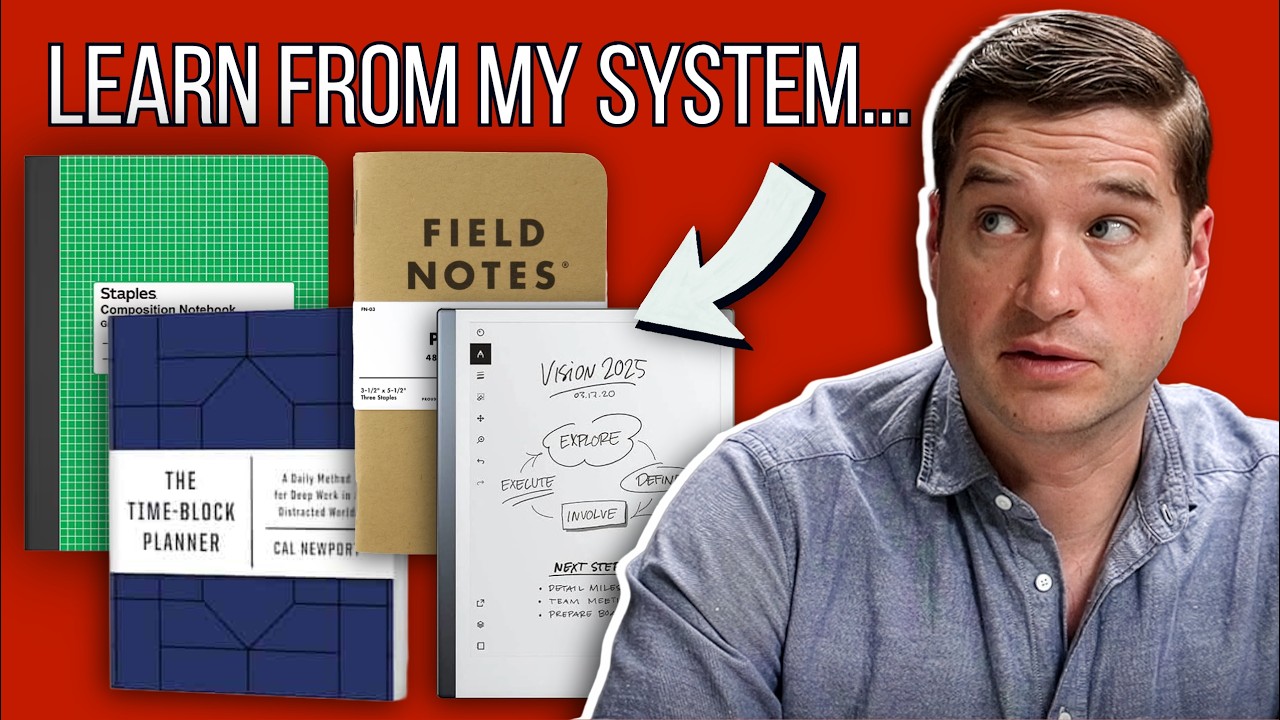
- He walks through the four notebook types he personally uses: a Time Block Planner (daily planning), a reMarkable Paper Pro (long-term strategic planning), Field Notes pocket notebooks (single-purpose brainstorming on a standing problem), and cheap gridline composition notebooks (in-the-moment working-memory extension, mostly for math).
- For each notebook he answers three questions: what he uses it for, why paper (vs. digital) suits that activity, and why that specific notebook format suits that activity.
- The second half is a mailbag segment: a Gen Z/IQ-decline article, a UK stat on parental conflict over school phone bans, a remote-work focus question, a World Cup attention-span anecdote, and a personal update (Colorado trip, Halloween light-controller build, two books finished: Ong's *Orality and Literacy* and Hardigan's *Lost*).
- Key stakeholders: knowledge workers and students trying to build a paper-based habit that sticks; parents managing phone rules; remote workers structuring unsupervised time.
- Risks/tradeoffs: the notebook advice is entirely anecdotal (n=1, Cal's own workflow) with no controlled comparison of paper vs. digital productivity; the Gen Z/IQ segment repeats a single neuroscientist's Senate testimony without independent verification.
- Bottom line: match the tool's physical properties (portability, lie-flat binding, grid density, disposability) to the cognitive task, rather than buying a notebook for its aesthetics.
## 📖 Main Content
Newport's framing device is that a notebook is inert without a "specific use ... that takes specific advantage of its analog format." He treats this as the answer to why most bought notebooks go unused: the failure isn't the object, it's the absence of a matched routine.
He organizes his own practice into four notebook/activity pairs:
1. **Time Block Planner → daily planning.** Time blocking (introduced in *Deep Work*, 2016) means assigning every minute of the workday a job instead of reacting to incoming demands. He credits it with roughly 2x output per unit time and easier entry into deep work. The planner's physical requirements are a lie-flat double-spiral binding and near-full-size pages, because planning needs room and a stable writing surface.
2. **reMarkable Paper Pro → longer-term strategic/vision planning.** He distinguishes reMarkable's e-ink writing surface from a lit LCD/OLED screen (an iPad or phone) — physical discs flip under an electric charge, closer to the feel of a Kindle than a tablet. He uses it for multi-month plans (e.g., a Halloween light-display project) because it supports color, diagrams, and highlighting that plain typing can't, while still backing up to the cloud. He also notes a psychological effect: because the device is expensive, he treats what he puts in it more seriously.
3. **Field Notes → single-purpose brainstorming.** A dedicated small notebook tracks progress on one hard, recurring problem (a book idea, a professional question, a personal goal) over weeks, letting him "double back" and accumulate insight rather than starting cold each time. The key property here is portability — pocket-size, flexible, cheap enough to buy in bulk and not be precious about.
4. **Gridline composition notebooks → working-memory extension.** This is explicitly not archival: it's for in-the-moment extension of working memory while doing hard technical work (his example is graph-theory/probabilistic-analysis research from his time as a theoretical computer scientist at MIT under Nancy Lynch). The grid must be visible but faint — too dark and it clutters the ink; too faint and it's useless for aligning equations, subscripts, and nested fractions.
A recurring meta-point: paper's advantage across all four cases is that it supports drawing, color, non-linear layout, and offline-ness — none of which a keyboard-and-screen interface replicates as naturally, and all of which pull him out of "the fully connected multitasking digital distraction machine."
The mailbag segment shifts topics but keeps a throughline of attention and technology:
- A shared article claims (via testimony from neuroscientist Jared Cooney Horvath) that Gen Z shows the first generational IQ decline since 19th-century data collection began, and frames this as a "reverse Flynn effect" tied to smartphone-era learning years. Newport treats the correlation as worth taking seriously (analogizing it to trans-fats and heart attacks) without fully endorsing causation.
- A UK "Cracked It" report on school phone bans: 39% of parents expect banning phones at school will increase pressure for phone time at home; 46% say screen time already causes the most household conflict. Newport's prescription: give phones no earlier than restricted-in-high-school/unrestricted-at-16, frame the phone as parent property, and enforce one binary rule (phones live in the kitchen at home) instead of ongoing negotiation.
- A remote-work listener question about compulsively podcast-listening/phone-checking between work blocks. Newport's answer combines time blocking (so "what's next" is never an open question) with variability/sustainability (accepting some days end at 3pm and some are packed, rather than forcing a fixed 8-hour frame).
- A World Cup anecdote (Uruguay's coach reportedly asked to shorten 10-minute team talks because players couldn't concentrate) becomes a jumping-off point for Newport's "attention contexts are unique" argument: concentration in one context (a match, with high stakes and no phones present) doesn't transfer to a different context (a locker room, with phones present and no immediate penalty for distraction) — echoing his broader claim that skill transfer (e.g., chess discipline transferring to phone discipline) is overrated.
- A personal-update segment: a Colorado trip (Crested Butte, Rocky Mountain National Park) taken without work; progress on an Ethernet-networked Halloween light controller; and two finished books — Walter Ong's *Orality and Literacy* (with a riff on the Phaedrus dialogue and the irony that Plato's suspicion of writing was itself only possible because he had a literate mind) and Rachel Hardigan's *Lost* (a dual narrative about Amelia Earhart and the expeditions searching for her wreckage).
### 🗒️ Notes
#### ⏱️ [0:00](https://www.youtube.com/watch?v=j0OydBfnvEA&t=0s) — How to use notebooks in 2026 (four-notebook system)
- Core claim: "It's not enough to simply own a nice notebook. You need a specific use for it that takes specific advantage of its analog format."
- **Notebook 1 — Time Block Planner (daily planning):** every minute of the workday gets a job; dark box = deep work, double line = admin work, triple line = a calendar appointment; requires lie-flat double-spiral binding and near-full-size pages; paper "feels more intentional" than moving blocks on a screen, and he keeps the planner in his bedroom to capture nighttime reminders without touching a phone.
- **Notebook 2 — reMarkable Paper Pro (long-term strategic/vision plans):** e-ink, not a lit LCD screen — "physical discs turn with electric" rather than glowing pixels; used for big multi-month projects (example given: a Halloween decoration controller layout); values color, diagrams, and highlighting over plain text, plus cloud backup; the cost of the device makes him take what's stored in it more seriously.
- **Notebook 3 — Field Notes (single-purpose brainstorming):** one notebook dedicated to one hard, ongoing problem (book ideas, professional strategy, personal goals) worked on over weeks; portability is the deciding factor — pocket-size, flexible, cheap enough (bought ~20 at a time) to not be precious about, more portable than the Moleskines he used previously.
- **Notebook 4 — gridline composition notebooks (working-memory extension):** used in the moment while doing hard technical work (his example: graph-theory/probabilistic-analysis research as a theoretical computer scientist); explicitly not archival — "It's not that it itself is archival"; grid must be faint blue, not high-contrast, or it clutters the handwriting.
- Producer Jesse Miller's own setup gets a short aside: Field Notes for general thoughts and problem-solving, a self-made smaller time-block planner, and a separate sheet for gym workouts and golf scorecards, deliberately used without a phone present.
#### ⏱️ [30:11](https://www.youtube.com/watch?v=j0OydBfnvEA&t=1811s) — Comments on a controversial article (Gen Z IQ claim)
- Listeners Joe and Marcy send an MSN piece citing neuroscientist Jared Cooney Horvath's Senate testimony that Gen Z (born 1997–early 2010s) shows measurable decline in attention, memory, reading, math, problem-solving, and overall IQ — the first generational decline since 19th-century data collection began.
- Newport frames this as the "reverse Flynn effect" (global IQ gains stalling around the point smartphones became ubiquitous) and analogizes the correlation to trans fats and heart attack rates, without claiming the causal mechanism is proven.
- Aside: he notes the MSN page itself is saturated with ads, joking that the ad density might be part of the attention problem.
#### ⏱️ [33:18](https://www.youtube.com/watch?v=j0OydBfnvEA&t=1998s) — Statistics about smartphone bans in schools
- Listener Jenny shares stats from a "Cracked It" report by U Switch: 39% of parents think reduced school screen time will increase pressure for home screen time; 46% say screen time is already one of the biggest sources of home conflict.
- Newport's prescription: no phone until high school (restricted) or 16 (unrestricted); the phone is explicitly parent property, not the child's; one binary household rule — phones stay plugged in in the kitchen while at home, including for the parents.
- Verbatim summary line: "Don't argue with terrorists."
#### ⏱️ [38:15](https://www.youtube.com/watch?v=j0OydBfnvEA&t=2295s) — A practical question about remote work
- Listener Jackson describes working alone at home and struggling not to check his phone or a podcast during downtime between meetings/deep-work blocks.
- Newport's fix: time block the day so "what's next" is never an open question, paired with building in variability and sustainability (some days end early, some are packed) rather than treating remote work as an 8-hour office shift that must be filled.
#### ⏱️ [40:57](https://www.youtube.com/watch?v=j0OydBfnvEA&t=2457s) — A question about focus and the World Cup
- Listener Ulisses shares a tweet: Uruguay's World Cup coach says players asked him to shorten his 10-minute team talks, prompting his own question about whether professional athletes should be able to concentrate for 10 minutes.
- Newport's response introduces "attention contexts are unique" — professional athletes clearly sustain intense concentration on the field (no phones, high stakes for lapses), but a locker-room speech is a different context where phones are present and there's no immediate penalty for disengaging; general concentration skill in one domain (chess, sport) doesn't automatically transfer to resisting phone distraction in another domain.
#### ⏱️ [46:08](https://www.youtube.com/watch?v=j0OydBfnvEA&t=2768s) — What Cal is up to
- Recently back from Crested Butte and Rocky Mountain National Park, Colorado, with his 8-year-old son; describes it as a genuine break — no work, minimal planning or brainstorming during the trip.
- Building a more sophisticated, Ethernet-networked Halloween light controller this year using off-the-shelf open-source controller software and a dedicated circuit board (previously self-built), which he frames as an example of pursuing "remarkable," non-instrumental projects — a theme in his forthcoming book *The Deep Life*.
#### ⏱️ [48:12](https://www.youtube.com/watch?v=j0OydBfnvEA&t=2892s) — What Cal is reading
- Finished Walter Ong's *Orality and Literacy: The Technologizing of the Word* — discusses Ong's point (new to Newport) that Plato's Socratic skepticism of writing in the Phaedrus was itself only possible because Plato had a post-literate mind; writing enabled the systematic philosophical thought Plato used to criticize writing.
- Finished Rachel Hardigan's *Lost*, a dual-narrative book about Amelia Earhart intertwined with modern expeditions (including a Bob Ballard-style deep-sea survey) searching for her wreckage near Howland Island.
- Also discusses an Audible/"Acquired" podcast episode on Walt Disney and reflects on long-form narrated audio as a possible middle ground between books and short-form audio content.
## 📚 References
- [MSN: "A neurologist claims Gen Z has a lower IQ than millennials"](https://www.msn.com/en-us/money/general/a-neurologist-claims-gen-z-has-a-lower-iq-than-millennials/ar-AA1XAIFu)
- [Tweet: Uruguay coach on shortened team talks](https://x.com/JimenaJuani/status/2072095851816620191?s=20)
- [Deep Questions — listen](https://www.thedeeplife.com/listen)
- [Cal Newport's books](https://www.calnewport.com/books)
- [Cal Newport's free deep-life guide](https://www.calnewport.com/ideas)
## 🗣️ Paraphrase
- A notebook only earns its keep when it's paired with a specific activity that genuinely needs paper's physical properties — drawing, portability, texture, or a lie-flat surface — not because the notebook itself is well made.
- Newport runs four notebooks in parallel, each doing a job a screen doesn't do as well: a planner for daily time blocking, a reMarkable for long, colorful strategic plans, a Field Notes pad for portable single-issue brainstorming carried over weeks, and a cheap gridline composition book for extending working memory during hard technical work in the moment.
- The back half of the episode applies the same "match the tool to the actual need" logic to phones: give kids phones later, make ownership unambiguous, and pick one simple household rule instead of negotiating daily; and to attention more broadly: focus built in one context (sport, remote-work time blocks) doesn't automatically carry over into a different context where the phone is present and the stakes for distraction feel lower.
## 📰 Newsletter
**Cal Newport's four-notebook system — and why the notebook you buy doesn't matter if the use doesn't**
This week's Deep Questions is a practical rundown worth stealing: Cal Newport uses four separate notebooks, each matched to a different job — a Time Block Planner for daily scheduling, a reMarkable Paper Pro for long strategic plans, a pocket Field Notes pad for single-issue brainstorming, and a cheap gridline composition book for extending working memory mid-problem. The through-line for anyone building an analog habit: buy the notebook *after* you know the specific, paper-dependent use case, not before.
The mailbag half covers a viral Gen Z/IQ-decline claim, a UK stat on parental conflict over school phone bans (worth a read if you're drafting family device policy), a remote-work focus question answered with time blocking + built-in variability, and a nice aside on why concentration skill doesn't transfer cleanly between contexts (World Cup locker rooms included).
Worth the listen if you've got an unused notebook sitting in a drawer.
Resources: [Deep Questions](https://www.thedeeplife.com/listen), [Cal Newport's books](https://www.calnewport.com/books)
## ✅ Action Items
#### DevRel
- Not applicable to this source — no developer relations, advocacy, or SDK/docs content in this episode.
#### OSPO
- Not applicable to this source — no open-source governance, licensing, or security-management content.
#### Community
- Not applicable to this source — no open-source maintainer/contributor/sponsor community content; the only "community" content is a podcast listener mailbag, which the Main Content and Notes sections above already cover.
#### WordPress
- Not applicable to this source — the episode does not reference WordPress, WordPress core, or any WordPress-adjacent team.
#### The WPCC
- Not applicable to this source — no WordPress Community Collective content.
#### FAIR
- Not applicable to this source — no FAIR governance/funding-transparency content.
## 🧪 Hypotheses
- Assigning each notebook a single, non-overlapping use case increases sustained usage compared to owning one general-purpose notebook.
- Physical constraints (grid density, binding, portability) measurably affect whether a notebook gets used for its intended purpose, independent of the writer's discipline.
- Time blocking (writing out a full-day plan on paper) increases self-reported output per hour relative to unstructured or purely digital daily planning.
- A single, unambiguous household phone rule (e.g., "phones stay in the kitchen") reduces daily parent-child negotiation frequency compared to case-by-case enforcement.
- Concentration ability is context-specific: high sustained focus in one domain (competitive sport, scheduled deep-work blocks) does not predict resistance to phone-checking in an unrelated, lower-stakes context.
### 📊 Methodology
- A diary study comparing daily output/self-reported focus for matched groups using a single general notebook vs. Newport's four-notebook, task-matched system over 4–8 weeks.
- A controlled test varying notebook physical properties (grid brightness, binding type, page size) against completion/return-to-notebook rates.
- A survey of households before/after adopting a single binary phone rule vs. continuing ad hoc negotiation, measuring reported conflict frequency (comparable to the U Switch "Cracked It" methodology cited in the episode).
- A cross-context concentration study measuring the same individuals' sustained-attention performance in a high-stakes task context vs. a low-stakes, phone-present context.
### ❓ Questions
- Does the psychological "seriousness" effect Newport attributes to the expensive reMarkable generalize to any costly tool, or is it specific to writing/planning tools?
- How much of the reported Gen Z IQ decline (per Horvath's testimony) survives after controlling for test administration changes, sampling, and the broader "reverse Flynn effect" literature, versus being attributable specifically to smartphone use?
- Would Newport's "phones live in the kitchen" rule hold up in households without a stay-at-home parent to enforce it consistently?
- Is the "attention contexts are unique" claim falsifiable, or does it risk being unfalsifiable by explaining away any case of inconsistent focus?
### 🔮 Future Research
- Longitudinal tracking of whether Newport's own notebook-use pattern (four notebooks, four purposes) remains stable over multiple years, versus drifting the way most single-notebook habits do.
- Independent replication of the Horvath Gen Z IQ testimony using peer-reviewed, published data rather than Senate testimony reported secondhand via a news aggregator.
- A study isolating which specific paper properties (tactile friction, non-linear layout, absence of notifications) drive the reported preference for analog planning over digital tools.
### 💡 Implications
- **Practice:** Individuals building a paper-habit should choose a notebook's physical format (binding, size, grid) only after fixing the specific activity, rather than the reverse.
- **Policy:** School/family phone-policy design benefits from binary, low-negotiation rules (as Newport argues) rather than ambiguous, case-by-case enforcement — relevant to the U Switch statistic cited in the episode.
- **Security:** Not directly addressed in this episode.
- **Education:** The Ong discussion (writing enabling systematic thought) has direct relevance to media-literacy and educational-technology debates about handwriting vs. typing.
- **Funding:** Not directly addressed in this episode.
### 🧠 Learning Styles Assessment
Reading level estimate: approximately 7th–8th grade (Flesch-Kincaid), consistent with conversational spoken-podcast register — short clauses, minimal jargon outside of "time blocking" and technical asides on graph theory.
#### 👀 Visual learners
- Present: on-screen photos of Newport's actual notebook pages (time-block plan sample, reMarkable Halloween-controller sketch, single-purpose brainstorming page, composition-notebook math page).
- Improve: side-by-side labeled diagrams comparing the four notebook formats and their physical specs (binding, size, grid weight) in one frame.
#### 🔊 Aural learners
- Present: full narrated audio via the podcast feed; conversational back-and-forth with producer Jesse Miller reinforces key points.
- Improve: a short (2–3 minute) audio-only recap of the four-notebook system for listeners who missed the video component.
#### 🗣️ Verbal learners
- Present: clear analogies (trans fats/heart attacks for the IQ correlation; "Don't argue with terrorists" for phone rules; chess-skill-transfer analogy for attention contexts).
- Improve: a plain-language glossary distinguishing "time blocking," "reverse Flynn effect," and "single-purpose planning" for listeners new to Newport's vocabulary.
#### 🧩 Kinesthetic learners
- Present: concrete, replicable steps for each notebook use case (e.g., "block out every minute," "keep one notebook per single problem").
- Improve: a downloadable starter checklist for setting up each of the four notebook types.
#### 🧠 Logical learners
- Present: the consistent three-question framework (what, why paper, why this format) applied to each notebook.
- Improve: a decision tree mapping task type → recommended notebook format.
#### 🧑🤝🧑 Social learners
- Present: the Jesse Miller Q&A segment models a real conversation about notebook habits.
- Improve: a listener-submission thread comparing notebook systems across the audience.
#### 🧘♀️ Solitary learners
- Present: reflection prompts implicit in the "why paper" question for each notebook.
- Improve: an explicit self-audit worksheet ("what task am I forcing onto the wrong tool?").
#### 🌿 Naturalistic learners
- Present: minimal — the episode doesn't address sustainability or environmental framing.
- Improve: a note on paper sourcing/waste for readers who cycle through cheap composition notebooks and Field Notes in bulk.
### 📊 Accessibility Assessment
#### Screen reader semantics
- Present: chapter markers in the video description provide navigable timestamps; podcast audio format is inherently screen-reader-friendly.
- Improve: add descriptive alt text for the on-screen notebook-page images for viewers who can't see the visual demonstration.
#### Keyboard navigation
- Present: standard YouTube/podcast-player keyboard controls apply; not a custom interface.
- Improve: not applicable beyond player-level controls, which are outside the content creator's control.
#### Contrast and readability
- Present: on-screen notebook photos are high-resolution close-ups per Newport's description.
- Improve: no independent verification possible without visual review of the video itself (this analysis is transcript-based).
#### Text resizing and reflow
- Present: not applicable — video/audio content, no reflowable text UI.
- Improve: not applicable.
#### Media and captions
- Present: YouTube auto-captions/transcript available (used to produce this analysis); podcast audio available separately.
- Improve: a human-reviewed, cleaned transcript (the auto-transcript used here has clear ASR artifacts, e.g., repeated words, run-on punctuation) would materially improve accessibility for deaf/hard-of-hearing viewers and for readers.
#### Forms and interactions
- Present: not applicable — no forms in the video itself.
- Improve: not applicable.
#### Standards reference
- Primary WCAG 2.2 AA gap identified: caption/transcript quality (raw ASR output has disfluencies and mis-segmented sentences that a cleaned transcript would resolve).
### 🌍 DEIB Assessment
#### Cultural breadth
- Present: minimal — the episode is US-centric (World Cup/Uruguay reference is the one non-US example); most anecdotes (Halloween decorations, US school phone policy, MSNBC/MSN) are US-specific.
- Improve: broaden phone-policy discussion beyond US school norms; note that "restricted phone in high school, unrestricted at 16" reflects a US cultural default, not a universal standard.
#### Inclusive language
- Present: gender-neutral references to "parents," "kids," and "listeners" throughout.
- Improve: the "Don't argue with terrorists" framing, while a deliberate rhetorical flourish, analogizes children to hostile combatants — a phrasing worth softening for a general-audience note.
#### Neurodiversity support
- Present: the four-notebook system itself is a useful external-structure aid (time blocking, working-memory extension) that maps well onto executive-function support strategies.
- Improve: explicitly connect the working-memory-extension notebook (composition notebook use case) to ADHD/executive-function research, which would strengthen the segment's practical value for neurodivergent listeners.
#### Representation
- Present: two listener voices in the mailbag (Joe/Marcy, Jenny, Jackson, Ulisses) represent a range of concerns (media literacy, parenting, remote work, sports fandom).
- Improve: no representation of non-US or non-English-speaking notebook/planning traditions.
#### Psychological safety
- Present: respectful tone throughout even on the contentious Gen Z/IQ topic ("controversial articles are my favorite type of article" framed as intellectual curiosity, not attack).
- Improve: the Gen Z/IQ segment could more explicitly flag that a single neuroscientist's testimony is not consensus science, to avoid listeners over-indexing on one contested claim.
### ✅ Logical Validity
#### Strong reasoning
- **Analogical strength (30:11):** Newport's trans-fats/heart-attack analogy for the Gen Z IQ correlation is a clear, well-chosen analogy for "correlation worth investigating, not yet proven causal" — it communicates appropriate epistemic caution without dismissing the finding.
- **Practical/causal reasoning (0:00–30:11):** the three-question framework (what/why paper/why this format) applied consistently across all four notebooks gives the notebook segment strong internal consistency — each claim about a notebook's format is tied to a stated functional need (portability, grid density, lie-flat binding).
- **Analogical strength (40:57):** the chess-skill-transfer analogy supporting "attention contexts are unique" is a reasonable inductive generalization from a domain Newport has covered extensively in his other work.
#### Fallacies
- **Hasty generalization (30:11):** the Gen Z IQ claim rests on one neuroscientist's Senate testimony reported via a single news aggregator (MSN); Newport treats it as worth taking seriously without checking for independent replication or peer review, which is a thin evidentiary base for a strong generational claim. Fix: seek the underlying published data Horvath cites, if any, before treating the conclusion as established.
- **Correlation/causation ambiguity (30:11):** the "reverse Flynn effect" timing correlation with smartphone ubiquity is presented suggestively (the trans-fats analogy implies causation) without ruling out confounds (test-administration changes, generational sampling differences). Newport partially hedges this himself but the analogy still nudges toward a causal reading.
- **Anecdotal generalization (0:00–30:11):** the entire four-notebook framework is drawn from a sample size of one (Newport's own habits) and presented as "the best system," per the video's own title — reasonable as personal testimony, weaker as a universal prescription.
#### Tone of voice
- Overall tone: conversational, confident, occasionally wry (jokes about MSN's ad density, "trader" banter with Jesse about notebook loyalty). Instructional register in the notebook segment; more casual/opinionated register in the mailbag segment.
### 🛡️ DARVO Analysis
Not applicable to this source — the episode contains no accusation, denial, attack, or victim/offender-reversal dynamic; it is instructional and advice-column content, not a response to any allegation.
## 🎯 Conclusion
- The core, transferable claim of the episode: a notebook only becomes useful when its physical format (binding, size, grid, portability) is deliberately matched to a specific, paper-dependent activity — buying a nice notebook first and hoping a use emerges rarely works.
- Practical next steps for readers: identify one recurring task currently done poorly on a screen (daily planning, a stuck problem, in-the-moment technical notes) and pick a notebook format whose physical constraints actually serve that task, rather than defaulting to whatever notebook is already on hand.
- Secondary takeaway from the mailbag: the same "match the tool/rule to the actual need" logic Newport applies to notebooks recurs in his phone-policy advice (one binary household rule beats ambiguous negotiation) and his attention argument (focus is context-specific, not a general-purpose skill that transfers automatically).
## 🔄 Refactor Appendix — How to Use Notebooks in 2026 (The Best System)
> Density: 2–5 Literature atoms (H3), 0–3 Permanent candidates (H4).
> Defaults: 3 Literature, 1 Permanent. Resonance filter: if you can't
> articulate in one line why a claim matters, drop it.
>
> Konik claim-header rules: present tense, declarative, ≤10 words when
> possible, searchable, unique, mirrors annotation focus if present.
>
> Atomicity: one declarative sentence per atom. "and"/"also" → split.
>
> Tag pool: #bmf · #addendum · #xref · #articleseed · #storystem · #share · #aphorisms
### 📚 Literature Atoms (H3)
#### [H1] Notebook use, not ownership, determines its value
> [!quote] ID:manual_j0OydBfnvEA_1
> "It's not enough to simply own a nice notebook. You need a specific use for it that takes specific advantage of its analog format."
**Context & use**:
- [0:00](https://www.youtube.com/watch?v=j0OydBfnvEA&t=0s), episode opening thesis statement.
- Frames the entire episode; every later notebook segment answers "what/why paper/why this format" in service of this claim.
**Tags**: #xref #aphorisms
**Highlight**: no Reader-side highlight object exists yet (manual offline fallback, not yet saved via Readwise API) — timestamp link above stands in for [view highlight].
<!-- atomicity: 1 idea ✓ -->
#### [H2] Time blocking assigns every workday minute a job
> [!quote] ID:manual_j0OydBfnvEA_2
> "the best way to make the most out of your mind during a workday is to actually block out the time of that day, to give every minute of your workday a job"
**Context & use**:
- [0:00](https://www.youtube.com/watch?v=j0OydBfnvEA&t=0s), within the Time Block Planner segment; originally sourced to Newport's 2016 book *Deep Work*.
- Central mechanism behind his claimed ~2x output gain and easier entry into deep work.
**Tags**: #xref
**Highlight**: no Reader-side highlight object exists yet (manual offline fallback).
<!-- atomicity: 1 idea ✓ -->
#### [H3] Hard problems require sustained, repeated thought
> [!quote] ID:manual_j0OydBfnvEA_3
> "But hard things required hard thought."
**Context & use**:
- [0:00](https://www.youtube.com/watch?v=j0OydBfnvEA&t=0s), justifying the Field Notes single-purpose-brainstorming notebook.
- Supports the claim that a dedicated notebook, revisited over weeks, is what lets difficult problems get solved rather than abandoned.
**Tags**: #xref #aphorisms
**Highlight**: no Reader-side highlight object exists yet (manual offline fallback).
<!-- atomicity: 1 idea ✓ -->
### 🧠 Permanent Candidates (H4)
#### [P1] Match the tool's physical constraints to the task, not the reverse
**Claim** (one sentence, Courtney's voice): A tool only earns continued use when its specific physical properties (portability, grid weight, binding, screen type) are chosen to serve one clearly defined task, rather than the task being retrofitted to whatever tool was already bought.
**Evidence pointer**: [[#H1 Notebook use not ownership determines its value]]
**Scope & conditions**: Holds for analog tools (notebooks, planners) and plausibly generalizes to app/software choice; breaks down when the "task" itself is undefined — the framework has nothing to say until a specific use case exists.
**Links** (≥1 with annotation):
- [[Deep Work — time blocking]] — because applies-in daily planning
- [[Tool-task fit]] — because extends to non-notebook tool selection generally
**Optional**: `status: seedling`
<!-- atomicity: 1 idea ✓ -->
### ✏️ Fleeting Queue
- [F1] Verify Horvath's Gen Z IQ/reverse-Flynn-effect testimony against a published, peer-reviewed source rather than the MSN aggregator citation — https://www.msn.com/en-us/money/general/a-neurologist-claims-gen-z-has-a-lower-iq-than-millennials/ar-AA1XAIFu #xref
- [F2] Consider whether "attention contexts are unique" (World Cup segment, [40:57](https://www.youtube.com/watch?v=j0OydBfnvEA&t=2457s)) connects to existing notes on skill-transfer/near-vs-far-transfer research #xref
### → Things 3 (max 2 actions)
- [ ] Read Walter Ong's *Orality and Literacy* (referenced at [48:12](https://www.youtube.com/watch?v=j0OydBfnvEA&t=2892s)) if researching writing-technology's effect on cognition — #things
<!-- deep-read:sections end -->
📄 **Full text:** [[Full Document Contents/Articles/How to Use Notebooks in 2026.md|How to Use Notebooks in 2026 by YouTube]]
## Highlights
- Do you like the idea of an old-fashioned paper notebook? I mean, a lot of people do. There's something aesthetically pleasing about a well-made notebook. There's also the excitement of anticipating the original thoughts or insights that this tool is going to help you usher into the world. But then, if you're like most people, you buy that fancy new notebook and it ends up sitting idle and then eventually you forget about it. So, here's the problem. It's not enough to simply own a nice ([View Highlight](https://read.readwise.io/read/01kxh9j92vwqzp13k16c40nwbm))
- Tags: atom/literature/h1
- haven't heard me talk about time blocking before, it's an idea that I first introduced in my 2016 book, Deep Work, where I say the the best way to make the most out of your mind during a workday is to actually block out the time of that day, to give every minute of your workday a job, to make a plan for your cognition as opposed to just reacting to what's happening, what's incoming, and what you feel like doing next. It could be an exhausting way to work, but it it I usually argue gets about on average 2x more results per ([View Highlight](https://read.readwise.io/read/01kxh9jev8gzk6y4qdkf8nqfmq))
- Tags: atom/literature/h2
- like this because complicated problems take thought. Like, we're not used to giving things extended thought anymore because we're so distracted and we're afraid of our own cognition. But hard things required hard thought. This is what I was taught as a theoretician at MIT. You want to solve a problem, you're going to come back to it again and again and again and your mind gets better at. You find different angles and eventually hopefully you make progress. So a single-purpose notebook helps you do that. You don't forget the things you've written down. You accumulate knowledge. You can double back. It's a great way to make progress on difficult projects. So why paper for ([View Highlight](https://read.readwise.io/read/01kxh9jmefevj22np8eepqgfvc))
- Tags: atom/literature/h3
- kitchen while we're at home. And that's just it. It's a binary rule. Boom. Boom. Boom. That's it. You want a phone? We do the rule. That's it. No more daily negotiations. No more arguments. No more uh vague shaming like, "Well, if I just act upset enough, maybe they'll voluntarily use the phone less. They will thank you. Their brain will fake you. Your cognitive fitness will thank you. Their mental health will thank you." So, I I to me I think that is the way to deal with teenagers and phones in your own home. Don't argue with terrorists. All right. What else do we got? Jesse, >> our next message is from Jackson who has ([View Highlight](https://read.readwise.io/read/01kxh9mjvb634tezxhr0n1wz5a))
- Tags: atom/literature/h4