How to Write a Book Millions of People Read
🔗 **Source:** [How to Write a Book Millions of People Read](https://www.youtube.com/watch?v=WKQDevJ6XTk)
> [!note]+ Document Notes
> > [!info] Provenance
> > **Analysis generated:** 2026-08-27 by Claude (Opus 5) via the `readwise-deep-read` pipeline.
> > **Source:** YouTube — https://www.youtube.com/watch?v=WKQDevJ6XTk
> > **Title:** "How to Write a Book Millions of People Read (Matt Haig Interview)" · **Transcript:** ~51,000 chars / ~9,000 words · video (long-form interview)
> > **Speakers:** **Matt Haig**, novelist (captioned once as *"Matt Hag"*), interviewed by **David Perell** — `[INFERENCE]` identified from the show name *"How I Write"*, the sponsor read in his own voice, and a reference to *"I'm getting David in this email."*
> > **Disclosed sponsor:** `[STATED]` **Alpha School**, read mid-interview by the host, who also states he mentored there and *"it's also where I want to send my kids to school one day."* `[INFERENCE]` Disclosed, and the claims in it are unaudited — see [The sponsor read](#the-sponsor-read-sits-oddly).
> > **Register key:** `[STATED]` speaker-stated · `[EVIDENCE]` demonstrated · `[INFERENCE]` reviewer inference · `[RECOMMEND]` reviewer recommendation.
> > **Coverage:** Full transcript read end to end. Machine captions corrupt several proper nouns (see [Transcription artifacts](#transcription-artifacts)).
>
> # 🏷️ Title: How to Write a Book Millions of People Read (Matt Haig Interview)
>
<!-- deep-read:sections start -->
## 🧭 Table of Contents
- [📝 Summary](#-summary)
- [📖 Main Content](#-main-content)
- [🗒️ Notes](#️-notes)
- [📚 References](#-references)
- [🗣️ Paraphrase](#️-paraphrase)
- [📰 Newsletter](#-newsletter)
- [✅ Action Items](#-action-items)
- [🧪 Hypotheses](#-hypotheses)
- [📊 Methodology](#-methodology)
- [❓ Questions](#-questions)
- [🔮 Future Research](#-future-research)
- [💡 Implications](#-implications)
- [🧠 Learning Styles Assessment](#-learning-styles-assessment)
- [📊 Accessibility Assessment](#-accessibility-assessment)
- [🌍 DEIB Assessment](#-deib-assessment)
- [✅ Logical Validity](#-logical-validity)
- [🛡️ DARVO Analysis](#-darvo-analysis)
- [🎯 Conclusion](#-conclusion)
### 🔗 References
Works and people named (no links captured):
- **The Midnight Library** — `[STATED]` *"more than 10 million copies… more than 288,000 reviews"*; book **number 20**
- **The Humans** · **The Possession of Mr Cave** · **The Life Impossible** · **The Midnight Train**
- **Francis Bickmore**, his editor of 15 years
- **A.A. Milne**, *Winnie-the-Pooh* (captioned *"a mil"*, *"battle of Assam"* → **the Somme**)
- **Keats**, **Byron**, **Borges** (captioned *"Bourhees"*), **Douglas Adams**, **Virginia Woolf**
- **NME** (captioned *"enemy"*), **Alpha School** (sponsor)
## 📝 Summary
**The process, stated bluntly.** `[STATED]` *"I'm totally stop start. I'm a lot of stop… it's 90% stop."* And the reframe that follows is the interview's most useful idea: `[STATED]` *"Writer's block for me is not knowing which idea to choose… there's a lot of work that doesn't feel like work and you're sort of beating yourself up because you think why aren't [you] working, but actually that turns out to be the most important work."*
**The editing mechanism is specific and transferable.** `[STATED]` *"my editor… will say a few things thinking I'm going to change a paragraph here, a paragraph there, and then suddenly I'll have wiped out 50,000 words."* Why: `[STATED]` *"if you're spotting a little problem there, I'm going to pull at that and think, what is that problem about? Oh, it's about that whole character doesn't need to be there or that whole premise."*
`[EVIDENCE]` With numbers: *The Humans* started at ~80,000 words, lost 40,000, then gained 55,000 between first and second draft.
**The structural argument about markets is the best-reasoned thing here.** `[STATED]` What is on the bookstore table was *"taken on and edited two years ago and written three years ago and conceived four, five years ago,"* so *"by looking at the tables in a bookstore you're just looking at the past… if you started writing a book now… it's going to be on tables in five years' time. So that's not the market."*
**The AI argument is a real structural claim, not a vibe.** `[STATED]` *"life famously evolves through mistakes and mutations… Whereas AI is set up to be a perfectionist. It sort of [weeds] out all mistakes. Any equivalent of mutation it stops. So we evolve in fundamentally opposite ways."*
**Bottom line.** `[INFERENCE]` Three genuinely portable mechanisms — **local symptoms as structural evidence**, **distance enabling intimacy**, and **production lag making trend-following structurally late** — inside a success story whose central advice is validated by an outcome that cannot be attributed to it.
## 📖 Main Content
### The 50,000-word deletion is the batch's recurring pattern in a different domain
`[STATED]` The editor flags a paragraph; Haig deletes a character, a premise, 50,000 words.
`[INFERENCE]` **The reasoning is that a local defect is evidence about structure rather than a thing to fix locally** — and this is the third domain in this batch to arrive at the same shape. The Argus disclosure found six individually-insufficient weaknesses that only mattered composed. The WP Rocket post-mortem found an unreproducible bug report and two unlinked support tickets, each individually dismissible and jointly decisive. **In all three, the instrument that assesses items one at a time is blind to the actual problem.**
`[EVIDENCE]` Haig names the alternative and rejects it: `[STATED]` *"there's a temptation to sort of correct sentences and correct lines and correct a little scene when really there's a bigger problem. It's not the thing that's happening on that specific page."*
`[RECOMMEND]` **The transferable question is "what is this a symptom of?" before "how do I fix this?"** — and it is worth applying to code review, to editing, and to any triage process. `[INFERENCE]` It also explains a failure mode of AI-assisted editing specifically: a model asked to improve a paragraph will improve the paragraph. **The question it will not ask unprompted is whether the paragraph should exist.**
### Diminishing returns, and the over-optimisation finding
`[STATED]` *"there comes a point that each draft you're improving things could start to make it worse… with me [it] is like the fourth or fifth round; after that you're getting so far away from the thing you started with that it's getting worse."*
`[EVIDENCE]` The illustration is good: over-produced pop where *"all the notes hit on the fours and the eights… it feels flat, it's too perfect,"* against a live band where *"there's a messiness, there's a chaos… that is very human."*
`[INFERENCE]` **This is Goodhart's Law in a creative register**, and it is the fourth appearance of that shape in this batch — after DX conceding *"PR throughput doesn't cover value,"* Graze's volume metrics standing in for creator income, and Baucham's *"affective principle"* where producing an experience became the measure of worship. **Optimising a proxy past a point degrades the thing the proxy stood for**, and Haig locates the threshold empirically at four or five drafts.
`[RECOMMEND]` The practical version: **know your own diminishing-returns point and stop there.** Haig knows his. Most people do not measure it and therefore cannot.
### The AI argument, its best version, and where it breaks
`[STATED]` *"AI is set up to be a perfectionist. It sort of [weeds] out all mistakes. Any equivalent of mutation it stops. So we evolve in fundamentally opposite ways. Life and technology evolve in fundamentally opposite ways."*
`[INFERENCE]` **This is a genuine structural argument and it deserves to be taken seriously before being contested.** Biological novelty requires error: mutation is the mechanism, and a system that eliminated all copying error would stop evolving. If optimisation systematically suppresses variation, then the two produce novelty by opposite means.
`[INFERENCE]` **Where it is weakest:** the premise that these systems suppress variation is not obviously true. Sampling temperature, stochastic decoding, and the training objective itself all introduce variation deliberately — the analogy to a mutation-free replicator is doing more work than the technical picture supports. **The argument is a good metaphor being asked to carry an empirical claim.**
`[EVIDENCE]` **And the second AI claim runs into Haig's own account of his best book.** He says: *"AI is looking at everything that's gone before. True creativity is going to become more valuable, i.e. creating new stuff… because it doesn't exist and it's only knowing what's existed."*
`[EVIDENCE]` But of *The Humans* — his breakthrough — he says it was *"very much me and all my influences in one sort of pot."* And of how he unstuck *The Midnight Train*: `[STATED]` *"what could I bring from children's literature? … children's books often have a magical train… the Railway Children, Harry Potter, Polar Express."*
`[INFERENCE]` **Both descriptions are recombination**, which is the thing he attributes exclusively to machines. `[INFERENCE]` He half-anticipates the objection — *"it's not like coming up with a new form, a new media. It's literally just trying to articulate emotions in a way that haven't been articulated before"* — and that retreat is the more defensible position: **the novelty is in the articulation, not in the elements.** Which is a claim about *felt* originality rather than combinatorial originality, and is much harder to operationalise than the version he leads with.
`[INFERENCE]` **The load-bearing premise is unsupported.** `[STATED]` *"if art is there to make us feel less alone, then how is AI, which is making us feel more alone, going to help with that?"* The parenthetical is the whole argument and it is asserted, not shown.
`[EVIDENCE]` **The prediction worth recording**, because it is falsifiable: `[STATED]` *"books made by humans, even if it becomes like, you know, human-made as a sticker like organic or fair trade… I think there will always be a value of being human for humans."* `[INFERENCE]` Provenance labelling for art, on the food-certification model. Watch for it.
### Distance enables intimacy — the most actionable mechanism here
`[EVIDENCE]` Two independent instances, and Haig draws the connection himself.
**One.** *The Humans* was `[STATED]` *"my most personal book, but it was also my most fantastical… it was literally about an alien from another planet coming to Earth to destroy humanity. So it wasn't my life."*
**Two.** `[STATED]` The first draft of *The Midnight Library* had a male protagonist named Adam, roughly Haig's age. *"I nearly gave up on the book just because I could not see this person."* Changing the character to Nora — different gender, age, location — fixed it: *"it suddenly wasn't me. And therefore, paradoxically, I put more of myself in… More of me went into this character as soon as it wasn't me."*
`[EVIDENCE]` And the diagnosis is precise: `[STATED]` *"when I'm writing someone who is basically me, one, it stops being a character, because it's just me and you don't really see yourself as a character… And then the other thing was I was a bit guarded, because it was me. It was like writing non-fiction."*
`[INFERENCE]` **Two separate mechanisms, both correct and both worth separating.** The first is a *perception* problem — proximity destroys the ability to see something as an object, the same way a word repeated aloud loses its meaning, and Haig makes exactly that comparison. The second is a *disclosure* problem — writing yourself directly triggers self-protection.
`[RECOMMEND]` **This generalises past fiction.** Anyone struggling to write about their own experience — a postmortem, a case study, an essay — may be hitting either or both, and the remedies differ: the perception problem needs distance, the disclosure problem needs the cover distance provides.
### The lag argument makes market research structurally impossible
`[STATED]` *"the moment you try and be commercial or try and research a market is the moment you will fail to be commercial."*
`[INFERENCE]` As stated that is a paradox-shaped assertion. **What makes it a real argument is the chain he supplies immediately after** — a book on the table today was acquired two years ago, written three years ago, conceived four or five years ago. `[STATED]` *"So by looking at the tables in a bookstore you're just looking at the past… That's not the market. That's the past from where you're going to be."*
`[INFERENCE]` **This is a mechanism, not advice, and it is checkable.** In any field with a multi-year production lag, observable "current trends" are a lagging indicator by roughly the length of that lag — so trend-following guarantees arriving late by construction rather than by bad luck. **The longer the production cycle, the worse trend-following performs**, which is why it works in fast-fashion and fails in publishing.
`[EVIDENCE]` His conclusion follows cleanly: `[STATED]` *"the only reader you're going to know is yourself. So you just have to be honest about the book you would want to read."*
### The survivorship problem, and the credit he deserves for how he handles it
`[EVIDENCE]` *The Midnight Library* was **book number 20**. `[STATED]` *"I had written a lot of books. I'd been rejected by a lot of publishers. I'd been dropped by a couple of publishers."*
`[EVIDENCE]` And *The Humans* — his UK breakthrough — was written at the worst possible moment: `[STATED]` *"we just had our first child and we had zero money and lots of debt. So we had a lot of financial pressure which would make you think you were going to try and write something safe and commercial. But… I just wrote my first attempt at ignoring all that."* His explanation: *"Because I'd been dropped, I had a kind of Devil May Care feeling like, well, probably no one's going to read this anyway."*
`[INFERENCE]` **The structural problem: this is "I ignored the market and it worked" told by someone for whom it worked.** The nineteen books before are in the sample by his own admission; **everyone whose book twenty also failed is not.** The advice — write what you want — is being validated by an outcome that cannot be attributed to it, because the counterfactual is unobservable.
`[INFERENCE]` **He deserves genuine credit for how much of this he volunteers.** Naming the number twenty, the rejections, and two droppings is more disclosure than success stories usually offer, and it converts the story from *this works* to *this worked eventually, for me, after nineteen failures.* `[RECOMMEND]` **Read the advice as a description of what he could sustain rather than as a strategy with a known success rate** — the honest version, which he nearly states.
### Readers knew before the author did
`[EVIDENCE]` Readers told him *The Humans* was a book about autism. `[STATED]` *"I was like, I hadn't written a book about autism. What are you talking about?"* Years later, after his son's diagnosis, Haig was diagnosed autistic himself. `[STATED]` *"maybe I was writing about what it feels like to be neurodivergent via this alien in a human body who doesn't understand human rules. But I didn't know I was writing that. I thought I was writing [a] Douglas Adams tribute."*
`[INFERENCE]` **A striking claim about what fiction does**, and it is consistent with his account of the form: `[STATED]` *"with fiction… you're writing what you know, but you're writing what you don't know you know."* `[INFERENCE]` The distance-enables-intimacy mechanism above is presumably what made it possible — an alien who cannot read human rules is far enough from the author to be written, and close enough to be true.
`[INFERENCE]` It is also unfalsifiable as evidence, and worth flagging as such: readers find patterns, some are confirmed by later events, and only the confirmed ones get retold.
### The Milne inversion
`[EVIDENCE]` `[STATED]` Milne *"had been in the First World War. He had been at the Battle of [the Somme]. He had what we now call PTSD"* — and wrote *"arguably the most comforting book."*
`[STATED]` The conclusion: *"often it's the most troubled or difficult minds [that] are creating the most comforting stuff. You always think that the sort of tortured geniuses will create the darkest, strangest works, but often the impulse is to go the other way — to create a sort of land where you feel safe and comfortable."*
`[INFERENCE]` **A genuine inversion of a cliché, and the better claim in the passage.** The Hundred Acre Wood as a constructed refuge is more interesting than the character-diagnosis game that precedes it.
`[EVIDENCE]` That game — Piglet/anxiety, Eeyore/depression, Tigger/ADHD, Owl/dyslexia, Pooh/addiction, Christopher Robin/hallucination — is retrospective diagnosis of fictional characters, and Haig marks it as anachronistic himself (*"with our sort of 2020s language"*). `[INFERENCE]` Enjoyable, unfalsifiable, and it does no work for the argument.
### The escalating goalposts
`[STATED]` *"I thought I'm going to be happy forever if I'm published… And you know, two weeks later, there's something else. You want to be on the tables in the bookstore. You want to be in the window… the Sunday Times bestseller list… international… the New York Times list… number one of the New York Times list. You want an adaptation because someone else is having an adaptation. It's endless."*
`[INFERENCE]` Familiar in outline; **the diagnosis underneath it is the part worth keeping.** `[STATED]` *"my own experience about mental illness and being a troubled teenager played a big part in my ambition, because one of my incentives to write is to be understood… if you're selling a lot of books… it makes you feel like, oh, I'm accepted."*
`[INFERENCE]` **The metric was standing in for something it could not deliver**, which is why no threshold satisfied it — the same structure as the proxy-metric findings elsewhere in this batch, applied to a person rather than a system.
`[EVIDENCE]` And it produces the interview's cleanest formulation: `[STATED]` *"People say you either write for readers or for yourself. No — I write for readers to understand what's going on inside me. So I write to be understood."* `[INFERENCE]` **That collapses a dichotomy most writing advice takes as foundational**, and it is more useful than either pole.
`[EVIDENCE]` Also: `[STATED]` *"I've been quite proud to define my career by what I'm saying no to as well as what I'm saying yes to."*
### Simple words — and why this does not contradict a technical style rule
`[STATED]` *"my English teacher always used to say you must never use 'nice'… And I think, why? Because people do use the word nice… I don't think there's any word that you definitely shouldn't use by virtue of it being overused."*
`[STATED]` And the positive case: *"if you've got a word like home or sky, it's just got an infinite sort of archetypal power… the most simple concepts and the most simple words are possibly the most powerful ones, because they're the most shared."*
`[INFERENCE]` **This looks like it conflicts with pass/fail style rules banning specific words, and it does not.** The rules that ban *significantly*, *robust*, or *very* target words that **displace information** — *"significantly faster"* occupies the slot where a number belongs. *Nice* displaces nothing; it is imprecise rather than evasive.
`[INFERENCE]` **Two different failure modes, and the test separates them cleanly: does the word stand where a fact should be?** If yes, cut it. If it is simply plain, plainness may be the point. `[RECOMMEND]` Worth adding to any style rule as the *reason* for the ban, since a rule without its reason gets over-applied.
### The sponsor read sits oddly
`[EVIDENCE]` Mid-interview, the host delivers an Alpha School ad: `[STATED]` *"54% of Americans read below a sixth grade level"* · *"all your academics at only 2 hours per day"* · *"Alpha classes test in the top 1% nationally"* · *"more than 90% of alpha students say they love school"* · *"the most talked about K-through-12 school in the world."* `[STATED]` He discloses mentoring there and wanting to send his own children.
`[INFERENCE]` **Every figure is unaudited and at least one is a commonly-misstated statistic.** The *"54% below sixth grade level"* claim derives from PIAAC literacy-level data and its popular gloss is contested. `[INFERENCE]` The others are self-reported by the school: *"test in the top 1%"* without naming the cohort or the test, and *"90% say they love school"* from an internal survey of enrolled students, which selects hard.
`[INFERENCE]` **The tonal collision is the point worth noting.** The interview's whole subject is honest writing, trusting your own perception, and resisting the pull of external validation — and it is interrupted by marketing claims that would not survive the scrutiny the interview otherwise models. **The disclosure is real and the credulity is unremarked.**
## 🗒️ Notes
### Transcription artifacts
`[EVIDENCE]` Machine captions corrupt most proper nouns:
| As captioned | Almost certainly |
|---|---|
| "Matt Hag" | **Matt Haig** |
| "Bourhees" | **Borges** |
| "a mil" | **A.A. Milne** |
| "battle of Assam" | **the Somme** |
| "enemy" (music magazine) | **NME** |
| "the Lou" | **the Louvre** |
| "upper middle ass" | upper middle **class** |
| "scrappy" (metaphorical) | **scrapheap** |
| "agrophobic" | agoraphobic |
| "anti-AII" | anti-AI |
| "K-through2" | **K-12** |
| "wheels out all mistakes" | **weeds** out |
`[INFERENCE]` **"Battle of Assam" for the Somme is the most damaging** — it is load-bearing for the Milne argument, and it sends anyone checking to the wrong continent.
### Substantive points
- **The first-draft illusion is well described:** `[STATED]` *"you will click send on your first draft thinking it's the most perfect, complete, finished thing… you think this time my editor is going to faint in wonder."* `[INFERENCE]` The mechanism given is proximity again — *"it doesn't actually feel like a first draft… you've lived inside of it."*
- **Editor fluency is a skill he names and few do:** `[STATED]` *"you know when they're saying something which a general reader would think versus when it's them as a person… He's sometimes a bit too nice. So I have to get to what he's actually saying."* `[INFERENCE]` **Fifteen years with one editor buys the ability to decode feedback**, which is a real argument for continuity in any review relationship.
- **Fiction versus non-fiction, precisely put:** `[STATED]` non-fiction confines you to *"what you absolutely know you know,"* while fiction is *"writing what you don't know you know."*
- **The flow state is described without mystification:** `[STATED]` *"If you're doing anything often enough and you're getting proficient at it, you can reach a point where it's becoming quite unconscious."* `[INFERENCE]` Proficiency as the precondition, not inspiration.
- **He names his own weakness and wears it:** `[STATED]` *"every sentence pretty much starts with 'and then'… I even have 'and then' tattooed on my wrist just to remind me."* `[INFERENCE]` And identifies its upside — rushing the first draft keeps him from lingering where he should not.
- **The two traps** — `[STATED]` *"the desire to be too popular… a people pleaser on the page"* and *"the desire to be taken seriously… to be awards worthy"* — with the admission that he has fallen into both.
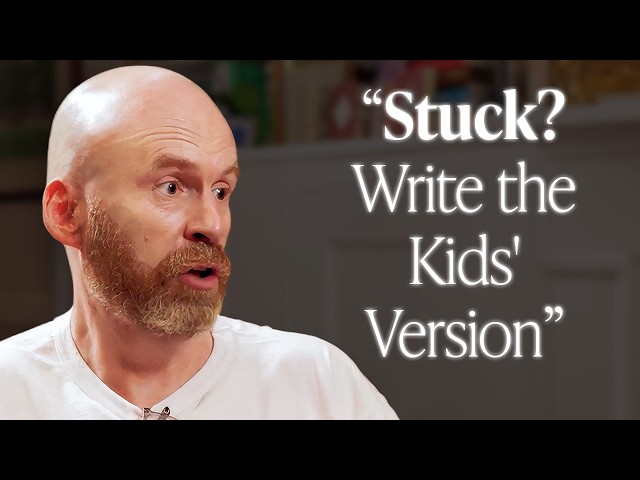
- **Children's fiction as a debugging tool:** `[STATED]` *"If I'm stuck writing a novel for adults, I try and think, what would be the children's story version of this?"* `[EVIDENCE]` It unstuck *The Midnight Train*, whose first draft was an AI dystopia that *"just wasn't working at all."* `[INFERENCE]` **A concrete constraint-relaxation technique**: children's fiction permits the surreal without justification — *"if you do that in an adult novel, you would have to have an essay on quantum physics about how it could be possible."*
- **"Feelings are contagious"** — `[STATED]` *"what you're feeling as you're writing is the feeling that the reader has when they're reading."* `[INFERENCE]` A strong claim with no evidence, and it **directly contradicts the thousand-words-a-day discipline model** he rejects in the same breath.
- **Why he writes the surreal now:** `[STATED]` *"in the internet age, in our increasingly divided society, it's hard to agree, to have a consensus, to have a unifying idea of what reality is… it seems almost arrogant to just write a novel and say this is reality."* `[INFERENCE]` **Fragmented consensus as a formal problem for realism** — a better argument for the fantastic than the usual one.
- **The proudest claim is about audience breadth:** `[STATED]` *"I don't have a specific reader… men, women, young people, old people… what I'm trying to do is reach that level of shared empathy."*
- **The closing advice is the through-line:** `[STATED]` to his son, on checking Reddit for the consensus view — *"just, what did you feel when you listened to that or when you read that? And that is your correct response to that."*
- **And the defence of difficulty:** `[STATED]` *"writers can be quite difficult people, but that difficulty has a use. It's to put a boundary around yourself."*
## 📚 References
`[EVIDENCE]` **No links captured**, expected for an interview. Works, people, and figures are named precisely throughout — ten million copies, 288,000 reviews, book twenty, 80,000 words, 40,000 cut, 55,000 added, fifteen years with one editor.
`[INFERENCE]` **The sales figures are the only externally checkable claims and they are sourced adequately** — the host says he *"just checked on Amazon"* for the review count. `[INFERENCE]` The craft claims are first-person testimony and are appropriately framed as such. **The unsourced material is entirely in the sponsor read**, which is the one place the interview's habits of verification lapse.
## 🗣️ Paraphrase
Matt Haig says his process is 90% stopping. Writer's block for him isn't the blank page — it's not knowing which of several ideas to commit to, and he has no reliable way to tell in advance which will work. The percolating feels like not working and turns out to be the important part.
He's had the same editor for fifteen years, which mostly buys the ability to tell when a note reflects his editor's personal taste and when it reflects what a general reader would think. The pattern is that his editor flags a paragraph and Haig deletes fifty thousand words — because a small problem on one page is usually pointing at a structural one. *The Humans* was eighty thousand words, lost forty thousand, gained fifty-five thousand. He also thinks revision has a ceiling: past the fourth or fifth pass you drift far enough from the original that it gets worse, like over-produced pop where every note lands exactly on the beat.
On AI, he thinks life evolves through mistakes and mutation while these systems are built to eliminate error, so the two produce novelty in opposite ways — and predicts human-made will become a label like organic or fair trade.
He doesn't believe in researching a market, and his reason is structural: a book on the table today was acquired two years ago, written three years ago, conceived five years ago. Looking at bestsellers is looking at the past. Your own book won't be on a table for five years, so the only reader you can know is yourself.
*The Midnight Library* was his twentieth book, after rejections and being dropped twice. The book that broke through in the UK was *The Humans*, written when he had a new baby, no money and debt — precisely when he should have played safe. It was his most personal book and also the one about an alien. Readers told him it was a book about autism; years later he was diagnosed autistic.
The same trick fixed *The Midnight Library*: the protagonist started as a man his own age and he nearly abandoned it, because writing yourself makes you guarded and stops you seeing a character at all. Changed to Nora, he could put far more of himself in.
He warns against two traps: wanting to be liked, and wanting to be taken seriously. And he describes ambition as an escalating ladder with no top — published, then tables, then windows, then lists — driven in his case by wanting to be understood.
## 📰 Newsletter
**"It's 90% stop."** Matt Haig on the writing process, and the reframe underneath it is the useful part: *"Writer's block for me is not knowing which idea to choose… there's a lot of work that doesn't feel like work and you're beating yourself up because you think why aren't [you] working, but actually that turns out to be the most important work."*
**The editing pattern is the thing to steal.** His editor flags a paragraph and Haig deletes **fifty thousand words** — *"if you're spotting a little problem there, I'm going to pull at that and think, what is that problem about? Oh, it's about that whole character doesn't need to be there."* **A local symptom is evidence about structure, not a thing to fix locally.** That's the third domain in this batch to land on the same shape, after Argus's six-link chain and WP Rocket's individually-dismissible signals — **the instrument that assesses items one at a time is blind to the real problem.** It also names a specific weakness of AI-assisted editing: ask a model to improve a paragraph and it will improve the paragraph. **The question it won't ask unprompted is whether the paragraph should exist.**
**And revision has a ceiling.** Past the fourth or fifth pass *"you're getting so far away from the thing you started with that it's getting worse"* — illustrated with over-produced pop where *"all the notes hit on the fours and the eights… it feels flat, it's too perfect."* Goodhart in a creative register, and the fourth instance this batch.
**The market argument is the best-reasoned thing here, because it's a mechanism rather than advice.** A book on the table today was acquired two years ago, written three, conceived five. *"By looking at the tables in a bookstore you're just looking at the past."* **Any field with a long production lag makes trend-following late by construction** — which is why it works in fast fashion and fails in publishing.
**The most actionable craft finding: distance enables intimacy.** *The Midnight Library*'s protagonist started as a man Haig's age and he nearly abandoned it. Changing to Nora — different gender, age, place — meant *"more of me went into this character as soon as it wasn't me."* Two mechanisms, worth separating: proximity destroys your ability to see something *as an object*, and writing yourself directly makes you **guarded**. Both apply well past fiction — to postmortems, case studies, anything about your own experience.
**One caveat to hold.** *The Midnight Library* was book **twenty**, after rejections and two droppings. This is "I ignored the market and it worked," told by someone for whom it worked — the people whose book twenty also failed aren't in the sample. **He volunteers the number, which is more honesty than these stories usually carry**, and it converts the claim from *this works* to *this worked eventually, for me, after nineteen failures.*
## ✅ Action Items
#### DevRel
- **Developer advocacy:** `[RECOMMEND]` **"What is this a symptom of?"** before *"how do I fix this?"* is a reusable review discipline, and the fifty-thousand-word deletion is the memorable version of it.
- **Education:** `[RECOMMEND]` Teach the **production-lag argument** as a general model — any field with a long cycle makes trend-following structurally late, and the fix is the same everywhere: build from your own judgment, because the observable market is history.
- **Developer experience:** `[INFERENCE]` The **children's-version technique** — ask what the simplified version of this problem would be — is a constraint-relaxation move that ports directly to documentation and API design.
- **Developer marketing / Community management / Cross-project:** Not applicable to this source.
#### OSPO
- **Policy & Governance / License Compliance / Security Management / Software Inventory / Developer Support / Community Engagement / Strategic Alignment:** Not applicable to this source — a craft interview with a novelist and no organisational surface.
#### Community
- **Maintainers:** `[INFERENCE]` The **editor-fluency** point transfers to review relationships: fifteen years with one reviewer buys the ability to decode *"is this their taste or a real problem?"* **A real argument for continuity in reviewer assignment**, which most projects rotate away from.
- **Contributors / Sponsors / Ecosystem:** Not applicable to this source.
#### WordPress
- **All teams:** Not applicable to this source. `[INFERENCE]` Enumerating teams would manufacture relevance the interview does not have.
#### The WPOCC
- **Programs / Projects / Funding experiments:** Not applicable to this source.
### FAIR
- Not applicable to this source in any respect.
### Writing practice
`[RECOMMEND]` Where this actually earns its place:
- **Adopt the symptom question.** When a reviewer flags a sentence, ask what it is a symptom of before rewriting it. `[INFERENCE]` The cost of asking is one minute; the cost of not asking is polishing something that should be deleted.
- **Find your own diminishing-returns point.** `[INFERENCE]` Haig's is the fourth or fifth pass, empirically. **Most people never measure theirs and so cannot stop at it** — and over-revision is invisible from the inside, because each individual change looks like an improvement.
- **The word-ban rule needs its reason attached.** `[INFERENCE]` Banning *significantly* or *robust* works because those words **stand where a fact belongs**. Haig's defence of *nice* is about a different failure — imprecision, not evasion. **Add the test to the rule: does the word occupy the slot where a number, name, or mechanism should be?** A rule without its reason gets over-applied to plain words that are doing their job.
- **Distance for difficult material.** `[INFERENCE]` For anything close to home — a postmortem, a personal essay, a retrospective — the guardedness is real and predictable, and displacement is a technique rather than an evasion.
## 🧪 Hypotheses
1. **H1 — Local edits mask structural defects.** Manuscripts revised primarily at sentence level show more structural problems at final review than those where early feedback triggered structural reassessment.
2. **H2 — Revision has a measurable inflection point.** Reader-rated quality rises then falls across successive drafts, with the peak clustering at a small number of passes.
3. **H3 — Production lag predicts trend-following failure.** Across creative industries, the commercial performance of trend-following work declines as production lag increases.
4. **H4 — Displacement increases disclosure.** Writers produce more self-revealing material when the protagonist differs demographically from themselves than when it matches.
5. **H5 — Human-provenance labelling emerges and commands a premium.** Within five years, "human-written" certification appears in trade publishing and correlates with price or placement advantage.
6. **H6 — Author affect transfers to reader affect.** Self-reported writer mood during composition predicts independent reader-rated emotional tone, above what content analysis explains.
## 📊 Methodology
- **H1:** Requires manuscript version histories with feedback logs, which publishers hold and rarely release. **Confound:** manuscripts receiving structural feedback are plausibly the weaker ones to begin with, so the arrow of causation needs establishing rather than assuming.
- **H2 — the most tractable and the most immediately useful.** Collect successive drafts of the same work, present them blind and in randomised order to independent readers, and plot rated quality against draft number. `[INFERENCE]` **A clear inflection point would be genuinely valuable to anyone who edits**, and Haig's fourth-or-fifth estimate is a testable prior.
- **H3:** Comparative industry analysis — trend-following work's performance against production lag, across fast fashion, games, film, and publishing. **Confound:** "trend-following" resists definition and will be coded post hoc; fix the operationalisation first or the result follows the coder.
- **H4:** Within-writer experiment — same prompt, matched and displaced protagonists; code output for self-disclosure with blinded raters. `[INFERENCE]` **Runnable at small scale**, and it tests the single most actionable claim in the interview.
- **H5 — pure observation, no design needed.** Watch for the label; record the date if it appears. `[EVIDENCE]` Haig's prediction is specific enough to score.
- **H6 — the weakest.** Diary-plus-rating study; **confound:** mood correlates with what a writer chooses to write about, so content is the obvious mediator and separating it is the whole difficulty. `[INFERENCE]` The claim is intuitive, widely believed, and would be hard to establish.
## ❓ Questions
- **Where exactly is the diminishing-returns point, and does it vary by writer or by project?** Haig gives one number from his own experience.
- `[INFERENCE]` Does the mutation argument survive contact with how these systems actually sample? **Temperature and stochastic decoding introduce variation deliberately**, which is the technical fact the metaphor has to accommodate.
- **How much of the twenty-books story is persistence and how much is survivorship?** Unanswerable from inside a success.
- Does displacement increase disclosure for writers generally, or is this specific to Haig?
- `[INFERENCE]` If readers identified autism in *The Humans* before the author knew, **what else are readers seeing that authors do not** — and how would anyone tell the true detections from the pattern-matching?
- `[EVIDENCE]` What are Alpha School's claims actually based on? Five statistics, none sourced, in an interview otherwise careful about evidence.
## 🔮 Future Research
- **Empirical work on revision inflection points.** `[INFERENCE]` Everyone who edits believes over-revision exists and nobody has located it.
- **Displacement as a disclosure technique.** `[INFERENCE]` Testable, actionable, and apparently untested outside craft anecdote.
- **Production lag as a predictor of trend-following failure.** `[INFERENCE]` Haig's mechanism is clean and generalises across industries; the comparative work does not appear to exist.
- **Provenance labelling in creative markets.** `[INFERENCE]` If the organic-food analogy holds, the interesting question is not whether the label appears but **who certifies it**, and on what evidence.
## 💡 Implications
- **Practice.** `[RECOMMEND]` **Ask what a flagged problem is a symptom of** before fixing it. Know your revision ceiling. Use displacement for material too close to write directly.
- **Policy.** Not applicable to this source.
- **Security.** Not applicable to this source.
- **Education.** `[EVIDENCE]` The production-lag argument is a **mechanism** rather than advice, which is why it is the interview's strongest content — and the general lesson for teaching is that **mechanisms transfer and maxims do not.**
- **Funding models.** `[INFERENCE]` One uncomfortable implication: the advice to write without regard to the market is materially easier to follow with a safety net, and Haig's own account undercuts it — *The Humans* was written under acute financial pressure specifically **because** being dropped removed the incentive to play safe. **Precarity produced the freedom, which is not a repeatable strategy.**
## 🧠 Learning Styles Assessment
**Reading level estimate.** `[INFERENCE]` **Flesch–Kincaid grade 9–10** — long spoken sentences with simple vocabulary and heavy subordination. Hand estimate on ~9,000 words, ±1.5 grades. `[EVIDENCE]` Almost no jargon; the few literary terms (*literary* vs *commercial*, *first draft*, *premise*) are used in senses a general listener already has. **Consistent with a writer whose stated aim is breadth of readership.**
#### 👀 Visual learners
- **Present:** Not assessable — a two-person interview with no visual content indicated.
- **Improve:** `[INFERENCE]` The one genuinely visual idea is the **word-count trajectory** of *The Humans* — 80,000 down to 40,000 up to 95,000 — which is a shape rather than three numbers, and is delivered as three numbers.
#### 🔊 Aural learners
- **Present:** `[EVIDENCE]` **The native format and unusually well suited.** Haig thinks aloud in complete arcs, and Perell's questions are short and open, which leaves the answers room.
- **Improve:** `[INFERENCE]` Little. The one cost is that the best formulations arrive mid-paragraph with no signposting, so a listener has no cue that something quotable is coming.
#### 🗣️ Verbal learners
- **Present:** `[EVIDENCE]` **The strongest dimension by a distance.** *"It's 90% stop."* *"You're writing what you don't know you know."* *"More of me went into this character as soon as it wasn't me."* *"I write to be understood."* `[INFERENCE]` Each compresses a real mechanism into a sentence, which is what the interview is for.
- **Improve:** Nothing substantive.
#### 🧩 Kinesthetic learners
- **Present:** `[EVIDENCE]` Two techniques a listener can apply immediately — **displacement** (change the protagonist's demographics) and the **children's-version question**.
- **Improve:** `[INFERENCE]` Neither is framed as an exercise. The children's-version technique in particular is a one-line prompt anyone could run on a stuck draft today, and it is told as an anecdote about *The Midnight Train*.
#### 🧠 Logical learners
- **Present:** `[EVIDENCE]` **The production-lag argument is properly constructed** — premise chain stated, conclusion drawn, and the counterintuitive result (market research is structurally impossible here) follows rather than being asserted.
- **Improve:** `[EVIDENCE]` **Two gaps a logical listener will catch.** The novelty argument treats recombination as the machine's limitation while describing his own best book as *"all my influences in one sort of pot."* And *"AI… is making us feel more alone"* is the load-bearing premise of the art argument, stated in a subordinate clause and never supported.
#### 🧑🤝🧑 Social learners
- **Present:** `[EVIDENCE]` The interview is genuinely dialogic — Perell pushes (*"What if I came to you and I was like, dude, I am being honest… No one is buying what I'm making"*), and the editor relationship, the son, and the friend at the Louvre all appear as real interlocutors.
- **Improve:** `[INFERENCE]` No dissenting voice. Perell agrees with essentially everything, including the AI argument, which is the part most needing a counterweight.
#### 🧘♀️ Solitary learners
- **Present:** `[EVIDENCE]` **Well served, and the subject matter is solitary work.** The material about ambition, validation, and trusting your own response is aimed squarely at someone working alone.
- **Improve:** `[INFERENCE]` No route onward — no reading list, no reference to the books discussed beyond their titles.
#### 🌿 Naturalistic learners
- **Present:** `[EVIDENCE]` **Genuinely present and load-bearing, unusually.** The central AI argument is an **evolutionary** one — mutation, DNA, error as the engine of novelty. And the recurring imagery is ecological: *"fishing your own imagination,"* *"on the banks of your own imagination,"* *"that unknown sort of lagoon that you're sat beside and watching things bubble up."*
- **Improve:** `[INFERENCE]` Nothing — this is one of the few sources in this batch where the naturalistic frame is doing explanatory work rather than decorating.
## 📊 Accessibility Assessment
Assessed against **WCAG 2.2 AA**. `[INFERENCE]` **Scope limit:** transcript and metadata only. I did not view the video, so framing, on-screen text, contrast, and player behaviour are **not assessed**; absence of a finding is not a pass.
#### Screen reader semantics
- **Not applicable** — video, not document.
#### Keyboard navigation
- **Not testable from the captured content.**
#### Contrast and readability
- **Not testable** — no visual content captured.
#### Text resizing and reflow
- **Not applicable** to a video.
#### Media and captions
- **Present:** `[EVIDENCE]` Captions exist and a transcript is retrievable.
- **Improve:** `[EVIDENCE]` **Proper-noun corruption throughout**, including **the subject's own surname** (*"Matt Hag"*), two authors (*"Bourhees"* for Borges, *"a mil"* for Milne), a battle (*"Assam"* for the Somme), a magazine (*"enemy"* for NME), and a museum (*"the Lou"*). **WCAG 1.2.2 Captions (Prerecorded), Level A.**
- `[INFERENCE]` **The Somme error is the one that does real damage** — it is load-bearing for the Milne argument about writing comfort out of trauma, and it sends anyone checking to entirely the wrong history.
- **Improve:** `[INFERENCE]` **Audio description need is low** — this is two people talking, and the content is fully carried by speech. `[INFERENCE]` **The interview format is the most accessible in this batch on that axis**, in contrast with the screen-share demos where the substance is visual and unnarrated.
#### Forms and interactions
- **Not applicable.**
#### Standards reference
- **1.2.2 Captions (Prerecorded), Level A** — **failure.** Systematic proper-noun corruption including the interviewee's surname. Confirmed from transcript.
- **1.2.3 / 1.2.5 Audio Description** — **need is low**; not assessable without viewing, and the format carries its content in speech.
- **3.1.3 Unusual Words (AAA, aspirational)** — **largely satisfied.** Minimal jargon throughout.
## 🌍 DEIB Assessment
#### Cultural breadth
- **Present:** `[EVIDENCE]` The class analysis is specific and honest, and rarely stated this plainly by someone inside the industry: `[STATED]` *"in the UK especially, books are very related to class… I grew up in a working-class town. I was considered quite posh because my mom was a teacher, my dad was an architect. And then you… enter the publishing industry and think, well, I didn't go to an expensive school. I didn't go to the top university."* `[INFERENCE]` **Class position as relational rather than fixed** — posh at home, lower-end in publishing — is a more useful account than most.
- **Improve:** `[INFERENCE]` The frame is entirely UK/US Anglophone publishing. Translation, non-Anglophone markets, and the economics of being read outside English do not appear, in an interview about reaching millions of readers.
#### Inclusive language
- **Present:** Neutral throughout; the neurodivergence discussion is first-person and non-clinical.
- **Improve:** `[EVIDENCE]` The Pooh archetype game assigns diagnoses to fictional characters — *"Piglet with anxiety, Eeyore with depression, Tigger ADHD, Owl's dyslexia and narcissistic personality"*. `[INFERENCE]` Haig flags the anachronism himself (*"with our sort of 2020s language"*), and it remains **diagnosis as a parlour game**, which sits oddly a few minutes after he discusses his own diagnosis seriously.
#### Neurodiversity support
- **Present:** `[EVIDENCE]` **The strongest dimension here, and it is substantive rather than gestural.** Haig discusses his ADHD and autism diagnoses as **working conditions rather than obstacles**: `[STATED]` *"I'm very ADHD. So for me, I can't write what I don't want to write, cuz I'm just too bored… I have to actually enjoy it."* `[INFERENCE]` **Motivation structure treated as a constraint to design around** rather than a deficiency to overcome — including the reframing of "90% stop" as the work rather than the failure to work.
- **Present:** `[EVIDENCE]` And the *"and then"* tattoo is a self-accommodation: an external reminder for a pattern he cannot reliably catch internally.
- **Improve:** `[INFERENCE]` Nothing substantive. `[EVIDENCE]` The one tension is that the retrospective reading of *The Humans* as an autism fable is presented as revelation, which risks implying such patterns are legible in hindsight generally — and only the confirmed readings get retold.
#### Representation
- **Present:** `[EVIDENCE]` Haig names being outside the literary establishment by education and class, and is explicit about writing across demographics: `[STATED]` *"I don't have a specific reader… men, women, young people, old people."*
- **Improve:** `[EVIDENCE]` **Every literary reference is a man** — Keats, Byron, Borges, Milne, Douglas Adams — with the single exception of Virginia Woolf, named in a list of university-syllabus authors he distinguishes himself from. `[INFERENCE]` For a two-hander between two men about writing, the absence is unremarked.
#### Psychological safety
- **Present:** `[EVIDENCE]` **Handled with real care and it is the interview's ethical high point.** Haig discusses a breakdown at 24, agoraphobia, giving up alcohol, first therapy in his forties, and a post-success *"mental health wobble"* — all without melodrama and without presenting suffering as the price of art. `[STATED]` The guilt of unhappiness after success is named precisely: *"when you have success you can have this sort of sudden guilt if you're not feeling happy all the time, cuz you're like, other people think, well, what have you got to worry about."*
- **Present:** `[EVIDENCE]` He also refuses the tortured-genius frame explicitly — *"often it's the most troubled or difficult minds [that] are creating the most comforting stuff."*
- **Improve:** `[INFERENCE]` The mid-interview **sponsor read is the one jarring element**, and its placement — immediately after a passage about art easing loneliness — is unfortunate rather than harmful.
## ✅ Logical Validity
#### Strong reasoning
- **The production-lag argument is the interview's best reasoning and is genuinely a mechanism.** Acquisition, editing, writing, and conception lags are each named, they compound, and the conclusion — that observable bestsellers are a lagging indicator by roughly five years — **follows deductively.** The counterintuitive result is earned rather than asserted.
- **The local-symptom-as-structural-evidence claim is well supported** by a specific mechanism and a numbered case (*The Humans*: 80k → 40k → 95k).
- **The displacement account gives two distinct causes** — proximity destroying object-perception, and self-protection under direct disclosure — rather than one vague one, and the word-repetition analogy is apt.
- **The ambition analysis is honest self-diagnosis:** the escalating ladder is described, and then explained by something underneath it (*"one of my incentives to write is to be understood"*), which is why no rung satisfied.
- **The dichotomy collapse is a real contribution:** `[STATED]` *"I write for readers to understand what's going on inside me"* dissolves write-for-yourself versus write-for-readers rather than picking a side.
#### Fallacies
- **Survivorship bias — structural to the interview.** Twenty books, rejections, two droppings, then ten million copies. **Weakness:** *ignore the market* is validated by an outcome that cannot be attributed to it, and the writers whose book twenty also failed are invisible. **Mitigation, and it is real:** he volunteers the number and the rejections, which is more than most such stories offer.
- **Special pleading on novelty.** Recombination is the machine's limitation; his own best book is *"me and all my influences in one sort of pot."* **Weakness:** the distinction he needs is between *combinatorial* and *felt* novelty, and he reaches it only under pressure. **Fix:** lead with the retreat — *"articulate emotions in a way that haven't been articulated before"* — which is defensible.
- **Unsupported load-bearing premise.** *"AI, which is making us feel more alone"* is the pivot of the whole art argument and appears in a subordinate clause. **Fix:** support it or weaken the conclusion.
- **Metaphor carrying an empirical claim.** The mutation argument requires that these systems suppress variation; sampling temperature and stochastic decoding introduce it deliberately. **Weakness:** the analogy is doing work the technical picture does not license.
- **Retrospective unfalsifiability.** The autism reading of *The Humans* is compelling and unfalsifiable — readers propose many patterns, later events confirm a few, and only the confirmed ones are recounted.
- **Anachronistic diagnosis, self-flagged.** The Pooh archetypes. Noted rather than pressed, since he marks it himself.
- **Unaudited claims in the sponsor read** — five statistics, none sourced, one a commonly-misstated figure — inside an interview otherwise careful about what it knows.
#### Tone of voice
`[EVIDENCE]` Reflective, self-deprecating, and unusually willing to name failure — the twenty books, the depressing third novel he recommends nobody read, falling into both traps he warns against, the *"and then"* tattoo. `[INFERENCE]` **The self-deprecation is load-bearing rather than decorative**: it is what makes the advice readable as description rather than prescription.
`[EVIDENCE]` Confidence tracks evidence better here than in most sources in this batch — the craft claims are marked as personal (*"with me,"* *"for me personally,"* *"this is what I hope"*), and the one place he generalises hardest is the AI argument, which he explicitly labels: `[STATED]` *"this is my one and only optimistic take about AI."*
`[EVIDENCE]` Perell's register is warm and agreeing throughout. `[INFERENCE]` It produces good access and no friction — **nobody in the conversation is positioned to push back on the weakest argument in it.**
## 🛡️ DARVO Analysis
**No DARVO pattern present.** `[EVIDENCE]` DARVO — Deny, Attack, Reverse Victim and Offender — describes a response to accusation. This is a craft interview with no accusation, no accused party, and no adversarial dimension.
Checking each element explicitly rather than omitting the section:
- **Deny:** `[EVIDENCE]` **Conspicuously absent.** Haig volunteers his failures unprompted — nineteen books before the breakthrough, being dropped twice, a third novel he describes as *"the most depressing book I think anyone's ever written… I would recommend no one to read this book,"* and falling into both of the traps he warns against. `[INFERENCE]` Naming your own worst work by title on a podcast is the inverse of the denial element.
- **Attack:** None. `[EVIDENCE]` The critique lands on **practices and industry patterns** — backward-looking trend analysis, the assumption that sentimentality is the worst thing art can be, gatekeeping by class and education. `[EVIDENCE]` The one named conflict is historical and someone else's: Byron's contempt for Keats. **No living person or organisation is attacked, including the publishers who dropped him**, whom he credits: *"one of the best things for me in terms of my career was being dropped."*
- **Reverse victim/offender:** `[EVIDENCE]` **Absent, and the material is right there.** A writer with mental-health struggles, class-marked exclusion from literary circles, and two droppings could easily construct a grievance narrative. `[INFERENCE]` He does the opposite — the exclusion becomes the thing that let him find his voice, and the mental-health material is discussed as experience rather than injury.
`[INFERENCE]` One adjacent observation, recorded separately because it is **not** DARVO: the interview's persuasive structure — hard-won authority, vulnerability, then a mid-roll advertisement whose claims are unaudited — is standard podcast construction. **The sponsorship is disclosed**, including the host's personal involvement, which is what keeps it transparent rather than a manoeuvre. Already logged under Logical Validity.
## 🎯 Conclusion
**Bottom line.** `[INFERENCE]` Three genuinely portable mechanisms inside a success story whose central advice cannot be validated by the success that is offered as its proof.
1. **A local symptom is evidence about structure.** `[STATED]` The editor flags a paragraph; Haig deletes 50,000 words — *"if you're spotting a little problem there… Oh, it's about that whole character doesn't need to be there."* `[INFERENCE]` **Third domain in this batch to land on this shape**, after Argus's six individually-insufficient weaknesses and WP Rocket's individually-dismissible signals: **the instrument that assesses items one at a time is blind to the actual problem.** And it names a specific limitation of AI-assisted editing — **ask a model to improve a paragraph and it will improve the paragraph; the question it won't ask unprompted is whether the paragraph should exist.**
2. **Revision has a ceiling and he located his empirically.** `[STATED]` Past the fourth or fifth pass *"you're getting so far away from the thing you started with that it's getting worse."* `[INFERENCE]` Goodhart in a creative register — **fourth instance in this batch** — and over-revision is invisible from the inside, because every individual change looks like an improvement.
3. **Distance enables intimacy, via two separable mechanisms.** `[STATED]` *"More of me went into this character as soon as it wasn't me."* `[INFERENCE]` Proximity destroys the ability to see something *as an object*; and writing yourself directly triggers guardedness — *"it was like writing non-fiction."* **Both apply well past fiction**, to postmortems, retrospectives, and anything about your own experience, and the remedies differ.
**The best-reasoned passage is the market argument, because it is a mechanism rather than a maxim.** `[STATED]` A book on the table today was acquired two years ago, written three, conceived five. **Any field with a long production lag makes trend-following late by construction** — which is why it works in fast fashion and fails in publishing. `[INFERENCE]` **Mechanisms transfer; maxims do not**, and that distinction is the interview's own best lesson about advice.
**Two things to hold against it.**
`[EVIDENCE]` **The AI argument's strongest form is genuinely interesting and its weakest form is contradicted by his own account.** *"Life evolves through mistakes and mutations… AI is set up to be a perfectionist"* is a real structural claim, though sampling temperature and stochastic decoding are variation introduced on purpose — the metaphor carries more than the technical picture licenses. And the novelty claim treats recombination as the machine's limitation while he describes *The Humans* as *"me and all my influences in one sort of pot."* `[INFERENCE]` **The defensible version is the one he retreats to under pressure:** the novelty is in the articulation, not the elements.
`[EVIDENCE]` **And *The Midnight Library* was book twenty.** `[INFERENCE]` This is *ignore the market and it worked*, told by someone for whom it worked, with everyone whose book twenty also failed outside the sample. **He volunteers the number, the rejections, and the two droppings, which is more honesty than these stories usually carry** — and it converts the claim from *this works* to *this worked eventually, for me, after nineteen failures.* `[INFERENCE]` One uncomfortable corollary he supplies and does not draw: *The Humans* was written under acute financial pressure **because** being dropped removed the incentive to play safe. **Precarity produced the freedom, which is not a repeatable strategy.**
**And a note on the style rules.** `[INFERENCE]` Haig's defence of *nice* looks like it conflicts with pass/fail bans on words like *significantly* or *robust*, and it does not. **Those bans work because such words stand where a fact belongs** — *"significantly faster"* occupies the slot for a number. *Nice* displaces nothing. **The test that separates them: does the word occupy the slot where a number, name, or mechanism should be?** Worth attaching to the rule, because a rule without its reason gets over-applied to plain words doing their job.
**Practical next steps.**
1. When a reviewer flags something, **ask what it is a symptom of** before rewriting it.
2. Find your own diminishing-returns point. Haig's is four or five passes; most people never measure theirs and therefore cannot stop at it.
3. For material too close to write directly, **displace it** — the guardedness is real and predictable.
4. `[EVIDENCE]` If quoting the transcript, correct the captions: **Haig**, **Borges**, **A.A. Milne**, and **the Somme** — not "Assam," which is load-bearing for the Milne argument and points at the wrong continent.
<!-- deep-read:sections end -->
📄 **Full text:** [[Full Document Contents/Articles/How to Write a Book Millions of People Read.md|How to Write a Book Millions of People Read by Matt Haig + David Perell (How I Write)]]
## Highlights
- paragraph here, a paragraph there, and then suddenly I'll have wiped out 50,000 words cuz I'm just like, you know, if if you're spotting a little problem there, ([View Highlight](https://read.readwise.io/read/01m12460765twhyr9p5yxs18xd))
- Note: A LOCAL SYMPTOM IS EVIDENCE ABOUT STRUCTURE, NOT A THING TO FIX LOCALLY. His editor flags a paragraph; Haig deletes a character, a premise, 50,000 words. His reasoning: "if you're spotting a little problem there, I'm going to pull at that and think, what is that problem about? Oh, it's about that whole character doesn't need to be there or that whole premise." And he names the alternative and rejects it: "there's a temptation to correct sentences and correct lines and correct a little scene when really there's a bigger problem. It's not the thing that's happening on that specific page." WITH NUMBERS: The Humans started ~80,000 words, LOST 40,000, then GAINED 55,000 between first and second draft. THIRD DOMAIN IN THIS BATCH TO LAND ON THIS EXACT SHAPE. Argus: six individually-insufficient weaknesses that only matter composed. WP Rocket: an unreproducible bug report plus two unlinked support tickets, each individually dismissible and jointly decisive. Here: a paragraph-level flaw that is actually a structural one. THE INSTRUMENT THAT ASSESSES ITEMS ONE AT A TIME IS BLIND TO THE ACTUAL PROBLEM — checklist security review, per-ticket triage, sentence-level editing, all the same defect. THE TRANSFERABLE MOVE: ASK "WHAT IS THIS A SYMPTOM OF?" BEFORE "HOW DO I FIX THIS?" Cost of asking: one minute. Cost of not asking: polishing something that should be deleted. AND IT NAMES A SPECIFIC LIMITATION OF AI-ASSISTED EDITING — ask a model to improve a paragraph and it WILL improve the paragraph. THE QUESTION IT WON'T ASK UNPROMPTED IS WHETHER THE PARAGRAPH SHOULD EXIST. #atom/zettel/z1 #action/h1
- there's a diminishing returns that happens with me. is like the fourth or fifth round after that you're you're getting so far away from ([View Highlight](https://read.readwise.io/read/01m1246fdh3yhtgxyj1fc5tj1v))
- Note: REVISION HAS A CEILING AND HE LOCATED HIS EMPIRICALLY. "There comes a point that each draft you're improving things could start to make it worse… after that you're getting so far away from the thing you started with that it's getting worse." His illustration is good: over-produced pop where "all the notes hit on the fours and the eights… it feels flat, it's too perfect," against a live band with "a messiness, a chaos that is very human." THIS IS GOODHART'S LAW IN A CREATIVE REGISTER — FOURTH INSTANCE IN THIS BATCH. DX conceding "PR throughput doesn't cover value." Graze's volume metrics standing in for creator income. Baucham's "affective principle," where producing an experience became the measure of worship. And here: optimising a draft past a point degrades the thing the drafts were improving. THE PRACTICAL VERSION: KNOW YOUR OWN DIMINISHING-RETURNS POINT AND STOP THERE. Haig knows his. Most people never measure theirs and therefore CAN'T stop at it — and OVER-REVISION IS INVISIBLE FROM THE INSIDE, because every individual change looks like an improvement. That's what makes it different from ordinary laziness about editing: the failure mode is diligence past the peak. TESTABLE AND TRACTABLE: collect successive drafts of the same work, present them BLIND and in RANDOMISED ORDER to independent readers, plot rated quality against draft number. A clear inflection point would be genuinely valuable to anyone who edits, and Haig's fourth-or-fifth is a testable prior. #atom/zettel/z2
- market going out and just looking at the tables in a bookstore you're just looking at the past really. You're not ([View Highlight](https://read.readwise.io/read/01m1247ab28ww6apbdxf6hmnk0))
- Note: THE BEST-REASONED PASSAGE IN THE INTERVIEW, BECAUSE IT'S A MECHANISM RATHER THAN A MAXIM. "The moment you try and be commercial or try and research a market is the moment you will fail to be commercial" is paradox-shaped assertion on its own. WHAT MAKES IT AN ARGUMENT IS THE LAG CHAIN HE SUPPLIES: a book on the table today was "taken on and edited two years ago and written 3 years ago and conceived four five years ago." Plus: "if you started writing a book now… it's going to be on tables in 5 years time. So that's not the market. That's the past from where you're going to be." THE GENERALISATION: IN ANY FIELD WITH A LONG PRODUCTION LAG, OBSERVABLE "CURRENT TRENDS" ARE A LAGGING INDICATOR BY ROUGHLY THE LENGTH OF THAT LAG — so trend-following guarantees arriving late BY CONSTRUCTION, not by bad luck. THE LONGER THE CYCLE, THE WORSE IT PERFORMS. That's why it works in fast fashion and fails in publishing, and it's checkable across industries. His conclusion follows cleanly: "the only reader you're going to know is yourself." AND THE META-LESSON IS THE INTERVIEW'S OWN BEST ONE: MECHANISMS TRANSFER, MAXIMS DON'T. Most writing advice is maxims. This passage is the exception, and it's the part worth carrying into any other domain. HOLD ONE CAVEAT ALONGSIDE IT: The Midnight Library was BOOK TWENTY, after rejections and two droppings. This is "ignore the market and it worked," told by someone for whom it worked — everyone whose book twenty ALSO failed is outside the sample. He volunteers the number, which is more than these stories usually offer, and it converts the claim from "this works" to "this worked eventually, for me, after nineteen failures." #atom/zettel/z3 #fallacy/survivorship