Introducing Concilium
🔗 **Source:** [Introducing Concilium](https://jonathanbossenger.com/2026/05/introducing-concilium/)
> [!note]+ Document Notes
> tags: #concilium #ai-agents #developer-tools #automattic #wordpress #open-source #rsm
> author: Jonathan Bossenger
> source: Personal Blog
> reference: https://jonathanbossenger.com/2026/05/introducing-concilium/
> date created: 2024-12-19 13:45
>
> # 🏷️ Title: Introducing Concilium
>
<!-- deep-read:sections start -->
## 🧰 Action Inbox
- [H1] Evaluate Concilium for multi-agent workflow management — WordPress documentation projects #wordpress
- [H2] Test GitHub integration features for issue/PR management — developer productivity #developer-tools
- [H3] Review RSM collaboration model for community project sprints — automattic workflow #automattic
## 🧭 Table of Contents
- [[#📝 Summary]]
- [[#📖 Main Content]]
- [[#🗒️ Notes]]
- [[#📚 References]]
- [[#🗣️ Paraphrase]]
- [[#📰 Newsletter]]
- [[#✅ Action Items]]
- [[#🧪 Hypotheses]]
- [[#📊 Methodology]]
- [[#❓ Questions]]
- [[#🔮 Future Research]]
- [[#💡 Implications]]
- [[#🧠 Learning Styles Assessment]]
- [[#📊 Accessibility Assessment]]
- [[#🌍 DEIB Assessment]]
- [[#✅ Logical Validity]]
- [[#🛡️ DARVO Analysis]]
- [[#🎯 Conclusion]]
### 🔗 References
- [Concilium GitHub Repository](https://github.com/jonathanbossenger/concilium)
- [Automattic Radical Speed Month](https://automattic.com)
## 📝 Summary
- Developer Advocate Jonathan Bossenger created Concilium, an open-source dashboard for managing multiple AI coding agent sessions during Automattic's Radical Speed Month (RSM)
- Tool addresses the complexity of running parallel agent sessions across multiple projects using GitHub Copilot and Claude Code
- RSM pairs developers for month-long autonomous shipping experiments; Bossenger worked on three projects simultaneously
- Concilium provides agent cards, terminal integration, and GitHub API access in a lightweight browser interface
- Why it matters: Demonstrates practical solutions for AI-assisted development workflow management as agent adoption scales
## 📖 Main Content
During Automattic's Radical Speed Month experiment, Jonathan Bossenger found himself managing multiple AI coding agent sessions across three projects: WP Docs Health Monitor (with JuanMa Garrido), Woo Email Health (with Job Thomas), and ultimately Concilium itself.
The core problem emerged from context-switching overhead. Bossenger's typical workflow involves GitHub Copilot for cloud-based development and Claude Code for local terminal work, usually manageable with 3 terminal tabs and 3 browser tabs. Scaling to multiple projects created an unmanageable proliferation of sessions.
Existing solutions like Paperclip, Multica, Conductor, and Superset felt overcomplicated for his specific need: a personal, lightweight dashboard for solo developer workflows with multiple agent sessions.
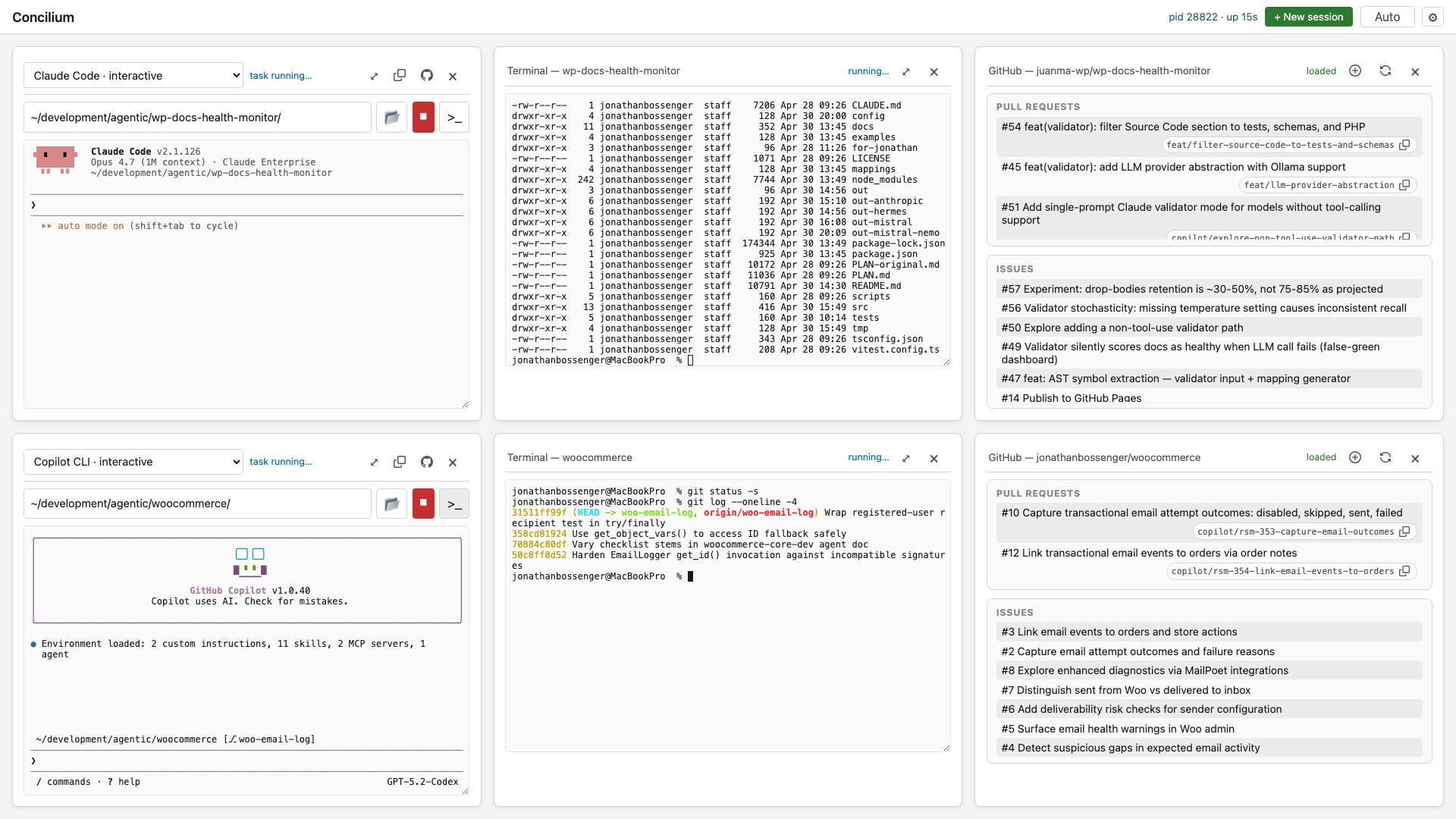
Concilium (Latin for "council") provides agent cards that combine local directory selection, preconfigured coding agents, and xterm terminal emulation in a browser interface. Additional features include GitHub integration for issues/PRs, arbitrary terminal commands, card expansion for focus, and drag-and-drop arrangement.
The tool exemplifies the "build vs. buy" decision in rapidly evolving spaces: when setup costs exceed development costs and the use case is narrow and well-defined, building focused solutions can be more efficient than adapting complex existing tools.
## 🗒️ Notes
#### ⏱️ [00:00](https://jonathanbossenger.com/2026/05/introducing-concilium/#what-is-radical-speed-month-anyway) — [H1] Radical Speed Month Context
- Key idea: RSM pairs developers for autonomous month-long shipping experiments
- Evidence: "pair up and ship something in a month. Any project, no approvals required"
#### ⏱️ [01:30](https://jonathanbossenger.com/2026/05/introducing-concilium/#wp-docs-health-monitor) — [H2] WP Docs Health Monitor Project
- Key idea: Automated documentation health scoring for Block Editor Handbook's 200+ pages
- Evidence: "automatically compares documentation against source code, produces a health score dashboard"
#### ⏱️ [03:00](https://jonathanbossenger.com/2026/05/introducing-concilium/#woo-email-health) — [H2] Woo Email Health Project
- Key idea: Built-in WooCommerce email monitoring to reduce support burden
- Evidence: "email troubleshooting doc is referenced in 1.4% of all Woo support interactions"
#### ⏱️ [04:30](https://jonathanbossenger.com/2026/05/introducing-concilium/#managing-multiple-agents) — [H1] Multi-Agent Workflow Challenges
- Key idea: Standard two-agent workflow becomes overwhelming with multiple projects
- Evidence: "Two projects means up to six tabs per open application"
#### ⏱️ [06:00](https://jonathanbossenger.com/2026/05/introducing-concilium/#typical-workflow) — [H3] Baseline Agent Workflow
- Key idea: GitHub Copilot for cloud development, Claude Code for local terminal work
- Evidence: "never hit my daily usage limits, as I'm sharing the work across the two agentic implementations"
#### ⏱️ [07:45](https://jonathanbossenger.com/2026/05/introducing-concilium/#reviewing-existing-landscape) — [H2] Existing Tool Landscape
- Key idea: Available solutions like Paperclip and Multica felt overcomplicated for solo developer needs
- Evidence: "seemed overcomplicated, with a lot of extras I didn't need"
#### ⏱️ [09:15](https://jonathanbossenger.com/2026/05/introducing-concilium/#vision) — [H1] Concilium Design Vision
- Key idea: Agent cards combining directory selection, agent configuration, and GitHub integration
- Evidence: "showed me, at a glance, what each agent was working on, but also let me interact with the pieces"
#### ⏱️ [11:00](https://jonathanbossenger.com/2026/05/introducing-concilium/#core-features) — [H2] Core Feature Set
- Key idea: Terminal emulation, GitHub API integration, and card-based interface management
- Evidence: "vanilla HTML/CSS/JS application for monitoring and managing multiple AI coding agent sessions"
#### ⏱️ [13:30](https://jonathanbossenger.com/2026/05/introducing-concilium/#quality-of-life) — [H3] Quality of Life Features
- Key idea: Card expansion, cloning, drag-and-drop, and theme support enhance usability
- Evidence: "expand a specific card to fit the full viewport, for more focused work"
#### ⏱️ [15:00](https://jonathanbossenger.com/2026/05/introducing-concilium/#build-vs-buy) — [H1] Build vs. Buy Decision Framework
- Key idea: Speed of iteration matters as much as end result quality in rapid development
- Evidence: "Every minute I spent wrestling with a tool that didn't quite fit my workflow was a minute not spent shipping"
#### ⏱️ [17:00](https://jonathanbossenger.com/2026/05/introducing-concilium/#development-approach) — [H2] Iterative Development Process
- Key idea: Using Concilium to build itself created immediate feedback loops
- Evidence: "I was building it as I was using it, every single day"
#### ⏱️ [18:30](https://jonathanbossenger.com/2026/05/introducing-concilium/#open-source-approach) — [H3] Open Source Strategy
- Key idea: GPL licensing and community feedback for narrow, well-defined use cases
- Evidence: "if the setup cost of adopting someone else's solution exceeds the cost of building your own focused version"
## 📚 References
- [Concilium GitHub Repository](https://github.com/jonathanbossenger/concilium)
- [WP Docs Health Monitor](https://github.com/wp-docs-health-monitor)
- [Woo Email Health](https://github.com/woo-email-health)
- [Paperclip](https://paperclip.com)
- [Multica](https://multica.com)
## 🗣️ Paraphrase
- Automattic's Radical Speed Month experiment pairs developers for autonomous month-long projects without approval requirements, leading Bossenger to work on three simultaneous projects
- Managing multiple AI coding agent sessions (GitHub Copilot and Claude Code) across projects created overwhelming tab proliferation and context-switching overhead that existing orchestration tools couldn't solve efficiently
- Concilium provides a lightweight browser dashboard with agent cards, terminal emulation, and GitHub integration specifically designed for solo developers running parallel agent sessions
## 📰 Newsletter
🚀 **New Tool Alert: Concilium for Multi-Agent Development**
Automattic Developer Advocate Jonathan Bossenger just open-sourced Concilium, a lightweight dashboard for managing multiple AI coding agent sessions. Born from the practical need to juggle three projects during Radical Speed Month, it combines terminal emulation with GitHub integration in a clean browser interface.
**Why This Matters:** As AI-assisted development scales, workflow management becomes crucial. Concilium's focused approach—agent cards, directory selection, and GitHub API access—offers a practical alternative to complex orchestration platforms.
**Key Features:** Terminal emulation via xterm, GitHub issue/PR management, drag-and-drop card arrangement, and light/dark themes. Built with vanilla HTML/CSS/JS for simplicity.
Resources: [Concilium on GitHub](https://github.com/jonathanbossenger/concilium), [Learn WordPress](https://learn.wordpress.org/), [Developer Docs](https://developer.wordpress.org/)
## ✅ Action Items
#### DevRel
- Developer experience: Evaluate Concilium's terminal integration patterns for improving local development workflows
- Education: Create workshops on AI-assisted development workflow management using multi-agent tools
- Developer advocacy: Share multi-project management strategies from RSM experience at WordCamps and meetups
- Community management: Facilitate feedback collection on agent orchestration tools in WordPress developer communities
#### WordPress
- Core: Investigate automated documentation health monitoring patterns from WP Docs Health Monitor for Core documentation
- Documentation: Apply health scoring concepts to DevHub and HelpHub content quality assessment
- Community: Share RSM collaboration model insights for community contributor onboarding and project sprints
- CLI: Consider WP-CLI integration opportunities for Concilium-style workflow management
#### OSPO
- Developer Support: Document best practices for build-vs-buy decisions in rapidly evolving AI tooling spaces
- Community Engagement: Evaluate RSM-style sprint formats for open source project acceleration
- Software Inventory: Track AI coding agent dependencies and licensing implications in development workflows
#### Community
- Contributors: Apply agent orchestration concepts to improve multi-repository contribution workflows
- Maintainers: Share Concilium's focused tool development approach as template for solving specific maintainer pain points
## 🧪 Hypotheses
- Multi-agent development workflows create exponential context-switching overhead that existing orchestration tools don't efficiently address for solo developers
- Focused, single-purpose tools outperform complex platforms when development speed matters more than feature completeness
- Real-time feedback loops from using tools during their development phase produce better usability outcomes than separate build-then-test cycles
- Pair programming experiments like RSM generate practical tooling innovations that individual development workflows miss
### 📊 Methodology
- Comparative usability study: Concilium vs. existing orchestration tools measuring context-switching time and cognitive load
- Development velocity analysis: RSM project completion rates and quality metrics compared to standard development cycles
- Tool adoption patterns: Survey WordPress developers on AI agent usage patterns and workflow management pain points
### ❓ Questions
- How do multi-agent workflows scale beyond 3-5 simultaneous projects before requiring different architectural approaches?
- What specific GitHub integration patterns provide highest developer productivity gains in agent-assisted development?
- How can RSM's autonomous pairing model be adapted for distributed open source contributor collaboration?
### 🔮 Future Research
- Integration patterns between Concilium and WordPress development environments (Local, wp-env, Playground)
- Automated workflow health monitoring for detecting agent session conflicts and resource contention
- Community-driven agent orchestration patterns for WordPress plugin and theme development teams
### 💡 Implications
- Practice: Multi-agent development requires dedicated workflow management tools as AI adoption scales across development teams
- Policy: Open source projects need guidelines for evaluating AI-assisted development tool dependencies and vendor lock-in risks
- Education: Developer training programs should include multi-agent workflow management alongside traditional development practices
- Funding: RSM-style sprint funding models could accelerate open source project development while generating practical tooling innovations
### 🧠 Learning Styles Assessment
Reading level estimate: Flesch-Kincaid Grade Level 12
#### 👀 Visual learners
- Present: Interface screenshots, workflow diagrams, card layout examples
- Improve: Architecture diagrams showing agent orchestration patterns, before/after workflow comparisons
#### 🔊 Aural learners
- Present: No audio version currently available
- Improve: 5-minute walkthrough video, developer interview about RSM experience
#### 🗣️ Verbal learners
- Present: Clear technical definitions, workflow analogies, step-by-step explanations
- Improve: Glossary of agent orchestration terms, comparison with familiar development tools
#### 🧩 Kinesthetic learners
- Present: GitHub repository with setup instructions, hands-on configuration examples
- Improve: Interactive demo environment, step-by-step installation checklist
#### 🧠 Logical learners
- Present: Build-vs-buy decision framework, feature comparison tables
- Improve: Cost-benefit analysis charts, workflow efficiency metrics
#### 🧑🤝🧑 Social learners
- Present: Collaboration stories from RSM projects, community feedback requests
- Improve: Discussion forums for workflow patterns, peer review opportunities
#### 🧘♀️ Solitary learners
- Present: Self-contained tool description, independent evaluation criteria
- Improve: Self-assessment questionnaire for workflow fit, personal productivity tracking
### 📊 Accessibility Assessment
#### Screen reader semantics
- Present: Logical heading structure, descriptive link text
- Improve: Code example alt text, terminal output descriptions
#### Keyboard navigation
- Present: Standard web navigation patterns
- Improve: Skip links for code sections, keyboard shortcuts documentation
#### Contrast and readability
- Present: Good text contrast in light theme
- Improve: Verify dark theme meets contrast requirements, test code syntax highlighting
#### Media and captions
- Present: No multimedia content
- Improve: Add captions if demo videos are created
### 🌍 DEIB Assessment
#### Cultural breadth
- Present: Global collaboration examples (Cape Town/Belgium team), international tool references
- Improve: Multi-timezone workflow considerations, localization planning
#### Inclusive language
- Present: Technical jargon well-defined, neutral terminology
- Improve: Plain-language executive summary, avoid developer-centric assumptions
#### Neurodiversity support
- Present: Structured content with clear headings, logical flow
- Improve: Consistent formatting patterns, reduce cognitive load in setup instructions
#### Representation
- Present: Diverse collaboration partnerships, inclusive team dynamics
- Improve: Varied use case examples beyond Automattic context
### ✅ Logical Validity
#### Strong reasoning
- Deductive strength: Build-vs-buy framework clearly articulated with specific criteria
- Inductive strength: Personal experience generalized to broader developer workflow challenges
- Causal reasoning: Clear connection between multi-project context and tool complexity requirements
- Analogical strength: Effective comparison between existing tools and identified gap
#### Fallacies
- Selection bias: Only considers author's specific workflow patterns without broader developer survey data
- False dilemma: Presents build-vs-buy as binary choice without considering adaptation/contribution to existing tools
#### Tone of voice
- Overall tone: Collaborative and reflective, sharing learning process openly while maintaining technical credibility
### 🛡️ DARVO Analysis
- Deny: No denial patterns present
- Attack: No attacking behavior observed
- Reverse victim/offender: No victim/offender dynamics present
- Emotional cues and rhetoric: Positive, solution-focused language encouraging community engagement
## 🎯 Conclusion
Concilium represents a practical solution to the emerging challenge of multi-agent development workflow management. Bossenger's build-vs-buy decision framework and iterative development approach offer valuable insights for the WordPress developer community as AI-assisted development becomes mainstream. The tool's open-source nature and focused design philosophy provide a template for addressing specific developer pain points without over-engineering solutions.
## 🧱 Refactor Appendix
### 📚 Literature Split Pad
### [H1] Multi
<!-- deep-read:sections end -->
📄 **Full text:** ![[Full Document Contents/Articles/Introducing Concilium.md|Introducing Concilium by jonathanbossenger.com]]
## Highlights
- The other application I’ll have open is a browser instance, also with a couple of open tabs, also usually no more than 3. One is usually pointing to the GitHub repository, where I’m doing things like creating new issues to assign to GitHub Copilot, or reviewing PRs. The other might be manually testing new features, and the third is usually for further research on something. ([View Highlight](https://read.readwise.io/read/01kqseq95e7x7fg9m3he72x10p))
- Tags: 👻 ai highlighted