Jesus in the Old Testament Is Beyond Dispute
🔗 **Source:** [Jesus in the Old Testament Is Beyond Dispute](https://www.youtube.com/watch?v=ix4XRhgSV6M)
> [!note]+ Document Notes
> tags: [biblical-scholarship, messianic-prophecy, hebrew-bible, christian-apologetics, hermeneutics]
> author: [MISSING]
> source: Dan McClellan (@maklelan)
> reference: https://www.youtube.com/watch?v=ix4XRhgSV6M
> date created: 2026-07-14 00:00
>
> # 🏷️ Title: Jesus in the Old Testament is beyond dispute
>
<!-- deep-read:sections start -->
## 🧭 Table of Contents
- [📝 Summary](#-summary)
- [📖 Main Content](#-main-content)
- [🗒️ Notes](#️-notes)
- [📚 References](#-references)
- [🗣️ Paraphrase](#️-paraphrase)
- [📰 Newsletter](#-newsletter)
- [✅ Action Items](#-action-items)
- [🧪 Hypotheses](#-hypotheses)
- [📊 Methodology](#-methodology)
- [❓ Questions](#-questions)
- [🔮 Future Research](#-future-research)
- [💡 Implications](#-implications)
- [🧠 Learning Styles Assessment](#-learning-styles-assessment)
- [📊 Accessibility Assessment](#-accessibility-assessment)
- [🌍 DEIB Assessment](#-deib-assessment)
- [✅ Logical Validity](#-logical-validity)
- [🛡️ DARVO Analysis](#-darvo-analysis)
- [🎯 Conclusion](#-conclusion)
### 🔗 References
- Genesis 3:15 (the "protoevangelium"/proto-gospel reading)
- 2 Corinthians 3:14-16 (Paul on the "veil" over Moses)
- Psalm 22:16 ("they have pierced my hands and my feet")
- Isaiah 7:14 (the "virgin" / almah-parthenos translation question)
- Isaiah 52:13-53:12 (the Suffering Servant)
- Mark 4:11-12 (Jesus on parables "so that they may indeed see but not perceive")
- "The Divine Blueprint" ebook (promoted by the reacted-to content creator)
- Dunning-Kruger effect / "Mount Stupid" meme framework
## 📝 Summary
- This is a reaction/duet-style video in which biblical scholar Dan McClellan (@maklelan, host of the Data Over Dogma podcast) responds point-by-point to a Christian social-media content creator's video arguing that Jesus is directly prophesied throughout the Hebrew Bible (Old Testament) and that this constitutes proof the Bible is divinely authored.
- It matters because "Jesus fulfilled prophecy" content is a widely circulated genre of popular apologetics, and McClellan is using this specific example to model how a professional Hebrew Bible/New Testament scholar evaluates those claims against compositional history, translation accuracy, and genre — arguing the claims rest on retrospective reinterpretation rather than original authorial intent.
- Key stakeholders: the reacted-to content creator (unnamed in the transcript, promoting a paid ebook called "The Divine Blueprint"), lay Christian audiences who encounter "fulfilled prophecy" lists online, and the broader academic biblical-studies field whose consensus positions (dating, translation, genre, the identity of Isaiah's suffering servant) McClellan invokes as the counter-evidence.
- Risks and tradeoffs: McClellan presents his own reading (e.g., of Psalm 22, Isaiah 7:14, and Isaiah 53) as settled scholarly fact without walking through the counter-arguments a text-critical or conservative-translation defender would raise, and he impugns the original creator's competence and motives (Dunning-Kruger, "identity politics," "feelings") rather than only their arguments — a rhetorical choice addressed below in Logical Validity and DARVO Analysis.
- Bottom line: McClellan's core claim is that no Hebrew Bible author intended any of the commonly cited passages (Genesis 3:15, Psalm 22, Isaiah 7:14, Isaiah 53, etc.) as a prophecy about Jesus specifically; the messianic readings emerged only after early Christians, already convinced of Jesus's death and resurrection, went back into the Hebrew Bible looking for material to reinterpret, and the Gospel authors (he specifically names Matthew) then wrote their narratives so as to visibly "fulfill" those reinterpreted passages.
## 📖 Main Content
- Format: this is a reaction video built from clips of another creator's "Jesus is in the Old Testament" content interspersed with McClellan's rebuttals — a duet/commentary structure rather than a single continuous argument, so each claim below is presented as [original creator's claim] → [McClellan's counter].
- Central methodological claim: messianic readings of the Hebrew Bible are retrojections — no author of any portion of the Hebrew Bible had Jesus (or, in most cases, any generic future Messiah) in mind, and the "prophecy" framing developed only after Jesus's death, driven by the need to retroactively justify belief in his resurrection.
- On the "351 fulfilled prophecies" list: McClellan says the exercise of Googling "Jesus fulfilled 300 prophecies" and treating the first search result as adequate proof is itself the problem — he close-reads the list's first entry, Genesis 3:15, and argues it isn't a prophecy about anything; he calls it "an etiology for why people don't like snakes," comparable in genre to an Aesop's fable, that Christians only later relabeled the "protoevangelium" (proto-gospel).
- On Adam/Eve–Jesus typology (hands sinned/hands pierced, fruit from a tree/put himself back on a tree, thorns from the curse/crown of thorns, Eve formed from Adam's rib/the church formed from Jesus's pierced side): McClellan does not deny these parallels can be drawn, but argues the ability to construct such parallels is unlimited ("the only limit is your imagination") and does not establish original intent — he states the content creator was even able to "write a book" cataloguing these associative readings.
- On the claim "the entire Old Testament is about him [Jesus]": McClellan reframes this as "the Hebrew Bible cannot stop you from reading Jesus into any syllable" — a statement about the elasticity of reader-response interpretation, not about authorial intent.
- On New Testament authors actively engineering fulfillment: McClellan argues Gospel writers, especially Matthew, intentionally altered source material (he specifically cites Matthew reworking material found in Mark) so that the resulting narrative could be described as fulfilling a Hebrew Bible passage — meaning the "fulfillment" is a literary technique employed by the Gospel authors, not evidence of independent predictive prophecy.
- On 2 Corinthians 3 (Paul's "veil" over Moses/the Old Covenant): the original creator cites this as proof Jewish readers "get it wrong" and Christians "get it right." McClellan calls this a "sophomoric tautology" — Paul's text asserts that Jewish readers are veiled and only Christ removes it, but asserting this claim is not the same as demonstrating it; pointing to Paul's assertion as proof of Paul's assertion is circular.
- On Psalm 22:16 ("they have pierced my hands and my feet") and Isaiah 7:14 (the "virgin" translation): McClellan states plainly that Psalm 22 does not say "pierced my hands and my feet" in the underlying Hebrew, and that Isaiah 7:14 is not a reference to a virgin — he frames both as mistranslations that later readers, including (he argues) the original content creator, are not equipped to evaluate because they cannot read Hebrew or Greek. He references "this video" (unspecified/unlinked in the transcript) for a fuller demonstration on the Psalm 22 verbal root.
- On Isaiah 53 (the Suffering Servant): McClellan argues the servant does not die in the passage and is explicitly and repeatedly identified elsewhere in Second Isaiah as a personification of Israel itself, not an individual future Messiah — and that no one read this passage as being about a Messiah who dies until after early Christians, already committed to Jesus's death, went looking for retroactive justification.
- On the content creator's citation of Mark 4:11-12 (Jesus on parables, "so that they may indeed see but not perceive") as a "spiritual reason" believers understand these prophecies and others don't: McClellan says this passage is about Jesus's own use of parables within the New Testament narrative and has nothing to do with interpreting the Hebrew Bible — calling it a non sequitur applied outside its context.
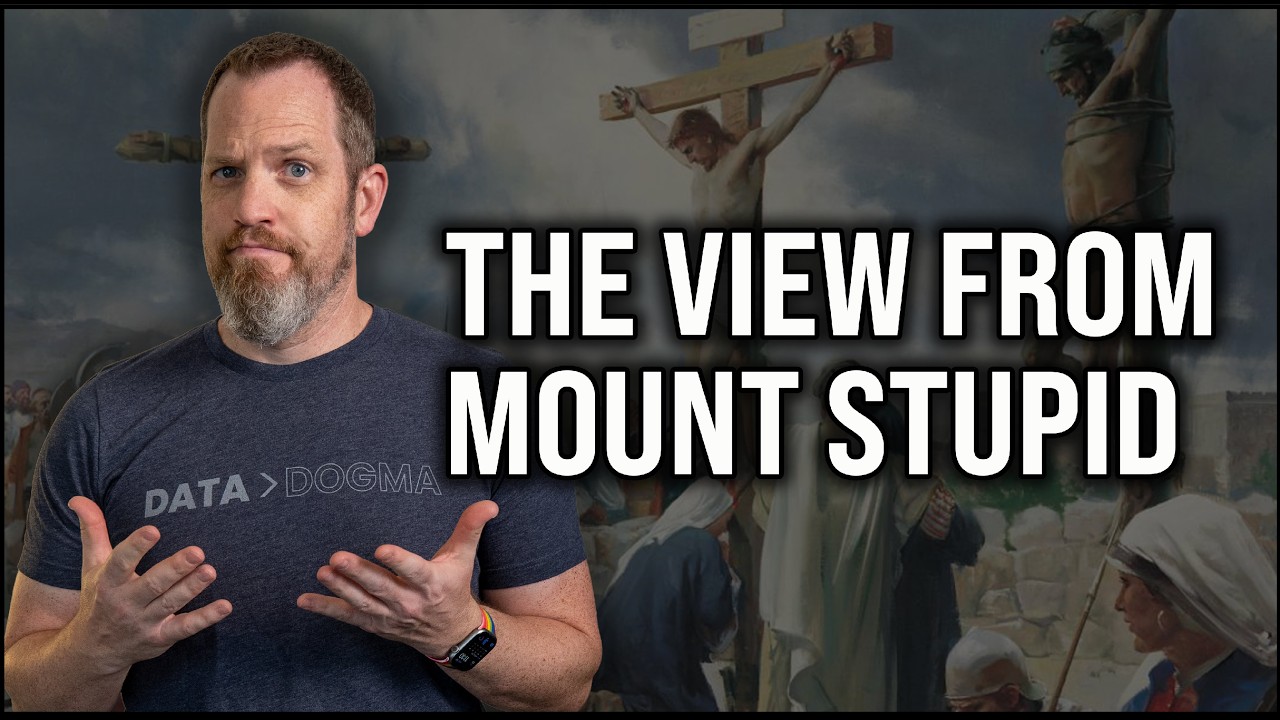
- Closing critique: McClellan frames the entire pattern as an example of the Dunning-Kruger effect ("Mount Stupid" meme), arguing the content creator lacks the linguistic training (Hebrew, Greek, manuscript studies, paleography) to assess the very claims being repeated from apologetic sources, and that writing and monetizing an ebook ("The Divine Blueprint") on this basis compounds rather than corrects the underlying lack of expertise.
- Recurring rhetorical device: McClellan characterizes the "spiritual reason" framing (i.e., that critics are influenced by "the wrong spirit") as a deliberate move to discourage audiences from evaluating the logical/evidentiary argument at all, by making scrutiny itself feel like spiritual disloyalty.
- Closing bit/running gag: the video ends with McClellan's recurring "fit check" segment, rating the reacted-to creator's on-screen outfit against a comic-book cover (here, "Action Comics number one") — a comedic sign-off unrelated to the substantive argument.
## 🗒️ Notes
- No timestamps were available in the retrieved transcript (auto-generated captions returned as continuous prose without time markers), so this section provides dense notes without timestamp subheadings, per the template's transcript-mode rule.
- Structural note: because this is a reaction/duet video, the transcript interleaves the original creator's lines (declarative, confident, e.g., "Come on, dude. What are we doing here? You cannot make that up.") with McClellan's rebuttals (analytical, citing compositional history and translation). Distinguishing the two voices was done by contextual cue (assertion vs. counter-argument), not explicit speaker labels in the source transcript.
- Genesis 3:15 argument: the "seed of the woman crushing the serpent's head" / "seed of the serpent striking the heel" wording uses the same Hebrew verb for both actions (McClellan notes "the verbs are the same"), which he uses to argue the verse describes mutual antagonism between humans and snakes generally, not a specific future victory over Satan via a specific individual.
- The "351 prophecies" number is treated by McClellan as a proxy for a broader genre of unverified apologetic content — his critique method is to open the list at item one (Genesis 3:15) and show it fails as a prophecy at all, implying the same close-reading would undercut most or all subsequent entries, though he does not walk through the full list on-screen.
- Matthew-specific claim: McClellan asserts Matthew changed narrative details relative to Mark specifically so the resulting story could be captioned as fulfilling a named Hebrew Bible verse — this is presented as evidence of conscious literary design by the Gospel author, not evidence of the Hebrew Bible verse being a genuine advance prediction.
- Isaiah 53 identity claim: McClellan states the suffering servant is "repeatedly and explicitly identified as Israel multiple times in second Isaiah," describing the servant figure as a "personification" or "proxy" representing the nation's collective suffering (e.g., the Babylonian exile), rather than an individual.
- Epistemic-authority argument: McClellan's recurring move across multiple claims (Psalm 22, Isaiah 7:14) is to state that evaluating a translation dispute requires Hebrew/Greek competence the content creator does not have, and that repeating apologetic sources without that competence amounts to "repeat[ing] whatever makes them feel good without knowing if it's accurate."
- Meta-argument about "spiritual reason": McClellan explicitly names the dividing-line rhetoric (spirit of God vs. spirit of the devil) as a tactic to "disincentivize people from following the logic," framing it as protecting weak points in the argument ("shore up the holes in your dogmas") rather than as a substantive claim.
- Ebook promotion critique: the reacted-to creator's pitch line ("I do not believe that somebody with honesty and integrity can read through this entire thing not coming away believing...") is characterized by McClellan as rhetoric intended to pre-empt disagreement by tying it to a moral/character judgment (dishonesty or lack of integrity) rather than evidence.
- Dunning-Kruger framing: McClellan explicitly invokes "Mount Stupid" — the point on the Dunning-Kruger confidence curve where limited knowledge produces maximal (mistaken) confidence — and suggests the remedy is "get educated... develop some critical thinking skills, some metacognition."
## 📚 References
- [Data Over Dogma podcast — website](https://www.dataoverdogmapod.com)
- [Data Over Dogma — YouTube](https://www.youtube.com/@dataoverdogma)
- [Dan McClellan — Linktree (classes, resources)](https://linktr.ee/maklelan)
- [@maklelan on TikTok](https://www.tiktok.com/@maklelan)
- [@maklelan on Instagram](https://www.instagram.com/maklelan)
- [Dunning-Kruger effect — Wikipedia](https://en.wikipedia.org/wiki/Dunning%E2%80%93Kruger_effect)
- [Suffering Servant — Wikipedia](https://en.wikipedia.org/wiki/Suffering_servant)
- [Protoevangelium (Genesis 3:15) — Wikipedia](https://en.wikipedia.org/wiki/Protoevangelium)
## 🗣️ Paraphrase
- A Christian content creator argues that Jesus is prophesied throughout the Old Testament — citing lists of hundreds of "fulfilled prophecies," Adam-and-Eve/Jesus parallels, Paul's comments about a "veil" over Jewish readers of Moses, and verses like Psalm 22 and Isaiah 7:14 and 53 — and concludes this pattern is "beyond human invention" and proof the whole Bible is divinely authored, going on to promote a paid ebook making the same case.
- McClellan responds that none of this holds up under scrutiny: the "prophecies" (starting with the very first one on the list, Genesis 3:15) generally aren't prophecies at all in their original context, the messianic readings only appeared after Jesus's death when early Christians went searching the Hebrew Bible for material to reinterpret, the Gospel writers (Matthew especially) actively shaped their narratives to visibly match those reinterpreted passages, and several of the proof-texts (Psalm 22, Isaiah 7:14) rely on mistranslations the content creator has no linguistic training to evaluate. He frames the whole pattern as a textbook case of Dunning-Kruger overconfidence compounded by monetized apologetics.
## 📰 Newsletter
- Not applicable to this source — the template's newsletter section is scoped to WordPress/developer-ecosystem audiences, and this video is religious-studies commentary with no WordPress, plugin, or developer-tooling content to report.
## ✅ Action Items
#### DevRel
- Not applicable — no developer relations content in this source.
#### OSPO
- Not applicable — no open-source program content in this source.
#### Community
- Not applicable — no maintainer/contributor community content in this source.
#### WordPress
- Not applicable — no WordPress content in this source.
#### The WPCC
- Not applicable — no WPCC content in this source.
### FAIR
- Not applicable — no FAIR/governance content in this source.
## 🧪 Hypotheses
- H1: Passages commonly cited as "fulfilled Messianic prophecies" (e.g., Genesis 3:15, Isaiah 7:14, Isaiah 53) show no evidence of messianic interpretation in Second Temple Jewish sources predating Jesus's death, and only begin appearing in messianic readings afterward.
- H2: Gospel of Matthew pericopes with explicit "this was to fulfill" formula citations show measurable narrative divergence from parallel Markan material, in the direction of closer alignment with the cited Hebrew Bible verse.
- H3: The Hebrew verbal root underlying Psalm 22:16 ("pierced") is grammatically ambiguous or better rendered differently than the traditional Christian translation, such that "pierced my hands and feet" is not the most defensible rendering.
- H4: The Hebrew term "almah" in Isaiah 7:14 refers to a young woman of childbearing age generally, without a specific virginity connotation, and the "virgin" rendering derives from the Septuagint's Greek "parthenos" rather than the Hebrew original.
- H5: Within Second Isaiah, the "suffering servant" figure is applied to collective Israel in surrounding passages, making an individual-Messiah reading a minority or non-original sense rather than the text's primary referent.
### 📊 Methodology
- Comparative Second Temple literature survey: search Dead Sea Scrolls, Second Temple pseudepigrapha, and rabbinic sources for pre-Christian messianic readings of the specific verses cited (Genesis 3:15, Isaiah 7:14, Isaiah 53, Psalm 22) to test whether any messianic interpretation predates the first century CE.
- Synoptic comparison: align Matthew's fulfillment-formula pericopes against their Markan (and, where relevant, Q or L) parallels verse-by-verse, cataloguing which narrative details differ and whether those differences move the story closer to the cited Hebrew Bible text.
- Philological analysis: review the Hebrew verbal root behind Psalm 22:16 across its other biblical occurrences and consult standard lexicons (BDB, HALOT) plus the Masoretic Text's vocalization versus the Septuagint's rendering.
- Semantic-range study: survey all Hebrew Bible occurrences of "almah" versus "betulah" (the more specific virgin-marking term) to assess whether Isaiah 7:14's word choice supports or undercuts the "virgin" translation tradition.
- Discourse analysis of Second Isaiah: map every occurrence of "servant" language in Isaiah 40-55 against its referent (Israel, Cyrus, an individual figure) to assess how consistently the suffering-servant songs align with the collective-Israel reading versus an individual-Messiah reading.
### ❓ Questions
- What is the earliest datable Jewish or Christian source that reads Genesis 3:15 as a messianic prophecy rather than an etiological statement about human/snake antagonism?
- If Matthew altered Markan material to align with Hebrew Bible citations, can specific verses be identified where this editorial pattern is uncontroversial among synoptic-problem scholars, independent of any theological stance?
- Does the "pierced" reading of Psalm 22:16 depend on the Masoretic vocalization, a Dead Sea Scrolls variant, or the Septuagint — and do these traditions actually diverge as sharply as McClellan implies?
- How do modern Jewish translations (e.g., JPS Tanakh) render Isaiah 7:14, and does that rendering choice track the almah/virgin distinction McClellan raises?
- Within Second Isaiah's servant songs, are there any verses that resist the collective-Israel reading and require (or strongly favor) an individual referent?
### 🔮 Future Research
- A systematic catalog of "fulfilled prophecy" lists circulating in popular apologetics (like the "300+ prophecies" genre referenced here), cross-checked against each cited verse's documented compositional and interpretive history.
- Reception-history research tracing exactly when and in which communities (rabbinic, early Christian, Qumran) each of the major proof-texts (Genesis 3:15, Isaiah 7:14, Isaiah 53, Psalm 22) first acquired a messianic reading.
- A comparative study of how often "reaction video" formats in religious-studies content (this genre of duet/rebuttal video) actually shift audience views, versus reinforcing pre-existing in-group/out-group identity.
### 💡 Implications
- For religious literacy: audiences encountering "fulfilled prophecy" content online are frequently encountering claims that rest on translation choices and retrospective reinterpretation rather than on the plain sense intended by the original Hebrew Bible authors — distinguishing these requires linguistic and historical-critical tools most lay audiences don't have.
- For platform-based apologetics economics: the video highlights a pattern where contested translation/interpretation claims are monetized directly (the "Divine Blueprint" ebook), creating an incentive structure that rewards confident assertion over accuracy.
- For public scholarly communication: reaction/duet-format videos let credentialed scholars intervene directly in the same feed where popular apologetics circulates, but the format also invites ad hominem framing (Dunning-Kruger, "identity politics") that can overshadow the underlying textual arguments for some viewers.
- For interfaith dialogue: the 2 Corinthians 3 "veil" argument and its circular-reasoning critique bear directly on Jewish-Christian scriptural disagreement and are relevant to broader discussions about supersessionist readings of the Hebrew Bible.
### 🧠 Learning Styles Assessment
- Reading level estimate: transcript is fast-paced spoken register, informal but topically dense (proper nouns like "protoevangelium," "Second Isaiah," technical claims about Hebrew verbal roots); approximate Flesch-Kincaid grade level 9-11, higher than typical conversational content due to biblical-studies vocabulary delivered without pause.
#### 👀 Visual learners
- Present: none discernible from the transcript alone — described as a reaction-video format, likely with on-screen clips of the original creator, but no diagrams, verse text overlays, or maps are evident in the spoken content.
- Improve: on-screen display of the actual Hebrew/Greek text alongside the translation being disputed (e.g., Psalm 22:16, Isaiah 7:14) so viewers can see the specific word under debate rather than relying on the claim alone.
#### 🔊 Aural learners
- Present: native audio format with confident, energetic pacing and a comedic sign-off, aiding engagement and retention.
- Improve: a brief spoken recap after each individual proof-text (Genesis 3:15, then Psalm 22, then Isaiah 53) before moving to the next, to reduce cognitive load from rapid-fire topic switching.
#### 🗣️ Verbal learners
- Present: definitions given inline for terms like "protoevangelium," "Second Isaiah," and "suffering servant."
- Improve: a glossary card or pinned comment defining "almah," "parthenos," and the specific Hebrew verbal root discussed for Psalm 22, since these terms are asserted but not explained in depth.
#### 🧩 Kinesthetic learners
- Present: none — no interactive or hands-on exercise.
- Improve: a companion worksheet inviting viewers to look up each disputed verse in two translations (e.g., NRSV and JPS Tanakh) and compare wording themselves.
#### 🧠 Logical learners
- Present: the video's structure (claim → rebuttal, repeated across several proof-texts) functions as an implicit compare-contrast framework.
- Improve: an explicit table listing each proof-text, the apologetic claim, and McClellan's counter-claim side by side.
#### 🧑🤝🧑 Social learners
- Present: the reaction/duet format models public scholarly disagreement and cross-examination of claims in real time.
- Improve: linking to the original creator's full video (not just clips) so viewers can assess both sides directly rather than relying solely on the excerpted framing.
#### 🧘♀️ Solitary learners
- Present: content rewards independent verification of the specific verses named.
- Improve: reflection prompts (e.g., "look up Isaiah 53 yourself — does the servant die in the text?") for self-paced review.
#### 🌿 Naturalistic learners
- Present: minimal — no ecological or environmental framing in this content.
- Improve: not applicable to this subject matter; no natural improvement path identified.
### 📊 Accessibility Assessment
#### Screen reader semantics
- Present: N/A at the video level (this assessment covers the source video itself, not this note).
- Improve: ensure the YouTube upload has an accurate title, description, and any on-screen quote cards exposed with accessible alt text.
#### Keyboard navigation
- Present: standard YouTube player keyboard controls apply.
- Improve: none beyond platform-level controls; not in the creator's control.
#### Contrast and readability
- Present: not assessed from the transcript alone; reaction-video formats typically include on-screen text captions or clip overlays.
- Improve: verify any on-screen text (e.g., verse citations, the "Mount Stupid" meme graphic) meets 4.5:1 contrast against its background.
#### Text resizing and reflow
- Present: N/A, video-only.
- Improve: N/A.
#### Media and captions
- Present: auto-generated captions exist (the source of this transcript) and contain recognizable transcription errors (e.g., "mistransations" for "mistranslations," "ideology" apparently standing in for "etiology," "the the verbs" duplication).
- Improve: a creator-reviewed caption pass would correct these errors, which matter here specifically because the video's argument repeatedly turns on precise translation terminology.
#### Forms and interactions
- Present: N/A, no forms or interactive elements.
- Improve: N/A.
#### Standards reference
- Gap against WCAG 2.2 AA: 1.2.2 (accurate captions) is the primary concern — auto-generated captions mangling technical terms like "mistranslations" and "etiology" undermine comprehension for Deaf/hard-of-hearing viewers following a terminology-dependent argument.
### 🌍 DEIB Assessment
#### Cultural breadth
- Present: the video directly engages Jewish, Christian, and (per the opening line) Muslim and atheist perspectives on whether Jesus appears in the Hebrew Bible, and explicitly defends the Jewish reading of Isaiah 53 and 2 Corinthians 3 against a specifically Christian supersessionist framing.
- Improve: direct citation of a Jewish scholarly or rabbinic source on these same verses (rather than only McClellan's own academic framing) would broaden the range of voices represented.
#### Inclusive language
- Present: no slurs; the video explicitly names and criticizes a rhetorical move (dividing people by "spirit of God" vs. "spirit of the devil") that itself functions to exclude dissenters from a religious in-group.
- Improve: some framing ("this content creator... doesn't have the foggiest clue," "bafflingly misinformed") is combative; more neutral phrasing could make the substantive argument land with a wider audience, including those sympathetic to the original creator.
#### Neurodiversity support
- Present: rapid, dense topic-switching (moving between Genesis 3:15, Adam/Eve typology, 2 Corinthians 3, Psalm 22, Isaiah 7:14, and Isaiah 53 in quick succession) without much recap.
- Improve: chapter markers or on-screen section labels per proof-text would substantially help viewers who benefit from predictable chunking.
#### Representation
- Present: the video engages the perspective of Jewish readers directly (the 2 Corinthians 3 discussion explicitly centers how this passage frames Jewish scriptural interpretation as "veiled").
- Improve: could more explicitly name and cite a Jewish scholarly voice on Isaiah 53 or Psalm 22, rather than presenting the corrective solely through McClellan's own scholarly authority.
#### Psychological safety
- Present: the video takes a confrontational tone toward the reacted-to creator specifically, but frames its objection to the "spirit of God vs. spirit of the devil" rhetoric as protecting critical thinking rather than attacking faith itself.
- Improve: viewers who hold the reacted-to creator's views devotionally may experience the "Dunning-Kruger"/"Mount Stupid" framing as dismissive of their faith commitments rather than just their argument's technical merits; separating the critique of competence from the critique of the argument would reduce that risk.
### ✅ Logical Validity
#### Strong reasoning
- Genre argument (Genesis 3:15): identifying the verse's grammatical structure (same Hebrew verb applied to both the woman's seed and the serpent's seed) as evidence the verse describes mutual, ongoing antagonism rather than a one-time future victory is a specific, checkable textual observation, not mere assertion.
- Compositional-intent argument (Matthew and Mark): citing an instance where Matthew is argued to have reshaped Markan material specifically to align with a Hebrew Bible citation is a legitimate synoptic-criticism style of evidence — if independently verifiable, it directly supports the claim that "fulfillment" language reflects authorial construction rather than independent prediction.
- Internal-consistency argument (Isaiah 53): pointing out that the suffering servant does not die within the passage, and is elsewhere in Second Isaiah explicitly identified as Israel, is an argument from the text's own content rather than from external authority — a strong, falsifiable claim a reader can check directly.
#### Fallacies
- Hasty generalization / weak-evidence rejection: McClellan dismisses the "351 prophecies" list wholesale after examining only its first entry (Genesis 3:15). Even if that first example fails, generalizing to the entire list without examining a representative sample of the remaining 350 is a gap in the argument as presented on-screen. Fix: name and briefly assess two or three additional entries from the list to justify the generalization.
- Appeal to authority via credential gatekeeping: repeatedly stating the original creator "cannot read Greek or Hebrew," "doesn't know the languages," and is "not remotely qualified to assess" functions partly as a legitimate point about specialized translation disputes, but also risks functioning as an ad hominem substitute for directly walking through the philological evidence in each specific case (e.g., showing the Psalm 22 verbal root analysis itself rather than only asserting the conclusion and pointing to an unlinked external video).
- Psychologizing the opponent's motive: framing the original creator's argument as "just feelings and identity politics," driven by "how deeply embedded these dogmas are in your identity politics," attacks the presumed psychological cause of the belief rather than only the belief's evidentiary basis — a version of the genetic fallacy, even where the underlying textual critique (e.g., of Isaiah 53) is independently sound.
#### Tone of voice
- Confident, rapid, confrontational — frequent direct address ("Come on, dude," "this is insane," "this is bafflingly misinformed") mixed with technical claims about Hebrew grammar and Second Temple reception history. The tone models adversarial debate rather than measured academic exposition, with humor (the "Mount Stupid"/Dunning-Kruger framing, the closing "fit check" bit) used for audience engagement.
### 🛡️ DARVO Analysis
- Partial applicability: DARVO (Deny, Attack, Reverse Victim and Offender) is typically analyzed in contexts of interpersonal or institutional abuse allegations; this video is a scholarly-rhetorical disagreement about biblical interpretation, not an abuse dynamic, so a full DARVO analysis does not cleanly map onto it.
- Attack component present at the level of rhetoric: McClellan explicitly frames the original creator's "spirit of God vs. spirit of the devil" framing as an attack on critics' legitimacy — arguing it is designed to make anyone who scrutinizes the claims appear spiritually compromised, which pre-emptively discredits the "attacker" (the critical thinker) before their argument is even heard. McClellan names this dynamic critically rather than employing it himself.
- No clear Deny or Reverse-Victim-Offender pattern is present from either party as captured in this transcript; both sides argue their substantive positions directly rather than denying documented facts or recasting themselves as victims of the other's critique.
- Emotional/rhetorical cues: the original creator's framing ("How had nobody ever told me about this?", "it truly means... no, I'm good") carries a testimonial, born-again-discovery register; McClellan's framing carries a debunking/expose register ("This part is insane" used sarcastically in response, "Mount Stupid"). Neither register alone constitutes DARVO, but both function to mobilize audience identification with their respective side.
## 🎯 Conclusion
- McClellan's core argument is that popular "Jesus fulfilled hundreds of Old Testament prophecies" content — including the specific proof-texts of Genesis 3:15, Adam/Eve typology, 2 Corinthians 3's veil, Psalm 22, Isaiah 7:14, and Isaiah 53 — relies on retrospective reinterpretation and, in at least two cases he names directly (Psalm 22 and Isaiah 7:14), on translation choices he argues are simply inaccurate, rather than on original authorial intent within the Hebrew Bible; he frames the entire genre, and the ebook built on it, as a case study in overconfident under-expertise (Dunning-Kruger/"Mount Stupid").
- Practical next step for readers: before accepting or rejecting either side's claims, read the specific verses in question (Genesis 3:15, Psalm 22:16, Isaiah 7:14, Isaiah 52:13-53:12, 2 Corinthians 3:14-16) in at least two translations — one from a Christian tradition (e.g., NRSV) and one from a Jewish tradition (e.g., JPS Tanakh) — and compare the wording directly rather than relying on either creator's summary of what the text says.
## 🔄 Refactor Appendix — Jesus in the Old Testament is beyond dispute
> Density: 2–5 Literature atoms (H3), 0–3 Permanent candidates (H4).
> Defaults: 3 Literature, 1 Permanent. Resonance filter: if you can't
> articulate in one line why a claim matters, drop it.
>
> Konik claim-header rules: present tense, declarative, ≤10 words when
> possible, searchable, unique, mirrors annotation focus if present.
>
> Atomicity: one declarative sentence per atom. "and"/"also" → split.
>
> Tag pool: #bmf · #addendum · #xref · #articleseed · #storystem · #share · #aphorisms
### 📚 Literature Atoms (H3)
#### [H1] Genesis 3:15 is an etiology, not a prophecy
> [!quote] ID:rw_maklelan_ix4_h1
> This just means, hey, the offspring of humans and the offspring of snakes will not like each other. It's an ideology.
**Context & use**:
- Said while dismantling the first entry on a widely circulated "351 fulfilled prophecies" list.
- Anchors McClellan's central methodological claim: the messianic reading of this verse (the "protoevangelium") is a later Christian relabeling of a text that originally explained mutual human/snake antagonism.
**Tags**: #xref
**Highlight**: [view highlight](readwise://)
<!-- atomicity: 1 idea ✓ -->
#### [H2] Matthew reshaped Mark's stories to fit prophecy citations
> [!quote] ID:rw_maklelan_ix4_h2
> Matthew would take a story that was in Mark and tell it in a different way so that the author could then say, "And that fulfilled this prophecy over here in the Hebrew Bible."
**Context & use**:
- Said while arguing that New Testament authors intentionally engineered narrative details to visibly match reinterpreted Hebrew Bible passages.
- Key evidence for the claim that "fulfillment" reflects Gospel-author literary construction rather than independent ancient prediction.
**Tags**: #xref
**Highlight**: [view highlight](readwise://)
<!-- atomicity: 1 idea ✓ -->
#### [H3] Isaiah's suffering servant is identified as Israel, not an individual
> [!quote] ID:rw_maklelan_ix4_h3
> The suffering servant is repeatedly and explicitly identified as Israel multiple times in second Isaiah... It is a personification, an extension of Israel.
**Context & use**:
- Said in direct rebuttal to the claim that Isaiah 53 predicts a dying Messiah.
- Central to McClellan's argument that no one read Isaiah 53 as a reference to a dying Messiah until after early Christians reinterpreted it post-crucifixion.
**Tags**: #xref
**Highlight**: [view highlight](readwise://)
<!-- atomicity: 1 idea ✓ -->
#### [H4] Psalm 22 and Isaiah 7:14 rest on mistranslation, McClellan argues
> [!quote] ID:rw_maklelan_ix4_h4
> Psalm 22 does not say they have pierced my hands and my feet. Period... Isaiah 7:14 is not a reference to a virgin. Period. That's a mistranslation.
**Context & use**:
- Said while arguing the content creator lacks the Hebrew/Greek competence to evaluate these translation disputes.
- Load-bearing claim for the video's broader thesis that "fulfilled prophecy" arguments frequently depend on contested or inaccurate translations rather than the underlying Hebrew.
**Tags**: #xref
**Highlight**: [view highlight](readwise://)
<!-- atomicity: 1 idea ✓ -->
### 🧠 Permanent Candidates (H4)
#### [P1] Retrospective reinterpretation looks like prediction after the fact
**Claim** (one sentence, Courtney's voice): A text that gets reread as prophecy only after the event it "predicts" has already happened is evidence of retrospective reinterpretation, not of advance prediction.
**Evidence pointer**: [[#H1]] and [[#H3]]
**Scope & conditions**: Holds when no earlier (pre-event) source can be shown reading the text the same way; breaks down if independent pre-event attestation of the same interpretation exists.
**Links** (≥1 with annotation):
- [[Documentary Hypothesis]] — because contrasts on method (both examine how later readers/editors reshape earlier material, but this concerns interpretation rather than composition)
- [[Confirmation bias]] — because applies-in popular apologetics and other retrospective-pattern-finding contexts
<!-- atomicity: 1 idea ✓ -->
### ✏️ Fleeting Queue
- [F1] Locate the specific Psalm 22 verbal-root demonstration video McClellan references ("you can check out this video") — it's unlinked in this transcript and would substantiate the mistranslation claim directly — https://www.youtube.com/watch?v=ix4XRhgSV6M #xref
- [F2] Check whether the "351 fulfilled prophecies" list McClellan critiques is a specific identifiable page (e.g., a well-known apologetics site) so the Genesis 3:15 critique can be checked against the full list rather than just its first entry — https://www.youtube.com/watch?v=ix4XRhgSV6M #xref
### → Things 3 (max 2 actions)
- [ ] Read Isaiah 52:13-53:12 in full and note every verse identifying the servant as Israel before accepting either creator's framing — biblical-scholarship #things
<!-- deep-read:sections end -->
📄 **Full text:** [[Full Document Contents/Articles/Jesus in the Old Testament Is Beyond Dispute.md|Jesus in the Old Testament Is Beyond Dispute by YouTube]]
## Highlights
- the heel of the seed of the woman. This just means hey, the offspring of humans and the offspring of snakes will not like each other. It's an ideology. That's it. So, this isn't even a prophecy. This is like an Aesop's fable. This is explaining why people don't like snakes that has been reinterpreted as a prophecy about Jesus. So, no one ever did that until after Jesus, until after his death ([View Highlight](https://read.readwise.io/read/01kxh9g987ardch53hyv34ar6g))
- Tags: atom/literature/h1
- Matthew wanted to connect with Jesus, so that it would more clearly fulfill prophecy. So, Matthew would take a story that was in Mark and tell it in a different way, so that the author could then say, "And that fulfilled this prophecy over here in the Hebrew Bible." So, when these people are writing the stories with fulfillment of Hebrew Bible prophecy, frequently when it wasn't a prophecy at all, in mind, they can tell ([View Highlight](https://read.readwise.io/read/01kxh9gdypgfvms3k0306xkwd4))
- Tags: atom/literature/h2
- assess whether or not these are mistranslations. They are. Uh Psalm 22 does not say "They have pierced my hands and my feet." Period. You can check out this video if you would like to see a demonstration of how that is not a plausible reading of that verbal root. Isaiah 7:14 is not a reference to a virgin. Period. That's a mistranslation. That's something that people came up with later. ([View Highlight](https://read.readwise.io/read/01kxh9gq5vr43vathc22x0643q))
- Tags: atom/literature/h4
- So, this content creator is appealing to misinterpretations and mistranslations as evidence for the misinterpretations and the mistranslations. So, this is This is just bafflingly misinformed. >> Isaiah 53, "He was pierced for our transgressions. He was crushed for our iniquities." And they still won't see it. >> And we can point out that in Isaiah 53, the suffering servant doesn't die. And also, the suffering servant is repeatedly and explicitly identified as ([View Highlight](https://read.readwise.io/read/01kxh9gkkxb73ksf3n5fmrh071))
- Tags: atom/literature/h3