June 19, 2026
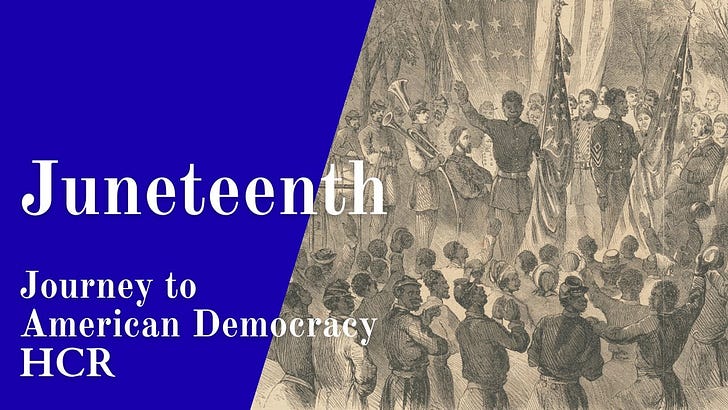
🔗 **Source:** [June 19, 2026](https://heathercoxrichardson.substack.com/p/june-19-2026)
> [!note]+ Document Notes
> tags: [juneteenth, reconstruction, emancipation, civil-rights, constitutional-amendments, racial-equality]
> author: Heather Cox Richardson
> source: Letters from an American (Substack)
> reference: https://heathercoxrichardson.substack.com/p/june-19-2026
> date created: 2026-06-20 12:00
>
> # 🏷️ Title: June 19, 2026
>
<!-- deep-read:sections start -->
## 🧭 Table of Contents
- [📝 Summary](#-summary)
- [📖 Main Content](#-main-content)
- [🗒️ Notes](#️-notes)
- [📚 References](#-references)
- [🗣️ Paraphrase](#️-paraphrase)
- [📰 Newsletter](#-newsletter)
- [✅ Action Items](#-action-items)
- [🧪 Hypotheses](#-hypotheses)
- [📊 Methodology](#-methodology)
- [❓ Questions](#-questions)
- [🔮 Future Research](#-future-research)
- [💡 Implications](#-implications)
- [🧠 Learning Styles Assessment](#-learning-styles-assessment)
- [📊 Accessibility Assessment](#-accessibility-assessment)
- [🌍 DEIB Assessment](#-deib-assessment)
- [✅ Logical Validity](#-logical-validity)
- [🛡️ DARVO Analysis](#-darvo-analysis)
- [🎯 Conclusion](#-conclusion)
### 🔗 References
- [Juneteenth original document — General Order No. 3 (National Archives)](https://www.archives.gov/news/articles/juneteenth-original-document)
- [13th Amendment (National Archives)](https://www.archives.gov/milestone-documents/13th-amendment)
- [14th Amendment (National Archives)](https://www.archives.gov/milestone-documents/14th-amendment)
- [Emancipation Proclamation transcript (National Archives)](https://www.archives.gov/exhibits/featured-documents/emancipation-proclamation/transcript.html)
- [Juneteenth — Handbook of Texas (TSHA)](https://www.tshaonline.org/handbook/entries/juneteenth)
- [S.475 — Juneteenth National Independence Day Act (Congress.gov)](https://www.congress.gov/bill/117th-congress/senate-bill/475)
## 📝 Summary
- **What happened.** On the Juneteenth federal holiday, historian Heather Cox Richardson recounts the history of the day: on June 19, 1865, Major General Gordon Granger arrived in Galveston, Texas, and issued General Order No. 3 informing the people of Texas that, under the Emancipation Proclamation, "all slaves are free." She traces why the news came so late (the Trans-Mississippi Department surrendered only on June 2, 1865), and how freedom was *won* by Black Americans who fought, nursed, labored, and resisted — not handed to them.
- **Why it matters.** Richardson reframes Juneteenth not as a single moment of liberation but as the opening of a constitutional project: the Thirteenth (abolition), Fourteenth (birthright citizenship, equal protection, due process), and Black male suffrage under the 1867 Military Reconstruction Act. Successive Juneteenth celebrations (1865, 1866, 1867) mark each new layer of secured freedom.
- **Key stakeholders.** Formerly enslaved Texans and Black Americans nationwide; white former Confederates who resisted equality; Congress and the federal government as enforcers; activist Opal Lee and the 2021 lawmakers who made Juneteenth a federal holiday; present-day Americans now contesting equal-rights protections.
- **Risks and tradeoffs.** The essay warns that the same arguments former Confederates used — that protecting minority rights "discriminates" against the white majority, and that democracy should be skewed toward the wealthy and white men — are "once again, gaining traction," putting the egalitarian nation Juneteenth celebrates "in danger."
- **Bottom line.** Juneteenth commemorates not a gift of freedom but a hard-won, federally-enforced promise of equality — a promise written into the Constitution and, Richardson argues, now at risk of being lost.
## 📖 Main Content
- **The delayed announcement.** Emancipation reached Galveston on June 19, 1865, only after the Confederacy's last major army surrendered. Lee surrendered the Army of Northern Virginia on April 9, 1865, but General Edmund Kirby Smith did not surrender the Trans-Mississippi Department until June 2 in Galveston (then fleeing to Mexico). Granger arrived seventeen days later to take charge and issued **General Order No. 3**.
- **What Order No. 3 said.** It informed Texans that "all slaves are free," declaring "an absolute equality of personal rights and rights of property between former masters and slaves," converting the master–slave relation into "that between employer and hired labor." It rested on the **Emancipation Proclamation** (Jan. 1, 1863), which freed people enslaved in states then in rebellion — Texas among them.
- **Freedom was earned, not gifted.** Richardson is emphatic: "emancipation was not a gift from white Americans." Black Americans fought and died for the Union as soldiers, nurses, and laborers; some fled to northern lines carrying intelligence or matériel; others hid wounded U.S. soldiers and helped them return.
- **White backlash and the Black Codes.** Defeated Confederates were "demoralized and angered" — cattleman Charles Goodnight recalled "It looked like everything worth living for was gone." States grudgingly ratified the **Thirteenth Amendment** (abolishing slavery "except as punishment for a crime") but enacted **Black Codes** binding freedpeople to yearlong labor contracts, barring them from assembling, owning guns/property, or testifying in court, outlawing interracial marriage, and letting white men buy convicts' jail terms to force debt-labor.
- **Congress responds.** Refusing to readmit southern states with Black Codes intact, Congress added the Thirteenth Amendment to the Constitution in December 1865. In 1866 it wrote the **Fourteenth Amendment**, establishing birthright citizenship and barring any state from abridging "privileges or immunities," denying "due process," or denying "equal protection of the laws." Richardson calls this "the whole ball game" — the teeth behind the Emancipation Proclamation's principles, with a clause empowering Congress to enforce it.
- **Black male suffrage and Juneteenth's spread.** When white southerners chose military rule over equality, Congress passed the **Military Reconstruction Act** (March 1867), mandating that Black men could vote for delegates to new constitutional conventions — the first time in U.S. history. The federal government encouraged "Juneteenth" celebrations to publicize these voting rights, spreading the tradition nationally.
- **The layered meaning of the early celebrations.** 1865 celebrated freedom and the war's end; 1866 celebrated freedom enshrined in the Constitution via the Thirteenth Amendment; 1867 celebrated Black men's freedom to vote — "the very real power of having a say in the government."
- **Decline and revival.** Juneteenth faded during Jim Crow but traveled with Black Americans migrating from the South during and after World War II. By the 1980s Texas made it a state holiday; in **2021**, partly through activist **Opal Lee's** pressure, Congress made it federal and President Biden signed it into law.
- **The contemporary warning.** Richardson closes by linking past to present: those who would "preserve a government that discriminates" by race, gender, religion, and ability have always claimed true democracy means "skewing the vote toward the wealthy and white men" and that equal-rights laws "discriminate against the white majority." Those voices "are, once again, gaining traction," and "we are in danger of losing the new nation that [Juneteenth] celebrated."
### 🗒️ Notes
- **Two surrenders, two dates.** Lee's April 9 surrender ended the eastern war; the western Confederacy held until Kirby Smith's June 2 surrender at Galveston — explaining the lag before June 19.
- **Granger's role.** Gordon Granger arrived June 19, 1865, took command of Texas troops, and issued General Order No. 3 that day.
- **Order No. 3 text** equates rights of "former masters and slaves" and reframes the relationship as "employer and hired labor" — a labor-relations transformation, not just a status change.
- **Legal chain of authority.** Order No. 3 → Emancipation Proclamation (Jan. 1, 1863) → applies because Texas was "in rebellion on January 1, 1863."
- **Agency of the enslaved.** Black Americans served as soldiers, nurses, day laborers; carried information/matériel to Union lines; sheltered wounded U.S. soldiers. "Emancipation was not a gift."
- **Goodnight quote** captures white Confederate despair: "It looked like everything worth living for was gone."
- **Black Codes itemized.** Yearlong field contracts; bans on assembly, guns, property, court testimony; anti-miscegenation; convict debt-peonage via bought-out jail terms.
- **Thirteenth Amendment** abolishes slavery "except as punishment for a crime" — Richardson notes the carve-out plainly; ratified into the Constitution December 1865.
- **Fourteenth Amendment (1866)** — birthright citizenship; privileges or immunities; due process; equal protection; congressional enforcement clause. Richardson: "That was the whole ball game."
- **Military Reconstruction Act (March 1867)** mandated Black male suffrage for convention delegates — a U.S. first; federal government promoted Juneteenth to spread the news.
- **Three Juneteenths, three meanings:** 1865 = freedom/war's end; 1866 = freedom constitutionalized; 1867 = the vote.
- **Decline/revival arc:** Jim Crow decline → Great Migration spread → 1980s Texas state holiday → 2021 federal holiday (Opal Lee; Biden signature).
- **Framing device.** "One hundred and sixty-one years after Juneteenth was established, we are in danger of losing the new nation that it celebrated."
- **Cross-ref (Juneteenth video pair this week):** Tim Whitaker and *The New Evangelicals* Juneteenth pieces — pair this historian's constitutional-narrative reading against their faith-community framing of the same holiday.
## 📚 References
- [General Order No. 3 / Juneteenth original document (National Archives)](https://www.archives.gov/news/articles/juneteenth-original-document)
- [Thirteenth Amendment (National Archives)](https://www.archives.gov/milestone-documents/13th-amendment)
- [Fourteenth Amendment (National Archives)](https://www.archives.gov/milestone-documents/14th-amendment)
- [Emancipation Proclamation transcript (National Archives)](https://www.archives.gov/exhibits/featured-documents/emancipation-proclamation/transcript.html)
- [Confederate "Cornerstone"/secession documents (Avalon Project, Yale Law)](https://avalon.law.yale.edu/19th_century/csa_scarsec.asp)
- [Juneteenth — Handbook of Texas (TSHA)](https://www.tshaonline.org/handbook/entries/juneteenth)
- [Juneteenth — Texas State Library and Archives](https://www.tsl.texas.gov/ref/abouttx/juneteenth)
- [S.475 — Juneteenth National Independence Day Act (Congress.gov)](https://www.congress.gov/bill/117th-congress/senate-bill/475)
- [Senate approves Juneteenth holiday bill (NPR, 2021)](https://www.npr.org/2021/06/15/1006934154/senate-unanimously-approves-a-bill-to-make-juneteenth-a-public-holiday)
- J. Evetts Haley, *Charles Goodnight: Cowman and Plainsman* (1949; rpt. University of Oklahoma Press, 1981).
## 🗣️ Paraphrase
- Juneteenth marks June 19, 1865, when Gordon Granger reached Galveston and issued General Order No. 3 declaring all enslaved people in Texas free; the date was late because the Confederacy's last major army surrendered only weeks earlier.
- The order rested on the 1863 Emancipation Proclamation and promised legal and property equality between former masters and the formerly enslaved, reframing their relationship as employer and paid labor.
- Crucially, freedom was won by Black Americans themselves — through military service, nursing, labor, intelligence-gathering, and sheltering Union soldiers — not bestowed by white Americans.
- White ex-Confederates resisted; states ratified the Thirteenth Amendment while passing Black Codes to keep freedpeople subordinate, prompting Congress to refuse readmission and then enact the Fourteenth Amendment guaranteeing citizenship, due process, and equal protection.
- Black male suffrage followed under the 1867 Military Reconstruction Act, and the federal government promoted Juneteenth to publicize those voting rights; each year's celebration (1865, 1866, 1867) marked a newly secured layer of freedom.
- After fading under Jim Crow and reviving through the Great Migration, Juneteenth became a Texas holiday in the 1980s and a federal holiday in 2021; Richardson warns that the egalitarian nation it celebrates is again under threat from those who frame equal-rights protections as discrimination against the white majority.
## 📰 Newsletter
**Juneteenth wasn't a gift — it was a hard-won constitutional promise**
Heather Cox Richardson's June 19 *Letters from an American* turns the Juneteenth holiday into a tight, sourced history lesson, and it's worth your time. The headline date — June 19, 1865, when General Gordon Granger issued General Order No. 3 in Galveston — was late for a reason: the Confederacy's last major army didn't surrender until June 2. But the essay's real argument is that freedom was *earned*, not bestowed: Black Americans fought, nursed, labored, carried intelligence to Union lines, and hid wounded soldiers. Richardson then walks the constitutional staircase that gave emancipation teeth — the Thirteenth Amendment (abolition), the Fourteenth ("the whole ball game": citizenship, due process, equal protection), and Black male suffrage under the 1867 Military Reconstruction Act — mapping each onto the layered meaning of the 1865, 1866, and 1867 celebrations. She closes with a warning that lands hard: the same arguments former Confederates used — that protecting minority rights "discriminates" against the white majority — are "once again, gaining traction." Pair it with this week's two Juneteenth videos (Tim Whitaker; The New Evangelicals) for a fuller picture: the historian gives you the constitutional spine, the video voices give you the lived and faith-community frames. History with receipts, and a present-tense stake.
## ✅ Action Items
#### DevRel
- Developer advocacy: Not applicable to this source — historical essay, no developer surface.
- Education: build a short explainer linking the 13th/14th Amendments to the layered Juneteenth celebrations (1865/66/67).
- Developer experience: Not applicable to this source.
- Developer marketing: clip the "emancipation was not a gift" frame as evergreen civic-history content.
- Community management: host a Juneteenth reading/discussion circle around the essay and its primary sources.
- Internal/external/cross-project: cross-link this analysis with the Tim Whitaker and The New Evangelicals Juneteenth pieces.
#### OSPO
- Policy & Governance: Not applicable to this source.
- License Compliance: confirm reuse terms for the National Archives images/transcripts if republishing.
- Security Management: Not applicable to this source.
- Software Inventory: Not applicable to this source.
- Developer Support: Not applicable to this source.
- Community Engagement: fund/curate primary-source civic-history reading lists.
- Strategic Alignment: track equity/anti-discrimination commitments as an organizational value, per the essay's warning.
#### Community
- Maintainers: Not applicable to this source.
- Contributors: Not applicable to this source.
- Sponsors: Not applicable to this source.
- Ecosystem: Not applicable to this source.
#### WordPress
- Core: Not applicable to this source.
- Core Performance: Not applicable to this source.
- Core AI: Not applicable to this source.
- **Core Program Team:** Not applicable to this source.
- Mobile: Not applicable to this source.
- Playground: Not applicable to this source.
- Community: add a Juneteenth/civic-history thread to meetup and event programming.
- Training: build a learning unit on primary-source reading using Order No. 3 and the Amendments.
- Marketing: Not applicable to this source.
- Support: Not applicable to this source.
- Design: Not applicable to this source.
- Documentation: model "link to primary sources" as a documentation discipline (this essay footnotes everything).
- Photos / TV / Openverse: source public-domain Juneteenth/Reconstruction imagery from the National Archives.
- Polyglots: glossary for "Black Codes," "Reconstruction," "equal protection," "Juneteenth."
- Accessibility: ensure any republished version meets WCAG (see Accessibility Assessment).
- Meta: Not applicable to this source.
- CLI: Not applicable to this source.
- Hosting: Not applicable to this source.
- Tide / Themes / Plugins: Not applicable to this source.
#### The WPCC
- Programs: Not applicable to this source.
- Projects: documentation project on civic-history primary-source literacy.
- Funding experiments: Not applicable to this source.
### FAIR
- Technical independence: Not applicable to this source.
- Policies and covenants: anti-discrimination and equal-access covenants echo the essay's equal-protection theme.
- Productized governance artifacts: an inclusion/equal-access charter referencing the equal-protection principle.
## 🧪 Hypotheses
- H1: The delay between Lee's April 9 surrender and the June 19 Galveston announcement is fully explained by the timing of the Trans-Mississippi Department's June 2 surrender plus logistics of occupation.
- H2: Black Americans' wartime contributions (military, nursing, labor, intelligence) materially shaped the speed and terms of emancipation enforcement — i.e., freedom was won, not merely granted.
- H3: The Black Codes' passage directly caused Congress's refusal to readmit southern states and the drafting of the Fourteenth Amendment.
- H4: Federal promotion of Juneteenth in 1867 measurably accelerated the holiday's geographic spread and Black voter awareness.
- H5: Juneteenth's decline under Jim Crow and revival via the Great Migration track demographic movement of Black southerners more than any policy change.
- H6: Present-day arguments that minority-rights protections "discriminate against the white majority" are rhetorically continuous with late-1860s former-Confederate arguments.
### 📊 Methodology
- H1/H3: archival document analysis of military surrender records, Granger's orders, state Black Code statutes, and congressional readmission debates (1865–1868).
- H2: synthesis of Civil War service records, USCT regimental histories, and primary accounts of enslaved-people's wartime resistance.
- H4: diffusion analysis correlating federal Reconstruction communications and Freedmen's Bureau activity with documented early Juneteenth observances.
- H5: geographic/demographic correlation of Great Migration census data with Juneteenth observance records by decade.
- H6: comparative rhetorical/discourse analysis of 1860s southern political texts against contemporary anti-DEI and voting-restriction arguments.
### ❓ Questions
- How complete was emancipation enforcement in regions beyond Galveston in the months after Order No. 3?
- To what extent did the "except as punishment for a crime" clause of the Thirteenth Amendment enable the very convict-labor system the Black Codes anticipated?
- How does the constitutional-staircase narrative (13th→14th→suffrage) interact with the later collapse of Reconstruction it does not cover here?
- What specific present-day measures does Richardson have in mind when she says these voices "are, once again, gaining traction"?
### 🔮 Future Research
- The convict-leasing pipeline as the durable legacy of the Thirteenth Amendment's penal exception.
- Comparative study of how Juneteenth's *meaning* shifted across 1865, 1866, 1867 and into the federal-holiday era.
- The rhetorical genealogy connecting Reconstruction-era "reverse discrimination" claims to modern anti-equal-protection politics.
- The role of Black wartime agency in shaping emancipation's legal terms, beyond the "gift" framing.
### 💡 Implications
- **Practice:** civic education should teach Juneteenth as a multi-year constitutional process, not a single 1865 event.
- **Policy:** equal-protection and voting-rights protections are framed here as the enforcement teeth of emancipation — weakening them re-opens the 1860s fight.
- **Security:** Not applicable to this source (no security/technical surface).
- **Education:** primary-source literacy (reading Order No. 3 and the Amendments directly) is the essay's implicit pedagogy.
- **Funding models:** institutions can fund primary-source civic-history programming and equal-access commitments.
### 🧠 Learning Styles Assessment
- Reading level estimate: dense expository prose with long compound sentences and legal quotations; ~Flesch–Kincaid Grade 12–14 (formal historical register, embedded amendment text). Flesch Reading Ease ~40–50.
#### 👀 Visual learners
- Present: none — prose essay, no images or charts in the supplied text.
- Improve: a timeline graphic (Apr 9 → Jun 2 → Jun 19 1865; 1865/66/67 celebrations; 1980s → 2021); a map of Juneteenth's spread; a side-by-side of the 13th/14th Amendment clauses.
#### 🔊 Aural learners
- Present: none in supplied text (the newsletter has an audio version elsewhere, not provided here).
- Improve: a narrated 3-minute audio recap; read-aloud of Order No. 3 and the Fourteenth Amendment text.
#### 🗣️ Verbal learners
- Present: strong — vivid quotations (Order No. 3, Goodnight's "everything worth living for was gone," "the whole ball game") and clear definitions of Black Codes.
- Improve: a glossary callout (Black Codes, Reconstruction, Trans-Mississippi Department, equal protection, due process).
#### 🧩 Kinesthetic learners
- Present: none hands-on.
- Improve: a primary-source worksheet matching each Amendment to the right it secures; a "trace the legal chain" exercise.
#### 🧠 Logical learners
- Present: clear causal/temporal structure (surrender timing → announcement; Black Codes → 14th Amendment → suffrage).
- Improve: a decision/flow diagram of the Reconstruction legal sequence; a cause-effect table.
#### 🧑🤝🧑 Social learners
- Present: none interactive (single-author essay).
- Improve: discussion prompts for a Juneteenth reading group; pairing with the two companion videos for debate.
#### 🧘♀️ Solitary learners
- Present: reflective historical narrative suited to solo reading.
- Improve: journaling prompts ("which secured freedom feels most fragile today, and why?").
#### 🌿 Naturalistic learners
- Present: faint — the Texas/Galveston setting and cattleman Goodnight's land-loss lament.
- Improve: tie the Great Migration geography to environmental/agricultural change in the South.
### 📊 Accessibility Assessment
#### Screen reader semantics
- Present: Substack article pages use headings and semantic structure.
- Improve: ensure the long block-quoted amendment text is marked up as a blockquote, not visual-only styling; descriptive headings.
#### Keyboard navigation
- Present: standard web page; links keyboard-reachable.
- Improve: verify the footnote/source links have visible focus and logical tab order.
#### Contrast and readability
- Present: Substack's default theme generally meets contrast norms.
- Improve: verify 4.5:1 on link colors and any pull-quote styling.
#### Text resizing and reflow
- Present: responsive article text.
- Improve: confirm the long quoted passages don't clip or overflow at 200% zoom.
#### Media and captions
- Present: text-first essay; no embedded media in the supplied content.
- Improve: if an audio narration is published, provide a transcript; caption any added timeline graphic with alt text.
#### Forms and interactions
- Present: subscribe/comment forms referenced by the platform.
- Improve: ensure form labels and inline validation on the subscribe flow.
#### Standards reference
- Maps to WCAG 2.2 AA: 1.3.1 (Info & Relationships — quote/heading markup), 1.4.3 Contrast, 2.1.1 Keyboard, 1.4.10 Reflow, 2.4.6 Headings/labels, 1.1.1 Non-text Content (alt text for any added graphics).
### 🌍 DEIB Assessment
#### Cultural breadth
- Present: strong — centers Black American history and agency; names the formerly enslaved as actors, not passive recipients; credits activist Opal Lee.
- Improve: more individual voices of the formerly enslaved themselves; Indigenous Texan context for the Galveston setting.
#### Inclusive language
- Present: respectful, precise ("enslaved Americans," "freedpeople," "Black Americans"); avoids euphemism about the Confederacy.
- Improve: define legal/historical jargon inline (Trans-Mississippi Department, Black Codes) for general readers.
#### Neurodiversity support
- Present: long dense paragraphs with few signposts.
- Improve: add subheadings and chunked summaries; a timeline to anchor the chronology.
#### Representation
- Present: foregrounds Black soldiers, nurses, laborers, and voters; names Goodnight to represent white-Confederate perspective critically.
- Improve: include named individual freedpeople and women's roles beyond the general "nurses" reference.
#### Psychological safety
- Present: handles enslavement and racial violence with directness and dignity; frames the present-day threat soberly, not sensationally.
- Improve: a content note for readers and, for classroom use, framing/support for discussing racial trauma and current politics.
### ✅ Logical Validity
#### Strong reasoning
- Causal (surrender timing → late announcement): well-grounded — the June 2 Trans-Mississippi surrender and June 19 occupation directly explain the lag.
- Causal (Black Codes → Fourteenth Amendment): cleanly mechanized — Congress refuses readmission, then drafts equal-protection language to bar exactly those laws.
- Documentary support: claims are anchored in primary texts (Order No. 3, Emancipation Proclamation, the Amendments) quoted verbatim, strengthening verifiability.
- Analogical (1860s "reverse discrimination" arguments ↔ today): historically substantiated continuity, presented as pattern recognition rather than loose comparison.
#### Fallacies
- **Presentist analogy / loaded framing** — "those voices are, once again, gaining traction" and "we are in danger of losing the new nation." Location: final paragraph. The contemporary claim is asserted without the specific present-day evidence the rest of the essay supplies for historical claims. Fix: name the specific current measures (court rulings, legislation) and cite them, as the historical sections do.
- **Selective scope (omission, not error)** — the constitutional-staircase narrative stops at 1867's gains and does not mention Reconstruction's subsequent collapse (Compromise of 1877, disfranchisement), which complicates the "new nation" frame. Location: throughout the celebratory arc. Fix: acknowledge the rollback to bound the optimism and sharpen the present-day warning.
- **Appeal to emotion (mild, in service of a true claim)** — Goodnight's "everything worth living for was gone" and the closing peril framing are emotionally weighted. Location: backlash and conclusion. Fix: retain (the emotion is evidentially earned) but pair the closing with concrete specifics.
#### Tone of voice
- Authoritative, sober, and morally clear; documentary and citation-driven in the body, shifting to urgent and cautionary in the final paragraph. Reverent toward Black agency; unsentimental about Confederate grievance.
### 🛡️ DARVO Analysis
- Deny: None — the essay denies nothing; it plainly states enslavement, the Black Codes, and white backlash.
- Attack: None directed at any accuser. It critiques former Confederates and present-day equal-rights opponents, but as historical/political analysis, not personal attack.
- Reverse victim/offender: Notably, the essay *names and resists* a DARVO move it attributes to others — former Confederates (and their modern echoes) "insisted … that any laws protecting the equal rights of minorities discriminate against the white majority," i.e., recasting the historically dominant group as the victim. Richardson identifies this reversal rather than performing it.
- Overall: DARVO is not applicable to the author's own rhetoric. The essay's analytical payload is, in part, an explicit exposure of a victim-offender reversal used by others.
## 🎯 Conclusion
- **Bottom line.** Juneteenth, in Richardson's telling, is not the day freedom was *given* but the day a hard-won freedom was *announced* — the opening of a constitutional project (13th, 14th, Black male suffrage) that Black Americans fought to secure and the federal government enforced. Each early celebration (1865, 1866, 1867) marked a new layer of that secured equality, and the holiday's path to 2021 federal recognition is itself a story of persistence (Opal Lee).
- **Next steps for readers.** (1) Read the primary sources she footnotes — Order No. 3, the Emancipation Proclamation, the Thirteenth and Fourteenth Amendments — directly. (2) Map each amendment to the specific right it secured. (3) Test her closing warning against current legislation and rulings, supplying the specifics the essay leaves implicit. (4) Pair this constitutional reading with the week's two Juneteenth videos (Tim Whitaker; The New Evangelicals) for lived and faith-community perspectives.
## 🔄 Refactor Appendix — June 19, 2026
> Density: 2–5 Literature atoms (H3), 0–3 Permanent candidates (H4).
> Defaults applied. Resonance filter on.
>
> Tag pool: #bmf · #addendum · #xref · #articleseed · #storystem · #share · #aphorisms
### 📚 Literature Atoms (H3)
#### [H1] Emancipation was won by the enslaved, not gifted by whites
> [!quote] ID:rw_pending
> "Black people in Galveston met the news Order No. 3 brought with celebrations in the streets, but emancipation was not a gift from white Americans."
**Context & use**:
- Black Americans fought and died as soldiers, nurses, and laborers; carried intelligence to Union lines; sheltered wounded U.S. soldiers.
- Reframes Juneteenth from passive liberation to earned freedom.
**Tags**: #xref #aphorisms #share
**Highlight**: [view highlight](readwise://pending)
<!-- atomicity: 1 idea ✓ -->
#### [H2] The Fourteenth Amendment put enforcement teeth behind emancipation
> [!quote] ID:rw_pending
> "That was the whole ball game, the one that would put teeth behind the principles in the Emancipation Proclamation."
**Context & use**:
- Establishes birthright citizenship, due process, equal protection, plus a congressional enforcement clause.
- A state legislature "could not discriminate against any of its citizens."
**Tags**: #xref #articleseed
**Highlight**: [view highlight](readwise://pending)
<!-- atomicity: 1 idea ✓ -->
#### [H3] Each early Juneteenth celebrated a newly secured freedom
> [!quote] ID:rw_pending
> "In 1865, Juneteenth was a celebration of freedom and the war's end. In 1866 it was a celebration of the enshrinement of freedom in the U.S. Constitution"
**Context & use**:
- 1865 = freedom/war's end; 1866 = freedom constitutionalized (13th); 1867 = the vote.
- Juneteenth marks a multi-year constitutional process, not one moment.
**Tags**: #xref #addendum
**Highlight**: [view highlight](readwise://pending)
<!-- atomicity: 1 idea ✓ -->
#### [H4] "Reverse discrimination" claims are an old Confederate argument
> [!quote] ID:rw_pending
> "They have also insisted, as former Confederates did in the late 1860s, that any laws protecting the equal rights of minorities discriminate against the white majority."
**Context & use**:
- Links present-day anti-equal-protection rhetoric to its 1860s ancestor.
- Names a victim-offender reversal used to resist equality.
**Tags**: #xref #articleseed #share
**Highlight**: [view highlight](readwise://pending)
<!-- atomicity: 1 idea ✓ -->
### 🧠 Permanent Candidates (H4)
#### [P1] Constitutional equality is enforced freedom, not declared freedom
**Claim** (one sentence, Courtney's voice): A proclamation of freedom only becomes real when the state is constitutionally barred from discriminating and empowered to enforce that bar, so equal-protection enforcement — not the announcement — is what secures liberation.
**Evidence pointer**: [[#H2]]
**Scope & conditions**: Holds where rights depend on state action and a higher authority can compel compliance. Breaks where enforcement mechanisms are absent, captured, or rolled back (as Reconstruction later was).
**Links**:
- [[Emancipation Proclamation]] — because extends
- [[Black Codes]] — because contrasts on state power to discriminate
- [[Equal protection clause]] — because applies-in constitutional enforcement
<!-- atomicity: 1 idea ✓ -->
### ✏️ Fleeting Queue
- [F1] Read General Order No. 3 and the 13th/14th Amendments directly via the National Archives links — https://www.archives.gov/news/articles/juneteenth-original-document #fleeting #inbox
- [F2] Open question: what specific 2026 measures does HCR mean by "those voices are, once again, gaining traction"? #fleeting #inbox
### → Things 3 (max 2 actions)
- [ ] Draft a Juneteenth note pairing HCR's constitutional reading with the Tim Whitaker and The New Evangelicals videos — #things
- [ ] Add the "emancipation was not a gift" frame to the civic-history resource — #things
<!-- deep-read:sections end -->
📄 **Full text:** ![[Full Document Contents/Articles/June 19, 2026.md|June 19, 2026 by heathercoxrichardson.substack.com]]
## Highlights
- Black people in Galveston met the news Order No. 3 brought with celebrations in the streets, but emancipation was not a gift from white Americans. Black Americans had fought and died for the United States*.* They had worked as soldiers, as nurses, and as day laborers in the Union army. Those who could had demonstrated their hatred of enslavement and the Confederacy by leaving their homes for the northern lines, sometimes delivering valuable information or matériel to the Union, while those unable to leave had hidden wounded U.S. soldiers and helped them get back to Union lines. ([View Highlight](https://read.readwise.io/read/01kvkrpa45br4ceg8hr16hpk7t))
- Note: H1 — Juneteenth as *earned* freedom, not a gift bestowed by white Americans: Black Americans fought, died, and labored for the Union.
- Tags: juneteenth, atom/literature/h1
- That was the whole ball game, the one that would put teeth behind the principles in the Emancipation Proclamation. The federal government had declared that a state legislature—no matter who elected it or what voters called for—could not discriminate against any of its citizens or arbitrarily take away any of a citizen’s rights. Then, like the Thirteenth Amendment before it, the Fourteenth declared that “Congress shall have the power to enforce, by appropriate legislation, the provisions of this article,” strengthening the federal government. ([View Highlight](https://read.readwise.io/read/01kvkrpdt70ga7s823p0vrvexf))
- Note: H2 + Permanent: a freedom proclamation becomes real only when the state is constitutionally barred from discriminating AND empowered to enforce that bar (the 14th Amendment) — enforcement, not the announcement, secures liberation.
- Tags: juneteenth, atom/literature/h2, atom/zettel/z1
- But throughout our history, those determined to preserve a government that discriminates between Americans according to race, gender, religion, ability, and so on, have embraced the idea that true democracy requires skewing the vote toward the wealthy and white men. They have also insisted, as former Confederates did in the late 1860s, that any laws protecting the equal rights of minorities discriminate against the white majority. ([View Highlight](https://read.readwise.io/read/01kvkrph04fpkxbx4f6esd8dkw))
- Note: H3 — the recurring rhetoric: the 1860s ex-Confederate claim that equal-rights laws "discriminate against the white majority" reappears today.
- Tags: atom/literature/h3, juneteenth