Keynote – Fireside Chat With Ma.tt Mullenweg & Robert Jacobi
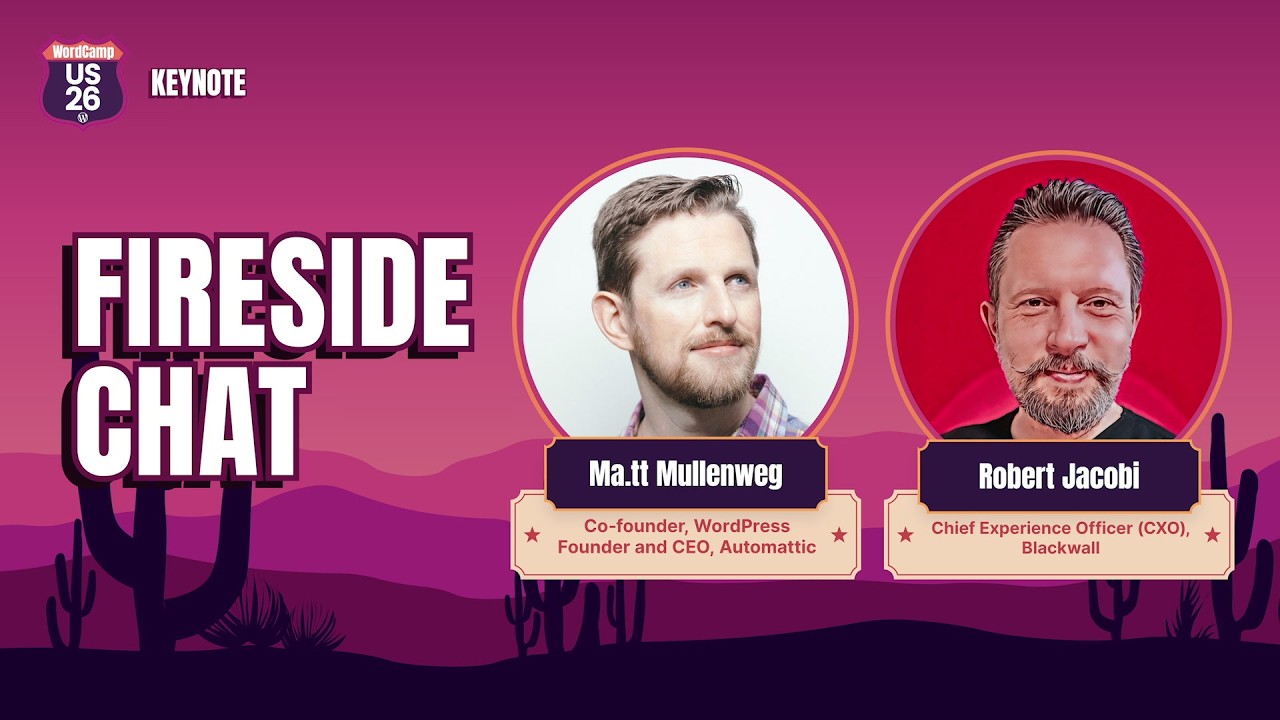
🔗 **Source:** [Keynote – Fireside Chat With Ma.tt Mullenweg & Robert Jacobi](https://www.youtube.com/watch?v=ss7ngc1VU-Q)
> [!note]+ Document Notes
> tags: [wordpress, matt-mullenweg, wordcamp-us, ai-in-open-source, five-for-the-future, wp-engine-litigation, plugin-directory-governance, open-source-collaboration]
> author: Matt Mullenweg, Robert Jacobi (WordCamp US)
> source: YouTube
> reference: Keynote – Fireside Chat with Matt Mullenweg & Robert Jacobi, WordCamp US 2026, Phoenix AZ
> date created: 2026-08-20
>
> > [!info] Generated analysis — not the author's words. Sections below are machine-written
> > from the captured source. Only text inside `> [!quote]` blocks is verbatim from the author.
> > Do not quote or attribute any other line to the named author.
>
> # 🏷️ Title: Keynote – Fireside Chat with Matt Mullenweg & Robert Jacobi
>
<!-- deep-read:sections start -->
## 🧭 Table of Contents
1. Summary
2. Main Content (with timestamped Notes)
3. References
4. Paraphrase
5. Newsletter
6. Action Items
7. Hypotheses
8. Methodology
9. Questions
10. Future Research
11. Implications
12. Learning Styles Assessment
13. Accessibility Assessment
14. DEIB Assessment
15. Logical Validity
16. DARVO Analysis
17. Conclusion
18. Refactor Appendix
19. Template Library
## 🔗 References (in-page)
- [Summary](#-summary)
- [Main Content](#-main-content)
- [Paraphrase](#-paraphrase)
- [Action Items](#-action-items)
- [Refactor Appendix](#-refactor-appendix)
## 📝 Summary
**What happened:** Matt Mullenweg (WordPress co-founder, Automattic CEO) closed WordCamp US 2026 in Phoenix with an unscripted "fireside chat" hosted by Robert Jacobi, replacing the traditional keynote-plus-lined-up-microphones Q&A format with a looser conversation (each participant holds one "veto card" to skip an off-topic question) followed by open audience Q&A. Phoenix's Chief Innovation Officer Michael Hamway opened by reading a mayoral proclamation naming August 19 "Phoenix WordCamp Day." The conversation ranged across: cleaner WordPress.org profile URLs (a same-day-shipped redirect feature), a "midwit meme" framing of whether WordPress is currently in a complexity trough between simplicity and hard-won simplicity-through-mastery, the state of open-weight/open-source LLMs (Qwen, DeepSeek, Kimi, GLM) closing the gap with frontier labs at a fraction of the cost, a revival of a 2007 self-contained single-file PHP project ("PHPlets"/"Piplets") as a database-free, no-dependency alternative to a full WordPress install, Five for the Future contributor-metric skepticism, plugin-directory incentive redesign, and a Q&A covering AI copyright status, book-scanning/training-data ethics, data center ecological impact, and interproject (WordPress/Joomla/Drupal) rivalry.
**Why it matters:** This is a primary, on-the-record source from WordPress's co-founder delivered days after (Mullenweg's own words) "this uh uh WPO survey ... that just came out was a good reminder how much people dislike AI" — an apparent direct reference to community pushback on Automattic/WordPress's AI push, plausibly the WPOCC "State of the Community 2026" survey given its timing and the audience's approving reaction. He also explicitly attributes part of WordPress's declining usage-share statistics to WP Engine no longer using the WordPress.org update server — tying a technical/product statistic directly to the ongoing Automattic–WP Engine dispute in a public forum, on the record, unprompted by a direct question about the litigation. Separately, he states plainly that current Five for the Future numbers (150,000 "contributors," 51,000 "sponsoring" companies) do not reflect reality and calls the program's current accounting "broken" — a notable public admission about a flagship WordPress governance/contribution program's data integrity, delivered in the same event cycle as the WPOCC's governance critique.
**Stakeholders:** Mullenweg and Automattic; the WordPress Five for the Future program and its listed contributors/sponsors; the Plugin Team and plugin directory ecosystem; WP Engine (referenced, not present); the WPOCC and community members surveyed on AI sentiment; Joomla and Drupal (interproject relationship); WordCamp US organizers and the City of Phoenix; open-weight AI labs (Alibaba/Qwen, DeepSeek, Moonshot/Kimi, Zhipu/GLM) referenced as comparators to "frontier" labs (Anthropic, OpenAI, Google).
**Risks:** (1) The unscripted, conversational format produces off-the-cuff numeric claims (contributor counts, cost-reduction multiples, model-performance comparisons, water/energy statistics) that are asserted without citation and should not be treated as verified figures without independent sourcing. (2) The WP Engine stat attribution and the Five for the Future "broken" admission are both consequential governance claims made informally in a fireside chat rather than a written statement — downstream synthesis should flag them as spoken remarks, not official position papers. (3) The AI-sentiment acknowledgment ("people dislike AI," "huge branding problem," "campaigning against it") is Mullenweg's own framing of community pushback as a branding/naming problem rather than, e.g., a governance, consent, or labor-impact problem — this framing is worth holding up against the WPOCC survey's own framing of the same discontent.
**Bottom line:** A wide-ranging, informal but substantive fireside chat that (a) previews a revived "PHPlets" self-contained-PHP-file project, (b) contains a rare direct, on-the-record acknowledgment from Mullenweg that WordPress statistics are affected by the WP Engine dispute and that Five for the Future's headline numbers don't reflect reality, and (c) shows Mullenweg responding to community AI-fatigue signals (plausibly including the WPOCC survey) by proposing a rebrand ("automation" instead of "AI") rather than a substantive change of course.
## 📖 Main Content
### 🗒️ Notes (timestamped segments, MM:SS from transcript)
- **[00:04–01:34]** Opening/housekeeping. Robert Jacobi (chief experience officer, company name transcribed unclearly as "Black Wall" — likely an ASR mis-hearing) welcomes the closing keynote. Phoenix Chief Innovation Officer Michael Hamway (name transcribed "Michael Hammet"/"Hammed" — ASR artifact) delivers a mayoral proclamation on behalf of Mayor Kate Gallego (transcribed "Kaygo"/"Ggo") naming August 19 "Phoenix WordCamp Day," citing WordPress's support for small businesses, developers, designers, and educators.
- **[01:34–04:20]** Mullenweg and Jacobi introduce the "fireside" format as a departure from lined-up-microphone Q&A; establish a mutual one-veto-per-person rule for off-topic questions. Mullenweg gives his social handles (photomatt on Tumblr/X, mattt on Bluesky) and pivots into a live product announcement: shortened WordPress.org profile URLs (`w.org/<username>`) — he states the redirect was "implemented yesterday" and full short-URL support is coming "in a few days." He proposes people display `.org` profile/blog URLs on conference badges instead of other social handles, and floats syncing Gravatar data with `.org` profiles.
- **[04:20–07:10]** Thesis statement: "basically sort of the thesis of what was going to be a much longer talk is that technology needs to enter the phase of making things simpler." Introduces the "midwit meme" (bell-curve internet meme contrasting naive simplicity, complex middle-stage overthinking, and hard-won simplicity/mastery) and asks whether WordPress/"we" are currently in the complex middle stage.
> [!quote] "so meaning that have we taken things that could be simple and added a lot of complexity and I actually think we often do this in life... I think right now with the current state of like LLMs and AI and everything like that, they often make very wordy complex solutions unless you guide it really well... as the models are getting smarter and smarter and smarter, they're making simpler solutions to things, which I think is so cool."
- **[07:10–12:00]** Open-weight AI model discussion. Names DeepSeek, Qwen (Alibaba, transcribed "Quinn"), Kimi (Moonshot, transcribed "Kimmy"/"K3"), and GLM (Zhipu) as Chinese labs closing the gap with US "frontier labs" (Anthropic, OpenAI, with Google "catching up"). Claims a recent Qwen release performs comparably to "Opus 5.6" at roughly 1/120th the cost and can run locally on a MacBook. Pivots to jobs/AI-anxiety: frames layoffs as "business model transitions," predicts more solo-operator/small-team high-revenue companies, and gets pushback from Jacobi on token affordability, to which Mullenweg reiterates the falling cost curve. Flags frontier-lab valuation/investment levels as a possible recession risk but downplays it, citing AI-assisted breakthroughs in math and medicine.
- **[12:00–14:30]** Format/portability tangent: argues HTML (not Markdown) is becoming the preferred self-contained output format for AI-generated "artifacts" because it can embed CSS, JS, and even media as data URIs in one file; criticizes WordPress/Gutenberg's current front-end HTML output as needlessly cluttered with block comments. Digresses into a personal history connecting T.S. Eliot annotation culture to the "kodus"/Genius (Rap Genius) annotation product and his early investment in it.
- **[14:30–20:10]** "WordPress Piplets" ("PHPlets") reveal — a revival of a circa-2007 project (built originally with collaborators including "Andy" and "Michael") reworked with a colleague ("Dan"). Described as a single, self-modifying PHP file with no database and no third-party packages, which appends its own data (arrays/JSON) to itself on save. Cites a benchmark: within 128 MB of memory it can store up to 25 MB of data (roughly 4 million words, described as larger than "over half... of all the WordPresses that we measure") and load in about 50 milliseconds. States intent to publish a GitHub repo, host a directory on WordPress.org, make entries "social" (remixable/forkable), and — with AI assistance — transpile the concept into other languages (Python, Ruby, Kotlin, Zig). Licensing undecided in the moment; Jacobi pushes for GPL3, Mullenweg leans MIT ("because again there's no reason for this to... it's kind of self-contained and you run it yourself").
- **[20:10–22:30]** Open-source-and-AI Q&A branch (audience-adjacent, still in the scripted portion): whether open source will be displaced by AI-generated code. Mullenweg cites GitHub's reported "6x in six months" growth and general open-source growth stats (unsourced, self-described as approximate), argues code generation getting cheap is "orthogonal" to open source's value (collaboration, license/rights, finding existing working code), and notes tech figures (cites Gary Tan) becoming open-source evangelists partly because training data itself draws heavily on open-source code.
- **[22:30–24:00]** Anecdote about a "top politician" describing a coalition of ideologically opposed constituents (caricatured as a "radical Berkeley" archetype and a conservative archetype) both opposing data centers in their district — used to illustrate that AI/data-center backlash crosses political lines.
- **[24:00–26:00]** Live product-announcement interlude: WordPress 7.1 release button ceremony — reports "1.4 million downloads" and "330,000" updates already at release, delivered by named release leads (Ann, Benjamin).
- **[26:00–31:30]** Five for the Future segment. States current weekly figures — roughly 2 million self-sponsored contribution hours pledged, from "150,000 contributors," with "51,000 companies sponsored" — and directly questions their accuracy in front of the room.
> [!quote] "So are these numbers surprising to anyone else? Yeah. Do we actually have 150,000 contributors? No, not at all... I'm not saying that contribution isn't important or the concept of five for the future isn't important. It's just right now the way the directory is working and the way we're highlighting this I don't think is in line with reality."
Proposes shifting measurement from self-reported "commitments" to observable actions (commits, posts, tickets closed, WordCamp organizing/attendance, foundation donations).
- **[31:30–36:00]** Plugin directory reform discussion. States a philosophy shift — "I would argue we maybe don't need more plugins anymore... We need maybe fewer things that work better" — references the "Protect the Shire" initiative's forthcoming automated scanning of plugin-directory updates for security/trust, praises Nick Hamze's editorial new-plugin-highlight effort, and expresses nostalgia for WP Tavern's plugin reviews with a stated intent to "bring that back." Floats reordering directory incentives around pro-social open-source participation rather than a strict commercial/non-commercial split, explicitly distinguishing this from "commercial bad, non-commercial good," and invokes his long-standing "conscious capitalism" framing.
- **[36:00–37:00]** Mullenweg explicitly connects the segment to the AI-sentiment moment:
> [!quote] "I'll say that, you know, this uh uh WPO survey or whatever that just came out was a good reminder how much people dislike AI... I wonder if something we've been doing wrong is actually emphasizing AI too much because we're kind of technic[al]... I think we might just need to rebrand some of what we're doing and not call it AI, call it automation or just something else... there's a huge branding problem right now and actually a lot of campaigning against it."
Note: the survey is referred to only as "WPO survey" in the transcript (ASR-garbled); given the timing and audience reaction, this plausibly refers to the WPOCC "State of the Community 2026" survey, but the transcript does not name the organization explicitly and this identification should be treated as probable, not confirmed.
- **[37:00–46:00]** Open audience Q&A. Topics in order: (1) AI Bill of Materials feature — reports 1.4 million downloads and 330,000 updates for the plugin-directory disclosure feature. (2) Copyright status of AI-generated open-source contributions — states his understanding that purely AI-generated output currently carries no copyright in the US per Copyright Office guidance, that modifying an existing file is a different question, and that contributors are "attesting" to license compliance. (3) Training-data ethics tangent: describes AI companies buying and scanning rare/out-of-print books, in some cases destroying them after scanning per court rulings, calling it "the loss of a library of Alexandria in some ways" (audience compares it to Fahrenheit 451). (4) Ecological impact of AI data centers — pushes back on water-usage narratives (claims self-contained/recirculating cooling, compares consumption to a "small percentage" of US golf-course water use), acknowledges backup gas-turbine power generation as a real but "interim" and comparatively modest pollution source, concedes noise/construction impacts as legitimate and mitigable (sound barriers), and proposes designing data centers as public-facing amenities (libraries, public internet access) citing "Switch" as an aesthetically notable example; states Automattic does not build data centers but colocates in roughly 32–33 facilities. (5) Interproject rivalry (WordPress/Joomla/Drupal) — discloses he invited Dries Buytaert (Drupal founder, referred to only as "Dre" in transcript) to WordCamp US, references a past joint appearance with Buytaert and Mike Little in London, and frames open-source licensing as designed for cross-project code sharing. States that per W3Techs, WordPress/Joomla/Drupal used to hold the top-three usage-share ranks and have since been overtaken in some rankings by Shopify and Squarespace, while WordPress itself remains #1 overall "with a little bit [of] wobbliness."
> [!quote] "some of the things that looks like it go down might actually be related to WP Engine uh, not using the WordPress.org update server anymore. So that's now affecting the stats and like the plug-in directory and some of the other stats that we have. The download stats and update stats, none of those sites are included in them."
Also questions W3Techs' methodology given "zombie sites" and spam, and states WordPress.org has begun "spidering the entire web" to build first-party usage statistics.
- **[46:00–end]** Closing. Notes an unusually high count of first-time WordCamp attendees this cycle and partly credits AI-assisted discovery (an anecdote about someone asking an AI assistant for local events, being pointed to WordCamp, attending Contributor Day, and winning an award). Ends on Mullenweg's stated preference for interproject collaboration over rivalry.
## 📚 References (primary sources preferred)
- Primary: this fireside-chat transcript itself (WordCamp US 2026 closing keynote, Phoenix, AZ) — the only primary source captured for this analysis.
- Referenced-but-not-linked by the speakers (not independently verified here, flagged for follow-up): the WordPress.org Five for the Future directory statistics; W3Techs CMS market-share rankings; the WordPress 7.1 release; the "Protect the Shire" plugin-security initiative; a "WPO survey" on community AI sentiment (probable WPOCC "State of the Community 2026" survey, unconfirmed by name in-transcript); US Copyright Office guidance on AI-generated works; Automattic's data center colocation footprint.
- Not applicable: this source contains no citations, bibliography, or study data of its own to catalog — all "references" above are entities mentioned in the conversation, not sources the transcript itself cites in written form.
## 🗣️ Paraphrase (paragraph-by-paragraph)
1. Phoenix's Chief Innovation Officer opens with a mayoral proclamation for "Phoenix WordCamp Day," framing WordPress's civic and economic value to the city before handing off to Mullenweg.
2. Mullenweg and Jacobi introduce a new unscripted "fireside" format with a mutual veto rule, then Mullenweg announces a same-day-shipped feature: shorter WordPress.org profile URLs, with a request that the community promote `.org` profiles over other social platforms on badges and bios.
3. Mullenweg frames his core thesis — that technology (and WordPress specifically) needs to move toward simplicity — using the "midwit" meme to ask whether the project is currently stuck in an over-complicated middle phase, and connects this to an observation that smarter AI models are trending toward simpler outputs.
4. A survey of the open-weight AI landscape follows: Chinese labs (DeepSeek, Qwen, Kimi, GLM) are described as closing in on US frontier labs at dramatically lower cost, which Mullenweg uses to argue AI-driven job disruption is really a "business model transition" that will favor small, independent teams.
5. Mullenweg argues HTML is overtaking Markdown as the preferred format for self-contained, portable AI-generated "artifacts," and pivots to criticizing WordPress's own front-end HTML output as unnecessarily cluttered — with a personal digression about T.S. Eliot's influence on the creation of Genius (Rap Genius).
6. He unveils a revived 2007-era side project, "PHPlets"/"Piplets" — a self-contained, database-free, single-file PHP application format with a specific memory/performance benchmark — and proposes a WordPress.org directory for community-submitted, forkable examples, potentially transpiled into other languages via AI.
7. A short discussion questions whether open source becomes obsolete as AI makes code generation cheap; Mullenweg argues code generation and open source's value (collaboration, licensing, reuse) are separate axes, and that many in tech have become more pro-open-source specifically because AI training relies so heavily on it.
8. A political anecdote illustrates that opposition to AI data centers crosses ideological lines, before a live interlude celebrating WordPress 7.1's release numbers.
9. Mullenweg publicly casts doubt on the accuracy of Five for the Future's headline contributor and sponsor numbers, proposing to replace self-reported "commitments" with observable, verifiable actions.
10. He describes a philosophical shift for the plugin directory — favoring fewer, better plugins, automated security scanning via "Protect the Shire," reviving WP Tavern-style editorial plugin reviews, and re-weighting incentives toward pro-social open-source participation rather than a commercial/non-commercial split.
11. He directly links this discussion to community pushback on AI, citing a recent survey ("WPO survey") as evidence people are tired of AI messaging, and proposes a branding fix — calling AI efforts "automation" instead — rather than describing a change in substance.
12. Audience Q&A opens with the AI Bill of Materials feature's adoption numbers, then covers AI-generated-content copyright status (currently uncopyrightable if purely AI-generated, per his understanding of US Copyright Office guidance), and a tangent on AI companies scanning and sometimes destroying rare books for training data, which he likens to the loss of the Library of Alexandria.
13. On data center ecological impact, Mullenweg rebuts water-usage concerns as overstated, acknowledges real but "interim" pollution from backup power generation, concedes noise/construction complaints as legitimate, and proposes designing future data centers as public amenities; he clarifies Automattic colocates rather than builds its own facilities.
14. On interproject rivalry with Joomla and Drupal, he discloses inviting Drupal's founder to WordCamp, frames the tribalism as counterproductive to shared open-source goals, and — asked to explain declining market-share statistics — attributes part of the apparent decline directly to WP Engine no longer reporting through the WordPress.org update server, while also questioning W3Techs' broader measurement methodology.
15. The session closes on an observation that WordCamp drew an unusually large number of first-time attendees this year, crediting AI-assisted event discovery in part, and ends on a stated preference for cross-project collaboration over rivalry.
## 📰 Newsletter
**WordPress-focused, witty, with links** — *(links below are placeholders; substitute canonical URLs before publishing, as this source transcript contains no linkable citations of its own)*
**Matt Mullenweg walks so fireside chats don't have to.** WordCamp US's closing keynote ditched the slide deck for a couch chat with Robert Jacobi — and it turns out unscripted Matt is a font of scoops. Headline #1: `.org` profile URLs just got shorter (`w.org/username`, full rollout "in a few days") — so update your badge before your Twitter handle does it for you. Headline #2: a 2007-vintage side project called PHPlets is back from the dead — a single self-contained PHP file with zero database and zero dependencies, benchmarked at 25 MB of data in 128 MB of RAM, loading in ~50ms. It's basically WordPress in a bottle, and Matt wants a whole remix-able directory of them on .org. Headline #3, the one that'll get quoted everywhere: Mullenweg told a packed room that Five for the Future's "150,000 contributors" figure isn't real, and that the way the program measures commitment "isn't in line with reality." Headline #4: he also said, out loud, unprompted, that part of WordPress's stat dip traces to WP Engine no longer pinging the .org update server — which is either a mundane data-hygiene note or a pointed remark depending on how much litigation history you're bringing to the room. And headline #5: days after community survey results reportedly showed AI fatigue running high, Matt's proposed fix is... a rename, from "AI" to "automation." Read into that what you will. WP Tavern-style plugin reviews are apparently coming back too, for whatever it's worth. Full transcript in the deep-read notes.
## ✅ Action Items
*(DevRel / OSPO / Community / WordPress subteams / The WPOCC / FAIR — derived from stated intentions in the conversation; none of these are commitments made by Courtney or her team, they are actions the speakers described or implied WordPress-side teams should take)*
- **Core / Meta:** Ship the full short-form WordPress.org profile URL feature (`w.org/<username>`) beyond the current redirect-only state.
- **Community / Five for the Future:** Redesign Five for the Future's measurement methodology to reflect verifiable actions (commits, posts, tickets, WordCamp organizing/attendance, donations) rather than self-reported pledges, per Mullenweg's stated dissatisfaction with current numbers.
- **Plugins:** Implement the "Protect the Shire" automated scanning of plugin-directory updates; revive editorial/reviewed plugin-highlight content (WP Tavern-style); redesign directory ranking incentives around pro-social open-source participation.
- **Marketing / Comms:** Decide whether to formally rebrand internal/public "AI" messaging as "automation" per Mullenweg's stated intent, and reconcile this with the WPOCC survey's substantive (not just branding) critique of AI emphasis — see DARVO Analysis below for a caution on treating this as a full response.
- **Training / Documentation:** Clean up Gutenberg's front-end HTML output (block comments) per Mullenweg's stated critique, if pursued as a technical follow-up.
- **The WPOCC:** Cross-reference this transcript's "WPO survey" reference against the WPOCC's own "State of the Community 2026" survey publication timeline to confirm or rule out the identification, given its relevance to the WPOCC's governance-critique narrative.
- **Core Program Team / Governance:** Document and publicly reconcile the stated WP Engine attribution for declining usage statistics with any official Automattic/WordPress.org communications on the litigation's operational effects.
- **FAIR:** Not applicable to this source — the transcript does not mention FAIR (the WordPress ecosystem's federated identity/authentication initiative) at all.
## 🧪 Hypotheses
1. The "WPO survey" reference is the WPOCC's "State of the Community 2026" survey, and Mullenweg's on-stage acknowledgment constitutes an indirect, public response to its findings.
2. Five for the Future's forthcoming metric redesign (if implemented) will show a significant downward revision in officially reported "active contributor" counts once self-reported pledges are replaced with observable-action tracking.
3. WordPress's measured usage-share decline in third-party trackers (W3Techs) is partially, not wholly, attributable to WP Engine's disconnection from the WordPress.org update server, with the remainder attributable to genuine market dynamics (Shopify/Squarespace growth, "zombie site" undercounting).
4. The PHPlets/"Piplets" revival will primarily attract experimentation from hobbyists and AI-tooling builders rather than production WordPress users, given its explicit no-database, single-file design constraints.
5. Framing AI community pushback as a "branding problem" (rename to "automation") will not resolve the underlying sentiment measured by community surveys, because the stated concerns (per the survey reference) are about emphasis and trust, not terminology.
6. Plugin-directory incentive redesign toward "pro-social participation" will generate contested debate about how "pro-social" is defined and scored, similar to past disputes over commercial-vs-community plugin visibility.
## 📊 Methodology
This source is a live, unscripted conversational transcript (fireside chat + open audience Q&A), not a study — it contains no research methodology of its own. Notable methodology-adjacent caveats for downstream use:
- **Transcript quality:** This is an auto-generated/ASR transcript with visible artifacts — misheard names ("Ma.tt" for "Matt," "Michael Hammet"/"Hammed" for the Phoenix official, "Kaygo"/"Ggo" for Mayor Gallego, "Quinn" for Qwen, "Kimmy"/"K3" for Kimi/K2, "pip lit"/"piplets" for what is very likely "PHPlets," "Black Wall" for Jacobi's employer, "Dre" left unexpanded for Dries Buytaert, "Chad" possibly "ChatGPT"). Names and product identifications above are best-effort reconstructions and should be verified against an official WordCamp US recording or transcript before being treated as authoritative.
- **All statistics cited by Mullenweg in this talk (contributor counts, cost multiples, model performance comparisons, water/energy comparisons, download/update counts, W3Techs rankings) are spoken, unsourced, and in several cases explicitly hedged by him as approximate ("I'm going to make up the numbers," "arbitrary... number I chose"). None should be cited as verified data without independent confirmation.**
- No data collection, sampling, or analysis method is described anywhere in this transcript — it is a conversation, not a study.
## ❓ Questions
- What organization/publication does "this uh uh WPO survey" actually refer to — is it confirmed to be the WPOCC's "State of the Community 2026" report, or a different survey?
- What specific mechanism will replace Five for the Future's current self-reported-pledge model, and on what timeline?
- Has WordPress.org published (or will it publish) an official statement quantifying how much of its measured usage-share decline is attributable to WP Engine's update-server disconnection versus other factors?
- Is the "PHPlets" project's source code and benchmark methodology publicly available for independent verification of the stated 25 MB/128 MB/50ms figures?
- Will the proposed "automation" rebrand of AI messaging be adopted formally, and if so, does community sentiment (per follow-up surveys) actually improve, or does the underlying concern persist under new terminology?
- What licensing model (MIT vs. GPL2+/GPL3) will the PHPlets project ultimately adopt, and does that choice affect its intended remix/fork/social directory model?
- Is Dries Buytaert's WordCamp appearance (referenced as already invited) confirmed and scheduled?
## 🔮 Future Research
- A structured comparison of the WPOCC "State of the Community 2026" survey's stated AI concerns against Mullenweg's "branding problem" framing in this talk, to assess whether the two are addressing the same underlying issue.
- An independent audit of Five for the Future's current versus reformed contributor-metric methodology once (if) it is redesigned.
- A quantitative breakdown, from WordPress.org or a third party, isolating WP Engine's specific contribution to recent CMS-market-share statistic movements.
- Technical evaluation of the PHPlets/single-file-PHP concept against existing lightweight/serverless PHP patterns (e.g., SQLite-based WordPress via Playground, flat-file CMSs) for security and scalability tradeoffs at higher data volumes than the 25 MB benchmark.
- Tracking whether the "Protect the Shire" automated plugin-scanning initiative ships, and its measurable effect on plugin-directory security incident rates.
## 💡 Implications
- **Practice:** Plugin and theme authors should watch for incentive-ranking changes in the WordPress.org directory (pro-social participation weighting) that could affect discoverability independent of download counts.
- **Policy/Governance:** A public, on-the-record admission that a flagship governance program's (Five for the Future) headline metrics are "not in line with reality" is a meaningful data point for any ongoing assessment of WordPress project governance transparency — worth cross-referencing against WPOCC governance-critique material already in the vault.
- **Security:** The "Protect the Shire" automated scanning initiative, if implemented, is directly relevant to plugin-directory security posture and should be tracked by anyone doing WordPress plugin security work.
- **Education/Community:** The stated intent to revive WP Tavern-style editorial plugin reviews and new-plugin discovery efforts is relevant to WordPress community education/content strategy planning.
- **Funding/Sponsorship:** If Five for the Future's sponsor-hours accounting changes, organizations that currently cite Five for the Future participation in marketing or governance-influence contexts may see their reported figures revised.
## 🧠 Learning Styles Assessment
- **Visual:** Low support — this is an audio/conversational source with no slides described in detail (Mullenweg states he cut most of his prepared slides); a viewer benefits from watching hand gestures/demos referenced (e.g., pointing at a laptop) but the transcript alone conveys none of this.
- **Aural:** High support — native format is spoken conversation; tone, humor, and audience reaction (laughter, applause cues) are integral to meaning, especially around the Five for the Future and AI-sentiment moments.
- **Verbal (reading/writing):** Moderate — the transcript is readable but colloquial, tangential, and non-linear; requires editorial reconstruction (as done in this analysis) to extract discrete claims.
- **Kinesthetic:** Low — no hands-on activity; the PHPlets demo was explicitly not performed live ("you're not going to do a live demo, are you? ... Oh, please not. No.").
- **Logical/Mathematical:** Moderate — contains several numeric claims (contributor counts, cost ratios, memory/performance benchmarks) that reward a reader who wants to fact-check and reconstruct the underlying math, though the source itself does not show its work.
- **Social:** High — the entire format is built around live audience interaction, veto-card banter, and Q&A; highly social by design.
- **Solitary:** Low-moderate — better suited to shared/community consumption (a conference audience) than solitary deep study, though the written transcript enables solitary analysis after the fact.
- **Naturalistic:** Low, with one exception — the data-center ecological-impact Q&A segment touches directly on environmental/resource themes (water use, energy, land use).
- **Estimated reading level:** Conversational/colloquial, roughly Flesch-Kincaid grade 6–8 for the raw transcript (short clauses, interruptions, informal register) — notably lower complexity than the technical/governance content it covers would suggest, because it's spoken rather than written prose.
## 📊 Accessibility Assessment (WCAG 2.2 AA mapping)
- **Text alternatives:** Not applicable to the transcript itself; the source video (not reviewed here) should be checked for captions/audio description compliance independently.
- **Time-based media:** The existence of this transcript is itself a positive accessibility signal (1.2.1/1.2.2 equivalents) — but the transcript as captured has no speaker-diarization labels beyond ">>", making it hard for screen-reader users to distinguish Mullenweg, Jacobi, Hamway, and audience members reliably. Recommend adding speaker labels if this is repurposed as a formal accessibility-compliant transcript.
- **Adaptable/distinguishable:** Not applicable — this is a text/notes artifact, not a UI, so contrast/resize criteria don't apply directly; downstream publishing (e.g., Obsidian Publish) should independently verify.
- **Navigable:** The timestamped Notes section above partially compensates for the source's lack of chapter markers, aiding navigation for anyone jumping to a specific topic.
- **Input modalities:** Not applicable — no interactive controls in this source.
- **Predictable/Input assistance:** Not applicable — conversational source, not a form or interface.
- **Cognitive/language clarity:** Moderate concern — heavy use of in-group jargon (Five for the Future, GPL2-vs-3, W3Techs, Protect the Shire) without definition; a reader unfamiliar with WordPress governance terms would struggle without supplementary glossing (partially addressed in this analysis's Main Content notes).
## 🌍 DEIB Assessment
- **Cultural breadth:** Narrow — the AI-model discussion centers US and Chinese labs; the open-source-rivalry discussion centers WordPress, Joomla, and Drupal (all historically Western/European-founded projects); no mention of open-source communities outside this axis.
- **Inclusive language:** Generally casual and inclusive in tone (no exclusionary language observed); one aside jokes about political stereotypes ("radical Berkeley," conservative "camo and a gun" caricature) — played for humor to illustrate cross-partisan data-center opposition, but relies on reductive stereotypes of both ends of the US political spectrum.
- **Neurodiversity support:** The unscripted, tangent-heavy, interruption-rich conversational style (frequent topic jumps, unfinished thoughts, in-jokes) may be harder to follow for some neurodivergent readers/listeners than a structured talk; the format itself (fireside vs. traditional keynote) was an explicit accessibility/engagement tradeoff decision by the organizers, not accidental.
- **Representation:** The two on-stage principals (Mullenweg, Jacobi) and the Phoenix city official are the primary voices; audience question-askers are not identified by name/role consistently in the transcript (first names only, e.g., "Michelle," partial identification of "Tempest").
- **Psychological safety:** The room's audible laughter/applause at the "people dislike AI" and "Five for the Future numbers aren't real" moments suggests an environment where public skepticism of leadership claims was tolerated and even welcomed — a positive signal for open critique within this specific event, worth noting alongside the WPOCC's broader governance-trust concerns.
## ✅ Logical Validity
**Strong reasoning:**
- The distinction drawn between "code generation getting cheap" and "open source's value" (collaboration, licensing, discoverability of existing solutions) as separate axes is a coherent, well-formed argument against a common "AI kills open source" claim.
- The Five for the Future critique is self-aware and specific — Mullenweg names the actual numbers, states the room's likely skepticism preemptively ("Do we actually have 150,000 contributors? No, not at all"), and proposes a concrete alternative (measure actions, not pledges) rather than just asserting a problem.
**Fallacies:**
- **Hasty generalization / anecdotal evidence** — the "AI drove first-time WordCamp attendance" claim rests on a single secondhand anecdote (a person who asked an AI assistant for local events) generalized into "we can thank AI for that at least a little bit." *Location:* closing segment, ~[46:00]. *Fix:* would need attendance-survey data on discovery channels to support the causal claim.
- **False dilemma (implicit)** — "call it automation or just something else" is presented as a fix for AI-fatigue sentiment, implicitly treating the problem as nomenclature rather than engaging with whether the underlying substantive concerns (raised by the referenced survey) require a different kind of response. *Location:* [~36:00–37:00]. *Fix:* explicitly separate "communications framing" from "substantive policy response" rather than conflating them.
- **Appeal to authority without citation** — multiple numeric claims (GitHub "6x in six months" growth, water-use comparisons to golf courses/almonds, Qwen-vs-Opus performance parity) are stated with confidence but no source, some explicitly flagged by the speaker himself as approximate. *Location:* throughout [07:10–12:00] and [37:00–44:00]. *Fix:* cite the underlying reports/benchmarks if these figures are to be used as evidence downstream.
**Tone of voice:** Informal, self-deprecating, digression-tolerant, frequently humorous; comfortable with public self-correction (e.g., openly walking back Five for the Future's numbers) and with fielding adversarial-leaning audience questions (data center ecology, AI copyright, interproject rivalry) without defensiveness in tone, even where the content itself is more evasive on substance (see DARVO note below).
## 🛡️ DARVO Analysis
DARVO (Deny–Attack–Reverse Victim and Offender) is a framework for analyzing responses to accusations of wrongdoing; it is applied cautiously here because this transcript is a casual conversation, not a direct response to a formal accusation, and forcing the frame where it doesn't fit would misrepresent the source.
- **Deny:** No direct denial pattern observed regarding the WP Engine-related statistics comment — Mullenweg states the WP Engine/update-server effect on statistics as a factual aside rather than denying an allegation. Not applicable in the classic DARVO sense here.
- **Attack:** Not observed — no counter-accusation is leveled against WP Engine, the WPOCC, or survey respondents in this transcript; the tone toward the "people dislike AI" finding is described as a "good reminder," not disputed or attacked.
- **Reverse victim-offender:** Not observed in this transcript. Worth flagging for cross-reference: the proposed "rebrand AI as automation" response could be read by a skeptical audience as sidestepping substantive criticism rather than directly engaging it, but this is a framing/response-adequacy critique, not a DARVO pattern — no victim/offender reversal language appears in the source.
**Overall:** This source does not exhibit DARVO dynamics. It is included here per the mandatory template structure; the honest finding is "not applicable, with the caveat above about response adequacy versus substance," rather than a false-positive DARVO flag.
## 🎯 Conclusion
**Bottom line:** This fireside chat is most valuable as a primary-source data point for two specific, quotable, on-the-record claims from Mullenweg: (1) that Five for the Future's headline contributor/sponsor metrics are acknowledged by him as not reflecting reality, and (2) that part of WordPress's measured usage-share decline is directly attributed by him to WP Engine's disconnection from the WordPress.org update server. Both are directly relevant to any ongoing tracking of WordPress governance transparency and the Automattic–WP Engine dispute. The AI-sentiment acknowledgment (referencing what is plausibly the WPOCC survey) shows Mullenweg is aware of community pushback but frames the response as branding rather than substance — a gap worth watching in future communications. Everything else (PHPlets revival, AI model landscape commentary, data center Q&A) is substantive but should be treated as informal, unsourced commentary rather than verified fact or official policy.
**Next steps:**
1. Confirm the "WPO survey" identification against the WPOCC "State of the Community 2026" report's publication date and content.
2. Track whether Five for the Future's metric methodology is actually revised, and compare before/after contributor counts.
3. Watch for any official WordPress.org/Automattic statement quantifying the WP Engine effect on usage statistics, to compare against this informal spoken estimate.
4. Watch for the PHPlets GitHub repository and WordPress.org directory launch.
## 🧱 Refactor Appendix
### 📚 Literature Split Pad
#### H1 — Strongest evidence-based claims
- **[L-H1-1]** Mullenweg states Five for the Future's reported ~150,000 "contributors" and 51,000 sponsoring companies do not reflect reality, and proposes replacing self-reported pledges with observable-action tracking. *(Timestamp ~[27:00–29:00])*
- **[L-H1-2]** Mullenweg attributes part of WordPress's declining third-party usage-share statistics directly to WP Engine no longer using the WordPress.org update server. *(Timestamp ~[44:00])*
#### H2 — Secondary evidence claims
- **[L-H2-1]** A recent open-weight model (referred to as "Quinn 3.8," likely Qwen3) is claimed to perform comparably to "Opus 5.6" at roughly 1/120th the inference cost and to run locally on a MacBook. *(Timestamp ~[08:30–09:30])*
- **[L-H2-2]** The revived PHPlets project benchmarks storage of up to 25 MB of data within 128 MB of memory, loading in ~50ms, with no database dependency. *(Timestamp ~[17:00–18:00])*
- **[L-H2-3]** Per US Copyright Office guidance as Mullenweg understands it, purely AI-generated output currently carries no copyright in the US; modifying an existing file raises separate questions. *(Timestamp ~[38:30–39:30])*
#### H3 — Supporting context
- **[L-H3-1]** Reference to "this uh uh WPO survey" as evidence of community AI fatigue, prompting the proposed "automation" rebrand. *(Timestamp ~[36:00–37:00])*
- **[L-H3-2]** WordPress 7.1 release-day figures reported live: 1.4 million downloads, 330,000 updates. *(Timestamp ~[25:00])*
- **[L-H3-3]** AI companies reportedly buying, scanning, and in some cases destroying rare/out-of-print books for training data, per court-ordered destruction requirements as described by Mullenweg. *(Timestamp ~[40:30–41:30])*
- **[L-H3-4]** Automattic colocates in roughly 32–33 data center facilities rather than building its own. *(Timestamp ~[44:30])*
### 🔖 Atomic Split Pad (Zettel candidates)
- **[Z-1]** *WordPress governance metrics can be publicly disavowed by leadership without formal process* — Five for the Future's numbers were called "not in line with reality" in an informal fireside chat, not a governance proposal or blog post — worth tracking whether this becomes formal policy or remains an unactioned aside.
- **[Z-2]** *Litigation-adjacent statistics get stated casually in public forums* — the WP Engine/update-server statistic attribution is a data point for tracking how the ongoing dispute surfaces in unscripted public communications versus formal statements.
- **[Z-3]** *"Rebrand AI as automation" is a communications strategy, not a policy change* — useful atomic concept for comparing stated versus substantive responses to community feedback across WordPress project communications generally.
- **[Z-4]** *Single-file, database-free PHP apps ("PHPlets") as a design pattern* — relevant to WordPress's broader "meets you where you are" simplicity thread (see also SQLite/Playground).
### 🕊️ Fleeting Queue
- Loose thread: is there a connection between the "midwit meme" framing of WordPress complexity and the WPOCC governance critique's own complexity/bureaucracy concerns? Worth a fleeting note, not yet a full atomic claim.
- Loose thread: Gary Tan's shift toward open-source evangelism as training-data dependency awareness grows — possible broader trend worth tracking across the AI/open-source intersection literature.
<!-- deep-read:sections end -->
📄 **Full text:** [[Full Document Contents/Articles/Keynote – Fireside Chat With Ma.tt Mullenweg & Robert Jacobi.md|Keynote – Fireside Chat With Ma.tt Mullenweg & Robert Jacobi by YouTube]]
## Highlights
- stuff. Well, basically sort of the thesis of what was going to be a much longer talk is that technology needs to enter the phase of making things simpler. ([View Highlight](https://read.readwise.io/read/01m0fm01qcj2c4gvxw6m2ajvfw))
- Note: Mullenweg's core thesis for the talk: WordPress/tech needs to move toward simplicity.
- Tags: wordpress-simplicity, atom/literature/h2
- >> You You can't talk about something about AI being in the mix somehow. So that's why >> Oh, sorry. Well, actually, I I'll say that, you know, this uh uh WPO survey or whatever that just came out was a good reminder how much people dislike AI. And you've probably seen like in these um commencement speeches and stuff, people mention AI and ([View Highlight](https://read.readwise.io/read/01m0fkzrkc68nzwj4z17m4jc3z))
- Note: Only direct reference to the recent community survey — engaged as AI-branding issue, not governance critique. Cross-link to WPOCC State of the Community 2026 note.
- Tags: atom/literature/h3
- I'll say that, you know, this uh uh WPO survey or whatever that just came out was a good reminder how much people dislike AI. And you've probably seen like in these um commencement speeches and stuff, people mention AI and everyone starts booing. It's kind of wild. So, uh I wonder if something we've been doing wrong is actually emphasizing AI too much because we're kind of technic >> Oh, preach. I'm going to clap for that one. >> I think we might just need to rebrand some of what we're doing and not call it AI, call it automation or just something else. Uh but we we've been really heavy into it and I think that's you know obviously I'm a huge optimist and believer in this but there's a huge branding problem right now and actually a lot of campaigning against it. ([View Highlight](https://read.readwise.io/read/01m0fm0rs7s1mrv90mny6jezpb))
- Note: Mullenweg references a community AI-sentiment survey (plausibly WPOCC State of the Community 2026) and proposes rebranding "AI" as "automation."
- Tags: atom/literature/h1, wpocc, community-ai-sentiment
- maintains the rights of the user. So again, open source, I think, is critical. It's it's sort of like a little bit of a separate axis. It's orthogonal to whether the generation of the code is cheap or easy. And and code generation is going to become cheaper and easy. The techn is going to be abundant. But then >> maybe even in Washington DC. No, I'm ([View Highlight](https://read.readwise.io/read/01m0fkzajnvme43sjj07vbv0fm))
- Note: Core argument: open source's value is orthogonal to AI code-generation cost.
- Tags: atom/literature/h1
- the five for the future hours. And so right now weekly there are two million uh self-sponsored hours pledged on the five for future directory um from 150,000 contributors. Uh 51,000 companies sponsored was actually a lot lower than I thought and I don't think it shows what number of contributors that is from companies. So ([View Highlight](https://read.readwise.io/read/01m0fkz4q7tg3bp5ak3m1j8bb2))
- Note: Mullenweg's own on-record skepticism of the Five for the Future "150,000 contributors" figure — leads into his "no, not at all" follow-up.
- Tags: atom/literature/h1
- right now weekly there are two million uh self-sponsored hours pledged on the five for future directory um from 150,000 contributors. Uh 51,000 companies sponsored was actually a lot lower than I thought and I don't think it shows what number of contributors that is from companies. So are these numbers surprising to anyone else? Yeah. Do we actually have 150,000 contributors? No, not at all. Why? ([View Highlight](https://read.readwise.io/read/01m0fm08jkexcdycp2em2z1vvs))
- Note: Mullenweg publicly questions Five for the Future's headline contributor/sponsor numbers in front of the room.
- Tags: atom/literature/h1, wordpress-governance, five-for-the-future
- that. I'm not saying that contribution isn't important or the concept of five for the future isn't important. It's just right now the way the directory is working and the way we're highlighting this I don't think is in line with reality. So um now why do the ([View Highlight](https://read.readwise.io/read/01m0fm0chzq955wzcpdk27cmkp))
- Note: Direct on-the-record admission that Five for the Future's current accounting doesn't reflect reality.
- Tags: atom/literature/h1, wordpress-governance, five-for-the-future
- at least uh and someone correct me if I'm wrong but the current uh sort of rule from the copyright office and other things is that something purely generated by I by AI or LLM has no copyrights. So literally no copyright at all. So um now obviously if the AI is modifying an existing file >> that's >> um it's sort of and that's why the ([View Highlight](https://read.readwise.io/read/01m0fkzgqw8ry2cn3b0h003x2a))
- Note: Claim about US Copyright Office guidance on AI-generated code — unverified in this pass, flag before citing externally.
- Tags: atom/literature/h2
- >> It's like the weirdest version of Fahrenheit 451 ever. >> I would say it's actually like the loss of a library of Alexandria in some ways. ([View Highlight](https://read.readwise.io/read/01m0fm0gdcw3rd0tv2eh9vmqqq))
- Note: Exchange on AI labs scanning and destroying rare books for training data.
- Tags: atom/literature/h3, ai-training-data-ethics
- interesting numbers on that. Uh, some of the things that looks like it go down might actually be related to WP Engine uh, not using the WordPress.org update server anymore. So that's now affecting the stats and like the plug-in directory and some of the other stats that we have. The download stats and update ([View Highlight](https://read.readwise.io/read/01m0fkzn44zfr3vn4bx2311e77))
- Note: Directly relevant to WP Engine litigation tracking in this vault — an unquantified single-cause claim, see Logical Validity/false-cause flag in notes.
- Tags: atom/literature/h2
- might actually be related to WP Engine uh, not using the WordPress.org update server anymore. So that's now affecting the stats and like the plug-in directory and some of the other stats that we have. The download stats and update stats, none of those sites are included in them. So all of those numbers ([View Highlight](https://read.readwise.io/read/01m0fm0n58d9m2a8apva42gadh))
- Note: Mullenweg directly attributes part of WordPress's declining usage-share statistics to WP Engine no longer using the .org update server.
- Tags: wordpress-statistics, wp-engine-litigation, atom/literature/h1