Learn Systems Thinking With Object-Process Modeling in PKM
[[3. Resources/Readwise/Full Document Contents/Articles/Learn Systems Thinking With Object-Process Modeling in PKM|Full Document Contents]]
## Document Notes
---
tags: #SystemsThinking #ObjectProcessModeling #PKM
- SystemsThinking
- ObjectProcessModeling
- PKM
Author: Jolt
Source: YouTube Video
Reference: [Learn Systems Thinking with Object-Process Modeling in PKM](https://www.youtube.com/watch?v=se7odslzd5U)
date created: 2024-09-15 20:00
---
# Title: Learn Systems Thinking with Object-Process Modeling in PKM
## Table of Contents:
- [[#📝 Summary:]]
- [[#📖 Main Content:]]
- [[#🗒️ Notes:]]
- [[#📖 References:]]
- [[#🗣️ Paraphrase:]]
- [[#📰 Newsletter:]]
- [[#✅ Action Items:]]
- [[#🧪 Hypotheses:]]
- [[#📊 Methodology:]]
- [[#❓ Questions:]]
- [[#🔮 Future Research:]]
- [[#💡 Implications:]]
- [[#🧠 Learning Styles Assessment:]]
- [[#📊 Accessibility Assessment:]]
- [[#🌍 DEIB (Diversity, Equity, Inclusion, and Belonging) Assessment:]]
- [[#✅ Logical Validity]]
- [[#🔍 SEO Evaluation]]
- [[#🎯 Conclusion]]
## 📝 Summary:
This video by Jolt introduces **Object-Process Modeling (OPM)** as a systems thinking tool that combines structure and behavior. OPM is used to visualize systems, showing how objects and processes interact. It emphasizes the importance of thinking systemically, especially when managing personal knowledge or complex workflows. The video walks through an example of modeling knowledge management, showing how tools like Excalidraw in Obsidian can be used to create and visualize these systems.
## 📖 Main Content:
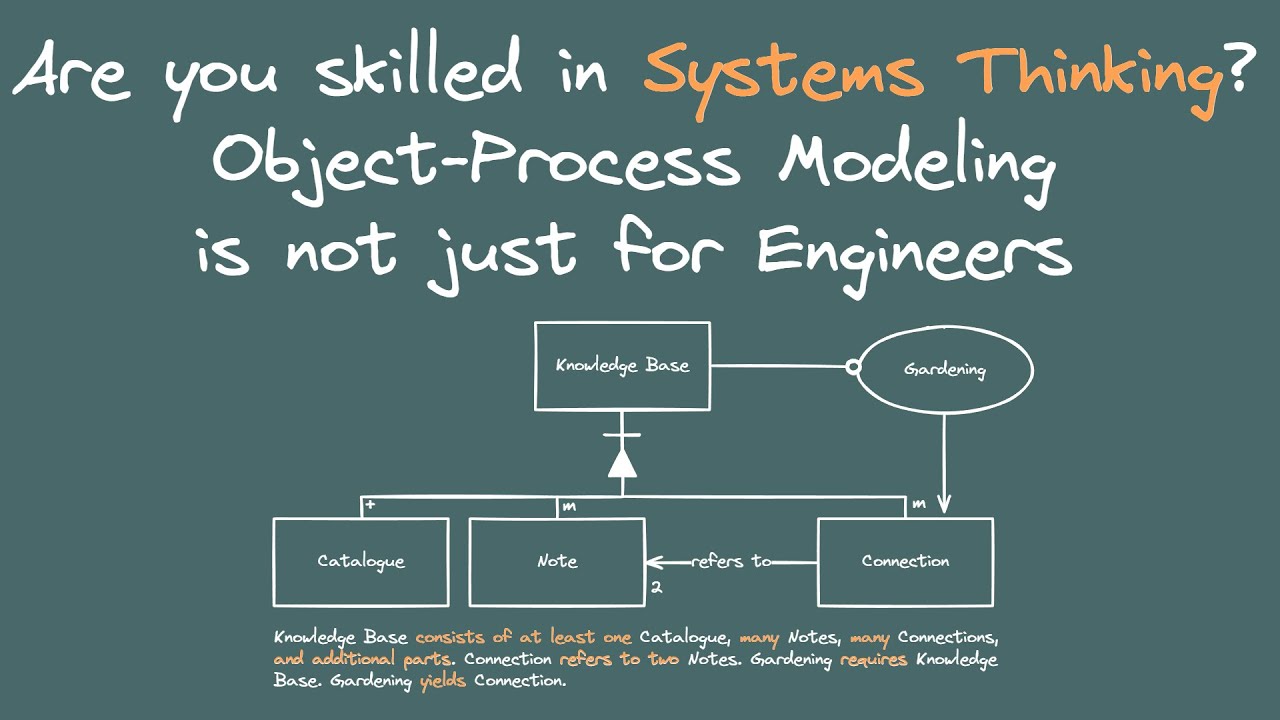
Object-Process Modeling (OPM) is a method that helps visualize **systems** by defining objects (things that exist) and processes (things that happen). OPM structures are represented using nouns and verbs, and the relationships between them are visually depicted. This method allows for **dual-channel processing**, combining text and visuals to enhance understanding.
- **Systems Thinking**: A holistic approach that emphasizes how parts of a system interact and affect one another.
- **Object-Process Methodology**: A visual language that combines structure (objects) and behavior (processes) into a single model.
- **OPD and OPL**: OPD (Object-Process Diagrams) and OPL (Object-Process Language) are the visual and textual formats used in OPM to represent systems.
- **Tools**: Excalidraw and Obsidian were highlighted as practical tools for diagramming and note-taking in PKM (Personal Knowledge Management).
### 🗒️ Notes:
- **OPM Concepts**:
- Objects are nouns (e.g., book) and processes are verbs (e.g., reading).
- Processes transform objects by creating, consuming, or affecting them.
- Systems consist of both **structure** (the static elements) and **behavior** (dynamic changes over time).
- **Practical Applications**:
- Modeling **personal knowledge management** systems.
- Using diagrams to **zoom in/out** on different abstraction levels.
- OPD allows concurrent processes to be represented, not just sequential ones.
- **PKM Framework**:
- The framework includes roles like librarian, architect, gardener, and writer, each reflecting different aspects of managing and producing knowledge.
## 📖 References:
- Jolt, [Learn Systems Thinking with Object-Process Modeling in PKM](https://www.youtube.com/watch?v=se7odslzd5U)
## 🗣️ Paraphrase:
1. OPM allows you to visually represent how processes (like reading) transform objects (like a book), providing a dual-channel approach by using both visuals and text to enhance understanding.
2. Systems can be viewed from two perspectives: structure, which describes what the system is made of, and behavior, which describes how the system changes over time.
## 📰 Newsletter:
🔍 **Master Systems Thinking with Object-Process Modeling**
This week, we’re diving into **systems thinking** using **Object-Process Modeling (OPM)**! OPM helps you visualize how objects and processes interact, making it a great tool for managing complex projects or personal workflows. Learn how you can implement this method using tools like **Excalidraw** and **Obsidian** to better organize your knowledge management system. Want to see how you can apply systems thinking to your own projects? Check out the full guide [here](https://www.youtube.com/watch?v=se7odslzd5U) and start building more efficient workflows today! 🌐
## ✅ Action Items:
- Explore using OPM in **Obsidian** for visualizing and managing knowledge systems.
- Practice mapping out objects and processes in your open-source projects to better understand system behaviors.
- Apply OPM to map out community workflows, showing how different contributors interact with projects.
## 🧪 Hypotheses:
- Using **OPM** to model complex systems will enhance understanding and reduce ambiguity in personal knowledge management.
- Dual-channel processing (visual and textual) improves retention and recall in system thinking.
### 📊 Methodology:
- Use Excalidraw and OPD to create visual maps of **open-source** project workflows.
- Test comprehension by comparing retention and problem-solving capabilities between OPM and traditional note-taking methods.
### ❓ Questions:
- How does OPM change your approach to complex system workflows?
- Can OPM help identify inefficiencies in current project management structures?
### 🔮 Future Research:
- Investigate how OPM can be applied to **team collaboration** in open-source projects.
- Study the impact of visual dual-channel learning on long-term retention of system processes.
### 💡 Implications:
If successfully implemented, OPM could become a standard tool for understanding complex workflows, enhancing productivity in both individual knowledge management and collaborative open-source environments.
### 🧠 Learning Styles Assessment:
1. **Visual Learners (Spatial)**:
- **Present**: Visual diagrams in OPD are a key component of OPM.
- **Improve**: Add more dynamic diagrams that change over time to show process behavior.
2. **Aural Learners (Auditory-Musical)**:
- **Improve**: Incorporate audio explanations or podcasts that discuss systems thinking.
3. **Verbal Learners (Linguistic)**:
- **Present**: The OPL textual component enhances understanding for verbal learners.
- **Improve**: Provide additional written examples and analogies.
4. **Physical Learners (Kinesthetic)**:
- **Improve**: Suggest hands-on activities like drawing concept maps by hand to engage kinesthetic learners.
5. **Logical Learners (Mathematical)**:
- **Present**: OPM’s structured approach to system relationships supports logical learners.
- **Improve**: Add more problem-solving examples that use OPM to enhance logical understanding.
6. **Social Learners (Interpersonal)**:
- **Improve**: Encourage group discussions on how different team members perceive system processes.
7. **Solitary Learners (Intrapersonal)**:
- **Present**: The individual mapping process supports solitary learners.
- **Improve**: Add reflection prompts to help learners better engage with the material personally.
8. **Naturalistic Learners**:
- **Improve**: Draw parallels between system models and natural systems for deeper engagement with naturalistic learners.
### 📊 Accessibility Assessment:
- **Screen Reader Compatibility**: Ensure diagrams are accompanied by detailed text descriptions for accessibility.
- **Keyboard Navigation**: Enhance support for keyboard-based navigation within visual modeling tools.
- **Contrast and Readability**: Use high-contrast colors in diagrams for better readability.
- **Text Resizing**: Make sure all visual models are scalable without losing clarity.
### 🌍 DEIB (Diversity, Equity, Inclusion, and Belonging) Assessment:
- **Cultural Relevance**: Introduce diverse examples from various cultural backgrounds in system modeling exercises.
- **Inclusive Language**: Use gender-neutral language and avoid technical jargon where possible.
- **Neurodiversity Support**: Simplify complex diagrams and break them into smaller chunks to support neurodiverse individuals.
- **Representation**: Add diverse representations in the examples used to model systems.
- **Psychological S
> [!note]+ Document Notes
> tags: [SystemsThinking, ObjectProcessModeling, PKM]
> - SystemsThinking
> - ObjectProcessModeling
> - PKM
> Author: Jolt
> Source: YouTube Video
> Reference: [Learn Systems Thinking with Object-Process Modeling in PKM](https://www.youtube.com/watch?v=se7odslzd5U)
> date created: 2024-09-15 20:00
>
> # Title: Learn Systems Thinking with Object-Process Modeling in PKM
>
<!-- deep-read:sections start -->
## Table of Contents:
1. [📝 Summary](#-summary)
2. [📖 Main Content](#-main-content)
3. [🗒️ Notes](#-notes)
4. [📖 References](#-references)
5. [🗣️ Paraphrase](#-paraphrase)
6. [📰 Newsletter](#-newsletter)
7. [✅ Action Items](#-action-items)
8. [🧪 Hypotheses](#-hypotheses)
9. [📊 Methodology](#-methodology)
10. [❓ Questions](#-questions)
11. [🔮 Future Research](#-future-research)
12. [💡 Implications](#-implications)
13. [🧠 Learning Styles Assessment](#-learning-styles-assessment)
14. [📊 Accessibility Assessment](#-accessibility-assessment)
15. [🌍 DEIB Assessment](#-deib-assessment)
16. [✅ Logical Validity](#-logical-validity)
17. [🔍 SEO Evaluation](#-seo-evaluation)
18. [🎯 Conclusion](#-conclusion)
## 📝 Summary:
This video by Jolt introduces **Object-Process Modeling (OPM)** as a systems thinking tool that combines structure and behavior. OPM is used to visualize systems, showing how objects and processes interact. It emphasizes the importance of thinking systemically, especially when managing personal knowledge or complex workflows. The video walks through an example of modeling knowledge management, showing how tools like Excalidraw in Obsidian can be used to create and visualize these systems.
## 📖 Main Content:
Object-Process Modeling (OPM) is a method that helps visualize **systems** by defining objects (things that exist) and processes (things that happen). OPM structures are represented using nouns and verbs, and the relationships between them are visually depicted. This method allows for **dual-channel processing**, combining text and visuals to enhance understanding.
- **Systems Thinking**: A holistic approach that emphasizes how parts of a system interact and affect one another.
- **Object-Process Methodology**: A visual language that combines structure (objects) and behavior (processes) into a single model.
- **OPD and OPL**: OPD (Object-Process Diagrams) and OPL (Object-Process Language) are the visual and textual formats used in OPM to represent systems.
- **Tools**: Excalidraw and Obsidian were highlighted as practical tools for diagramming and note-taking in PKM (Personal Knowledge Management).
### 🗒️ Notes:
- **OPM Concepts**:
- Objects are nouns (e.g., book) and processes are verbs (e.g., reading).
- Processes transform objects by creating, consuming, or affecting them.
- Systems consist of both **structure** (the static elements) and **behavior** (dynamic changes over time).
- **Practical Applications**:
- Modeling **personal knowledge management** systems.
- Using diagrams to **zoom in/out** on different abstraction levels.
- OPD allows concurrent processes to be represented, not just sequential ones.
- **PKM Framework**:
- The framework includes roles like librarian, architect, gardener, and writer, each reflecting different aspects of managing and producing knowledge.
## 📖 References:
- Jolt, [Learn Systems Thinking with Object-Process Modeling in PKM](https://www.youtube.com/watch?v=se7odslzd5U)
## 🗣️ Paraphrase:
1. OPM allows you to visually represent how processes (like reading) transform objects (like a book), providing a dual-channel approach by using both visuals and text to enhance understanding.
2. Systems can be viewed from two perspectives: structure, which describes what the system is made of, and behavior, which describes how the system changes over time.
## 📰 Newsletter:
🔍 **Master Systems Thinking with Object-Process Modeling**
This week, we’re diving into **systems thinking** using **Object-Process Modeling (OPM)**! OPM helps you visualize how objects and processes interact, making it a great tool for managing complex projects or personal workflows. Learn how you can implement this method using tools like **Excalidraw** and **Obsidian** to better organize your knowledge management system. Want to see how you can apply systems thinking to your own projects? Check out the full guide [here](https://www.youtube.com/watch?v=se7odslzd5U) and start building more efficient workflows today! 🌐
## ✅ Action Items:
- Explore using OPM in **Obsidian** for visualizing and managing knowledge systems.
- Practice mapping out objects and processes in your open-source projects to better understand system behaviors.
- Apply OPM to map out community workflows, showing how different contributors interact with projects.
## 🧪 Hypotheses:
- Using **OPM** to model complex systems will enhance understanding and reduce ambiguity in personal knowledge management.
- Dual-channel processing (visual and textual) improves retention and recall in system thinking.
### 📊 Methodology:
- Use Excalidraw and OPD to create visual maps of **open-source** project workflows.
- Test comprehension by comparing retention and problem-solving capabilities between OPM and traditional note-taking methods.
### ❓ Questions:
- How does OPM change your approach to complex system workflows?
- Can OPM help identify inefficiencies in current project management structures?
### 🔮 Future Research:
- Investigate how OPM can be applied to **team collaboration** in open-source projects.
- Study the impact of visual dual-channel learning on long-term retention of system processes.
### 💡 Implications:
If successfully implemented, OPM could become a standard tool for understanding complex workflows, enhancing productivity in both individual knowledge management and collaborative open-source environments.
### 🧠 Learning Styles Assessment:
1. **Visual Learners (Spatial)**:
- **Present**: Visual diagrams in OPD are a key component of OPM.
- **Improve**: Add more dynamic diagrams that change over time to show process behavior.
2. **Aural Learners (Auditory-Musical)**:
- **Improve**: Incorporate audio explanations or podcasts that discuss systems thinking.
3. **Verbal Learners (Linguistic)**:
- **Present**: The OPL textual component enhances understanding for verbal learners.
- **Improve**: Provide additional written examples and analogies.
4. **Physical Learners (Kinesthetic)**:
- **Improve**: Suggest hands-on activities like drawing concept maps by hand to engage kinesthetic learners.
5. **Logical Learners (Mathematical)**:
- **Present**: OPM’s structured approach to system relationships supports logical learners.
- **Improve**: Add more problem-solving examples that use OPM to enhance logical understanding.
6. **Social Learners (Interpersonal)**:
- **Improve**: Encourage group discussions on how different team members perceive system processes.
7. **Solitary Learners (Intrapersonal)**:
- **Present**: The individual mapping process supports solitary learners.
- **Improve**: Add reflection prompts to help learners better engage with the material personally.
8. **Naturalistic Learners**:
- **Improve**: Draw parallels between system models and natural systems for deeper engagement with naturalistic learners.
### 📊 Accessibility Assessment:
- **Screen Reader Compatibility**: Ensure diagrams are accompanied by detailed text descriptions for accessibility.
- **Keyboard Navigation**: Enhance support for keyboard-based navigation within visual modeling tools.
- **Contrast and Readability**: Use high-contrast colors in diagrams for better readability.
- **Text Resizing**: Make sure all visual models are scalable without losing clarity.
### 🌍 DEIB (Diversity, Equity, Inclusion, and Belonging) Assessment:
- **Cultural Relevance**: Introduce diverse examples from various cultural backgrounds in system modeling exercises.
- **Inclusive Language**: Use gender-neutral language and avoid technical jargon where possible.
- **Neurodiversity Support**: Simplify complex diagrams and break them into smaller chunks to support neurodiverse individuals.
- **Representation**: Add diverse representations in the examples used to model systems.
- **Psychological Safety**: Create a supportive environment by offering feedback mechanisms for students to ask questions or voice concerns.
### ✅ Logical Validity:
- **Sound Deductive Reasoning**: The explanation of OPM follows clear logical steps, showing how processes and objects interact.
- **No Fallacies Detected**: The reasoning is sound, with clear distinctions between different concepts and relationships.
### 🔍 SEO Evaluation:
1. **Keywords**: Systems thinking, Object-Process Modeling, Personal Knowledge Management.
2. **Meta Description**: Needs a summary including keywords like "systems thinking" and "OPM" to boost discoverability.
3. **Title Optimization**: Title is concise but could be improved by including "Systems Thinking for Personal Knowledge Management."
4. **Headers**: H1 and H2 tags are structured correctly, but more internal linking could improve SEO.
## 🎯 Conclusion:
Object-Process Modeling (OPM) is a highly effective tool for visualizing and understanding complex systems. By integrating OPM into personal knowledge management or project workflows, individuals and teams can improve clarity, collaboration, and productivity. The combination of visual diagrams and textual descriptions engages multiple learning styles, making OPM a versatile tool for systems thinking.
Short Summary for [Learn Systems Thinking with Object-Process Modeling in PKM](https://www.youtube.com/watch?v=se7odslzd5U) by [Merlin](https://merlin.foyer.work/)
Title: Systems Thinking with Object-Process Modeling Essentials for Complex World Perspective
[00:03](https://www.youtube.com/watch?v=se7odslzd5U&t=3) Object-Process Methodology is essential for systems thinking
[01:58](https://www.youtube.com/watch?v=se7odslzd5U&t=118) Objects and processes in Object-Process Modeling
[04:14](https://www.youtube.com/watch?v=se7odslzd5U&t=254) OPM enables leveraging verbal and visual abilities simultaneously
[06:15](https://www.youtube.com/watch?v=se7odslzd5U&t=375) Systems can be viewed in terms of structure and behavior
[08:14](https://www.youtube.com/watch?v=se7odslzd5U&t=494) Understanding relationships and content consumption in Object-Process Modeling
[10:11](https://www.youtube.com/watch?v=se7odslzd5U&t=611) Learning a modeling language opens new perspectives
[11:54](https://www.youtube.com/watch?v=se7odslzd5U&t=714) Introduction to Object-Process Modeling (OPM)
[13:43](https://www.youtube.com/watch?v=se7odslzd5U&t=823) The process of curating and organizing knowledge is crucial for personal knowledge management.
[15:28](https://www.youtube.com/watch?v=se7odslzd5U&t=928) OPM modeling with Object-Process Modeling and related tools
---------------------------------
Detailed Summary for [Learn Systems Thinking with Object-Process Modeling in PKM](https://www.youtube.com/watch?v=se7odslzd5U) by [Merlin](https://merlin.foyer.work/)
Title: Systems Thinking with Object-Process Modeling Essentials for Complex World Perspective
[00:03](https://www.youtube.com/watch?v=se7odslzd5U&t=3) Object-Process Methodology is essential for systems thinking
- OPD and OPL are standard modeling tools developed for systems thinking
- OPM can help understand complex systems and improve personal workflows
[01:58](https://www.youtube.com/watch?v=se7odslzd5U&t=118) Objects and processes in Object-Process Modeling
- Objects are things that exist or can exist, like books in OPM.
- Processes are events that happen or can happen, like reading in OPM.
[04:14](https://www.youtube.com/watch?v=se7odslzd5U&t=254) OPM enables leveraging verbal and visual abilities simultaneously
- OPM allows utilizing both verbal and visual skills simultaneously, enhancing cognitive capabilities.
- Processes in OPM can create, destroy, or influence objects, introducing the concept of states in addition to objects and processes.
[06:15](https://www.youtube.com/watch?v=se7odslzd5U&t=375) Systems can be viewed in terms of structure and behavior
- Structure refers to the static aspect, answering what the system is made of and how the parts are connected.
- Behavior pertains to the dynamic aspect, addressing how the system changes over time and what happens with the objects within.
[08:14](https://www.youtube.com/watch?v=se7odslzd5U&t=494) Understanding relationships and content consumption in Object-Process Modeling
- Content generalizes while reading and viewing consume. Specialized elements inherit properties from generalized elements.
- Artificial systems have a utility aspect, answering why a system is built and for whom, exclusive to artificial systems.
[10:11](https://www.youtube.com/watch?v=se7odslzd5U&t=611) Learning a modeling language opens new perspectives
- Learning a modeling language may be challenging, but can lead to understanding new cultures and perspectives.
- It is important to at least learn one or two modeling languages now to navigate life effectively.
[11:54](https://www.youtube.com/watch?v=se7odslzd5U&t=714) Introduction to Object-Process Modeling (OPM)
- OPM helps in scaling abstraction levels for complex models by adjusting scale and detail levels.
- OPM models should be read top-down to understand the interconnected processes and actions.
[13:43](https://www.youtube.com/watch?v=se7odslzd5U&t=823) The process of curating and organizing knowledge is crucial for personal knowledge management.
- Creating a system for storing notes and managing content is essential for effective knowledge management.
- The use of object-process modeling and diagramming methods can be particularly useful for internal organization and management of knowledge.
[15:28](https://www.youtube.com/watch?v=se7odslzd5U&t=928) OPM modeling with Object-Process Modeling and related tools
- Mention of plugin and video on slideshow scenario
- Availability of free OPM modeling tool - opcat, but with outdated installation requirements
<!-- deep-read:sections end -->
## Highlights
- Visual PKM. ([View Highlight](https://read.readwise.io/read/01j7vkhcgm7znsbf2rb2hf45wg))