Letter Brief Re Additional Rog Responses
🔗 **Source:** [Letter Brief Re Additional Rog Responses](https://storage.courtlistener.com/recap/gov.uscourts.cand.437474/gov.uscourts.cand.437474.312.0.pdf)
> [!note]+ Document Notes
> tags: [discovery-disputes, interrogatory-limits, wp-engine-litigation]
> author: [MISSING]
> source: CourtListener
> reference: [https://storage.courtlistener.com/recap/gov.uscourts.cand.437474/gov.uscourts.cand.437474.312.0.pdf]
> date created: {{date:YYYY-MM-DD}} {{time:HH:mm}}
>
> # 🏷️ Title: Letter Brief Re Additional Rog Responses
>
<!-- deep-read:sections start -->
## 🧭 Table of Contents
- [📝 Summary](#-summary)
- [📖 Main Content](#-main-content)
- [🗒️ Notes](#️-notes)
- [📚 References](#-references)
- [🗣️ Paraphrase](#️-paraphrase)
- [📰 Newsletter](#-newsletter)
- [✅ Action Items](#-action-items)
- [🧪 Hypotheses](#-hypotheses)
- [🎯 Conclusion](#-conclusion)
- [🔄 Refactor Appendix](#-refactor-appendix)
## 📝 Summary
- Gibson Dunn files opposition to WP Engine's motion to compel additional interrogatory responses in WP Engine v. Automattic litigation
- WP Engine served compound interrogatories exceeding Rule 33's 25-question limit without court permission, totaling 45-70 questions per defendant
- Motion filed after fact discovery closed, with inadequate meet-and-confer process (draft sent at 3:04 AM day of filing)
- Defendants argue relief should be denied as procedurally improper, untimely, and unnecessary given extensive discovery already completed
- Bottom line: Strategic discovery choices have consequences that Rule 33 doesn't require courts to cure retroactively
## 📖 Main Content
Automattic's counsel argues WP Engine's motion to compel additional interrogatory responses violates procedural rules and comes too late. The core dispute centers on Rule 33's presumptive 25-interrogatory limit per party.
### Discovery Scope and Timing
WP Engine served compound interrogatories to four defendants: 45 to Automattic, 70 to Mullenweg, 44 to WooCommerce, and 47 to WordPress Foundation. When defendants objected to exceeding Rule 33 limits, WP Engine continued serving additional questions without seeking court permission or stipulating with opposing counsel.
After completing extensive fact discovery—including depositions and 225,000+ produced documents—WP Engine filed this motion seeking responses to 13 interrogatories, several never actually served during discovery.
### Procedural Deficiencies
The brief emphasizes two procedural failures: inadequate meet-and-confer under Rule 37(a)(1) and violation of the court's joint-letter requirements. WP Engine's draft brief arrived at 3:04 AM on filing day, preventing meaningful collaboration on the joint submission.
### Merits Arguments
Defendants contend WP Engine had sufficient discovery tools (100 total interrogatories across defendants) but chose to draft duplicative and compound questions. Many interrogatories were substantively identical across parties, with overlapping entity definitions making responses redundant.
## 🗒️ Notes
- Strategic discovery planning matters—compound interrogatories exhaust limited question budgets
- Courts expect parties to seek permission before exceeding Rule 33 limits, not retroactive relief
- Extensive discovery record (225k+ documents, multiple depositions) undermines claims of insufficient information
- Meet-and-confer requirements have teeth—inadequate process alone can doom motions
- Timing matters in discovery disputes—waiting until after close of discovery weakens position
## 📚 References
- [Fed. R. Civ. P. 33](https://www.law.cornell.edu/rules/frcp/rule_33) - Interrogatories to parties
- [Fed. R. Civ. P. 37](https://www.law.cornell.edu/rules/frcp/rule_37) - Failure to make disclosures or cooperate in discovery
- James v. Asian Fam. Mkt., 2026 WL 622729 (9th Cir. 2026)
- Stearns v. Flores, 2006 WL 1980334 (E.D. Cal. 2006)
## 🗣️ Paraphrase
Automattic argues WP Engine shot itself in the foot with poor discovery planning. Instead of using their 100 available interrogatories strategically, WP Engine wrote overly complex, duplicative questions that exceeded Rule 33's limits. When defendants objected, WP Engine ignored compromise offers and kept serving more questions without court permission. Now, after discovery closed and they've already gotten extensive information through depositions and document production, WP Engine wants the court to bail them out of their strategic mistakes. Automattic says the procedural violations and late timing should doom the motion regardless of substance.
## 📰 Newsletter
Not applicable — legal filing
## ✅ Action Items
#### DevRel
Not applicable — legal filing
#### OSPO
- Monitor litigation developments affecting open source project governance models
- Review interrogatory strategies in potential IP disputes involving foundation structures
#### Community
- Track legal precedents affecting multi-entity open source ecosystems (WordPress Foundation, WooCommerce relationship structures)
#### WordPress
Not applicable — legal filing
#### The WPCC
- Analyze implications for foundation/commercial entity relationship structures in open source projects
### FAIR
- Document case study on discovery disputes in complex open source litigation for future reference
## 🧪 Hypotheses
- Courts will increasingly scrutinize discovery abuse in complex IP litigation involving open source projects
- Multi-entity structures (foundation + commercial arms) create discovery complexity that favors early strategic planning
- Procedural compliance matters more than substantive need when discovery limits are exceeded
### 📊 Methodology
- Case law analysis comparing discovery dispute outcomes in IP vs. general commercial litigation
- Survey of interrogatory strategies in trademark/open source disputes
- Analysis of meet-and-confer effectiveness in complex litigation
### ❓ Questions
- How do courts balance discovery needs against Rule 33 limits in multi-defendant IP cases?
- What constitutes adequate meet-and-confer in joint-letter jurisdictions?
- How does extensive alternative discovery (depositions, documents) affect compel motions?
### 🔮 Future Research
- Comparative analysis of discovery dispute patterns in open source litigation
- Empirical study of compound interrogatory success rates across case types
### 💡 Implications
- Discovery planning requires early assessment of interrogatory budgets across multiple defendants
- Procedural compliance can override substantive discovery needs in motion practice
- Open source litigation complexity doesn't automatically justify exceeding standard discovery limits
### 🧠 Learning Styles Assessment
Reading level: Legal professional (Flesch-Kincaid ~16-18)
#### 👀 Visual learners
Present: Structured brief format, numbered arguments
Improve: Discovery timeline diagram, interrogatory count visualization
#### 🔊 Aural learners
Present: Legal argument structure, oral advocacy preparation
Improve: Audio summary of key procedural points
#### 🗣️ Verbal learners
Present: Technical legal definitions, rule citations
Improve: Plain language summary of discovery concepts
#### 🧩 Kinesthetic learners
Present: Step-by-step procedural analysis
Improve: Discovery planning checklist, motion drafting workshop
#### 🧠 Logical learners
Present: Rule-based analysis, precedent application
Improve: Decision tree for discovery dispute strategies
#### 🧑🤝🧑 Social learners
Present: Adversarial brief structure
Improve: Mock meet-and-confer exercises
#### 🧘♀️ Solitary learners
Present: Independent legal research and analysis
Improve: Self-assessment questions on discovery strategy
#### 🌿 Naturalistic learners
Present: Litigation ecosystem relationships
Improve: Discovery process lifecycle analysis
### 📊 Accessibility Assessment
#### Screen reader semantics
Present: Clear heading structure, logical document flow
Improve: Alt text for any embedded exhibits
#### Keyboard navigation
Present: Standard PDF accessibility features
Improve: Enhanced navigation bookmarks
#### Contrast and readability
Present: Standard legal document formatting
Improve: Higher contrast version for visual impairments
#### Text resizing and reflow
Present: Reflowable text format
Improve: Mobile-optimized legal document viewing
#### Media and captions
Present: Text-only document
Improve: N/A for this document type
#### Forms and interactions
Present: Static document
Improve: N/A for this document type
#### Standards reference
Basic WCAG compliance through standard document structure
### 🌍 DEIB Assessment
#### Cultural breadth
Present: Standard US legal practice format
Improve: Context for international readers on US discovery rules
#### Inclusive language
Present: Professional legal terminology
Improve: Plain language glossary for legal terms
#### Neurodiversity support
Present: Structured argument format with clear headings
Improve: Executive summary with key takeaways highlighted
#### Representation
Present: Standard legal brief format
Improve: N/A for procedural filing
#### Psychological safety
Present: Professional adversarial tone appropriate for legal context
Improve: N/A for litigation document
### ✅ Logical Validity
#### Strong reasoning
- Rule-based analysis applying Fed. R. Civ. P. 33 and 37 requirements systematically
- Procedural argument sequence building from inadequate meet-and-confer to untimely filing
- Factual foundation through discovery record (225k+ documents, depositions) supporting "unnecessary" claim
#### Fallacies
- Minimal fallacies detected; brief adheres to legal argument standards
- Possible emphasis on procedural defects to avoid addressing substantive discovery needs
#### Tone of voice
Professional adversarial tone appropriate for litigation brief with confident assertions of procedural violations
### 🛡️ DARVO Analysis
Not applicable - standard adversarial legal brief format without DARVO patterns detected
## 🎯 Conclusion
This brief exemplifies strategic litigation defense: emphasize procedural failures to avoid substantive engagement with opponent's discovery needs. The 3:04 AM timing detail and extensive discovery record serve to paint WP Engine as procedurally careless and substantively greedy. For open source practitioners, this illustrates how multi-entity structures create discovery complexity requiring early strategic coordination across related defendants.
## 🔄 Refactor Appendix — Letter Brief Re Additional Rog Responses
### 📚 Literature Atoms
#### Discovery limits exist to prevent abuse, not accommodate poor planning
> [!quote] ID:filing_001
> Rule 33 does not require the Court to reopen discovery to address the consequences of those choices.
**Context & use**:
- Core argument against retroactive relief for exceeding interrogatory limits
- Emphasizes strategic choice consequences in discovery planning
**Tags**: #discovery-strategy #procedural-rules
<!-- atomicity: 1 idea ✓ -->
#### Compound interrogatories violate Rule 33 limits without court permission
> [!quote] ID:filing_002
> WP Engine served compound interrogatories totalling 45 to Automattic, 70 to Mr. Mullenweg, 44 to WooCommerce, and 47 to WordPress Foundation.
**Context & use**:
- Factual foundation for Rule 33 violation claim
- Demonstrates scope of discovery overreach across multiple defendants
**Tags**: #interrogatory-abuse #rule-33-violations
<!-- atomicity: 1 idea ✓ -->
#### Inadequate meet-and-confer defeats discovery motions regardless of merit
> [!quote] ID:filing_003
> A draft circulated at 3:04 a.m. on the day of filing does not afford the responding party a meaningful opportunity to participate.
**Context & use**:
- Procedural defense strategy emphasizing process failures
- Shows how timing violations can doom otherwise valid motions
**Tags**: #meet-and-confer #procedural-defenses
<!-- atomicity: 1 idea ✓ -->
### 🧠 Permanent Candidates
#### Discovery abuse claims require demonstrating strategic alternatives were available
**Claim**: Courts evaluate discovery disputes by examining whether the requesting party used available tools efficiently before seeking additional relief.
**Evidence pointer**: [[#Discovery limits exist to prevent abuse, not accommodate poor planning]]
**Scope & conditions**: Applies when parties had sufficient discovery tools but chose inefficient strategies; weakens when discovery genuinely inadequate for case complexity
**Links**:
- [[Federal Rules strategic compliance]] — because extends beyond mere technical compliance
- [[Litigation resource allocation]] — because contrasts with unlimited discovery models
<!-- atomicity: 1 idea ✓ -->
### ✏️ Fleeting Queue
- Review other WP Engine litigation filings for pattern analysis #litigation-tracking
- Research interrogatory limits in multi-defendant IP cases #discovery-research
### → Things 3
- [ ] Monitor docket for court ruling on this discovery motion #wpengine-litigation
- [ ] Research open source discovery dispute precedents for OSPO guidance #legal-research
<!-- deep-read:sections end -->
📄 **Full text:** ![[Full Document Contents/Articles/Letter Brief Re Additional Rog Responses.md|Letter Brief Re Additional Rog Responses by Ajay S. Krishnan]]
## Highlights
- **Rule 33's limits required leave of Court.**
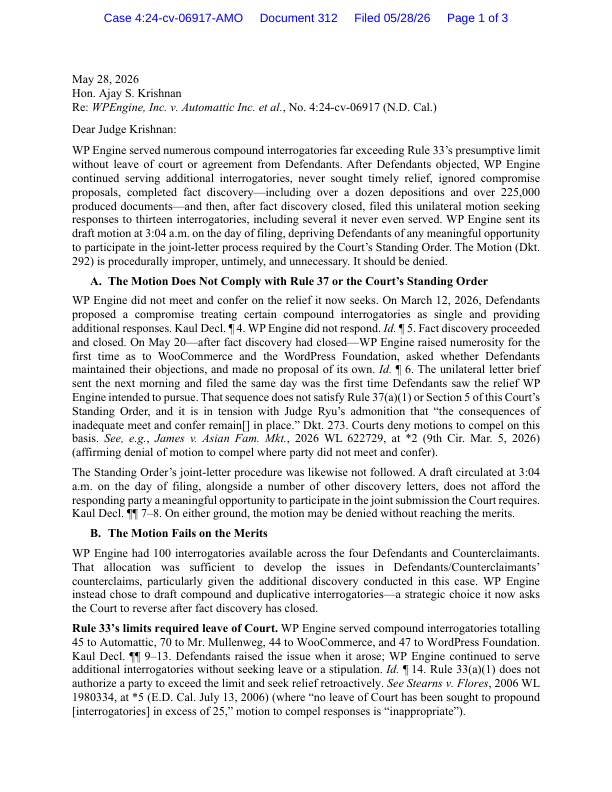
WP Engine served compound interrogatories totalling 45 to Automattic, 70 to Mr. Mullenweg, 44 to WooCommerce, and 47 to WordPress Foundation. Kaul Decl. ¶¶ 9–13. Defendants raised the issue when it arose; WP Engine continued to serve additional interrogatories without seeking leave or a stipulation.
*Id.*
¶ 14. Rule 33(a)(1) does not authorize a party to exceed the limit and seek relief retroactively.
*See Stearns v. Flores*
, 2006 WL 1980334, at \*5 (E.D. Cal. July 13, 2006) (where "no leave of Court has been sought to propound [interrogatories] in excess of 25," motion to compel responses is "inappropriate"). ([View Highlight](https://read.readwise.io/read/01kssthq4s9ch2fmm0y066x7t9))
- Note: Defendants' specific count: WPE served 45 to Automattic, 70 to Mullenweg, 44 to WooCommerce, 47 to WordPress Foundation — all without seeking leave of court under Rule 33(a)(1). Cites Stearns v. Flores for the principle that retroactive relief is "inappropriate."
- Tags: rule-33-interrogatories, discovery-limits, atom/literature/h2
- **WP Engine made strategic choices during fact discovery.**
It drafted compound interrogatories, exhausted its allotment, declined the compromise Defendants offered, and waited until after fact discovery closed to seek relief. Rule 33 does not require the Court to reopen discovery to address the consequences of those choices. Defendants respectfully request that the Court deny the motion. ([View Highlight](https://read.readwise.io/read/01kssthqp8qsyz57cg3dqgpq1e))
- Note: Defendants' framing of WPE's posture: compound interrogatories + declined compromise + waited until after fact discovery closed. The "strategic choices" framing makes the motion-to-compel an inappropriate remedy for self-inflicted depletion of allotment.
- Tags: strategic-choices, fact-discovery, atom/literature/h2