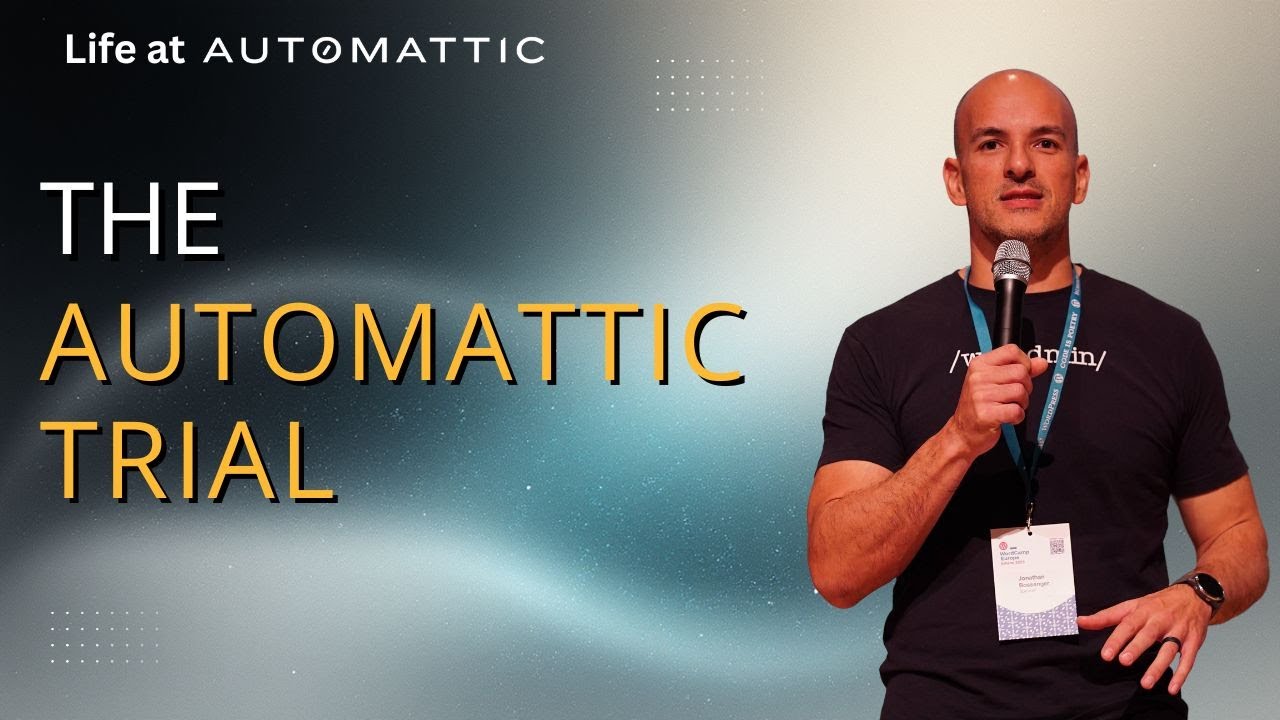
Life at Automattic: The Automattic Trial
> [!note]+ Document Notes
> tags: [automattic, remote-work, hiring-process]
> author: [MISSING]
> source: YouTube
> reference: https://www.youtube.com/watch?v=iq_JkTaCwL8
> date created: 2024-12-19 19:58
>
> # 🏷️ Title: Life at Automattic: The Automattic Trial
>
<!-- deep-read:sections start -->
## 🧰 Action Inbox
- [H1] Apply trial communication best practices — 00:00-15:00 #remote-hiring
- [H2] Request feedback after trial completion — 13:45 #professional-development
- [H3] Prepare for part-time trial commitment — 03:20 #time-management
## 🧭 Table of Contents
- [📝 Summary](#-summary)
- [📖 Main Content](#-main-content)
- [🗒️ Notes](#️-notes)
- [📚 References](#-references)
- [🗣️ Paraphrase](#️-paraphrase)
- [📰 Newsletter](#-newsletter)
- [✅ Action Items](#-action-items)
- [🧪 Hypotheses](#-hypotheses)
- [📊 Methodology](#-methodology)
- [❓ Questions](#-questions)
- [🔮 Future Research](#-future-research)
- [💡 Implications](#-implications)
- [🧠 Learning Styles Assessment](#-learning-styles-assessment)
- [📊 Accessibility Assessment](#-accessibility-assessment)
- [🌍 DEIB Assessment](#-deib-assessment)
- [✅ Logical Validity](#-logical-validity)
- [🛡️ DARVO Analysis](#-darvo-analysis)
- [🎯 Conclusion](#-conclusion)
### 🔗 References
- [Automattic Careers](https://automattic.com/careers/)
- [WordPress Developer Resources](https://developer.wordpress.org/)
## 📝 Summary
- Automattic uses a unique paid trial process where candidates work part-time with their potential team
- Trial provides mutual evaluation - teams assess candidates while candidates experience company culture
- Process includes full company access, dedicated support team, and real project work
- Candidates must balance trial work with existing commitments, typically 1-2 hours daily
- Bottom line: Transparent, immersive hiring process that benefits both parties but requires significant time investment
## 📖 Main Content
Automattic employs a distinctive hiring approach through paid trial periods where candidates work part-time with their prospective teams. This process occurs after initial interviews and take-home tasks, allowing both parties to evaluate fit through actual collaboration.
The trial structure provides candidates with comprehensive company access, including Slack, internal documentation, and most systems (excluding financial data). Support comes from assigned trial buddies, team leads, and HR representatives who guide candidates through the process.
Projects are designed as realistic work samples rather than immediate business needs, ensuring candidates aren't providing free labor. The speaker notes their trial projects weren't published as-is, emphasizing the evaluation rather than exploitation nature of the process.
Time commitments typically range from 1-2 hours daily or concentrated weekend work, requiring clear communication about availability and life circumstances. The process duration varies based on project completion, usually 2-3 weeks.
## 🗒️ Notes
#### ⏱️ [00:00](https://youtu.be/iq_JkTaCwL8?t=0) — [H1] Automattic Trial Overview
- Key idea: Unique paid trial process follows interviews and tasks
- Evidence: "You are basically hired to work part-time with generally the team that you're probably going to work for"
#### ⏱️ [01:15](https://youtu.be/iq_JkTaCwL8?t=75) — [H2] Mutual Evaluation Benefits
- Key idea: Teams assess candidates while candidates experience company culture
- Evidence: "The team gets to see whether what you bring fits in with what the team needs"
#### ⏱️ [02:30](https://youtu.be/iq_JkTaCwL8?t=150) — [H3] Time Management Challenge
- Key idea: Must balance trial work with existing full-time employment
- Evidence: "You now have to find time to work on the trial project outside of that"
#### ⏱️ [03:20](https://youtu.be/iq_JkTaCwL8?t=200) — [H2] Flexible Scheduling Approach
- Key idea: Candidates control time commitment and communicate availability
- Evidence: "I tried to put in about an hour every day at the end of my day"
#### ⏱️ [04:45](https://youtu.be/iq_JkTaCwL8?t=285) — [H3] Communication Importance
- Key idea: Clear upfront communication about constraints is essential
- Evidence: "Communicate all of that clearly and upfront so everybody knows where you're coming from"
#### ⏱️ [05:15](https://youtu.be/iq_JkTaCwL8?t=315) — [H2] Paid Trial Structure
- Key idea: Candidates receive compensation for trial work
- Evidence: "You do get paid for the trial. It's not exorbitant amounts of money, but you do get paid"
#### ⏱️ [06:30](https://youtu.be/iq_JkTaCwL8?t=390) — [H1] Project Design Philosophy
- Key idea: Trial projects are evaluation tools, not immediate business needs
- Evidence: "It wasn't like I was giving free work away... that work never got published as is"
#### ⏱️ [08:15](https://youtu.be/iq_JkTaCwL8?t=495) — [H2] Comprehensive Company Access
- Key idea: Candidates get nearly full access to company systems and people
- Evidence: "I think the only thing that I couldn't access was like financial information"
#### ⏱️ [09:30](https://youtu.be/iq_JkTaCwL8?t=570) — [H3] Support Team Structure
- Key idea: Multiple support roles guide candidates through trial
- Evidence: "You're assigned a trial buddy... You have a trial lead... there is a member of HR"
#### ⏱️ [10:45](https://youtu.be/iq_JkTaCwL8?t=645) — [H1] Success Strategy: Communication
- Key idea: Early and frequent communication about changes is critical
- Evidence: "Communicate early and often about any changes in your life or your planning"
#### ⏱️ [11:30](https://youtu.be/iq_JkTaCwL8?t=690) — [H2] Overcommunication Culture
- Key idea: Asking questions and clarifying everything aligns with company values
- Evidence: "One of the biggest tenants of working at automatic is to overcommunicate"
#### ⏱️ [12:15](https://youtu.be/iq_JkTaCwL8?t=735) — [H1] Full Commitment Expectation
- Key idea: Bring best effort regardless of limited time availability
- Evidence: "Treat it like you're working there... that's what they're looking for"
#### ⏱️ [13:45](https://youtu.be/iq_JkTaCwL8?t=825) — [H2] Learning from Feedback
- Key idea: Request specific feedback to improve future applications
- Evidence: "What could I have done better? what were you looking for that I didn't have?"
#### ⏱️ [14:30](https://youtu.be/iq_JkTaCwL8?t=870) — [H3] Growth Mindset Application
- Key idea: Use trial experience as learning opportunity regardless of outcome
- Evidence: "Don't pass up an opportunity to learn from a process"
## 📚 References
- [Automattic Careers](https://automattic.com/careers/)
- [Remote Work Best Practices](https://distributed.blog/)
- [P2 Collaboration Platform](https://p2theme.com/)
## 🗣️ Paraphrase
- Automattic's trial process lets candidates work part-time with potential teams while getting paid, providing real experience of company culture and communication styles
- The time commitment challenge requires balancing trial work with existing jobs, but flexible scheduling and clear communication about availability help manage this constraint
- Success depends on treating the trial seriously, overcommunicating throughout the process, and using feedback to improve regardless of the outcome
## 📰 Newsletter
**Inside Automattic's Revolutionary Hiring Process**
Automattic has pioneered a unique approach to hiring that could transform how we think about candidate evaluation. Their paid trial process lets potential team members work part-time with actual teams, creating authentic experiences for both parties.
**What makes this special?** Candidates get full access to company systems, dedicated support teams, and real project work - while getting paid for their time. It's not about free labor; it's about genuine cultural fit assessment.
**Key takeaway for hiring managers:** Consider how you might create more authentic evaluation experiences. The investment in comprehensive trials could dramatically improve hiring success rates and reduce early turnover.
Resources: [Automattic Careers](https://automattic.com/careers/), [Remote Hiring Guide](https://distributed.blog/), [P2 Collaboration](https://p2theme.com/)
## ✅ Action Items
#### DevRel
- Developer experience: Document trial buddy programs for technical evaluation
- Community management: Create feedback collection templates for trial participants
- Developer advocacy: Share hiring transparency as competitive advantage
#### Community
- Contributors: Adapt trial concepts for maintainer onboarding programs
- Ecosystem: Explore collaborative evaluation methods across projects
#### WordPress
- Community: Consider trial processes for key volunteer leadership roles
- Training: Develop trial-based certification or mentorship programs
- Meta: Evaluate contributor onboarding effectiveness using trial principles
#### FAIR
- Governance artifacts: Document transparent evaluation criteria and processes
- Policies: Ensure trial processes maintain fairness and equal access
## 🧪 Hypotheses
- Companies using immersive trial processes have lower employee turnover rates within first year
- Paid trial periods attract higher-quality candidates than unpaid assessments
- Mutual evaluation processes reduce hiring bias compared to traditional interviews
- Remote-first companies benefit more from trial processes than co-located teams
### 📊 Methodology
- Survey companies using trial processes vs traditional hiring for retention data
- Compare candidate quality metrics between paid and unpaid assessment methods
- Analyze bias indicators in trial-based vs interview-based hiring decisions
### ❓ Questions
- How do trial processes scale with company growth and hiring volume demands?
- What legal and compliance considerations affect trial implementation across jurisdictions?
- How might trial processes be adapted for executive or senior leadership hiring?
### 🔮 Future Research
- Longitudinal study of trial process effectiveness across different company sizes
- Investigation of trial process impact on diversity and inclusion outcomes
- Analysis of optimal trial duration and structure variations by role type
### 💡 Implications
- Practice: Hiring processes could shift toward collaborative evaluation rather than gatekeeping
- Policy: Employment law may need updates to accommodate trial-based hiring models
- Security: Company access policies require frameworks for temporary team members
- Education: Business schools should teach immersive evaluation methodologies
- Funding: HR budgets need allocation for trial compensation and support infrastructure
### 🧠 Learning Styles Assessment
Reading level estimate: 8th Grade
#### 👀 Visual learners
- Present: None identified in audio-only format
- Improve: Process flow diagrams, timeline visualizations, organizational charts
#### 🔊 Aural learners
- Present: Complete audio narration with personal experience examples
- Improve: Interview segments with trial participants and hiring managers
#### 🗣️ Verbal learners
- Present: Clear definitions, analogies, step-by-step explanations
- Improve: Glossary of Automattic-specific terms, comparison frameworks
#### 🧩 Kinesthetic learners
- Present: None identified in presentation format
- Improve: Interactive trial simulation, role-playing exercises, checklists
#### 🧠 Logical learners
- Present: Structured process explanation, cause-effect relationships
- Improve: Decision trees, cost-benefit analysis, success metrics
#### 🧑🤝🧑 Social learners
- Present: Team interaction descriptions, collaborative work examples
- Improve: Community discussion prompts, peer experience sharing
#### 🧘♀️ Solitary learners
- Present: Self-reflection opportunities, individual preparation advice
- Improve: Personal assessment worksheets, private preparation guides
#### 🌿 Naturalistic learners
- Present: Ecosystem thinking about company culture fit
- Improve: Organizational culture analogies, growth pattern comparisons
### 📊 Accessibility Assessment
#### Screen reader semantics
- Present: Audio format naturally supports screen reader users
- Improve: Transcript with proper heading structure, time-stamped sections
#### Keyboard navigation
- Present: Standard video player controls available
- Improve: Transcript navigation, skip-to-section functionality
#### Contrast and readability
- Present: Audio-only format avoids visual contrast issues
- Improve: High-contrast transcript options, customizable text sizing
#### Text resizing and reflow
- Present: Not applicable for audio content
- Improve: Responsive transcript design, mobile-friendly formatting
#### Media and captions
- Present: Audio available but no captions visible
- Improve: Auto-generated captions, professional transcript, downloadable text
#### Forms and interactions
- Present: Minimal interaction required
- Improve: Accessible comment submission, contact form alternatives
#### Standards reference
- Missing: WCAG 2.2 AA compliance for multimedia content (captions, transcripts)
### 🌍 DEIB Assessment
#### Cultural breadth
- Present: Remote work considerations, family responsibility acknowledgment
- Improve: Multi-timezone examples, international employment law considerations
#### Inclusive language
- Present: Gender-neutral terms, accessible explanations
- Improve: Plain language alternatives for company-specific jargon
#### Neurodiversity support
- Present: Clear structure, step-by-step guidance
- Improve: Processing time considerations, sensory accommodation options
#### Representation
- Present: Personal parenting experience, work-life balance challenges
- Improve: Diverse candidate experience examples, various career transition stories
#### Psychological safety
- Present: Encouragement to ask questions, failure as learning opportunity
- Improve: Anxiety management strategies, imposter syndrome acknowledgment
### ✅ Logical Validity
#### Strong reasoning
- Deductive strength: Strong logical flow from trial structure to outcomes
- Inductive strength: Personal experience generalized to broader applicability
- Causal reasoning: Clear cause-effect relationships between communication and success
- Analogical strength: Effective workplace behavior analogies throughout
#### Fallacies
- Anecdotal evidence: Over-reliance on personal experience without broader data
- Hasty generalization: Assuming all trials work similarly based on two experiences
#### Tone of voice
- Overall tone: Helpful and encouraging with practical, experience-based advice
### 🛡️ DARVO Analysis
- Deny: No concerning denial patterns identified
- Attack: No attacks on individuals or groups present
- Reverse victim/offender: No victim/offender dynamics present
- Emotional cues and rhetoric: Positive, supportive tone throughout with encouragement for learning
## 🎯 Conclusion
Automattic's trial process represents a significant evolution in hiring methodology, prioritizing authentic experience over traditional gatekeeping. The mutual evaluation model benefits both candidates and teams by reducing information asymmetry and cultural mismatches.
Key practical applications include implementing transparent communication expectations, providing comprehensive access and support, and treating evaluation as learning opportunities. The emphasis on overcommunication and collaborative work reflects broader remote work best practices.
This approach suggests a future where hiring becomes more partnership-oriented, with companies investing upfront in candidate experience to achieve better long-term outcomes. The model's success depends on organizational commitment to transparency and genuine mutual evaluation rather than extracting free labor.
## 🧱 Refactor Appendix
### 📚 Literature Split Pad
Purpose: Stage CEE units that become Literature notes.
Split level: H3
### [H1] Trial processes provide mutual evaluation opportunities
> [!quote] Life at Automattic: The Automattic Trial by [MISSING] via YouTube. Published [MISSING]. Accessed 2024-12-19.
> "The team gets to see whether what you bring fits in with what the team needs."
Demonstrates how trial periods benefit both hiring teams and candidates through authentic work experience rather than artificial interview scenarios.
[view highlight](https://youtu.be/iq_JkTaCwL8?t=75#H1) #xref #articleseed ID:rw_001
### [H2] Overcommunication enables remote trial success
> [!quote] Life at Automattic: The Automattic Trial
> "One of the biggest tenants of working at automatic is to overcommunicate."
Cultural alignment between trial expectations and ongoing work requirements creates consistent evaluation criteria.
[view highlight](https://youtu.be/iq_JkTaCwL8?t=
---
## Full Transcript
[00:00] So, in this episode, I want to talk a<br>[00:02] little bit about the automatic trial<br>[00:04] process. Now, if you don't know what the<br>[00:05] trial process is, it's part of the steps<br>[00:08] that you might follow if you apply for a<br>[00:10] job at Automatic.<br>[00:12] There's a couple of steps in the<br>[00:13] process. You'll have an interview, which<br>[00:16] will generally be via Slack. Then, you<br>[00:18] might have a small take-home task<br>[00:20] depending on what type of team you apply<br>[00:22] for. But then eventually, if you get<br>[00:24] through all of that, then you<br>[00:26] become part of a trial. Now, I've had<br>[00:30] the opportunity to apply for a number of<br>[00:32] different positions within automatic.<br>[00:34] The first one where I got through to the<br>[00:37] coding exercises when I applied as a<br>[00:41] code wrangler. The first one that I got<br>[00:43] through the to the trial was the first<br>[00:44] time I applied as a developer advocate.<br>[00:47] Uh so I've done the trial twice now. So<br>[00:49] I have a pretty good understanding of<br>[00:50] what happens in the trial, how the trial<br>[00:52] works. And so I wanted to talk about<br>[00:54] that process because a trial at<br>[00:57] Automatic is not something I've ever<br>[00:59] experienced anywhere else. I don't know<br>[01:00] any other companies that are doing it.<br>[01:02] But you are basically you are hired to<br>[01:06] work part-time with generally the team<br>[01:10] that you're probably going to work for<br>[01:11] if you get hired in the company. And<br>[01:13] that comes with a couple of pros, a<br>[01:17] couple of cons, but it's a really unique<br>[01:19] experience because<br>[01:21] number one, the team that you're<br>[01:23] applying to work for that you might end<br>[01:24] up working with actually gets an<br>[01:26] opportunity to work with you. And so<br>[01:28] they get to see whether what you bring<br>[01:30] fits in with what the team needs. They<br>[01:32] get to see how you work, how you<br>[01:34] communicate, how you do things. And so<br>[01:36] it gives them a good opportunity to go,<br>[01:37] hey, this person is great or we're not<br>[01:39] so sure, maybe try someone else. It also<br>[01:43] gives you the opportunity to experience<br>[01:45] what it's like working at automatic.<br>[01:47] Now, it's not exactly 100% the same, and<br>[01:50] I'll talk in a second about why, but it<br>[01:52] gives you a good idea about how<br>[01:54] automatic works, how communication<br>[01:56] works. You get a feel for that sort of<br>[01:59] cross time zone communication with<br>[02:00] different people in different time<br>[02:02] zones. Your you get to work in a P2<br>[02:06] environment if you've never done that<br>[02:07] before. You get to communicate via Slack<br>[02:09] if you've never done that before. So you<br>[02:11] get a good feel for whether and you get<br>[02:14] a good experience of the kind of work<br>[02:16] that you're going to do because you<br>[02:17] actually work on<br>[02:20] quote unquote an actual project and I'll<br>[02:22] talk about that in a second as well. The<br>[02:25] downsides for you as somebody going<br>[02:27] through that process is if you already<br>[02:29] have a full-time job, you now have to<br>[02:31] find time to work on the trial project<br>[02:33] outside of that. For some people that's<br>[02:35] problematic. So you might need to do a<br>[02:37] little bit of nights and weekends work.<br>[02:39] But what's great about it is you can<br>[02:43] determine how much time you have<br>[02:45] available, let the team know and then<br>[02:47] work according to that. So the first<br>[02:49] trial that I went through, I tried to<br>[02:51] put in about an hour every day at the<br>[02:53] end of my day. At the time I was, I<br>[02:55] think, yeah, at the time I was employed<br>[02:56] full-time, so I was working a roughly 9<br>[02:58] toive job. It was a remote position, so<br>[03:01] I had flexibility of my day, but I had<br>[03:03] to put in time outside of work. The<br>[03:06] second time I did the trial, I actually<br>[03:08] said to them, I don't have a lot of<br>[03:10] time. I might do an hour every day, but<br>[03:13] I can't guarantee it, but I will do one<br>[03:14] to two hours on the weekend. So, it did<br>[03:17] mean having to give up a little bit of<br>[03:19] my spare time, but I was able to make it<br>[03:21] work and I was able to communicate when<br>[03:24] changes happened. I have my wife and I<br>[03:26] have two then, two young boys. One of<br>[03:30] them's a little bit older now, but it<br>[03:32] does mean we have parental<br>[03:33] responsibilities and things that need to<br>[03:34] get done outside of work. And the big<br>[03:37] piece of advice that I would give to<br>[03:39] anybody going through the trial is to<br>[03:41] communicate all of that clearly and<br>[03:43] upfront so everybody knows where you're<br>[03:45] coming from, what your situation is,<br>[03:46] what your position is. You do get paid<br>[03:49] for the trial. It's not exorbitant<br>[03:51] amounts of money, but you do get paid<br>[03:52] that time. So, you're not going to be<br>[03:54] doing it for free. It's not a free<br>[03:56] project. And then essentially you get<br>[03:58] given a project. You get given a task<br>[04:00] and you work on that task. However long<br>[04:02] that takes. Sometimes if you can get it<br>[04:05] done in two weeks, it's over in two<br>[04:06] weeks. It might take you three weeks<br>[04:08] depending on how much time you have. But<br>[04:10] you work on a specific task. You get to<br>[04:11] work with the team. You get to see how<br>[04:13] the autonomy works, how the<br>[04:15] communication works and all that kind of<br>[04:17] thing. As for the project itself, you're<br>[04:21] the two experiences that I had was that<br>[04:22] it was not actually specifically<br>[04:24] something that the team needed right<br>[04:26] then and there. So it wasn't like as an<br>[04:28] example when I joined as a developer<br>[04:31] educator the task was to create a series<br>[04:34] of videos about a developer topic that I<br>[04:37] chose that work never got published as<br>[04:41] is even when I joined the company after<br>[04:43] I joined the company I at a later stage<br>[04:46] decided to repackage those videos and<br>[04:48] republish them and put them somewhere<br>[04:49] but it wasn't like I was giving free<br>[04:51] work away the experience I had with the<br>[04:53] developer advocate trial period was<br>[04:55] similar I had to put together a project<br>[04:57] for executing some task and that that<br>[04:59] project never really happened to the<br>[05:01] best of my knowledge. So, it's not like<br>[05:02] I'm giving free labor away. I'm getting<br>[05:04] paid for it, but it's just a great<br>[05:06] example of how the teams work. You are<br>[05:10] given access to practically the entire<br>[05:12] company. I think the only thing that I<br>[05:15] couldn't access was like financial<br>[05:16] information about the company's<br>[05:18] financials, but I could pretty much<br>[05:19] access the whole Slack instance. I<br>[05:21] pinged people in Slack that I knew at<br>[05:23] automatic and I said hi to them. I I was<br>[05:27] I had full access to the internal<br>[05:29] documentation, the internal company<br>[05:30] handbook. So, they really do open up the<br>[05:33] doors essentially and give you access to<br>[05:35] everything and you can ask questions.<br>[05:38] You're assigned a trial buddy. And so,<br>[05:40] essentially that person is somebody who<br>[05:42] works with you. You can ask them<br>[05:43] questions. You can ask them where this<br>[05:45] information is. How do I do that? You<br>[05:46] have a a trial lead, if you will. So,<br>[05:49] this person is the person you interact<br>[05:50] with and give feedback to and they give<br>[05:53] you the project and the task. uh there<br>[05:55] is a member of HR part of your trial. So<br>[05:57] there's a number of people that you can<br>[05:58] interact with and communicate with.<br>[06:00] You're not on your own. You almost are<br>[06:02] in this like little custom team that's<br>[06:04] put together for you for your trial. Uh<br>[06:06] so you really get that feeling of what<br>[06:08] it's like to work in an automatic team.<br>[06:10] Uh your trial buddy is not necessarily<br>[06:12] on the same time zone as you. So you<br>[06:14] have to manage communication, but it's a<br>[06:17] really it's the closest experience you<br>[06:19] can get to working at Automatic without<br>[06:22] actually being employed by Automatic. If<br>[06:25] you are going to apply, if you are<br>[06:27] thinking about joining the company and<br>[06:28] you want to make the best of your trial,<br>[06:30] my pieces of advice this, communicate<br>[06:33] early and often about any changes in<br>[06:35] your life or your planning around the<br>[06:37] trial. Let them know up front how much<br>[06:39] time you can spare, how much time you<br>[06:41] practically can spare. But if anything<br>[06:44] changes, communicate those changes. Read<br>[06:47] everything thoroughly, all the<br>[06:49] communication that you have with your<br>[06:50] team, with your trial buddy, with<br>[06:52] whoever is leading your trial, and ask<br>[06:55] questions if anything is unclear.<br>[06:56] Clarify everything. One of the biggest<br>[06:59] tenants of working at automatic is to<br>[07:01] overcommunicate, to make sure you have<br>[07:02] all the knowledge, to ask questions if<br>[07:04] you need to, to not feel bad about<br>[07:05] asking questions. And so in your trial,<br>[07:08] use that time to ask questions and make<br>[07:10] sure that you understand things and then<br>[07:12] and then treat it like you're working<br>[07:14] there. Bring your best to that trial. So<br>[07:17] don't see it as a I'm going to I'm going<br>[07:19] to 75% this. Whatever time you decide to<br>[07:22] dedicate, be it 1 hour on a Saturday or<br>[07:25] 1 hour on a Friday or two hours on a<br>[07:27] weekend, whatever it's going to be,<br>[07:29] treat it as if you are that is your job<br>[07:32] and this is how you will work every day<br>[07:33] because that's what they're looking for.<br>[07:35] They're looking at how you show up in<br>[07:37] the trial because that the assumption is<br>[07:39] that how that's how you will show up at<br>[07:42] work every day. And don't feel scared to<br>[07:45] reach out and ask questions of people be<br>[07:47] it the trial people, be it people within<br>[07:50] the company. They even say you can speak<br>[07:51] to this person, that person, they will<br>[07:53] apply. Like one of my trials, I had a<br>[07:55] technical person applied as well that I<br>[07:57] could ask technical questions of if I<br>[07:58] wasn't sure of. Don't be afraid to ask<br>[08:01] for that support. Every day at work, I<br>[08:03] ask my team questions about how how<br>[08:05] would they recommend this and that and<br>[08:06] the next thing. Working remotely,<br>[08:10] working autonomously means working<br>[08:12] collaboratively. So, you can't just be<br>[08:14] the kind of person who just runs off all<br>[08:16] the time and does your own thing and<br>[08:18] doesn't work in a team. So, be as<br>[08:19] communicative as possible. Treat it with<br>[08:21] the best of your capabilities as<br>[08:23] possible. If you need anything in the<br>[08:25] trial, ask for it. If you need something<br>[08:27] to complete the job, ask for it. Don't<br>[08:29] feel like you have to do it on your own,<br>[08:31] but show up how you plan to show up at<br>[08:33] work. And then have fun with it. Bring<br>[08:35] your best work. Do your best thing. Do<br>[08:37] bring your uniqueness to the trial and<br>[08:40] you will find it to be a very rewarding<br>[08:42] and positive experience. And then if you<br>[08:45] don't make it through after the trial, I<br>[08:47] highly recommend you will have an HR<br>[08:50] person working with you. I highly<br>[08:52] recommend asking them for feedback,<br>[08:54] saying to them, "What could I have done<br>[08:56] better? what were you looking for that I<br>[08:58] didn't have? When I did the developer<br>[09:00] advocate trial, uh, one of the pieces of<br>[09:02] feedback I got was around how I manage<br>[09:04] projects and my project management<br>[09:06] skills. And so that's something that I<br>[09:08] spent time working on. And I've spent<br>[09:09] time at automatic working on those<br>[09:11] things. So use the opportunity to get<br>[09:14] feedback from the people that you travel<br>[09:15] with and say, what could I what did I do<br>[09:18] well? What could I have done<br>[09:19] differently? What could I have done<br>[09:20] better? So that you can learn and grow<br>[09:22] through the process. Don't I say this to<br>[09:25] anybody who I meet don't pass up an<br>[09:27] opportunity to learn from a process.<br>[09:31] Okay, so that's my bit about the<br>[09:32] automatic trial. If you found this<br>[09:33] interesting or if you have any questions<br>[09:35] around it, please feel free to leave<br>[09:36] them in the comments or find me on<br>[09:38] social media or wherever. And I'll see<br>[09:40] you again maybe in about two weeks time<br>[09:42] where I'll talk about something else<br>[09:44] about working at Automatic. Bye.
<!-- deep-read:sections end -->
📄 **Full text:** ![[Full Document Contents/Articles/Life at Automattic The Automattic Trial|Life at Automattic: The Automattic Trial, YouTube]]
## Document Notes
## Highlights
- the knowledge, to ask questions if you need to, to not feel bad about asking questions. And so in your trial, use that time to ask questions and make sure that you understand things. Then, and then treat it like you're working, then bring your best to that trial. So don't see it as I'm gonna, I'm gonna 75% this. Whatever time you decide to dedicate, be it one hour on a Saturday, one hour on a Friday or two hours on a weekend, whatever it's going to be, treat it as if you are, that is your job ([View Highlight](https://read.readwise.io/read/01khfnqmtcmh6yj5srt089n756))
- Tags: 👻 ai highlighted