Manhattan Project Peacekeeper | ChatGPT Wrote My Accessibility Lawsuit
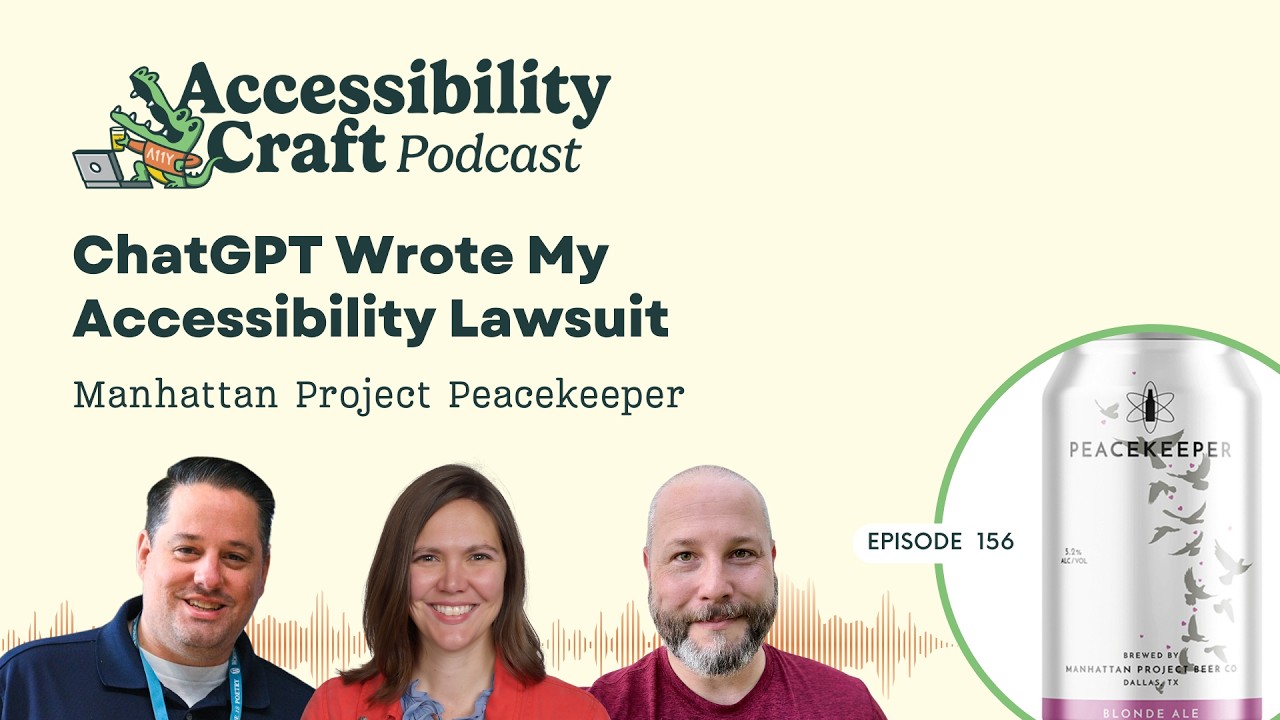
🔗 **Source:** [Manhattan Project Peacekeeper | ChatGPT Wrote My Accessibility Lawsuit](https://www.youtube.com/watch?v=rksVM0yE6xY)
> [!note]+ Document Notes
> tags: #accessibility #ai #lawsuits #ada #legal
> author: AccessibilityCraft
> source: Equalized Digital
> reference: https://www.youtube.com/watch?v=rksVM0yE6xY
> date created: 2024-12-19 10:30
>
> # 🏷️ Title: Manhattan Project Peacekeeper | ChatGPT Wrote My Accessibility Lawsuit
>
<!-- deep-read:sections start -->
## 🧰 Action Inbox
- [H1] Consult attorney before responding to any ADA lawsuit letter — prosay filings may contain AI-generated fake case citations #legal
- [H2] Implement proactive accessibility documentation process — document GitHub labels, user testing, remediation progress #accessibility
- [H3] Stay current on prosay filing trends — 69% increase in self-filed ADA lawsuits in 2025 #legal
## 🧭 Table of Contents
- [[#📝 Summary]]
- [[#📖 Main Content]]
- [[#🗒️ Notes]]
- [[#📚 References]]
- [[#🗣️ Paraphrase]]
- [[#📰 Newsletter]]
- [[#✅ Action Items]]
- [[#🧪 Hypotheses]]
- [[#📊 Methodology]]
- [[#❓ Questions]]
- [[#🔮 Future Research]]
- [[#💡 Implications]]
- [[#🧠 Learning Styles Assessment]]
- [[#📊 Accessibility Assessment]]
- [[#🌍 DEIB Assessment]]
- [[#✅ Logical Validity]]
- [[#🛡️ DARVO Analysis]]
- [[#🎯 Conclusion]]
### 🔗 References
- [Sefarth Law Firm Report on Prosay Lawsuits](URL)
- [NBC Article on AI Legal Defense](URL)
- [Accessibility People Are a Superpower by Jared Kuna](URL)
## 📝 Summary
- AccessibilityCraft hosts discuss alarming 69% increase in prosay (self-filed) ADA Title 3 lawsuits using AI-generated content
- Courts finding fake case citations and hallucinated legal references in AI-generated lawsuit filings
- Key stakeholders include business owners, accessibility professionals, attorneys, and people with disabilities seeking legitimate recourse
- Risk: AI-generated lawsuit spam could create judicial fatigue and undermine legitimate accessibility claims
- Bottom line: While AI democratizes legal access for some, poor fact-checking creates "legal slop" that damages accessibility advocacy
## 📖 Main Content
The episode explores the intersection of AI and accessibility litigation, focusing on a dramatic increase in prosay (self-filed) lawsuits targeting ADA Title 3 violations. Sefarth law firm reported a 69% increase in such filings, with many showing evidence of AI generation including fabricated case citations that don't exist.
The hosts debate whether this trend helps or hurts accessibility overall. Potential benefits include democratizing legal access for people with disabilities who can't afford attorneys. However, the downsides appear significant: creating judicial fatigue, generating animosity toward accessibility compliance, and drowning out legitimate claims in a sea of automated legal spam.
Courts are already pushing back against AI-generated filings containing hallucinated case law. The phenomenon represents a broader challenge of fact-checking AI output, similar to "vibe coding" in software development where initial AI results require extensive validation before production use.
## 🗒️ Notes
#### ⏱️ [00:00](https://youtu.be/rksVM0yE6xY?t=0) — [H1] Introduction and Beverage Review
- Key idea: Manhattan Project Peacekeeper Blonde Ale - neutral and complex beer pairing
- Evidence: "5.2% ABV and super minimalist design on the can"
#### ⏱️ [05:30](https://youtu.be/rksVM0yE6xY?t=330) — [H2] Plugin Achievement Announcement
- Key idea: Equalized Digital Accessibility Checker reaches #1 on WordPress.org feature plugins
- Evidence: "Our plugin is the number one feature plugin on WordPress.org right now"
#### ⏱️ [07:45](https://youtu.be/rksVM0yE6xY?t=465) — [H1] Accessibility Professionals as Superpowers
- Key idea: Accessibility specialists bridge multiple disciplines and stakeholder groups
- Evidence: "Natural bridge between different groups of stakeholders like engineering teams, design teams, and end users"
#### ⏱️ [12:15](https://youtu.be/rksVM0yE6xY?t=735) — [H1] Prosay Lawsuit Statistics
- Key idea: Dramatic increase in self-filed ADA lawsuits with suspected AI involvement
- Evidence: "In 2024 there were 1,774 federal lawsuits alleging Title 3 violations that were filed prosay by an individual. And in the first 9 months of 2025 that was 1867"
#### ⏱️ [15:20](https://youtu.be/rksVM0yE6xY?t=920) — [H1] Standing Requirements Challenge
- Key idea: AI-generated lawsuits may struggle with legal standing requirements
- Evidence: "How does AI actually implement standing? You have to show that somebody with the disability that needs to utilize a screen reader could not actually use your website"
#### ⏱️ [18:30](https://youtu.be/rksVM0yE6xY?t=1110) — [H2] Impact on Accessibility Perception
- Key idea: Automated lawsuits create animosity that may harm accessibility advocacy
- Evidence: "They're frustrated and they have been doing a lot of work... they feel like the people just want our money"
#### ⏱️ [22:45](https://youtu.be/rksVM0yE6xY?t=1365) — [H1] Fake Case Citations in Court Filings
- Key idea: Judges discovering AI hallucinated non-existent legal cases in prosay filings
- Evidence: "Plaintiff submission of fake hallucinated case citations... These cases appear to be non-existent"
#### ⏱️ [26:10](https://youtu.be/rksVM0yE6xY?t=1570) — [H2] AI Fact-Checking Education Need
- Key idea: People need to learn fact-checking skills rather than avoiding AI entirely
- Evidence: "We should be telling them how to fact check AI... We're all learning how to live in this new AI world"
#### ⏱️ [29:35](https://youtu.be/rksVM0yE6xY?t=1775) — [H3] Vibe Coding Analogy
- Key idea: AI legal filing parallels "vibe coding" - quick results that need extensive validation
- Evidence: "There's this weird phenomenon with AI... you go to test it without even looking at the code"
#### ⏱️ [33:20](https://youtu.be/rksVM0yE6xY?t=2000) — [H2] Democratization vs. Exploitation Balance
- Key idea: AI could help underemployed disabled people access legal system legitimately
- Evidence: "For some people being able to use AI... makes it even more equal access because we're not gatekeeped by, oh, I can't afford to pay you $5,000"
#### ⏱️ [37:15](https://youtu.be/rksVM0yE6xY?t=2235) — [H1] Customer Response to Serial Lawsuits
- Key idea: Business owners reaching breaking point with accessibility lawsuits
- Evidence: "The next lawsuit that comes in... I'm not paying it. I have enough of a legal war chest... I'm gonna fight this on behalf of my industry"
#### ⏱️ [41:50](https://youtu.be/rksVM0yE6xY?t=2510) — [H2] Time to Cure Legislation
- Key idea: Proposed 90-day cure period before ADA lawsuits could proceed
- Evidence: "A law was under discussion... that was going to mandate a time to cure for any ADA lawsuit whatsoever"
#### ⏱️ [45:30](https://youtu.be/rksVM0yE6xY?t=2730) — [H3] Response Strategy for AI-Generated Claims
- Key idea: Validate legal threats and push back on vague AI-generated demands
- Evidence: "Force them to do the work to actually prove that what they're saying is true"
#### ⏱️ [48:10](https://youtu.be/rksVM0yE6xY?t=2890) — [H1] People vs. Lawyers Communication Rule
- Key idea: Match communication level - lawyers should respond to lawyers, people to people
- Evidence: "Personal rule of thumb... people talk to people and lawyers talk to lawyers"
## 📚 References
- [Sefarth Law Firm Prosay Lawsuit Report](https://www.seyfarth.com/)
- [NBC Article on AI Legal Defense](https://www.nbc.com/)
- [Accessibility People Are a Superpower](https://jaredkuna.com/)
- [Equalized Digital Accessibility Checker](https://equalizedigital.com/accessibility-checker)
- [AccessibilityCraft with Richard Hunt](https://accessibilitycraft.com/)
## 🗣️ Paraphrase
- Self-filed ADA lawsuits have increased 69% with heavy AI involvement, including fabricated case citations that courts are rejecting
- While AI could democratize legal access for people with disabilities, poor implementation creates "legal slop" that damages accessibility advocacy
- Business owners are becoming increasingly frustrated with serial accessibility lawsuits, potentially leading to legal pushback and cure-period legislation
## 📰 Newsletter
**AI Meets Accessibility Litigation: What WordPress Site Owners Need to Know**
A concerning trend is emerging in accessibility law: a 69% increase in self-filed ADA lawsuits, many generated using AI tools. While this could theoretically help people with disabilities access legal recourse, the reality includes fabricated case citations and questionable standing claims that courts are rejecting.
For WordPress site owners, this underscores the importance of proactive accessibility. Document your efforts, implement proper testing workflows, and maintain accessibility statements. If you receive a legal threat, consult an attorney rather than attempting AI-generated responses.
The good news? Tools like Equalized Digital's Accessibility Checker (now #1 on WordPress.org!) help you identify and fix issues before they become legal problems.
Resources: [Learn WordPress](https://learn.wordpress.org/), [Developer Docs](https://developer.wordpress.org/), [WP-CLI](https://wp-cli.org/)
## ✅ Action Items
#### WordPress
- Accessibility: Promote proactive scanning tools and documentation practices
- Community: Share education on legitimate accessibility compliance vs. legal threats
- Documentation: Create guidance on accessibility statements and legal compliance
- Plugins: Support accessibility checker adoption and proper implementation
#### OSPO
- Policy & Governance: Monitor intersection of AI tools and legal compliance
- Developer Support: Training on accessibility documentation and evidence collection
- Community Engagement: Share best practices for responding to legal threats
#### Community
- Maintainers: Implement accessibility labels in issue tracking systems
- Contributors: Document accessibility improvements for legal protection
- Sponsors: Fund accessibility tooling and legal guidance resources
## 🧪 Hypotheses
- AI-generated accessibility lawsuits will create judicial fatigue leading to stricter filing requirements
- Business animosity from serial lawsuits will drive demand for cure-period legislation
- Courts will develop better mechanisms to detect AI-generated legal documents
- Legitimate accessibility advocates will be harmed by association with AI lawsuit spam
### 📊 Methodology
- Track prosay filing statistics over time across federal districts
- Survey business owner attitudes toward accessibility compliance pre/post AI lawsuit wave
- Analyze judicial dismissal patterns for AI-generated versus attorney-filed cases
### ❓ Questions
- Will courts implement technical measures to detect AI-generated filings?
- How can legitimate accessibility advocates distance themselves from AI lawsuit spam?
- What legislative responses will emerge to address automated legal threats?
### 🔮 Future Research
- Longitudinal study of accessibility compliance rates following AI lawsuit surge
- Analysis of judicial response patterns to AI-generated legal documents
- Investigation of standing requirements in automated accessibility litigation
### 💡 Implications
- Practice: Document all accessibility work for potential legal defense
- Policy: May accelerate cure-period legislation and filing requirements
- Security: Need better validation of AI-generated legal content
- Education: Critical need for AI fact-checking skills in legal contexts
- Funding: Resources needed for legitimate accessibility advocacy defense
### 🧠 Learning Styles Assessment
Reading level estimate: 12th grade
#### 👀 Visual learners
- Present: Podcast video format with screen sharing
- Improve: Court filing examples, lawsuit trend charts, process diagrams
#### 🔊 Aural learners
- Present: Full audio podcast format available
- Improve: Key quote compilations, expert interview segments
#### 🗣️ Verbal learners
- Present: Conversational format with analogies and examples
- Improve: Legal term glossary, step-by-step response guides
#### 🧩 Kinesthetic learners
- Present: Actionable advice and checklists
- Improve: Interactive legal response templates, documentation workflows
#### 🧠 Logical learners
- Present: Statistics, case studies, cause-and-effect analysis
- Improve: Decision trees for legal responses, risk assessment matrices
#### 🧑🤝🧑 Social learners
- Present: Panel discussion format, community examples
- Improve: Forum discussions, peer experience sharing
#### 🧘♀️ Solitary learners
- Present: Individual reflection on business practices
- Improve: Self-assessment tools, private documentation guides
#### 🌿 Naturalistic learners
- Present: Ecosystem thinking about legal/business/accessibility relationships
- Improve: Systems thinking diagrams, stakeholder impact maps
### 📊 Accessibility Assessment
#### Screen reader semantics
- Present: Full transcript provided, clear episode structure
- Improve: Time-stamped segment descriptions, speaker identification
#### Keyboard navigation
- Present: Standard podcast player controls
- Improve: Skip-to-segment functionality, keyboard shortcuts
#### Contrast and readability
- Present: High contrast show notes format
- Improve: Adjustable text sizing options, dark mode support
#### Media and captions
- Present: Full transcript and show notes available
- Improve: Video captions for visual content, downloadable transcripts
### 🌍 DEIB Assessment
#### Cultural breadth
- Present: US-focused legal discussion with business perspectives
- Improve: International accessibility law comparisons, global compliance approaches
#### Inclusive language
- Present: Person-first disability language, respectful legal terminology
- Improve: Multilingual resources, plain-language legal summaries
#### Representation
- Present: Business owner, accessibility professional, and legal perspectives
- Improve: Disabled plaintiff voices, diverse business size examples
#### Psychological safety
- Present: Respectful discussion of legitimate vs. exploitative claims
- Improve: Resources for those facing legal threats, support community connections
### ✅ Logical Validity
#### Strong reasoning
- Deductive strength: Legal standing requirements logically challenge AI-generated claims
- Inductive strength: Pattern recognition from court dismissals supports AI detection thesis
- Causal reasoning: Clear connection between AI lawsuit spam and accessibility community harm
- Analogical strength: "Vibe coding" effectively illustrates AI validation problems
#### Fallacies
- False dichotomy: Framing as purely good vs. bad when reality involves legitimate use cases
- Hasty generalization: Limited court examples may not represent broader trend
#### Tone of voice
- Overall tone: Professional concern with balanced analysis of complex issue
### 🛡️ DARVO Analysis
- Deny: No denial patterns observed in hosts' analysis
- Attack: Appropriate criticism of AI lawsuit spam without attacking legitimate claimants
- Reverse victim/offender: Careful distinction between exploitative filings and genuine accessibility needs
- Emotional cues and rhetoric: Measured concern rather than inflammatory language
## 🎯 Conclusion
The intersection of AI and accessibility litigation represents a double-edged sword that could either democratize access to justice or flood courts with automated spam. The key takeaway is that while AI tools may help legitimate claimants, the lack of proper fact-checking is creating "legal slop" that undermines the entire accessibility advocacy movement. Website owners should focus on proactive compliance and proper documentation, while the legal system must develop better mechanisms to distinguish between genuine accessibility needs and AI-generated exploitation.
## 🧱 Refactor Appendix
### 📚 Literature Split Pad
### [H1] AI-generated lawsuits create judicial fatigue in accessibility cases
> [!quote] Manhattan Project Peacekeeper | ChatGPT Wrote My Accessibility Lawsuit by AccessibilityCraft via Equalized Digital. Published 2024. Accessed 2024-12-19.
> "Do judges become fatigued by this? And anytime they see anything related to accessibility,
---
## Full Transcript
[00:08] Welcome to Accessibility Craft, where we<br>[00:10] explore the complex challenges and<br>[00:12] emerging trends that are shaping digital<br>[00:14] accessibility while sipping on unique<br>[00:15] craft beverages. This show is proudly<br>[00:18] produced by Equalized Digital, the most<br>[00:20] trusted name in WordPress accessibility.<br>[00:23] Join us every week as we break down<br>[00:25] accessibility news and share the expert<br>[00:27] strategies we've used to help make<br>[00:28] millions of websites more accessible.<br>[00:31] Grab a drink. The show starts now.<br>[00:35] >> Hey everybody, it's Amber and I'm here<br>[00:37] today with Chris.<br>[00:39] >> Hey everybody.<br>[00:41] >> And Steve.<br>[00:42] >> Hey everyone.<br>[00:44] and we are super excited to be here for<br>[00:49] episode number<br>[00:51] 156 of the AccessibilityCraft podcast.<br>[00:54] If you want to get show notes and a full<br>[00:56] transcript, you can find those if you go<br>[00:58] to accessibilitycraft.com56.<br>[01:03] We always start every episode with a<br>[01:05] beverage. What are we drinking today,<br>[01:06] Chris?<br>[01:08] >> We are back to the beers this week after<br>[01:10] a bit of a hiatus with weird kombuchas<br>[01:13] and other things. We are trying<br>[01:15] Manhattan Project Beer Co.'s Peacekeeper<br>[01:18] Blonde Ale. So, we're very gradually<br>[01:22] moving into springtime and summer. And<br>[01:26] so, starting to think about those<br>[01:28] beverages that pair well as as the<br>[01:30] weather gets warmer, so to speak. But<br>[01:33] they say that this is going to be I<br>[01:35] don't know how they're going to pull<br>[01:36] this off. I guess we're going to find<br>[01:37] out. They say it's neutral and complex<br>[01:39] at the same time, which is what makes it<br>[01:41] so special. So, be looking for<br>[01:43] neutrality and complexity, I guess, and<br>[01:45] hidden flavors.<br>[01:48] >> I have a question. You picked a beverage<br>[01:51] that's called Peacekeeper and says it's<br>[01:54] neutral. Do you expect us to be all<br>[01:56] peaceful and neutral on this podcast<br>[01:58] episode or are we allowed to get spicy<br>[02:00] if we want to?<br>[02:02] >> Oh, I think with the topic we have<br>[02:03] coming up here, I think we're allowed to<br>[02:05] have some strong opinions because it<br>[02:07] hits all the notes, right? It's got AI.<br>[02:09] It's got laws and legality and lawyers<br>[02:12] and judges and accessibility. So, it's<br>[02:15] all things that evoke strong emotion<br>[02:17] among our three hosts.<br>[02:20] >> It says on the can, it says it pairs<br>[02:22] well with patios, gram pics, like in<br>[02:25] Instagram and and apricot.<br>[02:28] >> All about it. I was like, what does that<br>[02:30] mean in the news? I'm like, oh yeah.<br>[02:36] Easy<br>[02:40] at scale.<br>[02:42] So, I guess this goes down easy.<br>[02:44] >> Yeah, we'll find out. I'm going to go<br>[02:46] and crack.<br>[02:46] >> So, that also could just mean it's<br>[02:47] boring.<br>[02:48] >> Yeah. And while we're opening these up<br>[02:50] and maybe sipping and smelling, I will<br>[02:52] note it's 5.2% ABV and super minimalist<br>[02:56] design on the can. And they have all<br>[02:57] their beers have a similar thing where<br>[03:00] it's like some kind of emblem inside the<br>[03:02] atomic symbol with the name of the beer<br>[03:05] and then some sort of very muted<br>[03:06] background illustration which is kind of<br>[03:09] fun. But<br>[03:10] >> mine like crazy.<br>[03:12] >> Mine did too. Mine Mine exploded out of<br>[03:15] the candy.<br>[03:15] >> Mine Mine did not. Do we need to take a<br>[03:18] >> Do we need to take a break to clean off<br>[03:19] some keyboards or are we good?<br>[03:20] >> No. No. We're good. It went away from<br>[03:22] the keyboard. But I swear if you were to<br>[03:24] slow down this video, you might actually<br>[03:26] see some beer like fly over my shoulder.<br>[03:29] I like when I tilt this down for a<br>[03:30] second. Look, it foamed up out of the<br>[03:33] top of the can. It's not foamy anymore,<br>[03:35] but it's almost like they overfilled the<br>[03:37] can because<br>[03:39] >> it's gone right up to the edge. I don't<br>[03:41] know.<br>[03:41] >> I spilled it on myself, but<br>[03:43] >> Oh, no.<br>[03:44] >> I've never had that happen. There's a<br>[03:46] first for everything on this podcast,<br>[03:48] apparently.<br>[03:50] And I'm really enjoying the nose coming<br>[03:52] out of this one. It's very like tropical<br>[03:54] and fruity smelling to me.<br>[03:58] I think that's got to be the hot.<br>[03:59] >> It's like It just smells like light<br>[04:01] beer.<br>[04:02] >> You smell tropical.<br>[04:05] >> Mhm. I do a little bit like passion<br>[04:08] fruit.<br>[04:11] >> Guess I get maybe a little bit of fruit<br>[04:13] on but it's subtle.<br>[04:16] >> I guess that's the point.<br>[04:19] Okay. Yeah, the nose had me more excited<br>[04:22] than Well, I'm gonna before I say<br>[04:23] anything else, I'm going to take one<br>[04:24] more sip.<br>[04:27] >> That's never a good sign when you're<br>[04:29] like, I got to taste it again before I<br>[04:30] decide what to say.<br>[04:35] >> I like the smell of this one more than I<br>[04:37] like the flavor. Like the smell, the<br>[04:39] nose had me really excited because I was<br>[04:41] getting like all these tropical floral<br>[04:43] notes, but it doesn't smell like a heavy<br>[04:45] beer, right? It smells like something<br>[04:46] that's going to be easy drinking. And I<br>[04:48] guess it's hitting that note, like the<br>[04:49] easy drinking note when I take a sip.<br>[04:51] Like decent acidity, decent balance. But<br>[04:53] I am definitely feeling like this one is<br>[04:55] leaning more towards the neutral and<br>[04:57] simple than any kind of hidden<br>[04:59] complexity. Like I'm not getting any<br>[05:01] kind of super deep or interesting. I<br>[05:04] mean, the way they described it makes me<br>[05:06] want to look for things, but I'm not<br>[05:07] finding a whole lot. What do you all<br>[05:09] think?<br>[05:11] Well, I mean, you guys kind of know this<br>[05:13] about me, but this is definitely my<br>[05:17] style of beer.<br>[05:19] I do like the light beers that are just<br>[05:22] really easy to drink. I mean, it's a<br>[05:24] patio. Like, says patio, pairs well with<br>[05:26] a patio for sure. If I just mow the<br>[05:28] grass and like I want to chill out and<br>[05:30] have something that is a bit refreshing<br>[05:33] and, you know, has a little bit of kick,<br>[05:36] this is it. I mean, this is really easy.<br>[05:40] Yeah,<br>[05:40] >> I agree. It's easy to drink. I don't<br>[05:42] feel like there's much depth to it. I<br>[05:45] don't get what they're saying. There's<br>[05:46] like hidden complexities. I don't think<br>[05:47] so. I will say it's a little bit hoppier<br>[05:50] on the finish than I expect a blonde to<br>[05:54] be. Like at least it's kind of IPAish.<br>[05:59] Not like overwhelming. Like IPAs are<br>[06:02] like I'm gonna be incredibly bitter.<br>[06:04] >> Yeah.<br>[06:04] >> At the end,<br>[06:05] >> but it has a little bit of that more<br>[06:07] than I normally expect in a blonde.<br>[06:09] >> It's Yeah. I would describe it as like<br>[06:11] more bitter than skunky. Like an IPA is<br>[06:15] a little more skunky to me. This is just<br>[06:17] kind of bitter with dry and bitter on<br>[06:19] the end, which I like.<br>[06:22] >> Okay. I have a thought now though. I was<br>[06:24] taking smaller sips and like I do the<br>[06:26] weird thing, you know, where you like<br>[06:27] try and move it around your mouth. See,<br>[06:29] do different parts of your tongues taste<br>[06:30] different things? And I couldn't really<br>[06:31] get much, but I just took a really big<br>[06:34] bottle. And I kind of get some tropical,<br>[06:38] maybe a little bit on that like larger<br>[06:42] mouthful.<br>[06:44] >> I'm not getting a whole lot of fruiness<br>[06:47] on the palette. It's all nose for me<br>[06:49] with the fruit, but it has a mild like<br>[06:52] bitter finish that lingers a little bit,<br>[06:54] but drops off pretty quickly. And yeah,<br>[06:57] I can see how this would pair well with<br>[06:59] a patio. I don't hate it. I just wish<br>[07:00] they hadn't told me to look for<br>[07:02] complexity cuz that that I think is the<br>[07:04] thing that I'm kind of hung up on.<br>[07:08] >> So, where are we all on our super not<br>[07:12] technical ratings of the thumbs up,<br>[07:14] thumbs in the middle, thumbs down? Would<br>[07:16] you get it again?<br>[07:18] >> Yeah, I'll go first. I'll give it a<br>[07:20] thumbs up because this is my style beer.<br>[07:22] Yeah.<br>[07:22] >> Yep. I'm thumbs up as well. Like I I<br>[07:25] know I harped on it for the muted<br>[07:27] palette, but it's a solid beer. Like I<br>[07:29] would be totally happy drinking this<br>[07:30] again.<br>[07:32] >> Oh, I'm the in the middle because I<br>[07:35] don't think it's bad. I would definitely<br>[07:38] drink it if someone gave it to me, but I<br>[07:41] tend to buy the more interesting or like<br>[07:43] stronger flavored stuff. So yeah, I<br>[07:45] think I'm kind of just in the middle on<br>[07:47] it. I'm not sure if I was walking to the<br>[07:48] store, this would be the one I would<br>[07:50] pick. Well,<br>[07:53] I know we have a little mini thing we<br>[07:55] were going to talk about, but can I also<br>[07:57] give one shout out? And I honestly I was<br>[07:59] like, wait, do I have a party hat? I<br>[08:01] wanted to show up to this recording with<br>[08:03] a party hat because our plugin is the<br>[08:05] number one feature plugin on<br>[08:07] WordPress.org right now. And I feel like<br>[08:10] we have to say something about that.<br>[08:11] Even though it might not be that way<br>[08:13] when this episode comes out, I have no<br>[08:15] idea how long they stay.<br>[08:17] >> But it's a cool achievement and I'm<br>[08:19] excited. So, I feel like we need to like<br>[08:21] have a toast to that or something before<br>[08:24] >> to literally being the number one on the<br>[08:26] plumbing repo everywhere. Thank you,<br>[08:28] Steve, for a timely DM to the right<br>[08:30] person at the right time.<br>[08:32] >> That's right.<br>[08:33] >> So, before we dive in really deep, we<br>[08:36] have kind of a fun article that we'll<br>[08:38] share in the show notes called<br>[08:41] accessibility people are a superpower<br>[08:44] from Jared Kuna. and he's talking about<br>[08:48] why people should take more advantage of<br>[08:52] the accessibility folks on their team<br>[08:55] and not just think of them as the little<br>[08:57] people in the corner who guarantee<br>[08:59] compliance. And he talks a lot about how<br>[09:03] people who have accessibility knowledge<br>[09:06] frequently have really broad skills that<br>[09:09] go across multiple disciplines. And a<br>[09:12] lot of times teams that have<br>[09:13] accessibility folks on them are more<br>[09:15] collaborative, which is really neat. And<br>[09:17] I don't know if you guys had any<br>[09:18] thoughts about this, but I think it's a<br>[09:20] cool article that would be useful for<br>[09:23] people to take a look at.<br>[09:26] >> We absolutely will link to this article.<br>[09:27] I think it's a great thing to promote<br>[09:30] and get out there because he even<br>[09:31] brought up some things that I didn't<br>[09:33] think about initially like the idea of<br>[09:36] an accessibility specialist as a natural<br>[09:39] bridge between different groups of<br>[09:40] stakeholders like engineering teams,<br>[09:43] design teams, and end users and how they<br>[09:45] kind of are these people that are in the<br>[09:48] middle of all three of those and may<br>[09:49] have skill sets in those disciplines as<br>[09:52] well. And I like that idea that us in<br>[09:56] our profession and the people on these<br>[09:58] teams kind of act as these bridges to<br>[10:01] help everybody pull in the same<br>[10:02] direction and understand one another. I<br>[10:04] think it's really cool.<br>[10:05] >> Yeah. Yeah. I mean, I think it it<br>[10:08] hearkens back to, you know, the whole<br>[10:09] shift left philosophy that we talk about<br>[10:11] a lot of where uh, you know, treating<br>[10:14] these people as part of the process as<br>[10:17] early on in the process as you possibly<br>[10:19] can is where they become that<br>[10:21] superpower. I think where a misuse of an<br>[10:24] accessibility professional in an<br>[10:26] organization a lot of times is to just<br>[10:29] see them as somebody that comes in after<br>[10:31] the fact that does QA and audits and<br>[10:33] everything's done because at that point<br>[10:36] the remediation is is costly to the<br>[10:40] product and probably doesn't make the<br>[10:42] product as good as it should have been<br>[10:43] to start out with.<br>[10:45] >> Yeah. Or to silo them off in their own<br>[10:47] little room department and not let them<br>[10:49] talk to anyone. That's another one that<br>[10:50] we see sometimes. I think kind of an<br>[10:53] underlying thing about this too that is<br>[10:56] interesting is he talks about you know<br>[10:58] accessibility professionals having like<br>[11:01] varied skill set across different what<br>[11:05] can be siloed in an organization and it<br>[11:07] made me think a little bit about us and<br>[11:09] I think part of what has made us strong<br>[11:11] is like Steve's a developer but he has a<br>[11:13] design background and he understands<br>[11:14] design in a way and so he's capable of<br>[11:17] doing a lot more and he knows<br>[11:19] accessibility and I'm an accessibility<br>[11:21] person who maybe understands stuff,<br>[11:26] right? Like more code probably than the<br>[11:28] average person. And I do think that when<br>[11:30] you have people like that in your<br>[11:32] organization that have skills that reach<br>[11:34] across multiple parts of a phase of a<br>[11:38] project or of a software product that<br>[11:40] you really should make use of them<br>[11:42] because they're going to bring so much<br>[11:44] more than someone who's I can only write<br>[11:45] code or I can only design things in<br>[11:48] Figma.<br>[11:49] >> Yeah. And it creates somebody with<br>[11:51] context that spans across multiple<br>[11:53] departments of your company. And that<br>[11:55] could be like, well, you know, this team<br>[11:58] that's working on this feature, we were<br>[12:00] talking about this the other day. So, if<br>[12:02] you're going to implement this, then<br>[12:04] maybe we should get together with them<br>[12:05] and have a conversation. Like, it<br>[12:07] literally helps be that glue in the<br>[12:09] organization. Well, it's time to switch<br>[12:12] over to today's main topic, which I'm<br>[12:16] calling ChatGpt wrote my accessibility<br>[12:19] lawsuit. But before we get into that,<br>[12:22] we're going to take a short commercial<br>[12:23] break.<br>[12:25] This episode of Accessibility Craft is<br>[12:28] sponsored by Equalized Digital<br>[12:30] Accessibility Checker, the WordPress<br>[12:32] plug-in that helps you find<br>[12:33] accessibility problems before you hit<br>[12:35] publish. Thousands of businesses,<br>[12:37] nonprofits, universities, and government<br>[12:39] agencies around the world trust<br>[12:41] Accessibility Checker to help their<br>[12:43] teams find, fix, and prevent<br>[12:45] accessibility problems on an ongoing<br>[12:47] basis. New to accessibility? Equalized<br>[12:50] Digital Accessibility Checker is here to<br>[12:52] teach you every step of the way. Whether<br>[12:54] you're a content creator or a developer,<br>[12:56] our detailed documentation guides you<br>[12:58] through fixing accessibility issues.<br>[13:01] Never lose track of accessibility again<br>[13:03] with real time scans each time you save.<br>[13:06] Powerful reports inside the WordPress<br>[13:07] dashboard and a front-end view to help<br>[13:10] you track down hard to find issues. Scan<br>[13:13] unlimited post and pages with<br>[13:14] Accessibility Checker free. Upgrade to<br>[13:16] Accessibility Checker Pro to scan your<br>[13:18] website in bulk, whether it has 10 pages<br>[13:21] or 10,000.<br>[13:23] Download Accessibility Checker today at<br>[13:25] equalizedigital.com/acessibility-checker.<br>[13:30] Use coupon code accessibility craft to<br>[13:33] save 10% on any plan.<br>[13:38] >> We're back. So Steve and Amber, leading<br>[13:41] up to this episode, I shared a couple of<br>[13:43] different articles with you and I want<br>[13:46] to go into them one at a time. So the<br>[13:49] first article that I found which was<br>[13:52] from October of 2025 was from Sefarth<br>[13:56] which is a law firm and they were<br>[13:59] observing this trend at the end of last<br>[14:01] year going into this year where there<br>[14:03] was roughly a I think 69%<br>[14:07] increase in prosay lawsuits happening in<br>[14:11] their area of service. And a prosay<br>[14:13] lawsuit for the uninitiated is someone<br>[14:15] who is self-filing. So, they're not an<br>[14:18] attorney. They haven't retained a<br>[14:19] lawyer, but they're filing these<br>[14:21] lawsuits. And some of these lawsuits<br>[14:23] were related to the Fair Housing Act or<br>[14:26] FHA, but there was also a massive uptick<br>[14:28] in ADA Title 3, which is what caught my<br>[14:31] eye. And they speculate based on the<br>[14:34] filings and based on some early case<br>[14:37] dismissals from judges and findings from<br>[14:39] judges that there's heavy use of AI<br>[14:42] happening in the filing of these<br>[14:44] lawsuits.<br>[14:45] And before I get into this too much<br>[14:51] further, with this shift we're seeing<br>[14:53] from maybe human-led lawsuits with a<br>[14:57] partner between a human and a law firm<br>[14:59] to humans and AI leading these Title 3<br>[15:03] lawsuits, probably also using automated<br>[15:06] tests to find the issues. I'm wondering<br>[15:08] what your highle reaction is for that.<br>[15:11] Would a automated legal wave help or<br>[15:15] hurt the cause of accessibility overall<br>[15:16] do you think?<br>[15:17] >> You know,<br>[15:19] Oh, go ahead, Steve.<br>[15:20] >> I would before I give like a full<br>[15:22] reaction, I would one question, how does<br>[15:26] this work without standing, right? Like<br>[15:29] in a legal complaint, you have to have<br>[15:31] standing. meaning that you have to show<br>[15:34] that somebody with the disability that<br>[15:37] needs to utilize a screen reader could<br>[15:39] not actually use your website. So, how<br>[15:42] does AI actually implement standing? the<br>[15:46] end that they actually intended to<br>[15:49] patronize the business because I know<br>[15:51] there was a lawsuit against a realer<br>[15:54] that didn't have all text for all the<br>[15:56] pictures of the houses and that got<br>[15:59] dismissed because the person lived in<br>[16:00] another state and the judge is like you<br>[16:03] were not really thinking about buying a<br>[16:05] house in this state. It is weird because<br>[16:08] some of that standing stuff is pretty<br>[16:11] broad<br>[16:13] and I'm sure that if I, you know, use we<br>[16:18] have a version of accessibility checker<br>[16:20] that can scan anything. I could just go<br>[16:22] scan like every restaurant website in my<br>[16:24] town and find problems on them<br>[16:29] and then I guess go and be like I'm<br>[16:32] gonna sue literally every restaurant in<br>[16:34] my town because I yeah have gone to that<br>[16:37] restaurant for dinner.<br>[16:40] Now it might be a little harder because<br>[16:41] they'd be like no you're a vegetarian.<br>[16:42] You would have never eaten at my<br>[16:43] barbecue restaurant.<br>[16:45] But I don't know standing is kind of<br>[16:47] broad right.<br>[16:49] Well, and and and<br>[16:52] what's the outcome? Like, if a letter is<br>[16:55] sent to a company, is the goal of the<br>[16:57] person doing this to scare them, to get<br>[16:59] them to pay some fee to make them go<br>[17:02] away before they even reach litigation?<br>[17:05] >> Circling back to your original question,<br>[17:07] Chris, on is this good or bad?<br>[17:13] I think ultimately it's probably bad<br>[17:16] because I think that it creates<br>[17:18] animosity. I'll be totally honest. We<br>[17:21] had a kickoff call for a user testing<br>[17:23] session with a company that's has<br>[17:26] e-commerce. They've been sued multiple<br>[17:28] times and they're frustrated and they<br>[17:30] have been doing a lot of work and<br>[17:31] they're trying to document it and that's<br>[17:33] why you know they're like we want real<br>[17:34] users to test our website which is<br>[17:36] amazing but they're like we feel like<br>[17:38] the people just want our money because<br>[17:41] when we fix the problem they identified<br>[17:43] they don't say okay never mind you did<br>[17:44] what I wanted they're like no you still<br>[17:47] owe me money<br>[17:49] and so I feel like it's horrible because<br>[17:53] part of me is like this kind of making<br>[17:57] it faster and easier. It's going to<br>[17:59] create so much bad will around<br>[18:02] accessibility that it will ultimately<br>[18:05] hurt the accessibility of the internet<br>[18:07] as a whole. Like that that's what I<br>[18:08] think is going to happen. Now, do I wish<br>[18:11] that it would help? Yes. Because I wish<br>[18:14] that people would be like, "Oh, this is<br>[18:16] actually the reality is some people are<br>[18:18] motivated by fear or the the legal risk<br>[18:22] more than they're motivated by the I<br>[18:24] want to be a good person." and make sure<br>[18:26] everyone can access my stuff. And so,<br>[18:28] you know, I'm like, maybe if there's<br>[18:30] more and more of these, then they will<br>[18:32] see more risk and then they'll take it<br>[18:34] more seriously. And that's what I would<br>[18:36] hope, but I don't know if that will be<br>[18:38] the reality. Like, I feel like more<br>[18:41] lawsuits, especially from serial<br>[18:44] plaintiffs who questionably actually<br>[18:46] wanted to use the website, doesn't help<br>[18:49] accessibility's case.<br>[18:51] >> I think I would agree. I think you're<br>[18:53] right. I think it's a bit of a<br>[18:54] double-edged sword. More accountability<br>[18:57] is good, but at the same time, what<br>[18:59] starts to happen is this starts to<br>[19:01] become noise at scale. I think you're<br>[19:04] completely right. I'm going to echo<br>[19:05] that. I think it could have an<br>[19:07] incredible negative impact on<br>[19:09] accessibility as a whole if it's not<br>[19:12] treated right or if companies don't<br>[19:14] learn the right way to combat it.<br>[19:17] >> You think, Chris?<br>[19:18] >> Well, I tend to agree with both of you.<br>[19:20] I think that this is going to create<br>[19:23] blowback and I kind of wonder if this is<br>[19:26] something that's going to tip the scales<br>[19:29] on the legislation side of things. I<br>[19:32] know that a law was under discussion at<br>[19:35] one point and maybe has since gone away<br>[19:38] in California that was going to mandate<br>[19:41] a time to cure for any<br>[19:44] ADA lawsuit whatsoever, like a 90-day<br>[19:48] time to cure before someone could<br>[19:50] actually take them to court or ask them<br>[19:53] for any money whatsoever. I kind of<br>[19:55] wonder if with this accelerating influx<br>[19:57] of individually filed lawsuits using<br>[20:00] automated testing tools and AI and<br>[20:02] things like that is going to kind of tip<br>[20:04] the scales towards us seeing more<br>[20:06] legislation like that get introduced.<br>[20:08] Just to share a couple of additional<br>[20:09] stats from this article that again we'll<br>[20:11] link to. In 2024 there were 1,774<br>[20:15] federal lawsuits alleging Title 3<br>[20:17] violations that were filed prosay by an<br>[20:20] individual. And in the first 9 months of<br>[20:23] 2025<br>[20:24] that that was 1867. So it's a clear<br>[20:27] acceleration. There were still 3 months<br>[20:30] left to go in 2025 and it had already<br>[20:32] exceeded the total count for the prior<br>[20:33] year. So it's definitely increasing. But<br>[20:36] I have a follow-up question that I want<br>[20:37] to get to, but I think it it's good to<br>[20:39] give a reference related to that first.<br>[20:42] So, I have open on my screen and I'll<br>[20:44] share a screenshot for this and for the<br>[20:46] listening audience and the viewing<br>[20:47] audience, but basically this article<br>[20:50] from this law firm linked to a finding<br>[20:53] from a judge that cited plaintiff<br>[20:56] submission of fake hallucinated case<br>[20:59] citations. And it says here that the<br>[21:01] court has reviewed defendants's motion<br>[21:03] to strike DE82 and has independently<br>[21:05] checked the cases cited in plaintiff's<br>[21:07] discovery motions and replies. The court<br>[21:11] found that the f the following issues.<br>[21:12] First, plaintiff sites Perez v. Miami<br>[21:15] Dade County 297 FRD62625<br>[21:19] and Jacobs v. Atrium MedC 2020 WL and a<br>[21:23] big string of numbers and all these<br>[21:24] others. These cases appear to be<br>[21:26] non-existent and it keeps going and it<br>[21:29] cites more things. And so this is the<br>[21:31] other part of this that kind of exits<br>[21:34] the sphere of accessibility a little bit<br>[21:36] which is does this just turn<br>[21:37] accessibility into a spam problem for<br>[21:41] courts and lawyers rather than a human<br>[21:43] problem for users.<br>[21:46] >> You know what I would say though<br>[21:48] I have seen news articles about this<br>[21:52] happening not just to non attorneys. So,<br>[21:56] I get that this is especially bad<br>[21:57] because non- attorneys are filing these<br>[21:59] cases and citing fake laws or fake court<br>[22:04] cases. Well, I have also read about<br>[22:06] attorneys using AI to generate briefs<br>[22:10] and citing fake cases. I think and Chris<br>[22:14] and I have had a separate conversation<br>[22:16] about this with how much our kids school<br>[22:19] is like freaking out about AI,<br>[22:21] especially in middle school. Like the<br>[22:23] middle school teacher is like, "We're<br>[22:24] not actually having them do assignments<br>[22:26] outside of class now. She's having them<br>[22:27] write them all there because she doesn't<br>[22:28] want them to use AI." And I'm like, "I<br>[22:30] don't think we should be telling them<br>[22:32] how to use AI. We should be telling them<br>[22:33] how to fact check AI."<br>[22:35] >> Mhm.<br>[22:36] >> It's what you need.<br>[22:38] >> Yeah. We're all learning how to live in<br>[22:40] this new AI world. And I'll kind of I'll<br>[22:44] liken this to my experience with AI and<br>[22:46] it's very development driven. Um because<br>[22:48] of course we're a development company<br>[22:50] making software. And there's this weird<br>[22:52] phenomenon with AI. And it's, you know,<br>[22:55] it's called vibe coding. The whole vibe<br>[22:57] coding thing where you have an idea for<br>[23:00] something, you go to the AI, you punch<br>[23:02] it in, and you sit back and you let it<br>[23:04] run, and then you go to test it without<br>[23:07] even looking at the code, and you're<br>[23:08] like, "Oh man, this kind of works. This<br>[23:10] is amazing. I didn't do anything. I just<br>[23:12] sat here for five minutes, and why the<br>[23:16] AI vibed away, and now I have something<br>[23:17] that works." and it gives the appearance<br>[23:20] that you've done something but in<br>[23:22] reality a piece of software if I were to<br>[23:25] release that it would be very bad. So,<br>[23:28] so we'll do that as a proof of concept<br>[23:30] for a feature in software, but then<br>[23:32] we're spend a month, refining it, going<br>[23:36] through the code, making sure that it<br>[23:38] actually did what it said was going to<br>[23:39] do it, that it's not going to have any<br>[23:40] implications throughout the rest of the<br>[23:42] application, that it doesn't break any<br>[23:44] of our tests, our unit tests that we<br>[23:46] have set up. and just making it<br>[23:49] something that is production ready,<br>[23:51] that's something that us as senior<br>[23:53] developers that have been making<br>[23:55] software for 20 years can put our name<br>[23:58] on. And I think the same thing's<br>[24:00] happening to these lawyers. I'll put it<br>[24:02] in quote because I don't know if they're<br>[24:04] actual lawyers, but they're putting a a<br>[24:07] URL to a website in and they're, you<br>[24:09] know, they're probably saying something<br>[24:10] about, you know, ADA or WIKAG or<br>[24:13] whatever, and then it comes back with<br>[24:15] results. The AI wants to give you<br>[24:17] results, but they're not going those<br>[24:20] additional steps to validate that<br>[24:21] information is correct and that it is<br>[24:24] right. And then they're basically<br>[24:26] submitting legal slop to the courts. So,<br>[24:30] it creates all this noise. It's going to<br>[24:32] create fatigue with judges as well. So,<br>[24:34] that can be another huge unintended<br>[24:36] consequence, too. Is do judges become<br>[24:39] fatigued by this? And anytime they see<br>[24:41] anything related to accessibility,<br>[24:42] they're like, "Get this out of my<br>[24:44] court." Now, on the flip side though, I<br>[24:46] think something to think about that is<br>[24:48] really interesting<br>[24:50] is that<br>[24:53] for some people<br>[24:55] being able to use AI, as long as they<br>[24:58] figure out how to fact check it<br>[24:59] appropriately,<br>[25:01] and us as here in America, the fact that<br>[25:05] we have the right to create a lawsuit<br>[25:07] without being forced to pay someone is<br>[25:10] very helpful because there might be<br>[25:12] people, including maybe a lot of people<br>[25:14] disabilities who are undermployed who<br>[25:16] couldn't afford to hire an attorney. And<br>[25:20] so perhaps this makes it even more equal<br>[25:24] access because we're not gatekeeped by,<br>[25:26] oh, I can't afford to pay you $5,000 to<br>[25:29] get you to write a brief for me. Um,<br>[25:33] >> so that's what makes it a little hard. I<br>[25:35] don't want to say that I think this is<br>[25:36] all bad because if a real person who has<br>[25:40] tried already to get a business to<br>[25:43] support them and maybe they live in a<br>[25:45] small town, it's the only pharmacy. They<br>[25:48] have to be able to get their medication<br>[25:49] from here. They don't have another<br>[25:50] alternative or whatever. Like they<br>[25:53] should be able to file a lawsuit. And if<br>[25:56] AI can help them do that, then I think<br>[25:59] that, you know, it is a good thing. But<br>[26:02] there's this whole the whole underlying<br>[26:04] of what is the actual motivation behind<br>[26:07] the people I think is a lot more<br>[26:11] worrisome.<br>[26:13] So what may actually end up taking place<br>[26:16] over time is the opportunists who are<br>[26:18] using this to make a quick buck are<br>[26:20] going to ruin a real avenue of recourse<br>[26:23] for the people who are experiencing<br>[26:25] actual harm and maybe have actual<br>[26:28] standing because they're just going to<br>[26:29] get lost in the deluge of AI slop<br>[26:32] lawsuits as Steve coined it whereas they<br>[26:35] you know maybe in a different time could<br>[26:37] have<br>[26:39] been heard by a judge if they were you<br>[26:41] know a real plaintiff with a problem<br>[26:43] that they tried to get addressed in the<br>[26:45] normal channels and had to turn to the<br>[26:47] legal system for relief. So, there's a<br>[26:49] followup to this, right? The other<br>[26:51] article I found is from NBC and they<br>[26:54] they were covering a slightly different<br>[26:56] story, but it was it was related to<br>[26:58] prosay uh legal filings and it followed<br>[27:01] 15 different plaintiffs who were using<br>[27:03] AI to try to help with their legal<br>[27:05] defense or dealing with legal issues<br>[27:07] that they were experiencing like with<br>[27:09] landlords or with business disputes or<br>[27:11] things of that nature and kind of the<br>[27:13] pitfalls of that. And I'm I'm just<br>[27:17] wondering like high level was the<br>[27:20] intersection of accessibility and AI and<br>[27:23] litigation on your 2026 bingo card that<br>[27:27] you wrote at the end of last year<br>[27:28] because it really wasn't on mine. Like<br>[27:31] this caught me completely off guard.<br>[27:35] >> Yeah, it totally was not on my radar.<br>[27:38] some of the articles like I mentioned<br>[27:39] before about attorneys doing it, but I<br>[27:42] guess it didn't really occur to me that<br>[27:44] people like I guess attorneys are people<br>[27:48] too.<br>[27:50] Non- attorney people.<br>[27:50] >> Are they though? No, I'm just kidding.<br>[27:52] I'm just kidding.<br>[27:52] >> No, are they?<br>[27:55] >> Sorry to Laney Fineold and some of the<br>[27:58] we've had on this podcast.<br>[28:02] I know. I guess I didn't really see that<br>[28:04] as a thing, but maybe, you know, also<br>[28:06] we're in our little bubbles and I'm in a<br>[28:08] bubble of privilege. There haven't been<br>[28:11] many places when I've been like, I feel<br>[28:12] like I need to sue somebody. You know, I<br>[28:15] in that article, I mean, that was the<br>[28:17] thing where I was saying, okay, it does<br>[28:19] sort of seem like this could be<br>[28:22] beneficial and helpful because there was<br>[28:24] a woman who successfully used that to<br>[28:28] get an appeal through when the initial<br>[28:32] case didn't work out the way she<br>[28:35] thought. And it saved her like tens of<br>[28:37] thousands of dollars in rent that she<br>[28:39] actually should not have had to pay. Um,<br>[28:42] at least according to the article, it's<br>[28:44] weird. It's mixed. I see good for this,<br>[28:47] but I also see potential concerns.<br>[28:51] You know, I'd be curious to know what<br>[28:53] you guys think about<br>[28:56] if we all decide that all these ADA<br>[29:00] lawsuits for websites are bad.<br>[29:04] What is the alternative or how do we<br>[29:07] make them stop? Right? Like I know that<br>[29:10] proposed law in California is back and<br>[29:13] it's back on the docket to maybe be<br>[29:14] talked about again which is you won't be<br>[29:16] able to sue the business. You'll have to<br>[29:18] sue the developer who built the website<br>[29:20] or<br>[29:22] you know there's also like the European<br>[29:24] Accessibility Act is not really about<br>[29:26] lawsuits. It's about fines from the<br>[29:28] government. So, it's like a weird if we<br>[29:29] don't like this path that people can use<br>[29:32] AI to generate lawsuits, like what is<br>[29:34] the alternative or how do we solve the<br>[29:36] underlying problem that makes people<br>[29:38] even want to do this?<br>[29:41] >> I mean, that is the million-dollar<br>[29:43] question, right? This play out so many<br>[29:45] different ways when it comes to legal<br>[29:48] claims, right? There's companies that<br>[29:49] actually have enough revenue to to take<br>[29:52] on the legal risk as a cog, as a cost of<br>[29:55] doing business. So to them it doesn't<br>[29:58] matter, right? As long as the money's<br>[30:00] there, they can get out of it. They just<br>[30:01] pay the fine and move on. This is not a<br>[30:04] new thing, right? Like it's just being<br>[30:06] accelerated with AI. And kind of our<br>[30:09] questioning is, is it going to dilute<br>[30:11] the thing or is it actually going to<br>[30:12] allow some smaller players to actually<br>[30:15] be heard? But it's like my take on a lot<br>[30:19] of legal stuff when it comes to<br>[30:20] accessibility. I don't personally like<br>[30:22] it. And in a perfect world, I don't<br>[30:25] think we should be suing each other for<br>[30:27] money because anytime the money enters<br>[30:28] the situation, it changes. And at the<br>[30:31] end of a lot of these lawsuits,<br>[30:34] the winner is not the person that needed<br>[30:36] to use that website to get their food or<br>[30:38] to get their drugs, like their<br>[30:40] prescriptions. The winner is the lawyers<br>[30:42] or the courts, the government. Rarely do<br>[30:45] we see the little guy that actually was<br>[30:48] put out<br>[30:49] get the net benefit from this.<br>[30:52] Yeah, it's a huge issue. And I'll even<br>[30:55] hearken back to the conversation that<br>[30:57] Amber briefly alluded to that we were<br>[30:59] having this morning with a customer<br>[31:01] who's coming on for some services. And<br>[31:04] he straight up said, the owner of this<br>[31:06] company, the next lawsuit that comes in,<br>[31:08] and they've had several, I'm not paying<br>[31:10] it. and I have enough of a legal war<br>[31:14] chest or cash reserves that I'm gonna<br>[31:16] fight this on behalf of my industry<br>[31:18] because he's in the unique position of<br>[31:20] at least he feels we'll see if we can<br>[31:22] validate his claims, right? But he feels<br>[31:24] his website is accessible enough that<br>[31:27] anyone who wants to do anything on it<br>[31:28] should be able to even if they<br>[31:30] experience an inconvenience, it should<br>[31:32] be a relatively minor one that isn't a<br>[31:34] blocker is kind of how he put it. And if<br>[31:36] I'm a business owner wearing the<br>[31:38] business owner hat, and that's the true<br>[31:39] reality of my website, that anyone who<br>[31:42] comes to it, regardless of what tech<br>[31:43] they're using, they can get through the<br>[31:45] user experience, they can do what they<br>[31:47] need to do, and they can move on with<br>[31:48] their day. And maybe there are little<br>[31:50] minor issues. I would probably also feel<br>[31:52] that I shouldn't be able to be on the<br>[31:54] receiving end of a five figure lawsuit<br>[31:56] because of a minor inconvenience.<br>[31:58] Usually those should be reserved for<br>[32:00] serious issues or blockers or a refusal<br>[32:02] to cooperate or whatever it is just as<br>[32:04] far as like a a moral thing. You know,<br>[32:06] if you're missing alt text on an image,<br>[32:08] unless it's a truly essential image,<br>[32:11] probably the user can get the<br>[32:13] information somehow, right? And it<br>[32:14] shouldn't be, oh, you're missing alt<br>[32:16] text on one image and your website's<br>[32:18] otherwise perfect, so here's a lawsuit<br>[32:19] for 10 grand, right? I don't think<br>[32:21] anyone would find that to be reasonable<br>[32:25] that someone would go and demand money<br>[32:27] for that.<br>[32:28] any sort of concept that says<br>[32:31] you have to you have a period of time in<br>[32:34] which you can try to solve the problems<br>[32:37] whether that's before you get a fine or<br>[32:39] before you get sued. I mean I do feel<br>[32:41] like in an ideal world there's some sort<br>[32:44] of process where every website has an<br>[32:46] accessibility statement. It tells people<br>[32:48] how to get help. If there is a problem,<br>[32:51] a user can report, get the assistance,<br>[32:54] and then the website will fix the<br>[32:55] problem. So, it won't exist for future<br>[32:57] people. And if there's some sort of<br>[32:59] process there, then, you know, there<br>[33:02] shouldn't need to be lawsuits and fines.<br>[33:06] But of course, you know, then we are in<br>[33:07] the land of not everybody thinks that<br>[33:09] way. So, I don't know. It's hard.<br>[33:12] >> Having some kind of formal process that<br>[33:13] you had to have gone through in order to<br>[33:15] be able to rise to the occasion of<br>[33:17] demanding money or getting in front of a<br>[33:19] judge, I think would be good. You know,<br>[33:21] there has to be some sort of track<br>[33:22] record of I submitted a complaint, they<br>[33:24] didn't cure it for 3 months and didn't<br>[33:27] provide me a meaningful resolution,<br>[33:29] therefore I sue you. I think that's at<br>[33:31] least some of the stuff that's coming<br>[33:32] out or that had been discussed<br>[33:34] previously in California and proposed<br>[33:36] and I guess it didn't really go anywhere<br>[33:37] like that 90 days to cure stipulation.<br>[33:39] I'd love to see that come back. I think<br>[33:41] that would be a good starting point for<br>[33:43] a deepening of making these lawsuits not<br>[33:47] impossible to file, but certainly to try<br>[33:49] to cut out the noise and get to the real<br>[33:52] people experiencing real problems that<br>[33:54] aren't being cured. But I'm also curious<br>[33:56] without advising on anyone's specific<br>[33:59] website or case if this changes how we<br>[34:04] would approach a conversation with<br>[34:05] customers who maybe experienced one of<br>[34:08] these prosay or individually filed<br>[34:10] threats. Would our advice to them change<br>[34:14] at all as far as like accessibility<br>[34:16] statements, automated scanning, like<br>[34:18] auditing and all the things? Would we<br>[34:20] pay more attention to what the person is<br>[34:22] actually claiming in their lawsuit<br>[34:24] filing versus if it came from a law<br>[34:26] firm?<br>[34:28] >> What do you all think?<br>[34:29] >> Oh, versus if it comes from a law firm?<br>[34:31] No, I don't think the type of lawsuit<br>[34:33] matters. I know that when we do audits,<br>[34:35] if someone has been sued already, we ask<br>[34:37] them, "What are the problems that they<br>[34:40] mentioned?" And we would, of course, go<br>[34:41] fix those first, even if sometimes<br>[34:44] they're like not what I think are the<br>[34:47] most important problems. And I don't<br>[34:49] think you'd do that any differently<br>[34:50] whether it was a law firm or an<br>[34:52] individual filing the lawsuit. You of<br>[34:54] course want to fix a problem someone<br>[34:55] flagged first.<br>[34:57] >> Yeah. But I would caution or I probably<br>[34:59] would lean in that, you know, if a case<br>[35:02] like this did come across our desk, one<br>[35:04] of these prosay cases that we could kind<br>[35:08] of tell was AI generated.<br>[35:11] I think a lot of times when people are<br>[35:12] threatened with a letter, they don't go<br>[35:14] out and validate what the law is and<br>[35:16] what their threat level of compliance<br>[35:18] is. So I think it's worth taking a step<br>[35:21] back and saying, well, what's my<br>[35:23] compliance requirements?<br>[35:26] I need to evaluate this legal language<br>[35:28] in this AI generated document. I can't<br>[35:31] tell if it's AI 100%, but maybe it is.<br>[35:33] It feels like it is. It kind of smells<br>[35:35] like AI slop. So you then have to step<br>[35:38] back and say, well, is this actually<br>[35:39] legal? Maybe you do need to reach out to<br>[35:41] a real lawyer to validate it. And then<br>[35:44] the compliance sides, you need to have<br>[35:47] some way to evaluate the legal and the<br>[35:50] compliance side of things to see if this<br>[35:51] is a credible claim against your<br>[35:54] company. I think the way that this is<br>[35:56] going to be combed a little bit, the AI<br>[35:58] stuff, is I think that by people<br>[36:00] actually pushing back a little bit and<br>[36:02] saying, you know, you need to validate<br>[36:03] these claims like you made these big<br>[36:06] claims. they hired Equalized Digital and<br>[36:08] they're saying that, you know, you're<br>[36:10] not actually correct in some of these<br>[36:12] claims. And I think a little bit of push<br>[36:15] back is probably going to be good to<br>[36:17] combat some of this. And I think in<br>[36:19] their own industry, in the courts, I<br>[36:22] think they're going to get push back,<br>[36:23] too. Like I said, I think judges are<br>[36:25] going to get tired of dealing with slop<br>[36:28] and these soft claims. Sometimes could<br>[36:30] be incorrect claims. and we'll probably<br>[36:33] put a little bit of shame towards the<br>[36:35] lawyers and maybe even their own<br>[36:36] industry. I know in the software<br>[36:37] industry like we we're all vibe coding<br>[36:40] but there's a whole negative con<br>[36:43] connotation with vibe coding as well.<br>[36:45] You know it's all this is AI slop right<br>[36:48] I think some of these things will<br>[36:49] selfcorrect but I think we need to hold<br>[36:51] each other accountable on many levels.<br>[36:55] >> Yeah. You know my advice I'm sitting<br>[36:58] here thinking of this is I agree with<br>[36:59] Steve. I think you need to if you get a<br>[37:02] letter, you probably should go talk to<br>[37:03] an attorney. I don't think you should<br>[37:04] ask chat GPT about your letter.<br>[37:08] >> Go find a real attorney.<br>[37:10] >> Yeah, that's like a weird Oraoros<br>[37:11] situation.<br>[37:14] >> Yeah, I know, right? I got this. Is it<br>[37:15] right, Chad? Oh, I wrote that for this<br>[37:17] other person. Yes, it's perfect.<br>[37:20] >> No, go listen to our podcast episode<br>[37:22] with Richard Hunt, who is an attorney<br>[37:24] who defends businesses against these<br>[37:27] kind of serial lawsuits. He had a lot of<br>[37:30] interesting things to say and definitely<br>[37:32] like reaching out to an attorney for<br>[37:33] legal advice because we're talking about<br>[37:35] the law right now but we're people we're<br>[37:37] not attorney<br>[37:39] so you know we're not giving you any<br>[37:41] legal advice right now but that's what I<br>[37:43] would say and I think as far as the<br>[37:45] website<br>[37:47] regardless of where a lawsuit or a<br>[37:49] complaint might come from the best thing<br>[37:51] you can do is be proactive<br>[37:54] make accessibility part of your process<br>[37:56] document what you're doing like in That<br>[37:58] could be as simple as we have an<br>[38:00] accessibility label in our GitHub repo,<br>[38:04] which then makes it really easy if I<br>[38:05] ever need to pull up a list of every<br>[38:07] accessibility issue I've resolved,<br>[38:10] right? If you can show, oh, our website<br>[38:12] got this much better as far as automated<br>[38:14] issues. Documenting when you doing<br>[38:16] things like having users test like we<br>[38:18] were talking about this other company is<br>[38:20] going to do. I think any of that is<br>[38:22] probably the best thing, but really,<br>[38:26] yeah, I don't know. The lawsuits are<br>[38:27] weird.<br>[38:29] Well, my advice would be if one of these<br>[38:31] lawsuits or letters comes in, because<br>[38:34] usually it starts with a letter, right?<br>[38:35] They don't go immediately to court<br>[38:37] filings because court filings cost<br>[38:39] money. Usually the courts charge a fee<br>[38:41] for filing something. If you get one of<br>[38:43] these letters with the blessing of your<br>[38:45] attorney and after an attorney has<br>[38:47] reviewed it, one thing that I have had<br>[38:50] success with previously responding to<br>[38:52] like copyright trolls, which is an<br>[38:53] entirely separate domain, but like<br>[38:55] people that go find images on your<br>[38:57] website, say they want thousands of<br>[38:59] dollars from you because you're<br>[39:00] violating copyright for some copyright<br>[39:02] holder they represent. I will go back<br>[39:05] and forth with them ad nauseium asking<br>[39:07] for deeper and deeper levels of<br>[39:08] clarification on the exact copyright<br>[39:11] holder where the copyright was held and<br>[39:13] registered, the exact image mark and the<br>[39:16] exact URL where they found it and blah<br>[39:18] blah blah. And I will just waste their<br>[39:20] time basically. But basically, you know,<br>[39:23] I think everything starts with the<br>[39:24] advice of an attorney. But for some of<br>[39:26] these, if you get like a vague letter,<br>[39:28] my first step would be force them to do<br>[39:30] the work to<br>[39:32] actually prove that what they're saying<br>[39:34] is true.<br>[39:35] >> Yeah. Yeah.<br>[39:37] I kind of have a personal rule of thumb<br>[39:39] and it's people talk to people and<br>[39:41] lawyers talk to lawyers. If you get a<br>[39:43] letter from a lawyer, find a lawyer to<br>[39:46] talk to that lawyer. If you get a letter<br>[39:47] from a person, you could probably talk<br>[39:49] to him.<br>[39:50] >> Yep. Yep. If there's one takeaway,<br>[39:53] consult your lawyer. Well, thanks for<br>[39:54] the interesting conversation, Chris. I<br>[39:57] think it will be, you know, interesting<br>[40:00] over the years as we continue to watch<br>[40:02] more and more AI get added into our<br>[40:06] collective culture and community and see<br>[40:09] all the different things that it impacts<br>[40:11] and it's going to touch some part of our<br>[40:13] jobs in many different ways.<br>[40:15] >> This kind of thing is going to stay on<br>[40:16] my radar for a while now. I'm going to<br>[40:18] be looking for more headlines about<br>[40:20] Prosay filings for Title 3 and maybe<br>[40:23] we'll do an update episode in a year or<br>[40:25] so and see if anything changed.<br>[40:28] >> All right. Well, thank you both for<br>[40:29] being here and we will go ahead and wrap<br>[40:31] up there and we'll see you all on<br>[40:33] another conversation episode in a couple<br>[40:35] weeks. Bye.<br>[40:36] >> Yep. See you.<br>[40:37] >> Bye.<br>[40:38] >> Thanks for listening to Accessibility<br>[40:40] Craft. If you found this episode<br>[40:41] valuable, please help us reach more<br>[40:43] people by subscribing, reviewing, or<br>[40:45] liking the show and sharing this with<br>[40:47] your colleagues. Accessibility Craft is<br>[40:49] a production of Equalized Digital, Inc.<br>[40:51] Steve Jones composed our theme music. To<br>[40:53] learn how Equalized Digital can support<br>[40:55] you on your accessibility journey, visit<br>[40:57] us at equalizedigital.com.
<!-- deep-read:sections end -->
📄 **Full text:** ![[Full Document Contents/Articles/Manhattan Project Peacekeeper ChatGPT Wrote My Accessibility Lawsuit|Manhattan Project Peacekeeper | ChatGPT Wrote My Accessibility Lawsuit, YouTube]]
## Highlights
- this, then maybe we should get together with them and have a conversation. Like it literally helps be that glue in the organization. Chris Hinds: Well, it's time to switch over to today's main topic, which I'm calling ChatGPT Wrote My Accessibility Lawsuit. But before we get into that, we're gonna take a short commercial break. Steve Jones: This episode of Accessibility Craft is sponsored by Equalize Digital ([View Highlight](https://read.readwise.io/read/01kmdssdvdyb3zrbn6h5kc6xcr))
- Tags: 👻 ai highlighted
- automated tests to find the issues. I'm wondering what your high level reaction is for that. Would a automated legal wave help or hurt the cause of accessibility overall, do you think? Amber: You know what's, oh, go ahead, Steve. What do you think? Steve Jones: Before I give like a full reaction, I would one, question how does this work without standing. Right? Like in a legal complaint, you have to have standing. ([View Highlight](https://read.readwise.io/read/01kmdssdxje4nrgrdw2hrxw069))
- Tags: 👻 ai highlighted
- then they will see more risk and then they'll take it more seriously. And that's what I would hope, but I don't know if that will be the reality. Like I feel like more lawsuits, especially from serial plaintiffs who questionably actually wanted to use the website, doesn't help accessibility's case. Steve Jones: I think I would agree. I think you're right. I think it's a bit of a double edged sword. More accountability is good, but at the same time, what starts to happen is ([View Highlight](https://read.readwise.io/read/01kmdsse0xc40zwxdn7v8k4f95))
- Tags: 👻 ai highlighted
- this starts to become noise at scale. I think you're completely right, I'm gonna echo that I think it could have an incredible negative impact on accessibility as a whole if it's not treated right. Or if companies don't learn the right way to combat it. Amber: What do you think, Chris? Chris Hinds: Well, I tend to agree with both of you. I think that this is going to create blowback and I kind of wonder if this is something that's going to tip the scales on the legislation side of things. ([View Highlight](https://read.readwise.io/read/01kmdsse4brw4sa4g3b79mm1w8))
- Tags: 👻 ai highlighted
- And so this is the other part of this that kind of exits the sphere of accessibility a little bit, which is does this just turn accessibility into a spam problem for courts and lawyers rather than a human problem for users? Amber: You know what I would say though, I have seen news articles about this happening, not just to non-attorneys. So I get that this is especially bad because non-attorneys are filing these cases and citing fake laws or fake court cases? ([View Highlight](https://read.readwise.io/read/01kmdsse5whxnyqawbm4cwe9fg))
- Tags: 👻 ai highlighted
- followed 15 different plaintiffs who were using AI to try to help with their legal defense or dealing with legal issues that they were experiencing, like with landlords or with business disputes or things of that nature. And kind of the pitfalls of that. And I'm, I'm just wondering like high level was the intersection of accessibility and AI in litigation on your 2026 Bingo Card that you wrote at the end of last year? Because it really wasn't on mine like this caught me completely off guard. ([View Highlight](https://read.readwise.io/read/01kmdsse8gdpba7kn1vqm9sqj5))
- Tags: 👻 ai highlighted
- And definitely like reaching out to an attorney for legal advice. 'Cause we're talking about the law right now. But we're people, we're not attorneys. So, you know, we're not giving you any legal advice right now. But that's what I would say. And I think as far as the website. Regardless of where a lawsuit or a complaint might come from, the best thing you can do is be proactive. Make accessibility part of your process, document what you're doing. Like, and that could be as simple as we have an accessibility label in our ([View Highlight](https://read.readwise.io/read/01kmdssebzfq8bgzy2j9vp88ax))
- Tags: 👻 ai highlighted
- GitHub repo, which then makes it really easy if I ever need to pull up a list of every accessibility issue I've resolved. If you can show, oh, our website got this much better as far as automated issues. Documenting when you are doing things like having users test, like we were talking about, this other company is gonna do. I think any of that is probably best thing, but really. Yeah, I don't know. The lawsuits are weird. Chris Hinds: Well, my advice would be if one of these ([View Highlight](https://read.readwise.io/read/01kmdsseer8eq3yttpw3rrjke3))
- Tags: 👻 ai highlighted