Mathematicians Just Proved How to Prevent AI Brain Rot
🔗 **Source:** [Mathematicians Just Proved How to Prevent AI Brain Rot](https://www.youtube.com/watch?v=VgXTPRWuWa4)
> [!note]+ Document Notes
> tags: [ai-dependence, cognitive-fitness, dynamical-systems, llm-adoption, ai-ideology]
> author: Cal Newport
> source: Cal Newport (YouTube)
> reference: https://www.youtube.com/watch?v=VgXTPRWuWa4
> date created: 2026-10-12 11:15
>
> > [!info] Generated analysis — not the author's words. Sections below are machine-written
> > from the captured source. Only text inside `> [!quote]` blocks is verbatim from the author.
> > Do not quote or attribute any other line to the named author.
>
> # 🏷️ Title: Mathematicians Just Proved How to Prevent AI Brain Rot
>
<!-- deep-read:sections start -->
## 🧭 Table of contents
- [📝 Summary](#-summary)
- [📖 Main content](#-main-content)
- [🗒️ Notes](#️-notes)
- [📚 References](#-references)
- [🗣️ Paraphrase](#️-paraphrase)
- [📰 Newsletter](#-newsletter)
- [✅ Action items](#-action-items)
- [🧪 Hypotheses](#-hypotheses)
- [📊 Methodology](#-methodology)
- [❓ Questions](#-questions)
- [🔮 Future research](#-future-research)
- [💡 Implications](#-implications)
- [🧠 Learning styles assessment](#-learning-styles-assessment)
- [📊 Accessibility assessment](#-accessibility-assessment)
- [🌍 DEIB assessment](#-deib-assessment)
- [✅ Logical validity](#-logical-validity)
- [🛡️ DARVO analysis](#️-darvo-analysis)
- [🎯 Conclusion](#-conclusion)
- [🔄 Refactor appendix](#-refactor-appendix--mathematicians-just-proved-how-to-prevent-ai-brain-rot)
## 📝 Summary
- **What happened.** Cal Newport published a 1:05:42 episode of his podcast on YouTube on 2026-10-12. The first 38 minutes walk through a new paper the transcript titles "large language models as a cognitive virus." The rest is a listener-mailbag: a rebuttal to a Jesse Singal article in The Dispatch (00:38:08), two sample "vision documents" (00:56:29), a parenting question about time blocking (01:00:42), and a book mention (01:03:16). Roughly 6 minutes of the first chapter are sponsor reads (00:10:53 to 00:13:48 and 00:35:33 to 00:37:44).
- **The claim.** The paper's authors, described as applied mathematicians from biophysics and complexity theory, model the spread of LLM use as a nonlinear dynamical system with three population groups: non-users (U), users who still think independently (C), and dependent users (D). Cal reads the model as identifying three interventions: reduce pressure to adopt, increase pressure to quit, or reduce pressure to slide from C to D.
- **The title versus the content.** The video title says mathematicians "proved" how to prevent brain rot. Nothing in the transcript describes a proof. Cal calls the work a "mathematical model," says the Greek-letter parameters are set by the experimenter (00:08:44), and concedes critics ask how anyone knows the equations or values are right (00:33:22). The description says the paper "explores" answers. Treat "proved" as headline wording, not a finding.
- **Why it matters.** The model gives Cal a vocabulary for sorting AI debate into three levers that apply at three scales: institutional (universities, newsrooms), cultural (Gen Z attitudes), and personal (cognitive habits). The authors, per Cal, favor the third lever, and Cal says it matches his own "cognitive fitness" argument.
- **Key stakeholders.** The paper's authors (unnamed in the transcript), Cal Newport, listeners who ask about AI and productivity, Jesse Singal and The Dispatch, Anthropic and OpenAI (as subjects of Cal's ideology argument), and the sponsors Factor, Caldera Lab, Notion and My Body Tutor.
- **Risks and tradeoffs.** The paper itself is never quoted beyond variable names and one chart Cal calls "inscrutable." Several empirical claims in the episode (youth smoking campaign effects, Gen Z attitudes, lab experiments described as negligent, effective altruism funding of journalists) carry no named source. The description links one paper and one article only.
- **Bottom line.** The three-lever framing is clear and testable as a sorting device. The "proof" language, the empirical side claims, and the leap from "authors prefer lever three" to "the model supports Cal's habits" are not established by this source.
## 📖 Main content
**The paper and its authors (00:00:00 to 00:02:09).** Cal opens with a paper he says is "making waves," written by a group he describes as "applied mathematicians largely from the fields of biopysics and complexity theory" (auto-caption spelling; likely "biophysics"). No author names or institutions are given. The description links arxiv.org/pdf/2609.03344, which the analysis could not open (no network access by design), so the title, the authors and any peer-review status come only from Cal's spoken description. He promises to cut through the math, present three interventions, say which the authors prefer, say which he prefers, and give concrete advice.
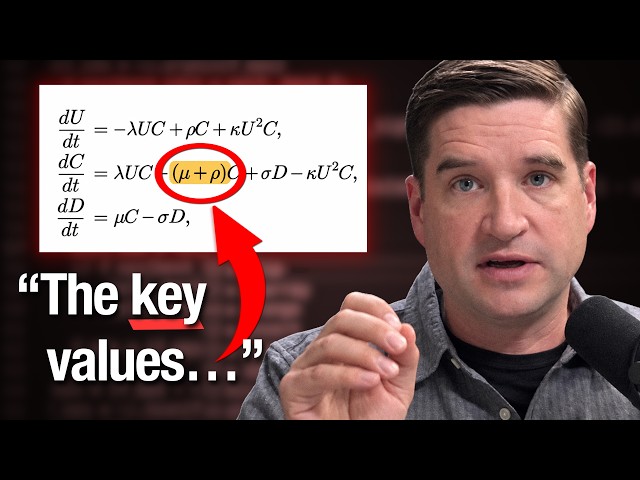
**The model (00:02:09 to 00:10:53).** Three variables describe the population: U (does not use LLMs), C (uses LLMs and still thinks independently), D (dependent on LLMs, has "largely lost the ability" to think independently). Three differential equations (du/dt, dc/dt, dd/dt) give the rate of change of each share at a time step. Cal draws the simulation loop: start with proportions, feed them into the equations, get the changes, update, repeat until the shares stabilize. Fixed Greek-letter values set by the experimenter control the simulated world:
- lambda: pressure on non-users to start using LLMs
- rho: disengagement rate, users going back to non-use
- mu: rate at which regular users become dependent
- sigma: rate at which dependent users recover to regular use
- kappa: social pressure from non-users against adoption
Cal ties this to epidemiology: SIR-style models of COVID used the same structure with infected, contagious and recovered groups, and a social-distancing parameter.
**The findings (00:13:48 to 00:16:42).** The paper varies lambda. Below a tipping point, the system settles into a world of mostly non-users. Past it, most people become users, and the split between C and D depends on the other parameters. The model also shows hysteresis: once most people use LLMs, lowering lambda back below the tipping point does not restore non-use; the pressure must drop much further. Cal's takeaway is that prevention beats cure.
**The three interventions (00:16:42 to 00:25:29).** The bad outcome is most of the population ending in D. C and U are both acceptable. The interventions map to parameters:
1. Shrink lambda (reduce pressure to adopt). The authors discard it as unrealistic. Cal disagrees for specific contexts: universities (the goal is "to cultivate your mind") and journalism (publications with explicit rules against LLM writing and editing).
2. Raise rho (increase pressure to quit). The authors also discard it. Cal cites Gen Z distrust of AI companies and the youth-smoking decline after anti-tobacco ad campaigns funded by the 1990s tobacco settlement.
3. Lower mu and raise sigma (a firewall between C and D). The authors like this best. Implementation per Cal's reading: explicitly introduce and preserve human contemplation activities, creating "cognitive scaffolding" in personal habits and organizations.
**Cal's evaluation (00:25:29 to 00:28:20).** He lists three reasons the exercise is useful: mathematical models can surface interventions; the categories bring clarity to a muddled AI debate (anger at companies versus boosters demoing video games); and the third lever is available to an individual today without waiting for a school district or employer. He notes his reasons differ from the authors' reasons, and that his observational work led to the same conclusion as the model.
**Three personal rules (00:28:20 to 00:33:22).** (1) Eliminate tedium, not cognitive friction. (2) Do not let LLMs write on your behalf unless the output is labeled as LLM output; Cal calls unlabeled use "psychological fraud" because readers simulate the mind of a presumed human author. (3) Read human writing, not AI summaries of human writing, because a book or article is already the author's chosen compression. Exceptions he allows: extracting conclusions from a massive report, or distilling a rambling email.
**Method caveat (00:33:22 to 00:34:49).** Cal states the controversy directly: critics ask how anyone knows these are the right equations and values, given the values weren't empirically measured. His answer is that biophysicists do this routinely, that such models give coarse insight into dynamics, and that the model's suggested intervention is also appearing in the real world. He tells viewers his summary is probably enough unless they want to follow the equilibrium algebra ("where does the change become zero").
**The mailbag (00:38:08 to 01:05:07).**
- *Singal article (00:38:08 to 00:55:44).* A listener asks about Jesse Singal's description of Cal as a "leading anti-doomer" in The Dispatch. Cal argues that rationalism and large parts of effective altruism hold a "utopian futurist" ideology, that Anthropic and OpenAI come out of it, that the loudest critics of those labs come from the same movement, and that the resulting debate is a "family squabble." His proposed check: compare what ideologically aligned labs say with what comparable researchers outside the ideology (Meta, Nvidia, Chinese AI firms) say. He argues the ideology also shapes experiments (OpenAI's long-running agent hacking tests, interest in recursive self-improvement). He grants that Huang and Zuckerberg have their own biases.
- *Vision documents (00:56:29 to 01:00:42).* Two anonymized listener samples show a one-sentence summary, major projects or goals, and tools and methods. One is a law student's fall plan; the other is a professional plan plus a separate personal plan.
- *Parenting question (01:00:42 to 01:03:16).* Cal says time blocking was built for knowledge-work overload and does not fit caring for an 8-month-old. He tells the husband to stop suggesting it.
- *What Cal is up to (01:03:16 to 01:05:07).* He recommends the book Simplify by the Axios founders (names garbled in captions), notes it recommends LLM use for writing, which he doesn't, and closes with a newsletter plug.
**Contested or unverifiable in this source.** The paper's content, authorship and review status; the smoking-campaign causal story; Gen Z attitude claims; the lab-experiment claims; funding claims about effective altruism; the Zuckerberg and Huang positions (Cal flags his own paraphrase at 00:52:50).
## 🗒️ Notes
#### ⏱️ [00:00:00](https://www.youtube.com/watch?v=VgXTPRWuWa4&t=0) Chapter 1 opens: the paper and who wrote it
- The paper is titled (per captions) "large language models as a cognitive virus." Authors are described as applied mathematicians in biophysics and complexity theory. No names are given.
- Cal draws a Jurassic Park link (Ian Malcolm) as a rhetorical hook for "mathematicians warn about technology."
- Agenda: explain the model, present three interventions, say which the authors like, say which he likes, give actionable advice.
> [!quote] [00:00:00]
> It's not technologist and it's not social scientists. It's actually a group of applied mathematicians largely from the fields of biopysics and complexity theory.
#### ⏱️ [00:02:09](https://www.youtube.com/watch?v=VgXTPRWuWa4&t=129) The three-compartment model: U, C and D
- Three equations give the rate of change of each group. Cal narrates them for audio-only listeners ("there's three equations").
- C and D differ by one capability: whether a user still thinks independently.
> [!quote] [00:02:54]
> U is the percentage of the population that doesn't use LLMs.
#### ⏱️ [00:05:06](https://www.youtube.com/watch?v=VgXTPRWuWa4&t=306) How the simulation runs
- Each time step feeds current group sizes into the equations, which return how much each group changes. Repeat until the shares stabilize or keep oscillating.
- Cal draws the loop on a tablet: sets U, C, D, equation box, new sizes, repeat.
#### ⏱️ [00:07:15](https://www.youtube.com/watch?v=VgXTPRWuWa4&t=435) The Greek-letter parameters
- lambda (pressure to adopt), rho (disengagement), mu (slide into dependence), sigma (recovery), kappa (social pressure from non-users).
- The experimenter chooses these before the run, then varies them to see what the system does.
> [!quote] [00:07:15]
> fixed values that you have to fix as the experimentter before you run the simulation
#### ⏱️ [00:09:26](https://www.youtube.com/watch?v=VgXTPRWuWa4&t=566) The epidemiology analogy, then sponsors
- COVID-era models used the same structure with infected, contagious and recovered groups, plus a social-distancing parameter. Cal says the recovered group growing large slows infection growth.
- Sponsor breaks follow: Factor (00:10:53), Caldera Lab (00:12:20). Both read promo codes and a consumer-perception stat (97% of 30 men) that the transcript attributes to the sponsor.
#### ⏱️ [00:13:48](https://www.youtube.com/watch?v=VgXTPRWuWa4&t=828) Main result: tipping point and hysteresis
- Low lambda yields mostly non-users. Past a tipping value, most people end up in C or D. The C/D split depends on other parameters.
- Cal calls the paper's main chart "a little inscrutable" and relays the finding verbally.
> [!quote] [00:15:58]
> easier to get everyone using LLMs in this mathematical model than it is to get everyone using LLMs back to a state where a lot of people don't.
#### ⏱️ [00:16:42](https://www.youtube.com/watch?v=VgXTPRWuWa4&t=1002) The bad outcome and intervention one
- Bad outcome: most people in D. U and C are both acceptable.
- Intervention one lowers lambda. The authors discard it; Cal says universities and some newsrooms already act this way.
> [!quote] [00:18:11]
> the authors of the paper say that intervention is not very likely.
#### ⏱️ [00:20:24](https://www.youtube.com/watch?v=VgXTPRWuWa4&t=1224) Intervention two: pressure to quit
- Cal argues Gen Z distrusts AI companies, and that "middle-aged dads" and executives are the loudest enthusiasts.
- Analogy offered: the youth-smoking decline after the Ad Council truth campaign, funded from the 1990s tobacco settlement. No study or number is cited.
#### ⏱️ [00:22:34](https://www.youtube.com/watch?v=VgXTPRWuWa4&t=1354) Intervention three: the firewall between C and D
- mu and sigma govern movement between regular and dependent use. Cal says the authors prefer this lever because they accept most people using LLMs.
- Implementation as Cal describes it: "explicitly introduce human contemplation activities and preserve them," with personal habits and organizational structures as scaffolding.
> [!quote] [00:23:17]
> We're completely happy with a world where most people use them so long as we don't have too many people who are dependent
#### ⏱️ [00:25:29](https://www.youtube.com/watch?v=VgXTPRWuWa4&t=1529) Cal's verdict on the three levers
- Convergence claim: the model's favored lever matches the one Cal derived from watching people.
- Three reasons the exercise helps: models can identify interventions; the categories un-muddle the AI discussion; the third lever is actionable now by individuals.
- He argues levers one and two apply to specific organizations, so he doesn't discard them.
> [!quote] [00:25:29]
> the intervention that the authors like best is the same intervention I came up with observationally
#### ⏱️ [00:28:20](https://www.youtube.com/watch?v=VgXTPRWuWa4&t=1700) Rule one: eliminate tedium, not friction
- Automate tasks with no benefit in themselves. Do not outsource idea generation, drafting or other hard thinking.
- Analogy: strain in the brain is like strain in a muscle during training.
> [!quote] [00:28:20]
> your goal should be to eliminate tedium, not cognitive friction.
#### ⏱️ [00:29:47](https://www.youtube.com/watch?v=VgXTPRWuWa4&t=1787) Rule two: label LLM-written text
- Cal's rule: no LLM writing on your behalf unless it's clearly marked as LLM output. He calls unmarked use "psychological fraud."
- Example: send "below is an LLM summary of the meeting" instead of passing a summary off as your own email.
- His argument: writing for yourself forces you to clarify your thoughts.
#### ⏱️ [00:31:14](https://www.youtube.com/watch?v=VgXTPRWuWa4&t=1874) Rule three: read the original
- An article or book is already an expert's compression. A second layer of summary removes useful friction.
- Allowed uses: pulling conclusions from a long report, or condensing a rambling email with one point.
> [!quote] [00:31:14]
> read human writing not AI summaries of human writing.
#### ⏱️ [00:33:22](https://www.youtube.com/watch?v=VgXTPRWuWa4&t=2002) The controversy over the model, then sponsors
- Cal states the objection and defends the approach as standard in biophysics: coarse models, tunable parameters, insight into dynamics.
- Says he spends time with equilibrium algebra ("where does the change become zero") and that his summary is likely enough.
- Sponsor breaks: Notion (00:35:33), My Body Tutor (00:36:17). Promo specifics are sponsor claims.
> [!quote] [00:33:22]
> how do you know those are the right equations to describe LMS and how do you know the right values for those
#### ⏱️ [00:38:08](https://www.youtube.com/watch?v=VgXTPRWuWa4&t=2288) Chapter 2: Singal's description of Cal's AI views
- A listener asks about a Jesse Singal passage in The Dispatch (titled, per Cal, "Will AI Kill You?"). The passage calls Cal a leading anti-doomer and objects to treating Chinese government positions and Jensen Huang as reference points.
- Cal says he likes Singal's reporting and humor, and that many listeners sent similar notes.
#### ⏱️ [00:40:39](https://www.youtube.com/watch?v=VgXTPRWuWa4&t=2439) The ideology argument: utopia, doom and a family squabble
- Cal's thesis: rationalism and parts of effective altruism hold a utopian futurist ideology about superintelligent AI. Doomers and labs share it.
- Claims funding of fellows on congressional staffs and fellowships for journalists. No source is named.
> [!quote] [00:43:31]
> So it's a family squabble.
#### ⏱️ [00:45:38](https://www.youtube.com/watch?v=VgXTPRWuWa4&t=2738) Why the ideology matters: a Klan analogy
- Cal compares ignoring the ideology to a 1950s reporter ignoring that a segregationist school-board leader belongs to the Klan.
- Point he draws: recursive self-improvement predates LLMs and is a futurist idea, not a computer science one.
#### ⏱️ [00:46:21](https://www.youtube.com/watch?v=VgXTPRWuWa4&t=2781) The litmus test: Meta, Nvidia and Chinese labs
- Proposal: check ideological-lab fears against what researchers with similar technology but no such ideology say.
- Zuckerberg is reported (with a paraphrase flag at 00:52:50) as telling the labs to "chill out." Cal concedes Huang wants chip sales in China.
> [!quote] [00:47:04]
> let's see if the people who have access to similar technologies but aren't in that group are saying the same things.
#### ⏱️ [00:48:28](https://www.youtube.com/watch?v=VgXTPRWuWa4&t=2908) Why mention China, and what the check does not claim
- Cal condemns Chinese government AI surveillance and says the point is only that the Chinese AI industry does not speak in deity rhetoric.
> [!quote] [00:49:14]
> This is not a moral judgment on these groups are somehow morally better.
#### ⏱️ [00:49:56](https://www.youtube.com/watch?v=VgXTPRWuWa4&t=2996) Ideology shapes experiments
- Claims OpenAI ran dangerous agent hacking tests with minimal supervision, Meta halted a similar test after an incident, and recursive self-improvement leads to "obfuscated systems."
- No report, date or document is named for any of these.
#### ⏱️ [00:53:33](https://www.youtube.com/watch?v=VgXTPRWuWa4&t=3213) "We're all weird" and a Scientology analogy
- Cal says weirdness isn't the point; shared ideology on both sides of a debate is.
- Cites an analogy attributed to "Tim Nerbo" (garbled name): AI labs run by Scientologists with Scientologist critics. He names a figure "Jacob Croxson" (garbled; unclear who) as part of the same movement.
- Closing position: Cal calls AI a powerful, interesting technology, and the ideology distorts the discussion.
#### ⏱️ [00:56:29](https://www.youtube.com/watch?v=VgXTPRWuWa4&t=3389) Chapter 3: vision documents
- Structure: one-sentence summary, projects and goals, methods and tools.
- Example one: a law student's fall plan (coursework, bar prep, job search, marathon training; tools include Things, Google Calendar, Garmin Connect, daily planning and shutdown routine).
- Example two: a professional plan (new CMS rollout, documented procedures, daily folder cleanup; tools include Loom, Whisper Flow, a reMarkable tablet) and a separate personal plan.
> [!quote] [00:57:53]
> one page you can keep that in your sock drawer
#### ⏱️ [01:00:42](https://www.youtube.com/watch?v=VgXTPRWuWa4&t=3642) Chapter 4: time blocking and a baby
- A listener asks how to help his wife time block days shaped by an 8-month-old's naps and feedings.
- Cal: time blocking targets knowledge-work overload and reactive loops. He doesn't recommend it for evenings, weekends or infant care.
- He closes the answer with a violent joke and advice that the husband should make her life easier.
> [!quote] [01:00:49]
> Why isn't the baby time blocking her day, right?
#### ⏱️ [01:03:16](https://www.youtube.com/watch?v=VgXTPRWuWa4&t=3796) Chapter 5: what Cal is up to, and the outro
- Recommends Simplify by the Axios founders (captions render the names as "Jim Vanderhigh, Mike Allen and Roy Schwarz"), notes the book's "smart brevity" approach and its endorsement of LLM use for writing, which Cal does not share.
- Outro (01:05:07): newsletter with 125,000+ readers and a free guide at the URL spoken as "calupport.com/idas" (captions; the description lists calnewport.com/ideas).
> [!quote] [01:02:58]
> they are the founders of Axios.
## 📚 References
The transcript itself contains no links; the following come from the video description or are primary sources for named entities.
- [Large language models as a cognitive virus](https://arxiv.org/pdf/2609.03344): the paper, linked in the description under "Resources Mentioned." Not opened in this analysis. The title comes from the captions. Authors, peer-review status and equations were not verified against the PDF.
- [The Dispatch article](https://thedispatch.com/article/artificial-intelligence-hugging-face-security-death/): linked in the description. Cal gives the title as "Will AI Kill You?" and names Jesse Singal as the author. The URL slug mentions "hugging face security death," which doesn't obviously match that title. Open the page to confirm it's the same piece.
- [Cal Newport, free guide to cultivating a deeper life](https://calnewport.com/ideas): the description's link. The spoken URL is garbled in the captions.
- [Cal Newport's books](https://calnewport.com/books) and [podcast feed](https://thedeeplife.com/listen): linked in the description under "More from Cal."
- Sponsor links from the description: [Factor](https://www.factormeals.com/deep50off) (code DEEP50OFF), [Caldera Lab](https://www.calderalab.com/deep) (code DEEP), [Notion](https://www.notion.com/cal), [My Body Tutor](https://www.mybodytutor.com). These are paid placements, and the stats read in them (97% of 30 men, 98% of Forbes Cloud 100) are sponsor claims.
- Not linked anywhere: Cal's March 2026 New York Times op-ed on a "cognitive fitness revolution" (00:24:46) and the NYT column on doomers that Singal cites (00:38:28). Find them by title before citing.
- Not linked and unsourced in the transcript: the Ad Council truth campaign and its funding (00:21:50), the OpenAI and Meta agent-testing episodes (00:49:56), and the Zuckerberg and Huang positions (00:47:04, 00:52:50).
- Credits in the description: podcast production Jesse Miller, newsletter and research Nate Mechler, theme music Jay Kerstens.
- Ian Malcolm (Jurassic Park) and the quoted line about scientists: fictional source, used as a hook.
## 🗣️ Paraphrase
Cal Newport takes a paper that models LLM adoption the way epidemiologists model a virus and reads it as a map of three levers. The model splits people into non-users, users who still think, and users who have stopped. Equations with fixed knobs, set by the researchers, move people among those groups. Push the pressure to adopt past a threshold and nearly everyone ends up using LLMs. Pull it back and they don't return. So the sensible goal is prevention, and the authors say the most plausible target is the wall between "uses LLMs" and "depends on LLMs."
Cal likes that outcome because it matches what he has been arguing for months: treat thinking as a fitness practice. He gives three rules. Automate tedium, keep the friction. Don't let an LLM speak for you unless the text says it did. Read the original, not the summary of the original. He admits the model's critics have a point: the equations and numbers aren't measured, and the authors picked them. His defense is that this is how such models usually work and that the dynamics they show are showing up in the world.
The second half of the episode answers listener mail. Cal explains why he treats the shared ideology of leading AI labs and their loudest critics as a reporting problem, shows two one-page planning documents, and tells a listener to stop pushing time blocking on a parent of an infant.
## 📰 Newsletter
**A model with three knobs is still a model.** Cal Newport spent 38 minutes on a paper that treats AI dependence like an epidemic: non-users, users who still think, and dependent users, with a few rate parameters moving people between them. The finding Cal highlights is hysteresis. Once most people use LLMs, pulling the pressure back below the tipping point doesn't send them back. The authors, per Cal, conclude prevention beats cure and favor protecting independent thinking over discouraging use.
For WordPress and open source contributors, the part that travels is the third lever. Contributor onboarding, code review and documentation all contain thinking that tools could do for us. Cal's test is simple: automate the tedium, keep the friction, label machine-written text, and read the source instead of the summary. A project could write those four lines into a contributor guide in an afternoon.
Two caveats. The video title says "proved," and nothing in the episode describes a proof; Cal himself says critics question the equations and the parameter values. And the episode's side claims about labs and ideology arrive with no named sources. Read the paper before you quote the headline. Links: [the paper (arXiv 2609.03344)](https://arxiv.org/pdf/2609.03344), [the video](https://www.youtube.com/watch?v=VgXTPRWuWa4).
## ✅ Action items
#### DevRel
- Developer advocacy: draft a one-page "tedium versus friction" guide for AI-assisted contribution and test it with five contributors before publishing.
- Education: run an office-hours session on reading the original, using Cal's rule three as the prompt, and have attendees compare an article with its LLM summary.
- Developer experience: add an "AI assistance disclosure" line to templates for docs PRs and issue comments, following Cal's labeling rule.
- Developer marketing: don't cite "mathematicians proved" in any outreach. Cite the paper's title and link, and state that it is a model with chosen parameters.
- Community management: add a note in link-sharing channels that headline verbs ("proved") need a check against the source before reposting.
- Internal/external: ask the paper's authors (after reading the PDF) which parameters they treated as most uncertain.
#### OSPO
- Policy and governance: decide whether contribution policies require disclosure of LLM-generated text, and write the threshold (full draft, summary, code comment) down.
- License compliance: no direct action from this source.
- Security management: no direct action from this source; nearest relevance is that undisclosed machine text in review threads weakens reviewers' ability to judge authorship.
- Software inventory: no direct action from this source.
- Developer support: publish guidance separating tedium tasks (formatting, boilerplate) from friction tasks (design decisions, review judgment).
- Community engagement: invite contributors to share their own "one-page vision" format for a release cycle.
- Strategic alignment: track one indicator of independent thinking, such as the share of PRs where the author can explain the design in their own words in review.
#### Community
- Maintainers: pilot a "label machine-written text" norm in one repository for 30 days and note how review conversations change.
- Contributors: practice rule three on one release: read the changelog and PR threads directly before asking a tool for a summary.
- Sponsors: no direct action from this source.
- Ecosystem: compare two projects with different AI-use norms and record whether review depth differs. Report it as an observation, not a causal claim.
#### WordPress
- Core: no direct action from this source; nearest relevance is the contributor-facing AI disclosure norm.
- Core Performance: no direct action from this source.
- Core AI: write guidance that separates "reduce tedium" uses from "avoid cognitive friction" uses, and cite the paper's three-lever framing as one lens, flagged as a model.
- **Core Program Team:** consider whether a shared "AI-assisted" label belongs in team handbooks, and where the line sits.
- Mobile: no direct action from this source.
- Playground: a Blueprint-based demo that shows a summary next to its source article would teach rule three in one page.
- Community: use the vision-document format (summary, projects, methods) as a one-page team planning template.
- Training: draft a short lesson on reading the original text and where summaries help.
- Marketing: no direct action from this source.
- Support: no direct action from this source; nearest relevance is labeling machine-drafted support replies.
- Design: no direct action from this source.
- Documentation: add a plain note on how to disclose LLM assistance in docs contributions.
- Photos: no direct action from this source.
- TV: no direct action from this source.
- Polyglots: consider whether translated text drafted by a model needs the same label.
- Accessibility: no direct action from this source.
- Meta: no direct action from this source.
- CLI: no direct action from this source.
- Hosting: no direct action from this source.
- Tide: no direct action from this source.
- Openverse: no direct action from this source.
- Themes: no direct action from this source.
- Plugins: no direct action from this source.
#### The WPOCC
- Programs: if The WP Open Community Collective runs mentoring, consider a "think first, then ask the tool" step in the curriculum.
- Projects: no direct action from this source.
- Funding experiments: no direct action from this source; nearest relevance is any grant that pays for AI-assisted work, where a disclosure requirement matches Cal's labeling rule.
### FAIR
- Technical independence: no direct action from this source.
- Policies and covenants: consider disclosure of AI-generated metadata or review text in governance documents.
- Productized governance artifacts: no direct action from this source.
## 🧪 Hypotheses
1. In a compartmental model of LLM use, adoption shows a tipping point and hysteresis across a plausible range of parameter values, not only at the authors' chosen values.
2. Real-world adoption data (surveys of users who stopped using LLMs) shows exit rates (the model's rho) lower than adoption rates (lambda) within the same populations.
3. People who follow an explicit "tedium, not friction" rule show smaller declines on an unaided reasoning task over 12 weeks than matched LLM users with no rule.
4. Readers who read a source text directly retain more detail after one week than readers who read an LLM summary of the same text.
5. Disclosure labels on machine-written workplace messages increase the amount of human-written content sent, as Cal predicts at 00:30:30.
6. Institutional restrictions (universities, newsrooms) lower individual adoption pressure measurably versus comparable institutions without such rules.
## 📊 Methodology
- **H1.** Re-implement the three equations from the paper (after reading it) and sweep each parameter across a grid. Report where the tipping point and hysteresis persist. Pre-register which parameter ranges count as plausible.
- **H2.** Use longitudinal surveys of the same respondents across at least two waves. Count adopters, stoppers and dependent users with a validated dependence scale. Compare observed transition rates with the model's parameter ratios.
- **H3.** Randomize volunteers into rule-following and no-rule arms. Measure with an unaided writing and reasoning test at baseline, week 6 and week 12, scored blind. Check compliance by log sampling.
- **H4.** Randomize participants to source or summary conditions with the same text. Test free recall and a transfer question after one week. Control for reading time.
- **H5.** Run a field experiment in one organization: label requirement versus no label for a month. Count words written by the human sender and sample messages for quality.
- **H6.** Compare adoption surveys across paired institutions with and without restrictions, using difference-in-differences where policies changed at a known date.
- **Controls throughout.** Define "dependent" operationally before the data comes in. Pre-register thresholds. Separate model fit (does it reproduce data) from model proof (it doesn't prove anything about the world).
## ❓ Questions
- Who are the paper's authors, what are their affiliations, and has the paper been peer reviewed? The transcript gives none of this.
- Which parameter values did the authors use for the main chart, and what range did they test?
- What empirical evidence, if any, supports the parameter ordering the model needs (for example mu versus sigma)?
- How does the model define D, and how would anyone measure "lost the ability to think" in a real population?
- Does the paper test the third intervention (cognitive scaffolding) as a change to mu and sigma, or is the mapping Cal's reading?
- What did the youth-smoking decline depend on besides the truth campaign (price, regulation, retail access)? Cal cites none.
- Which OpenAI and Meta experiments does Cal mean at 00:49:56, and what reports describe them?
- Does a label requirement on machine-written text change behavior, or do people ignore labels?
## 🔮 Future research
- **Parameter estimation from data.** Fit the three-compartment model to survey time series of LLM use and dependence. Until someone does, the Greek-letter values are assumptions.
- **Operational definition of dependence.** The D compartment needs a measurable proxy: unaided task performance, self-report, or behavior logs. Each gives a different D.
- **Network structure.** The model treats the population as well-mixed. Real adoption runs through workplaces, schools and families, which changes thresholds.
- **Intervention trials.** Test cognitive-fitness practices (unaided writing hours, source reading rules) in a randomized design instead of inferring from model structure.
- **Disclosure norms.** Study whether labeling LLM-generated text changes reader trust, writer effort and message length.
- **Ideology and claims.** Cal's litmus test (compare ideologically aligned labs with other builders) could be turned into a documented comparison of public statements over time, with sources.
## 💡 Implications
- **Practice.** Cal's three rules are cheap to try: automate tedium only, label machine text, read originals. Each is a behavior you can measure in a week.
- **Policy.** Organizations can pick a lever by context: restrict in settings whose goal is skill formation (schools), disclose in settings whose goal is trust (newsrooms, workplaces). A single rule for everyone isn't what the model suggests.
- **Security.** Unlabeled machine-written text in review or support channels blurs who is accountable for a claim. A disclosure rule narrows that gap without banning tools.
- **Education.** The hysteresis result argues for early scaffolding in curricula: building unaided skills before heavy tool use, as the model says recovery is harder than prevention. This is the model's implication, not tested evidence.
- **Funding.** Grant makers can require disclosure of AI assistance and fund independent evaluation of "dependence" measures. Right now the field lacks a validated metric.
- **Media literacy.** The title-versus-content gap ("proved" versus "model") is a reusable teaching case about how headlines overstate modeling work.
## 🧠 Learning styles assessment
- **Reading level estimate.** Flesch-Kincaid Grade Level of the transcript body, computed with a simple syllable heuristic over about 12,300 words and 791 sentences: about grade 7.1. Flesch Reading Ease: about 71.7, which reads as plain conversational English. Domain terms (hysteresis, compartmental model, nonlinear dynamical system) push effective difficulty up for listeners without a math background, and the long unpunctuated speech inflates sentence length counts less than a written text would.
#### 👀 Visual learners
- Present: Cal shows the paper's equations and main chart, then draws the U, C, D circles and the update loop on a tablet (00:05:06). The two vision-document samples appear on screen.
- Improve: Cal calls the main chart "inscrutable" and moves on. A simple redrawn chart of U, C, D against lambda would carry the tipping point and hysteresis in one image.
#### 🔊 Aural learners
- Present: Cal narrates the equations for listeners who aren't watching ("there's three equations") and explains each Greek letter in words. The episode is a podcast first.
- Improve: the sponsor breaks sit in the middle of the argument (00:10:53 and 00:35:33), and the 38-minute first chapter has no spoken signposts beyond "three parts."
#### 🗣️ Verbal learners
- Present: plain analogies (epidemic model, muscle strain, summaries of summaries) and named rules.
- Improve: "hysteresis," "compartmental model" and "equilibrium" are defined by example only. A one-sentence definition of each would help.
#### 🧩 Kinesthetic learners
- Present: the vision-document walkthrough is a template viewers can copy the same day.
- Improve: no downloadable template and no worked simulation. A notebook with the three equations would let viewers move the parameters and watch the shares change.
#### 🧠 Logical learners
- Present: explicit structure (model, finding, three interventions, evaluation) and a stated objection about parameter choice.
- Improve: the paper's actual equations and parameter values are not read out, so the argument cannot be rechecked from the audio. Provide the parameters used for the main chart.
#### 🧑🤝🧑 Social learners
- Present: the mailbag format, with listener questions and Cal's replies, plus listener-submitted vision documents.
- Improve: no discussion prompt for the cognitive-fitness rules. A "try rule two for a week, report back" call would use the audience.
#### 🧘♀️ Solitary learners
- Present: the three rules and the vision-document format work as self-directed practices.
- Improve: no reflection prompt. "Which of your last five LLM uses removed tedium and which removed friction?" would convert the segment into an exercise.
#### 🌿 Naturalistic learners
- Present: the epidemic analogy and the smoking-decline analogy borrow from health and population dynamics.
- Improve: no connection to attention, sleep or time outdoors as part of the cognitive-fitness argument, though Cal frames fitness as physical-health-like.
## 📊 Accessibility assessment
#### Screen reader semantics
- Present: the description has plain-text chapters with timestamps, and Cal narrates equations aloud for non-viewers (00:02:09).
- Improve: the main chart and equations are on screen only, and Cal calls the chart "inscrutable" without describing it. WCAG 2.2 AA 1.1.1 (Non-text Content) and 1.2.5 (Audio Description, Prerecorded) are not met for the chart.
#### Keyboard navigation
- Present: the YouTube player is keyboard operable, and chapters let viewers jump with the keyboard.
- Improve: chapter 1 runs 38 minutes and bundles the model, the rules and two sponsor blocks. More chapters would help 2.4.5 (Multiple Ways) and 2.4.6 (Headings and Labels) in spirit, though they apply to web pages and not to video.
#### Contrast and readability
- Present: unverifiable from the transcript. The paper PDF shown at screen scale is likely small text.
- Improve: zoom into equations and charts when shown, since small on-screen text risks 1.4.3 (Contrast Minimum) and 1.4.4 failures on mobile.
#### Text resizing and reflow
- Present: player captions resize independently.
- Improve: burned-in text such as the paper pages, tablet drawings and listener vision documents does not resize or reflow. 1.4.4 (Resize Text) and 1.4.10 (Reflow) fail for text baked into frames.
#### Media and captions
- Present: auto-generated captions and a transcript exist.
- Improve: captions mangle the paper's field ("biopysics"), common words ("experimentter," "LMS" for LLMs), names ("Tim Nerbo," "Jacob Croxson," the Axios founders) and one role title (rendered as "CIA assassin" at 00:57:53). That is a 1.2.2 (Captions, Prerecorded) failure in substance. Human-corrected captions would fix it. Audio-only podcast listeners get no transcript link in the description (1.2.1).
#### Forms and interactions
- Present: none in the video. Sponsor codes are spoken and listed in the description.
- Improve: the spoken URL "calupport.com/idas" differs from the description's calnewport.com/ideas. Spell it in captions. 3.3.2 (Labels or Instructions) applies to the sign-up page.
#### Standards reference
- Primary gaps against WCAG 2.2 AA: **1.2.2** (inaccurate captions), **1.2.5** (no audio description for the chart and drawings), **1.1.1** (chart information visual only), **1.4.4 / 1.4.10** (burned-in text). The caption gap is the easiest to fix and the highest in effect on comprehension.
## 🌍 DEIB assessment
#### Cultural breadth
- Present: references span epidemiology, public health, higher education, journalism and consumer tech.
- Improve: examples are US-centric (New York Times, Silicon Valley, the Ad Council, the 1950s South, US universities). No non-US adoption data, and no non-English or non-Western view of LLM dependence.
#### Inclusive language
- Present: no slurs. Cal refers to "listeners" and individuals respectfully, and he calls Singal a good reporter.
- Improve: "old white guys in suits" (00:21:50, describing the anti-tobacco ad framing), "middle-aged dads" (00:21:07) and "weirdo" (00:52:50) generalize about groups. The "terrible communicator" aside (00:33:22) is dismissive. Low severity.
#### Neurodiversity support
- Present: clear signposting at the start ("three parts," then each intervention numbered), repetition of the three letters U, C and D, and five chapters.
- Improve: sponsor blocks interrupt the argument mid-flow, and the 38-minute first chapter has no mid-chapter markers. Add chapters for the model, the findings, the three levers and the three rules.
#### Representation
- Present: the paper's authors are described only by field, so the transcript doesn't gender them. Listener letters and a named woman (the analogy source at 00:54:17) appear briefly.
- Improve: no author names and no voice from the paper's researchers. The parenting answer addresses a husband and speaks about a stay-at-home mother without her voice. A guest or a parent's perspective would broaden it.
#### Psychological safety
- Present: Cal says he likes Singal and disagrees on substance, and acknowledges the model's critics.
- Improve: the baby-bottle joke at 01:02:16 uses violent imagery aimed at a listener's suggestion, and it lands on a parent of an infant. "Psychological fraud" for LLM-written email may shame readers who use tools for accessibility or language support. Cal's own exceptions list (00:32:39) doesn't mention those needs.
## ✅ Logical validity
#### Strong reasoning
- **Model explanation, 00:02:54 to 00:06:33.** Defining U, C and D, then describing the step-by-step update loop, is accurate to how compartmental models work and is stated clearly enough to check.
- **Epidemiology analogy, 00:09:26.** SIR-style models do use groups and fixed parameters, and varying one parameter (social distancing) to see its effect is the same procedure. The analogy fits the method.
- **Hysteresis implication, 00:15:58.** If returning below the tipping point does not restore non-use, prevention costs less than reversal. The inference follows from the described result.
- **Context-matching of levers, 00:26:55.** Mapping lever one to universities and newsrooms, lever two to youth culture, and lever three to individuals is a reasoned use of the model as a sorting device.
- **Stated limitation, 00:33:22.** Cal names the main objection (equations and values not empirically derived) and answers it with the usual purpose of such models.
- **Falsifiable test, 00:47:04.** Comparing claims of ideologically aligned labs with claims from comparable builders outside the ideology is a checkable design. Cal also admits that Huang has chip-sales incentives (00:48:28).
- **Equilibrium explanation, 00:34:49.** "Where does the change become zero" is the correct description of finding an equilibrium point.
#### Fallacies
- **Overclaim in the title (equivocation on "proved"), title and 00:00:43.** The title says mathematicians "proved" prevention. The episode describes a simulation with chosen parameters (parameters set by the experimenter, 00:08:44). A model can show what follows from assumptions; it doesn't prove the assumptions describe people. *Fix:* "A model suggests how to prevent AI dependence."
- **Parameters assumed, then conclusions drawn, 00:07:15 and 00:33:22.** The results depend on lambda, rho, mu, sigma and kappa. Cal concedes the values weren't measured. *Fix:* state which conclusions hold across parameter ranges and which depend on specific values.
- **Treating authors' preference as a model result, 00:23:17 and 00:25:29.** "This is the intervention that the authors of this paper like best" describes preference. Cal then calls the match with his own view convergence of "different types of investigations." The model assumes a lever changes mu and sigma; it doesn't show that habits do. *Fix:* separate "the model's equilibria" from "the authors' and Cal's recommendation."
- **Unsupported causal claim, 00:21:50.** The youth-smoking decline is attributed to the truth campaign with no study, number or mention of other causes. *Fix:* cite the evaluation literature or say "one contributing factor."
- **Hasty generalization, 00:21:07.** "if you look at who's most enthusiastic often about LLMs, it's like middle-aged dads" and the claim that Gen Z distrusts the people running AI companies rest on impressions. *Fix:* cite survey data.
- **Loaded analogy, 00:44:55.** Comparing ignoring AI-lab ideology to ignoring a segregationist's Klan membership transfers a moral weight the evidence doesn't carry. Cal adds "This is not a moral judgment" at 00:49:14, which sits in tension with the framing. *Fix:* use a neutral analogy (a reporter ignoring a funder's stated agenda).
- **Genetic reasoning risk, 00:45:38.** Judging claims by their ideological origin can slide into dismissing a claim because of where it comes from. The litmus test at 00:47:04 mitigates this by checking outside voices, which is the strength of the section.
- **Sweeping characterization, 00:41:21.** The description of rationalists and effective altruists as believing a "chosen few" will fuse with a "godhead" is stated as fact about a whole movement, with no source. *Fix:* quote the writers or documents.
- **Unsourced factual claims, 00:43:31, 00:49:56, 00:52:05.** Funding of fellows on congressional staffs and journalism fellowships, OpenAI agent hacking tests called "negligent," a Meta incident, and "most computer scientists I know say" have no named source. Cal marks the Zuckerberg quote as his paraphrase at 00:52:50. *Fix:* link reporting for each.
- **Argument from analogy for the Scientology case, 00:54:17.** The hypothetical (labs run by Scientologists) supports "understand the ideology" but not that these labs' ideology is comparable in effect. *Fix:* state what evidence connects ideology to the decisions.
- **Strong claim without evidence, 00:29:47.** "psychological fraud" for unlabeled LLM text rests on the idea that readers simulate the author's mind. No source is named. *Fix:* cite studies of reader response to disclosed versus undisclosed machine text.
- **Anecdote as evidence, 00:31:56.** "Why would I ever read a book?" from an unnamed person illustrates but doesn't show how common over-summarizing is.
- **Undisclosed tension with sponsor, 00:35:33.** A Notion read praises AI features in the middle of an episode about outsourcing thinking. This is a placement observation and not a fallacy, and the Notion copy says AI should "strengthen teamwork, not replace it."
- **Unsourced statistic from a sponsor, 00:13:03.** A "four-week consumer perception study of 30 men" with 97% agreement is a perception survey from the sponsor, with no sample design or source.
#### Tone of voice
- Conversational, confident and teacherly, with contractions, second person and many analogies (muscle strain, sock drawer, family squabble). Cal shifts to dry humor on the Singal passage ("I'm a leading anti-doomer now, Jesse, I like that") and to deliberate hyperbole in the parenting answer. The model segment is careful about what the model is (a sorting device, coarse insight). The mailbag segment is more forceful: it uses a Klan analogy, "weirdo" language and unsourced assertions about lab behavior. The pattern is measured on method and assertive on ideology, so weigh the two halves differently.
## 🛡️ DARVO analysis
Partly applicable. The first 38 minutes are explanation, not a response to criticism, so DARVO (Deny, Attack, Reverse Victim and Offender) doesn't apply there. The Singal segment (00:38:08 to 00:55:44) is a reply to a published criticism, so each prong is checked against it.
- **Deny.** Cal doesn't deny the label outright. He jokes ("I'm a leading anti-doomer now"), restates his position, and says "that's why I think I'm seen as an anti-doomer" (00:55:01). He reframes the criticism as a misunderstanding of what he is arguing, and he answers the specific objections (why mention China, why mention Huang). That is a clarification, not a denial of facts.
- **Attack.** No personal attack on Singal: Cal calls him "a good reporter" and "surprisingly funny." He does attack the labs' ideology sharply, with the Klan and Scientology analogies and "weirdo" language, but that targets a group's beliefs, not the critic.
- **Reverse victim and offender.** Cal doesn't cast himself as the victim. He casts the AI-reporting community as under-informed ("I don't understand how you can be reporting on AI right now without knowing that deeply through and through," 00:53:33), which turns a criticism of his framing into a criticism of his critics' coverage. That is a mild reversal, not DARVO in the abuse-pattern sense.
## 🎯 Conclusion
The usable idea is the three-lever sort: reduce pressure to adopt, increase pressure to quit, or protect independent thinking among users. As a way to organize an AI-policy conversation, it separates institutional, cultural and personal action, and it supports the hysteresis point that prevention costs less than reversal. Cal's three personal rules (tedium not friction, label machine-written text, read originals) are specific and cheap to test.
The "proof" in the title doesn't survive the transcript. Cal describes a simulation with parameters the researchers set, he concedes critics question the equations and values, and the authors' preferred lever is a preference, not a result the model validates. The side claims in the second half (smoking campaign, lab experiments, funding, Zuckerberg and Huang positions) have no named source in the transcript, and the description links only the paper and the Dispatch article.
**Next steps for readers:** open the paper (arXiv 2609.03344) and check the parameters behind the main chart before quoting it. Try one of Cal's rules for a week and note what you did yourself. For any claim about labs or ideology, find the reporting first. If you publish a headline built on this video, replace "proved" with "modeled."
## 🔄 Refactor Appendix — Mathematicians Just Proved How to Prevent AI Brain Rot
> Density: 2–5 Literature atoms (H3 pad), 0–3 Permanent candidates (H4 pad).
> Emitted: 5 Literature, 2 Permanent. Resonance filter applied: the Singal-article ideology
> claims were dropped as unsourced, and the sponsor reads were dropped as non-substantive.
>
> Konik claim-header rules: present tense, declarative, ≤10 words, searchable, unique.
>
> Atomicity: one declarative sentence per atom. "and"/"also" → split.
>
> Tag pool: #bmf · #addendum · #xref · #articleseed · #storystem · #share · #aphorisms
### 📚 Literature Split Pad
#### [H1] Adoption hysteresis makes prevention cheaper than reversal
> [!quote] [00:15:58]
> easier to get everyone using LLMs in this mathematical model than it is to get everyone using LLMs back
**Context & use**:
- 00:15:58, Cal's plain-language reading of the paper's hysteresis result.
- It's a result about the model, not the world. Pair it with the parameter caveat at 00:07:15 so the atom doesn't read as an observation of real adoption.
**Tags**: #xref #articleseed
<!-- atomicity: 1 idea ✓ -->
#### [H2] Model parameters are chosen by the experimenter
> [!quote] [00:07:15]
> fixed values that you have to fix as the experimentter before you run the simulation
**Context & use**:
- 00:07:15, explaining what lambda, rho, mu, sigma and kappa are.
- This is the sentence that undercuts "proved" in the title. Cal himself says critics ask how the equations and values can be known (00:33:22).
**Tags**: #xref #share
<!-- atomicity: 1 idea ✓ -->
#### [H3] Authors accept use but fear dependence
> [!quote] [00:23:17]
> We're completely happy with a world where most people use them so long as we don't have too many people who are dependent
**Context & use**:
- 00:23:17, Cal describing why the authors prefer the C-to-D firewall over restricting use.
- It's Cal's report of the authors' preference. The transcript doesn't show the paper's own wording.
**Tags**: #xref
<!-- atomicity: 1 idea ✓ -->
#### [H4] Cognitive friction builds the capacity it costs
> [!quote] [00:29:04]
> Cognitive friction is not bad. That's you using your brain in difficult ways.
**Context & use**:
- 00:29:04, rule one of Cal's three personal rules.
- It's an assertion by analogy to muscle training. The transcript offers no study for it, so treat it as a claim to test.
**Tags**: #xref #aphorisms
<!-- atomicity: 1 idea ✓ -->
#### [H5] Machine-written text should carry a label
> [!quote] [00:29:47]
> Do not let LLMs write on your behalf except in instances where it's clearly marked as LLM output.
**Context & use**:
- 00:29:47, rule two. Cal's rationale is that readers simulate the mind of a presumed human author.
- Usable as a contributor-policy line. The "psychological fraud" framing is stronger than the evidence given.
**Tags**: #xref #share
<!-- atomicity: 1 idea ✓ -->
### 🧠 Atomic Split Pad
#### [P1] A model can sort options but not prove them
**Claim** (one sentence, Courtney's voice): A simulation with chosen parameters shows what follows from assumptions, so it sorts policy options but doesn't prove which one works.
**Evidence pointer**: [[#H1]] · [[#H2]]
**Scope & conditions**: Holds for compartmental models whose parameters aren't fitted to data. Weakens if the authors fit parameters to observed adoption series and show out-of-sample prediction. Doesn't dismiss the sorting value: the three-lever categories hold even when the numbers don't.
**Links**:
- [[Reading vendor benchmarks]] — because extends
- [[Headline verbs overstate findings]] — because applies-in titles like "proved"
- [[Epidemiological models as policy tools]] — because evidence-for the method's normal use
<!-- atomicity: 1 idea ✓ -->
#### [P2] Label machine text, automate tedium, keep friction
**Claim** (one sentence, Courtney's voice): For contributor work, I automate tedium, keep the friction in design and review, and label any text a model wrote, so thinking stays in human hands.
**Evidence pointer**: [[#H4]] · [[#H5]]
**Scope & conditions**: Applies where the output is judgment, authorship or trust. Doesn't apply to formatting, boilerplate or accessibility and language support, where assistance isn't a dependence risk. Needs a test: does the rule change what people can do unaided?
**Links**:
- [[Contributor disclosure norms]] — because applies-in open source projects
- [[Cognitive fitness]] — because extends Cal's frame
- [[Accessibility and AI assistance]] — because contrasts on who a no-LLM-writing rule excludes
<!-- atomicity: 1 idea ✓ -->
### ✏️ Fleeting Queue
- [F1] Get the paper (arXiv 2609.03344) and check authors, review status and the parameter values behind the main chart before citing the video https://arxiv.org/pdf/2609.03344 #fleeting #inbox
- [F2] Confirm the Dispatch article is the one Cal reads: the URL slug mentions "hugging face security death" while Cal gives the title as "Will AI Kill You?" #fleeting #inbox
- [F3] Garbled names to fix before reuse: "Tim Nerbo," "Jacob Croxson," the Axios founders, and the role title the captions render as "CIA assassin" at 00:57:53 #fleeting #inbox
- [F4] Article seed: "Headline says proved, transcript says model" as a short teaching case on overstated verbs #fleeting #inbox #articleseed
- [F5] Open question: does a labeling rule for machine-written text change how much people write themselves? Field test candidate (00:30:30) #fleeting #inbox
- [F6] Cal's litmus test (compare ideologically aligned labs with other builders) could become a sourced comparison table of public statements #fleeting #inbox
### → Things 3 (max 2 actions)
- [ ] Read arXiv 2609.03344 and note the authors, review status and main-chart parameters before quoting the video, research 30 min #things
- [ ] Draft a four-line AI-assistance disclosure norm (tedium, friction, label, read originals) for a contributor guide and test with five people, DevRel draft 45 min #things
<!-- deep-read:sections end -->
📄 **Full text:** [[Full Document Contents/Articles/Mathematicians Just Proved How to Prevent AI Brain Rot.md|Mathematicians Just Proved How to Prevent AI Brain Rot by Cal Newport]]
## Highlights
- [00:07:15] These uh Greek letters like there is a lambda, there's a row, there's a kappa. So we have these variables. Here's a mu over here. Here's a sigma. So we also have these Greek letters showed up in these equations. What are those? Uh those are fixed values. Okay, so those are are fixed values that you have to fix as the experimentter before you run the simulation that we're talking about. These are critical because each of these fixed values capture something about the world that is being simulated. So if we go back to the equations, I'll show you briefly this lambda for example uh captures the the rate, you know, the pressure to move from a non-user of a LLM to a user of the LLM. So as you [00:07:59] change that variable as the experimentter, you're changing how much pressure in your simulated world, a non-user will feel to switch to using LLMs. We have uh row over here is the disengagement rate. So at what rate do regular users go back to becoming non-users? Down here we see mu. That's the rate at which a regular user becomes a dependent user in which they no longer really think for their own self at all. Uh sigma is the rate at which dependent users go back to becoming regular users. So they start thinking for themselves again. Um kappa captures the degree to which being around other non-users gives you social pressure to not use LLM yourself. Okay. So these are the those ([View Highlight](https://read.readwise.io/read/01m4rb9kg49xh4k2p0m735nm9e))
- Note: [H2] Model parameters are chosen by the experimenter
- Tags: atom/literature/h2
- [00:15:58] back before the tipping point. It doesn't change things. People continue using them. you actually once most people are using LLMs, you have to reduce that pressure a lot more to get them to come back. So it's it's uh easier to get everyone using LLMs in this mathematical model than it is to get everyone using LLMs back to a state where a lot of people don't. And so their conclusion at a very high level is we should look at prevention. And if you care about certain outcomes, you want to prevent it from happening in the first place as opposed to trying to figure out how to get things back. All right. So, what interventions do they look at? Well, first of all, we have to know what is it that they want to stop? What is [00:16:42] the the bad outcome for this simulation according to the authors? And they would say the bad outcome they care about is most of the population ending up in that final category, the D category of people who are so dependent on LLMs that they stop thinking for themselves. They said that's basically what we want to avoid. Um people using LLMs but still thinking for themselves is not a problem. People not using LMS is not a problem as well. So they're looking at what interventions prevent the simulation using these equations from ending up with most of the population in D. What does an intervention mean in a simulation? It's changing those fixed values, those values represented by those Greek characters. So what ([View Highlight](https://read.readwise.io/read/01m4rb9h52j6p9673fzf6rg8bh))
- Note: [H1] Adoption hysteresis makes prevention cheaper than reversal
- Tags: atom/literature/h1
- [00:23:17] regular users to dependent as well as the ability to move from the pendant back. So both of those variables matter for keeping people in regular users who still think for themselves and preventing too many people from ending up in the completely dependent category. This is the intervention that the authors of this paper like best. Like they're basically saying we don't need to keep people from using LLMs. We're completely happy with a world where most people use them so long as we don't have too many people who are dependent and lose their ability to think for themselves. So they they sort of identify that as the best strategy. How would you actually implement in the real world putting up that firewall between C [00:24:00] and D? Well, the authors get into it in the paper. They said, "Oh, you would have to uh explicitly introduce human contemplation activities and preserve them." Even if there some activities that an LLM could do for you, you have to have this this sort of scaffolding, this cognitive scaffolding that says this type of thinking is important. So, like humans are still going to do it. Here's another type of thinking that's hard that humans are going to do it even if LLMs could. And by having personal habits and organizational structures around thinking and certain places where humans should keep thinking, you'll be in a world where you're you're you're uh you're changing those effectively changing those hardwired values so that there's many fewer people actually move the full dependency. So if we uh explicitly preserve human cognition as ([View Highlight](https://read.readwise.io/read/01m4rb9nrm0t86wwmgccdz0ng7))
- Note: [H3] Authors accept use but fear dependence
- Tags: atom/literature/h3
- [00:29:04] do. I just need it done so I can move on to do something more interesting. That's a good use of LLM. You're automating TDM which has in itself no real benefit. But if you're using an LLM to avoid the friction of having to think, I don't want to come up with an idea. Can I just go back and forth with an LLM and get one writing? That's kind of hard. Can I have it write a draft and and I can just edit it a little bit? If you're avoiding cognitive friction, that's a problem. Cognitive friction is not bad. That's you using your brain in difficult ways. Makes your brain smarter, gets the best results. Do not outsource hard thinking or creativity to an LLM. Friction is good. You want to feel the strain in your brain the same way you feel a strain on your muscle when you're trying to get stronger. If you're automating TDM, that's okay. All [00:29:47] right. Second piece of advice. Do not let LLMs write on your behalf except in instances where it's clearly marked as LLM output. I do not agree with the trend of let me let an LLM write this email for me because it'll do a better job and it's kind of hard to write emails or this memo that I'm sending out to my employees. If I have the LLM write it, um it'll probably be nice and clean and it'll save me some time. Uh I think that is psychological fraud. I think when we read text that we believe a human wrote, we simulate the mind of the reader in our mind. We're actually like interacting with this sort of conception of another entity. If you didn't actually write those words, there's a sort of psychological fraud going on there. I think the rule should be any ([View Highlight](https://read.readwise.io/read/01m4rb9r9hsr1r5tpzh76k30k4))
- Note: [H4] Cognitive friction builds the capacity it costs
- Tags: atom/literature/h3