Mike Winger's Brutal Response to "Speaking in Tongues" Stream...
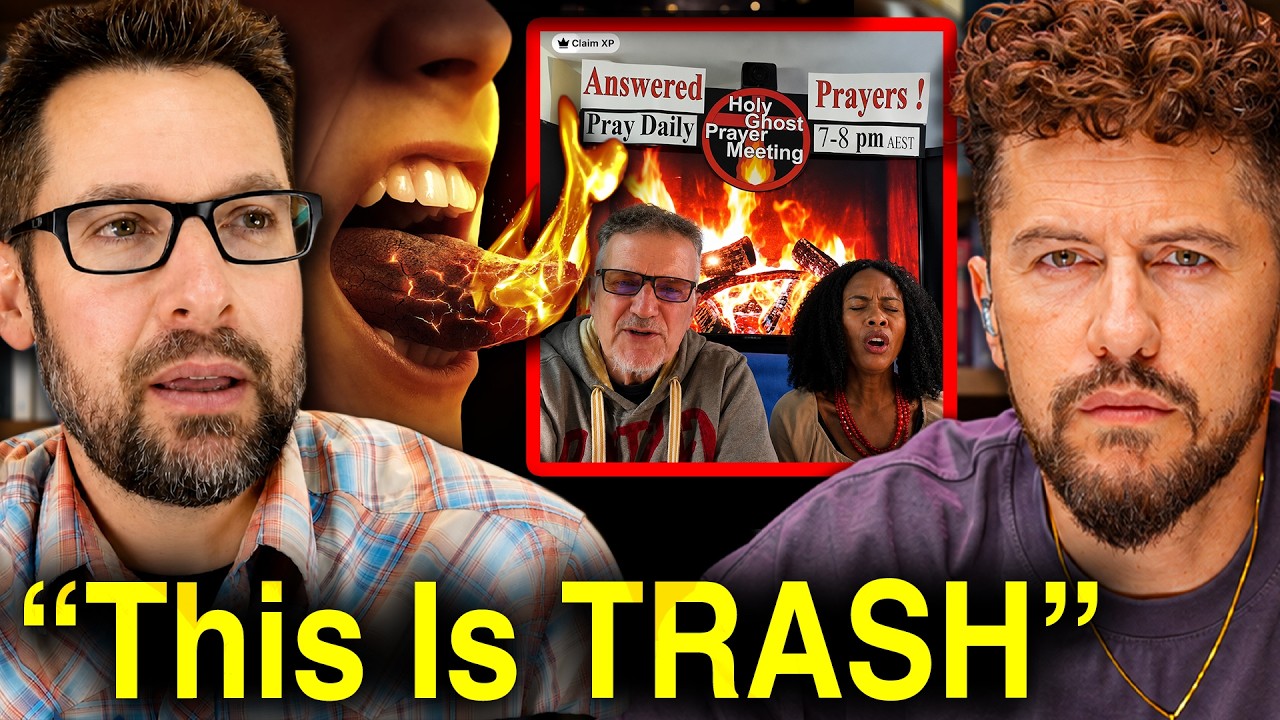
🔗 **Source:** [Mike Winger's Brutal Response to "Speaking in Tongues" Stream...](https://www.youtube.com/watch?v=SzhqYHkGyMc)
> [!note]+ Document Notes
> tags: [speaking-in-tongues, biblical-interpretation, charismatic-christianity, church-order, spiritual-gifts]
> author: "YouTube commentator"
> source: "https://www.youtube.com/watch?v=SzhqYHkGyMc"
> reference: "01kya7effsbpr54xrs9aszmeka"
> date created: 2026-07-24
>
> # 🏷️ Title: Mike Winger's Brutal Response To "Speaking In Tongues" Stream...
>
<!-- deep-read:sections start -->
## 🧭 Table of Contents
References; summary; main content; notes; paraphrase; newsletter; actions; hypotheses; methodology; questions; research; implications; assessments; logic; DARVO; conclusion; refactor appendix; templates.
## 🔗 References
- Video: https://www.youtube.com/watch?v=SzhqYHkGyMc
- Reader document: 01kya7effsbpr54xrs9aszmeka
## 📝 Summary
A charismatic commentator reviews criticism of a public tongues livestream and tests the practice against 1 Corinthians 12–14. The central claim is that public spiritual gifts must build up the church, and uninterpreted repetitive speech presented as a performance fails that standard. The video also argues that not every Christian receives the same gift.
## 📖 Main Content
The speaker plays the criticized stream, quotes six objections, and studies the Greek term glossa alongside passages in Acts and Corinthians. He emphasizes interpretation, orderly participation, love, and common good. He distinguishes belief that gifts continue from acceptance of every claimed manifestation.
### 🗒️ Notes
- 00:00–05:00 — criticized livestream, six objections, and the meaning of glossa
- 05:00–10:00 — distribution of gifts, love, edification, and the claim that not all speak in tongues
- 10:00–18:00 — public order, interpretation, private prayer claims, and charitable correction
- Scope: This note analyzes the captured transcript. Linked claims and allegations are not treated as independently verified without primary records.
## 📚 References
- Primary captured source: https://www.youtube.com/watch?v=SzhqYHkGyMc
- Verify cited studies, legal filings, historical links, statistics, quotations, and allegations against original records before publication.
## 🗣️ Paraphrase
Continuationism does not require uncritical acceptance. The speaker treats scriptural purpose and procedure as tests: a public gift should be intelligible through interpretation and should serve others rather than display the speaker.
## 📰 Newsletter
**Why this matters for WordPress:** A charismatic commentator reviews criticism of a public tongues livestream and tests the practice against 1 Corinthians 12–14. The central claim is that public spiritual gifts must build up the church, and uninterpreted repetitive speech presented as a performance fails that standard. The video also argues that not every Christian receives the same gift. Open-web teams should turn the key claim into a small reproducible check, report limits beside results, and keep affected contributors in the decision. [Watch the source](https://www.youtube.com/watch?v=SzhqYHkGyMc).
## ✅ Action Items
- DevRel: turn claims into reproducible examples; OSPO: review governance and dependency effects; Community: include affected people in review; WordPress — Core: assess platform relevance; Core Performance: measure cost and latency; Core AI: define model tests; Core Program Team: coordinate milestones; Mobile: test small screens; Playground: build a safe reproduction; Community: gather contributor feedback; Training: create a lesson; Marketing: state limits; Support: collect failure patterns; Design: review workflows; Documentation: record behavior and caveats; Photos: not applicable unless visual assets are needed; TV: consider a short explainer; Polyglots: preserve cultural context; Accessibility: test WCAG 2.2 AA; Meta: review site and API effects; CLI: expose repeatable checks; Hosting: test deployment constraints; Tide: automate relevant quality checks; Openverse: review open-asset implications; Themes: test presentation effects; Plugins: publish compatibility guidance. The WPOCC: consider community-governance effects. FAIR: note effects on federated open-source collaboration.
## 🧪 Hypotheses
1. If a claimed spiritual gift can be tested by its stated purpose, procedure, and effect on the community., a bounded comparison will show a measurable change in error, trust, or decision quality.
2. The effect will differ by user expertise, task complexity, and access to independent review.
3. Publishing source limits next to the result will reduce later overgeneralization.
## 📊 Methodology
Define the unit of analysis, baseline, outcome, failure classes, cost, time, and affected groups before testing. Preserve inputs and report null results. For testimony or commentary, triangulate with primary documents and responses from named parties. For technical demonstrations, reproduce the code and compare maintainability, accessibility, and performance as well as the showcased score.
## ❓ Questions
- Which claim would change the conclusion if false?
- What evidence is first-hand, reproduced, inferred, or alleged?
- Who gains authority or revenue under the proposed account?
- Which costs fall outside the measured outcome?
## 🔮 Future Research
Replicate across contexts; compare short- and long-term effects; test alternative explanations; obtain primary records; and track whether gains or harms persist in operational use.
## 💡 Implications
Practice: run bounded trials and preserve dissent. Policy: require traceable evidence for high-impact claims. Security: inspect authority, data, and failure paths. Education: teach source comparison. Funding: tie spending to measured outcomes and public reporting.
## 🧠 Learning Styles Assessment
- Visual: map claim, evidence, mechanism, and counterclaim.
- Aural: compare the speaker’s case with a sourced response.
- Verbal: restate the thesis without promotional or adversarial language.
- Kinesthetic: reproduce the technical or documentary check.
- Logical: separate observations, premises, inferences, and conclusions.
- Social: discuss with people who hold differing views.
- Solitary: keep a prediction and error log.
- Naturalistic: inspect resource and environmental effects where relevant.
- Reading level: approximately grade 10–12; technical and theological terms need definitions.
## 📊 Accessibility Assessment
- Perceivable: captions, transcript, alt text, and sufficient contrast (WCAG 1).
- Operable: keyboard access, visible focus, and adequate target size (WCAG 2).
- Understandable: clear headings, definitions, and consistent navigation (WCAG 3).
- Compatible: semantic markup and valid names, roles, and values (WCAG 4).
- Cognitive: short sections, summaries, and explicit argument structure.
- Motion and media: user controls and no forced motion.
- Testing: automated checks plus keyboard, screen-reader, zoom, reflow, and cognitive review against WCAG 2.2 AA.
## 🌍 DEIB Assessment
- Cultural breadth: state geographic, denominational, institutional, and language scope.
- Inclusive language: criticize claims and conduct without stereotyping groups.
- Neurodiversity support: predictable structure, definitions, and examples.
- Representation: seek the views of people affected and those criticized.
- Psychological safety: allow dissent without forcing public disclosure of harm or belief.
## ✅ Logical Validity
The argument grounds its main rules in specific passages and distinguishes public practice from private belief. The strongest overreach is treating every New Testament use of tongues as conclusively an ordinary human language; contested interpretations of angelic or private prayer language need fuller engagement. Harsh labels may block correction.
- Strong reasoning: the source offers a clear claim and identifiable mechanism.
- Fallacy check: watch for hasty generalization, selection bias, false cause, motive attribution, title overstatement, and analogy used as proof.
- Fix: add primary evidence, comparison data, definitions, uncertainty, and counterevidence.
- Tone: conversational and persuasive; adversarial sections need extra care.
## 🛡️ DARVO Analysis
No complete DARVO sequence is established by the transcript alone. Where allegations or conflict appear, evaluate denial, criticism, and claims of harm separately before assigning the pattern.
## 🎯 Conclusion
A claimed spiritual gift can be tested by its stated purpose, procedure, and effect on the community. The next step is a source-level check against a baseline or primary record.
## 🧱 Refactor Appendix
### Literature Split Pad
- Thesis: A charismatic commentator reviews criticism of a public tongues livestream and tests the practice against 1 Corinthians 12–14. The central claim is that public spiritual gifts must build up the church, and uninterpreted repetitive speech presented as a performance fails that standard. The video also argues that not every Christian receives the same gift.
- Evidence state: transcript analyzed; linked claims require primary-source checks.
- Cross-links: [[speaking-in-tongues]] [[biblical-interpretation]] [[charismatic-christianity]] [[church-order]] [[spiritual-gifts]]
#### Atomic Split Pad
- A claimed spiritual gift can be tested by its stated purpose, procedure, and effect on the community.
- Belief that gifts continue does not imply that every claimed manifestation is authentic.
- Correction is more credible when its tone matches the love and edification standard it invokes.
#### Fleeting Queue
- What evidence would falsify the thesis?
- Which existing vault note should receive each atom?
- Revisit after a primary-source response or material product change.
<!-- deep-read:sections end -->
📄 **Full text:** [[Full Document Contents/Articles/Mike Winger's Brutal Response to Speaking in Tongues Stream....md|Mike Winger's Brutal Response to "Speaking in Tongues" Stream... by YouTube commentator]]
## Highlights
- is this is Mike and he's always going at the charismatics. He's always going at the Bethl types, so on and so forth." But, I do think it's important for us to slow down and actually examine the scriptures. And this is me as someone who's spoken in tongues before. So 1 Corinthians chapter 12 and 14 is where you see Paul dealing with the church in Corinth regarding spiritual gifts. 1 Corinthians 12 uh 7 is where he says that there is this distribution of gift that is given for the common good. In ([View Highlight](https://read.readwise.io/read/01kya7m74p6b1arzmn8yz0at4r))
- Note: Central transcript passage selected during deep read.
- Tags: speaking-in-tongues, atom/literature/h1
- the Lord. Okay. So what is the reference here? This is Isaiah 28:11 and 12. This is not about just a personal prayer language. This is God using different languages to reach different types of people. Verse 22, tongues then are a sign not for believers but for unbelievers. So why is that? Why is it why is it because languages if someone comes in and they're hearing a different language spoken and they hear it in their own native language. This is a sign for unbelievers. Right? Prophecy, however, is a sign for unbelievers but for believers. So if the whole church comes together and everyone speaks in ([View Highlight](https://read.readwise.io/read/01kya7m7zsdsj48s5d8cb12knq))
- Note: Supporting transcript passage selected during deep read.
- Tags: speaking-in-tongues, atom/literature/h2
- standing in the synagogues and on the street corners to be seen by others. Truly I tell you, they have received their reward in full. But when you pray, go into your room, close the door, and pray to your father who is unseen. Then your father who sees what is done in secret will reward you. And when you pray, do not keep on babbling like the pagans, for they think they will be heard because of their many words. Do not be like them, for you, your father knows what you need before you ask him. And then this how you should pray. And it goes into the Lord's prayer. So, I ([View Highlight](https://read.readwise.io/read/01kya7m9bg0p27d0d86pac2chj))
- Note: Supporting transcript passage selected during deep read.
- Tags: speaking-in-tongues, atom/literature/h3
## Links
- [[3. Resources/Permanent Notes/Public Spiritual Gifts Are Accountable to Communal Intelligibility and Benefit]] — supports: public manifestations are tested by their procedure and common benefit.
- [[3. Resources/MOCs/Faith & Theology MOC]] — belongs-to: spiritual gifts and congregational discernment.