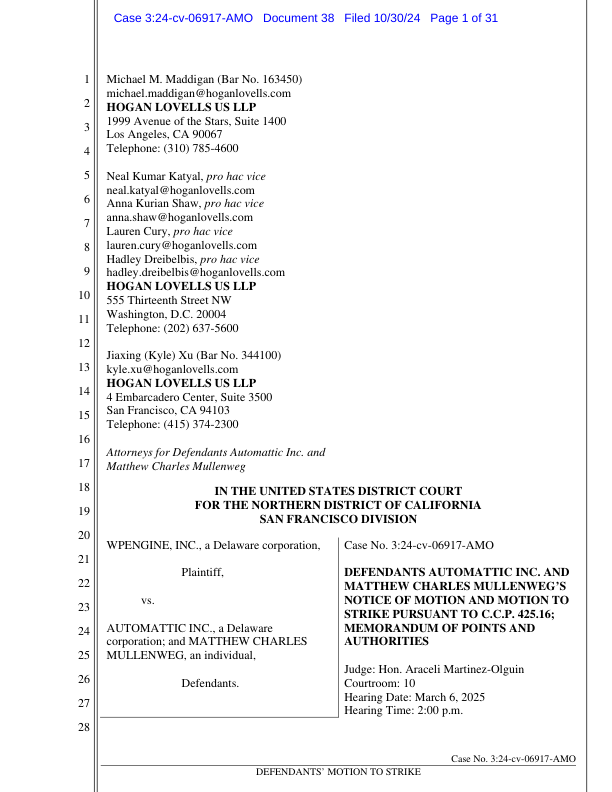
Motion to Strike
Full Document Contents/Articles/Motion to Strike.md, Motion to Strike , þÿBriggHA.
> [!note]+ Document Notes
> tags:
> - #OpenSource
> - #Legal
> - #WordPress
> Author: Courtney Robertson
> Source: Court Documents
> Reference: [Link to document](gov.uscourts.cand.437474.37.29.pdf)
> date created: 2024-11-03 10:00
>
> # Title: Analysis of Defendants' Motion to Strike in the Automattic Inc. vs. WP Engine Inc. Case
>
<!-- deep-read:sections start -->
## Table of Contents:
- [Summary](#summary)
- [Main Content](#main-content)
- [Notes](#notes)
- [References](#references)
- [Paraphrase](#paraphrase)
- [Newsletter](#newsletter)
- [Action Items](#action-items)
### References: Include a list of sources consulted and cited in the article.
## 📝 Summary:
The document outlines the defense by Automattic Inc. and Matthew Charles Mullenweg in a legal dispute against WP Engine Inc. regarding statements made about WP Engine's contribution to the WordPress community and their use of the WordPress software. Automattic's defense leverages California's anti-SLAPP statute to counter claims of defamation brought forth by WP Engine.
## 📖 Main Content:
The defense argues that the contested statements, considered opinions and protected speech under the First Amendment, do not constitute defamation. They emphasize the public interest and debate surrounding the governance and sustainability of open-source software like WordPress, which supports Automattic's anti-SLAPP motion.
### 🗒️ Notes
- **Protected Speech**: Defendants argue that the statements made by Matthew Mullenweg are protected under the First Amendment as they pertain to public discussion on open-source sustainability and contributions.
- **Anti-SLAPP Defense**: Automattic uses California’s anti-SLAPP statute to attempt to dismiss the defamation claims, suggesting that the lawsuit aims to suppress free speech.
- **Public Interest**: The defense highlights the relevance of the discussion in the broader context of open-source software management and community health.
- **Opinion vs. Fact**: Statements made by Mullenweg are claimed to be his opinions, based on disclosed facts, rather than assertions of false facts.
- **Material Falsity**: The defense challenges the plaintiff's ability to prove the material falsity of the opinions expressed by Mullenweg.
### 🗒️ Expanded Notes:
- **Protected Speech**:
- **Constitutional Protection**: The defense asserts that the statements made by Matthew Mullenweg fall under the protection of the First Amendment, emphasizing that these statements concern a public issue—namely, the governance and health of the open-source community around WordPress.
- **Opinion vs. Fact**: The defense categorizes the statements as opinions rather than assertions of fact, pointing out that these opinions are based on disclosed facts regarding WP Engine's contributions to the WordPress project and are thus not actionable under defamation law.
- **Relevance of Free Speech**: The argument highlights the vital role of free speech in fostering open and public discussions about the sustainability of open-source projects, which is crucial for their development and governance.
- **Anti-SLAPP Defense**:
- **Statutory Basis**: Automattic's defense leverages the anti-SLAPP (Strategic Lawsuit Against Public Participation) statute in California, designed to prevent the misuse of legal systems to intimidate individuals engaged in protecting their First Amendment rights.
- **Application of Anti-SLAPP**: The motion to strike, if successful, would not only dismiss the defamation claims but also potentially award legal fees to Automattic, thereby underscoring the legal protections available to those participating in matters of public significance.
- **Impact on Lawsuit**: This approach seeks to underline that the lawsuit could stifle legitimate discourse on matters of significant public interest, particularly the involvement of commercial entities in open-source communities.
- **Public Interest**:
- **Community Engagement**: The defense points to the extensive interest and involvement of the WordPress community in discussions about how entities like WP Engine contribute to the platform.
- **Broader Implications**: It notes that the outcome of this legal battle has broader implications for how open-source communities negotiate commercial interests and community health, potentially setting precedents for future interactions between private entities and open-source projects.
- **Opinion vs. Fact**:
- **Nature of Statements**: Detailed examination of how the disputed statements reflect personal judgments and subjective assessments rather than verifiable facts.
- **Legal Precedent**: Reference to legal precedents that protect opinion, especially when such opinions are based on clearly disclosed facts, reinforcing that such expressions cannot form the basis of a defamation claim.
- **Material Falsity**:
- **Burden of Proof**: Discussion on the plaintiff's burden to demonstrate that the opinions expressed by Mullenweg are materially false—a significantly high bar in defamation cases involving matters of public concern.
- **Challenges in Proving Falsity**: Analysis of the inherent challenges WP Engine faces in proving the material falsity of opinions that are based on disclosed facts about their contributions to WordPress and the modifications they have made to the standard WordPress software.
## 📖 References:
- California Civil Procedure Code § 425.16 – Anti-SLAPP Statute
- First Amendment protections of free speech
## 🗣️ Paraphrase:
- **Original**: "The statements made are protected under the First Amendment and do not constitute defamation."
- **Paraphrased**: "The remarks in question are safeguarded by the First Amendment and are not defamatory."
## 📰 Newsletter:
**This Month in WordPress**: Dive into the latest legal battle involving WordPress giants Automattic Inc. and WP Engine Inc. Discover the intricate details of the case where Automattic leverages California's anti-SLAPP law to defend against defamation claims by WP Engine. Learn how this case could influence open-source community dynamics and what it means for future contributions to the platform. Stay tuned for updates on this developing story and more in our comprehensive coverage.
## ✅ Action Items:
- **Educational Workshops**: Organize workshops to educate open-source developers about legal protections like anti-SLAPP and the importance of understanding copyright and speech rights in software development.
- **Community Discussions**: Facilitate community forums to discuss the impact of legal challenges on open-source projects and ways to support sustainable contributions.
- **Advocacy for Open Source**: Use insights from this case to advocate for policies that protect open-source contributors and promote transparency in project governance.
## 🎯 Conclusion:
The motion to strike by Automattic Inc. underscores the complex interplay between free speech and defamation in the context of open-source software development. This case highlights the need for clear guidelines on contributions and the expression of opinions within the open-source community.
<!-- deep-read:sections end -->
## Highlights
- Defendants request that the Court grant its anti-SLAPP motion because (a) WP Engine’s Cause ([View Highlight](https://read.readwise.io/read/01jbsvw2p7vfb5t6nsp0yrd4dw))
- s ([View Highlight](https://read.readwise.io/read/01jbsvw34zdxbztmazsj87gkdq))
- es of Action 9-11 arise out of Matt’s exercise of his constitutional right of free speech in connection with a public issue; and (b) WP Engine cannot show a probability of prevailing on any of those causes of action. Accordingly, Defendants request an order striking Causes of Action Nine, ([View Highlight](https://read.readwise.io/read/01jbsvw0h0jmy2gf05r0frg6aq))
- Those claims fail as a matter of law and must be struck under California’s anti-SLAPP law because they improperly seek to impose liability for commentary and debate on an issue of public interest—namely, WP Engine’s commitment (or lack thereof) to the WordPress community—without any valid basis. ([View Highlight](https://read.readwise.io/read/01jbss8zsj7n5w493ntmttb19n))
- Nor has WP Engine adequately alleged (much less shown) that the statements in question are substantially false, as is its burden. ([View Highlight](https://read.readwise.io/read/01jbss9jqtsdcgbr7tqs7rv30t))
- That program calls on companies benefiting from WordPress to sign a “pledge” to contribute their time and efforts to core development, translation, and training (among other things), with the overarching goal of supporting the sustained growth of the WordPress project. ([View Highlight](https://read.readwise.io/read/01jbsscpk95k8x7cgfj7xqvqss))
- . In the years following Silver Lake’s control of WP Engine, WP Engine’s priorities seemingly shifted towards maximizing profits. For example, to decrease its hosting costs, WP Engine substantially modified its WordPress offering, disabling a core WordPress feature: revisions. ([View Highlight](https://read.readwise.io/read/01jbssd4b54ay8a23kw5c956q7))
- . During the Q&A session, Matt spoke about current issues affecting WordPress and open source, including, among other topics, the Five for the Future initiative, the ways in which for-profit companies can donate resources back to WordPress, and the role of private equity in the open source community. Id. ([View Highlight](https://read.readwise.io/read/01jbsvwjnhb9sqaxa2cx3n471d))
- Matt understood this modification to be unique to WP Engine, and an example of the ways in which private equity’s profit interests can interfere with WordPress’s core promises and functions. Mullenweg Decl. ¶ 24, Ex. 7. ([View Highlight](https://read.readwise.io/read/01jbssed7yyj8h96d2br0vftt6))
- Whether an allegedly defamatory statement is one of opinion or fact is a question of law.” ([View Highlight](https://read.readwise.io/read/01jbssfnkjcyz1yf1yze8v1mwp))
- Additionally, Matt’s use of the figurative and hyperbolic phrases “parasitic entity” and “squeeze every bit out” to convey his opinion of private equity’s presence in open source communities and companies that benefit from WordPress without contributing sufficient time or resources to support its sustained growth, negates any impression that Statements One and Two are communicating actual facts as opposed to opinions. ([View Highlight](https://read.readwise.io/read/01jbssg8pq16ze3rd386c2b2jb))
- Whether an entity is or is not “parasitic” or how and whether every “bit” has been “squeezed” from a business are “vague and subjective,” and not “specific and measurable claim[s], capable of being proved false.” ([View Highlight](https://read.readwise.io/read/01jbssgg4j6ttvxhppm1dw9k0k))
- . In his blog posts, Matt disclosed his specific basis for stating that WP Engine’s product was “not WordPress,” but a “cheap knock-off” and “hacked up, bastardized simulacra”: namely, that WP Engine disables revisions by default, such that website hosts have to pay to store revisions; the revisions feature is “at the core of the user promise of protecting your data”; and of all the recommended hosts on the Website that Matt tested, WP Engine was the only one he found that disabled revisions by default. M ([View Highlight](https://read.readwise.io/read/01jbssh3zg6xsy1p1xhfreeywb))
- Matt’s use of the colorful and expressive phrases “chopped up, hacked, butchered” and “cheap knock-off” to describe WP Engine’s offering in light of its decision to disable revisions by default, which he stated was contrary to the WordPress ethos and a product of private equity interests creeping into open source, is also too broad and figurative to be objectively verifiable. ([View Highlight](https://read.readwise.io/read/01jbsshf7td4bb2nwchfew2c8w))
- Accordingly, Matt’s Statements are non-actionable opinion. WP Engine may not like Matt’s opinions about private equity in open source or the sufficiency of WP Engine’s contributions to the WordPress community, or the language he used to express them, but it has no basis for asking this Court to punish Matt for expressing those opinions. ([View Highlight](https://read.readwise.io/read/01jbssj1vmpv15wmxjcp9zq0gh))
- As discussed above, the Statements are not capable of being proven false in the requisite sense. But even if the Statements were considered factual, they are not actionable because has not alleged, and cannot show, they are materially false. ([View Highlight](https://read.readwise.io/read/01jbssjnagzw06tq7p4x7bpag8))