Mozilla Announces "Thunderbolt" as an Open-Source, Enterprise AI Client
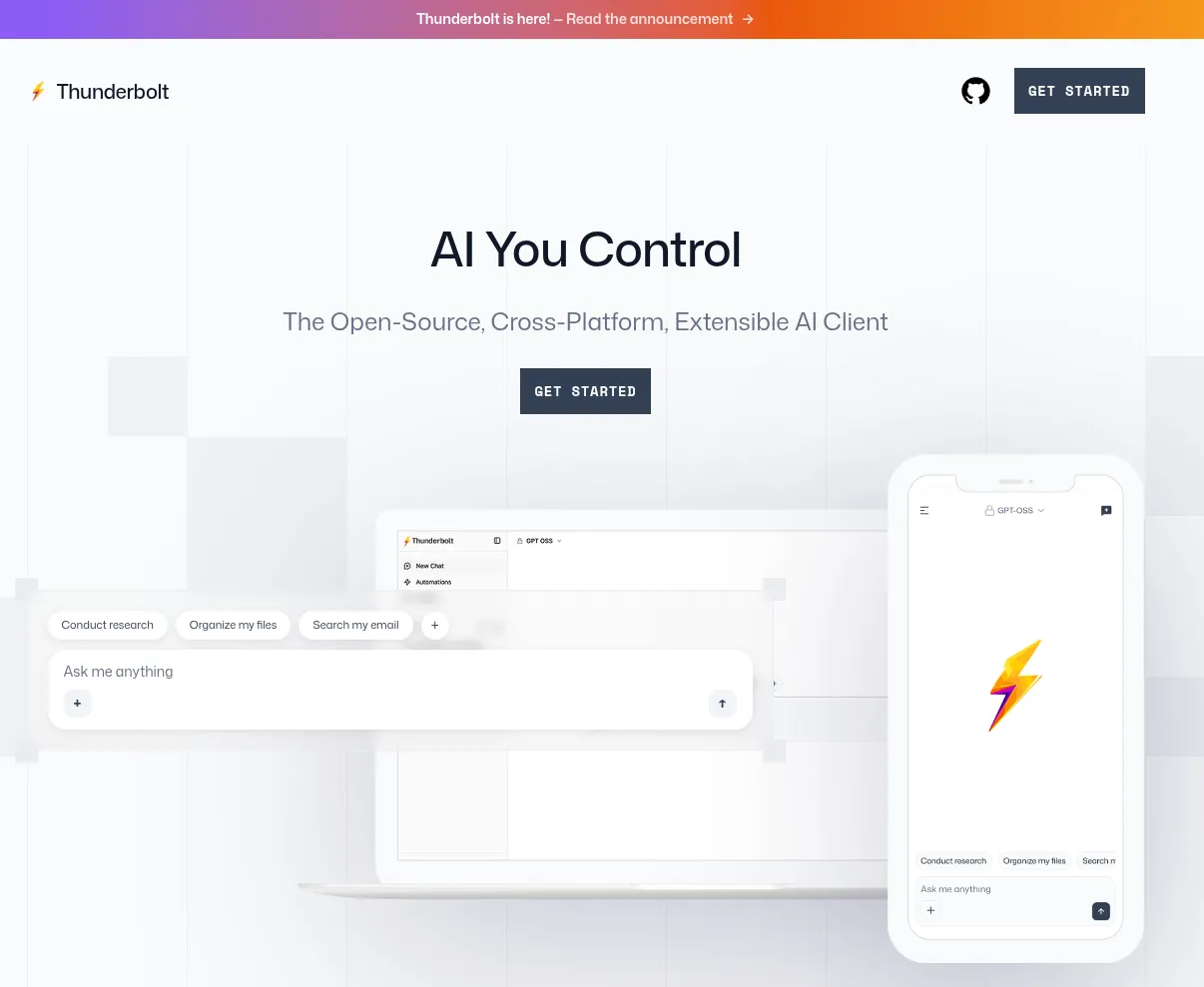
🔗 **Source:** [Mozilla Announces "Thunderbolt" as an Open-Source, Enterprise AI Client](https://www.phoronix.com/news/Mozilla-Thunderbolt)
> [!note]+ Document Notes
> tags: #mozilla #open-source #enterprise-ai #self-hosted #ai-client
> author: Michael Larabel
> source: Phoronix
> reference: https://www.phoronix.com/news/Mozilla-Thunderbolt
> date created: 2024-12-19 14:30
>
> # 🏷️ Title: Mozilla Announces "Thunderbolt" As An Open-Source, Enterprise AI Client
>
<!-- deep-read:sections start -->
## 🧰 Action Inbox
- [H1] Evaluate Mozilla Thunderbolt for self-hosted AI deployment — enterprise readiness assessment #enterprise-ai
- [H2] Test multi-platform compatibility across Linux/macOS/Windows/mobile — deployment planning #cross-platform
- [H3] Research trademark implications of "Thunderbolt" naming choice — brand risk analysis #branding
## 🧭 Table of Contents
- [[#📝 Summary]]
- [[#📖 Main Content]]
- [[#🗒️ Notes]]
- [[#📚 References]]
- [[#🗣️ Paraphrase]]
- [[#📰 Newsletter]]
- [[#✅ Action Items]]
- [[#🧪 Hypotheses]]
- [[#📊 Methodology]]
- [[#❓ Questions]]
- [[#🔮 Future Research]]
- [[#💡 Implications]]
- [[#🧠 Learning Styles Assessment]]
- [[#📊 Accessibility Assessment]]
- [[#🌍 DEIB Assessment]]
- [[#✅ Logical Validity]]
- [[#🛡️ DARVO Analysis]]
- [[#🎯 Conclusion]]
### 🔗 References
- [Mozilla Thunderbolt Official Site](https://thunderbolt.io)
- [GitHub Repository](https://github.com/mozilla/thunderbolt)
## 📝 Summary
- Mozilla announced "Thunderbolt," an open-source enterprise AI client for organizations wanting self-hosted AI infrastructure
- The platform supports multiple AI models, enterprise data integration, workflow automation, and cross-platform deployment
- Despite functionality, the naming choice conflicts with Intel's Thunderbolt interface technology
- Available under MPL 2.0 license with enterprise licensing options through MZLA Technologies Corporation
- Bottom line: Mozilla enters enterprise AI market with sovereignty-focused solution but questionable branding
## 📖 Main Content
Mozilla's Thunderbolt represents a strategic move into enterprise AI infrastructure, positioning itself as a "sovereign AI client" that prioritizes organizational control and data independence. The platform addresses growing enterprise concerns about AI vendor lock-in by offering self-hosted deployment options with extensive integration capabilities.
The system supports both commercial and open-source AI models, allowing organizations to choose based on their specific needs, compliance requirements, and budget constraints. Integration capabilities include deepset's Haystack platform, Model Context Protocol (MCP) servers, and Agent Client Protocol (ACP) for comprehensive enterprise connectivity.
However, the naming choice raises significant concerns. "Thunderbolt" is already established as Intel's high-speed interface technology, creating potential trademark conflicts and market confusion. This decision appears particularly puzzling given Mozilla's typically careful approach to product naming and brand management.
## 🗒️ Notes
## 📚 References
- [Mozilla Thunderbolt Official Site](https://thunderbolt.io)
- [GitHub Repository - Mozilla Thunderbolt](https://github.com/mozilla/thunderbolt)
- [Intel Thunderbolt Technology](https://www.intel.com/content/www/us/en/architecture-and-technology/thunderbolt/thunderbolt-technology-general.html)
## 🗣️ Paraphrase
- Mozilla launched an open-source enterprise AI platform designed for organizations seeking control over their AI infrastructure without vendor dependency
- The platform emphasizes flexibility through support for various AI models and extensive enterprise system integration capabilities
- The controversial "Thunderbolt" name conflicts with Intel's established interface technology, raising questions about Mozilla's trademark research
## 📰 Newsletter
Mozilla just announced Thunderbolt, an open-source enterprise AI client that puts organizations in control of their AI infrastructure!
**Key highlights:**
- Self-hosted deployment with your choice of AI models
- Native apps for all major platforms (Linux, macOS, Windows, iOS, Android)
- Enterprise integration with existing data pipelines and protocols
- MPL 2.0 licensed with enterprise support options
This could be game-changing for organizations concerned about AI vendor lock-in and data sovereignty. The cross-platform approach and protocol flexibility make it particularly appealing for diverse enterprise environments.
**One caveat:** The "Thunderbolt" name might cause confusion with Intel's interface technology - worth watching for potential trademark issues.
Resources: [Mozilla Thunderbolt](https://thunderbolt.io), [GitHub Repo](https://github.com/mozilla/thunderbolt), [MPL 2.0 License](https://www.mozilla.org/en-US/MPL/2.0/)
## ✅ Action Items
#### OSPO
- License Compliance: Review MPL 2.0 implications for enterprise deployment and integration requirements
- Software Inventory: Evaluate Thunderbolt for internal AI infrastructure needs and SBOM integration
- Security Management: Assess self-hosted deployment security controls and vulnerability management processes
#### Community
- Ecosystem: Monitor Mozilla's enterprise AI strategy impact on broader open-source AI ecosystem coordination
- Contributors: Evaluate contribution opportunities to Mozilla Thunderbolt project for organizational benefit
#### WordPress
- Core AI: Assess potential integration opportunities between WordPress AI initiatives and Mozilla Thunderbolt platform
- Meta: Evaluate Thunderbolt for WordPress.org infrastructure AI applications and tooling
#### The WPCC
- Programs: Consider Mozilla Thunderbolt case study for open-source enterprise software fellowship programs
- Funding: Explore collaboration opportunities with Mozilla on AI infrastructure funding initiatives
#### FAIR
- Technical independence: Document Thunderbolt as example of sovereign AI infrastructure for organizational independence
- Governance artifacts: Review Mozilla's enterprise AI governance model for community best practices
## 🧪 Hypotheses
- Mozilla Thunderbolt will gain traction primarily among privacy-conscious enterprises and government organizations
- The naming conflict with Intel Thunderbolt will create market confusion and potential legal challenges
- Self-hosted AI deployment will become a key differentiator for enterprise AI platforms
- Integration protocol support will determine Thunderbolt's enterprise adoption success
### 📊 Methodology
- Enterprise adoption tracking through GitHub stars, download metrics, and case study publications
- Trademark dispute monitoring through legal databases and Mozilla communications
- Self-hosted AI market analysis comparing Thunderbolt features against competitor offerings
### ❓ Questions
- How will Mozilla resolve the Thunderbolt trademark conflict with Intel's established technology?
- What enterprise compliance certifications will Mozilla pursue for Thunderbolt deployment?
- How does Thunderbolt's performance compare with cloud-hosted AI services for similar workloads?
### 🔮 Future Research
- Long-term sustainability analysis of Mozilla's enterprise AI business model
- Comparative study of open-source vs proprietary enterprise AI platform adoption patterns
- Investigation of sovereign AI requirements across different regulatory environments
### 💡 Implications
- Practice: Organizations gain viable alternative to cloud-hosted AI services with greater control
- Policy: Self-hosted AI deployment may influence enterprise AI governance and compliance frameworks
- Security: On-premises AI deployment shifts security responsibilities from vendors to organizations
- Education: Enterprise teams need training on self-hosted AI infrastructure management
- Funding: Mozilla's enterprise licensing model may influence open-source AI project sustainability strategies
### 🧠 Learning Styles Assessment
Reading level estimate: 12th grade (Flesch-Kincaid Grade Level)
#### 👀 Visual learners
- Present: Product announcement structure, feature lists
- Improve: Architecture diagrams, deployment topology visuals, integration flowcharts
#### 🔊 Aural learners
- Present: News article format suitable for text-to-speech
- Improve: Podcast interview with Mozilla team, audio feature walkthrough
#### 🗣️ Verbal learners
- Present: Technical terminology definitions, platform descriptions
- Improve: Analogies comparing to familiar enterprise software, glossary of AI terms
#### 🧩 Kinesthetic learners
- Present: References to hands-on deployment and testing
- Improve: Step-by-step installation guide, interactive demo environment
#### 🧠 Logical learners
- Present: Feature comparison lists, licensing structure
- Improve: Decision matrix for platform selection, ROI calculation framework
#### 🧑🤝🧑 Social learners
- Present: Community discussion in comments section
- Improve: User forum links, community adoption case studies
#### 🧘♀️ Solitary learners
- Present: Individual analysis and evaluation opportunity
- Improve: Self-assessment checklist for organizational fit
#### 🌿 Naturalistic learners
- Present: Technology ecosystem positioning
- Improve: Sustainability implications of self-hosted vs cloud AI deployment
### 📊 Accessibility Assessment
#### Screen reader semantics
- Present: Clear headline hierarchy, descriptive article structure
- Improve: More descriptive link text beyond "GitHub Repository"
#### Keyboard navigation
- Present: Standard web navigation patterns
- Improve: Skip links to main content sections
#### Contrast and readability
- Present: Standard text contrast on news site
- Improve: Verification of 4.5:1 contrast ratios across all text elements
#### Text resizing and reflow
- Present: Responsive design on news platform
- Improve: Testing at 200% zoom for content accessibility
#### Media and captions
- Present: Text-based article format
- Improve: Alt text for any embedded images or diagrams
#### Forms and interactions
- Present: Basic comment form functionality
- Improve: Accessible form labels and error handling
#### Standards reference
- Map accessibility improvements to WCAG 2.2 AA success criteria for news content
### 🌍 DEIB Assessment
#### Cultural breadth
- Present: Global technology perspective
- Improve: International enterprise use cases, multi-region deployment considerations
#### Inclusive language
- Present: Technical language appropriate for enterprise audience
- Improve: Plain language explanations of technical concepts
#### Neurodiversity support
- Present: Structured article format with clear sections
- Improve: More frequent headings, bullet point summaries
#### Representation
- Present: Focus on technology rather than individual representation
- Improve: Include diverse enterprise user perspectives and use cases
#### Psychological safety
- Present: Professional, respectful technology coverage
- Improve: Community guidelines reference for discussion participation
### ✅ Logical Validity
#### Strong reasoning
- Deductive strength: Mozilla's enterprise focus logically follows from market demand for sovereign AI
- Inductive strength: Cross-platform support indicates comprehensive enterprise strategy
- Causal reasoning: Self-hosted deployment addresses enterprise data sovereignty concerns
- Analogical strength: Comparison to Thunderbird email client establishes Mozilla's enterprise software precedent
#### Fallacies
- Appeal to novelty: Assumption that open-source approach is inherently superior without evidence
- False dichotomy: Framing as choice between vendor lock-in vs. complete independence without middle options
#### Tone of voice
- Overall tone: Professional tech journalism with critical analysis of naming decision
### 🛡️ DARVO Analysis
- Deny: No denial patterns present in straightforward product announcement coverage
- Attack: Constructive criticism of naming choice rather than personal attacks
- Reverse victim/offender: No victim/offender dynamics in technology coverage
- Emotional cues and rhetoric: Balanced reporting with legitimate concern about trademark issues
## 🎯 Conclusion
Mozilla Thunderbolt represents a significant entry into the enterprise AI market with a sovereignty-focused approach that addresses real organizational concerns about vendor lock-in and data control. The technical capabilities and cross-platform support demonstrate Mozilla's serious commitment to enterprise adoption.
However, the naming conflict with Intel's Thunderbolt technology creates unnecessary market confusion and potential legal complications that could hinder adoption. Organizations should evaluate the platform's technical merits while monitoring how Mozilla addresses this branding challenge.
The success of Thunderbolt will likely depend on Mozilla's ability to build enterprise partnerships, provide robust support infrastructure, and demonstrate clear performance advantages over cloud-hosted alternatives.
## 🧱 Refactor Appendix
### 📚 Literature Split Pad
Purpose: Stage CEE units that become Literature notes.
Split level: H3
### [H1] Mozilla launches sovereign AI client for enterprises
> [!quote] [Mozilla Announces "Thunderbolt" As An Open-Source, Enterprise AI Client](https://www.phoronix.com/news/Mozilla-Thunderbolt) by [[Michael Larabel]] via [[Phoronix]]. Published 2026-04-16. Accessed 2024-12-19.
> "Thunderbolt is designed as a sovereign AI client – an open-source, extensible workspace where users can interact with AI through chat, search, and research."
Enterprise AI platform emphasizing organizational control and self-hosted deployment options.
[view highlight](https://www.phoronix.com/news/Mozilla-Thunderbolt#H1) #xref #articleseed ID:rw_moz_thunderbolt_001
### [H2] Cross-platform deployment supports enterprise adoption
> [!quote] [Mozilla Announces "Thunderbolt" As An Open-Source, Enterprise AI Client](https://www.phoronix.com/news/Mozilla-Thunderbolt)
> "Work seamlessly across devices with native applications for Windows, macOS, Linux, iOS, and Android"
Comprehensive platform support reduces enterprise deployment friction and maximizes organizational reach.
[view highlight](https://www.phoronix.com/news/Mozilla-Thunderbolt#H2) #xref ID:rw_moz_thunderbolt_002
---
### 🔖 Atomic Split Pad (Zettel Candidates)
Purpose: Promote reusable claims into Atomic notes.
Split level: H4
#### [Z1] Sovereign AI addresses enterprise vendor lock-in concerns
- Applies to organizations prioritizing data control and infrastructure independence
- Referenced throughout Mozilla Thunderbolt announcement
- Links: [[Enterprise-AI-Strategy]] [[Vendor-Independence]]
#### [Z2] Trademark conflicts create avoidable market confusion
- Particularly relevant when established technology brands overlap
- Demonstrated by Mozilla Thunderbolt vs Intel Thunderbolt naming
- Links: [[Brand-Strategy]] [[Trademark-Risk]]
---
### ✏️ Fleeting Queue
Purpose: Capture quick actions for Fleeting notes.
- [F1] Research Intel Thunderbolt trademark scope and enforcement history — https://www.phoronix.com/news/Mozilla-Thunderbolt #fleeting #inbox
- [F2] Monitor Mozilla Thunderbolt GitHub repository for enterprise adoption indicators — https://github.com/mozilla/thunderbolt #fleeting #inbox
- [F3] Evaluate MPL 2.0 licensing implications for enterprise AI deployment — licensing analysis #fleeting #inbox
<!-- deep-read:sections end -->
📄 **Full text:** ![[Full Document Contents/Articles/Mozilla Announces Thunderbolt as an Open-Source, Enterprise AI Client.md|Mozilla Announces "Thunderbolt" as an Open-Source, Enterprise AI Client by phoronix.com]]
## Highlights
- It's an interesting AI initiative from Mozilla but just an awful name. While playing off their Thunderbird mail client, Thunderbolt is already a well known technology interface among lots of other "Thunderbolt" usage out there in other contexts. Even just from the Thunderbolt interface alone, it's very surprising they still went with the name for this new Mozilla AI initiative. ([View Highlight](https://read.readwise.io/read/01kpbbsr6c9xqkfe0b1c64tw8a))
- Tags: 👻 ai highlighted
- It's an interesting AI initiative from Mozilla but just an awful name. While playing off their Thunderbird mail client, Thunderbolt is already a well known technology interface among lots of other "Thunderbolt" usage out there in other contexts. Even just from the Thunderbolt interface alone, it's very surprising they still went with the name for this new Mozilla AI initiative. ([View Highlight](https://read.readwise.io/read/01kpbct98w64veg66c9j23pezk))
- Tags: 👻 ai highlighted