My AI Security Pipeline for WordPress Plugins
🔗 **Source:** [My AI Security Pipeline for WordPress Plugins](https://anchor.host/anyone-can-audit-wordpress/)
> [!note]+ Document Notes
> tags: [ai-security, wordpress-plugins, vulnerability-disclosure, claude-code, bug-bounty, security-automation]
> author: Austin Ginder
> source: anchor.host
> reference: https://anchor.host/anyone-can-audit-wordpress/
> date created: {{date:YYYY-MM-DD}} {{time:HH:mm}}
>
> # 🏷️ Title: My AI Security Pipeline for WordPress Plugins
>
<!-- deep-read:sections start -->
## 🧭 Table of Contents
- [📝 Summary](#-summary)
- [📖 Main Content](#-main-content)
- [🗒️ Notes](#️-notes)
- [📚 References](#-references)
- [🗣️ Paraphrase](#️-paraphrase)
- [📰 Newsletter](#-newsletter)
- [✅ Action Items](#-action-items)
- [🧪 Hypotheses](#-hypotheses)
- [📊 Methodology](#-methodology)
- [❓ Questions](#-questions)
- [🔮 Future Research](#-future-research)
- [💡 Implications](#-implications)
- [🧠 Learning Styles Assessment](#-learning-styles-assessment)
- [📊 Accessibility Assessment](#-accessibility-assessment)
- [🌍 DEIB Assessment](#-deib-assessment)
- [✅ Logical Validity](#-logical-validity)
- [🛡️ DARVO Analysis](#-darvo-analysis)
- [🎯 Conclusion](#-conclusion)
### 🔗 References
- [Coverage scoreboard — wpregistry.io/coverage](https://wpregistry.io/coverage)
- [Patchstack](https://patchstack.com/) and [Wordfence](https://www.wordfence.com/) — the two bug bounty platforms referenced.
- CVEs named: JetSmartFilters (9.3 SQL injection), Abandoned Cart Pro for WooCommerce (privilege escalation), WooCommerce Anti-Fraud (broken access control), Simple Shopping Cart (IDOR).
## 📝 Summary
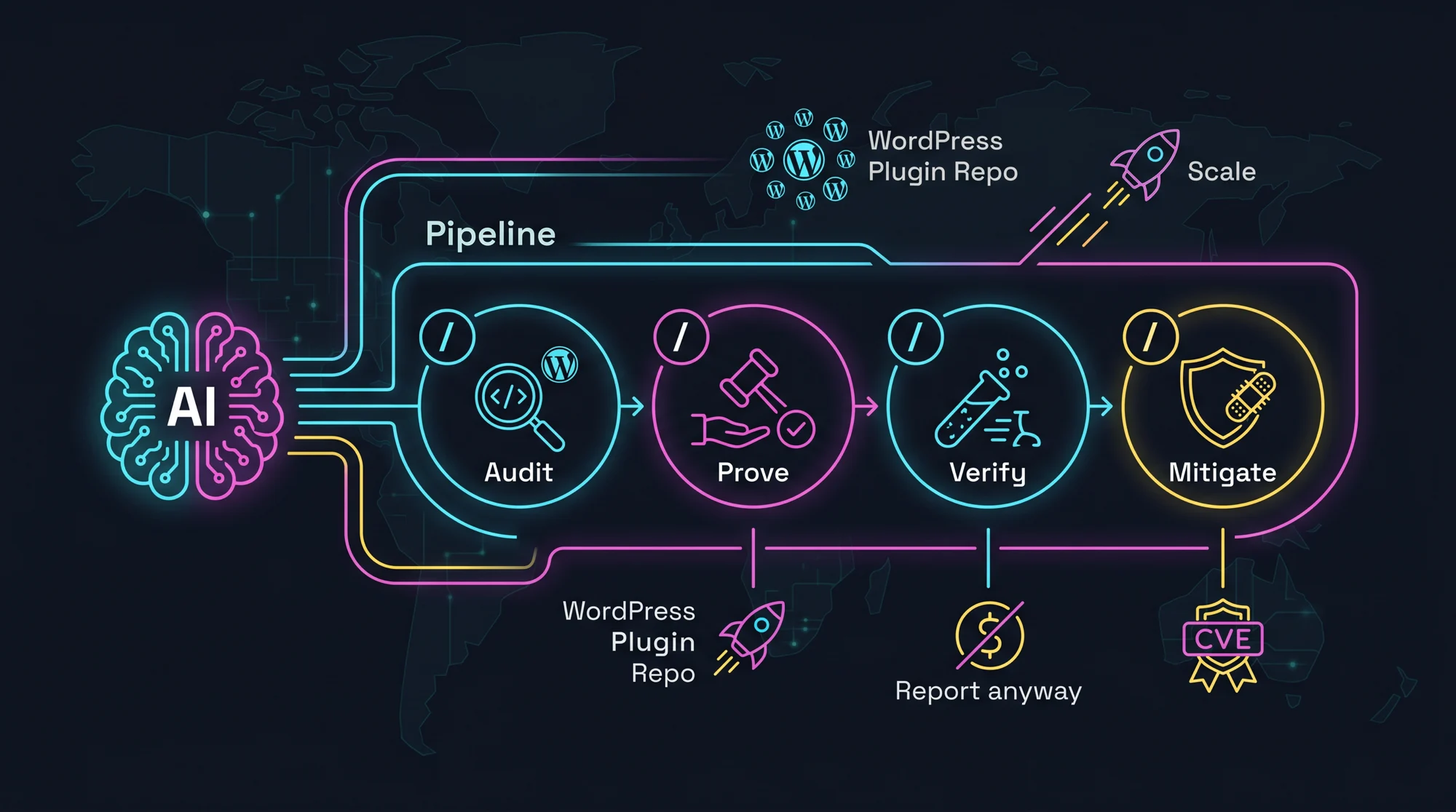
- A solo WordPress host operator built a four-step AI pipeline (Claude Code slash commands) that audits plugin code, proves each finding by firing the exploit on a fresh local WordPress install, then submits it to a bounty platform or straight to the vendor.
- Why it matters: it moves plugin security auditing from specialist security firms (Wordfence, Patchstack) to any individual with a Claude subscription and a local WordPress. That reframes who is responsible for scanning the repository.
- Key stakeholders: WordPress plugin authors, bounty platforms, hosting companies, and the millions of sites running the top 5,000 plugins (~327M active installs).
- Risks and tradeoffs: AI over-reports (false positives), bounty economics are shrinking, and the metrics here are one operator's self-reported dashboards, not independently audited numbers.
- Bottom line: the discipline that makes AI auditing trustworthy is the same maker/checker rule — never trust a finding until you make it prove itself by running the exploit. Reading beats source-reading; only runtime confirms.
## 📖 Main Content
- The core thesis is a governance rule, not a tooling trick: an AI audit produces a *claim*, and a claim is not a vulnerability until you have fired the exploit against a real WordPress install with its own defenses (`wp_kses`, capability checks) in place. This directly mirrors Courtney's maker/checker doctrine — the auditor is the maker, the proof-of-concept run is the blind checker that re-derives truth from source (a live exploit) rather than grading the audit's own reasoning.
- The pipeline has four steps, each a Claude Code slash command: (1) `/wp-registry-scan` fans out parallel sub-agents to read every PHP file for injection, missing capability checks, and broken access control; (2) `/proof-of-concept` spins up a fresh site, installs the exact version, seeds the scenario, and tries to fire the exploit — if nothing fires, the finding dies; (3) submit real high-impact bugs to a bounty platform, everything else to the vendor; (4) redirect or follow up (out-of-scope → vendor, duplicate → move on, accepted → track to CVE).
- The Gutenverse case is the load-bearing anecdote. The "glamorous" finding (an image block echoing an SVG value with no sanitizing) was a false positive — `wp_kses` stripped the tag. The "boring sibling" (a Fun Fact block attribute breakout with *no tag*) was the real vulnerability, because `wp_kses` only processes tags, so a tagless value survives. Claude nearly discarded the real bug by pattern-matching it to the disproven one. Only the run-it rule saved it.
- The tell for guessing: if your reason for dismissing a finding uses words like "bounded," "harmless," or "does not reach," you are inferring runtime behavior from source code — the moment to stop and build the proof of concept.
- The economics: most real bugs are not bounty-eligible (only the highest-impact tier qualifies — unauthenticated SQLi, account takeover). A Contributor-level stored XSS is real, needs patching, but pays nothing. Report anyway; route to the vendor. Payout math is thin and shrinking: ~$550 for May, which the author says would have been $0 in June under tightening guidelines.
- Two rules make it scale cheaply: audit only the latest version (old versions waste tokens and get rejected as stale), and audit each unique build exactly once (hash identical files across thousands of sites — you audit code, not websites). The bottleneck is tokens, not speed; the whole operation runs on a $200/month Claude Max plan shared with all other work.
- Contested / uncertain: every performance and coverage number is self-reported from the author's own logs and dashboards. The 94.7% weighted coverage figure counts by active installs, which flatters the picture — the raw count is 2,050 of 5,000 plugins (41%). Both framings are true; the weighting choice is a rhetorical one worth naming.
### 🗒️ Notes
- Author positions himself as not-a-security-researcher — a host who patches sites and cleans malware — to make the "anyone can do this" claim land harder.
- Democratization framing: "Not just Wordfence. Not just Patchstack." One person + Claude subscription + local WordPress can audit a large portion of the repository.
- Step 2 is the whole thesis operationalized: force the AI to stop reading and start running. False-positive rate "drops off a cliff" once Claude must prove claims rather than assert them.
- Gutenverse transcript is a rare in-the-wild example of an AI catching its own pattern-matching error mid-reasoning — "I refuted the first one empirically. I am about to refuse the second one on a guess." That self-correction is exactly the behavior maker/checker discipline is meant to force structurally rather than hope for.
- Wordfence scorecard: 8 pending, 6 duplicates, 1 rejected out of scope, 1 validated. Duplicates dominate — others are running similar scans, so speed-to-file matters (echoes the job-scan "apply same-day" pattern).
- Patchstack May: 10 validated, 7 valid-but-duplicate, 5 rejected. Validated ten ranged CVSS 6.5 up to a pair of criticals at 9.8 and 9.9.
- Public CVEs that landed: 9.3 SQLi in JetSmartFilters, priv-esc in Abandoned Cart Pro for WooCommerce, broken access control in WooCommerce Anti-Fraud, IDOR in Simple Shopping Cart.
- Scale numbers: 918 unique plugin/theme builds in a 7-day stretch; busiest single day 396; ~100 plugins per sitting with 10 audits running in parallel.
- Inflow vs. throughput: top 5,000 plugins pushed only 612 updates in 7 days (1,680 over 30 days). One person auditing ~1,000 builds/week outpaces the ~600/week inflow — an individual can stay current with the popular half, not just sweep once.
- Coverage by install tier: 10M+ 100% (3/3); 500k+ 100% (68/68); 100k+ 99% (333/335); 10k+ 62% (886/1,433); 1k+ 13% (368/2,766). The head is covered; the long tail is the gap.
- Turnover framing: last 24h 112 plugins (2.2%, ~33.7M installs); 7d 612 (12.2%, ~81.4M); 14d 984 (19.7%, ~117.3M); 30d 1,680 (33.6%, ~184.5M).
## 📚 References
- [My AI Security Pipeline for WordPress Plugins — Austin Ginder, anchor.host](https://anchor.host/anyone-can-audit-wordpress/)
- [wpregistry.io/coverage — public coverage scoreboard](https://wpregistry.io/coverage)
- [Patchstack](https://patchstack.com/)
- [Wordfence](https://www.wordfence.com/)
- Related reading for Courtney's own thread: Patchstack 7.0.2 SQLi and Repository RCE disclosure writeups (recently deep-read).
## 🗣️ Paraphrase
- Auditing WordPress plugins for security used to belong to specialist firms. It doesn't anymore — one person with Claude and a local WordPress install can scan a big slice of the repository and find unreported bugs.
- The pipeline is four commands: audit the code, prove the finding by actually firing it locally, submit it to a bounty platform or the vendor, then redirect or follow up until it closes.
- The one rule that matters most: an AI finding is a claim, not a fact. Make the AI run the exploit for real; the false-positive rate collapses the moment it has to prove rather than assert.
- A real example: the flashy finding was fake (stripped by `wp_kses`), the boring one was real (a tagless attribute breakout that survives the filter), and the AI nearly threw the real one away by assuming it matched the fake one.
- Most real bugs earn no bounty but still need patching, so report them to the vendor. Two rules keep it cheap: audit only the latest version, and audit each unique build once. The value isn't the payout — it's the coverage.
## 📰 Newsletter
- A WordPress host just showed that plugin security auditing is no longer a job only Wordfence and Patchstack can do. Austin Ginder wired four Claude Code slash commands into a pipeline that reads plugin code, then *proves* each finding by firing the exploit on a throwaway WordPress install before anyone submits it.
- The keeper idea for anyone building with AI: treat every finding as a claim, not a fact. The false-positive rate falls off a cliff the moment you make the model run the exploit instead of asserting it from a code read. It's maker/checker discipline applied to security research — and there's a great real-world moment where Claude nearly discards a genuine bug because it looked like a false positive it had just disproven.
- The scale is the eye-opener: one operator, ~1,000 unique plugin builds a week, on a $200/month plan, covering every plugin above 500k installs at its current version. Coverage scoreboard: [wpregistry.io/coverage](https://wpregistry.io/coverage).
- Worth reading alongside the recent Patchstack disclosures if you run production WordPress or ship plugins.
## ✅ Action Items
#### DevRel
- Developer advocacy: consider a talk/demo on "treat AI findings as claims" — the run-it-to-prove-it rule generalizes well beyond security to any AI-assisted dev workflow.
- Education: build a short workshop or office-hours segment on local proof-of-concept setup (fresh WP install, seed scenario, fire exploit) as a teachable maker/checker loop.
- Developer experience: document the `wp_kses` tag-vs-attribute nuance (tagless values survive the filter) as an examples-first security note for plugin authors.
- Developer marketing: the "anyone can audit" framing is a strong narrative hook for responsible-disclosure content.
- Community management: flag the disclosure-etiquette angle — the author thanks platforms for tolerating early mistakes; set norms for new AI-assisted reporters.
- Internal/external/cross-project: align with plugin review team on the duplicate-flood problem this creates.
#### OSPO
- Policy & Governance: define contribution/disclosure policy for AI-assisted vulnerability reports before the volume spikes.
- License Compliance: not applicable to this source — the piece is about security auditing, not licensing.
- Security Management: vuln intake and embargo policy needs an explicit "proof-of-concept required" gate matching step 2 of this pipeline.
- Software Inventory: hashing unique plugin builds is a de facto SBOM-adjacent practice worth borrowing for freshness tracking.
- Developer Support: consult on tooling/legal guardrails for individuals now running mass audits.
- Community Engagement: coordinate with upstream platforms on scaling submission review.
- Strategic Alignment: report the coverage-vs-bounty economics shift to leadership.
#### Community
- Maintainers: release hygiene matters more now — a new release is the only thing that creates a fresh build to audit.
- Contributors: onboarding for first-time security reporters to avoid platform-banning mistakes.
- Sponsors: not applicable to this source — no sponsorship model discussed.
- Ecosystem: coordinated-disclosure drills as AI raises report volume.
#### WordPress
- Core: not applicable to this source — no core-specific action; the piece targets plugins.
- Plugins: review throughput and security-liaison capacity will be stressed by AI-scale reporting; provenance checks on unique builds are relevant.
- Security: map the Contributor-level stored XSS "coverage gap" (real bug, no bounty) as a policy question for the security team.
- Hosting: cross-host checklists could adopt the "audit the build, not the install" hashing approach.
- Meta/Tide: Tide's automated scoring overlaps this space — a false-positive review loop is directly relevant.
- Documentation: examples-first pattern for `wp_kses` behavior with tagless attributes.
#### The WPCC
- Not applicable to this source — no funding-experiment or fellowship angle raised.
### FAIR
- Technical independence: the build-hashing/provenance approach aligns with local metadata and provenance goals; a self-run auditing pipeline is an independence story worth noting.
## 🧪 Hypotheses
- Requiring a live proof-of-concept before submission reduces false-positive vulnerability reports by a large margin versus audit-only reporting.
- Auditing each unique build once (by hash) rather than per-install lets a single operator cover the popular head of the repository within a fixed token budget.
- Tightening bounty guidelines in 2026 reduces payouts faster than AI reduces the cost of finding bugs, pushing more valid findings toward direct-to-vendor reporting.
- AI code auditors systematically over-weight "glamorous" tag-based findings and under-weight tagless attribute-breakout bugs unless forced to test empirically.
- Duplicate rates rise as AI auditing democratizes, making speed-to-file the dominant factor in bounty eligibility.
### 📊 Methodology
- Controlled comparison: run a sample of plugins through audit-only vs. audit-plus-proof and measure validated-vs-rejected rates on a bounty platform.
- Token-budget study: log token spend per unique build and model coverage as a function of monthly budget and inflow rate.
- Longitudinal payout tracking across the guideline change to test the $550→$0 claim generalizes beyond one operator.
- Blind classification test: feed known tagless-attribute bugs to an AI auditor and measure the discard rate without a run-it rule.
### ❓ Questions
- Does the "94.7% weighted by installs" figure hold up if weighted by number of plugins instead? (Raw count says 41%.)
- How reproducible is the pipeline for someone who is not already a hosting operator with thousands of sites to hash?
- What is the actual false-positive rate before and after step 2, in numbers rather than "off a cliff"?
- How do platforms plan to handle the incoming volume of AI-assisted reports and the duplicate flood?
- Where does vendor-direct disclosure go when the vendor is unresponsive or hostile?
### 🔮 Future Research
- A shared, deduplicated registry of audited builds so multiple operators don't re-audit identical hashes.
- Standardized proof-of-concept harnesses (fresh WP + seeded scenario) as reusable, open tooling.
- Study of the "coverage gap" tier — bugs real enough to patch but below every bounty bar — and who ends up patching them.
### 💡 Implications
- Practice: security auditing shifts from firms to individuals; the differentiator becomes disclosure discipline and proof, not access to scanning tools.
- Policy: bounty platforms must redraw scope as supply of valid findings outpaces budget.
- Security: the run-it-to-prove-it rule is a transferable safeguard for any AI-assisted engineering, not just security.
- Education: local proof-of-concept setup becomes a core teachable skill.
- Funding models: direct-to-vendor becomes the default path for the majority of real-but-unpaid bugs.
### 🧠 Learning Styles Assessment
- Reading level estimate: approximately Flesch-Kincaid grade 8–9 (Flesch Reading Ease roughly 60–65). Short sentences, concrete nouns, minimal jargon beyond `wp_kses` and CVSS. Accessible to a general developer audience.
#### 👀 Visual learners
- Present: inline numeric breakdowns (coverage tiers, turnover percentages); a referenced public scoreboard.
- Improve: an architecture diagram of the four-step pipeline; a before/after bar chart of coverage by install tier; a flow showing where findings branch to bounty vs. vendor.
#### 🔊 Aural learners
- Present: none — text only.
- Improve: a 3–5 minute audio summary of the pipeline and the Gutenverse anecdote.
#### 🗣️ Verbal learners
- Present: strong analogies ("glamorous finding was fake and the boring sibling was the real one"), plain-language callouts in bold.
- Improve: a short glossary (`wp_kses`, CVSS, IDOR, broken access control, stored XSS).
#### 🧩 Kinesthetic learners
- Present: step-by-step pipeline; the proof-of-concept is inherently hands-on.
- Improve: a reproducible lab (sample vulnerable plugin + commands) readers can run.
#### 🧠 Logical learners
- Present: clear cause-effect reasoning; inflow-vs-throughput math; tiered tables in prose.
- Improve: a decision tree for step 4 (out-of-scope → vendor, duplicate → drop, accepted → CVE); an explicit false-positive KPI.
#### 🧑🤝🧑 Social learners
- Present: the transcript dialogue between Austin and Claude models a pairing interaction.
- Improve: a discussion prompt or community thread on disclosure etiquette.
#### 🧘♀️ Solitary learners
- Present: self-paced, reflective first-person narrative.
- Improve: a self-check ("is my dismissal reason a guess?") worksheet from the "bounded/harmless/does not reach" tell.
#### 🌿 Naturalistic learners
- Present: ecosystem framing (head vs. long tail of the repository).
- Improve: lifecycle view of a plugin build from release to audit to CVE.
### 📊 Accessibility Assessment
- Assessment covers the source article as published; the reference is a blog post, so several media criteria are not applicable.
#### Screen reader semantics
- Present: clear heading hierarchy and bold emphasis in the source.
- Improve: ensure the numeric breakdowns render as real tables with headers, not run-on prose, for screen reader navigation.
#### Keyboard navigation
- Present: standard blog article, links keyboard-reachable.
- Improve: not applicable beyond standard web navigation — no custom interactions.
#### Contrast and readability
- Present: standard blog typography.
- Improve: verify the anchor.host theme meets 4.5:1 on body text and links.
#### Text resizing and reflow
- Present: prose reflows.
- Improve: confirm the inline data lists don't clip at 200% zoom.
#### Media and captions
- Present: the author mentions recording the exploit "on camera" but no captioned video is embedded in the text provided.
- Improve: if a demo video ships, add captions and a transcript.
#### Forms and interactions
- Not applicable to this source — the article contains no forms.
#### Standards reference
- Map the prose-as-data-tables gap to WCAG 2.2 AA 1.3.1 (Info and Relationships); confirm link contrast against 1.4.3.
### 🌍 DEIB Assessment
#### Cultural breadth
- Present: the "anyone can do this" framing is inclusive of non-specialists.
- Improve: examples are English/US-platform centric (Wordfence, Patchstack); note global disclosure norms.
#### Inclusive language
- Present: plain, jargon-light, gender-neutral.
- Improve: expand security acronyms on first use for non-experts.
#### Neurodiversity support
- Present: chunked sections, consistent bolded takeaways, predictable structure.
- Improve: a short TL;DR at the top would help.
#### Representation
- Present: single first-person operator perspective.
- Improve: balance with voices from plugin authors on the receiving end of AI-scale reports.
#### Psychological safety
- Present: honest, non-blaming framing; the author owns his own mistakes ("nearly threw away the actual vulnerability").
- Improve: a note on responsible disclosure timelines to protect vendors and users.
### ✅ Logical Validity
#### Strong reasoning
- Causal (strong): "make the AI prove its claims → false-positive rate drops" is supported by a concrete mechanism (WordPress runtime defenses like `wp_kses`) and a worked example (Gutenverse), not just assertion. Location: the "claim, not a fact" section.
- Inductive (moderate): the scaling argument (inflow < throughput, therefore one person can keep pace) follows from the author's own logs; the logic is sound *if* the input numbers are accurate.
- Analogical (strong): the glamorous-vs-boring-sibling framing clarifies why pattern-matching misfires — a genuinely illuminating analogy.
#### Fallacies
- Hasty generalization / sample of one: "One person ... can audit a large portion of the entire WordPress repository" generalizes from a single operator who already runs thousands of sites (giving him the build corpus to hash). Fix: state the preconditions that make the throughput reachable.
- Suppressed-framing / misleading vividness: "94.7% weighted by active installs" foregrounds the flattering metric; the raw 2,050/5,000 (41%) is present but downplayed. Both are true — name the weighting choice explicitly rather than leading with the rosier number.
- Unverifiable self-report: all payout, dashboard, and coverage figures are the author's own screenshots. Not a fallacy per se, but every metric is single-source and should be read as a claim, not an audited fact — the same skepticism the article itself preaches. The $0-for-June payout is a projection, not a recorded result.
#### Tone of voice
- Confident, plainspoken, self-deprecating about mistakes ("Huge thanks for Patchstack and Wordfence for not outright banning me"). Persuasive and practitioner-credible; the humility about false positives strengthens rather than weakens the case.
### 🛡️ DARVO Analysis
- Not applicable to this source — the article is a first-person methodology writeup with no accused party, no defensive posture, and no accuser to attack. There is no denial, attack, or victim/offender reversal to analyze. If anything, the author volunteers his own errors rather than deflecting them.
## 🎯 Conclusion
- Bottom line: the tooling is interesting, but the transferable lesson is the discipline — an AI finding is a claim, and only running the exploit turns it into a fact. That is maker/checker doctrine applied to security research, and the Gutenverse near-miss is proof that no amount of careful source-reading substitutes for the checker step.
- Practical next steps for readers: adopt a "prove it before you trust it" gate for any AI-assisted work; when your dismissal reason sounds like "bounded" or "harmless," stop and test; and read the coverage/payout metrics here as single-source claims, weighing the 41% raw coverage against the 94.7% install-weighted figure before repeating either.
## 🔄 Refactor Appendix — My AI Security Pipeline for WordPress Plugins
> Density: 2–5 Literature atoms (H3), 0–3 Permanent candidates (H4).
> Resonance filter applied: five atoms carry the piece — the claim-not-fact
> thesis, the prove-by-running fix, the build-not-install scaling rule, the
> coverage-over-bounty value inversion, and the head-of-repo coverage result.
### 📚 Literature Atoms (H3)
#### [H1] An AI finding is a claim, not a vulnerability
> [!quote] ID:rw_anchor01
> It is a claim that needs to be verified.
**Context & use**:
- "Treat every AI finding as a claim, not a fact" section.
- The governing rule of the whole pipeline; maps directly to maker/checker — the audit is the maker, the proof-of-concept is the blind checker.
**Tags**: #xref #aphorisms
<!-- atomicity: 1 idea ✓ -->
#### [H2] Make the AI run the exploit to kill false positives
> [!quote] ID:rw_anchor02
> The false positive rate drops off a cliff the moment you make Claude prove its own claims instead of asserting them from an audit.
**Context & use**:
- Same section, immediately after the thesis.
- The operational fix: reading code asserts, running the exploit proves. Transferable to any AI-assisted engineering.
**Tags**: #xref #addendum
<!-- atomicity: 1 idea ✓ -->
#### [H3] Audit the unique build, not each website
> [!quote] ID:rw_anchor03
> You are auditing code, not websites.
**Context & use**:
- "Two rules that save an enormous number of tokens" section.
- Hashing identical builds across thousands of installs is what makes personal-scale coverage possible.
**Tags**: #xref
<!-- atomicity: 1 idea ✓ -->
#### [H4] Coverage, not the bounty, is the payoff
> [!quote] ID:rw_anchor04
> The value is not the bounty. The value is the coverage.
**Context & use**:
- "Most real bugs are not worth any money" section.
- Reframes success: most real bugs pay nothing but still need patching, so report to the vendor.
**Tags**: #xref #aphorisms
<!-- atomicity: 1 idea ✓ -->
#### [H5] The popular head of the repository is fully covered
> [!quote] ID:rw_anchor05
> Every single plugin above 500,000 installs has been audited at its current version.
**Context & use**:
- Coverage-by-tier section near the close.
- The headline result — one person covering the most-installed plugins; note it's install-weighted, not raw-count.
**Tags**: #xref
<!-- atomicity: 1 idea ✓ -->
### 🧠 Permanent Candidates (H4)
#### [P1] Trust an AI claim only after it re-derives from source
**Claim** (one sentence, Courtney's voice): An AI's finding is advisory until an independent check re-derives it from source — running the exploit, re-running the test — because source-reading asserts while execution proves.
**Evidence pointer**: [[#H1]] and [[#H2]]
**Scope & conditions**: Holds wherever an AI's output is a checkable claim (security findings, test results, code correctness). Breaks when no cheap deterministic check exists to re-derive the result.
**Links** (≥1 with annotation):
- [[Maker-checker discipline]] — because extends
- [[Verify before done]] — because applies-in AI-assisted security work
`proof_state: supported`
<!-- atomicity: 1 idea ✓ -->
### ✏️ Fleeting Queue
- [F1] The `wp_kses` tag-vs-tagless-attribute nuance is a reusable plugin-security teaching example — write it up examples-first. #fleeting #inbox
- [F2] Duplicate-flood pattern (6 of 8 Wordfence reports were dupes) echoes the job-scan "file same-day" lesson — worth a cross-note. #fleeting #inbox
### → Things 3 (max 2 actions)
- [ ] Draft a DevRel note or talk framing "treat every AI finding as a claim, not a fact" as maker/checker for AI-assisted dev — anchor.host pipeline #things
- [ ] Read alongside the recent Patchstack SQLi/RCE writeups and log the Contributor-level XSS "coverage gap" as an open security-policy question #things
<!-- deep-read:sections end -->
📄 **Full text:** [[Full Document Contents/Articles/My AI Security Pipeline for WordPress Plugins.md|My AI Security Pipeline for WordPress Plugins by Austin Ginder]]
## Highlights
- It is a claim that needs to be verified. ([View Highlight](https://read.readwise.io/read/01kxts7c9ja8w79ms2yptc7c6p))
- Note: H1 — the governing rule: an AI audit produces a claim, not a vulnerability. Only a live proof-of-concept confirms it. This IS the maker/checker doctrine applied to vuln research.
- Tags: atom/literature/h1
- The false positive rate drops off a cliff the moment you make Claude prove its own claims instead of asserting them from an audit. ([View Highlight](https://read.readwise.io/read/01kxts7dqr2y1nn6wfy4175yva))
- Note: H1 — the operational fix: source-reading asserts, running the exploit proves. Force the AI to stop reading and start running.
- Tags: atom/literature/h1
- The value is not the bounty. The value is the coverage. ([View Highlight](https://read.readwise.io/read/01kxts7hnbs83avrpawvhw7qqx))
- Note: H2 — reframes success: most real bugs pay nothing but still need patching, so report them to the vendor anyway (step 4 of the pipeline).
- Tags: aphorisms, atom/literature/h2
- You are auditing code, not websites. ([View Highlight](https://read.readwise.io/read/01kxts7fng1djewzsc7gv1nfy0))
- Note: H2 — the scaling insight: hash identical builds and audit each unique build once. This is what makes personal-scale coverage of the repository possible.
- Tags: atom/literature/h2
- Every single plugin above 500,000 installs has been audited at its current version. ([View Highlight](https://read.readwise.io/read/01kxts7kqj2aby3w5zytn0m7wv))
- Note: H3 — the headline result from one solo operator (install-weighted: 2,050 of 5,000 raw, but 94.7% by active installs; 100% above 500k).
- Tags: atom/literature/h3